










Toys Shape Minds no. 5
Text by Annie Gérin
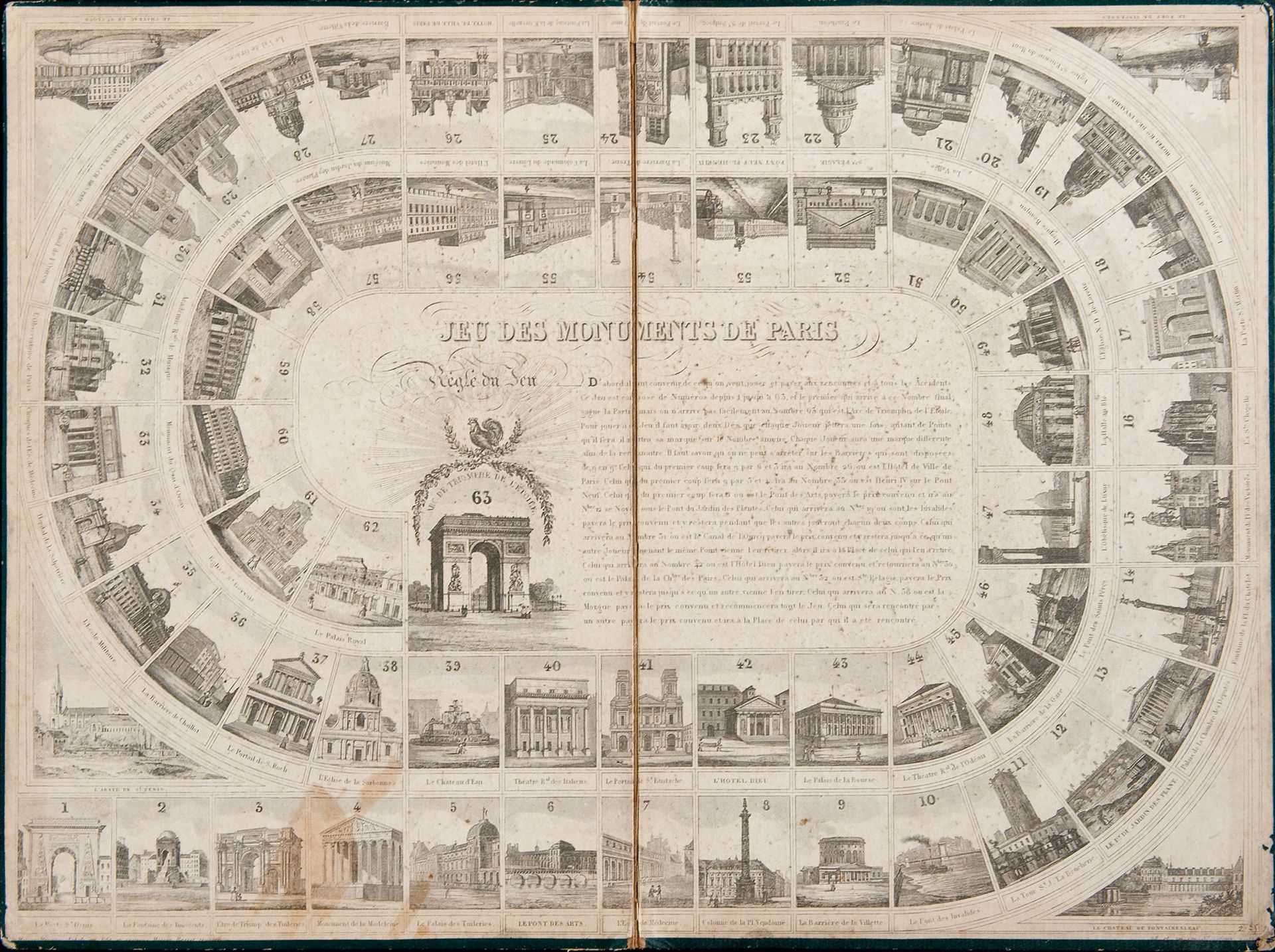
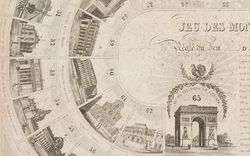
Basset, Paris. Jeu des monuments de Paris, between 1836 and 1848. TS2301.T7.P3 B381 1836
Le Jeu des monuments de Paris (The Game of the Monuments of Paris) descends from an ancient Greek game. It is one among many expressions of what became broadly known as the Game of Goose, a didactic board game that gained in popularity throughout Europe in the eighteenth and nineteenth centuries with the expansion of commercial print culture. Published in print runs that often exceeded tens of thousands of copies, few of these board games have been preserved.
In late eighteenth-century France the traditional bucolic theme of the Game of Goose was often replaced by a variety of topics drawn from history, politics, modern technology, and natural sciences, supported by rich iconographic, cultural, and ideological references. Through the mass-produced prints that served as boards, players became acquainted with the history of royal dynasties, heraldry, military strategies, modes of transportation, and species of birds and plants, as well as architectural styles and monuments. The extraordinary popularity of the game was then attributed to its potential to couple recreation with the acquisition of varied knowledge.
In order to play the game, players must throw dice and travel along a spiral path composed of sixty-three illustrated squares, leading them from the periphery to the centre of the board. The object of the game is to be the first to land on the last square, representing a promised land of sorts (in the numerological tradition, the number sixty-three represents the culmination of historical evolution). Players have to contend with benefits and obstacles that provoke leaps forward, bounds backward, and lost turns. In adult versions of the Game of Goose, monetary fines are also paid on penalty squares, as is the case in Le Jeu des monuments de Paris.
In this version of the game, the spiral path leads players along a tour of Paris’s great architectural monuments. Each square is illustrated with a detailed etching of la Porte Saint-Denis, le Palais Royal, le Quay d’Orsay, la Colonnade du Louvre, le Panthéon, l’Hôtel des Invalides, and so on. Hospitals, bridges, and the Paris morgue all assume roles in galvanizing the game, altering the course of players. The ultimate square, number 63, is occupied by the Arc de Triomphe. Above it floats a rooster in a sunburst, the symbol of the July Monarchy.
The winning destination is never trivial in variations of the Game of Goose, and Le Jeu des monuments de Paris makes no exception. The Arc de Triomphe was commissioned by Napoléon Bonaparte in 1806 to celebrate the victory of his armies at Austerlitz. In his initial plan, a triumphal avenue was meant to originate from the Arc de Triomphe, crossing Paris from west to east, linking various monuments such as the Louvre and the Bastille. However, during the Bourbon Restoration (1814–1830) that followed the ousting of Napoléon from France, construction was halted. It was only completed under the July Monarchy (1830–1848) and was unveiled to Parisian crowds in 1836.
Le Jeu des monuments de Paris is hence more than a simple game staged in a monumental setting. Following Alois Riegl’s definition, it is in itself a monument, an object designed with the precise intention of maintaining present particular human deeds for future generations. It proposes a history of Paris through its monuments, leading up to the Napoleonic victory. But it also strategically stakes a place for the embattled July Monarchy on square 63.
Annie Gérin was a 2002–2003 Visiting Scholar at the CCA and contributed this text to our website in 2009. Our collection holds a significant number of toys and games related to architecture and society.


