


Mobilizing Resources
Shirley Surya and Li Hua interview Zhu Guangya about Third Front Construction
This oral history was led by Shirley Surya and Li Hua and filmed by Wang Tuo for the exhibition How Modern: Biographies of Architecture in China 1949-1979.


Zhu Guangya oral history, from Wang Tuo, Intensity in Ten Cities (2025), co-commissioned by the CCA and M+, Hong Kong for How Modern: Biographies of Architecture in China 1949-1979. © Wang Tuo
- Shirley Surya and Li Hua
- What was Third Front Construction, and what prompted its development?
- Zhu Guangya
- The Third Front Construction was planned in 1964, launched in 1965, and continued until 1980, after the beginning of the Reform and Opening-up period. Chinese officials felt that the pace of socialist construction was too slow in the 1950s, so they launched movements like the Great Leap Forward and the Mass Steel Production campaign. These ran into serious problems and failed in many respects, but their determination to carry out socialist development remained strong. By 1958, Nikita Khrushchev began mocking China’s efforts, which marked the beginning of a serious ideological rift between China and the Soviet Union. Until then, China had viewed the United States as its main adversary. Now, suddenly, it had two major enemies. And if we included India in the south and the Taiwanese governed by the Nationalists, we were surrounded.
Years of warfare shaped the CCP and the government, so they maintained a strong sense of vigilance. Even in peacetime, they emphasized the need to prepare for war. Mao proposed the idea of national defense through strategically building a third defensive layer in this context. He said that if we consider the areas along the border to be a first line, the areas behind them are the second line—we should build a third front deep inland.
China had previously treated the north as a base for heavy industry since it bordered the Soviet Union. This was no longer suitable, so heavy industry needed to move to the interior. Many industries in the east needed to be moved. The most important among these to bring to the Third Front focused on national defense, which we then called the First Ministry of Machinery. Others were dedicated to the nuclear industry, as well as making airplanes, electronics, and conventional weapons, shipbuilding, aerospace, and missiles. Based on what I’ve read, about four million people were mobilized to the Third Front. Entire factories were relocated, along with workers and their families.
Factories were built in the mountains, backed by mountains, to remain hidden. This isolation meant that raw materials had to be transported thousands of kilometres to this location by train, and then by truck deep into the mountains. Once production had finished at the bearing factory, the constructed parts were transported back to the railway and sent east. From an economic standpoint, this was obviously inefficient. No capitalist would ever do things this way. The state was willing to take a financial loss to ensure national security.
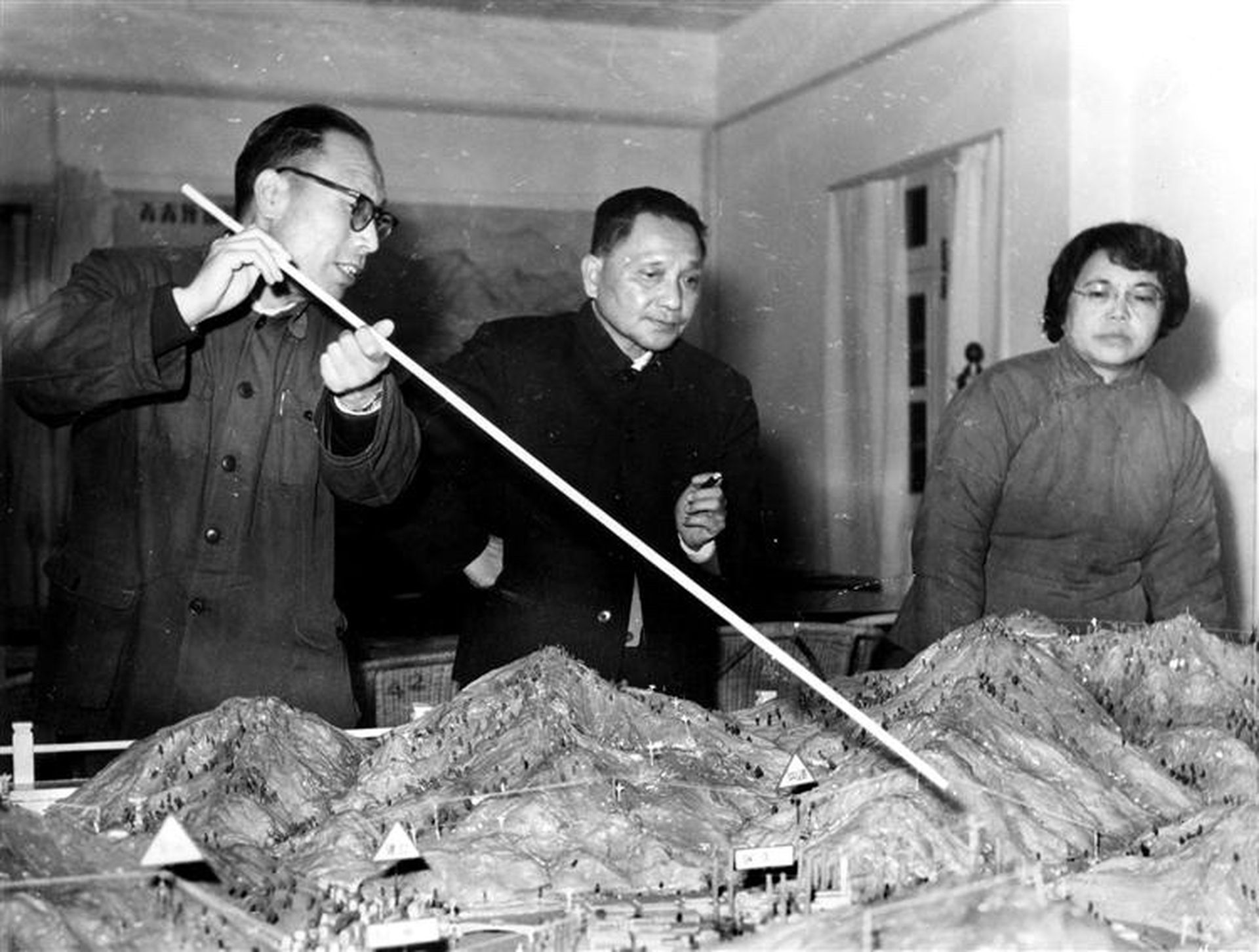
Photograph of Deng Xiaoping planning the Third Front Construction, ca. 1960s. © School of Architecture and Urban Planning, Huazhong University of Science and Technology
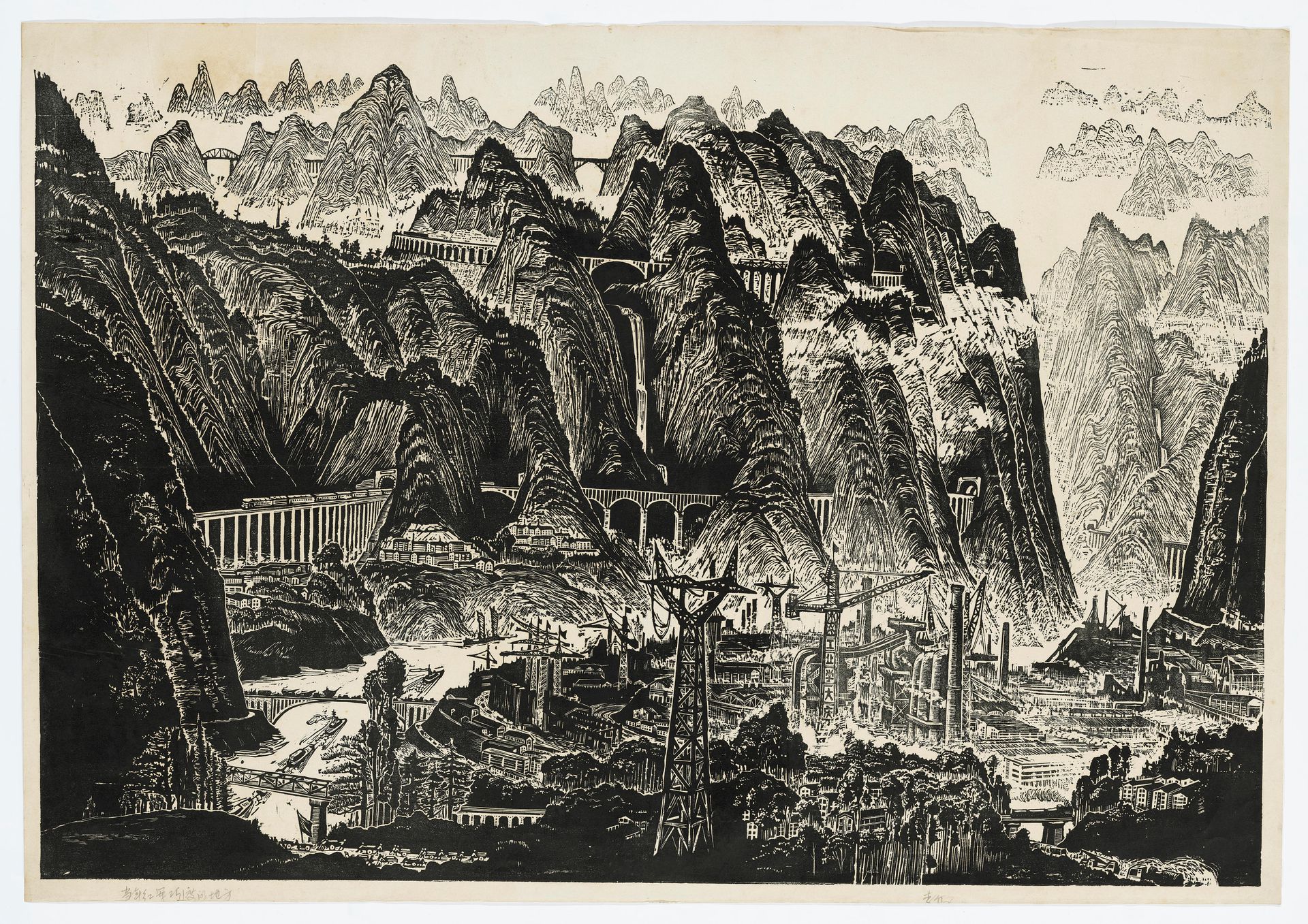
Li Jiewen, The Bridge Which the Red Army Crossed by Strategy, ca. 1970s. Woodcut. P-335H, Chang Tsong Zung Johnson
- SS & LH
- How were you involved in designing the factory buildings?
- ZG
- My role wasn’t to do design work—the designs already existed. The Luoyang Bearing Plant Design Office, the unit I initially reported to, had completed a great deal of factory design work. There was also a design institute in Xi’an that had produced designs as well. My job at the construction site involved implementing those drawings, managing the construction process, and addressing various issues that arose, including material supply problems, design modifications, supplementary drawings, and quality control issues.
At that point, many factory staff and workers had arrived, but the state still had to cover their salaries. So, the factory became anxious: they wanted to finish the design quickly and begin construction. They couldn’t wait for the design unit, so they decided to design things themselves. Fortunately, we had a strong team, so we started doing the design work independently, supplementing and adjusting the original plans ourselves.
At the same time, changes also occurred in the construction process. Initially, the work was originally handled by a construction company in Shanghai, at least until it got more technically demanding. This was under a planned economy, so the factory couldn’t handle the construction without permission from the authorities. However, this process took too long, so the factory decided to bring in rural labourers. We had a highly modern construction project with very traditional labour methods, and I had to oversee both. - SS & LH
- Given the lack of technical personnel and the shortage of materials on-site, did your approach to design include new methods or innovations?
- ZG
- There were many changes to designs during the construction process, with traditional Chinese ways strongly influencing practices. For instance, minor buildings often didn’t even have proper blueprints. The leaders would say, “Just draw it directly on the ground, one-to-one scale!” Before the plans were even finalized, you’d sketch it full-scale on the ground. Then they’d start digging immediately and build it right away—this is very characteristically Chinese. But this was only done for small, secondary buildings, as it involved a certain amount of risk. Still, when you get to the factory site, the constraints of the terrain make it impossible to use the standard drawings without adapting them. Production processes also differ from factory to factory, so we had to custom-design structural frames and joints. I think one of the most important things we did was to integrate the actual local conditions—terrain, process, materials—and design accordingly.
We couldn’t wait for others to provide designs for civil architecture. Once people arrived at the factories, they needed somewhere to live. At the old steelmaking factory, there had been a big smokestack and a flue underneath, where many people lived. That wasn’t sustainable. So, we decided to construct a whole dormitory zone. Initially, the design unit took charge, but they fell behind. As a result, we ended up designing both the dormitories and the school, and later a hospital. This big factory became a small society. Eventually, they even asked us to design a department store for the town.
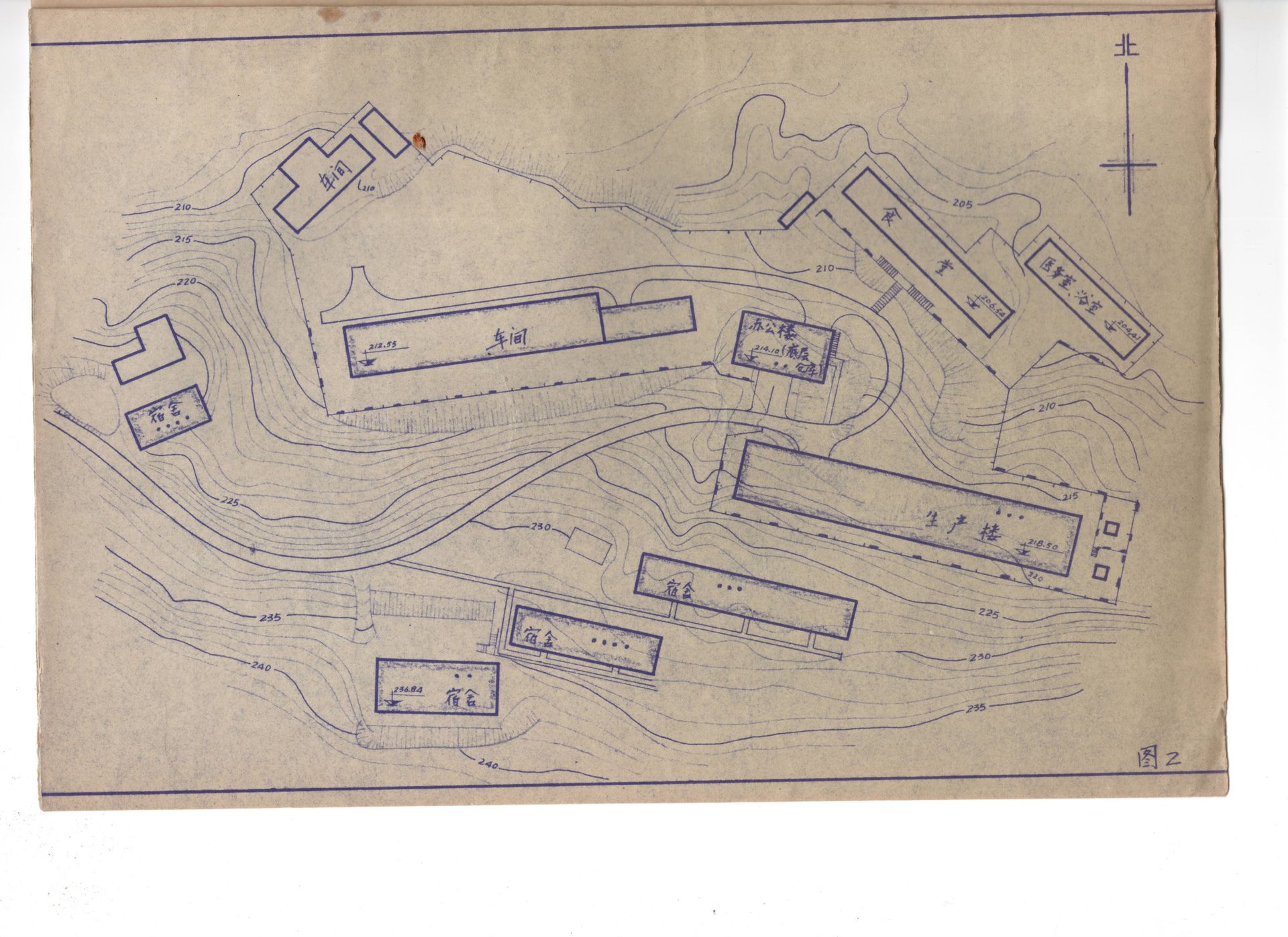
Site plan of dispersed factory workshops typical of a Third Front Construction project, 1969. © Gao Yizhuo
- SS & LH
- Even though in most Third Front locations the principle was “production first, then living conditions,” your case seems to have been better?
- ZG
- Yes, it was comparatively better. Whole families had come from the eastern regions to this remote place. You couldn’t expect them to live in poverty or let their kids go without an education. If those problems weren’t resolved, you couldn’t expect production to go smoothly. And that thinking was relatively new at the time: how to save money while solving workers’ problems as best as possible. Even then, this kind of thinking was criticized. Fortunately, the factory leadership understood and ramped up housing construction.
I think our most significant breakthrough was beyond architecture. It was in changing those idealized ideas instilled in us at school about what architecture should be. Instead, we had to face the complexity and multifaceted scope of “socially necessary architecture.” That shift in mindset was a significant challenge. - SS & LH
- The Third Front Construction basically came to a stop in the 1970s. What led to this abrupt change?
- ZG
- Richard Nixon’s visit to Beijing shook the world. China has seen itself as having two enemies, but now, one was clearly no longer an enemy, and the one that remained didn’t seem quite so threatening anymore. We began to ask ourselves: Why are we out here, transporting materials from the eastern regions, producing things here, and then shipping them back? What’s the point of that? At the same time, the downfall of the Gang of Four marked the start of a critique of the extreme leftist line of the Cultural Revolution. Then came the Third Plenary Session of the 11th Central Committee in 1978, and with it, Reform and Opening-up. Our national strategy shifted, and the original goals of the Third Front Construction were irrelevant, so the campaign came to a natural end.
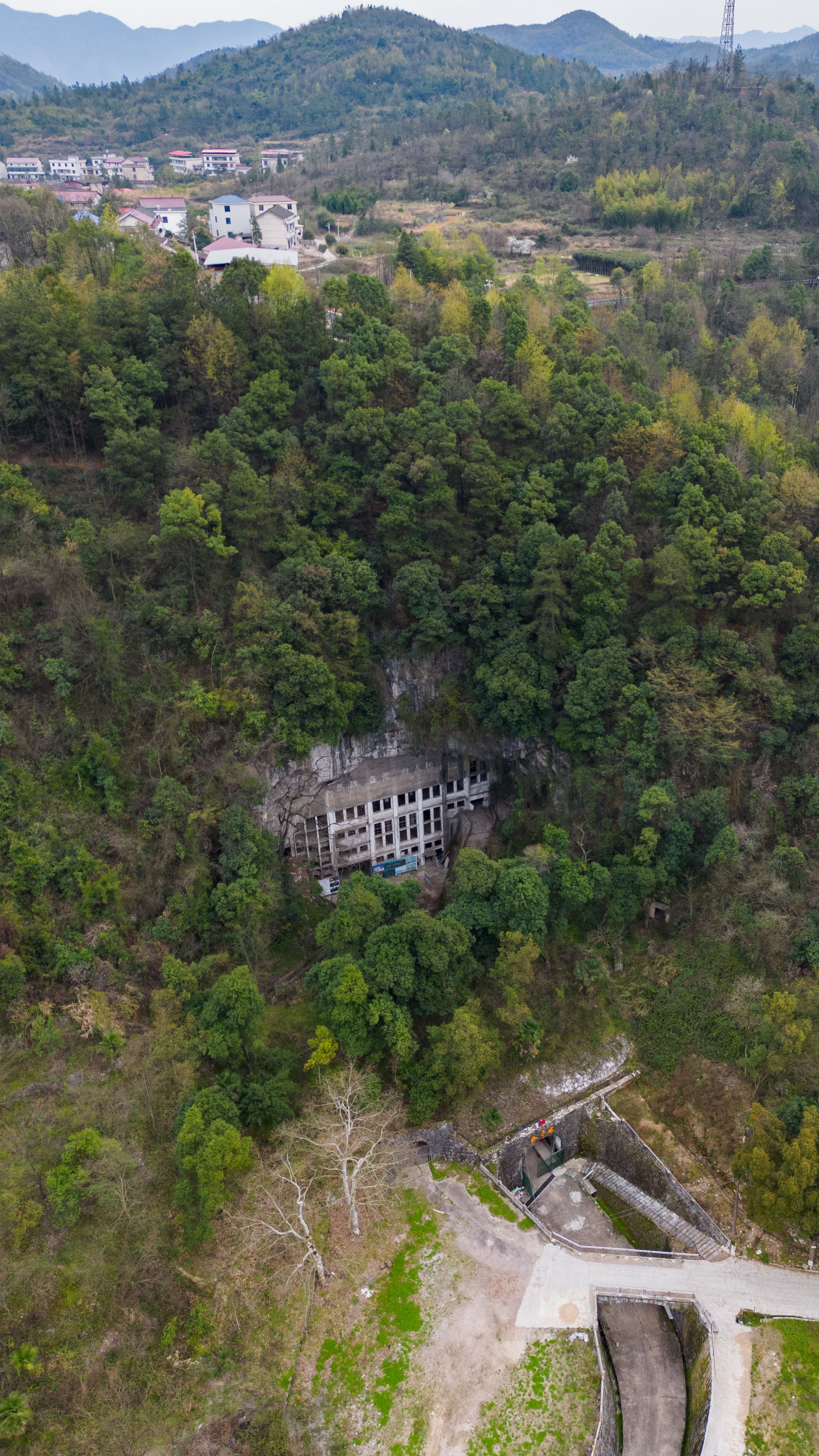
Tan Gangyi, Factory 544 sited in a secluded area, Hunan, 2025. Digital photograph. © Tan Gangyi
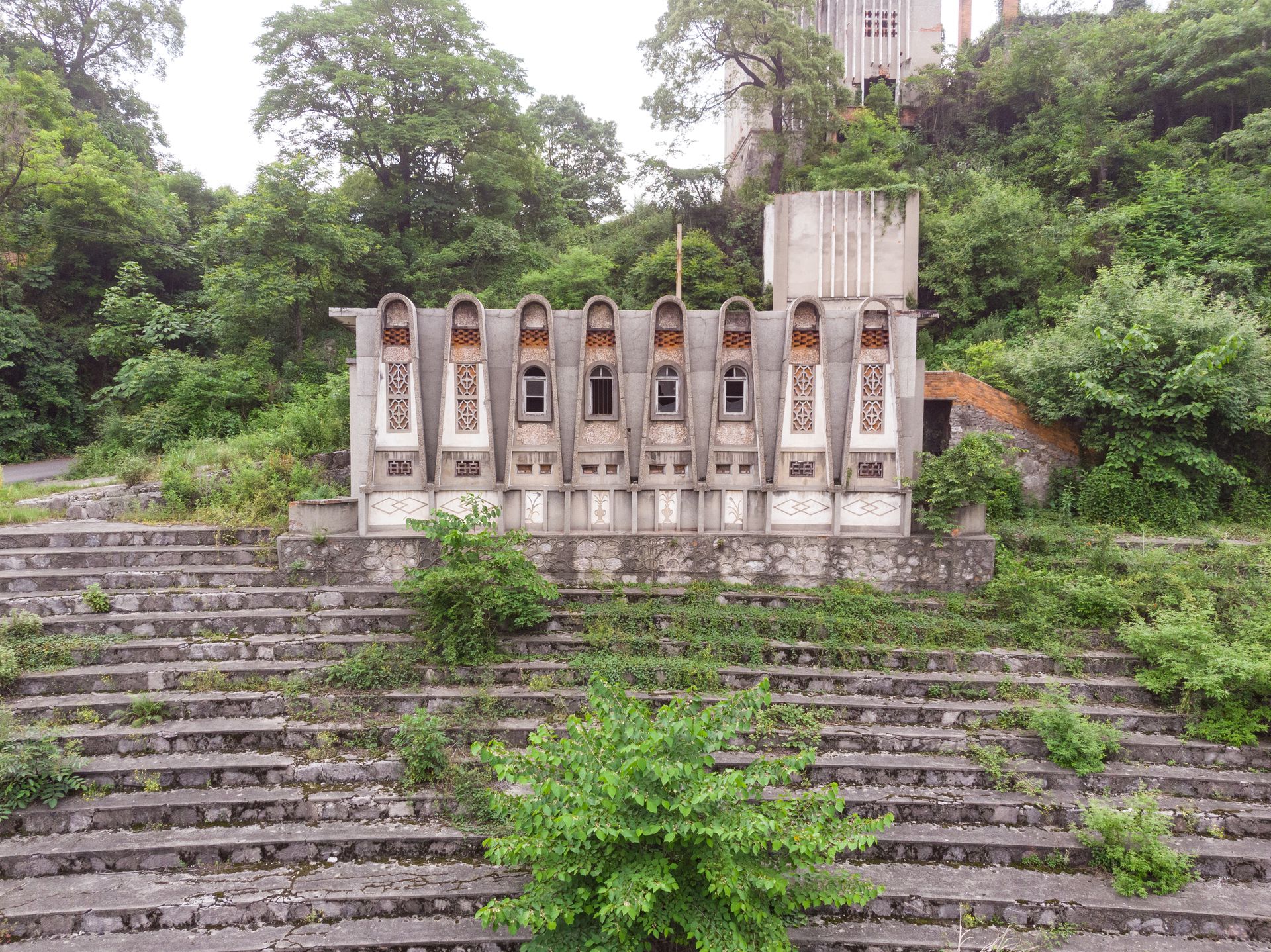
Gao Yizhuo and Tan Gangyi, Theatre screening room in Factory 238, Hubei, 2019. Digital photograph. © Gao Yizhuo and Tan Gangyi
- SS & LH
- The Third Front must have had a significant impact within inner China. What kinds of legacies did it leave behind for China’s development?
- ZG
- This is something I’ve often thought about, and this kind of reflection carries meaning for the future. In the past, our way of thinking was linear: a rational cause leads to a sensible result. But with the Third Front—and even the Cultural Revolution—an irrational cause produced a somewhat rational outcome.
The Third Front caused enormous waste. The government invested more than 200 billion yuan in the project. If the factories had continued to operate, they would’ve continued to lose money. Construction involved poorly thought-out decisions, including poor site selection, full-scale mock-ups, and rammed-earth construction. But on the flip side, if we were to develop the central and western regions now, the cost would be far, far higher. At the time, despite the waste, things were still relatively cheap. Labour costs were low. So, by today’s standards, the total cost to the state was bearable. More importantly, the Third Front created a whole industrial base in central and western China.
The Third Front also resulted in a wealth of experience for those who worked there. It gave us courage. And it wasn’t just a domestic matter, but something with global relevance. Today, the world is full of contradictions and uncertainties. The thinking we learned at the Third Front—a non-linear, S-shaped logic—has value for the whole world.


