


Outer Space (Culture Lab, 1992)
Brian Boigon asks Elizabeth Grosz, Sanford Kwinter, and Bruce Sterling to reflect on the computer revolution and its impact on bodies in space
The following text is an excerpt from the Q&A session of Culture Lab 1.4: “Outer Space.” Culture Lab was a series of symposia hosted by Brian Boigon throughout the early 1990s at The Rivoli Club in Toronto. Boigon’s symposia are the central focus of the CCA exhibition Interactive Entertainment Architecture: Culture Lab, Toronto 1991–1994, curated by Farzin Lotfi-Jam.


View of Rivoli on Queen St. W during the Outer Space symposium in Toronto, 1992. Brian Boigon fonds, CCA. Gift of Brian Boigon © Brian Boigon
- BB
- Speakers here presented a series of arguments which set out the beginnings of a road war between the clean, dry, and high fidelity of the digital field against the dust, dirt, and filth of the analog scroll. Yet I do not wish to create a colonial dialectic. However, if my body’s going to flip into VR DNA, then are we going to have the chooser gender button on all by itself? Or are we going to be able to cut our torsos with the Mutual of Omaha’s Wild Kingdom? And since fabric softeners are going to become softer than soft, are we bound or unbound to become a liquid, soft, smart, organic—or inorganic—body?
I have one rather discreet question. Could one speculate on the parallel between how the automobile revolutionized all our bodies in space and how the personal computer will do—or has done—the same? And what would some of the attributes of this body revolution be?
- BS
- I see a lot of parallels between hot rod culture and hacker culture. It’s true. Maybe I should poll the audience on this?
You got a chance, ladies and gentlemen. We’re going to give you the complete retrofit here. We’re going to boost your IQ up to 200 and really increase your intelligence to the point where you can learn Japanese or Unix programing in a week. And we’re going to do it by a series of implants. And we’re really pretty good at it—only not perfect, because this is the real world, and unfortunately, there’s one chance in ten that, instead of being as brilliant as Goethe at his highest, you’re going to end up with legendary psychasthenia, in which the subject does not know how to place themselves in space and hears the voices of others resonating inside his or her head or body. And this is going to be permanent. We’re talking insect fear psychosis here. Ten percent chance.
Okay, I got a bottle of it right here. I’d like to see people raise their hands: how many people here are willing to take a chance at the Godhead? One, two, three, four, five. Ladies and gentlemen, there’s only one chance in ten that you get the legendary psychasthenia; other than that, you’re going to be an eight-legged, post-human groove machine. There are only half a dozen people in the audience. Oh, well. I’m sorry, people are just going to be ruthlessly crushed by the new super race. You had to be written down by the digital hot rodders of the twenty-first century century, or you’ll just be brushed aside.
Excerpt from Bruce Sterling’s presentation at “Outer Space,” Culture Lab, 1992. Brian Boigon fonds, CCA. Gift of Brian Boigon © Brian Boigon
- BB
- Maybe their IQs are already over 200?
- BS
- Maybe they can fieldstrip their own hot rods? I’m surprised that so few people went for the software upgrade. Just because of legendary psychasthenia? That’s such a wimpy thing to get. The possibilities of a heavy-duty neural crash are so much worse.
- BB
- I think people in Toronto are having some difficulty with science fiction writers. There’s a little bit of complexity around your credibility in terms of what you’re selling.
- BS
- How about if I bargain a little? Let’s say it’s gone on five years, and the Japanese have entered the market. And now, instead of one chance in ten, it’s only one chance in a hundred that you get legendary psychasthenia. How many people are going to go for it? One percent—just a one percent chance of total neural crash. Other than that, you’ve seen people take this, and they’ve become incredibly wealthy, and sexy, and famous, and they’re never wearing out. And the stupidest person you know took it and became brilliant overnight, and beats you at Scrabble now. And it’s totally humiliating. And you’re feeling very left out.
- Audience
- Why don’t you drink it, and we’ll see what happens?
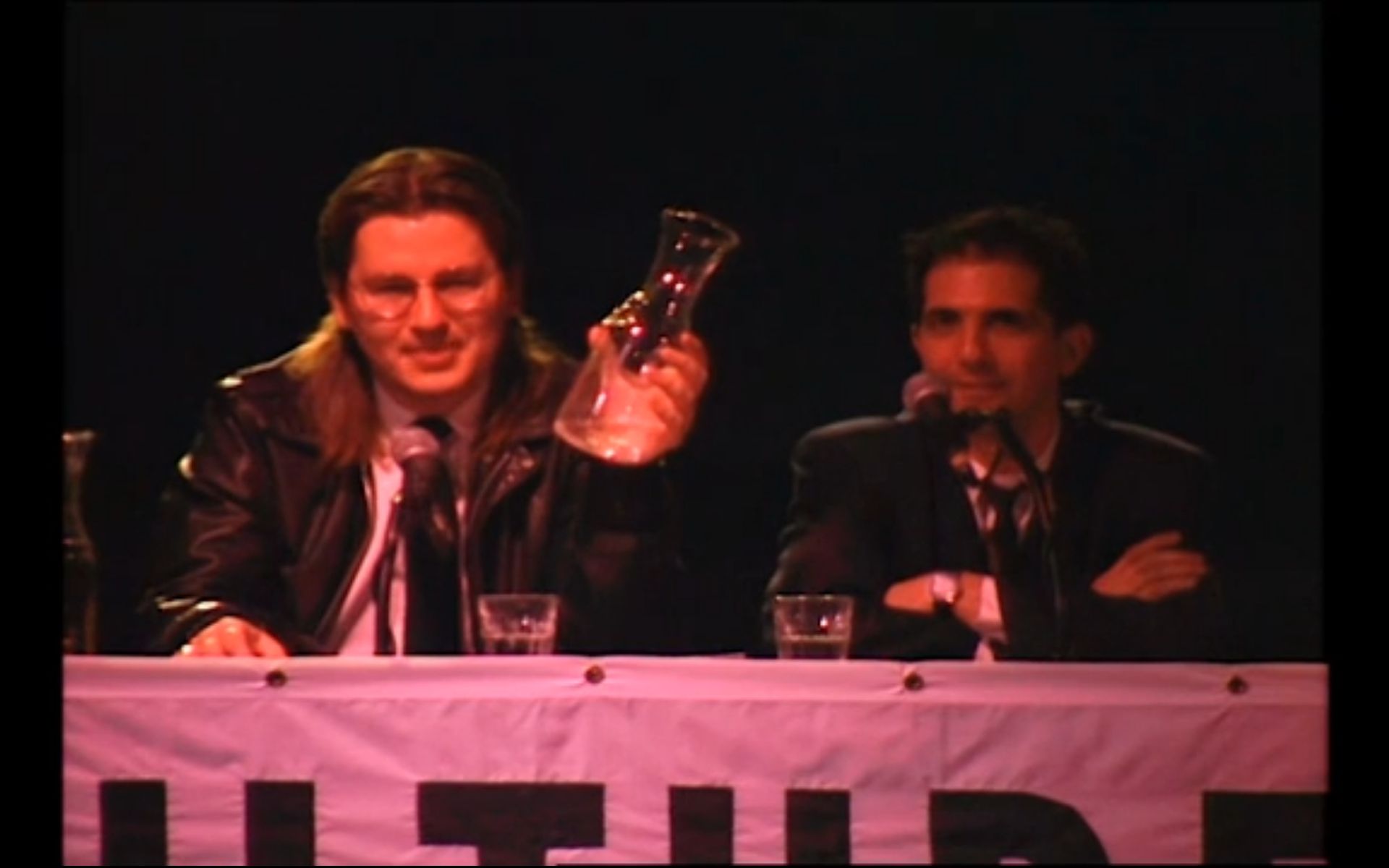
View of Brian Boigon and Bruce Sterling during the “Outer Space” symposium, Culture Lab, Toronto, 1992. Brian Boigon fonds, CCA. Gift of Brian Boigon © Brian Boigon
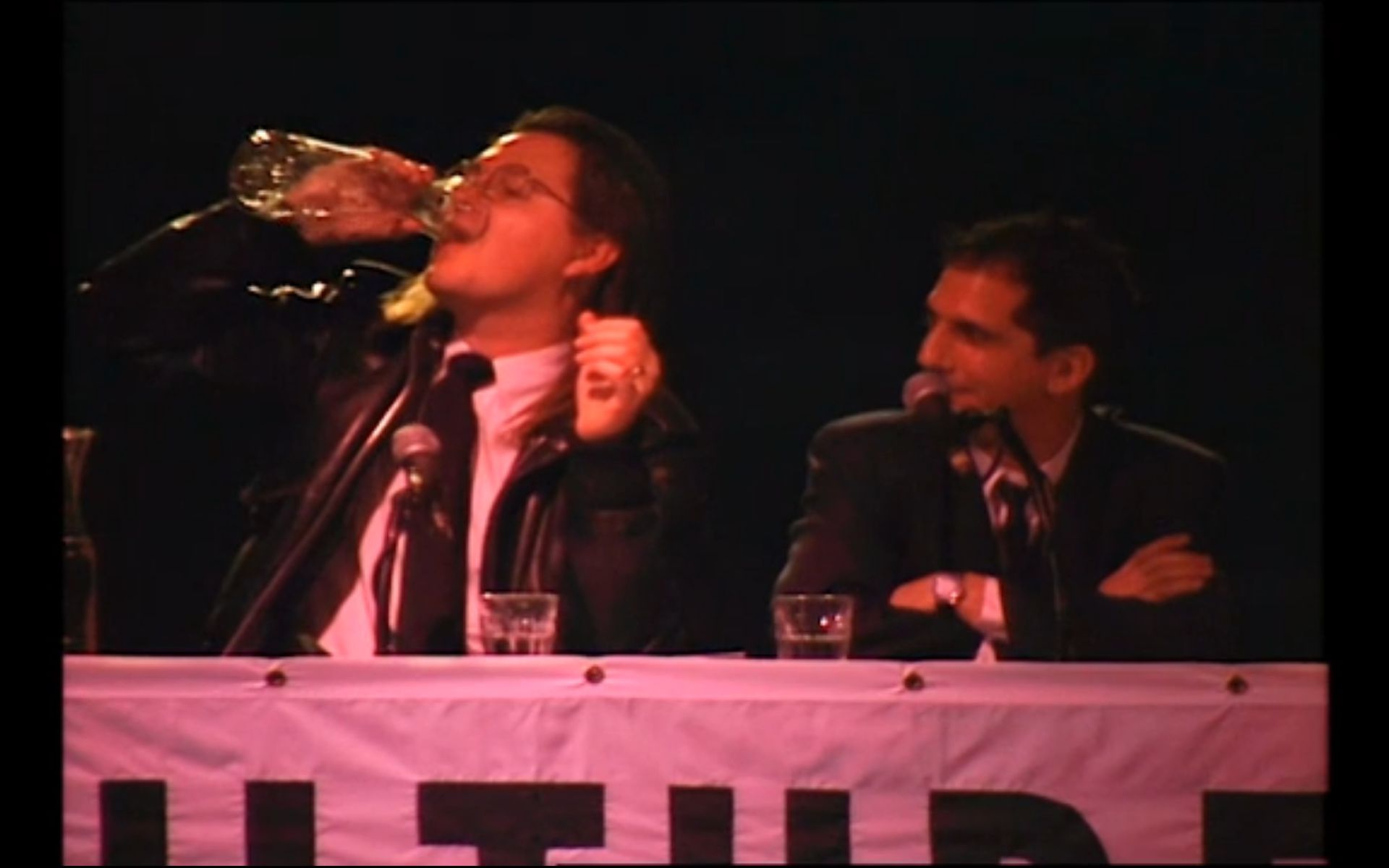
View of Brian Boigon and Bruce Sterling at Culture Lab; “Outer Space” in Toronto, 1992. Brian Boigon fonds, CCA. Gift of Brian Boigon © Brian Boigon
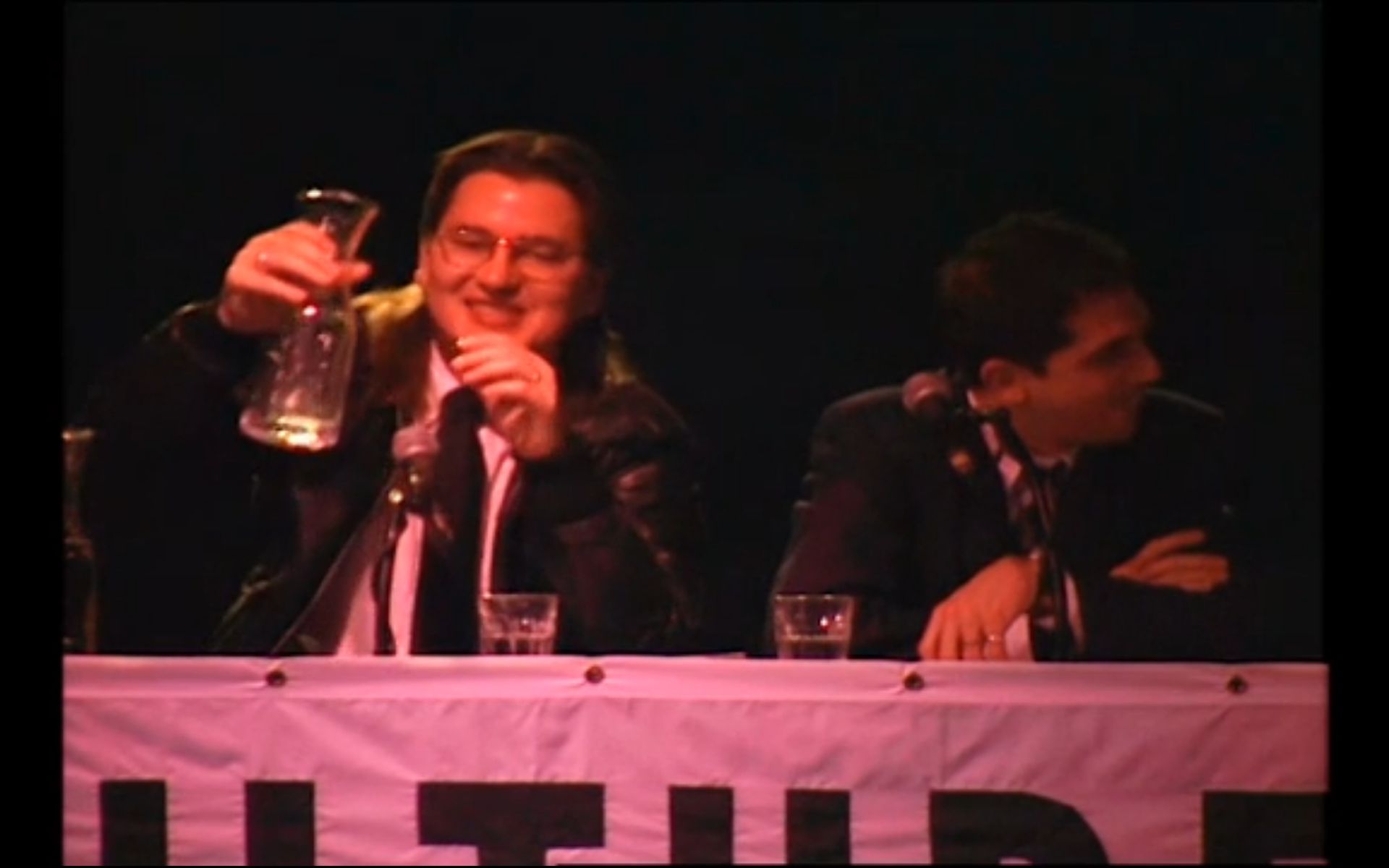
View of Brian Boigon and Bruce Sterling at Culture Lab; “Outer Space” in Toronto, 1992. Brian Boigon fonds, CCA. Gift of Brian Boigon © Brian Boigon


- BS
- Oh. Man, that’s good stuff, ladies and gentlemen. Nothing like those Chiba labs.
How many people? At one percent. One percent! Come on, ladies and gentlemen, one person. You think there’s a one percent chance you’ll be run over by a streetcar out there? Where is your sense of adventure? I can’t believe this.
- EG
- Would you buy a used car from this man?
- BS
- Well, how many people in here own their own cars? They obviously thought the human body was utterly indestructible, or they would never put all those sharp, jagged objects in front of it while you’re hurtling down the road at sixty miles an hour. It just baffles me. People have no sense of risk. One percent chance of risk. And you can drive out of here in a car and hit a tram broadside like that. Not your fault. Complete random, chaotic, cellular automata fluctuation and you can be mangled for life. To hell with cars. You’ll be driving around in a little motorized wheelchair with a battery for decades. And you’re willing to take that risk every day. And you have to. Well, maybe not in Toronto. There are good subways here.
Excerpt from Elizabeth Grosz’s presentation at the “Outer Space” symposium, Culture Lab, 1992. Brian Boigon fonds, CCA. Gift of Brian Boigon © Brian Boigon
- BB
- Why don’t we open it to the floor? Does anybody have any questions they’d like to ask?
- Audience
- Relating to what you were saying earlier about psychasthenia. When someone goes out of their body, where do they go?
- EG
- To ask the question “where?” is to have a location in space. The problem with psychasthenia is there is no location in space. They are space. They become space. So you can ask the question, “where is space?” But there is no answer.
- BS
- How many of them can dance on the head of a pin?
- EG
- Probably all of them.
- BS
- You know, the human condition is not everything it’s cracked up to be. I don’t understand. I mean, my feeling is, if there were a devilish post-human drug around that could make you live for two centuries, the Pope would be the first in line.
- EG
- I think plastic surgery is sort of a quarter of the way there. I have no personal objection to it, but what worries me about it, ethically is that you can go in, pay 2000 bucks, and look as if you’ve got curves, or muscles, or whatever it is that you weren’t born with, so that you can have this fantasy of being this agent outside of your own body; being able to tailor it like you use an instrument.
- BS
- Okay, well maybe you just want to pay for it. Let me put it this way. I didn’t ask to be born a human being. That was something for nothing. I would prefer to be healthy, and young, and a genius forever rather than acquiescing, and decay, and senility, and death for no particular reason other than some muddy ethical one.
- SK
- I’d like to get into the problem of this abstract, timeless world of the nets. Wasteless activities like sex, play, war—all those sumptuary activities which belong to the decay of the body—they belong to the agonistic, almost tragic, waning of time. Wagering your energy, wagering your body against this thing, which is greater. I believe that the thrill is in turning this tragic slide into entropy into a kind of momentarily beautiful form in time.
Excerpt from Sanford Kwinter’s presentation at the “Outer Space” symposium, Culture Lab, 1992. Brian Boigon fonds, CCA. Gift of Brian Boigon © Brian Boigon
- SK
- It’s clear that the institutional discourse is to sell your time, or merely to consider it negligible—that, in fact, we could substitute it with fantasies of being eternal. It’s the idea that the nets are a new and total environment that we are being already drawn into. I mean, we’ve been drawn into it ever since the thirties. I merely feel that there’s lots that’s brilliant and extremely progressive in the way the nets are being used. What I am not convinced of, however, is that we have a safety net to prevent us from what seems to be an almost inevitable fate.


