


138 Results
Form:
books
books
Price:
$34.95
(available to order)
Summary:
This book introduces an archaeological approach to the study of media - one that sifts through the evidence to learn how media were written about, used, designed, preserved, and sometimes discarded. Edited by Erkki Huhtamo and Jussi Parikka, with contributions from internationally prominent scholars from Europe, North America, and Japan, the essays help us understand how(...)
$34.95
(available to order)
Summary:
This book introduces an archaeological approach to the study of media - one that sifts through the evidence to learn how media were written about, used, designed, preserved, and sometimes discarded. Edited by Erkki Huhtamo and Jussi Parikka, with contributions from internationally prominent scholars from Europe, North America, and Japan, the essays help us understand how(...)
Title:
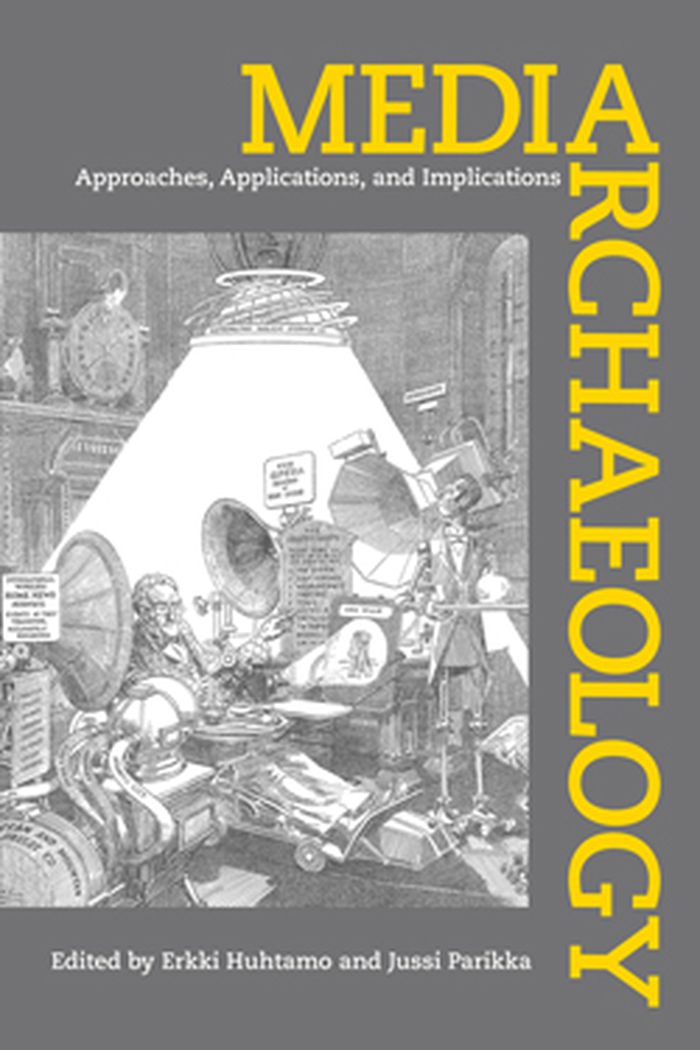
Media archaeology: approaches, applications, and implications
Actions:
Price:
$34.95
(available to order)
Summary:
This book introduces an archaeological approach to the study of media - one that sifts through the evidence to learn how media were written about, used, designed, preserved, and sometimes discarded. Edited by Erkki Huhtamo and Jussi Parikka, with contributions from internationally prominent scholars from Europe, North America, and Japan, the essays help us understand how the media that predate today's interactive, digital forms were in their time contested, adopted and embedded in the everyday.
Media archaeology: approaches, applications, and implications
Actions:
Price:
$34.95
(available to order)
Summary:
This book introduces an archaeological approach to the study of media - one that sifts through the evidence to learn how media were written about, used, designed, preserved, and sometimes discarded. Edited by Erkki Huhtamo and Jussi Parikka, with contributions from internationally prominent scholars from Europe, North America, and Japan, the essays help us understand how the media that predate today's interactive, digital forms were in their time contested, adopted and embedded in the everyday.
Form:
books
books
Publication:
April 2011
April 2011
Subject:
Archive, library and the digital
Archive, library and the digital
Form:
books
books
Actions:
Price:
$47.00
(available to order)
Summary:
In The Second Self, Sherry Turkle looks at the computer not as a "tool," but as part of our social and psychological lives; she looks beyond how we use computer games and spreadsheets to explore how the computer affects our awareness of ourselves, of one another, and of our relationship with the world. "Technology," she writes, "catalyzes changes not only in what we do(...)
$47.00
(available to order)
Summary:
In The Second Self, Sherry Turkle looks at the computer not as a "tool," but as part of our social and psychological lives; she looks beyond how we use computer games and spreadsheets to explore how the computer affects our awareness of ourselves, of one another, and of our relationship with the world. "Technology," she writes, "catalyzes changes not only in what we do(...)
Publication:
January 2005
January 2005
Title:
The second self: computers and the human spirit
Actions:
Price:
$47.00
(available to order)
Summary:
In The Second Self, Sherry Turkle looks at the computer not as a "tool," but as part of our social and psychological lives; she looks beyond how we use computer games and spreadsheets to explore how the computer affects our awareness of ourselves, of one another, and of our relationship with the world. "Technology," she writes, "catalyzes changes not only in what we do but in how we think." First published in 1984, The Second Self is still essential reading as a primer in the psychology of computation. This twentieth anniversary edition allows us to reconsider two decades of computer culture--to (re)experience what was and is most novel in our new media culture and to view our own contemporary relationship with technology with fresh eyes.
The second self: computers and the human spirit
Actions:
Price:
$47.00
(available to order)
Summary:
In The Second Self, Sherry Turkle looks at the computer not as a "tool," but as part of our social and psychological lives; she looks beyond how we use computer games and spreadsheets to explore how the computer affects our awareness of ourselves, of one another, and of our relationship with the world. "Technology," she writes, "catalyzes changes not only in what we do but in how we think." First published in 1984, The Second Self is still essential reading as a primer in the psychology of computation. This twentieth anniversary edition allows us to reconsider two decades of computer culture--to (re)experience what was and is most novel in our new media culture and to view our own contemporary relationship with technology with fresh eyes.
Form:
books
books
Publication:
January 2005
January 2005
Form:
books
books
Actions:
Price:
$15.95
(available to order)
Summary:
The history of computing could be told as the story of hardware and software, or the story of the Internet, or the story of "smart" hand-held devices, with subplots involving IBM, Microsoft, Apple, Facebook, and Twitter. In this concise and accessible account of the invention and development of digital technology, computer historian Paul Ceruzzi offers a broader and more(...)
$15.95
(available to order)
Summary:
The history of computing could be told as the story of hardware and software, or the story of the Internet, or the story of "smart" hand-held devices, with subplots involving IBM, Microsoft, Apple, Facebook, and Twitter. In this concise and accessible account of the invention and development of digital technology, computer historian Paul Ceruzzi offers a broader and more(...)
Publication:
June 2012
June 2012
Title:
Computing : a concise history
Actions:
Price:
$15.95
(available to order)
Summary:
The history of computing could be told as the story of hardware and software, or the story of the Internet, or the story of "smart" hand-held devices, with subplots involving IBM, Microsoft, Apple, Facebook, and Twitter. In this concise and accessible account of the invention and development of digital technology, computer historian Paul Ceruzzi offers a broader and more useful perspective.
Computing : a concise history
Actions:
Price:
$15.95
(available to order)
Summary:
The history of computing could be told as the story of hardware and software, or the story of the Internet, or the story of "smart" hand-held devices, with subplots involving IBM, Microsoft, Apple, Facebook, and Twitter. In this concise and accessible account of the invention and development of digital technology, computer historian Paul Ceruzzi offers a broader and more useful perspective.
Form:
books
books
Publication:
June 2012
June 2012
Form:
books
books
Price:
$6.95
(available to order)
Summary:
Depuis le développement de l’imprimerie, la civilisation occidentale vivait dans la culture du livre comme les poissons vivent dans l’eau, c’est-à-dire sans le savoir. Elle avait à ce point imprégné nos façons de sentir et de penser que nous avions fini par la confondre avec la nature humaine. Les technologies numériques nous ont brutalement confrontés au fait qu’il(...)
$6.95
(available to order)
Summary:
Depuis le développement de l’imprimerie, la civilisation occidentale vivait dans la culture du livre comme les poissons vivent dans l’eau, c’est-à-dire sans le savoir. Elle avait à ce point imprégné nos façons de sentir et de penser que nous avions fini par la confondre avec la nature humaine. Les technologies numériques nous ont brutalement confrontés au fait qu’il(...)
Publication:
September 2013
September 2013
Title:
Du livre et des écrans : plaidoyer pour une indispensable complémentarité
Actions:
Price:
$6.95
(available to order)
Summary:
Depuis le développement de l’imprimerie, la civilisation occidentale vivait dans la culture du livre comme les poissons vivent dans l’eau, c’est-à-dire sans le savoir. Elle avait à ce point imprégné nos façons de sentir et de penser que nous avions fini par la confondre avec la nature humaine. Les technologies numériques nous ont brutalement confrontés au fait qu’il existe d’autres relations possibles à l’identité, au temps, aux autres, à l’espace et aux apprentissages. Et du coup, nous ne pouvons plus penser l’homme, la culture, l’enseignement et l’éducation de la même façon.
Du livre et des écrans : plaidoyer pour une indispensable complémentarité
Actions:
Price:
$6.95
(available to order)
Summary:
Depuis le développement de l’imprimerie, la civilisation occidentale vivait dans la culture du livre comme les poissons vivent dans l’eau, c’est-à-dire sans le savoir. Elle avait à ce point imprégné nos façons de sentir et de penser que nous avions fini par la confondre avec la nature humaine. Les technologies numériques nous ont brutalement confrontés au fait qu’il existe d’autres relations possibles à l’identité, au temps, aux autres, à l’espace et aux apprentissages. Et du coup, nous ne pouvons plus penser l’homme, la culture, l’enseignement et l’éducation de la même façon.
Form:
books
books
Publication:
September 2013
September 2013
Form:
books
books
Price:
$29.95
(available to order)
Summary:
The dawn of the electronic media age in the 1960s began a cultural shift from the modernist grid and its determination of projection and representation to the fluid structures and circuits of the network, presenting art with new challenges and possibilities. This anthology considers art at the center of network theory, from the 1960s to the present
$29.95
(available to order)
Summary:
The dawn of the electronic media age in the 1960s began a cultural shift from the modernist grid and its determination of projection and representation to the fluid structures and circuits of the network, presenting art with new challenges and possibilities. This anthology considers art at the center of network theory, from the 1960s to the present
Title:
Networks
Actions:
Price:
$29.95
(available to order)
Summary:
The dawn of the electronic media age in the 1960s began a cultural shift from the modernist grid and its determination of projection and representation to the fluid structures and circuits of the network, presenting art with new challenges and possibilities. This anthology considers art at the center of network theory, from the 1960s to the present
Networks
Actions:
Price:
$29.95
(available to order)
Summary:
The dawn of the electronic media age in the 1960s began a cultural shift from the modernist grid and its determination of projection and representation to the fluid structures and circuits of the network, presenting art with new challenges and possibilities. This anthology considers art at the center of network theory, from the 1960s to the present
Form:
books
books
Publication:
March 2014
March 2014
Subject:
Archive, library and the digital
Archive, library and the digital
Form:
books
books
Actions:
Price:
$30.95
(available to order)
Summary:
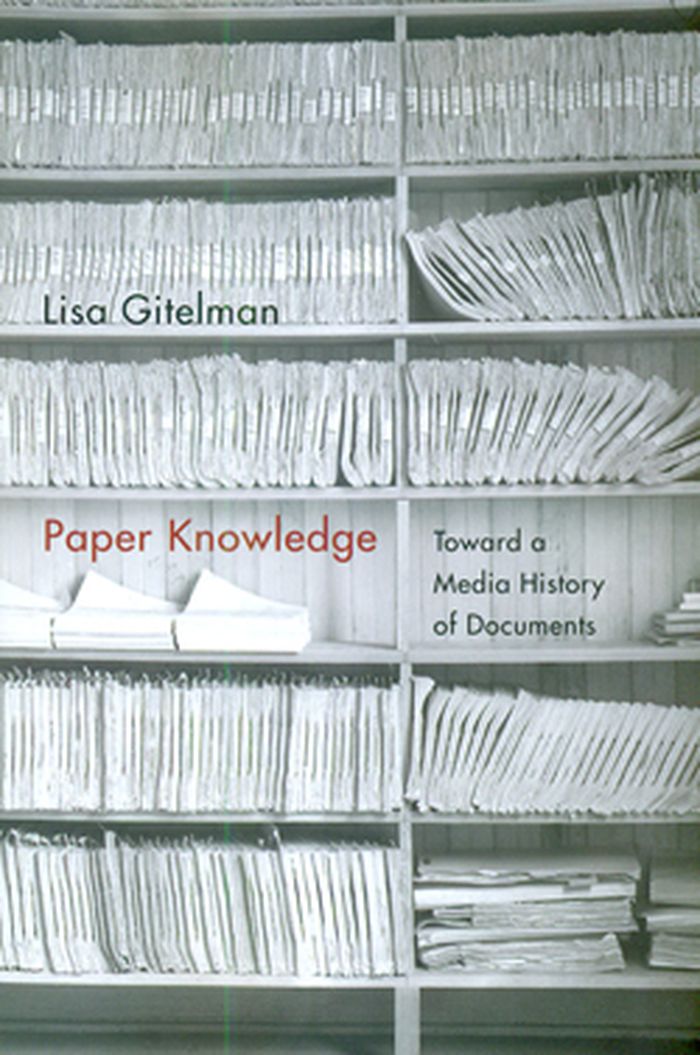
Paper Knowledge is a remarkable book about the mundane: the library card, the promissory note, the movie ticket, the PDF (Portable Document Format). It is a media history of the document. Drawing examples from the 1870s, the 1930s, the 1960s, and today, Lisa Gitelman thinks across the media that the document form has come to inhabit over the last 150 years, including(...)
$30.95
(available to order)
Summary:
Paper Knowledge is a remarkable book about the mundane: the library card, the promissory note, the movie ticket, the PDF (Portable Document Format). It is a media history of the document. Drawing examples from the 1870s, the 1930s, the 1960s, and today, Lisa Gitelman thinks across the media that the document form has come to inhabit over the last 150 years, including(...)
Title:
Paper knowledge: toward a media history of documents
Actions:
Price:
$30.95
(available to order)
Summary:
Paper Knowledge is a remarkable book about the mundane: the library card, the promissory note, the movie ticket, the PDF (Portable Document Format). It is a media history of the document. Drawing examples from the 1870s, the 1930s, the 1960s, and today, Lisa Gitelman thinks across the media that the document form has come to inhabit over the last 150 years, including letterpress printing, typing and carbon paper, mimeograph, microfilm, offset printing, photocopying, and scanning.
Paper knowledge: toward a media history of documents
Actions:
Price:
$30.95
(available to order)
Summary:
Paper Knowledge is a remarkable book about the mundane: the library card, the promissory note, the movie ticket, the PDF (Portable Document Format). It is a media history of the document. Drawing examples from the 1870s, the 1930s, the 1960s, and today, Lisa Gitelman thinks across the media that the document form has come to inhabit over the last 150 years, including letterpress printing, typing and carbon paper, mimeograph, microfilm, offset printing, photocopying, and scanning.
Form:
books
books
Publication:
March 2014
March 2014
Subject:
Archive, library and the digital
Archive, library and the digital
Form:
books
books

Actions:
Price:
$27.50
(available to order)
Summary:
Todd Presner, David Shepard, and Yoh Kawano put digital humanities theory into practice to chart the proliferating cultural records of places around the world. A digital platform transmogrified into a book, it explains the ambitious online project of the same name that maps the historical layers of city spaces in an interactive, hypermedia environment. The authors examine(...)
$27.50
(available to order)
Summary:
Todd Presner, David Shepard, and Yoh Kawano put digital humanities theory into practice to chart the proliferating cultural records of places around the world. A digital platform transmogrified into a book, it explains the ambitious online project of the same name that maps the historical layers of city spaces in an interactive, hypermedia environment. The authors examine(...)
Subject:
Archive, library and the digital
Archive, library and the digital
Publication:
June 2014
June 2014
Title:
Hypercities: thick mapping in the digital humanities
Actions:
Price:
$27.50
(available to order)
Summary:
Todd Presner, David Shepard, and Yoh Kawano put digital humanities theory into practice to chart the proliferating cultural records of places around the world. A digital platform transmogrified into a book, it explains the ambitious online project of the same name that maps the historical layers of city spaces in an interactive, hypermedia environment. The authors examine the media archaeology of Google Earth and the cultural–historical meaning of map projections, and explore recent events—the “Arab Spring” and the Fukushima nuclear power plant disaster—through social media mapping that incorporates data visualizations, photographic documents, and Twitter streams.
Hypercities: thick mapping in the digital humanities
Actions:
Price:
$27.50
(available to order)
Summary:
Todd Presner, David Shepard, and Yoh Kawano put digital humanities theory into practice to chart the proliferating cultural records of places around the world. A digital platform transmogrified into a book, it explains the ambitious online project of the same name that maps the historical layers of city spaces in an interactive, hypermedia environment. The authors examine the media archaeology of Google Earth and the cultural–historical meaning of map projections, and explore recent events—the “Arab Spring” and the Fukushima nuclear power plant disaster—through social media mapping that incorporates data visualizations, photographic documents, and Twitter streams.
Form:
books
books
Publication:
June 2014
June 2014
Subject:
Archive, library and the digital
Archive, library and the digital
Form:
books
books

Title:
The library beyond the book
The library beyond the book
Actions:
Price:
$26.50
(available in store)
Summary:
With textbook readers and digital downloads proliferating, it is easy to imagine a time when printed books will vanish. Such forecasts miss the mark, argue Jeffrey Schnapp and Matthew Battles. Future bookshelves will not be wholly virtual, and libraries will thrive—although in a variety of new social, cultural, and architectural forms. Schnapp and Battles combine deep(...)
$26.50
(available in store)
Summary:
With textbook readers and digital downloads proliferating, it is easy to imagine a time when printed books will vanish. Such forecasts miss the mark, argue Jeffrey Schnapp and Matthew Battles. Future bookshelves will not be wholly virtual, and libraries will thrive—although in a variety of new social, cultural, and architectural forms. Schnapp and Battles combine deep(...)
Subject:
Archive, library and the digital
Archive, library and the digital
Publication:
June 2014
June 2014
Title:
The library beyond the book
Actions:
Price:
$26.50
(available in store)
Summary:
With textbook readers and digital downloads proliferating, it is easy to imagine a time when printed books will vanish. Such forecasts miss the mark, argue Jeffrey Schnapp and Matthew Battles. Future bookshelves will not be wholly virtual, and libraries will thrive—although in a variety of new social, cultural, and architectural forms. Schnapp and Battles combine deep study of the library’s history with a record of institutional and technical innovation at metaLAB, a research group at the forefront of the digital humanities.
The library beyond the book
Actions:
Price:
$26.50
(available in store)
Summary:
With textbook readers and digital downloads proliferating, it is easy to imagine a time when printed books will vanish. Such forecasts miss the mark, argue Jeffrey Schnapp and Matthew Battles. Future bookshelves will not be wholly virtual, and libraries will thrive—although in a variety of new social, cultural, and architectural forms. Schnapp and Battles combine deep study of the library’s history with a record of institutional and technical innovation at metaLAB, a research group at the forefront of the digital humanities.
Form:
books
books
Publication:
June 2014
June 2014
Subject:
Archive, library and the digital
Archive, library and the digital
Form:
books
books
Actions:
Price:
$34.00
(available to order)
Summary:
Graphesis provides a descriptive critical language for the analysis of graphical knowledge. In an interdisciplinary study fusing digital humanities with media studies and graphic design history, Drucker outlines the principles by which visual formats organize meaningful content. Among the most significant of these formats is the graphical user interface (GUI)—the dominant(...)
$34.00
(available to order)
Summary:
Graphesis provides a descriptive critical language for the analysis of graphical knowledge. In an interdisciplinary study fusing digital humanities with media studies and graphic design history, Drucker outlines the principles by which visual formats organize meaningful content. Among the most significant of these formats is the graphical user interface (GUI)—the dominant(...)
Title:
Graphesis: visual forms of knowledge production
Actions:
Price:
$34.00
(available to order)
Summary:
Graphesis provides a descriptive critical language for the analysis of graphical knowledge. In an interdisciplinary study fusing digital humanities with media studies and graphic design history, Drucker outlines the principles by which visual formats organize meaningful content. Among the most significant of these formats is the graphical user interface (GUI)—the dominant feature of the screens of nearly all consumer electronic devices. Because so much of our personal and professional lives is mediated through visual interfaces, it is important to start thinking critically about how they shape knowledge, our behavior, and even our identity.
Graphesis: visual forms of knowledge production
Actions:
Price:
$34.00
(available to order)
Summary:
Graphesis provides a descriptive critical language for the analysis of graphical knowledge. In an interdisciplinary study fusing digital humanities with media studies and graphic design history, Drucker outlines the principles by which visual formats organize meaningful content. Among the most significant of these formats is the graphical user interface (GUI)—the dominant feature of the screens of nearly all consumer electronic devices. Because so much of our personal and professional lives is mediated through visual interfaces, it is important to start thinking critically about how they shape knowledge, our behavior, and even our identity.
Form:
books
books
Publication:
June 2014
June 2014
Subject:
Archive, library and the digital
Archive, library and the digital
Form:
books
books

Price:
$26.95
(available in store)
Summary:
Loin de céder au catastrophisme ambiant, cet ouvrage propose quelques clés pour faire face à l'incertitude, pour apprendre à naviguer selon les nouvelles lois du monde numérique et à en relever les défis.
$26.95
(available in store)
Summary:
Loin de céder au catastrophisme ambiant, cet ouvrage propose quelques clés pour faire face à l'incertitude, pour apprendre à naviguer selon les nouvelles lois du monde numérique et à en relever les défis.
Title:
La menace fantôme: les industries culturelles face au numérique
Actions:
Price:
$26.95
(available in store)
Summary:
Loin de céder au catastrophisme ambiant, cet ouvrage propose quelques clés pour faire face à l'incertitude, pour apprendre à naviguer selon les nouvelles lois du monde numérique et à en relever les défis.
La menace fantôme: les industries culturelles face au numérique
Actions:
Price:
$26.95
(available in store)
Summary:
Loin de céder au catastrophisme ambiant, cet ouvrage propose quelques clés pour faire face à l'incertitude, pour apprendre à naviguer selon les nouvelles lois du monde numérique et à en relever les défis.
Form:
books
books
Publication:
November 2014
November 2014
Subject:
Archive, library and the digital
Archive, library and the digital


