


138 Results
Form:
books
books
Actions:
Price:
$34.95
(available to order)
Summary:
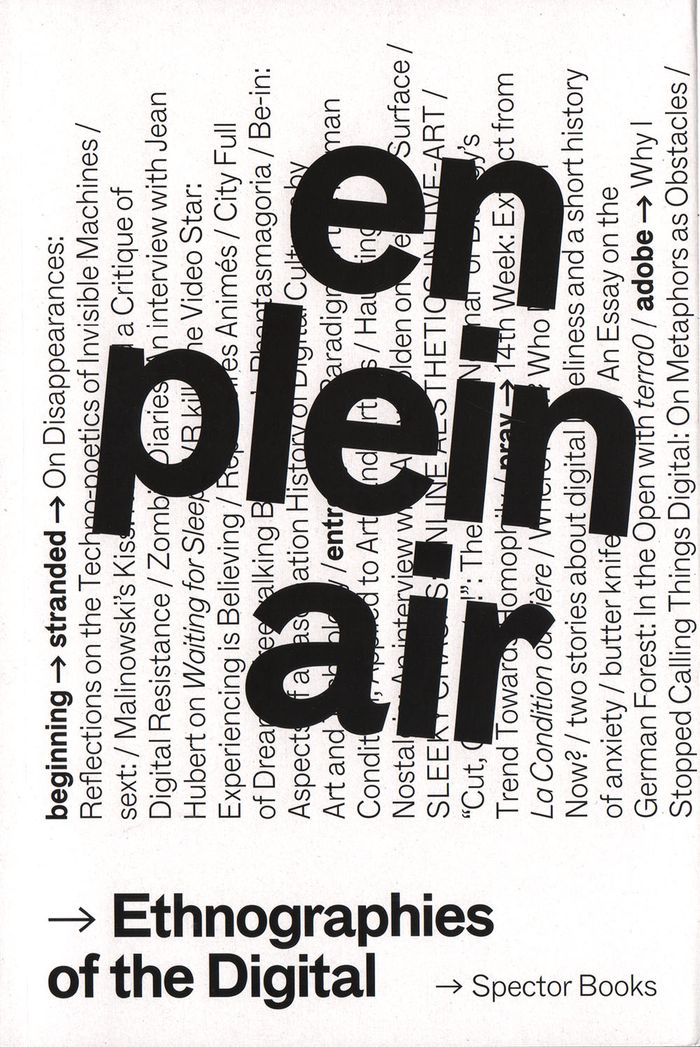
En plein air — painting outdoors — traditionally describes the impressionist revolt against the studio. This book compiles texts by media scholars, scientists, artists, anthropologists and theorists exploring the concept of en plein air in terms of the digital, a realm with ever-evolving boundaries.
$34.95
(available to order)
Summary:
En plein air — painting outdoors — traditionally describes the impressionist revolt against the studio. This book compiles texts by media scholars, scientists, artists, anthropologists and theorists exploring the concept of en plein air in terms of the digital, a realm with ever-evolving boundaries.
Title:
En plein air: ethnographies of the digital
Actions:
Price:
$34.95
(available to order)
Summary:
En plein air — painting outdoors — traditionally describes the impressionist revolt against the studio. This book compiles texts by media scholars, scientists, artists, anthropologists and theorists exploring the concept of en plein air in terms of the digital, a realm with ever-evolving boundaries.
En plein air: ethnographies of the digital
Actions:
Price:
$34.95
(available to order)
Summary:
En plein air — painting outdoors — traditionally describes the impressionist revolt against the studio. This book compiles texts by media scholars, scientists, artists, anthropologists and theorists exploring the concept of en plein air in terms of the digital, a realm with ever-evolving boundaries.
Form:
books
books
Publication:
April 2019
April 2019
Subject:
Archive, library and the digital
Archive, library and the digital
Form:
books
books
Actions:
Price:
$41.99
(available in store)
Summary:
Digital and social media have transformed how much and how fast we communicate, but they have also altered the palette of expressive strategies: the cultural forms that shape how citizens, activists, and artists speak and interact. Most familiar among these strategies are storytelling and representation. In A Theory of Assembly, Kyle Parry argues that one of the most(...)
$41.99
(available in store)
Summary:
Digital and social media have transformed how much and how fast we communicate, but they have also altered the palette of expressive strategies: the cultural forms that shape how citizens, activists, and artists speak and interact. Most familiar among these strategies are storytelling and representation. In A Theory of Assembly, Kyle Parry argues that one of the most(...)
Publication:
January 2023
January 2023
Title:
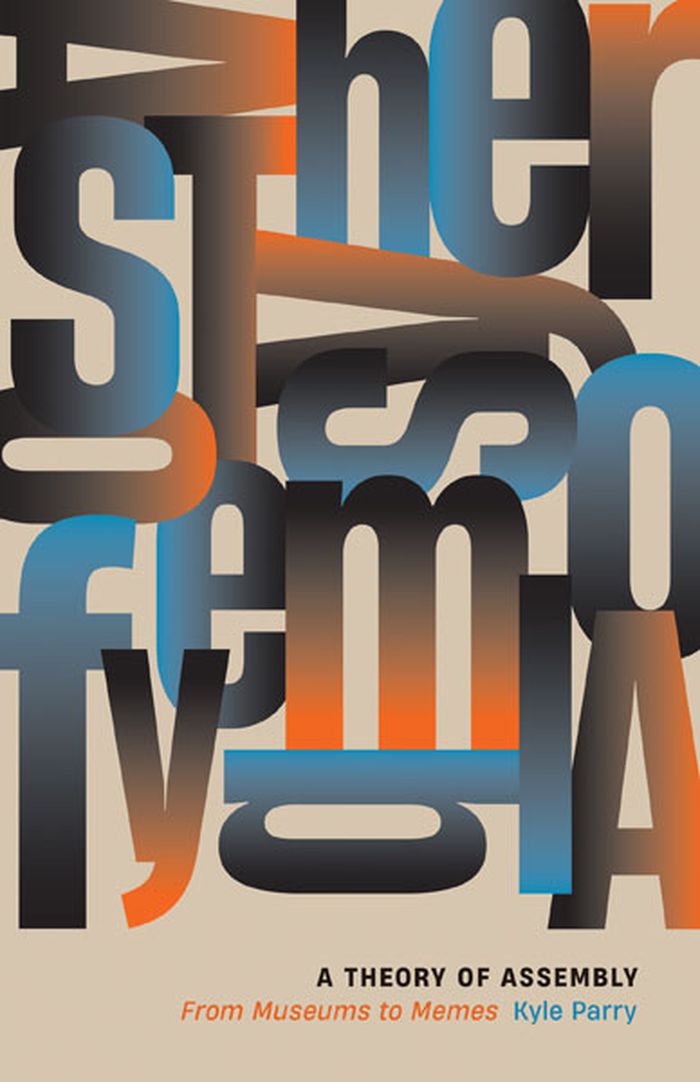
A theory of assembly: From museums to memes
Actions:
Price:
$41.99
(available in store)
Summary:
Digital and social media have transformed how much and how fast we communicate, but they have also altered the palette of expressive strategies: the cultural forms that shape how citizens, activists, and artists speak and interact. Most familiar among these strategies are storytelling and representation. In A Theory of Assembly, Kyle Parry argues that one of the most powerful and pervasive cultural forms in the digital era is assembly. Whether as subtle photographic sequences, satirical Venn diagrams, or networked archives, projects based in assembly do not so much narrate or represent the world as rearrange it. This work of rearranging can take place at any scale, from a simple pairing of images, undertaken by one person, to the entire history of internet memes, undertaken by millions. With examples ranging from GIFs and paintings to museum exhibitions and social movement hashtags, Parry shows how, in the internet age, assembly has come to equal narrative and representation in its reach and influence, particularly as a response to ecological and social violence. He also emphasizes the ambivalence of assembly—the way it can be both emancipatory and antidemocratic.
A theory of assembly: From museums to memes
Actions:
Price:
$41.99
(available in store)
Summary:
Digital and social media have transformed how much and how fast we communicate, but they have also altered the palette of expressive strategies: the cultural forms that shape how citizens, activists, and artists speak and interact. Most familiar among these strategies are storytelling and representation. In A Theory of Assembly, Kyle Parry argues that one of the most powerful and pervasive cultural forms in the digital era is assembly. Whether as subtle photographic sequences, satirical Venn diagrams, or networked archives, projects based in assembly do not so much narrate or represent the world as rearrange it. This work of rearranging can take place at any scale, from a simple pairing of images, undertaken by one person, to the entire history of internet memes, undertaken by millions. With examples ranging from GIFs and paintings to museum exhibitions and social movement hashtags, Parry shows how, in the internet age, assembly has come to equal narrative and representation in its reach and influence, particularly as a response to ecological and social violence. He also emphasizes the ambivalence of assembly—the way it can be both emancipatory and antidemocratic.
Form:
books
books
Publication:
January 2023
January 2023
Form:
books
books
Title:
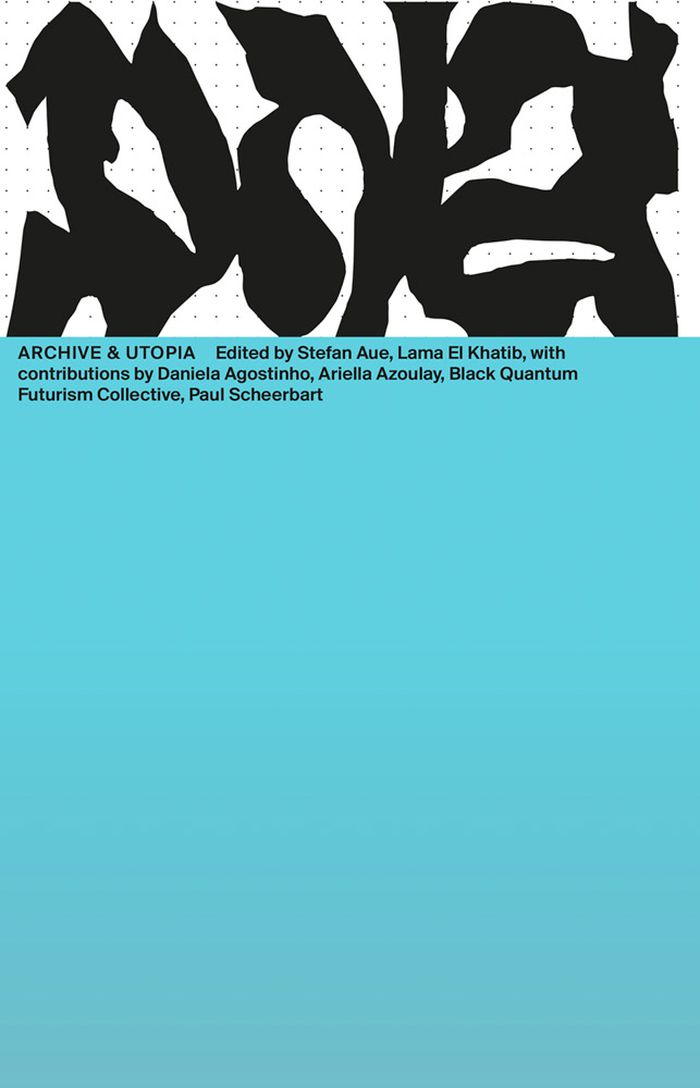
DNA 14: Archives and Utopia
DNA 14: Archives and Utopia
Actions:
Price:
$21.00
(available in store)
Summary:
Traditional archivism runs the risk of perpetuating hegemonic ways of thinking by anticipating what will be of importance in the future through the framework of present-day realities and power structures. These genre-busting ruminations gather new methods for designing views of potential worlds and forms of archival activism.
$21.00
(available in store)
Summary:
Traditional archivism runs the risk of perpetuating hegemonic ways of thinking by anticipating what will be of importance in the future through the framework of present-day realities and power structures. These genre-busting ruminations gather new methods for designing views of potential worlds and forms of archival activism.
Subject:
Archive, library and the digital
Archive, library and the digital
Publication:
December 2022
December 2022
Title:
DNA 14: Archives and Utopia
Actions:
Price:
$21.00
(available in store)
Summary:
Traditional archivism runs the risk of perpetuating hegemonic ways of thinking by anticipating what will be of importance in the future through the framework of present-day realities and power structures. These genre-busting ruminations gather new methods for designing views of potential worlds and forms of archival activism.
DNA 14: Archives and Utopia
Actions:
Price:
$21.00
(available in store)
Summary:
Traditional archivism runs the risk of perpetuating hegemonic ways of thinking by anticipating what will be of importance in the future through the framework of present-day realities and power structures. These genre-busting ruminations gather new methods for designing views of potential worlds and forms of archival activism.
Form:
books
books
Publication:
December 2022
December 2022
Subject:
Archive, library and the digital
Archive, library and the digital
Form:
books
books
Title:
Module B. 2015/2019
Module B. 2015/2019
Actions:
Price:
$20.00
(available in store)
Summary:
MODULE B. interroge la bibliothèque en tant qu’espace de classement, de présentation et de collection d’un savoir personnel ou collectif. À l’ère du numérique, il s’agit aussi de dégager la signification de la bibliothèque, sa manière d’agencer un espace, sa définition matérielle et les formes de sa virtualisation. Lors de l’inauguration du projet MODULE B. en 2015, le(...)
$20.00
(available in store)
Summary:
MODULE B. interroge la bibliothèque en tant qu’espace de classement, de présentation et de collection d’un savoir personnel ou collectif. À l’ère du numérique, il s’agit aussi de dégager la signification de la bibliothèque, sa manière d’agencer un espace, sa définition matérielle et les formes de sa virtualisation. Lors de l’inauguration du projet MODULE B. en 2015, le(...)
Title:
Module B. 2015/2019
Actions:
Price:
$20.00
(available in store)
Summary:
MODULE B. interroge la bibliothèque en tant qu’espace de classement, de présentation et de collection d’un savoir personnel ou collectif. À l’ère du numérique, il s’agit aussi de dégager la signification de la bibliothèque, sa manière d’agencer un espace, sa définition matérielle et les formes de sa virtualisation. Lors de l’inauguration du projet MODULE B. en 2015, le visiteur était amené à remplir l’une des 16 fiches du répertoire créé pour l’occasion, portant chacune un intitulé différent, une interrogation particulière sur la définition d’une bibliothèque, à travers un prisme différent. Suite à l’exposition de Module B. à hon\ books en 2019, antoine lefebvre editions publie la collection des fiches recueillies par le collectif.
Module B. 2015/2019
Actions:
Price:
$20.00
(available in store)
Summary:
MODULE B. interroge la bibliothèque en tant qu’espace de classement, de présentation et de collection d’un savoir personnel ou collectif. À l’ère du numérique, il s’agit aussi de dégager la signification de la bibliothèque, sa manière d’agencer un espace, sa définition matérielle et les formes de sa virtualisation. Lors de l’inauguration du projet MODULE B. en 2015, le visiteur était amené à remplir l’une des 16 fiches du répertoire créé pour l’occasion, portant chacune un intitulé différent, une interrogation particulière sur la définition d’une bibliothèque, à travers un prisme différent. Suite à l’exposition de Module B. à hon\ books en 2019, antoine lefebvre editions publie la collection des fiches recueillies par le collectif.
Form:
books
books
Publication:
October 2022
October 2022
Subject:
Archive, library and the digital
Archive, library and the digital
Form:
books
books

Price:
$25.00
(available to order)
Summary:
This volume explores the curious afterlives of the floppy disk in the 21st century through the work of those involved with the medium today. The book reflects on notions of obsolescence, media preservation and nostalgia, and challenges these by showing the endurance and versatility of this familiar piece of technology. From floppy filmmakers to floppy painters and beyond:(...)
$25.00
(available to order)
Summary:
This volume explores the curious afterlives of the floppy disk in the 21st century through the work of those involved with the medium today. The book reflects on notions of obsolescence, media preservation and nostalgia, and challenges these by showing the endurance and versatility of this familiar piece of technology. From floppy filmmakers to floppy painters and beyond:(...)
Subject:
Archive, library and the digital
Archive, library and the digital
Publication:
November 2022
November 2022
Title:
Floppy disk fever: The curious afterlives of a flexible medium
Actions:
Price:
$25.00
(available to order)
Summary:
This volume explores the curious afterlives of the floppy disk in the 21st century through the work of those involved with the medium today. The book reflects on notions of obsolescence, media preservation and nostalgia, and challenges these by showing the endurance and versatility of this familiar piece of technology. From floppy filmmakers to floppy painters and beyond: what drives people to continue working with the medium that is typically deemed obsolete? What challenges and affordances does it provide? And what does the future hold in store for the familiar black square? By looking at the current presence of past technology we can assess our present-day situation and speculate on the future developments of our media landscape. After all, the technology of the past is also part of our future. This volume features interviews with key players in the contemporary floppy-disk world, including not only artists and filmmakers using floppy disks in their practice but also businessmen, archivists and museum proprietors working to preserve the medium.
Floppy disk fever: The curious afterlives of a flexible medium
Actions:
Price:
$25.00
(available to order)
Summary:
This volume explores the curious afterlives of the floppy disk in the 21st century through the work of those involved with the medium today. The book reflects on notions of obsolescence, media preservation and nostalgia, and challenges these by showing the endurance and versatility of this familiar piece of technology. From floppy filmmakers to floppy painters and beyond: what drives people to continue working with the medium that is typically deemed obsolete? What challenges and affordances does it provide? And what does the future hold in store for the familiar black square? By looking at the current presence of past technology we can assess our present-day situation and speculate on the future developments of our media landscape. After all, the technology of the past is also part of our future. This volume features interviews with key players in the contemporary floppy-disk world, including not only artists and filmmakers using floppy disks in their practice but also businessmen, archivists and museum proprietors working to preserve the medium.
Form:
books
books
Publication:
November 2022
November 2022
Subject:
Archive, library and the digital
Archive, library and the digital
Form:
books
books

Actions:
Price:
$23.95
(available to order)
Summary:
This book makes available for the first time in English an important interview on the topic of photography that Jacques Derrida granted in 1992 to the German theorist of photography Hubertus von Amelunxen and the German literary and media theorist Michael Wetzel. Their conversation addresses questions of presence and its manufacture, the technicity of presentation, the(...)
$23.95
(available to order)
Summary:
This book makes available for the first time in English an important interview on the topic of photography that Jacques Derrida granted in 1992 to the German theorist of photography Hubertus von Amelunxen and the German literary and media theorist Michael Wetzel. Their conversation addresses questions of presence and its manufacture, the technicity of presentation, the(...)
Subject:
Archive, library and the digital
Archive, library and the digital
Publication:
August 2010
August 2010
Title:
Copy, archive, signature: A conversation on photography
Actions:
Price:
$23.95
(available to order)
Summary:
This book makes available for the first time in English an important interview on the topic of photography that Jacques Derrida granted in 1992 to the German theorist of photography Hubertus von Amelunxen and the German literary and media theorist Michael Wetzel. Their conversation addresses questions of presence and its manufacture, the technicity of presentation, the volatility of the authorial subject, and the concept of memory. Derrida offers a penetrating intervention with regard to the distinctive nature of photography vis-à-vis related technologies such as cinema, television, and video. Questioning the divides between so-called old and new media, original and reproduction, analog and digital modes of recording and presenting, he provides stimulating insights into the ways in which we think and speak about the photographic image today.
Copy, archive, signature: A conversation on photography
Actions:
Price:
$23.95
(available to order)
Summary:
This book makes available for the first time in English an important interview on the topic of photography that Jacques Derrida granted in 1992 to the German theorist of photography Hubertus von Amelunxen and the German literary and media theorist Michael Wetzel. Their conversation addresses questions of presence and its manufacture, the technicity of presentation, the volatility of the authorial subject, and the concept of memory. Derrida offers a penetrating intervention with regard to the distinctive nature of photography vis-à-vis related technologies such as cinema, television, and video. Questioning the divides between so-called old and new media, original and reproduction, analog and digital modes of recording and presenting, he provides stimulating insights into the ways in which we think and speak about the photographic image today.
Form:
books
books
Publication:
August 2010
August 2010
Subject:
Archive, library and the digital
Archive, library and the digital
Form:
books
books

Price:
$26.95
(available in store)
Summary:
Loin de céder au catastrophisme ambiant, cet ouvrage propose quelques clés pour faire face à l'incertitude, pour apprendre à naviguer selon les nouvelles lois du monde numérique et à en relever les défis.
$26.95
(available in store)
Summary:
Loin de céder au catastrophisme ambiant, cet ouvrage propose quelques clés pour faire face à l'incertitude, pour apprendre à naviguer selon les nouvelles lois du monde numérique et à en relever les défis.
Title:
La menace fantôme: les industries culturelles face au numérique
Actions:
Price:
$26.95
(available in store)
Summary:
Loin de céder au catastrophisme ambiant, cet ouvrage propose quelques clés pour faire face à l'incertitude, pour apprendre à naviguer selon les nouvelles lois du monde numérique et à en relever les défis.
La menace fantôme: les industries culturelles face au numérique
Actions:
Price:
$26.95
(available in store)
Summary:
Loin de céder au catastrophisme ambiant, cet ouvrage propose quelques clés pour faire face à l'incertitude, pour apprendre à naviguer selon les nouvelles lois du monde numérique et à en relever les défis.
Form:
books
books
Publication:
November 2014
November 2014
Subject:
Archive, library and the digital
Archive, library and the digital
Form:
books
books

Actions:
Price:
$34.95
(available in store)
Summary:
Great American writers—William Carlos Williams, Jonathan Edwards, Emily Dickinson, Noah Webster, Hart Crane, Wallace Stevens, Henry James — all in the physicality of their archival manuscripts — are the presiding spirits of Spontaneous Particulars: Telepathy of Archives. Also woven into Susan Howe’s newest book are beautiful photographs of embroideries and textiles from(...)
$34.95
(available in store)
Summary:
Great American writers—William Carlos Williams, Jonathan Edwards, Emily Dickinson, Noah Webster, Hart Crane, Wallace Stevens, Henry James — all in the physicality of their archival manuscripts — are the presiding spirits of Spontaneous Particulars: Telepathy of Archives. Also woven into Susan Howe’s newest book are beautiful photographs of embroideries and textiles from(...)
Publication:
November 2014
November 2014
Title:
Spontaneous particulars: the telepathy of archives
Actions:
Price:
$34.95
(available in store)
Summary:
Great American writers—William Carlos Williams, Jonathan Edwards, Emily Dickinson, Noah Webster, Hart Crane, Wallace Stevens, Henry James — all in the physicality of their archival manuscripts — are the presiding spirits of Spontaneous Particulars: Telepathy of Archives. Also woven into Susan Howe’s newest book are beautiful photographs of embroideries and textiles from anonymous craftspeople. All the archived materials are links, discoveries, chance encounters, the visual and acoustic shocks of rooting around amid physical archives.
Spontaneous particulars: the telepathy of archives
Actions:
Price:
$34.95
(available in store)
Summary:
Great American writers—William Carlos Williams, Jonathan Edwards, Emily Dickinson, Noah Webster, Hart Crane, Wallace Stevens, Henry James — all in the physicality of their archival manuscripts — are the presiding spirits of Spontaneous Particulars: Telepathy of Archives. Also woven into Susan Howe’s newest book are beautiful photographs of embroideries and textiles from anonymous craftspeople. All the archived materials are links, discoveries, chance encounters, the visual and acoustic shocks of rooting around amid physical archives.
Form:
books
books
Publication:
November 2014
November 2014
Form:
books
books
Actions:
Price:
$14.95
(available to order)
Summary:
L’apparition du numérique a entraîné ces dernières années une transformation profonde des modèles de production et de circulation des livres, qui ont peu changé depuis le XVIIIe siècle. Le web, en particulier, a provoqué une remise en question du sens même du partage des connaissances : d’une économie de la rareté, nous sommes passés à la surabondance. Auparavant, une(...)
$14.95
(available to order)
Summary:
L’apparition du numérique a entraîné ces dernières années une transformation profonde des modèles de production et de circulation des livres, qui ont peu changé depuis le XVIIIe siècle. Le web, en particulier, a provoqué une remise en question du sens même du partage des connaissances : d’une économie de la rareté, nous sommes passés à la surabondance. Auparavant, une(...)
Subject:
Archive, library and the digital
Archive, library and the digital
Publication:
November 2014
November 2014
Title:
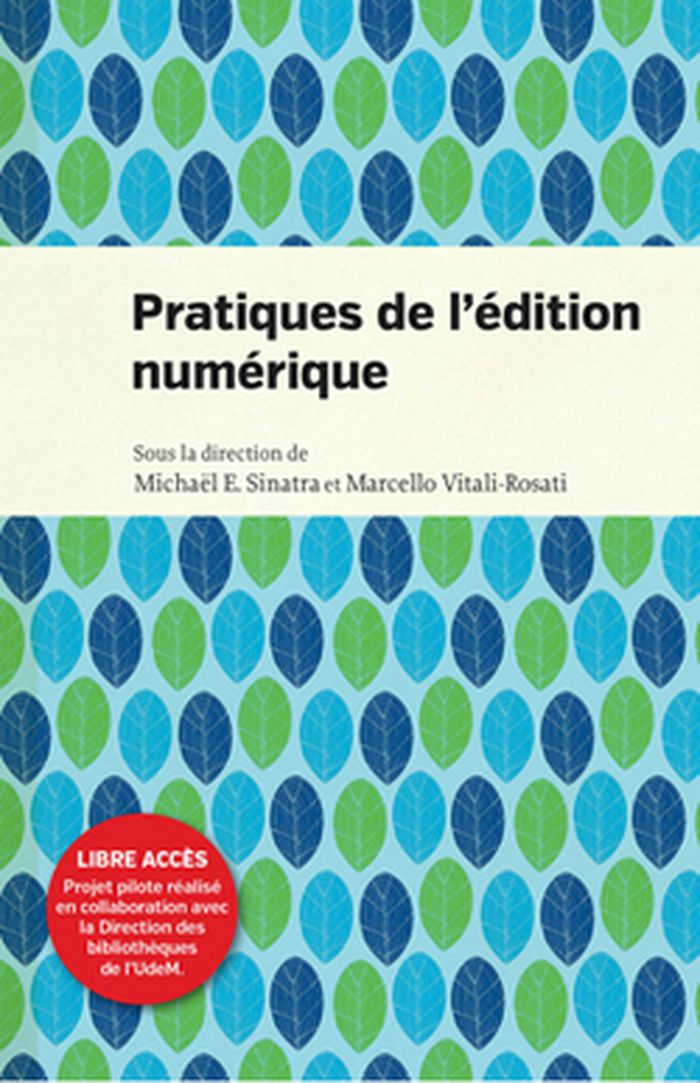
Pratique de l'édition numérique
Actions:
Price:
$14.95
(available to order)
Summary:
L’apparition du numérique a entraîné ces dernières années une transformation profonde des modèles de production et de circulation des livres, qui ont peu changé depuis le XVIIIe siècle. Le web, en particulier, a provoqué une remise en question du sens même du partage des connaissances : d’une économie de la rareté, nous sommes passés à la surabondance. Auparavant, une poignée d’institutions centralisatrices, privées et publiques, étaient garantes du choix, de l’évaluation et de la distribution des contenus ; aujourd’hui, il n’y a plus de systèmes de légitimation, ou alors ils sont déstructurés. Après avoir fait le constat de la crise de ces modèles et de la difficulté d’en proposer de nouveaux, ce livre présente les enjeux et les défis complexes du nouveau monde de l’édition numérique.
Pratique de l'édition numérique
Actions:
Price:
$14.95
(available to order)
Summary:
L’apparition du numérique a entraîné ces dernières années une transformation profonde des modèles de production et de circulation des livres, qui ont peu changé depuis le XVIIIe siècle. Le web, en particulier, a provoqué une remise en question du sens même du partage des connaissances : d’une économie de la rareté, nous sommes passés à la surabondance. Auparavant, une poignée d’institutions centralisatrices, privées et publiques, étaient garantes du choix, de l’évaluation et de la distribution des contenus ; aujourd’hui, il n’y a plus de systèmes de légitimation, ou alors ils sont déstructurés. Après avoir fait le constat de la crise de ces modèles et de la difficulté d’en proposer de nouveaux, ce livre présente les enjeux et les défis complexes du nouveau monde de l’édition numérique.
Form:
books
books
Publication:
November 2014
November 2014
Subject:
Archive, library and the digital
Archive, library and the digital
Form:
books
books

Actions:
Price:
$11.95
(available to order)
Summary:
Nous sommes en 1763. L'un des maîtres de la correspondance s'adresse ici à monsieur de Sartine, son vieil ami, alors directeur de la Librairie. Et c'est un véritable plaidoyer pour la défense du Libraire-Éditeur. Il s'interroge d'abord sur le lien entre le commerce et la littérature et décrit avec soin, mais sans la condamner, la transformation de la valeur littéraire en(...)
$11.95
(available to order)
Summary:
Nous sommes en 1763. L'un des maîtres de la correspondance s'adresse ici à monsieur de Sartine, son vieil ami, alors directeur de la Librairie. Et c'est un véritable plaidoyer pour la défense du Libraire-Éditeur. Il s'interroge d'abord sur le lien entre le commerce et la littérature et décrit avec soin, mais sans la condamner, la transformation de la valeur littéraire en(...)
Publication:
January 2015
January 2015
Title:
Lettre historique & politique adressée à un magistrat sur le commerce de la librairie
Actions:
Price:
$11.95
(available to order)
Summary:
Nous sommes en 1763. L'un des maîtres de la correspondance s'adresse ici à monsieur de Sartine, son vieil ami, alors directeur de la Librairie. Et c'est un véritable plaidoyer pour la défense du Libraire-Éditeur. Il s'interroge d'abord sur le lien entre le commerce et la littérature et décrit avec soin, mais sans la condamner, la transformation de la valeur littéraire en valeur mercantile. Ce faisant, il lie le sort de la littérature à celui de l'édition. Il plaide en faveur d'un fonds de librairie, celui qui s'écoule lentement, en équilibre avec les ventes plus rapides. Au fil d'une véritable enquête, il démontre par là même au lecteur contemporain que les problèmes qui se posent aujourd'hui au libraire ou à l'éditeur sont loin d'être récents, bien qu'ils se posent aujourd’hui plus que jamais.
Lettre historique & politique adressée à un magistrat sur le commerce de la librairie
Actions:
Price:
$11.95
(available to order)
Summary:
Nous sommes en 1763. L'un des maîtres de la correspondance s'adresse ici à monsieur de Sartine, son vieil ami, alors directeur de la Librairie. Et c'est un véritable plaidoyer pour la défense du Libraire-Éditeur. Il s'interroge d'abord sur le lien entre le commerce et la littérature et décrit avec soin, mais sans la condamner, la transformation de la valeur littéraire en valeur mercantile. Ce faisant, il lie le sort de la littérature à celui de l'édition. Il plaide en faveur d'un fonds de librairie, celui qui s'écoule lentement, en équilibre avec les ventes plus rapides. Au fil d'une véritable enquête, il démontre par là même au lecteur contemporain que les problèmes qui se posent aujourd'hui au libraire ou à l'éditeur sont loin d'être récents, bien qu'ils se posent aujourd’hui plus que jamais.
Form:
books
books
Publication:
January 2015
January 2015


