


878 Results
Form:
books
books
Actions:
Price:
$26.95
(available in store)
Summary:
Le paradoxe est frappant : alors que le pouvoir d’achat culmine en tête des préoccupations de nos contemporains, nous consommons beaucoup trop au regard de nos besoins réels et des limites planétaires. Samuel Sauvage décrypte les rouages de cette addiction généralisée et de son corollaire, la production de masse. Une spirale implacable qu’il analyse à travers les(...)
$26.95
(available in store)
Summary:
Le paradoxe est frappant : alors que le pouvoir d’achat culmine en tête des préoccupations de nos contemporains, nous consommons beaucoup trop au regard de nos besoins réels et des limites planétaires. Samuel Sauvage décrypte les rouages de cette addiction généralisée et de son corollaire, la production de masse. Une spirale implacable qu’il analyse à travers les(...)
Title:
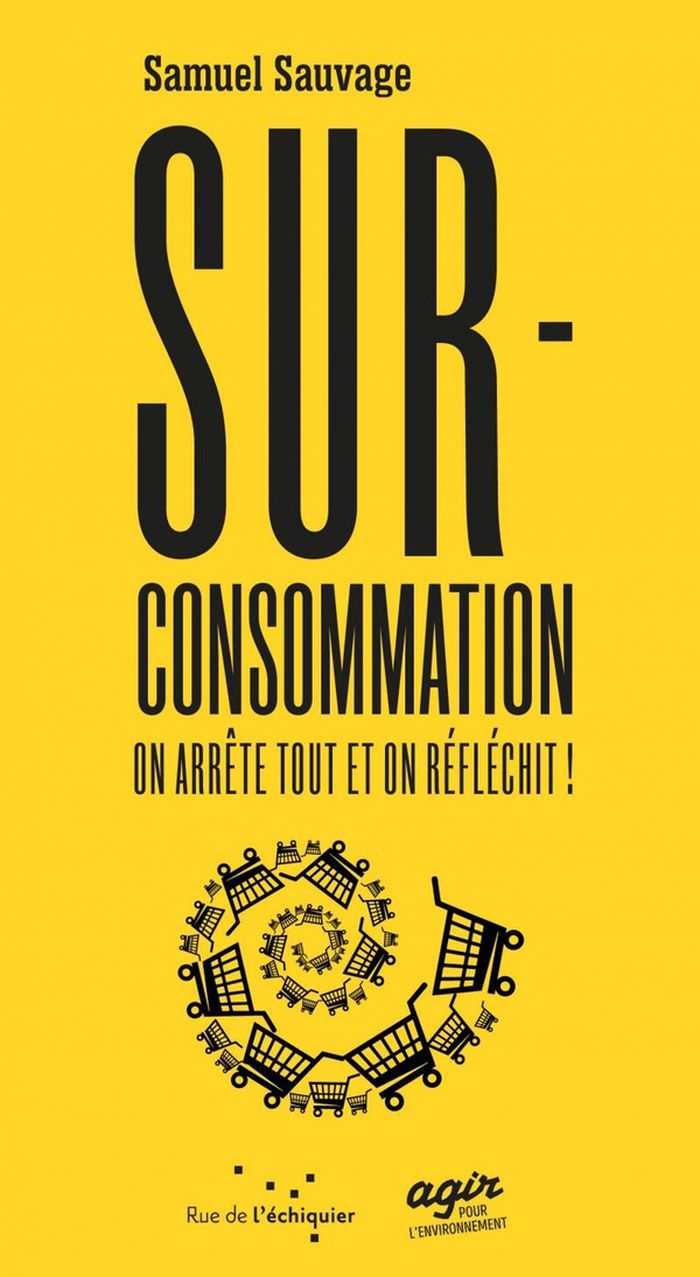
Surconsommation : On arrête tout et on réfléchit !
Actions:
Price:
$26.95
(available in store)
Summary:
Le paradoxe est frappant : alors que le pouvoir d’achat culmine en tête des préoccupations de nos contemporains, nous consommons beaucoup trop au regard de nos besoins réels et des limites planétaires. Samuel Sauvage décrypte les rouages de cette addiction généralisée et de son corollaire, la production de masse. Une spirale implacable qu’il analyse à travers les mécanismes du « Bémol » : Besoins artificiels, Extension des marchés, Marchandisation de la société, Obsolescence programmée et "Low cost." Pour sortir de cette spirale, la voie de l’action individuelle – la fameuse « consommation responsable » – doit être repensée et surtout intégrée à une démarche collective et systémique pour mettre un terme à la surconsommation. Face au Bémol, l’auteur appelle à un « Dièse » résolument politique : Désarmer la publicité, Impulser un nouvel imaginaire, Encadrer la production, Soutenir les alternatives, Embarquer les acteurs.
Surconsommation : On arrête tout et on réfléchit !
Actions:
Price:
$26.95
(available in store)
Summary:
Le paradoxe est frappant : alors que le pouvoir d’achat culmine en tête des préoccupations de nos contemporains, nous consommons beaucoup trop au regard de nos besoins réels et des limites planétaires. Samuel Sauvage décrypte les rouages de cette addiction généralisée et de son corollaire, la production de masse. Une spirale implacable qu’il analyse à travers les mécanismes du « Bémol » : Besoins artificiels, Extension des marchés, Marchandisation de la société, Obsolescence programmée et "Low cost." Pour sortir de cette spirale, la voie de l’action individuelle – la fameuse « consommation responsable » – doit être repensée et surtout intégrée à une démarche collective et systémique pour mettre un terme à la surconsommation. Face au Bémol, l’auteur appelle à un « Dièse » résolument politique : Désarmer la publicité, Impulser un nouvel imaginaire, Encadrer la production, Soutenir les alternatives, Embarquer les acteurs.
Form:
books
books
Publication:
October 2025
October 2025
Subject:
Critical Theory
Critical Theory
Form:
books
books
Price:
$21.95
(available to order)
Summary:
L’œuvre de Tolkien est une implacable dénonciation du pouvoir, dont les formes les plus tyranniques sont explicitement accusées d’être responsables des violences qui dévastent la Terre du Milieu et ses habitants. Pourtant, depuis quelques décennies, l’extrême droite multiplie les tentatives d’accaparement de l’univers tolkienien. En effet, stratèges et intellectuels à la(...)
$21.95
(available to order)
Summary:
L’œuvre de Tolkien est une implacable dénonciation du pouvoir, dont les formes les plus tyranniques sont explicitement accusées d’être responsables des violences qui dévastent la Terre du Milieu et ses habitants. Pourtant, depuis quelques décennies, l’extrême droite multiplie les tentatives d’accaparement de l’univers tolkienien. En effet, stratèges et intellectuels à la(...)
Title:
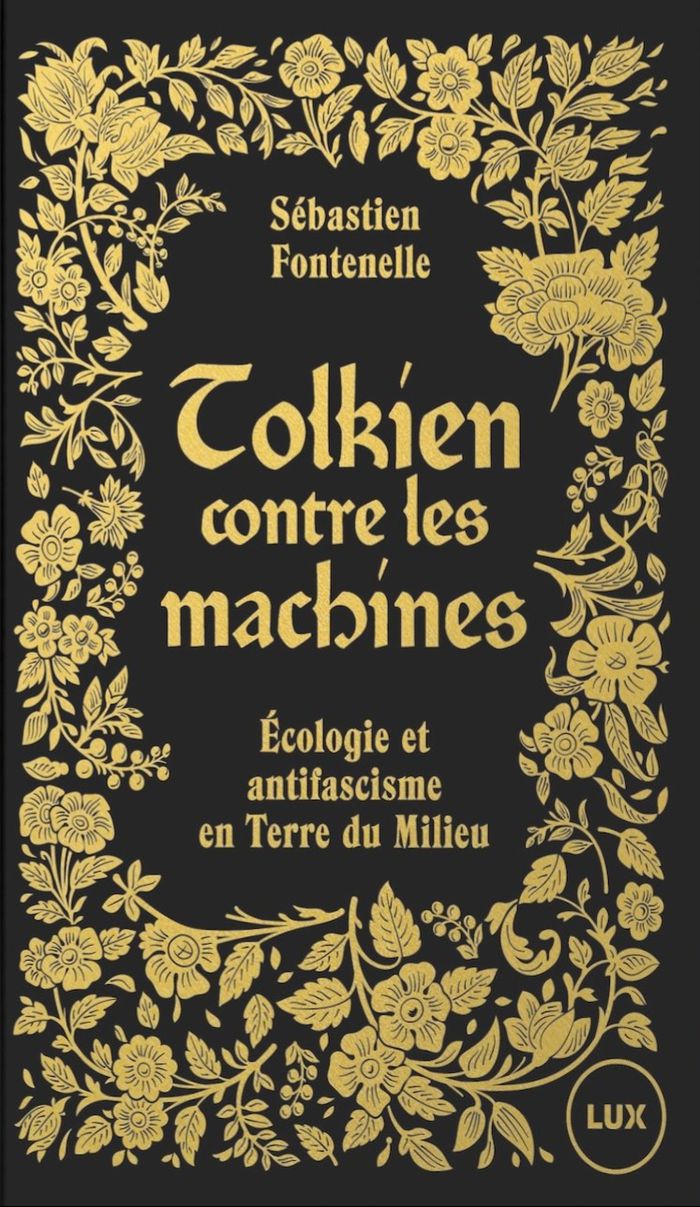
Tolkien contre les machines : Écologie et antifascisme en Terre du Milieu
Actions:
Price:
$21.95
(available to order)
Summary:
L’œuvre de Tolkien est une implacable dénonciation du pouvoir, dont les formes les plus tyranniques sont explicitement accusées d’être responsables des violences qui dévastent la Terre du Milieu et ses habitants. Pourtant, depuis quelques décennies, l’extrême droite multiplie les tentatives d’accaparement de l’univers tolkienien. En effet, stratèges et intellectuels à la solde des réactionnaires qui briguent le pouvoir, ou qui l’ont déjà pris, tentent de combler un vide culturel. Pour ce faire, ils ne trouvent rien de mieux que d’essayer de s’approprier une œuvre populaire, certes, mais qui défend l’exact opposé de ce que prône leur idéologie.
Tolkien contre les machines : Écologie et antifascisme en Terre du Milieu
Actions:
Price:
$21.95
(available to order)
Summary:
L’œuvre de Tolkien est une implacable dénonciation du pouvoir, dont les formes les plus tyranniques sont explicitement accusées d’être responsables des violences qui dévastent la Terre du Milieu et ses habitants. Pourtant, depuis quelques décennies, l’extrême droite multiplie les tentatives d’accaparement de l’univers tolkienien. En effet, stratèges et intellectuels à la solde des réactionnaires qui briguent le pouvoir, ou qui l’ont déjà pris, tentent de combler un vide culturel. Pour ce faire, ils ne trouvent rien de mieux que d’essayer de s’approprier une œuvre populaire, certes, mais qui défend l’exact opposé de ce que prône leur idéologie.
Form:
books
books
Publication:
November 2025
November 2025
Subject:
Critical Theory
Critical Theory
Form:
books
books
Price:
$24.95
(available in store)
Summary:
À partir d'expériences pratiques, « Désapprendre en traduisant » s'appuie sur la traduction comme outil pédagogique, acte de résistance et geste de soin dans un contexte politique hostile. La curatrice, autrice, éditrice et traductrice autodidacte Virginie Bobin y revisite une série d'ateliers, expositions et autres activités collectives prenant la traduction comme sujet(...)
$24.95
(available in store)
Summary:
À partir d'expériences pratiques, « Désapprendre en traduisant » s'appuie sur la traduction comme outil pédagogique, acte de résistance et geste de soin dans un contexte politique hostile. La curatrice, autrice, éditrice et traductrice autodidacte Virginie Bobin y revisite une série d'ateliers, expositions et autres activités collectives prenant la traduction comme sujet(...)
Title:
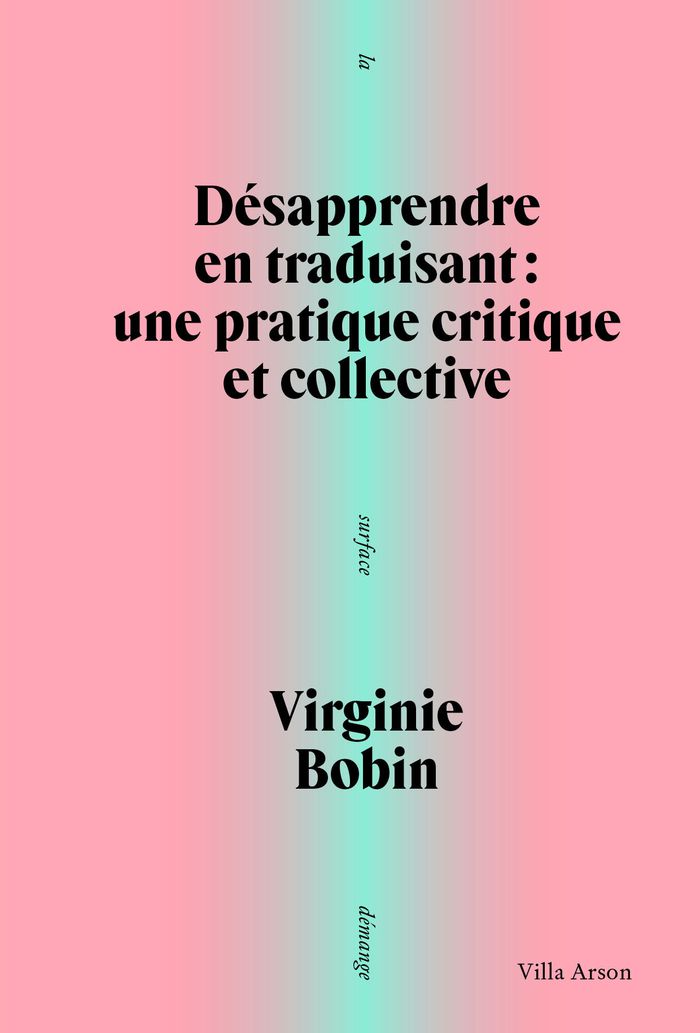
Désapprendre en traduisant : Une pratique critique et collective
Actions:
Price:
$24.95
(available in store)
Summary:
À partir d'expériences pratiques, « Désapprendre en traduisant » s'appuie sur la traduction comme outil pédagogique, acte de résistance et geste de soin dans un contexte politique hostile. La curatrice, autrice, éditrice et traductrice autodidacte Virginie Bobin y revisite une série d'ateliers, expositions et autres activités collectives prenant la traduction comme sujet et comme méthode pour ébranler les conceptions excluantes de la langue, de l'identité et de l'appartenance. À travers le prisme ambigu de l'intraduisibilité, le livre se penche sur les rapports de pouvoir qui sous-tendent le travail de l'art dans divers contextes institutionnels, académiques ou militants. S'inscrivant dans des généalogies et des méthodologies féministes, « Désapprendre en traduisant » place le travail collectif et les relations affectives au cœur des pratiques critiques, comme l'illustre la correspondance avec Andrea Ancira, publiée à la fin du livre.
Désapprendre en traduisant : Une pratique critique et collective
Actions:
Price:
$24.95
(available in store)
Summary:
À partir d'expériences pratiques, « Désapprendre en traduisant » s'appuie sur la traduction comme outil pédagogique, acte de résistance et geste de soin dans un contexte politique hostile. La curatrice, autrice, éditrice et traductrice autodidacte Virginie Bobin y revisite une série d'ateliers, expositions et autres activités collectives prenant la traduction comme sujet et comme méthode pour ébranler les conceptions excluantes de la langue, de l'identité et de l'appartenance. À travers le prisme ambigu de l'intraduisibilité, le livre se penche sur les rapports de pouvoir qui sous-tendent le travail de l'art dans divers contextes institutionnels, académiques ou militants. S'inscrivant dans des généalogies et des méthodologies féministes, « Désapprendre en traduisant » place le travail collectif et les relations affectives au cœur des pratiques critiques, comme l'illustre la correspondance avec Andrea Ancira, publiée à la fin du livre.
Form:
books
books
Publication:
October 2025
October 2025
Subject:
Critical Theory
Critical Theory
Form:
books
books
Title:
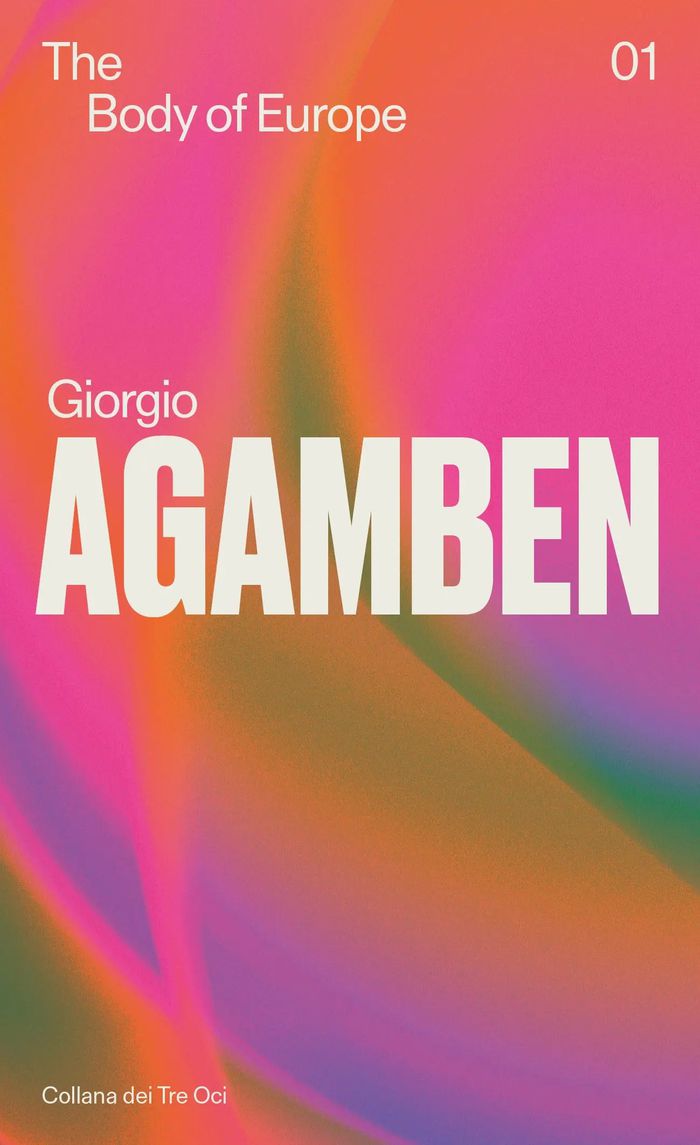
The body of Europe
The body of Europe
Actions:
Price:
$15.75
(available in store)
Summary:
A ghost is haunting Europe: the ghost of Europe itself. It is a ghost without flesh and bone – a vanishing body that seems to satisfy itself with a vague geographical description. At best Europe refers to the sister of Cadmus, once upon a time abducted by Zeus. Can’t we do better? Is Europe condemned to incarnate itself in a name whose sole reality is to be the one of a(...)
$15.75
(available in store)
Summary:
A ghost is haunting Europe: the ghost of Europe itself. It is a ghost without flesh and bone – a vanishing body that seems to satisfy itself with a vague geographical description. At best Europe refers to the sister of Cadmus, once upon a time abducted by Zeus. Can’t we do better? Is Europe condemned to incarnate itself in a name whose sole reality is to be the one of a(...)
Title:
The body of Europe
Actions:
Price:
$15.75
(available in store)
Summary:
A ghost is haunting Europe: the ghost of Europe itself. It is a ghost without flesh and bone – a vanishing body that seems to satisfy itself with a vague geographical description. At best Europe refers to the sister of Cadmus, once upon a time abducted by Zeus. Can’t we do better? Is Europe condemned to incarnate itself in a name whose sole reality is to be the one of a political strategy, of a way to deal with crisis? Wouldn’t it be time that we start to interrogate what Europe could mean beyond ghosts and petty politics? After all, it is very well possible that what we call Europe has a body, has a corpus – and that this corpus is no other than the ensemble composed by the fragments of its literary history. What if Europe was not a matter of geography or politics, but a matter of literature – a matter of sense and sensibility: a way to welcome what, in a human body, makes it alive?
The body of Europe
Actions:
Price:
$15.75
(available in store)
Summary:
A ghost is haunting Europe: the ghost of Europe itself. It is a ghost without flesh and bone – a vanishing body that seems to satisfy itself with a vague geographical description. At best Europe refers to the sister of Cadmus, once upon a time abducted by Zeus. Can’t we do better? Is Europe condemned to incarnate itself in a name whose sole reality is to be the one of a political strategy, of a way to deal with crisis? Wouldn’t it be time that we start to interrogate what Europe could mean beyond ghosts and petty politics? After all, it is very well possible that what we call Europe has a body, has a corpus – and that this corpus is no other than the ensemble composed by the fragments of its literary history. What if Europe was not a matter of geography or politics, but a matter of literature – a matter of sense and sensibility: a way to welcome what, in a human body, makes it alive?
Form:
books
books
Publication:
October 2025
October 2025
Subject:
Critical Theory
Critical Theory
Form:
books
books
Title:
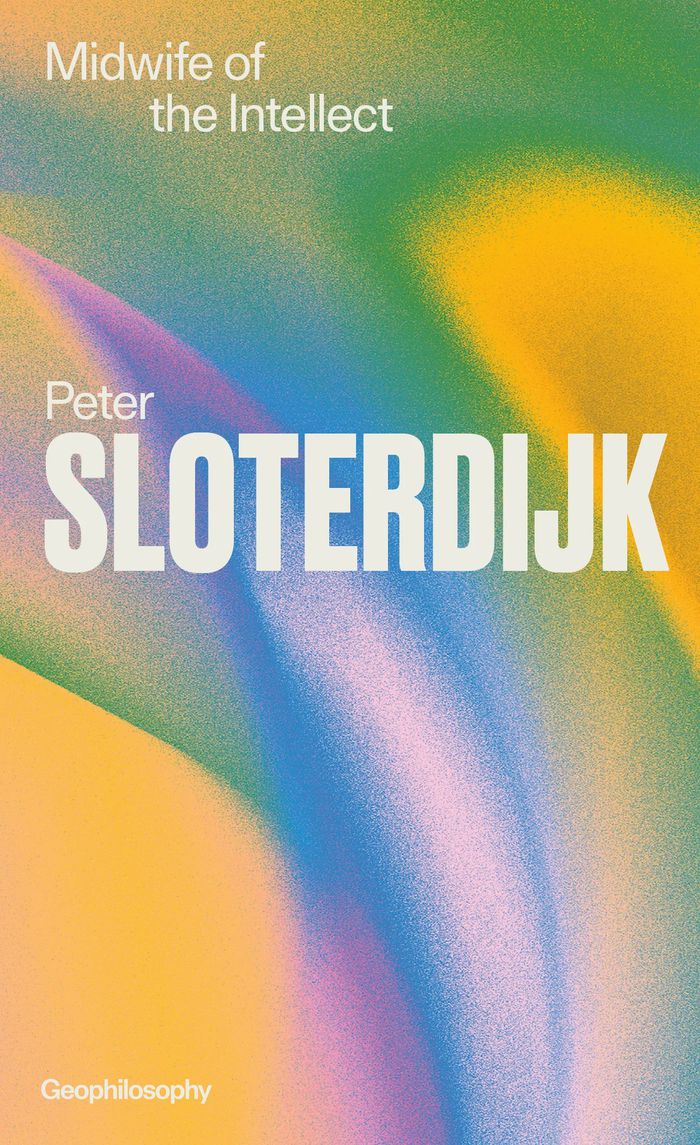
Midwife of the intellect
Midwife of the intellect
Actions:
Price:
$15.75
(available in store)
Summary:
How could a Rhineland mystic of the 13th century help us better navigate the 21st? In a provocative reading of the work of Meister Eckhart, Peter Sloterdijk offers a compelling answer: What medieval mysticism teaches us is that all there is doesn’t exist per se—everything only exists in relation. For Eckhart, living on Earth is the same as the Holy Trinity: in a(...)
$15.75
(available in store)
Summary:
How could a Rhineland mystic of the 13th century help us better navigate the 21st? In a provocative reading of the work of Meister Eckhart, Peter Sloterdijk offers a compelling answer: What medieval mysticism teaches us is that all there is doesn’t exist per se—everything only exists in relation. For Eckhart, living on Earth is the same as the Holy Trinity: in a(...)
Title:
Midwife of the intellect
Actions:
Price:
$15.75
(available in store)
Summary:
How could a Rhineland mystic of the 13th century help us better navigate the 21st? In a provocative reading of the work of Meister Eckhart, Peter Sloterdijk offers a compelling answer: What medieval mysticism teaches us is that all there is doesn’t exist per se—everything only exists in relation. For Eckhart, living on Earth is the same as the Holy Trinity: in a symbiosis, a form of co-relationship forgotten for too long. The triumph of individualism led to the shared illusion that humans, like everything else on the planet, had an essence, an identity, a being. But nothing could be more false. What everything is, is the others. What everything is, is a shared relationality. We are not alone—we are also all others; we depend on them. In the Anthropocene, when planetary symbiosis has never been more jeopardized, shifting our metaphysics and recalling lessons such as those of Meister Eckhart has become vital.
Midwife of the intellect
Actions:
Price:
$15.75
(available in store)
Summary:
How could a Rhineland mystic of the 13th century help us better navigate the 21st? In a provocative reading of the work of Meister Eckhart, Peter Sloterdijk offers a compelling answer: What medieval mysticism teaches us is that all there is doesn’t exist per se—everything only exists in relation. For Eckhart, living on Earth is the same as the Holy Trinity: in a symbiosis, a form of co-relationship forgotten for too long. The triumph of individualism led to the shared illusion that humans, like everything else on the planet, had an essence, an identity, a being. But nothing could be more false. What everything is, is the others. What everything is, is a shared relationality. We are not alone—we are also all others; we depend on them. In the Anthropocene, when planetary symbiosis has never been more jeopardized, shifting our metaphysics and recalling lessons such as those of Meister Eckhart has become vital.
Form:
books
books
Publication:
November 2025
November 2025
Subject:
Critical Theory
Critical Theory
Form:
books
books
Title:
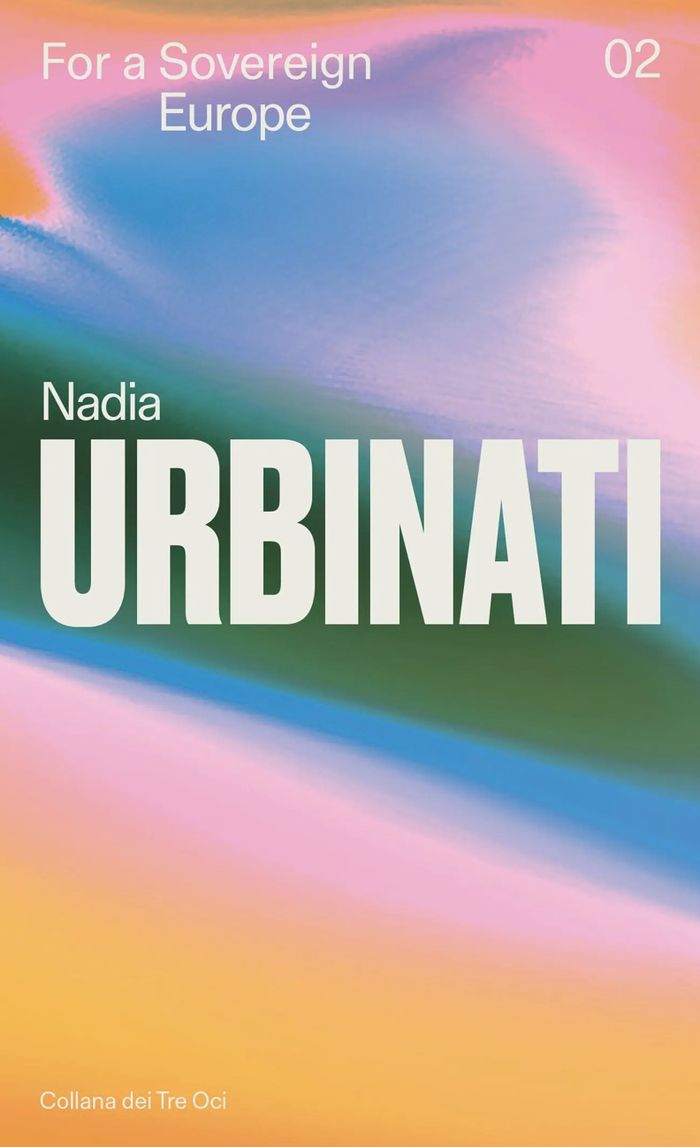
For a sovereign Europe
For a sovereign Europe
Actions:
Price:
$14.00
(available in store)
Summary:
A specter haunts Europe: the specter of sovereignty. Legacy of a prestigious political tradition, sovereignty has metamorphosed into a monster in the 19th century, with the advent of nationalism and the ensuing catastrophes that tainted the globe in blood. Today, at a time when nationalist passions seem to be back with a vengeance, a renewed call for sovereignty presents(...)
$14.00
(available in store)
Summary:
A specter haunts Europe: the specter of sovereignty. Legacy of a prestigious political tradition, sovereignty has metamorphosed into a monster in the 19th century, with the advent of nationalism and the ensuing catastrophes that tainted the globe in blood. Today, at a time when nationalist passions seem to be back with a vengeance, a renewed call for sovereignty presents(...)
Title:
For a sovereign Europe
Actions:
Price:
$14.00
(available in store)
Summary:
A specter haunts Europe: the specter of sovereignty. Legacy of a prestigious political tradition, sovereignty has metamorphosed into a monster in the 19th century, with the advent of nationalism and the ensuing catastrophes that tainted the globe in blood. Today, at a time when nationalist passions seem to be back with a vengeance, a renewed call for sovereignty presents itself as a return towards populations and territories to be defended. Any project aiming at doing away with nations and finding the route towards a larger political ensembles seems to be barred by what is now presented as a sacred value – the one of a people selecting its own way of being governed. But what if this was wrong? What if sovereignty could designate another horizon than the one of nations? What if Europe could become the place for a new experiment on the meaning and extension of sovereignty and democracy? This would mean a sovereign Europe.
For a sovereign Europe
Actions:
Price:
$14.00
(available in store)
Summary:
A specter haunts Europe: the specter of sovereignty. Legacy of a prestigious political tradition, sovereignty has metamorphosed into a monster in the 19th century, with the advent of nationalism and the ensuing catastrophes that tainted the globe in blood. Today, at a time when nationalist passions seem to be back with a vengeance, a renewed call for sovereignty presents itself as a return towards populations and territories to be defended. Any project aiming at doing away with nations and finding the route towards a larger political ensembles seems to be barred by what is now presented as a sacred value – the one of a people selecting its own way of being governed. But what if this was wrong? What if sovereignty could designate another horizon than the one of nations? What if Europe could become the place for a new experiment on the meaning and extension of sovereignty and democracy? This would mean a sovereign Europe.
Form:
books
books
Publication:
November 2025
November 2025
Subject:
Critical Theory
Critical Theory
Form:
books
books

Actions:
Price:
$15.75
(available in store)
Summary:
Linear history is a myth. In the past, it was useful. But today, it has become more and more unsustainable as its mythical dimension had to face the hard truths of science. With the evolution of physics, in particular quantum physics, we don’t have any choice left: we have to reconsider the nature of history just as we had to reconsider the very nature of reality. Rather(...)
$15.75
(available in store)
Summary:
Linear history is a myth. In the past, it was useful. But today, it has become more and more unsustainable as its mythical dimension had to face the hard truths of science. With the evolution of physics, in particular quantum physics, we don’t have any choice left: we have to reconsider the nature of history just as we had to reconsider the very nature of reality. Rather(...)
Title:
For a quantum theory of history
Actions:
Price:
$15.75
(available in store)
Summary:
Linear history is a myth. In the past, it was useful. But today, it has become more and more unsustainable as its mythical dimension had to face the hard truths of science. With the evolution of physics, in particular quantum physics, we don’t have any choice left: we have to reconsider the nature of history just as we had to reconsider the very nature of reality. Rather than a univocal logic, looking at time as if it was some sort of a river flowing from the past to the future, quantum theory introduces us to a world made of multiple states and configurations all at once. The present, the future and the past are suddenly changing status, reversing their course or reinventing the precession of one upon the others. But if history has lost its linearity, what does it change for the creatures of history – for us? What does it change for our historical societies? What does it change for politics? The answer is simple: everything. It is high time that we take notice.
For a quantum theory of history
Actions:
Price:
$15.75
(available in store)
Summary:
Linear history is a myth. In the past, it was useful. But today, it has become more and more unsustainable as its mythical dimension had to face the hard truths of science. With the evolution of physics, in particular quantum physics, we don’t have any choice left: we have to reconsider the nature of history just as we had to reconsider the very nature of reality. Rather than a univocal logic, looking at time as if it was some sort of a river flowing from the past to the future, quantum theory introduces us to a world made of multiple states and configurations all at once. The present, the future and the past are suddenly changing status, reversing their course or reinventing the precession of one upon the others. But if history has lost its linearity, what does it change for the creatures of history – for us? What does it change for our historical societies? What does it change for politics? The answer is simple: everything. It is high time that we take notice.
Form:
books
books
Publication:
October 2025
October 2025
Subject:
Critical Theory
Critical Theory
Form:
books
books
Title:
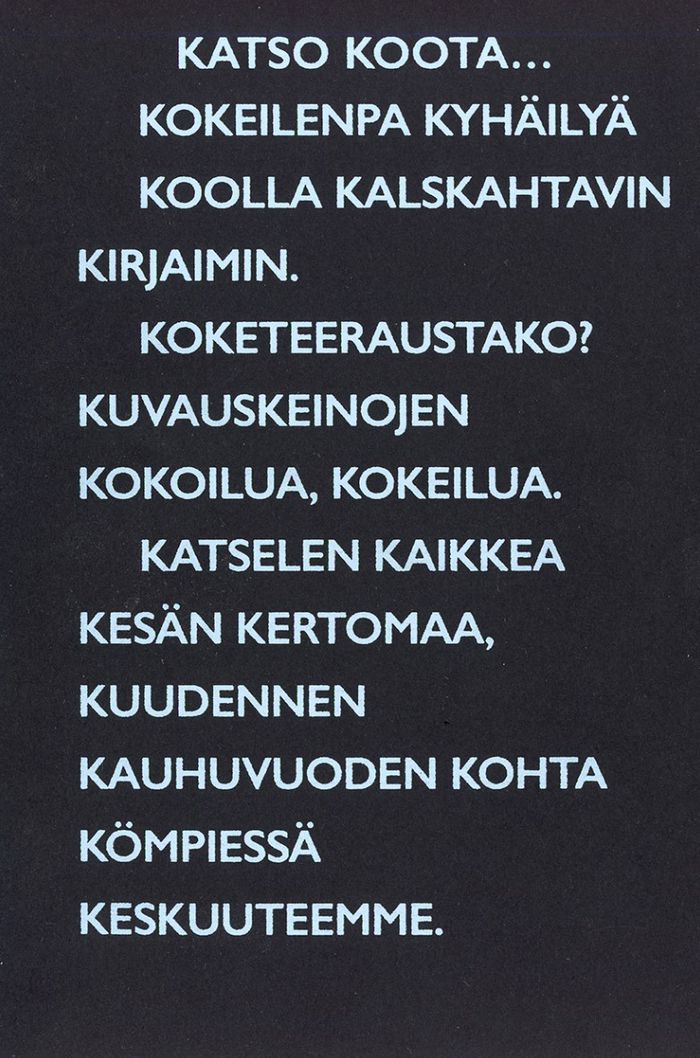
Katso Koota/ Look at K
Katso Koota/ Look at K
Actions:
Price:
$26.00
(available in store)
Summary:
Olavi Laiho (1907-1944) was a writer, political organiser, and communist agitator, who was first imprisoned in 1932—a time when "communist laws" were in effect in Finland—for producing political material and running an illegal printing press in his home. He opposed Finland's WW2 era fighting alongside Nazi Germany against the Soviet Union, edited illegal journals, but(...)
$26.00
(available in store)
Summary:
Olavi Laiho (1907-1944) was a writer, political organiser, and communist agitator, who was first imprisoned in 1932—a time when "communist laws" were in effect in Finland—for producing political material and running an illegal printing press in his home. He opposed Finland's WW2 era fighting alongside Nazi Germany against the Soviet Union, edited illegal journals, but(...)
Title:
Katso Koota/ Look at K
Actions:
Price:
$26.00
(available in store)
Summary:
Olavi Laiho (1907-1944) was a writer, political organiser, and communist agitator, who was first imprisoned in 1932—a time when "communist laws" were in effect in Finland—for producing political material and running an illegal printing press in his home. He opposed Finland's WW2 era fighting alongside Nazi Germany against the Soviet Union, edited illegal journals, but also planned armed resistance and facilitated correspondence between the party's leadership in Helsinki and the Soviet embassy in Stockholm. Just a couple of weeks before his execution, Laiho wrote a remarkable essay "Katso Koota" [Look at K], using only words starting with the letter K. "Katso Koota" is an early example of Finnish modern alliterative writing, a lipogram, a literary technique in which every word must start with the same letter. Laiho's "Katso Koota" predates the French Oulipo ("workshop of potential literature") of the 1960s. Considering that he produced his "constrained writing" under conditions of extreme political and cultural confinement, it can be considered a true form of avant-garde subversion.
Katso Koota/ Look at K
Actions:
Price:
$26.00
(available in store)
Summary:
Olavi Laiho (1907-1944) was a writer, political organiser, and communist agitator, who was first imprisoned in 1932—a time when "communist laws" were in effect in Finland—for producing political material and running an illegal printing press in his home. He opposed Finland's WW2 era fighting alongside Nazi Germany against the Soviet Union, edited illegal journals, but also planned armed resistance and facilitated correspondence between the party's leadership in Helsinki and the Soviet embassy in Stockholm. Just a couple of weeks before his execution, Laiho wrote a remarkable essay "Katso Koota" [Look at K], using only words starting with the letter K. "Katso Koota" is an early example of Finnish modern alliterative writing, a lipogram, a literary technique in which every word must start with the same letter. Laiho's "Katso Koota" predates the French Oulipo ("workshop of potential literature") of the 1960s. Considering that he produced his "constrained writing" under conditions of extreme political and cultural confinement, it can be considered a true form of avant-garde subversion.
Form:
books
books
Publication:
December 2025
December 2025
Subject:
Critical Theory
Critical Theory
Form:
books
books
Title:
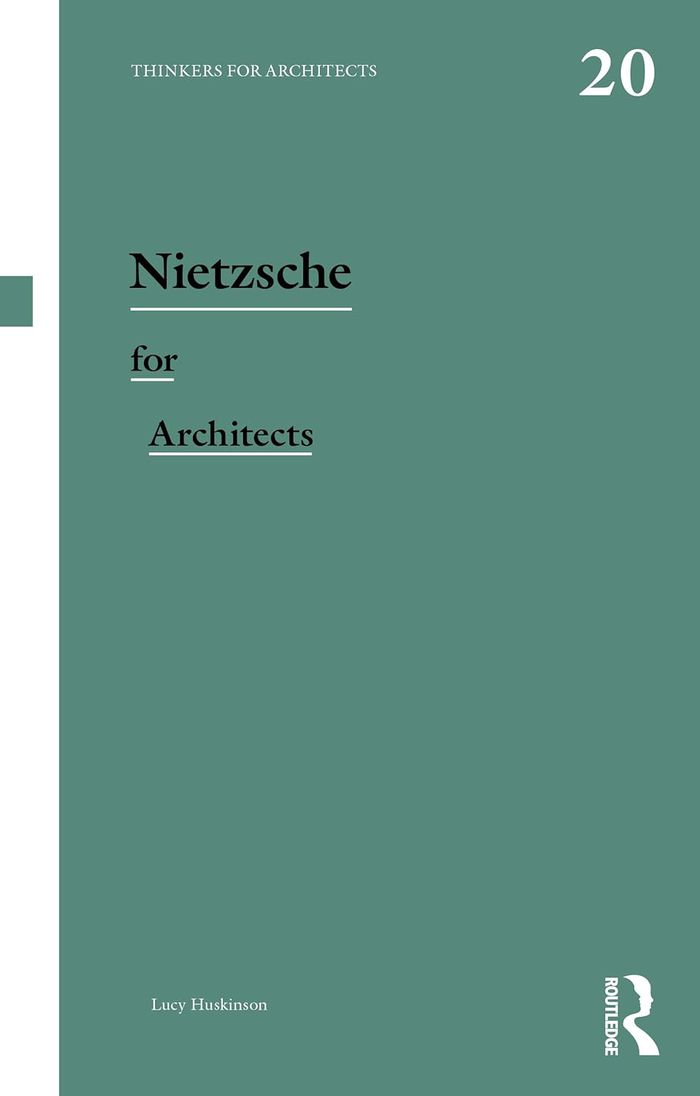
Nietzsche for architects
Nietzsche for architects
Actions:
Price:
$48.95
(available in store)
Summary:
Nietzsche’s philosophy is provocative and complex and has been hugely influential on modern intellectual history and European culture. But his critical approach and writing style invites misunderstandings, sometimes with disastrous consequences. His ideas—or those loosely associated with him—are often briefly cited in scholarly studies in architectural theory and history.(...)
$48.95
(available in store)
Summary:
Nietzsche’s philosophy is provocative and complex and has been hugely influential on modern intellectual history and European culture. But his critical approach and writing style invites misunderstandings, sometimes with disastrous consequences. His ideas—or those loosely associated with him—are often briefly cited in scholarly studies in architectural theory and history.(...)
Title:
Nietzsche for architects
Actions:
Price:
$48.95
(available in store)
Summary:
Nietzsche’s philosophy is provocative and complex and has been hugely influential on modern intellectual history and European culture. But his critical approach and writing style invites misunderstandings, sometimes with disastrous consequences. His ideas—or those loosely associated with him—are often briefly cited in scholarly studies in architectural theory and history. His ideas are thought to have influenced the theories and designs of such iconic architects as Le Corbusier, Henry van de Velde, Bruno Taut, Louis H. Sullivan, Lebbeus Woods, and Peter Eisenman, as well as competing approaches to architecture and design, such as those adopted by the Bauhaus School and the Nazis. In the bewildering array of architectural positions that lay claim to Nietzsche as an influence, how can we begin to make sense of Nietzsche’s own approach to architecture? And how can we identify within his complex philosophy the key ideas and themes we require to make sense of his contribution to architecture? This first introduction to Nietzsche’s philosophy written specifically for architects locates his evaluation of appropriate and inappropriate architecture in the body of his writings and presents a clear overview of Nietzsche’s insights into architectural design alongside his advice for architects and designers.
Nietzsche for architects
Actions:
Price:
$48.95
(available in store)
Summary:
Nietzsche’s philosophy is provocative and complex and has been hugely influential on modern intellectual history and European culture. But his critical approach and writing style invites misunderstandings, sometimes with disastrous consequences. His ideas—or those loosely associated with him—are often briefly cited in scholarly studies in architectural theory and history. His ideas are thought to have influenced the theories and designs of such iconic architects as Le Corbusier, Henry van de Velde, Bruno Taut, Louis H. Sullivan, Lebbeus Woods, and Peter Eisenman, as well as competing approaches to architecture and design, such as those adopted by the Bauhaus School and the Nazis. In the bewildering array of architectural positions that lay claim to Nietzsche as an influence, how can we begin to make sense of Nietzsche’s own approach to architecture? And how can we identify within his complex philosophy the key ideas and themes we require to make sense of his contribution to architecture? This first introduction to Nietzsche’s philosophy written specifically for architects locates his evaluation of appropriate and inappropriate architecture in the body of his writings and presents a clear overview of Nietzsche’s insights into architectural design alongside his advice for architects and designers.
Form:
books
books
Publication:
November 2025
November 2025
Subject:
Critical Theory
Critical Theory
Form:
books
books
Title:
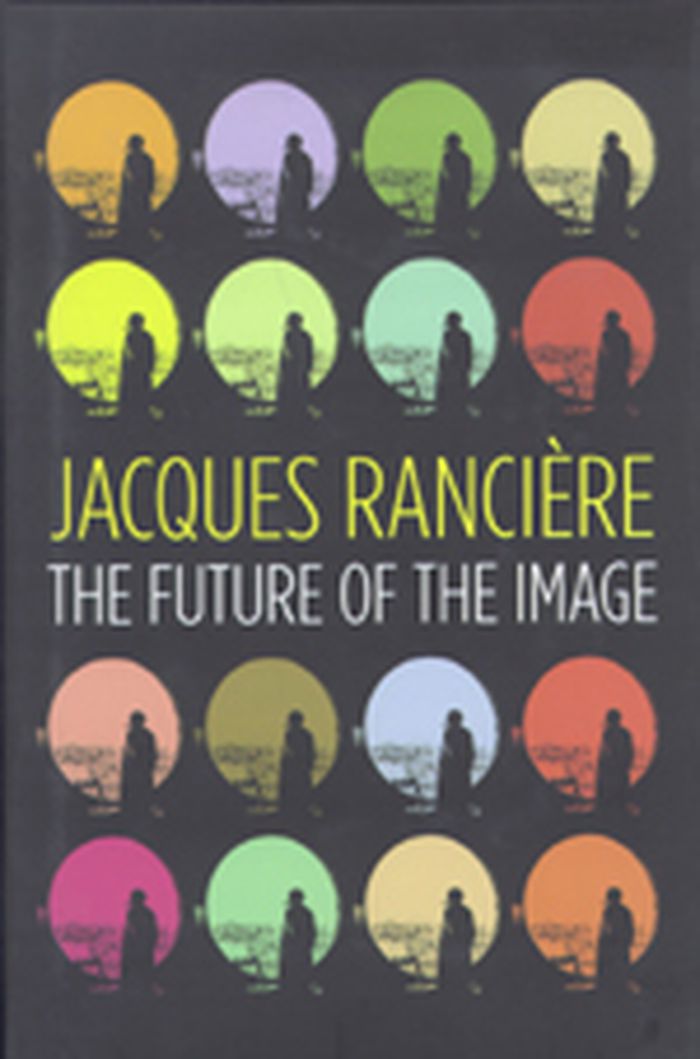
The future of the image
The future of the image
Actions:
Price:
$33.50
(available to order)
Summary:
In "The future of the image", Jacques Rancière develops a fascinating new concept of the image in contemporary art, showing how art and politics have always been intrinsically intertwined. Covering a range of art movements, and thinkers such as Foucault, Deleuze, Adorno, Barthes, Lyotard and Greenberg, Rancière argues that contemporary theorists of the image are suffering(...)
$33.50
(available to order)
Summary:
In "The future of the image", Jacques Rancière develops a fascinating new concept of the image in contemporary art, showing how art and politics have always been intrinsically intertwined. Covering a range of art movements, and thinkers such as Foucault, Deleuze, Adorno, Barthes, Lyotard and Greenberg, Rancière argues that contemporary theorists of the image are suffering(...)
Title:
The future of the image
Actions:
Price:
$33.50
(available to order)
Summary:
In "The future of the image", Jacques Rancière develops a fascinating new concept of the image in contemporary art, showing how art and politics have always been intrinsically intertwined. Covering a range of art movements, and thinkers such as Foucault, Deleuze, Adorno, Barthes, Lyotard and Greenberg, Rancière argues that contemporary theorists of the image are suffering from religious tendencies. He suggests that there is a stark political choice in art : it can either reinforce a radical democracy, or create a new reactionary mysticism. For Rancière there is never a pure art : the aesthetic revolution will always embrace egalitarian ideals.
The future of the image
Actions:
Price:
$33.50
(available to order)
Summary:
In "The future of the image", Jacques Rancière develops a fascinating new concept of the image in contemporary art, showing how art and politics have always been intrinsically intertwined. Covering a range of art movements, and thinkers such as Foucault, Deleuze, Adorno, Barthes, Lyotard and Greenberg, Rancière argues that contemporary theorists of the image are suffering from religious tendencies. He suggests that there is a stark political choice in art : it can either reinforce a radical democracy, or create a new reactionary mysticism. For Rancière there is never a pure art : the aesthetic revolution will always embrace egalitarian ideals.
Form:
books
books
Publication:
June 2007, London, New York
June 2007, London, New York
Subject:
Critical Theory
Critical Theory


