


878 Results
Form:
books
books
Actions:
Price:
$33.95
(available to order)
Summary:
In 'influx & efflux' Jane Bennett pursues a question that was bracketed in her book Vibrant Matter: how to think about human agency in a world teeming with powerful nonhuman influences? 'Influx & efflux'—a phrase borrowed from Whitman's 'Song of Myself'—refers to everyday movements whereby outside influences enter bodies, infuse and confuse their organization, and then(...)
$33.95
(available to order)
Summary:
In 'influx & efflux' Jane Bennett pursues a question that was bracketed in her book Vibrant Matter: how to think about human agency in a world teeming with powerful nonhuman influences? 'Influx & efflux'—a phrase borrowed from Whitman's 'Song of Myself'—refers to everyday movements whereby outside influences enter bodies, infuse and confuse their organization, and then(...)
Title:
Influx & efflux: writing up with Walt Whitman
Actions:
Price:
$33.95
(available to order)
Summary:
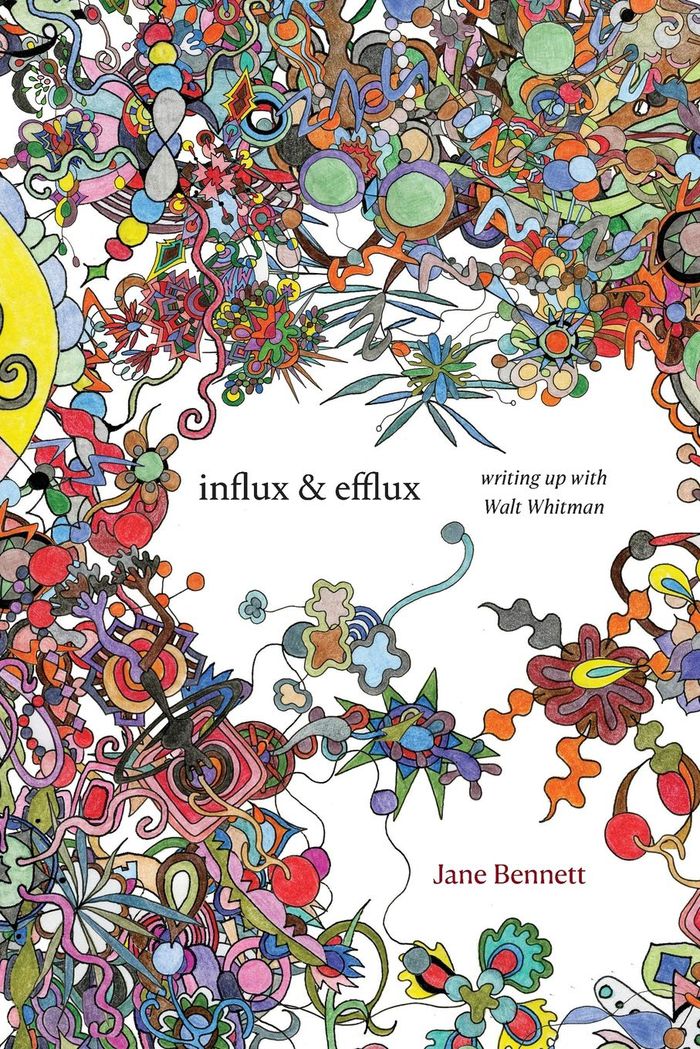
In 'influx & efflux' Jane Bennett pursues a question that was bracketed in her book Vibrant Matter: how to think about human agency in a world teeming with powerful nonhuman influences? 'Influx & efflux'—a phrase borrowed from Whitman's 'Song of Myself'—refers to everyday movements whereby outside influences enter bodies, infuse and confuse their organization, and then exit, themselves having been transformed into something new. How to describe the human efforts involved in that process? What kinds of 'I' and 'we' can live well and act effectively in a world of so many other lively materialities? Drawing upon Whitman, Thoreau, Caillois, Whitehead, and other poetic writers, Bennett links a nonanthropocentric model of self to a radically egalitarian pluralism and also to a syntax and style of writing appropriate to the entangled world in which we live.
Influx & efflux: writing up with Walt Whitman
Actions:
Price:
$33.95
(available to order)
Summary:
In 'influx & efflux' Jane Bennett pursues a question that was bracketed in her book Vibrant Matter: how to think about human agency in a world teeming with powerful nonhuman influences? 'Influx & efflux'—a phrase borrowed from Whitman's 'Song of Myself'—refers to everyday movements whereby outside influences enter bodies, infuse and confuse their organization, and then exit, themselves having been transformed into something new. How to describe the human efforts involved in that process? What kinds of 'I' and 'we' can live well and act effectively in a world of so many other lively materialities? Drawing upon Whitman, Thoreau, Caillois, Whitehead, and other poetic writers, Bennett links a nonanthropocentric model of self to a radically egalitarian pluralism and also to a syntax and style of writing appropriate to the entangled world in which we live.
Form:
books
books
Publication:
May 2020
May 2020
Subject:
Critical Theory
Critical Theory
Form:
books
books
Actions:
Price:
$24.95
(available to order)
Summary:
The historical continuity of spinal catastrophism, traced across multiform encounters between philosophy, psychology, biology, and geology. Drawing on cryptic intimations in the work of J. G. Ballard, Georges Bataille, William Burroughs, André Leroi-Gourhan, Elaine Morgan, and Friedrich Nietzsche, in the late twentieth century Daniel Barker formulated the axioms of(...)
$24.95
(available to order)
Summary:
The historical continuity of spinal catastrophism, traced across multiform encounters between philosophy, psychology, biology, and geology. Drawing on cryptic intimations in the work of J. G. Ballard, Georges Bataille, William Burroughs, André Leroi-Gourhan, Elaine Morgan, and Friedrich Nietzsche, in the late twentieth century Daniel Barker formulated the axioms of(...)
Title:
Spinal Catastrophism: a secret history
Actions:
Price:
$24.95
(available to order)
Summary:
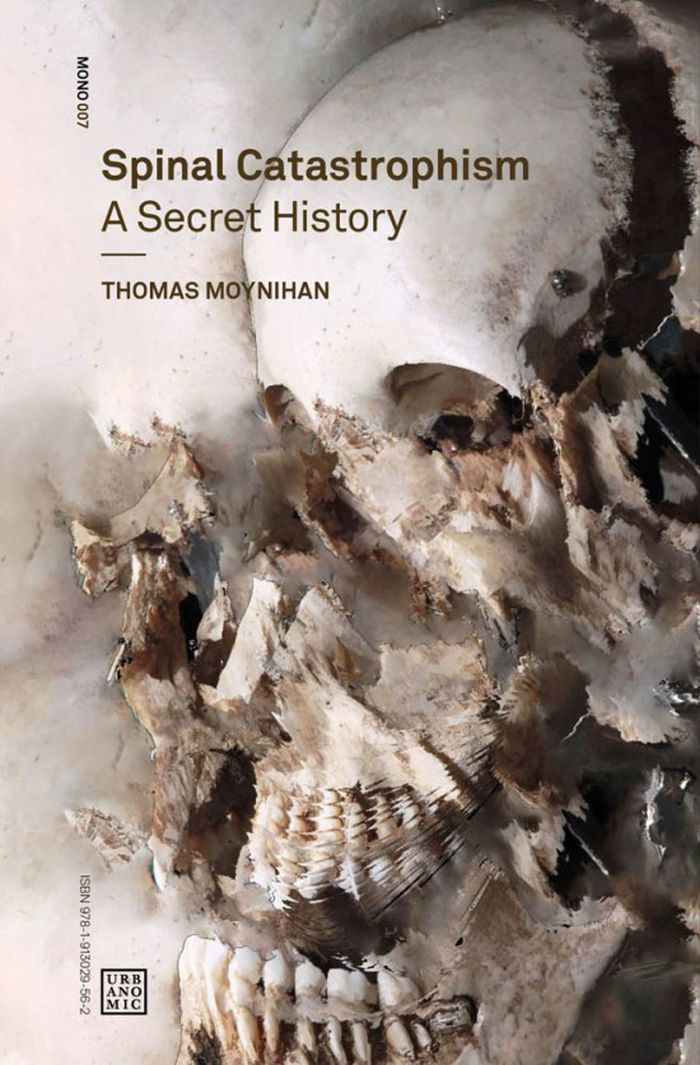
The historical continuity of spinal catastrophism, traced across multiform encounters between philosophy, psychology, biology, and geology. Drawing on cryptic intimations in the work of J. G. Ballard, Georges Bataille, William Burroughs, André Leroi-Gourhan, Elaine Morgan, and Friedrich Nietzsche, in the late twentieth century Daniel Barker formulated the axioms of spinal catastrophism: If human morphology, upright posture, and the possibility of language are the ramified accidents of natural history, then psychic ailments are ultimately afflictions of the spine, which itself is a scale model of biogenetic trauma, a portable map of the catastrophic events that shaped that atrocity exhibition of evolutionary traumata, the sick orthograde talking mammal.
Spinal Catastrophism: a secret history
Actions:
Price:
$24.95
(available to order)
Summary:
The historical continuity of spinal catastrophism, traced across multiform encounters between philosophy, psychology, biology, and geology. Drawing on cryptic intimations in the work of J. G. Ballard, Georges Bataille, William Burroughs, André Leroi-Gourhan, Elaine Morgan, and Friedrich Nietzsche, in the late twentieth century Daniel Barker formulated the axioms of spinal catastrophism: If human morphology, upright posture, and the possibility of language are the ramified accidents of natural history, then psychic ailments are ultimately afflictions of the spine, which itself is a scale model of biogenetic trauma, a portable map of the catastrophic events that shaped that atrocity exhibition of evolutionary traumata, the sick orthograde talking mammal.
Form:
books
books
Publication:
January 2020
January 2020
Subject:
Critical Theory
Critical Theory
Form:
books
books
Title:
Derrida, suppléments
Derrida, suppléments
Actions:
Price:
$43.95
(available to order)
Summary:
Il ne s’agit pas d’ajouter quelque chose à Derrida. Pas non plus de suppléer à des manques chez lui. Rien du double sens de ce mot dont il a fait une de ses signatures conceptuelles. Ces textes écrits au gré des circonstances – colloques, ouvrages collectifs – et au fil de 25 années ne sont ni des études, ni des commentaires, ni des interprétations de la pensée de(...)
$43.95
(available to order)
Summary:
Il ne s’agit pas d’ajouter quelque chose à Derrida. Pas non plus de suppléer à des manques chez lui. Rien du double sens de ce mot dont il a fait une de ses signatures conceptuelles. Ces textes écrits au gré des circonstances – colloques, ouvrages collectifs – et au fil de 25 années ne sont ni des études, ni des commentaires, ni des interprétations de la pensée de(...)
Title:
Derrida, suppléments
Actions:
Price:
$43.95
(available to order)
Summary:
Il ne s’agit pas d’ajouter quelque chose à Derrida. Pas non plus de suppléer à des manques chez lui. Rien du double sens de ce mot dont il a fait une de ses signatures conceptuelles. Ces textes écrits au gré des circonstances – colloques, ouvrages collectifs – et au fil de 25 années ne sont ni des études, ni des commentaires, ni des interprétations de la pensée de Derrida. Ce sont, pour le dire ainsi, des réponses à sa présence.
Derrida, suppléments
Actions:
Price:
$43.95
(available to order)
Summary:
Il ne s’agit pas d’ajouter quelque chose à Derrida. Pas non plus de suppléer à des manques chez lui. Rien du double sens de ce mot dont il a fait une de ses signatures conceptuelles. Ces textes écrits au gré des circonstances – colloques, ouvrages collectifs – et au fil de 25 années ne sont ni des études, ni des commentaires, ni des interprétations de la pensée de Derrida. Ce sont, pour le dire ainsi, des réponses à sa présence.
Form:
books
books
Publication:
January 2019
January 2019
Subject:
Critical Theory
Critical Theory
Form:
books
books
Actions:
Price:
$12.00
(available to order)
Summary:
Sur quoi repose la société de l'Internet? Quels enjeux environnementaux et sociaux soulève le bonheur de la connexion permanente? À quels renoncements, à quels sacrifices mène la numérisation de nos vies? Les technologies se sont multipliées sans véritable délibération sur leurs implications sociétales. Dans ce conditionnement généralisé, nous nous sommes résignés à ce(...)
$12.00
(available to order)
Summary:
Sur quoi repose la société de l'Internet? Quels enjeux environnementaux et sociaux soulève le bonheur de la connexion permanente? À quels renoncements, à quels sacrifices mène la numérisation de nos vies? Les technologies se sont multipliées sans véritable délibération sur leurs implications sociétales. Dans ce conditionnement généralisé, nous nous sommes résignés à ce(...)
Title:
Internet ou le retour à la bougie
Actions:
Price:
$12.00
(available to order)
Summary:
Sur quoi repose la société de l'Internet? Quels enjeux environnementaux et sociaux soulève le bonheur de la connexion permanente? À quels renoncements, à quels sacrifices mène la numérisation de nos vies? Les technologies se sont multipliées sans véritable délibération sur leurs implications sociétales. Dans ce conditionnement généralisé, nous nous sommes résignés à ce que le numérique façonne notre existence. L'ambition de cet essai est d'ouvrir le débat sur ce sujet, mais aussi de faire découvrir des auteurs passionnants (Jacques Ellul, Hartmut Rosa, Philippe Bihouix, Bernard Charbonneau, Jaime Semprun...) afin de prendre la mesure de cette démesure qui semble achever l'expropriation des humains d'eux-mêmes et la destruction du monde vivant. Ce pamphlet, véritable critique radicale de l'Internet et de la société technicienne, se mêle à un récit de vie élaboré à partir d'une observation attentive des transformations de nos vies quotidiennes au travail, dans l'espace social et dans le domaine privé.
Internet ou le retour à la bougie
Actions:
Price:
$12.00
(available to order)
Summary:
Sur quoi repose la société de l'Internet? Quels enjeux environnementaux et sociaux soulève le bonheur de la connexion permanente? À quels renoncements, à quels sacrifices mène la numérisation de nos vies? Les technologies se sont multipliées sans véritable délibération sur leurs implications sociétales. Dans ce conditionnement généralisé, nous nous sommes résignés à ce que le numérique façonne notre existence. L'ambition de cet essai est d'ouvrir le débat sur ce sujet, mais aussi de faire découvrir des auteurs passionnants (Jacques Ellul, Hartmut Rosa, Philippe Bihouix, Bernard Charbonneau, Jaime Semprun...) afin de prendre la mesure de cette démesure qui semble achever l'expropriation des humains d'eux-mêmes et la destruction du monde vivant. Ce pamphlet, véritable critique radicale de l'Internet et de la société technicienne, se mêle à un récit de vie élaboré à partir d'une observation attentive des transformations de nos vies quotidiennes au travail, dans l'espace social et dans le domaine privé.
Form:
books
books
Publication:
February 2020
February 2020
Subject:
Critical Theory
Critical Theory
Form:
books
books

Price:
$23.95
(available in store)
Summary:
Perdre la maison, la laisser derrière, de force ou par choix, c'est bien plus que quitter une coque faite de béton, de bois ou autres matériaux de construction. Cette maison, nous l'avons investie de nos gestes quotidiens, de nos pensées et de nos souvenirs. Nous l'avons modelée à notre image, selon nos goûts et nos besoins. En retour, la maison nous a conféré abri et(...)
$23.95
(available in store)
Summary:
Perdre la maison, la laisser derrière, de force ou par choix, c'est bien plus que quitter une coque faite de béton, de bois ou autres matériaux de construction. Cette maison, nous l'avons investie de nos gestes quotidiens, de nos pensées et de nos souvenirs. Nous l'avons modelée à notre image, selon nos goûts et nos besoins. En retour, la maison nous a conféré abri et(...)
Title:
Perdre la maison : essai sur l'art et le deuil de l'espace habité
Actions:
Price:
$23.95
(available in store)
Summary:
Perdre la maison, la laisser derrière, de force ou par choix, c'est bien plus que quitter une coque faite de béton, de bois ou autres matériaux de construction. Cette maison, nous l'avons investie de nos gestes quotidiens, de nos pensées et de nos souvenirs. Nous l'avons modelée à notre image, selon nos goûts et nos besoins. En retour, la maison nous a conféré abri et sécurité, procurant confort et chaleur, non seulement pour le corps, mais aussi pour l'esprit. Que se passe-t-il dès lors qu'elle est perdue ou quittée ? Cet essai - qui mélange habilement art, architecture, psychanalyse et philosophie - met en scène le deuil du réceptacle de vie qui n'est plus, tout comme cela se fait pour un défunt, puisque la maison est en quelque sorte le double de notre corps. Nécessaire et fascinant temps de transition, afin que puisse s'opérer l'investissement d'un lieu nouveau.
Perdre la maison : essai sur l'art et le deuil de l'espace habité
Actions:
Price:
$23.95
(available in store)
Summary:
Perdre la maison, la laisser derrière, de force ou par choix, c'est bien plus que quitter une coque faite de béton, de bois ou autres matériaux de construction. Cette maison, nous l'avons investie de nos gestes quotidiens, de nos pensées et de nos souvenirs. Nous l'avons modelée à notre image, selon nos goûts et nos besoins. En retour, la maison nous a conféré abri et sécurité, procurant confort et chaleur, non seulement pour le corps, mais aussi pour l'esprit. Que se passe-t-il dès lors qu'elle est perdue ou quittée ? Cet essai - qui mélange habilement art, architecture, psychanalyse et philosophie - met en scène le deuil du réceptacle de vie qui n'est plus, tout comme cela se fait pour un défunt, puisque la maison est en quelque sorte le double de notre corps. Nécessaire et fascinant temps de transition, afin que puisse s'opérer l'investissement d'un lieu nouveau.
Form:
books
books
Publication:
March 2020
March 2020
Subject:
Critical Theory
Critical Theory
Form:
books
books
Price:
$23.00
(available to order)
Summary:
On a visit to Auschwitz-Birkenau, Georges Didi-Huberman tears three pieces of bark from birch trees on the edge of the site. Looking at these pieces after his return home, he sees them as letters, a flood, a path, time, memory, flesh. The bark serves as a springboard to Didi-Huberman’s meditations on his visit, recorded in this spare, poetic, and powerful book. Bark is a(...)
$23.00
(available to order)
Summary:
On a visit to Auschwitz-Birkenau, Georges Didi-Huberman tears three pieces of bark from birch trees on the edge of the site. Looking at these pieces after his return home, he sees them as letters, a flood, a path, time, memory, flesh. The bark serves as a springboard to Didi-Huberman’s meditations on his visit, recorded in this spare, poetic, and powerful book. Bark is a(...)
Title:
Bark
Actions:
Price:
$23.00
(available to order)
Summary:
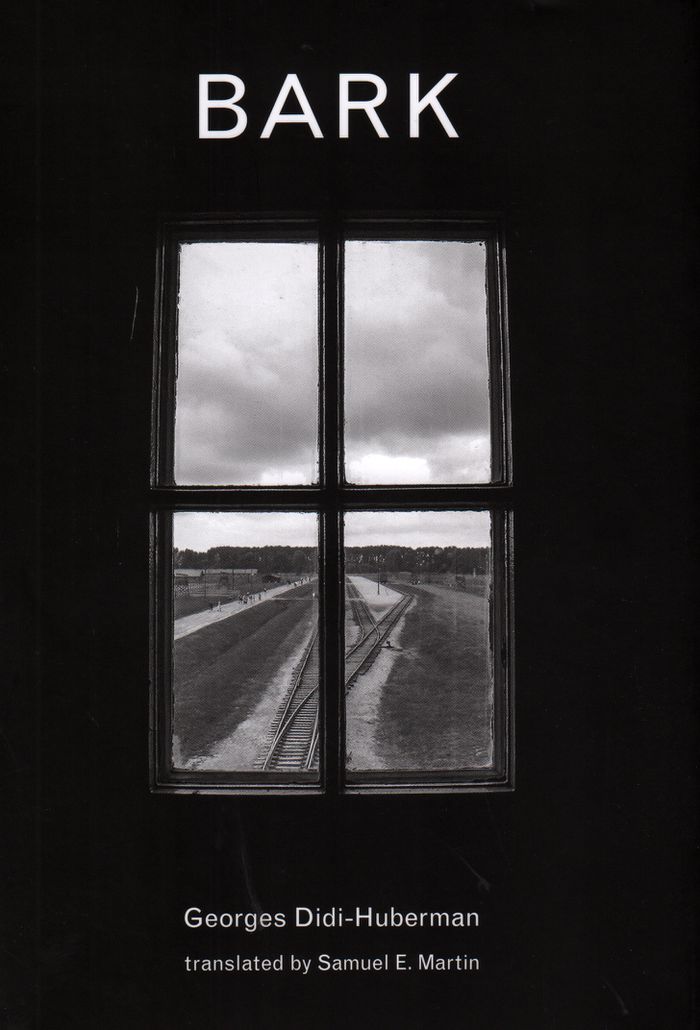
On a visit to Auschwitz-Birkenau, Georges Didi-Huberman tears three pieces of bark from birch trees on the edge of the site. Looking at these pieces after his return home, he sees them as letters, a flood, a path, time, memory, flesh. The bark serves as a springboard to Didi-Huberman’s meditations on his visit, recorded in this spare, poetic, and powerful book. Bark is a personal account, drawing not on the theoretical apparatus of scholarship but on Didi-Huberman’s own history, memory, and knowledge. The text proceeds as a series of reflections, accompanied by Didi-Huberman’s photographs of the visit. The photographs are not meant to be art—Didi-Huberman confesses that he “photographed practically everything without looking”—but approach it nevertheless. Didi-Huberman tells us that his grandparents died at Auschwitz, but his account is more universal than biographical. As he walks from place to place, he observes that in German birches are birken; Birkenau designates the meadow where the birches grow. Didi-Huberman sees and photographs the “reconstructed” execution wall; the floors of the crematorium, forgotten witnesses to killing; and the birch trees, lovely but also resembling prison bars. Taking his own photographs, he thinks of the famous photographs taken in 1944 by a member of the Sonderkommando, the only photographic documentation of the camp before the Germans destroyed it, hoping to hide the evidence of their crimes. Didi-Huberman notices a “bizarre proliferation of white flowers on the exact spot of the cremation pits.” The dead are not departed.
Bark
Actions:
Price:
$23.00
(available to order)
Summary:
On a visit to Auschwitz-Birkenau, Georges Didi-Huberman tears three pieces of bark from birch trees on the edge of the site. Looking at these pieces after his return home, he sees them as letters, a flood, a path, time, memory, flesh. The bark serves as a springboard to Didi-Huberman’s meditations on his visit, recorded in this spare, poetic, and powerful book. Bark is a personal account, drawing not on the theoretical apparatus of scholarship but on Didi-Huberman’s own history, memory, and knowledge. The text proceeds as a series of reflections, accompanied by Didi-Huberman’s photographs of the visit. The photographs are not meant to be art—Didi-Huberman confesses that he “photographed practically everything without looking”—but approach it nevertheless. Didi-Huberman tells us that his grandparents died at Auschwitz, but his account is more universal than biographical. As he walks from place to place, he observes that in German birches are birken; Birkenau designates the meadow where the birches grow. Didi-Huberman sees and photographs the “reconstructed” execution wall; the floors of the crematorium, forgotten witnesses to killing; and the birch trees, lovely but also resembling prison bars. Taking his own photographs, he thinks of the famous photographs taken in 1944 by a member of the Sonderkommando, the only photographic documentation of the camp before the Germans destroyed it, hoping to hide the evidence of their crimes. Didi-Huberman notices a “bizarre proliferation of white flowers on the exact spot of the cremation pits.” The dead are not departed.
Form:
books
books
Publication:
October 2017
October 2017
Subject:
Critical Theory
Critical Theory
Form:
books
books
Actions:
Price:
$41.95
(available to order)
Summary:
This volume from Goldsmiths Press examines the career of the cultural studies pioneer Stuart Hall, investigating his influence and revealing lesser-known facets of his work. These essays evaluate the legacies of his particular brand of cultural studies and demonstrate how other scholars and activists have utilized his thinking in their own research. In her contribution,(...)
$41.95
(available to order)
Summary:
This volume from Goldsmiths Press examines the career of the cultural studies pioneer Stuart Hall, investigating his influence and revealing lesser-known facets of his work. These essays evaluate the legacies of his particular brand of cultural studies and demonstrate how other scholars and activists have utilized his thinking in their own research. In her contribution,(...)
Subject:
Critical Theory
Critical Theory
Publication:
November 2017
November 2017
Title:
Stuart Hall: conversations, projects and legacies
Actions:
Price:
$41.95
(available to order)
Summary:
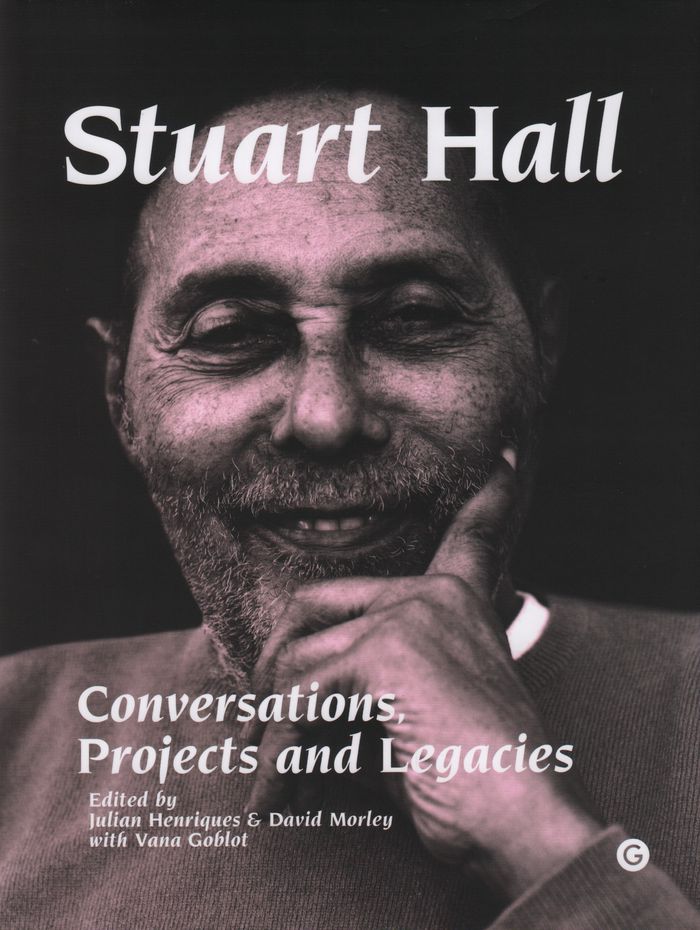
This volume from Goldsmiths Press examines the career of the cultural studies pioneer Stuart Hall, investigating his influence and revealing lesser-known facets of his work. These essays evaluate the legacies of his particular brand of cultural studies and demonstrate how other scholars and activists have utilized his thinking in their own research. In her contribution, Angela Davis argues that the model of politics, ideology, and race initially developed by Hall and his colleagues in England continues to resonate when applied to America’s racialized policing. This book provides a comprehensive look at how, under Hall’s intellectual leadership, British cultural studies transformed itself from a form of “local” knowledge to the international field of study we know today.
Stuart Hall: conversations, projects and legacies
Actions:
Price:
$41.95
(available to order)
Summary:
This volume from Goldsmiths Press examines the career of the cultural studies pioneer Stuart Hall, investigating his influence and revealing lesser-known facets of his work. These essays evaluate the legacies of his particular brand of cultural studies and demonstrate how other scholars and activists have utilized his thinking in their own research. In her contribution, Angela Davis argues that the model of politics, ideology, and race initially developed by Hall and his colleagues in England continues to resonate when applied to America’s racialized policing. This book provides a comprehensive look at how, under Hall’s intellectual leadership, British cultural studies transformed itself from a form of “local” knowledge to the international field of study we know today.
Form:
books
books
Publication:
November 2017
November 2017
Subject:
Critical Theory
Critical Theory
Form:
books
books
Price:
$19.95
(available in store)
Summary:
Now is the phantom chapter to the Invisible Committee's previous book, To Our Friends: a new critique from the anonymous collective that establishes their opposition to the world of capital and its law of labor, addresses current anti-terrorist rhetoric and the ferocious repression that comes with it, and clarifies the end of social democracy and the growing rumors of the(...)
$19.95
(available in store)
Summary:
Now is the phantom chapter to the Invisible Committee's previous book, To Our Friends: a new critique from the anonymous collective that establishes their opposition to the world of capital and its law of labor, addresses current anti-terrorist rhetoric and the ferocious repression that comes with it, and clarifies the end of social democracy and the growing rumors of the(...)
Title:
Now
Actions:
Price:
$19.95
(available in store)
Summary:
Now is the phantom chapter to the Invisible Committee's previous book, To Our Friends: a new critique from the anonymous collective that establishes their opposition to the world of capital and its law of labor, addresses current anti-terrorist rhetoric and the ferocious repression that comes with it, and clarifies the end of social democracy and the growing rumors of the need for a coming “civil war.” Now emerges at a time when the Invisible Committee’s contestation has found echoes throughout the West, with a collapse of trust in the police, an inept weariness on the part of the political system, a growing urgency for opposition, a return of the theme of the Commune, a vanishing distinction between radicals and citizens, and a widespread refusal on the part of the citizen to be governed. As farcical political elections continue to unfold worldwide like a line of tumbling dominoes, and governments increasingly struggle to reclaim a legitimacy that has already slipped out of their grasp, Now clarifies the Invisible Committee’s attitude toward all such elections and their outcome: one of utter indifference. Now proposes a “destituent process” that charts out a different path to be taken, a path of outright refusal that simply ignores elections altogether. It is a path that calls for taking over the world and not taking power, for exploring new forms of life and not a new constitution, and for desertion and silence as alternatives to proclamations and crashes. It is also a call for an unprecedented communism—a communism stronger than nation and country.
Now
Actions:
Price:
$19.95
(available in store)
Summary:
Now is the phantom chapter to the Invisible Committee's previous book, To Our Friends: a new critique from the anonymous collective that establishes their opposition to the world of capital and its law of labor, addresses current anti-terrorist rhetoric and the ferocious repression that comes with it, and clarifies the end of social democracy and the growing rumors of the need for a coming “civil war.” Now emerges at a time when the Invisible Committee’s contestation has found echoes throughout the West, with a collapse of trust in the police, an inept weariness on the part of the political system, a growing urgency for opposition, a return of the theme of the Commune, a vanishing distinction between radicals and citizens, and a widespread refusal on the part of the citizen to be governed. As farcical political elections continue to unfold worldwide like a line of tumbling dominoes, and governments increasingly struggle to reclaim a legitimacy that has already slipped out of their grasp, Now clarifies the Invisible Committee’s attitude toward all such elections and their outcome: one of utter indifference. Now proposes a “destituent process” that charts out a different path to be taken, a path of outright refusal that simply ignores elections altogether. It is a path that calls for taking over the world and not taking power, for exploring new forms of life and not a new constitution, and for desertion and silence as alternatives to proclamations and crashes. It is also a call for an unprecedented communism—a communism stronger than nation and country.
Form:
books
books
Publication:
November 2017
November 2017
Subject:
Critical Theory
Critical Theory
Form:
books
books
Title:
Carceral capitalism
Carceral capitalism
Actions:
Price:
$19.95
(available in store)
Summary:
In this collection of essays in Semiotext(e)’s Intervention series, Jackie Wang examines the contemporary incarceration techniques that have emerged since the 1990s. The essays illustrate various aspects of the carceral continuum, including the biopolitics of juvenile delinquency, predatory policing, the political economy of fees and fines, cybernetic governance, and(...)
$19.95
(available in store)
Summary:
In this collection of essays in Semiotext(e)’s Intervention series, Jackie Wang examines the contemporary incarceration techniques that have emerged since the 1990s. The essays illustrate various aspects of the carceral continuum, including the biopolitics of juvenile delinquency, predatory policing, the political economy of fees and fines, cybernetic governance, and(...)
Title:
Carceral capitalism
Actions:
Price:
$19.95
(available in store)
Summary:
In this collection of essays in Semiotext(e)’s Intervention series, Jackie Wang examines the contemporary incarceration techniques that have emerged since the 1990s. The essays illustrate various aspects of the carceral continuum, including the biopolitics of juvenile delinquency, predatory policing, the political economy of fees and fines, cybernetic governance, and algorithmic policing. Included in this volume is Wang’s influential critique of liberal anti-racist politics, “Against Innocence,” as well as essays on RoboCop, techno-policing, and the aesthetic problem of making invisible forms of power legible.
Carceral capitalism
Actions:
Price:
$19.95
(available in store)
Summary:
In this collection of essays in Semiotext(e)’s Intervention series, Jackie Wang examines the contemporary incarceration techniques that have emerged since the 1990s. The essays illustrate various aspects of the carceral continuum, including the biopolitics of juvenile delinquency, predatory policing, the political economy of fees and fines, cybernetic governance, and algorithmic policing. Included in this volume is Wang’s influential critique of liberal anti-racist politics, “Against Innocence,” as well as essays on RoboCop, techno-policing, and the aesthetic problem of making invisible forms of power legible.
Form:
books
books
Publication:
February 2018
February 2018
Subject:
Critical Theory
Critical Theory
Form:
books
books
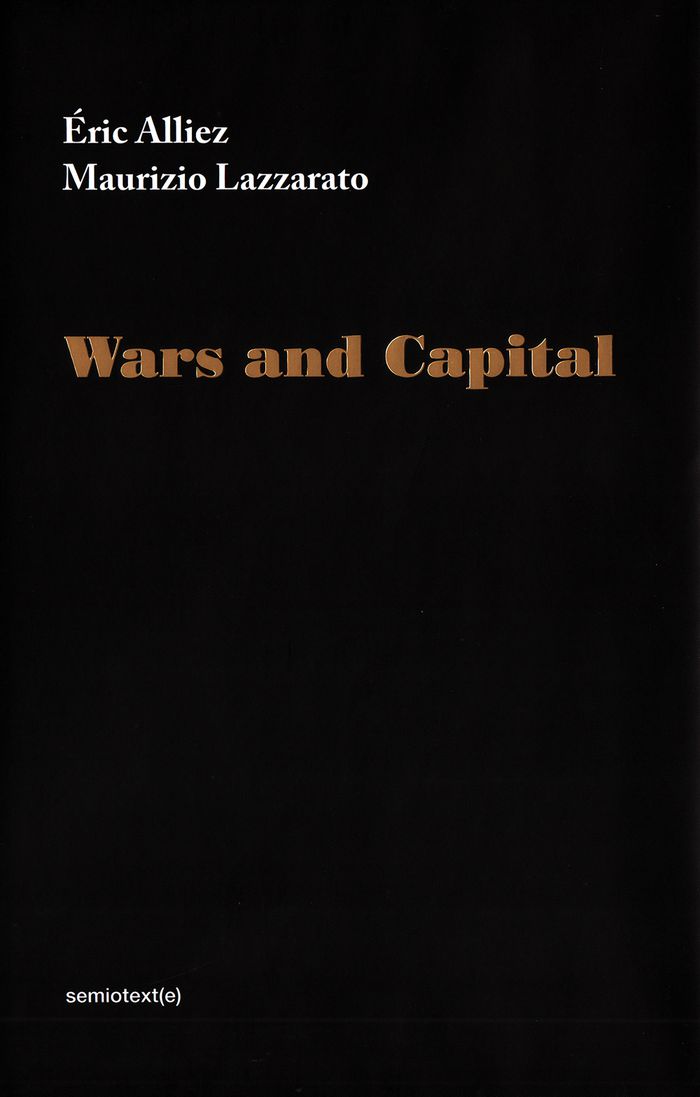
Title:
Wars and capital
Wars and capital
Actions:
Price:
$37.50
(available to order)
Summary:
In "Wars and Capital", Éric Alliez and Maurizio Lazzarato propose a counter-history of capitalism to recover the reality of the wars that are inflicted on us and denied to us. We experience not the ideal war of philosophers, but wars of class, race, sex, and gender; wars of civilization and the environment; wars of subjectivity that are raging within populations and that(...)
$37.50
(available to order)
Summary:
In "Wars and Capital", Éric Alliez and Maurizio Lazzarato propose a counter-history of capitalism to recover the reality of the wars that are inflicted on us and denied to us. We experience not the ideal war of philosophers, but wars of class, race, sex, and gender; wars of civilization and the environment; wars of subjectivity that are raging within populations and that(...)
Title:
Wars and capital
Actions:
Price:
$37.50
(available to order)
Summary:
In "Wars and Capital", Éric Alliez and Maurizio Lazzarato propose a counter-history of capitalism to recover the reality of the wars that are inflicted on us and denied to us. We experience not the ideal war of philosophers, but wars of class, race, sex, and gender; wars of civilization and the environment; wars of subjectivity that are raging within populations and that constitute the secret motor of liberal governmentality. By naming the enemy (refugees, migrants, Muslims), the new fascisms establish their hegemony on the processes of political subjectivation by reducing them to racist, sexist, and xenophobic slogans, fanning the flames of war among the poor and maintaining the total war philosophy of neoliberalism.
Wars and capital
Actions:
Price:
$37.50
(available to order)
Summary:
In "Wars and Capital", Éric Alliez and Maurizio Lazzarato propose a counter-history of capitalism to recover the reality of the wars that are inflicted on us and denied to us. We experience not the ideal war of philosophers, but wars of class, race, sex, and gender; wars of civilization and the environment; wars of subjectivity that are raging within populations and that constitute the secret motor of liberal governmentality. By naming the enemy (refugees, migrants, Muslims), the new fascisms establish their hegemony on the processes of political subjectivation by reducing them to racist, sexist, and xenophobic slogans, fanning the flames of war among the poor and maintaining the total war philosophy of neoliberalism.
Form:
books
books
Publication:
May 2018
May 2018
Subject:
Critical Theory
Critical Theory


