


2221 Results
Form:
books
books
Title:
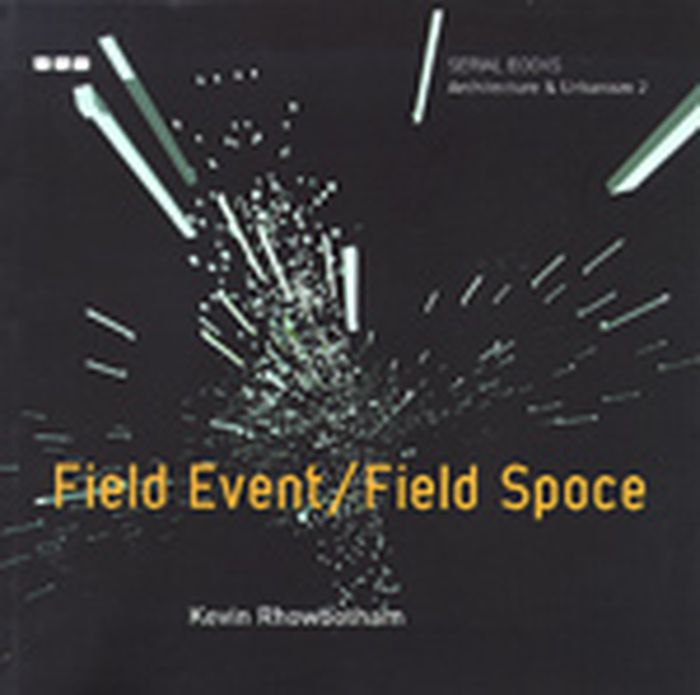
Field event / field space
Field event / field space
Actions:
Price:
$23.95
(available to order)
Summary:
A collection of two and three dimensional studies describing an architecture and urbanism which proceeds from the idea of field or ground as the basis for a radical architecture. Collecting together detailed studies of the urbanisms of central European cities and cities of the former East Block, Field Event/Field Space takes a critical view of contemporary(...)
$23.95
(available to order)
Summary:
A collection of two and three dimensional studies describing an architecture and urbanism which proceeds from the idea of field or ground as the basis for a radical architecture. Collecting together detailed studies of the urbanisms of central European cities and cities of the former East Block, Field Event/Field Space takes a critical view of contemporary(...)
Title:
Field event / field space
Actions:
Price:
$23.95
(available to order)
Summary:
A collection of two and three dimensional studies describing an architecture and urbanism which proceeds from the idea of field or ground as the basis for a radical architecture. Collecting together detailed studies of the urbanisms of central European cities and cities of the former East Block, Field Event/Field Space takes a critical view of contemporary urban ideas, proposing stategies which counter the dominant paradigm of an oppositional Modernism.
Field event / field space
Actions:
Price:
$23.95
(available to order)
Summary:
A collection of two and three dimensional studies describing an architecture and urbanism which proceeds from the idea of field or ground as the basis for a radical architecture. Collecting together detailed studies of the urbanisms of central European cities and cities of the former East Block, Field Event/Field Space takes a critical view of contemporary urban ideas, proposing stategies which counter the dominant paradigm of an oppositional Modernism.
Form:
books
books
Publication:
January 1998, London
January 1998, London
Subject:
Architectural Theory
Architectural Theory
Form:
books
books
Title:
Grace and architecture
Grace and architecture
Actions:
Price:
$31.95
(available in store)
Summary:
Through a constructive way of looking at the timing of architecture, this reference explores the myths of a critical history. The featured ideas are made more concrete and specific by focusing the enquiry on a forgotten building outside Helsinki — Espoonlahti Church — designed by the architects Timo and Tuomo Suomalainen.
$31.95
(available in store)
Summary:
Through a constructive way of looking at the timing of architecture, this reference explores the myths of a critical history. The featured ideas are made more concrete and specific by focusing the enquiry on a forgotten building outside Helsinki — Espoonlahti Church — designed by the architects Timo and Tuomo Suomalainen.
Title:
Grace and architecture
Actions:
Price:
$31.95
(available in store)
Summary:
Through a constructive way of looking at the timing of architecture, this reference explores the myths of a critical history. The featured ideas are made more concrete and specific by focusing the enquiry on a forgotten building outside Helsinki — Espoonlahti Church — designed by the architects Timo and Tuomo Suomalainen.
Grace and architecture
Actions:
Price:
$31.95
(available in store)
Summary:
Through a constructive way of looking at the timing of architecture, this reference explores the myths of a critical history. The featured ideas are made more concrete and specific by focusing the enquiry on a forgotten building outside Helsinki — Espoonlahti Church — designed by the architects Timo and Tuomo Suomalainen.
Form:
books
books
Publication:
February 1998, Helsinki
February 1998, Helsinki
Subject:
Architectural Theory
Architectural Theory
Form:
books
books
Price:
$49.95
(available to order)
Summary:
Fontaine, Viollet-le-Duc, Hankar, Horta, Guimard,Tony Garnier, Le Corbusier.
$49.95
(available to order)
Summary:
Fontaine, Viollet-le-Duc, Hankar, Horta, Guimard,Tony Garnier, Le Corbusier.
Title:
Les bâtisseurs d'avenir : portraits d'architectes XIXe-XXe siècle
Actions:
Price:
$49.95
(available to order)
Summary:
Fontaine, Viollet-le-Duc, Hankar, Horta, Guimard,Tony Garnier, Le Corbusier.
Les bâtisseurs d'avenir : portraits d'architectes XIXe-XXe siècle
Actions:
Price:
$49.95
(available to order)
Summary:
Fontaine, Viollet-le-Duc, Hankar, Horta, Guimard,Tony Garnier, Le Corbusier.
Form:
books
books
Publication:
October 1998, Paris
October 1998, Paris
Subject:
Architectural Theory
Architectural Theory
Form:
books
books
Title:
Terminal architecture
Terminal architecture
Actions:
Price:
$37.50
(available in store)
Summary:
In this book, British architecture critic Martin Pawley argues that design innovation and notions of obsolescence and replacement have been subordinated to rules for the benefit of heritage and tourism, resulting in cities which appear classical or Victorian. He claims that only by redefining our values can architecture continue to evolve and remain innovative.
$37.50
(available in store)
Summary:
In this book, British architecture critic Martin Pawley argues that design innovation and notions of obsolescence and replacement have been subordinated to rules for the benefit of heritage and tourism, resulting in cities which appear classical or Victorian. He claims that only by redefining our values can architecture continue to evolve and remain innovative.
Title:
Terminal architecture
Actions:
Price:
$37.50
(available in store)
Summary:
In this book, British architecture critic Martin Pawley argues that design innovation and notions of obsolescence and replacement have been subordinated to rules for the benefit of heritage and tourism, resulting in cities which appear classical or Victorian. He claims that only by redefining our values can architecture continue to evolve and remain innovative.
Terminal architecture
Actions:
Price:
$37.50
(available in store)
Summary:
In this book, British architecture critic Martin Pawley argues that design innovation and notions of obsolescence and replacement have been subordinated to rules for the benefit of heritage and tourism, resulting in cities which appear classical or Victorian. He claims that only by redefining our values can architecture continue to evolve and remain innovative.
Form:
books
books
Publication:
September 1998, London
September 1998, London
Subject:
Architectural Theory
Architectural Theory
Form:
books
books
Price:
$77.00
(available to order)
Summary:
Introductory essays and selected translations by Samir Younés.
$77.00
(available to order)
Summary:
Introductory essays and selected translations by Samir Younés.
Title:
The historical dictionary of architecture of Quatremère de Quincy
Actions:
Price:
$77.00
(available to order)
Summary:
Introductory essays and selected translations by Samir Younés.
The historical dictionary of architecture of Quatremère de Quincy
Actions:
Price:
$77.00
(available to order)
Summary:
Introductory essays and selected translations by Samir Younés.
Form:
books
books
Publication:
January 1900, London
January 1900, London
Subject:
Architectural Theory
Architectural Theory
Form:
books
books
Actions:
Price:
$60.00
(available to order)
Summary:
Conception and birth, growth and maturity, aging and death--these are important moments in the human life story. They are also stages in the existence of a building, says the author of this unconventional history of the rituals and practices that surround built structures in America. Drawing on sources as varied as Masonic manuals, promotional brochures, janitorial(...)
$60.00
(available to order)
Summary:
Conception and birth, growth and maturity, aging and death--these are important moments in the human life story. They are also stages in the existence of a building, says the author of this unconventional history of the rituals and practices that surround built structures in America. Drawing on sources as varied as Masonic manuals, promotional brochures, janitorial(...)
Title:
Building lives : constructing rites and passages
Actions:
Price:
$60.00
(available to order)
Summary:
Conception and birth, growth and maturity, aging and death--these are important moments in the human life story. They are also stages in the existence of a building, says the author of this unconventional history of the rituals and practices that surround built structures in America. Drawing on sources as varied as Masonic manuals, promotional brochures, janitorial contracts, tourist guidebooks, and religious texts, cultural historian Neil Harris explores the rites of building passage over the past one hundred and fifty years. In this generously illustrated volume, he offers fascinating new insights into the social and cultural roles of buildings. This book suggests that architecture is a performing art as well as a fine art. Harris provides entertaining accounts of building introductions and presentations; celebrations, including groundbreakings, cornerstone layings, dedication ceremonies, and milestone anniversaries; efforts by builders, designers, real estate agents, photographers, and users to endow buildings with personality; debates over the naming of buildings; and attempts to document the erection and aging of buildings. Harris details recent strenuous efforts to prolong building life and vitality, and the increasing concern over "sick" and endangered buildings. Observing the difficulty that people experience in saying goodbye to old buildings that feel like friends, he calls for ceremony to mark the end as well as the beginning of a building's life.
Building lives : constructing rites and passages
Actions:
Price:
$60.00
(available to order)
Summary:
Conception and birth, growth and maturity, aging and death--these are important moments in the human life story. They are also stages in the existence of a building, says the author of this unconventional history of the rituals and practices that surround built structures in America. Drawing on sources as varied as Masonic manuals, promotional brochures, janitorial contracts, tourist guidebooks, and religious texts, cultural historian Neil Harris explores the rites of building passage over the past one hundred and fifty years. In this generously illustrated volume, he offers fascinating new insights into the social and cultural roles of buildings. This book suggests that architecture is a performing art as well as a fine art. Harris provides entertaining accounts of building introductions and presentations; celebrations, including groundbreakings, cornerstone layings, dedication ceremonies, and milestone anniversaries; efforts by builders, designers, real estate agents, photographers, and users to endow buildings with personality; debates over the naming of buildings; and attempts to document the erection and aging of buildings. Harris details recent strenuous efforts to prolong building life and vitality, and the increasing concern over "sick" and endangered buildings. Observing the difficulty that people experience in saying goodbye to old buildings that feel like friends, he calls for ceremony to mark the end as well as the beginning of a building's life.
Form:
books
books
Publication:
October 1998, New Haven
October 1998, New Haven
Subject:
Architectural Theory
Architectural Theory
Form:
books
books
Actions:
Price:
$43.95
(available to order)
Summary:
In a series of cogent and balanced arguments, Harries questions the premises on which architects and theorists have long relied--premises which have contributed to architecture's current identity crisis and marginalization. He first criticizes the aesthetic (...)
$43.95
(available to order)
Summary:
In a series of cogent and balanced arguments, Harries questions the premises on which architects and theorists have long relied--premises which have contributed to architecture's current identity crisis and marginalization. He first criticizes the aesthetic (...)
Title:
The ethical function of architecture
Actions:
Price:
$43.95
(available to order)
Summary:
In a series of cogent and balanced arguments, Harries questions the premises on which architects and theorists have long relied--premises which have contributed to architecture's current identity crisis and marginalization. He first criticizes the aesthetic approach, focusing on the problems of decoration and ornament. He then turns to the language of architecture. If the main task of architecture is indeed interpretation, in just what sense can it be said to speak, and what should it be speaking about? Expanding upon suggestions made by Martin Heidegger, Harries also considers the relationship of building to the idea and meaning of dwelling. Architecture, Harries observes, has a responsibility to community; but its ethical function is inevitably also political. He concludes by examining these seemingly paradoxical functions.
The ethical function of architecture
Actions:
Price:
$43.95
(available to order)
Summary:
In a series of cogent and balanced arguments, Harries questions the premises on which architects and theorists have long relied--premises which have contributed to architecture's current identity crisis and marginalization. He first criticizes the aesthetic approach, focusing on the problems of decoration and ornament. He then turns to the language of architecture. If the main task of architecture is indeed interpretation, in just what sense can it be said to speak, and what should it be speaking about? Expanding upon suggestions made by Martin Heidegger, Harries also considers the relationship of building to the idea and meaning of dwelling. Architecture, Harries observes, has a responsibility to community; but its ethical function is inevitably also political. He concludes by examining these seemingly paradoxical functions.
Form:
books
books
Publication:
September 1998, Cambridge, Mass.
September 1998, Cambridge, Mass.
Subject:
Architectural Theory
Architectural Theory
Form:
books
books
Price:
$52.50
(available to order)
Summary:
To concentrate only on the profession of architecture is to ignore the much larger field of architecture, which structures the entire social universe of the architect and of which architects are only one part. This book critically surveys that field, exposing(...)
$52.50
(available to order)
Summary:
To concentrate only on the profession of architecture is to ignore the much larger field of architecture, which structures the entire social universe of the architect and of which architects are only one part. This book critically surveys that field, exposing(...)
Title:
The favored circle : the social foundations of architectural distinction
Actions:
Price:
$52.50
(available to order)
Summary:
To concentrate only on the profession of architecture is to ignore the much larger field of architecture, which structures the entire social universe of the architect and of which architects are only one part. This book critically surveys that field, exposing many myths and debunking a number of heroes in the process. Using the conceptual apparatus of French sociologist Pierre Bourdieu, Stevens describes the field of architecture on two levels. First, he provides a detailed account of the field as it is at any given point in time, describing the different components and their relationships. Second, he analyzes the dynamics of the field through time, from the Renaissance to the present. He discusses the system of architectural education, as well as everyday aspects such as the competition for reputation. He concludes that throughout history, the most eminent architects have been connected to each other by master-pupil and collegiate relations. These networks, which still exist, provide a mechanism for architectural influence that runs parallel to that of the university-based schools.
The favored circle : the social foundations of architectural distinction
Actions:
Price:
$52.50
(available to order)
Summary:
To concentrate only on the profession of architecture is to ignore the much larger field of architecture, which structures the entire social universe of the architect and of which architects are only one part. This book critically surveys that field, exposing many myths and debunking a number of heroes in the process. Using the conceptual apparatus of French sociologist Pierre Bourdieu, Stevens describes the field of architecture on two levels. First, he provides a detailed account of the field as it is at any given point in time, describing the different components and their relationships. Second, he analyzes the dynamics of the field through time, from the Renaissance to the present. He discusses the system of architectural education, as well as everyday aspects such as the competition for reputation. He concludes that throughout history, the most eminent architects have been connected to each other by master-pupil and collegiate relations. These networks, which still exist, provide a mechanism for architectural influence that runs parallel to that of the university-based schools.
Form:
books
books
Publication:
November 1998, Cambridge, Mass.
November 1998, Cambridge, Mass.
Subject:
Architectural Theory
Architectural Theory
Form:
books
books
Actions:
Price:
$60.00
(available to order)
Summary:
Critical theories such as those of the Frankfurt School of the twenties and thirties gave rise to a complex and sophisticated critique of modernity and modernism. The history and theory of twentieth-century architecture, which developed rather independently of (...)
$60.00
(available to order)
Summary:
Critical theories such as those of the Frankfurt School of the twenties and thirties gave rise to a complex and sophisticated critique of modernity and modernism. The history and theory of twentieth-century architecture, which developed rather independently of (...)
Title:
Architecture and modernity : a critique
Actions:
Price:
$60.00
(available to order)
Summary:
Critical theories such as those of the Frankfurt School of the twenties and thirties gave rise to a complex and sophisticated critique of modernity and modernism. The history and theory of twentieth-century architecture, which developed rather independently of this rich tradition, appear naive and unbalanced in comparison. In this exploration of the relationship between modernity, dwelling, and architecture, Hilde Heynen attempts to bridge this gap between the discourse of the modern movement and cultural theories of modernity. On one hand, she discusses architecture from the perspective of critical theory, and on the other she modifies positions within critical theory by linking them with architecture. She assesses architecture as a cultural field that structures daily life and that embodies major contradictions inherent in modernity, arguing that architecture nonetheless has a certain capacity to adopt a critical stance vis-à-vis modernity. The book provides architectural students with an introduction to the discourse of critical theory. The subchapters on Walter Benjamin, Ernst Bloch, Theodor Adorno, and the Venice School (Tafuri, Dal Co, Cacciari) can be studied independently.
Architecture and modernity : a critique
Actions:
Price:
$60.00
(available to order)
Summary:
Critical theories such as those of the Frankfurt School of the twenties and thirties gave rise to a complex and sophisticated critique of modernity and modernism. The history and theory of twentieth-century architecture, which developed rather independently of this rich tradition, appear naive and unbalanced in comparison. In this exploration of the relationship between modernity, dwelling, and architecture, Hilde Heynen attempts to bridge this gap between the discourse of the modern movement and cultural theories of modernity. On one hand, she discusses architecture from the perspective of critical theory, and on the other she modifies positions within critical theory by linking them with architecture. She assesses architecture as a cultural field that structures daily life and that embodies major contradictions inherent in modernity, arguing that architecture nonetheless has a certain capacity to adopt a critical stance vis-à-vis modernity. The book provides architectural students with an introduction to the discourse of critical theory. The subchapters on Walter Benjamin, Ernst Bloch, Theodor Adorno, and the Venice School (Tafuri, Dal Co, Cacciari) can be studied independently.
Form:
books
books
Publication:
November 1998, Cambridge, Mass.
November 1998, Cambridge, Mass.
Subject:
Architectural Theory
Architectural Theory
Form:
books
books
Title:
The visual culture reader
The visual culture reader
Actions:
Price:
$47.95
(available to order)
Summary:
This book covers a wealth of visual forms including photography, painting, sculpture, fashion, advertising, virtual reality and other electronic imaging systems.
$47.95
(available to order)
Summary:
This book covers a wealth of visual forms including photography, painting, sculpture, fashion, advertising, virtual reality and other electronic imaging systems.
Title:
The visual culture reader
Actions:
Price:
$47.95
(available to order)
Summary:
This book covers a wealth of visual forms including photography, painting, sculpture, fashion, advertising, virtual reality and other electronic imaging systems.
The visual culture reader
Actions:
Price:
$47.95
(available to order)
Summary:
This book covers a wealth of visual forms including photography, painting, sculpture, fashion, advertising, virtual reality and other electronic imaging systems.
Form:
books
books
Publication:
November 1998, London
November 1998, London
Subject:
Architectural Theory
Architectural Theory


