


452 Results
Form:
books
books
Title:
Rêve d'Egypte
Rêve d'Egypte
Actions:
Price:
$58.95
(available to order)
Summary:
Photographies d'Harold Allen, François-Xavier Bouchart et de Mark Ruwedel sur le thème de l'architecture égyptisante.
$58.95
(available to order)
Summary:
Photographies d'Harold Allen, François-Xavier Bouchart et de Mark Ruwedel sur le thème de l'architecture égyptisante.
Title:
Rêve d'Egypte
Actions:
Price:
$58.95
(available to order)
Summary:
Photographies d'Harold Allen, François-Xavier Bouchart et de Mark Ruwedel sur le thème de l'architecture égyptisante.
Rêve d'Egypte
Actions:
Price:
$58.95
(available to order)
Summary:
Photographies d'Harold Allen, François-Xavier Bouchart et de Mark Ruwedel sur le thème de l'architecture égyptisante.
Form:
books
books
Publication:
March 1999, Paris
March 1999, Paris
Subject:
Theory of Photography
Theory of Photography
Form:
books
books
Price:
$145.00
(available to order)
Summary:
Second edition, revised and enlarged.
$145.00
(available to order)
Summary:
Second edition, revised and enlarged.
Title:
An American century of photography : from dry-plate to digital
Actions:
Price:
$145.00
(available to order)
Summary:
Second edition, revised and enlarged.
An American century of photography : from dry-plate to digital
Actions:
Price:
$145.00
(available to order)
Summary:
Second edition, revised and enlarged.
Form:
books
books
Publication:
February 1999, New York
February 1999, New York
Subject:
Theory of Photography
Theory of Photography
Form:
books
books
Price:
$47.50
(available to order)
Summary:
L'ouvrage analyse avec précision l'emprise de la technologie, de la science et de la raison sur l'art. Depuis la photographie jusqu'à la pointe la plus avancée du numérique. Au fil de ce parcours sont abordées sous un nouvel éclairage quelques-unes des grandes questions qui ont jalonné la modernité depuis Baudelaire.
$47.50
(available to order)
Summary:
L'ouvrage analyse avec précision l'emprise de la technologie, de la science et de la raison sur l'art. Depuis la photographie jusqu'à la pointe la plus avancée du numérique. Au fil de ce parcours sont abordées sous un nouvel éclairage quelques-unes des grandes questions qui ont jalonné la modernité depuis Baudelaire.
Title:
La technologie dans l'art : de la photographie à la réalité virtuelle
Actions:
Price:
$47.50
(available to order)
Summary:
L'ouvrage analyse avec précision l'emprise de la technologie, de la science et de la raison sur l'art. Depuis la photographie jusqu'à la pointe la plus avancée du numérique. Au fil de ce parcours sont abordées sous un nouvel éclairage quelques-unes des grandes questions qui ont jalonné la modernité depuis Baudelaire.
La technologie dans l'art : de la photographie à la réalité virtuelle
Actions:
Price:
$47.50
(available to order)
Summary:
L'ouvrage analyse avec précision l'emprise de la technologie, de la science et de la raison sur l'art. Depuis la photographie jusqu'à la pointe la plus avancée du numérique. Au fil de ce parcours sont abordées sous un nouvel éclairage quelques-unes des grandes questions qui ont jalonné la modernité depuis Baudelaire.
Form:
books
books
Publication:
November 1998, Paris
November 1998, Paris
Subject:
Theory of Photography
Theory of Photography
Form:
books
books
Actions:
Price:
$52.50
(available to order)
Summary:
Selections from the Helen Kornblum Collection.
$52.50
(available to order)
Summary:
Selections from the Helen Kornblum Collection.
Subject:
Theory of Photography
Theory of Photography
Publication:
August 1998, Saint Louis
August 1998, Saint Louis
Title:
Defining eye : women photographers of the 20th century
Actions:
Price:
$52.50
(available to order)
Summary:
Selections from the Helen Kornblum Collection.
Defining eye : women photographers of the 20th century
Actions:
Price:
$52.50
(available to order)
Summary:
Selections from the Helen Kornblum Collection.
Form:
books
books
Publication:
August 1998, Saint Louis
August 1998, Saint Louis
Subject:
Theory of Photography
Theory of Photography
Form:
books
books
Actions:
Price:
$39.99
(available to order)
Summary:
Through the intimate and compelling personal stories of American workers in a small factory town, this book explores the meaning of work at the end of the twentieth century. Bill Bamberger took his revealing and powerful photographs during the last four months of operation on the factory floor.
$39.99
(available to order)
Summary:
Through the intimate and compelling personal stories of American workers in a small factory town, this book explores the meaning of work at the end of the twentieth century. Bill Bamberger took his revealing and powerful photographs during the last four months of operation on the factory floor.
Subject:
Theory of Photography
Theory of Photography
Publication:
April 1998, New York
April 1998, New York
Title:
Closing : the life and death of an American factory
Actions:
Price:
$39.99
(available to order)
Summary:
Through the intimate and compelling personal stories of American workers in a small factory town, this book explores the meaning of work at the end of the twentieth century. Bill Bamberger took his revealing and powerful photographs during the last four months of operation on the factory floor.
Closing : the life and death of an American factory
Actions:
Price:
$39.99
(available to order)
Summary:
Through the intimate and compelling personal stories of American workers in a small factory town, this book explores the meaning of work at the end of the twentieth century. Bill Bamberger took his revealing and powerful photographs during the last four months of operation on the factory floor.
Form:
books
books
Publication:
April 1998, New York
April 1998, New York
Subject:
Theory of Photography
Theory of Photography
Form:
books
books
Actions:
Price:
$91.00
(available to order)
Summary:
This book exlores the humourous commentary about photography that emerged in the medium's first seventy-five years, providing a panorama of photographic comedy in its many aspects, both pictorial and literary.
$91.00
(available to order)
Summary:
This book exlores the humourous commentary about photography that emerged in the medium's first seventy-five years, providing a panorama of photographic comedy in its many aspects, both pictorial and literary.
Subject:
Theory of Photography
Theory of Photography
Publication:
March 1998, University Park, Penn.
March 1998, University Park, Penn.
Title:
Positive pleasures : early photography and humor
Actions:
Price:
$91.00
(available to order)
Summary:
This book exlores the humourous commentary about photography that emerged in the medium's first seventy-five years, providing a panorama of photographic comedy in its many aspects, both pictorial and literary.
Positive pleasures : early photography and humor
Actions:
Price:
$91.00
(available to order)
Summary:
This book exlores the humourous commentary about photography that emerged in the medium's first seventy-five years, providing a panorama of photographic comedy in its many aspects, both pictorial and literary.
Form:
books
books
Publication:
March 1998, University Park, Penn.
March 1998, University Park, Penn.
Subject:
Theory of Photography
Theory of Photography
Form:
books
books
Price:
$98.00
(available to order)
Summary:
"Les photographies de Julian Rosefeldt et Piero Steinle illustrent la fin de l'espace réel au profit de l'instantanéité du temps réel. Temps réel de la prise de vue, qui précède celui de l'espace virtuel du monde de demain". Paul Virilio
$98.00
(available to order)
Summary:
"Les photographies de Julian Rosefeldt et Piero Steinle illustrent la fin de l'espace réel au profit de l'instantanéité du temps réel. Temps réel de la prise de vue, qui précède celui de l'espace virtuel du monde de demain". Paul Virilio
Subject:
Theory of Photography
Theory of Photography
Publication:
November 1997, Paris
November 1997, Paris
Title:
Paris : Les cathédrales inconnues, espaces vides dans l'ombre de la ville
Actions:
Price:
$98.00
(available to order)
Summary:
"Les photographies de Julian Rosefeldt et Piero Steinle illustrent la fin de l'espace réel au profit de l'instantanéité du temps réel. Temps réel de la prise de vue, qui précède celui de l'espace virtuel du monde de demain". Paul Virilio
Paris : Les cathédrales inconnues, espaces vides dans l'ombre de la ville
Actions:
Price:
$98.00
(available to order)
Summary:
"Les photographies de Julian Rosefeldt et Piero Steinle illustrent la fin de l'espace réel au profit de l'instantanéité du temps réel. Temps réel de la prise de vue, qui précède celui de l'espace virtuel du monde de demain". Paul Virilio
Form:
books
books
Publication:
November 1997, Paris
November 1997, Paris
Subject:
Theory of Photography
Theory of Photography
Form:
books
books
Actions:
Price:
$30.00
(available to order)
Summary:
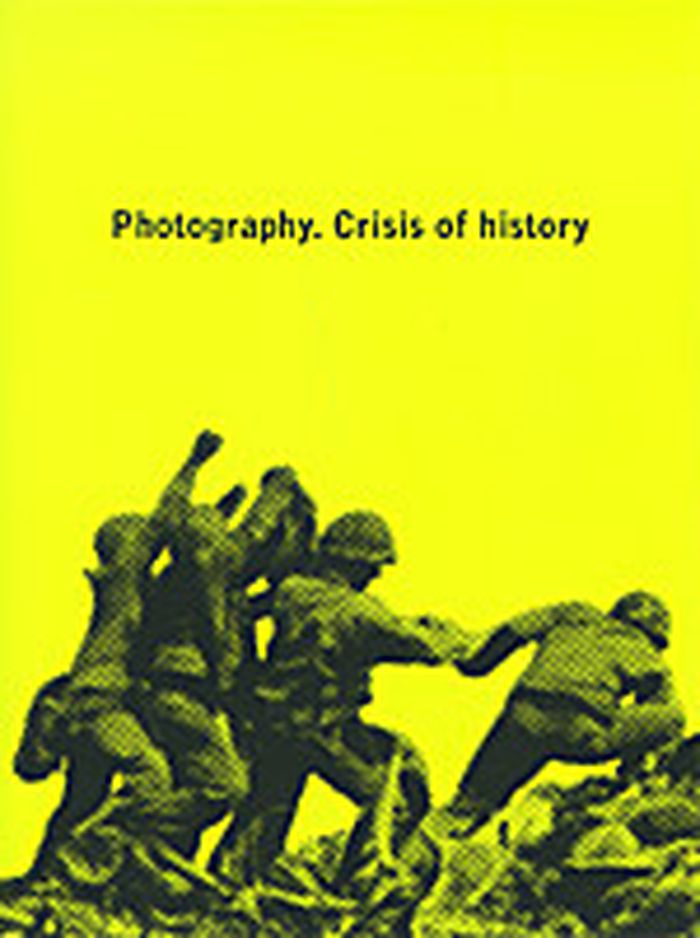
In this book an international group of specialist historians, critics and photographers revise the dominant models on which our knowledge of the history of photography has been based and set out a number of possible alternatives.
$30.00
(available to order)
Summary:
In this book an international group of specialist historians, critics and photographers revise the dominant models on which our knowledge of the history of photography has been based and set out a number of possible alternatives.
Title:
Photography : crisis of history
Actions:
Price:
$30.00
(available to order)
Summary:
In this book an international group of specialist historians, critics and photographers revise the dominant models on which our knowledge of the history of photography has been based and set out a number of possible alternatives.
Photography : crisis of history
Actions:
Price:
$30.00
(available to order)
Summary:
In this book an international group of specialist historians, critics and photographers revise the dominant models on which our knowledge of the history of photography has been based and set out a number of possible alternatives.
Form:
books
books
Publication:
March 2001, Barcelona
March 2001, Barcelona
Subject:
Theory of Photography
Theory of Photography
Form:
books
books
Price:
$74.95
(available to order)
Summary:
"The great wide open" focuses on photographic concepts of the "panoramic," or the wide-angled view, tracing how this specific form of visual representation amplified the idea of the American West as a supposedly virgin and sparsely populated land of endless resources, and an ideal landscape for American enterprise.
$74.95
(available to order)
Summary:
"The great wide open" focuses on photographic concepts of the "panoramic," or the wide-angled view, tracing how this specific form of visual representation amplified the idea of the American West as a supposedly virgin and sparsely populated land of endless resources, and an ideal landscape for American enterprise.
Subject:
Theory of Photography
Theory of Photography
Publication:
June 2001, London
June 2001, London
Title:
The great wide open : panoramic photographs of the American West
Actions:
Price:
$74.95
(available to order)
Summary:
"The great wide open" focuses on photographic concepts of the "panoramic," or the wide-angled view, tracing how this specific form of visual representation amplified the idea of the American West as a supposedly virgin and sparsely populated land of endless resources, and an ideal landscape for American enterprise.
The great wide open : panoramic photographs of the American West
Actions:
Price:
$74.95
(available to order)
Summary:
"The great wide open" focuses on photographic concepts of the "panoramic," or the wide-angled view, tracing how this specific form of visual representation amplified the idea of the American West as a supposedly virgin and sparsely populated land of endless resources, and an ideal landscape for American enterprise.
Form:
books
books
Publication:
June 2001, London
June 2001, London
Subject:
Theory of Photography
Theory of Photography
Form:
books
books
Actions:
Price:
$52.50
(available to order)
Summary:
In "Each Wild Idea", Geoffrey Batchen explores a wide range of photographic subjects, from the timing of the medium's invention to the various implications of cyberculture. Along the way, he reflects on contemporary art photography, the role of the vernacular in (...)
$52.50
(available to order)
Summary:
In "Each Wild Idea", Geoffrey Batchen explores a wide range of photographic subjects, from the timing of the medium's invention to the various implications of cyberculture. Along the way, he reflects on contemporary art photography, the role of the vernacular in (...)
Title:
Each wild idea : writing, photography, history
Actions:
Price:
$52.50
(available to order)
Summary:
In "Each Wild Idea", Geoffrey Batchen explores a wide range of photographic subjects, from the timing of the medium's invention to the various implications of cyberculture. Along the way, he reflects on contemporary art photography, the role of the vernacular in photography's history, and the Australianness of Australian photography. The essays all focus on a consideration of specific photographs--from a humble combination of baby photos and bronzed booties to a masterwork by Alfred Stieglitz. Although Batchen views each photograph within the context of broader social and political forces, he also engages its own distinctive formal attributes. In short, he sees photography as something that is simultaneously material and cultural. In an effort to evoke the lived experience of history, he frequently relies on sheer description as the mode of analysis, insisting that we look right at--rather than beyond--the photograph being discussed. A constant theme throughout the book is the question of photography's past, present, and future identity.
Each wild idea : writing, photography, history
Actions:
Price:
$52.50
(available to order)
Summary:
In "Each Wild Idea", Geoffrey Batchen explores a wide range of photographic subjects, from the timing of the medium's invention to the various implications of cyberculture. Along the way, he reflects on contemporary art photography, the role of the vernacular in photography's history, and the Australianness of Australian photography. The essays all focus on a consideration of specific photographs--from a humble combination of baby photos and bronzed booties to a masterwork by Alfred Stieglitz. Although Batchen views each photograph within the context of broader social and political forces, he also engages its own distinctive formal attributes. In short, he sees photography as something that is simultaneously material and cultural. In an effort to evoke the lived experience of history, he frequently relies on sheer description as the mode of analysis, insisting that we look right at--rather than beyond--the photograph being discussed. A constant theme throughout the book is the question of photography's past, present, and future identity.
Form:
books
books
Publication:
March 2001, Cambridge
March 2001, Cambridge
Subject:
Theory of Photography
Theory of Photography


