


1923 Results
Form:
books
books

Actions:
Price:
$72.95
(available to order)
Summary:
Longtemps un épiphénomène, les gated communities -enclaves résidentielles privées protégées par des murs ou grilles et à l'entrée réservée aux seuls résidents ou leurs invités - prospèrent dans le monde entier. Elles ne relèvent plus d'une aberration urbaine ou de simples «ghettos pour riches», mais incarnent l'aboutissement d'une évolution, peut-être inexorable, de la(...)
$72.95
(available to order)
Summary:
Longtemps un épiphénomène, les gated communities -enclaves résidentielles privées protégées par des murs ou grilles et à l'entrée réservée aux seuls résidents ou leurs invités - prospèrent dans le monde entier. Elles ne relèvent plus d'une aberration urbaine ou de simples «ghettos pour riches», mais incarnent l'aboutissement d'une évolution, peut-être inexorable, de la(...)
Title:
Prisonniers volontaires du rêve américain
Actions:
Price:
$72.95
(available to order)
Summary:
Longtemps un épiphénomène, les gated communities -enclaves résidentielles privées protégées par des murs ou grilles et à l'entrée réservée aux seuls résidents ou leurs invités - prospèrent dans le monde entier. Elles ne relèvent plus d'une aberration urbaine ou de simples «ghettos pour riches», mais incarnent l'aboutissement d'une évolution, peut-être inexorable, de la ville contemporaine où la mixité et l'hétérotopie deviennent l'exception. Observant Los Angeles - the Wonder City of America - l'ouvrage éclaire les conditions d'apparition du phénomène : étalement, insécurité, ségrégation raciale ou sociale, hégémonie du marketing, privatisation de l'espace public... Dans l'environnement incertain des mégapoles où tout est démesuré, sans qualité, et l'habitant un être nomade, le salut apparaît dans de petites communautés homogènes, où la réminiscence du village le dispute au modèle du parc à thèmes. Parcs, campus, gated communities et autres enclaves privées, autarciques, structurées en réseau, forment l'alternative à la ville traditionnelle. Partout, le domaine commun, celui de l'espace civique partagé et libre, se voit remplacé par des territoires morcelés, repliés sur eux, " contrôlés " : celui des gangs et des exclus ou celui des tenants du rêve américain.
Prisonniers volontaires du rêve américain
Actions:
Price:
$72.95
(available to order)
Summary:
Longtemps un épiphénomène, les gated communities -enclaves résidentielles privées protégées par des murs ou grilles et à l'entrée réservée aux seuls résidents ou leurs invités - prospèrent dans le monde entier. Elles ne relèvent plus d'une aberration urbaine ou de simples «ghettos pour riches», mais incarnent l'aboutissement d'une évolution, peut-être inexorable, de la ville contemporaine où la mixité et l'hétérotopie deviennent l'exception. Observant Los Angeles - the Wonder City of America - l'ouvrage éclaire les conditions d'apparition du phénomène : étalement, insécurité, ségrégation raciale ou sociale, hégémonie du marketing, privatisation de l'espace public... Dans l'environnement incertain des mégapoles où tout est démesuré, sans qualité, et l'habitant un être nomade, le salut apparaît dans de petites communautés homogènes, où la réminiscence du village le dispute au modèle du parc à thèmes. Parcs, campus, gated communities et autres enclaves privées, autarciques, structurées en réseau, forment l'alternative à la ville traditionnelle. Partout, le domaine commun, celui de l'espace civique partagé et libre, se voit remplacé par des territoires morcelés, repliés sur eux, " contrôlés " : celui des gangs et des exclus ou celui des tenants du rêve américain.
Form:
books
books
Publication:
January 2007, Paris
January 2007, Paris
Subject:
Urban Theory
Urban Theory
Form:
books
books
Actions:
Price:
$23.95
(available to order)
Summary:
"Lots of parking" examines a neglected aspect of this rise of the automobile: the impact on America not of cars in motion but of cars at rest. While most studies have tended to focus on highway construction and engineering improvements to accommodate increasing flow and the desire for speed, John A. Jakle and Keith A. Sculle examine a fundamental feature of the urban,(...)
$23.95
(available to order)
Summary:
"Lots of parking" examines a neglected aspect of this rise of the automobile: the impact on America not of cars in motion but of cars at rest. While most studies have tended to focus on highway construction and engineering improvements to accommodate increasing flow and the desire for speed, John A. Jakle and Keith A. Sculle examine a fundamental feature of the urban,(...)
Subject:
Urban Theory
Urban Theory
Publication:
July 2005, Charlottesville / London
July 2005, Charlottesville / London
Title:
Lots of parking : land use in a car culture
Actions:
Price:
$23.95
(available to order)
Summary:
"Lots of parking" examines a neglected aspect of this rise of the automobile: the impact on America not of cars in motion but of cars at rest. While most studies have tended to focus on highway construction and engineering improvements to accommodate increasing flow and the desire for speed, John A. Jakle and Keith A. Sculle examine a fundamental feature of the urban, and suburban, scene—the parking lot. Their lively and exhaustive exploration traces the history of parking from the curbside to the rise of public and commercial parking lots and garages and the concomitant demolition of the old pedestrian-oriented urban infrastructure. In an accessible style enhanced by a range of interesting and unusual illustrations, Jakle and Sculle discuss the role of parking in downtown revitalization efforts and, by contrast, its role in the promotion of outlying suburban shopping districts and its incorporation into our neighborhoods and residences.
Lots of parking : land use in a car culture
Actions:
Price:
$23.95
(available to order)
Summary:
"Lots of parking" examines a neglected aspect of this rise of the automobile: the impact on America not of cars in motion but of cars at rest. While most studies have tended to focus on highway construction and engineering improvements to accommodate increasing flow and the desire for speed, John A. Jakle and Keith A. Sculle examine a fundamental feature of the urban, and suburban, scene—the parking lot. Their lively and exhaustive exploration traces the history of parking from the curbside to the rise of public and commercial parking lots and garages and the concomitant demolition of the old pedestrian-oriented urban infrastructure. In an accessible style enhanced by a range of interesting and unusual illustrations, Jakle and Sculle discuss the role of parking in downtown revitalization efforts and, by contrast, its role in the promotion of outlying suburban shopping districts and its incorporation into our neighborhoods and residences.
Form:
books
books
Publication:
July 2005, Charlottesville / London
July 2005, Charlottesville / London
Subject:
Urban Theory
Urban Theory
Form:
books
books
Title:
Planet of slums
Planet of slums
Actions:
Price:
$34.00
(available to order)
Summary:
From the sprawling barricadas of Lima to the garbage hills of Manila, urbanization has been disconnected from industrialization, even economic growth. Davis portrays a vast humanity warehoused in shantytowns and exiled from the formal world economy. He argues that the rise of this informal urban proletariat is a wholly original development unforeseen by either classical(...)
$34.00
(available to order)
Summary:
From the sprawling barricadas of Lima to the garbage hills of Manila, urbanization has been disconnected from industrialization, even economic growth. Davis portrays a vast humanity warehoused in shantytowns and exiled from the formal world economy. He argues that the rise of this informal urban proletariat is a wholly original development unforeseen by either classical(...)
Title:
Planet of slums
Actions:
Price:
$34.00
(available to order)
Summary:
From the sprawling barricadas of Lima to the garbage hills of Manila, urbanization has been disconnected from industrialization, even economic growth. Davis portrays a vast humanity warehoused in shantytowns and exiled from the formal world economy. He argues that the rise of this informal urban proletariat is a wholly original development unforeseen by either classical Marxism or neo-liberal theory
Planet of slums
Actions:
Price:
$34.00
(available to order)
Summary:
From the sprawling barricadas of Lima to the garbage hills of Manila, urbanization has been disconnected from industrialization, even economic growth. Davis portrays a vast humanity warehoused in shantytowns and exiled from the formal world economy. He argues that the rise of this informal urban proletariat is a wholly original development unforeseen by either classical Marxism or neo-liberal theory
Form:
books
books
Publication:
March 2006, New York
March 2006, New York
Subject:
Urban Theory
Urban Theory
Form:
books
books
Actions:
Price:
$29.95
(available to order)
Summary:
L'ouvrage propose une promenade dans les œuvres majeures de Renzo Piano, étudiées du point de vue de leur impact urbain, avec une accentuation sur la Cité internationale de Lyon, une balise de qualité entre fleuve et parc, nouvelle polarité et pièce urbaine, innovante à bien des égards : au-delà de sa réussite plastique, elle illustre de façon exemplaire la continuité(...)
$29.95
(available to order)
Summary:
L'ouvrage propose une promenade dans les œuvres majeures de Renzo Piano, étudiées du point de vue de leur impact urbain, avec une accentuation sur la Cité internationale de Lyon, une balise de qualité entre fleuve et parc, nouvelle polarité et pièce urbaine, innovante à bien des égards : au-delà de sa réussite plastique, elle illustre de façon exemplaire la continuité(...)
Subject:
Urban Theory
Urban Theory
Publication:
July 2005, Paris
July 2005, Paris
Title:
Penser la ville heureuse : Renzo Piano
Actions:
Price:
$29.95
(available to order)
Summary:
L'ouvrage propose une promenade dans les œuvres majeures de Renzo Piano, étudiées du point de vue de leur impact urbain, avec une accentuation sur la Cité internationale de Lyon, une balise de qualité entre fleuve et parc, nouvelle polarité et pièce urbaine, innovante à bien des égards : au-delà de sa réussite plastique, elle illustre de façon exemplaire la continuité politique nécessaire à la concrétisation d'un projet urbain ambitieux, la créativité et le professionnalisme tenace de ses concepteurs comme de ses maîtres d'ouvrage, toutes conditions indispensables à la fabrication d'une ville heureuse. Préface de Gilles de Robien.
Penser la ville heureuse : Renzo Piano
Actions:
Price:
$29.95
(available to order)
Summary:
L'ouvrage propose une promenade dans les œuvres majeures de Renzo Piano, étudiées du point de vue de leur impact urbain, avec une accentuation sur la Cité internationale de Lyon, une balise de qualité entre fleuve et parc, nouvelle polarité et pièce urbaine, innovante à bien des égards : au-delà de sa réussite plastique, elle illustre de façon exemplaire la continuité politique nécessaire à la concrétisation d'un projet urbain ambitieux, la créativité et le professionnalisme tenace de ses concepteurs comme de ses maîtres d'ouvrage, toutes conditions indispensables à la fabrication d'une ville heureuse. Préface de Gilles de Robien.
Form:
books
books
Publication:
July 2005, Paris
July 2005, Paris
Subject:
Urban Theory
Urban Theory
Form:
books
books
Actions:
Price:
$65.00
(available to order)
Summary:
What makes a good city? This question has long preoccupied groups interested and involved in the making and remaking of city spaces. In "The moral economy of cities", Evelyn S. Ruppert contends that the vision of the ‘good city’ embraced by professionals in the business of city making recognizes the interests of a dominant public, namely middle class consumers, office(...)
$65.00
(available to order)
Summary:
What makes a good city? This question has long preoccupied groups interested and involved in the making and remaking of city spaces. In "The moral economy of cities", Evelyn S. Ruppert contends that the vision of the ‘good city’ embraced by professionals in the business of city making recognizes the interests of a dominant public, namely middle class consumers, office(...)
Title:
The moral economy of cities : shaping good citizens
Actions:
Price:
$65.00
(available to order)
Summary:
What makes a good city? This question has long preoccupied groups interested and involved in the making and remaking of city spaces. In "The moral economy of cities", Evelyn S. Ruppert contends that the vision of the ‘good city’ embraced by professionals in the business of city making recognizes the interests of a dominant public, namely middle class consumers, office workers, tourists, and families. This vision stigmatizes certain members of the public like street youth, panhandlers, discount-and low-income shoppers, and the language used to extol the virtues of the good city inherently moralizes social conduct in the city. Using the redevelopment of the Yonge-Dundas intersection in downtown Toronto in the mid-1990s as a case study, Ruppert examines the language of planners, urban designers, architects, and marketing analysts to reveal the extent to which moralization legitimizes these professions in the public eye and buttresses the very projects they produce. Ruppert’s conclusion that economic practices are not free from moral investment encourages the considerable task of re-examining the implications of city planning and development worldwide.
The moral economy of cities : shaping good citizens
Actions:
Price:
$65.00
(available to order)
Summary:
What makes a good city? This question has long preoccupied groups interested and involved in the making and remaking of city spaces. In "The moral economy of cities", Evelyn S. Ruppert contends that the vision of the ‘good city’ embraced by professionals in the business of city making recognizes the interests of a dominant public, namely middle class consumers, office workers, tourists, and families. This vision stigmatizes certain members of the public like street youth, panhandlers, discount-and low-income shoppers, and the language used to extol the virtues of the good city inherently moralizes social conduct in the city. Using the redevelopment of the Yonge-Dundas intersection in downtown Toronto in the mid-1990s as a case study, Ruppert examines the language of planners, urban designers, architects, and marketing analysts to reveal the extent to which moralization legitimizes these professions in the public eye and buttresses the very projects they produce. Ruppert’s conclusion that economic practices are not free from moral investment encourages the considerable task of re-examining the implications of city planning and development worldwide.
Form:
books
books
Publication:
October 2005, Toronto
October 2005, Toronto
Subject:
Urban Theory
Urban Theory
Form:
books
books
Title:
City economics
City economics
Actions:
Price:
$74.95
(available to order)
Summary:
This introductory textbook on the economics of cities is aimed at students of urban and regional policy as well as of undergraduate economics. It deals with standard topics, including automobiles, mass transit, pollution, housing, and education but it also discusses non-standard topics such as segregation, water supply, sewers, garbage, fire prevention, housing codes,(...)
$74.95
(available to order)
Summary:
This introductory textbook on the economics of cities is aimed at students of urban and regional policy as well as of undergraduate economics. It deals with standard topics, including automobiles, mass transit, pollution, housing, and education but it also discusses non-standard topics such as segregation, water supply, sewers, garbage, fire prevention, housing codes,(...)
Title:
City economics
Actions:
Price:
$74.95
(available to order)
Summary:
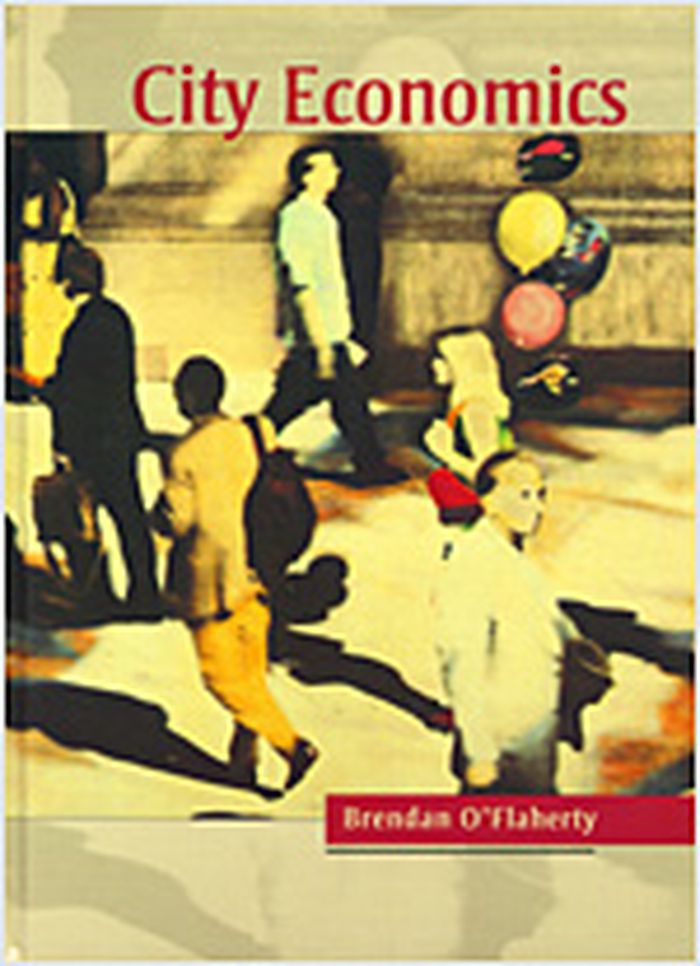
This introductory textbook on the economics of cities is aimed at students of urban and regional policy as well as of undergraduate economics. It deals with standard topics, including automobiles, mass transit, pollution, housing, and education but it also discusses non-standard topics such as segregation, water supply, sewers, garbage, fire prevention, housing codes, homelessness, crime, illicit drugs, and economic development.
City economics
Actions:
Price:
$74.95
(available to order)
Summary:
This introductory textbook on the economics of cities is aimed at students of urban and regional policy as well as of undergraduate economics. It deals with standard topics, including automobiles, mass transit, pollution, housing, and education but it also discusses non-standard topics such as segregation, water supply, sewers, garbage, fire prevention, housing codes, homelessness, crime, illicit drugs, and economic development.
Form:
books
books
Publication:
October 2005, Cambridge, Mass.
October 2005, Cambridge, Mass.
Subject:
Urban Theory
Urban Theory
Form:
books
books
Actions:
Price:
$17.50
(available to order)
Summary:
The product of 4 years of work from "In the field", an artists collective that explores the complex social constellations around urban land use issues. "In the field" works towards a broader understanding of what it means to creatively generate public spaces and autonomous neighborhood planning. They share ideas and take action inhabiting, transforming, and opening up(...)
$17.50
(available to order)
Summary:
The product of 4 years of work from "In the field", an artists collective that explores the complex social constellations around urban land use issues. "In the field" works towards a broader understanding of what it means to creatively generate public spaces and autonomous neighborhood planning. They share ideas and take action inhabiting, transforming, and opening up(...)
Title:
Belltown paradise / Making their own plans
Actions:
Price:
$17.50
(available to order)
Summary:
The product of 4 years of work from "In the field", an artists collective that explores the complex social constellations around urban land use issues. "In the field" works towards a broader understanding of what it means to creatively generate public spaces and autonomous neighborhood planning. They share ideas and take action inhabiting, transforming, and opening up spaces around the world to new possibilities.
Belltown paradise / Making their own plans
Actions:
Price:
$17.50
(available to order)
Summary:
The product of 4 years of work from "In the field", an artists collective that explores the complex social constellations around urban land use issues. "In the field" works towards a broader understanding of what it means to creatively generate public spaces and autonomous neighborhood planning. They share ideas and take action inhabiting, transforming, and opening up spaces around the world to new possibilities.
Form:
books
books
Publication:
January 2005, Chicago
January 2005, Chicago
Subject:
Urban Theory
Urban Theory
Form:
books
books
Title:
Sprawl : a compact history
Sprawl : a compact history
Actions:
Price:
$34.50
(available to order)
Summary:
As anyone who has flown into Los Angeles at dusk or Houston at midday knows, urban areas today defy traditional notions of what a city is. Our old definitions of urban, suburban, and rural fail to capture the complexity of these vast regions with their superhighways, subdivisions, industrial areas, office parks, and resort areas pushing far out into the countryside.(...)
$34.50
(available to order)
Summary:
As anyone who has flown into Los Angeles at dusk or Houston at midday knows, urban areas today defy traditional notions of what a city is. Our old definitions of urban, suburban, and rural fail to capture the complexity of these vast regions with their superhighways, subdivisions, industrial areas, office parks, and resort areas pushing far out into the countryside.(...)
Title:
Sprawl : a compact history
Actions:
Price:
$34.50
(available to order)
Summary:
As anyone who has flown into Los Angeles at dusk or Houston at midday knows, urban areas today defy traditional notions of what a city is. Our old definitions of urban, suburban, and rural fail to capture the complexity of these vast regions with their superhighways, subdivisions, industrial areas, office parks, and resort areas pushing far out into the countryside. Detractors call it sprawl and assert that it is economically inefficient, socially inequitable, environmentally irresponsible, and aesthetically ugly. Robert Bruegmann calls it a logical consequence of economic growth and the democratization of society, with benefits that urban planners have failed to recognize. In his history of the expanded city, Bruegmann overturns every assumption we have about sprawl. Taking a long view of urban development, he demonstrates that sprawl is neither recent nor particularly American but as old as cities themselves, just as characteristic of ancient Rome and eighteenth-century Paris as it is of Atlanta or Los Angeles. Nor is sprawl the disaster claimed by many contemporary observers. Although sprawl, like any settlement pattern, has undoubtedly produced problems that must be addressed, it has also provided millions of people with the kinds of mobility, privacy, and choice that were once the exclusive prerogatives of the rich and powerful. The first major book to strip urban sprawl of its pejorative connotations, Sprawl offers a completely new vision of the city and its growth. Bruegmann leads readers to the powerful conclusion that ''in its immense complexity and constant change, the city-whether dense and concentrated at its core, looser and more sprawling in suburbia, or in the vast tracts of exurban penumbra that extend dozens, even hundreds, of miles-is the grandest and most marvelous work of mankind.''
Sprawl : a compact history
Actions:
Price:
$34.50
(available to order)
Summary:
As anyone who has flown into Los Angeles at dusk or Houston at midday knows, urban areas today defy traditional notions of what a city is. Our old definitions of urban, suburban, and rural fail to capture the complexity of these vast regions with their superhighways, subdivisions, industrial areas, office parks, and resort areas pushing far out into the countryside. Detractors call it sprawl and assert that it is economically inefficient, socially inequitable, environmentally irresponsible, and aesthetically ugly. Robert Bruegmann calls it a logical consequence of economic growth and the democratization of society, with benefits that urban planners have failed to recognize. In his history of the expanded city, Bruegmann overturns every assumption we have about sprawl. Taking a long view of urban development, he demonstrates that sprawl is neither recent nor particularly American but as old as cities themselves, just as characteristic of ancient Rome and eighteenth-century Paris as it is of Atlanta or Los Angeles. Nor is sprawl the disaster claimed by many contemporary observers. Although sprawl, like any settlement pattern, has undoubtedly produced problems that must be addressed, it has also provided millions of people with the kinds of mobility, privacy, and choice that were once the exclusive prerogatives of the rich and powerful. The first major book to strip urban sprawl of its pejorative connotations, Sprawl offers a completely new vision of the city and its growth. Bruegmann leads readers to the powerful conclusion that ''in its immense complexity and constant change, the city-whether dense and concentrated at its core, looser and more sprawling in suburbia, or in the vast tracts of exurban penumbra that extend dozens, even hundreds, of miles-is the grandest and most marvelous work of mankind.''
Form:
books
books
Publication:
October 2005, Chicago, London
October 2005, Chicago, London
Subject:
Urban Theory
Urban Theory
Form:
books
books
Actions:
Price:
$29.95
(available to order)
Summary:
When the public coffers are low, the burden for social policy and urban planning falls more to citizens, and community apathy or simply lack of involvement can have dire consequences. Addressing this globally crucial issue is the second volume in a series from the International Building Exhibition (IBA), an initiative helmed by the Bauhaus Dessau Foundation-housed in(...)
$29.95
(available to order)
Summary:
When the public coffers are low, the burden for social policy and urban planning falls more to citizens, and community apathy or simply lack of involvement can have dire consequences. Addressing this globally crucial issue is the second volume in a series from the International Building Exhibition (IBA), an initiative helmed by the Bauhaus Dessau Foundation-housed in(...)
Title:
The other city, volume 2 : civic culture
Actions:
Price:
$29.95
(available to order)
Summary:
When the public coffers are low, the burden for social policy and urban planning falls more to citizens, and community apathy or simply lack of involvement can have dire consequences. Addressing this globally crucial issue is the second volume in a series from the International Building Exhibition (IBA), an initiative helmed by the Bauhaus Dessau Foundation-housed in Walter Gropius’s former studio-and exploring urban redevelopment in a number of German cities. The aim is that these pilot programs will provide practical models for worldwide urban research and design by 2010. Here, both local administrators and planning experts examine the role of citizen commitment, whether in direct political action or in everyday urban life.
The other city, volume 2 : civic culture
Actions:
Price:
$29.95
(available to order)
Summary:
When the public coffers are low, the burden for social policy and urban planning falls more to citizens, and community apathy or simply lack of involvement can have dire consequences. Addressing this globally crucial issue is the second volume in a series from the International Building Exhibition (IBA), an initiative helmed by the Bauhaus Dessau Foundation-housed in Walter Gropius’s former studio-and exploring urban redevelopment in a number of German cities. The aim is that these pilot programs will provide practical models for worldwide urban research and design by 2010. Here, both local administrators and planning experts examine the role of citizen commitment, whether in direct political action or in everyday urban life.
Form:
books
books
Publication:
August 2005, Berlin
August 2005, Berlin
Subject:
Urban Theory
Urban Theory
Form:
books
books
Price:
$29.95
(available to order)
Summary:
All urban dwellers have seen them: vacant apartment blocks, blighted business districts, destitute streets, industrial wastelands. Exurban growth has led to shrinking cities, a perennial problem. Grappling with this change, both philosophically and practically, is the purpose of this illustrated collection of essays, a rich resource for the generation of architects,(...)
$29.95
(available to order)
Summary:
All urban dwellers have seen them: vacant apartment blocks, blighted business districts, destitute streets, industrial wastelands. Exurban growth has led to shrinking cities, a perennial problem. Grappling with this change, both philosophically and practically, is the purpose of this illustrated collection of essays, a rich resource for the generation of architects,(...)
Title:
Work place city : perspectives of an urban redevelopment culture
Actions:
Price:
$29.95
(available to order)
Summary:
All urban dwellers have seen them: vacant apartment blocks, blighted business districts, destitute streets, industrial wastelands. Exurban growth has led to shrinking cities, a perennial problem. Grappling with this change, both philosophically and practically, is the purpose of this illustrated collection of essays, a rich resource for the generation of architects, engineers, and urban planners who must face the decay. The contributions by a range of politicians, scholars, and planners arose out of the series of "Tatort Stadt" ("Work Place City") events, conferences, and exhibitions sponsored by the German government and the Bauhaus Dessau Foundation (the research and design center carrying forward the Bauhaus legacy). Exploring both current and proposed projects, these approaches recognize the need for structural change, acknowledging that urban redevelopment requires much more than demolition.
Work place city : perspectives of an urban redevelopment culture
Actions:
Price:
$29.95
(available to order)
Summary:
All urban dwellers have seen them: vacant apartment blocks, blighted business districts, destitute streets, industrial wastelands. Exurban growth has led to shrinking cities, a perennial problem. Grappling with this change, both philosophically and practically, is the purpose of this illustrated collection of essays, a rich resource for the generation of architects, engineers, and urban planners who must face the decay. The contributions by a range of politicians, scholars, and planners arose out of the series of "Tatort Stadt" ("Work Place City") events, conferences, and exhibitions sponsored by the German government and the Bauhaus Dessau Foundation (the research and design center carrying forward the Bauhaus legacy). Exploring both current and proposed projects, these approaches recognize the need for structural change, acknowledging that urban redevelopment requires much more than demolition.
Form:
books
books
Publication:
August 2005, Berlin
August 2005, Berlin
Subject:
Urban Theory
Urban Theory


