


1053 Results
Form:
books
books
Holdings:
Description:
xviii, 429 pages : illustrations, maps ; 25 cm
Description:
xviii, 429 pages : illustrations, maps ; 25 cm
Author:
Subject:
Publication:
London ; New York : Routledge, 1998.
London ; New York : Routledge, 1998.
Title:
Places through the body / edited by Heidi J. Nast and Steve Pile.
Actions:
Holdings:
Description:
xviii, 429 pages : illustrations, maps ; 25 cm
Places through the body / edited by Heidi J. Nast and Steve Pile.
Actions:
Holdings:
Description:
xviii, 429 pages : illustrations, maps ; 25 cm
Form:
books
books
Publication:
London ; New York : Routledge, 1998.
London ; New York : Routledge, 1998.
Author:
Subject:
Form:
books
books
Actions:
Price:
$45.95
(available to order)
Summary:
In his new book, critical theorist Mark Neocleous engages in a sustained critique of the theory and practice of pacification. Combining philosophical analysis with historical detail, Neocleous analyses the development of pacification as a key concept through which capitalist modernity has been organised, offering readers the first book that treats pacification as an(...)
$45.95
(available to order)
Summary:
In his new book, critical theorist Mark Neocleous engages in a sustained critique of the theory and practice of pacification. Combining philosophical analysis with historical detail, Neocleous analyses the development of pacification as a key concept through which capitalist modernity has been organised, offering readers the first book that treats pacification as an(...)
Title:
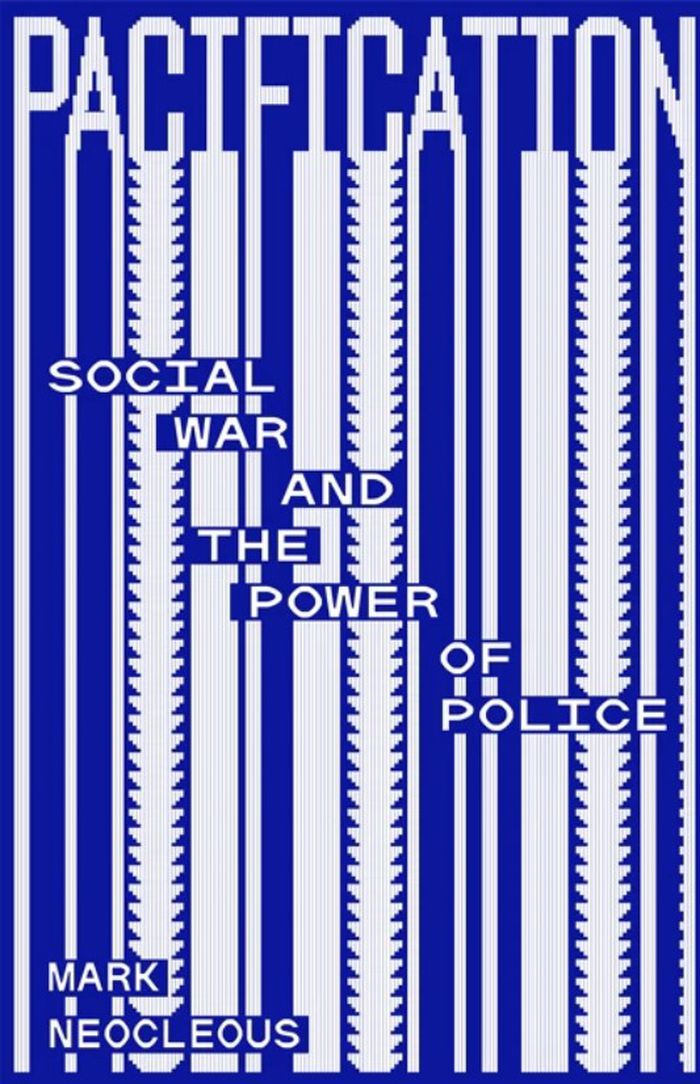
Pacification: Social war and the power of police
Actions:
Price:
$45.95
(available to order)
Summary:
In his new book, critical theorist Mark Neocleous engages in a sustained critique of the theory and practice of pacification. Combining philosophical analysis with historical detail, Neocleous analyses the development of pacification as a key concept through which capitalist modernity has been organised, offering readers the first book that treats pacification as an important concept in the history of state power and capitalism. Neocleous’s approach is fourfold, examining pacification as social warfare carried out through the ideology of peace; as a form of social police carried out through mechanisms of security; as law and order exercised through the permanent wars of class society; and as the myriad practices of power designed to counter insurgency. Making use of official documents of state, the writings of counterinsurgency thinkers and the ideas perpetuated by practitioners of counterrevolution, the book unravels the complex ways through which pacification generates new forms of social war and new modes of policing that reproduce capitalist order and fabricate obedient subjects. Through expansive accounts of war and police, and engaging with a range of topics from debt to death, from stasis to civil war, and from the police kettle to the politics of fear, the book offers a provocative analysis of the ways in which state and capital combine to build a pacified social order.
Pacification: Social war and the power of police
Actions:
Price:
$45.95
(available to order)
Summary:
In his new book, critical theorist Mark Neocleous engages in a sustained critique of the theory and practice of pacification. Combining philosophical analysis with historical detail, Neocleous analyses the development of pacification as a key concept through which capitalist modernity has been organised, offering readers the first book that treats pacification as an important concept in the history of state power and capitalism. Neocleous’s approach is fourfold, examining pacification as social warfare carried out through the ideology of peace; as a form of social police carried out through mechanisms of security; as law and order exercised through the permanent wars of class society; and as the myriad practices of power designed to counter insurgency. Making use of official documents of state, the writings of counterinsurgency thinkers and the ideas perpetuated by practitioners of counterrevolution, the book unravels the complex ways through which pacification generates new forms of social war and new modes of policing that reproduce capitalist order and fabricate obedient subjects. Through expansive accounts of war and police, and engaging with a range of topics from debt to death, from stasis to civil war, and from the police kettle to the politics of fear, the book offers a provocative analysis of the ways in which state and capital combine to build a pacified social order.
Form:
books
books
Publication:
February 2025
February 2025
Subject:
Social
Social
Form:
books
books
Title:
Eating architecture
Eating architecture
Actions:
Price:
$52.00
(available to order)
Summary:
The contributors to this highly original collection of essays explore the relationship between food and architecture, asking what can be learned by examining the (often metaphorical) intersection of the preparation of meals and the production of space. In a culture that includes the Food Channel and the knife-juggling chefs of Benihana, food has become not only an(...)
$52.00
(available to order)
Summary:
The contributors to this highly original collection of essays explore the relationship between food and architecture, asking what can be learned by examining the (often metaphorical) intersection of the preparation of meals and the production of space. In a culture that includes the Food Channel and the knife-juggling chefs of Benihana, food has become not only an(...)
Subject:
Architectural Theory
Architectural Theory
Publication:
May 2004, Cambridge, Mass.
May 2004, Cambridge, Mass.
Title:
Eating architecture
Actions:
Price:
$52.00
(available to order)
Summary:
The contributors to this highly original collection of essays explore the relationship between food and architecture, asking what can be learned by examining the (often metaphorical) intersection of the preparation of meals and the production of space. In a culture that includes the Food Channel and the knife-juggling chefs of Benihana, food has become not only an obsession but an alternative art form. The nineteen essays and "Gallery of Recipes" in "Eating Architecture" seize this moment to investigate how art and architecture engage issues of identity, ideology, conviviality, memory, and loss that cookery evokes. The essays are organized into four sections that lead the reader from the landscape to the kitchen, the table, and finally the mouth. The essays in "Place Settings" examine the relationships between food and location that arise in culinary colonialism and the global economy of tourism. "Philosophy in the Kitchen" traces the routines that create a site for aesthetic experimentation, including an examination of gingerbread houses as art, food, and architectural space. The essays in "Table Rules" consider the spatial and performative aspects of eating and the ways in which shared meals are among the most perishable and preserved cultural artifacts. Finally, "Embodied Taste" considers the sensual apprehension of food and what it means to consume a work of art. The "Gallery of Recipes" contains images by contemporary architects on the subject of eating architecture.
Eating architecture
Actions:
Price:
$52.00
(available to order)
Summary:
The contributors to this highly original collection of essays explore the relationship between food and architecture, asking what can be learned by examining the (often metaphorical) intersection of the preparation of meals and the production of space. In a culture that includes the Food Channel and the knife-juggling chefs of Benihana, food has become not only an obsession but an alternative art form. The nineteen essays and "Gallery of Recipes" in "Eating Architecture" seize this moment to investigate how art and architecture engage issues of identity, ideology, conviviality, memory, and loss that cookery evokes. The essays are organized into four sections that lead the reader from the landscape to the kitchen, the table, and finally the mouth. The essays in "Place Settings" examine the relationships between food and location that arise in culinary colonialism and the global economy of tourism. "Philosophy in the Kitchen" traces the routines that create a site for aesthetic experimentation, including an examination of gingerbread houses as art, food, and architectural space. The essays in "Table Rules" consider the spatial and performative aspects of eating and the ways in which shared meals are among the most perishable and preserved cultural artifacts. Finally, "Embodied Taste" considers the sensual apprehension of food and what it means to consume a work of art. The "Gallery of Recipes" contains images by contemporary architects on the subject of eating architecture.
Form:
books
books
Publication:
May 2004, Cambridge, Mass.
May 2004, Cambridge, Mass.
Subject:
Architectural Theory
Architectural Theory
Form:
books
books
Title:
Eating architecture
Eating architecture
Actions:
Price:
$39.95
(available to order)
Summary:
The contributors to this collection of essays explore the relationship between food and architecture, asking what can be learned by examining the (often metaphorical) intersection of the preparation of meals and the production of space. In a culture that includes the Food Channel and the knife-juggling chefs of Benihana, food has become not only an obsession but an(...)
$39.95
(available to order)
Summary:
The contributors to this collection of essays explore the relationship between food and architecture, asking what can be learned by examining the (often metaphorical) intersection of the preparation of meals and the production of space. In a culture that includes the Food Channel and the knife-juggling chefs of Benihana, food has become not only an obsession but an(...)
Title:
Eating architecture
Actions:
Price:
$39.95
(available to order)
Summary:
The contributors to this collection of essays explore the relationship between food and architecture, asking what can be learned by examining the (often metaphorical) intersection of the preparation of meals and the production of space. In a culture that includes the Food Channel and the knife-juggling chefs of Benihana, food has become not only an obsession but an alternative art form. The nineteen essays and "Gallery of Recipes" in "Eating architecture" seize this moment to investigate how art and architecture engage issues of identity, ideology, conviviality, memory, and loss that cookery evokes. The essays are organized into four sections that lead the reader from the landscape to the kitchen, the table, and finally the mouth. The essays in "Place settings" examine the relationships between food and location that arise in culinary colonialism and the global economy of tourism. "Philosophy in the kitchen" traces the routines that create a site for aesthetic experimentation, including an examination of gingerbread houses as art, food, and architectural space. The essays in "Table rules" consider the spatial and performative aspects of eating and the ways in which shared meals are among the most perishable and preserved cultural artifacts. Finally, "Embodied taste" considers the sensual apprehension of food and what it means to consume a work of art. The "Gallery of recipes" contains images by contemporary architects on the subject of eating architecture.
Eating architecture
Actions:
Price:
$39.95
(available to order)
Summary:
The contributors to this collection of essays explore the relationship between food and architecture, asking what can be learned by examining the (often metaphorical) intersection of the preparation of meals and the production of space. In a culture that includes the Food Channel and the knife-juggling chefs of Benihana, food has become not only an obsession but an alternative art form. The nineteen essays and "Gallery of Recipes" in "Eating architecture" seize this moment to investigate how art and architecture engage issues of identity, ideology, conviviality, memory, and loss that cookery evokes. The essays are organized into four sections that lead the reader from the landscape to the kitchen, the table, and finally the mouth. The essays in "Place settings" examine the relationships between food and location that arise in culinary colonialism and the global economy of tourism. "Philosophy in the kitchen" traces the routines that create a site for aesthetic experimentation, including an examination of gingerbread houses as art, food, and architectural space. The essays in "Table rules" consider the spatial and performative aspects of eating and the ways in which shared meals are among the most perishable and preserved cultural artifacts. Finally, "Embodied taste" considers the sensual apprehension of food and what it means to consume a work of art. The "Gallery of recipes" contains images by contemporary architects on the subject of eating architecture.
Form:
books
books
Publication:
April 2006
April 2006
Form:
books
books
Actions:
Holdings:
Description:
272 pages : illustrations (chiefly color) ; 28 cm
Description:
272 pages : illustrations (chiefly color) ; 28 cm
Author:
Subject:
Publication:
New York, New York : Princeton Architectural Press, [2014], ©2014
New York, New York : Princeton Architectural Press, [2014], ©2014
Title:
Abbott Miller : design and content / foreword, Rick Poynor ; essays, Ellen Lupton, Abbott Miller ; conversation, Michael Bierut, Abbott Miller, Eddie Opara, Paula Scher.
Actions:
Holdings:
Description:
272 pages : illustrations (chiefly color) ; 28 cm
Abbott Miller : design and content / foreword, Rick Poynor ; essays, Ellen Lupton, Abbott Miller ; conversation, Michael Bierut, Abbott Miller, Eddie Opara, Paula Scher.
Actions:
Holdings:
Description:
272 pages : illustrations (chiefly color) ; 28 cm
Form:
books
books
Publication:
New York, New York : Princeton Architectural Press, [2014], ©2014
New York, New York : Princeton Architectural Press, [2014], ©2014
Author:
Subject:
Form:
books
books
Actions:
Holdings:
Description:
xvi, 303 pages : illustrations, plans ; 25 cm
Description:
xvi, 303 pages : illustrations, plans ; 25 cm
Author:
Subject:
Publication:
Farnham Surrey, England ; Burlington, VT : Ashgate, [2014], ©2014
Farnham Surrey, England ; Burlington, VT : Ashgate, [2014], ©2014
Title:
Exhibitions and the development of modern planning culture / edited by Robert Freestone, University of New South Wales and Marco Amati, La Trobe University, Victoria, Australia.
Actions:
Holdings:
Description:
xvi, 303 pages : illustrations, plans ; 25 cm
Exhibitions and the development of modern planning culture / edited by Robert Freestone, University of New South Wales and Marco Amati, La Trobe University, Victoria, Australia.
Actions:
Holdings:
Description:
xvi, 303 pages : illustrations, plans ; 25 cm
Form:
books
books
Publication:
Farnham Surrey, England ; Burlington, VT : Ashgate, [2014], ©2014
Farnham Surrey, England ; Burlington, VT : Ashgate, [2014], ©2014
Author:
Subject:
Form:
books
books
Actions:
Holdings:
Description:
volumes : illustrations (chiefly color) ; 27 cm
Description:
volumes : illustrations (chiefly color) ; 27 cm
Author:
Subject:
Publication:
Addis Ababa : EiABC, 2012-<2015>
Addis Ababa : EiABC, 2012-<2015>
Title:
Building Ethiopia / Zegeye Cherenet, Helawi Sewnet.
Actions:
Holdings:
Description:
volumes : illustrations (chiefly color) ; 27 cm
Building Ethiopia / Zegeye Cherenet, Helawi Sewnet.
Actions:
Holdings:
Description:
volumes : illustrations (chiefly color) ; 27 cm
Form:
books
books
Publication:
Addis Ababa : EiABC, 2012-<2015>
Addis Ababa : EiABC, 2012-<2015>
Author:
Subject:
Form:
books
books
Actions:
Holdings:
Description:
xix, 258 pages : illustrations (chiefly color) ; 26 cm.
Description:
xix, 258 pages : illustrations (chiefly color) ; 26 cm.
Author:
Subject:
Publication:
Austin [Tex.] : University of Texas Press, 2011.
Austin [Tex.] : University of Texas Press, 2011.
Title:
Designing Pan-America : U.S. architectural visions for the Western Hemisphere / Robert Alexander González.
Actions:
Holdings:
Description:
xix, 258 pages : illustrations (chiefly color) ; 26 cm.
Designing Pan-America : U.S. architectural visions for the Western Hemisphere / Robert Alexander González.
Actions:
Holdings:
Description:
xix, 258 pages : illustrations (chiefly color) ; 26 cm.
Form:
books
books
Publication:
Austin [Tex.] : University of Texas Press, 2011.
Austin [Tex.] : University of Texas Press, 2011.
Author:
Subject:
Form:
books
books
Actions:
Holdings:
Description:
252 pages : illustrations, maps ; 29 cm.
Description:
252 pages : illustrations, maps ; 29 cm.
Author:
Subject:
Publication:
Leuven : Leuven University Press, ©2012.
Leuven : Leuven University Press, ©2012.
Title:
Making a new world : architecture & communities in interwar Europe / Rajesh Heynickx & Tom Avermaete, eds.
Actions:
Holdings:
Description:
252 pages : illustrations, maps ; 29 cm.
Making a new world : architecture & communities in interwar Europe / Rajesh Heynickx & Tom Avermaete, eds.
Actions:
Holdings:
Description:
252 pages : illustrations, maps ; 29 cm.
Form:
books
books
Publication:
Leuven : Leuven University Press, ©2012.
Leuven : Leuven University Press, ©2012.
Author:
Subject:
Form:
books
books
Price:
$18.95
(available to order)
Summary:
Artifacts (including works of architecture) play dual roles; they simultaneously perform functions and carry meaning. Columns support roofs, but while the sturdy Tuscan and Doric types traditionally signify masculinity, the slim and elegant Ionic and Corinthian kinds read as feminine. Words are often inscribed on objects. (On a door: "push" or "pull.") Today, information(...)
$18.95
(available to order)
Summary:
Artifacts (including works of architecture) play dual roles; they simultaneously perform functions and carry meaning. Columns support roofs, but while the sturdy Tuscan and Doric types traditionally signify masculinity, the slim and elegant Ionic and Corinthian kinds read as feminine. Words are often inscribed on objects. (On a door: "push" or "pull.") Today, information(...)
Title:
World's greatest architect: making, meaning, and network culture: 0
Actions:
Price:
$18.95
(available to order)
Summary:
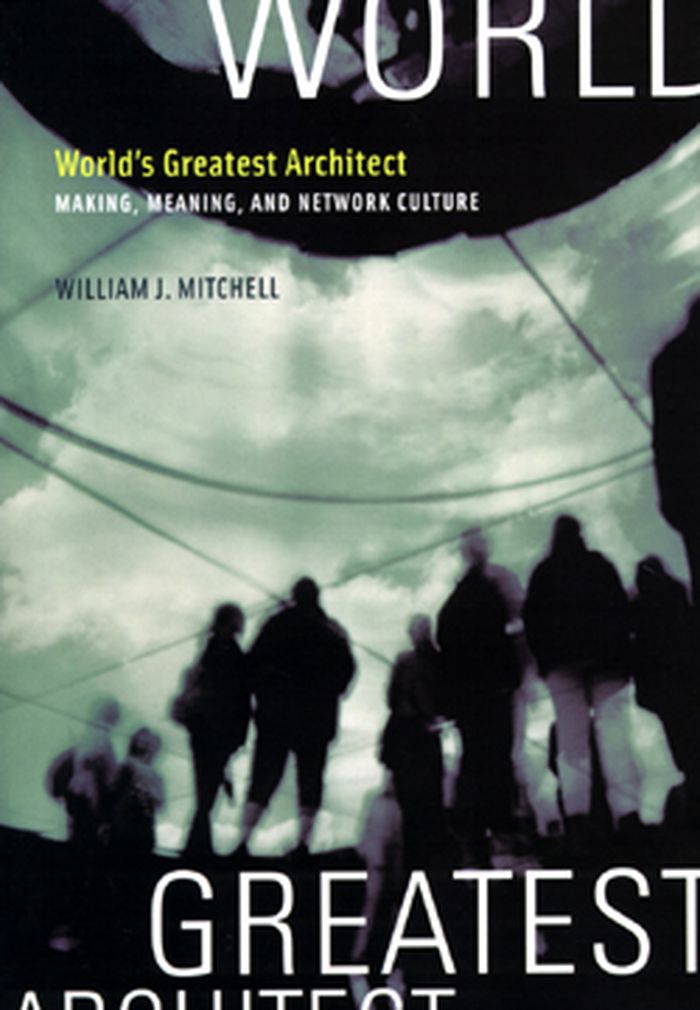
Artifacts (including works of architecture) play dual roles; they simultaneously perform functions and carry meaning. Columns support roofs, but while the sturdy Tuscan and Doric types traditionally signify masculinity, the slim and elegant Ionic and Corinthian kinds read as feminine. Words are often inscribed on objects. (On a door: "push" or "pull.") Today, information is digitally encoded (dematerialized) and displayed (rematerialized) to become part of many different objects, at one moment appearing on a laptop screen and at another, perhaps, on a building facade (as in Times Square). Well-designed artifacts succeed in being both useful and meaningful. In "World's Greatest Architect", William Mitchell offers a series of snapshots - short essays and analyses - that examine the systems of function and meaning currently operating in our buildings, cities, and global networks.In his writing, Mitchell makes connections that aren't necessarily obvious but are always illuminating, moving in one essay from Bush-Cheney's abuse of language to Robert Venturi's argument against rigid ideology and in favor of graceful pragmatism. He traces the evolution of Las Vegas from Sin/Sign City to family-friendly resort and residential real estate boomtown. A purchase of chips leads not only to a complementary purchase of beer but to thoughts of Eames chairs (like Pringles) and Gehry (fun to imitate with tortilla chips in refried beans). As for who the world's greatest architect might be, here's a hint: he's also the oldest.
World's greatest architect: making, meaning, and network culture: 0
Actions:
Price:
$18.95
(available to order)
Summary:
Artifacts (including works of architecture) play dual roles; they simultaneously perform functions and carry meaning. Columns support roofs, but while the sturdy Tuscan and Doric types traditionally signify masculinity, the slim and elegant Ionic and Corinthian kinds read as feminine. Words are often inscribed on objects. (On a door: "push" or "pull.") Today, information is digitally encoded (dematerialized) and displayed (rematerialized) to become part of many different objects, at one moment appearing on a laptop screen and at another, perhaps, on a building facade (as in Times Square). Well-designed artifacts succeed in being both useful and meaningful. In "World's Greatest Architect", William Mitchell offers a series of snapshots - short essays and analyses - that examine the systems of function and meaning currently operating in our buildings, cities, and global networks.In his writing, Mitchell makes connections that aren't necessarily obvious but are always illuminating, moving in one essay from Bush-Cheney's abuse of language to Robert Venturi's argument against rigid ideology and in favor of graceful pragmatism. He traces the evolution of Las Vegas from Sin/Sign City to family-friendly resort and residential real estate boomtown. A purchase of chips leads not only to a complementary purchase of beer but to thoughts of Eames chairs (like Pringles) and Gehry (fun to imitate with tortilla chips in refried beans). As for who the world's greatest architect might be, here's a hint: he's also the oldest.
Form:
books
books
Publication:
September 2008, Boston
September 2008, Boston
Subject:
Architectural Theory
Architectural Theory


