


1067 Results
Form:
books
books
Actions:
Price:
$56.95
(available to order)
Summary:
Film noir remains one of the most enduring legacies of 1940's and 1950's Hollywood. Populated by double-crossing, unsavory characters, this pioneering film style explored a shadow side of American life during a period of tremendous prosperity and optimism. Edward Dimendberg compellingly demonstrates how film noir is preoccupied with modernity, particularly the urban(...)
$56.95
(available to order)
Summary:
Film noir remains one of the most enduring legacies of 1940's and 1950's Hollywood. Populated by double-crossing, unsavory characters, this pioneering film style explored a shadow side of American life during a period of tremendous prosperity and optimism. Edward Dimendberg compellingly demonstrates how film noir is preoccupied with modernity, particularly the urban(...)
Subject:
Commercial interiors, Building types
Commercial interiors, Building types
Publication:
April 2004, Cambridge, Mass.
April 2004, Cambridge, Mass.
Title:
Film noir and the spaces of modernity
Actions:
Price:
$56.95
(available to order)
Summary:
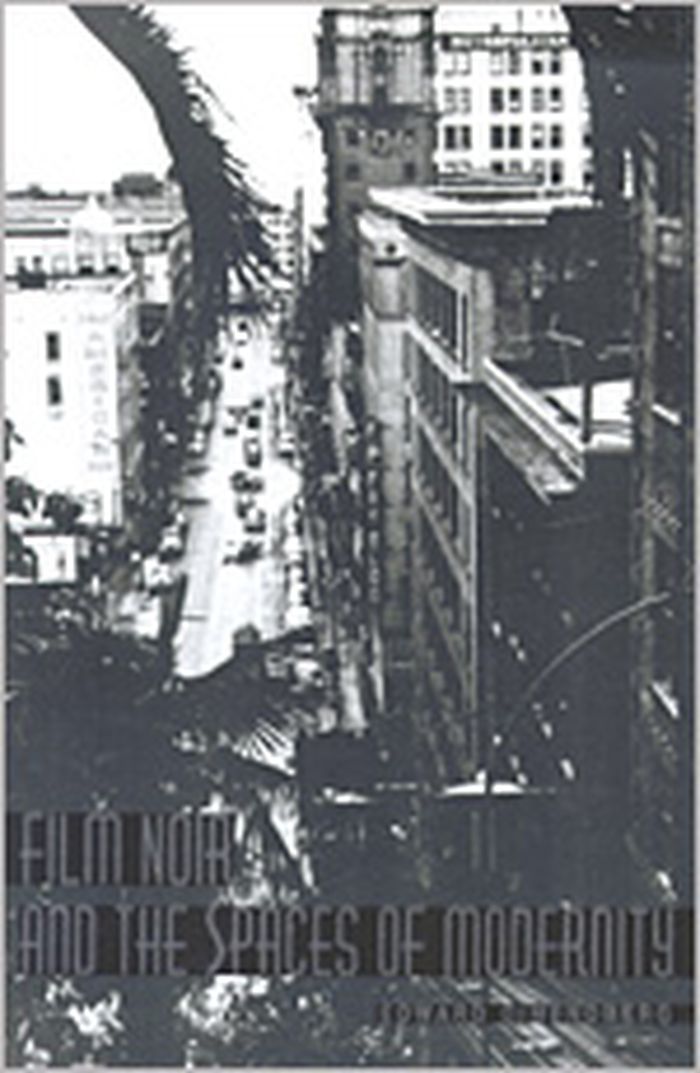
Film noir remains one of the most enduring legacies of 1940's and 1950's Hollywood. Populated by double-crossing, unsavory characters, this pioneering film style explored a shadow side of American life during a period of tremendous prosperity and optimism. Edward Dimendberg compellingly demonstrates how film noir is preoccupied with modernity, particularly the urban landscape. The originality of Dimendberg's approach lies in his examining these films in tandem with historical developments in architecture, city planning, and modern communications systems. He confirms that noir is not simply a reflection of modernity but a virtual continuation of the spaces of the metropolis. He convincingly shows that Hollywood's dark thrillers of the postwar decades were determined by the same forces that shaped the city itself. Exploring classic examples of film noir such as "The Asphalt Jungle", "Double Indemnity", "Kiss Me Deadly", and "The Naked City" alongside many lesser-known works, Dimendberg masterfully interweaves film history and urban history while perceptively analyzing works by Raymond Chandler, Edward Hopper, Siegfried Kracauer, and Henri Lefebvre. A bold intervention in cultural studies and a major contribution to film history, Film Noir and the Spaces of Modernity will provoke debate by cinema scholars, urban historians, and students of modern culture - and will captivate admirers of a vital period in American cinema.
Film noir and the spaces of modernity
Actions:
Price:
$56.95
(available to order)
Summary:
Film noir remains one of the most enduring legacies of 1940's and 1950's Hollywood. Populated by double-crossing, unsavory characters, this pioneering film style explored a shadow side of American life during a period of tremendous prosperity and optimism. Edward Dimendberg compellingly demonstrates how film noir is preoccupied with modernity, particularly the urban landscape. The originality of Dimendberg's approach lies in his examining these films in tandem with historical developments in architecture, city planning, and modern communications systems. He confirms that noir is not simply a reflection of modernity but a virtual continuation of the spaces of the metropolis. He convincingly shows that Hollywood's dark thrillers of the postwar decades were determined by the same forces that shaped the city itself. Exploring classic examples of film noir such as "The Asphalt Jungle", "Double Indemnity", "Kiss Me Deadly", and "The Naked City" alongside many lesser-known works, Dimendberg masterfully interweaves film history and urban history while perceptively analyzing works by Raymond Chandler, Edward Hopper, Siegfried Kracauer, and Henri Lefebvre. A bold intervention in cultural studies and a major contribution to film history, Film Noir and the Spaces of Modernity will provoke debate by cinema scholars, urban historians, and students of modern culture - and will captivate admirers of a vital period in American cinema.
Form:
books
books
Publication:
April 2004, Cambridge, Mass.
April 2004, Cambridge, Mass.
Subject:
Commercial interiors, Building types
Commercial interiors, Building types
Form:
books
books
Actions:
Price:
$93.99
(available to order)
Summary:
The building of the Victoria and Albert Museum, begun in 1857, is the most elaborately designed and decorated museum in Britain. This book is the first to consider the V as a work of art in itself, presenting drawings, watercolours and historic photographs relating to the museum’s 19th-century exteriors and interiors. Much of this visual material is previously unpublished(...)
$93.99
(available to order)
Summary:
The building of the Victoria and Albert Museum, begun in 1857, is the most elaborately designed and decorated museum in Britain. This book is the first to consider the V as a work of art in itself, presenting drawings, watercolours and historic photographs relating to the museum’s 19th-century exteriors and interiors. Much of this visual material is previously unpublished(...)
Title:
Designing the V: the museum as a work of art (1857-1909)
Actions:
Price:
$93.99
(available to order)
Summary:
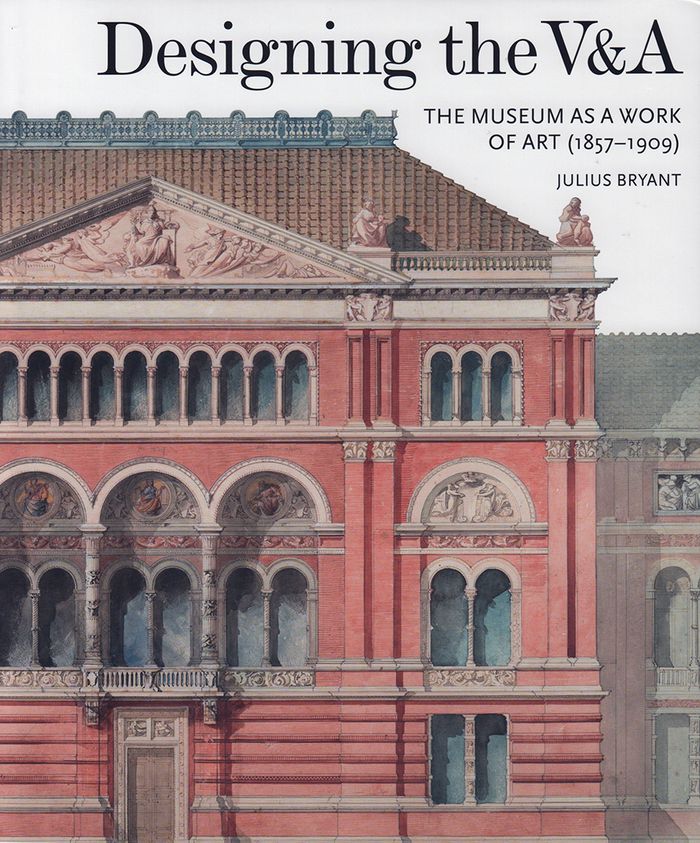
The building of the Victoria and Albert Museum, begun in 1857, is the most elaborately designed and decorated museum in Britain. This book is the first to consider the V as a work of art in itself, presenting drawings, watercolours and historic photographs relating to the museum’s 19th-century exteriors and interiors. Much of this visual material is previously unpublished and is outside the canon of Victorian art and design. The V’s first Director, Henry Cole, conceived the museum’s building as a showcase for leading Victorian artists to design and decorate. This book reveals for the first time the ways in which Cole’s expressed policy to ‘assemble a splendid collection of objects representing the application of Fine Arts to manufacture’ was applied to the fabric of the building, as he engaged leading painters such as Frederic Leighton, G.F. Watts and Edward Burne-Jones, as well as specialists in decoration such as Owen Jones and Morris and Company, to decorate and design for a building raised by engineers using innovatory materials and techniques. This book represents a fascinating, untold chapter in the history of British 19th-century art, design, architecture and museums, and provides an essential key to understanding the evolution of the museum’s early collections and identity.
Designing the V: the museum as a work of art (1857-1909)
Actions:
Price:
$93.99
(available to order)
Summary:
The building of the Victoria and Albert Museum, begun in 1857, is the most elaborately designed and decorated museum in Britain. This book is the first to consider the V as a work of art in itself, presenting drawings, watercolours and historic photographs relating to the museum’s 19th-century exteriors and interiors. Much of this visual material is previously unpublished and is outside the canon of Victorian art and design. The V’s first Director, Henry Cole, conceived the museum’s building as a showcase for leading Victorian artists to design and decorate. This book reveals for the first time the ways in which Cole’s expressed policy to ‘assemble a splendid collection of objects representing the application of Fine Arts to manufacture’ was applied to the fabric of the building, as he engaged leading painters such as Frederic Leighton, G.F. Watts and Edward Burne-Jones, as well as specialists in decoration such as Owen Jones and Morris and Company, to decorate and design for a building raised by engineers using innovatory materials and techniques. This book represents a fascinating, untold chapter in the history of British 19th-century art, design, architecture and museums, and provides an essential key to understanding the evolution of the museum’s early collections and identity.
Form:
books
books
Publication:
March 2017
March 2017
Subject:
Museums and Universal Exhibitions
Museums and Universal Exhibitions
Form:
books
books
Price:
$45.95
(available to order)
Summary:
Preserving New York: Winning the Right to Protect A Citys Landmarks is the largely unknown inspiring story of the origins of New York Citys nationally acclaimed landmarks law. The decades of struggle behind the law, its intellectual origins, the men and women who fought for it, the forces that shaped it, and the buildings lost and saved on the way to its ultimate passage,(...)
$45.95
(available to order)
Summary:
Preserving New York: Winning the Right to Protect A Citys Landmarks is the largely unknown inspiring story of the origins of New York Citys nationally acclaimed landmarks law. The decades of struggle behind the law, its intellectual origins, the men and women who fought for it, the forces that shaped it, and the buildings lost and saved on the way to its ultimate passage,(...)
Publication:
October 2007, New York, London
October 2007, New York, London
Title:
Preserving New York: winning the right to protect a City's landmark
Actions:
Price:
$45.95
(available to order)
Summary:
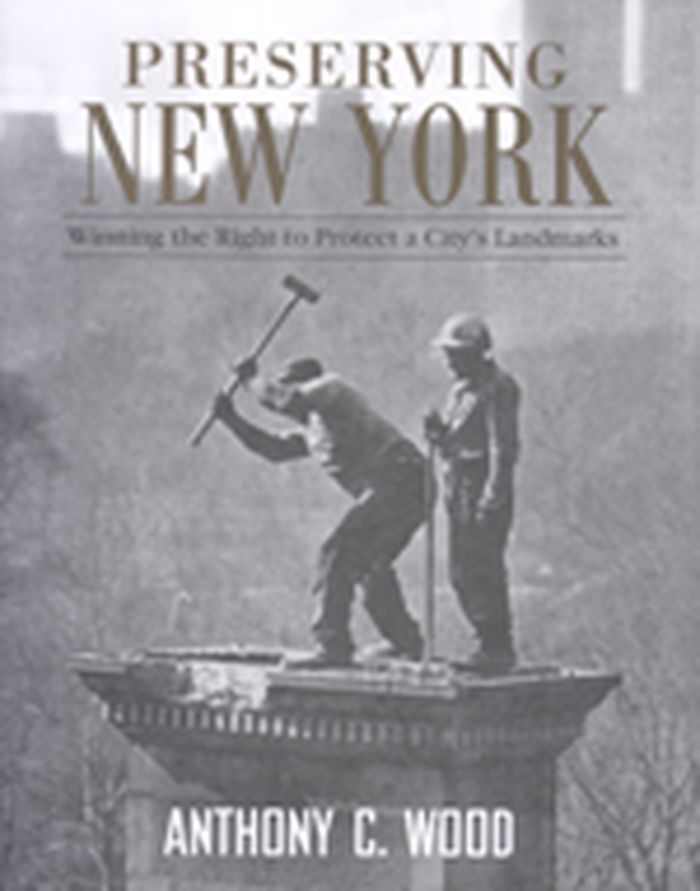
Preserving New York: Winning the Right to Protect A Citys Landmarks is the largely unknown inspiring story of the origins of New York Citys nationally acclaimed landmarks law. The decades of struggle behind the law, its intellectual origins, the men and women who fought for it, the forces that shaped it, and the buildings lost and saved on the way to its ultimate passage, span from 1913 to 1965. Intended for the interested public as well as students of New York City history, architecture, and preservation itself, over 100 illustrations help reveal a history richer and more complex than the accepted myth that the landmarks law sprang from the wreckage of the great Pennsylvania Station. Images include those by noted historic photographers as well as those from newspaper accounts of the time. Forgotten civic leaders such as Albert S. Bard and lost buildings including the Brokaw Mansions, are unveiled in an extensively researched narrative bringing this essential episode in New Yorks history to futuregenerations tasked with protecting the citys landmarks. For the first time, the story of how New York won the right to protect its treasured buildings, neighborhoods and special places is brought together to enjoy, inform, and inspire all who love New York.
Preserving New York: winning the right to protect a City's landmark
Actions:
Price:
$45.95
(available to order)
Summary:
Preserving New York: Winning the Right to Protect A Citys Landmarks is the largely unknown inspiring story of the origins of New York Citys nationally acclaimed landmarks law. The decades of struggle behind the law, its intellectual origins, the men and women who fought for it, the forces that shaped it, and the buildings lost and saved on the way to its ultimate passage, span from 1913 to 1965. Intended for the interested public as well as students of New York City history, architecture, and preservation itself, over 100 illustrations help reveal a history richer and more complex than the accepted myth that the landmarks law sprang from the wreckage of the great Pennsylvania Station. Images include those by noted historic photographers as well as those from newspaper accounts of the time. Forgotten civic leaders such as Albert S. Bard and lost buildings including the Brokaw Mansions, are unveiled in an extensively researched narrative bringing this essential episode in New Yorks history to futuregenerations tasked with protecting the citys landmarks. For the first time, the story of how New York won the right to protect its treasured buildings, neighborhoods and special places is brought together to enjoy, inform, and inspire all who love New York.
Form:
books
books
Publication:
October 2007, New York, London
October 2007, New York, London
Form:
books
books
Actions:
Price:
$38.95
(available to order)
Summary:
Since its publication twenty years ago, Brian Massumi's pioneering ''Parables for the virtual'' has become an essential text for interdisciplinary scholars across the humanities. Massumi views the body and media such as television, film, and the internet as cultural formations that operate on multiple registers of sensation. Renewing and assessing William James's radical(...)
$38.95
(available to order)
Summary:
Since its publication twenty years ago, Brian Massumi's pioneering ''Parables for the virtual'' has become an essential text for interdisciplinary scholars across the humanities. Massumi views the body and media such as television, film, and the internet as cultural formations that operate on multiple registers of sensation. Renewing and assessing William James's radical(...)
Title:
Parables for the virtual: movement, affect, sensation
Actions:
Price:
$38.95
(available to order)
Summary:
Since its publication twenty years ago, Brian Massumi's pioneering ''Parables for the virtual'' has become an essential text for interdisciplinary scholars across the humanities. Massumi views the body and media such as television, film, and the internet as cultural formations that operate on multiple registers of sensation. Renewing and assessing William James's radical empiricism and Henri Bergson's philosophy of perception through the filter of the postwar French philosophy of Deleuze, Guattari, and Foucault, Massumi links a cultural logic of variation to questions of movement, affect, and sensation. Replacing the traditional opposition of literal and figural with distinctions between stasis and motion and between actual and virtual, Massumi tackles related theoretical issues by applying them to cultural mediums as diverse as architecture, body art, the digital art of Stelarc, and Ronald Reagan's acting career. The result is an intriguing combination of cultural theory, science, and philosophy that asserts itself in a crystalline and multifaceted argument. This twentieth anniversary edition includes a new preface in which Massumi situates the book in relation to developments since its publication and outlines the evolution of its main concepts. It also includes two short texts, "Keywords for Affect" and "Missed Conceptions about Affect," in which Massumi explicates his approach to affect in ways that emphasize the book's political and philosophical stakes.
Parables for the virtual: movement, affect, sensation
Actions:
Price:
$38.95
(available to order)
Summary:
Since its publication twenty years ago, Brian Massumi's pioneering ''Parables for the virtual'' has become an essential text for interdisciplinary scholars across the humanities. Massumi views the body and media such as television, film, and the internet as cultural formations that operate on multiple registers of sensation. Renewing and assessing William James's radical empiricism and Henri Bergson's philosophy of perception through the filter of the postwar French philosophy of Deleuze, Guattari, and Foucault, Massumi links a cultural logic of variation to questions of movement, affect, and sensation. Replacing the traditional opposition of literal and figural with distinctions between stasis and motion and between actual and virtual, Massumi tackles related theoretical issues by applying them to cultural mediums as diverse as architecture, body art, the digital art of Stelarc, and Ronald Reagan's acting career. The result is an intriguing combination of cultural theory, science, and philosophy that asserts itself in a crystalline and multifaceted argument. This twentieth anniversary edition includes a new preface in which Massumi situates the book in relation to developments since its publication and outlines the evolution of its main concepts. It also includes two short texts, "Keywords for Affect" and "Missed Conceptions about Affect," in which Massumi explicates his approach to affect in ways that emphasize the book's political and philosophical stakes.
Form:
books
books
Publication:
September 2021
September 2021
Subject:
Critical Theory
Critical Theory
Form:
books
books
Actions:
Price:
$46.95
(available to order)
Summary:
Support structures is a manual for what bears, sustains, and props, for those things that encourage, care for, and assist; for that which advocates, articulates; for what stands behind, frames, and maintains: it is a manual for those things that give support. While the work of supporting might traditionally appear as subsequent, unessential, and lacking value in itself,(...)
$46.95
(available to order)
Summary:
Support structures is a manual for what bears, sustains, and props, for those things that encourage, care for, and assist; for that which advocates, articulates; for what stands behind, frames, and maintains: it is a manual for those things that give support. While the work of supporting might traditionally appear as subsequent, unessential, and lacking value in itself,(...)
Title:
Céline Condorelli: support structures
Actions:
Price:
$46.95
(available to order)
Summary:
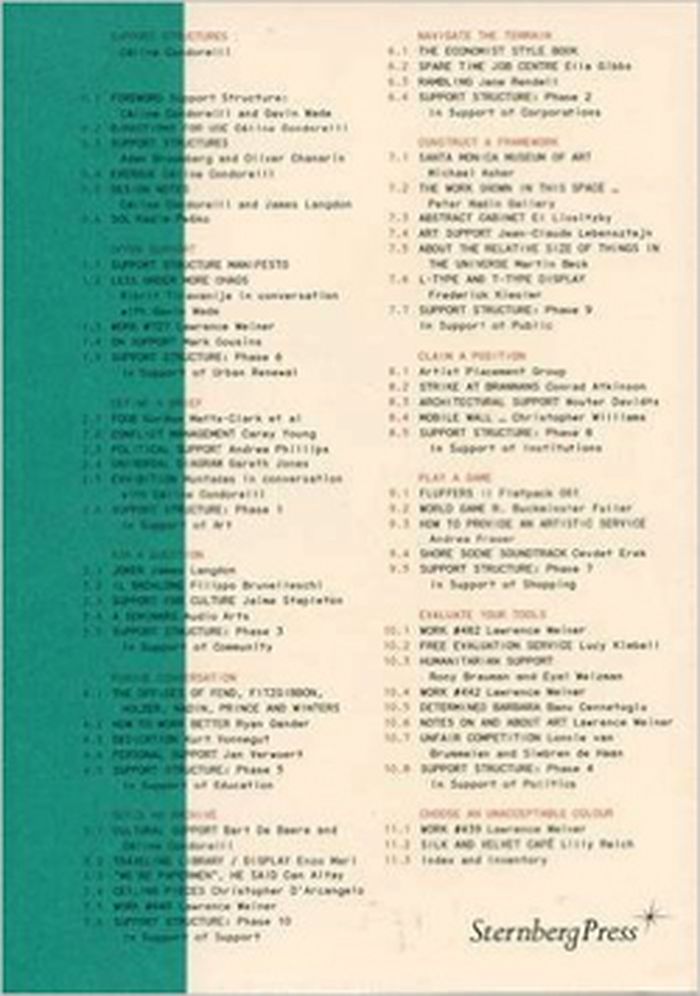
Support structures is a manual for what bears, sustains, and props, for those things that encourage, care for, and assist; for that which advocates, articulates; for what stands behind, frames, and maintains: it is a manual for those things that give support. While the work of supporting might traditionally appear as subsequent, unessential, and lacking value in itself, this manual is an attempt to restore attention to one of the neglected, yet crucial modes through which we apprehend and shape the world. Support structures is a critical enquiry into what constitutes “support,” and documents the collaborative project “Support Structure” by Céline Condorelli and Gavin Wade. While registering and collecting reference projects in a new archive of support structures alongside its ten-phase project, different writers, thinkers, and practitioners were invited from various fields to elaborate on frameworks and work on texts , which form the theoretical backbone of the publication. The collection of contributions offers different possibilities for engaging in this unchartered territory, from propositions to projects, existing systems to ones invented for specific creative processes. Support structures offers support through potential methodologies, inspirations and activations for practice, and addresses important questions for art and architecture practices on forms of display, organization, articulation, appropriation, autonomy, and temporariness, and the manifestations of blindness towards them.
Céline Condorelli: support structures
Actions:
Price:
$46.95
(available to order)
Summary:
Support structures is a manual for what bears, sustains, and props, for those things that encourage, care for, and assist; for that which advocates, articulates; for what stands behind, frames, and maintains: it is a manual for those things that give support. While the work of supporting might traditionally appear as subsequent, unessential, and lacking value in itself, this manual is an attempt to restore attention to one of the neglected, yet crucial modes through which we apprehend and shape the world. Support structures is a critical enquiry into what constitutes “support,” and documents the collaborative project “Support Structure” by Céline Condorelli and Gavin Wade. While registering and collecting reference projects in a new archive of support structures alongside its ten-phase project, different writers, thinkers, and practitioners were invited from various fields to elaborate on frameworks and work on texts , which form the theoretical backbone of the publication. The collection of contributions offers different possibilities for engaging in this unchartered territory, from propositions to projects, existing systems to ones invented for specific creative processes. Support structures offers support through potential methodologies, inspirations and activations for practice, and addresses important questions for art and architecture practices on forms of display, organization, articulation, appropriation, autonomy, and temporariness, and the manifestations of blindness towards them.
Form:
books
books
Publication:
October 2009
October 2009
Subject:
Contemporary Art Monographs
Contemporary Art Monographs
Form:
books
books
Actions:
Price:
$53.95
(available to order)
Summary:
With his astounding building cuts and intersects, Gordon Matta-Clark (1943-1978) opened up elegant geometries in the very structures that seem most substantial and most authoritative in urban existence, revealing the alienations of the urban fabric as convenient fictions and allowing life to flow into the most inhospitable and self-contained of buildings. One of his(...)
$53.95
(available to order)
Summary:
With his astounding building cuts and intersects, Gordon Matta-Clark (1943-1978) opened up elegant geometries in the very structures that seem most substantial and most authoritative in urban existence, revealing the alienations of the urban fabric as convenient fictions and allowing life to flow into the most inhospitable and self-contained of buildings. One of his(...)
Publication:
November 2011
November 2011
Title:
Gordon Matta-Clark, moment to moment : space
Actions:
Price:
$53.95
(available to order)
Summary:
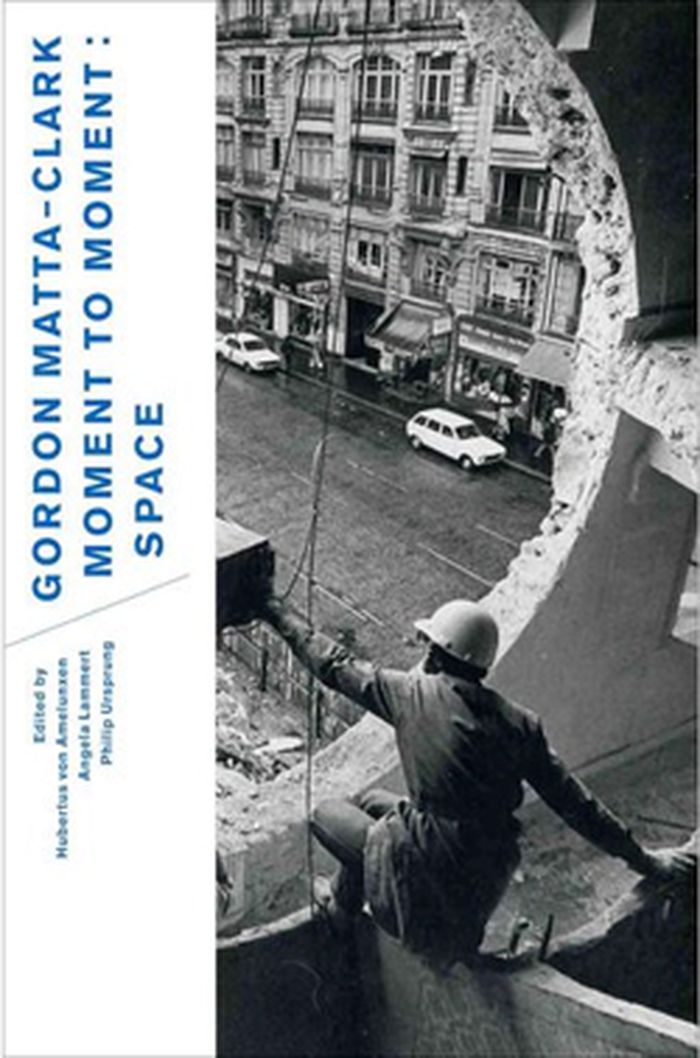
With his astounding building cuts and intersects, Gordon Matta-Clark (1943-1978) opened up elegant geometries in the very structures that seem most substantial and most authoritative in urban existence, revealing the alienations of the urban fabric as convenient fictions and allowing life to flow into the most inhospitable and self-contained of buildings. One of his favorite responses to a work came from a Parisian concierge: “I see the purpose for that hole - it is an experiment in bringing light and air into spaces that never had enough of either.” Throughout his all-too-brief career, Matta-Clark undertook civic aeration on many fronts, cofounding the now legendary Food Restaurant in 1971, buying up empty lots in Queens and evolving his theory of “anarchitecture” in films, photomontages and numerous writings and drawings. Anarchitecture redefined negative space in art as a political act, distinguishing itself from architecture by imagining a cure for its most pernicious effects. Gordon Matta-Clark : Moment to Moment offers a comprehensive overview of this courageous and liberating artist with a wealth of documentation and reproductions from across Matta-Clark's oeuvre, as well as critical commentary from Philip Ursprung, Angela Lammert, Hubertus von Amelunxen, Dan Graham and others.
Gordon Matta-Clark, moment to moment : space
Actions:
Price:
$53.95
(available to order)
Summary:
With his astounding building cuts and intersects, Gordon Matta-Clark (1943-1978) opened up elegant geometries in the very structures that seem most substantial and most authoritative in urban existence, revealing the alienations of the urban fabric as convenient fictions and allowing life to flow into the most inhospitable and self-contained of buildings. One of his favorite responses to a work came from a Parisian concierge: “I see the purpose for that hole - it is an experiment in bringing light and air into spaces that never had enough of either.” Throughout his all-too-brief career, Matta-Clark undertook civic aeration on many fronts, cofounding the now legendary Food Restaurant in 1971, buying up empty lots in Queens and evolving his theory of “anarchitecture” in films, photomontages and numerous writings and drawings. Anarchitecture redefined negative space in art as a political act, distinguishing itself from architecture by imagining a cure for its most pernicious effects. Gordon Matta-Clark : Moment to Moment offers a comprehensive overview of this courageous and liberating artist with a wealth of documentation and reproductions from across Matta-Clark's oeuvre, as well as critical commentary from Philip Ursprung, Angela Lammert, Hubertus von Amelunxen, Dan Graham and others.
Form:
books
books
Publication:
November 2011
November 2011
Form:
books
books
Actions:
Price:
$25.95
(available to order)
Summary:
We surround ourselves with material things that are invested with memories but can only stand for what we have lost. Physical objects—such as one’s own body—situate and define us; yet at the same time they are fundamentally indifferent to us. The melancholy of this rift is a rich source of inspiration for artists. Peter Schwenger deftly weaves together philosophical(...)
$25.95
(available to order)
Summary:
We surround ourselves with material things that are invested with memories but can only stand for what we have lost. Physical objects—such as one’s own body—situate and define us; yet at the same time they are fundamentally indifferent to us. The melancholy of this rift is a rich source of inspiration for artists. Peter Schwenger deftly weaves together philosophical(...)
Title:
The tears of things : Melancholy and physical objects
Actions:
Price:
$25.95
(available to order)
Summary:
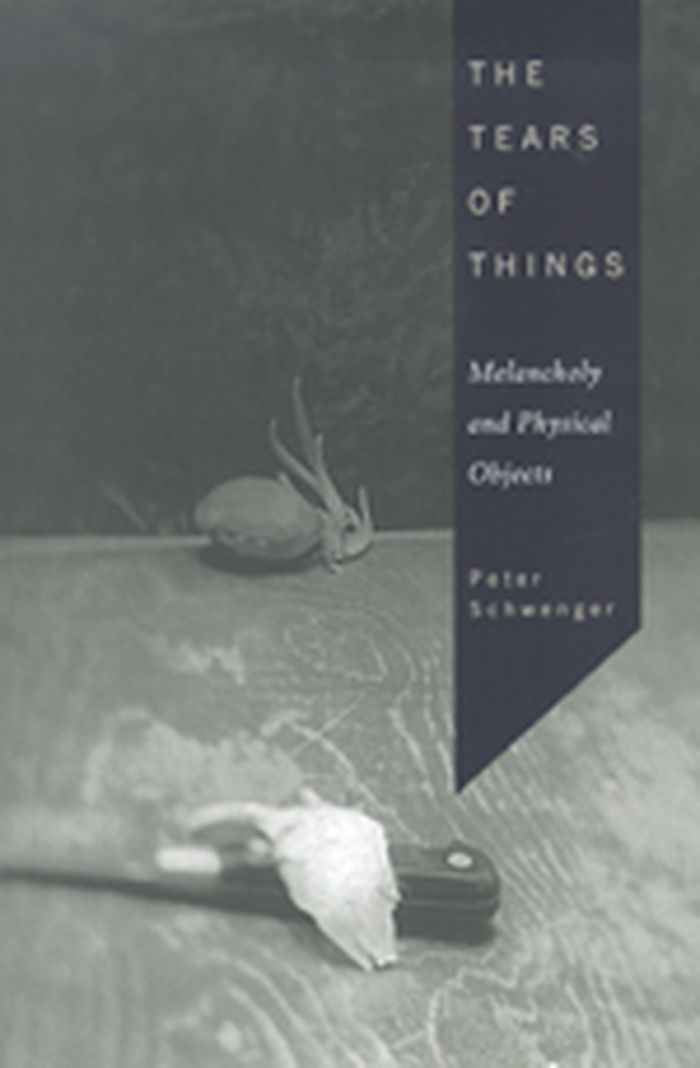
We surround ourselves with material things that are invested with memories but can only stand for what we have lost. Physical objects—such as one’s own body—situate and define us; yet at the same time they are fundamentally indifferent to us. The melancholy of this rift is a rich source of inspiration for artists. Peter Schwenger deftly weaves together philosophical and psychoanalytical theory with artistic practice. Concerned in part with the act of collecting, The Tears of Things is itself a collection of exemplary art objects—literary and cultural attempts to control and possess things—including paintings by Georgia O’Keeffe and René Magritte; sculpture by Louise Bourgeois and Marcel Duchamp; Joseph Cornell’s boxes; Edward Gorey’s graphic art; fiction by Virginia Woolf, Georges Perec, and Louise Erdrich; the hallucinatory encyclopedias of Jorge Luis Borges and Luigi Serafini; and the corpse photographs of Joel Peter Witkin. However, these representations of objects perpetually fall short of our aspirations. Schwenger examines what is left over—debris and waste—and asks what art can make of these. What emerges is not an art that reassembles but one that questions what it means to assemble in the first place. Contained in this catalog of waste is that ultimate still life, the cadaver, where the subject-object dichotomy receives its final ironic reconciliation. Peter Schwenger is professor of English at Mount St. Vincent University in Halifax, Nova Scotia. He is the author of Fantasm and Fiction: On Textual Envisioning, Letter Bomb: Nuclear Holocaust and the Exploding Word, and Phallic Critiques: Masculinity and Twentieth-Century Literature.
The tears of things : Melancholy and physical objects
Actions:
Price:
$25.95
(available to order)
Summary:
We surround ourselves with material things that are invested with memories but can only stand for what we have lost. Physical objects—such as one’s own body—situate and define us; yet at the same time they are fundamentally indifferent to us. The melancholy of this rift is a rich source of inspiration for artists. Peter Schwenger deftly weaves together philosophical and psychoanalytical theory with artistic practice. Concerned in part with the act of collecting, The Tears of Things is itself a collection of exemplary art objects—literary and cultural attempts to control and possess things—including paintings by Georgia O’Keeffe and René Magritte; sculpture by Louise Bourgeois and Marcel Duchamp; Joseph Cornell’s boxes; Edward Gorey’s graphic art; fiction by Virginia Woolf, Georges Perec, and Louise Erdrich; the hallucinatory encyclopedias of Jorge Luis Borges and Luigi Serafini; and the corpse photographs of Joel Peter Witkin. However, these representations of objects perpetually fall short of our aspirations. Schwenger examines what is left over—debris and waste—and asks what art can make of these. What emerges is not an art that reassembles but one that questions what it means to assemble in the first place. Contained in this catalog of waste is that ultimate still life, the cadaver, where the subject-object dichotomy receives its final ironic reconciliation. Peter Schwenger is professor of English at Mount St. Vincent University in Halifax, Nova Scotia. He is the author of Fantasm and Fiction: On Textual Envisioning, Letter Bomb: Nuclear Holocaust and the Exploding Word, and Phallic Critiques: Masculinity and Twentieth-Century Literature.
Form:
books
books
Publication:
May 2006, Minnesota
May 2006, Minnesota
Subject:
Architectural Theory
Architectural Theory
Form:
journals and magazines
journals and magazines
Title:
OASE #84: Models Maquettes
OASE #84: Models Maquettes
Actions:
Price:
$39.00
(available to order)
Summary:
In recent decades models have made a contribution to architectural discourse that should not be underestimated. Christophe Van Gerrewey considers the models in OMA’s oeuvre and ascertains that OMA’s models always take on a life of their own, turning into ‘a realisation of what architecture promises, yet can never attain itself’. For example, the two plaster models of(...)
$39.00
(available to order)
Summary:
In recent decades models have made a contribution to architectural discourse that should not be underestimated. Christophe Van Gerrewey considers the models in OMA’s oeuvre and ascertains that OMA’s models always take on a life of their own, turning into ‘a realisation of what architecture promises, yet can never attain itself’. For example, the two plaster models of(...)
Title:
OASE #84: Models Maquettes
Actions:
Price:
$39.00
(available to order)
Summary:
In recent decades models have made a contribution to architectural discourse that should not be underestimated. Christophe Van Gerrewey considers the models in OMA’s oeuvre and ascertains that OMA’s models always take on a life of their own, turning into ‘a realisation of what architecture promises, yet can never attain itself’. For example, the two plaster models of the Très Grande Bibliothèque in Paris afforded new insights into a space that can be read both as mass and as counter-mass, while the model of the cruise terminal in Zeebrugge exemplified the power of the iconic form. OASE 84 devotes considerable attention to (architectural) models that play an important part in the work of various artists as well, like in the work of Mike Kelley and Thomas Demand. These models are hardly ever meant to be realised on a different scale elsewhere; they work with the dualistic connotations of the model directly. Although the two disciplines have markedly different motives for using models, we are confident that the cross-pollination brought about here will generate novel insights about the model’s significance and possibilities. With contributions by Jacob Bil, Adam Caruso, Thomas Demand, Job Floris, Kersten Geers, Christophe Van Gerrewey, Anne Holtrop, Christian Hubert, Junya Ishigami, Krijn de Koning, Véronique Patteeuw, Bas Princen, Hans Teerds, Milica Topalovic and Stefaan Vervoort OASE is an independent, international journal published in Dutch and English that features architecture, urban design and landscape design. Each issue is devoted to a topical theme and thus makes a significant contribution to international discourse within these fields. OASE is published three times a year
OASE #84: Models Maquettes
Actions:
Price:
$39.00
(available to order)
Summary:
In recent decades models have made a contribution to architectural discourse that should not be underestimated. Christophe Van Gerrewey considers the models in OMA’s oeuvre and ascertains that OMA’s models always take on a life of their own, turning into ‘a realisation of what architecture promises, yet can never attain itself’. For example, the two plaster models of the Très Grande Bibliothèque in Paris afforded new insights into a space that can be read both as mass and as counter-mass, while the model of the cruise terminal in Zeebrugge exemplified the power of the iconic form. OASE 84 devotes considerable attention to (architectural) models that play an important part in the work of various artists as well, like in the work of Mike Kelley and Thomas Demand. These models are hardly ever meant to be realised on a different scale elsewhere; they work with the dualistic connotations of the model directly. Although the two disciplines have markedly different motives for using models, we are confident that the cross-pollination brought about here will generate novel insights about the model’s significance and possibilities. With contributions by Jacob Bil, Adam Caruso, Thomas Demand, Job Floris, Kersten Geers, Christophe Van Gerrewey, Anne Holtrop, Christian Hubert, Junya Ishigami, Krijn de Koning, Véronique Patteeuw, Bas Princen, Hans Teerds, Milica Topalovic and Stefaan Vervoort OASE is an independent, international journal published in Dutch and English that features architecture, urban design and landscape design. Each issue is devoted to a topical theme and thus makes a significant contribution to international discourse within these fields. OASE is published three times a year
Form:
journals and magazines
journals and magazines
Publication:
August 2011
August 2011
Form:
books
books
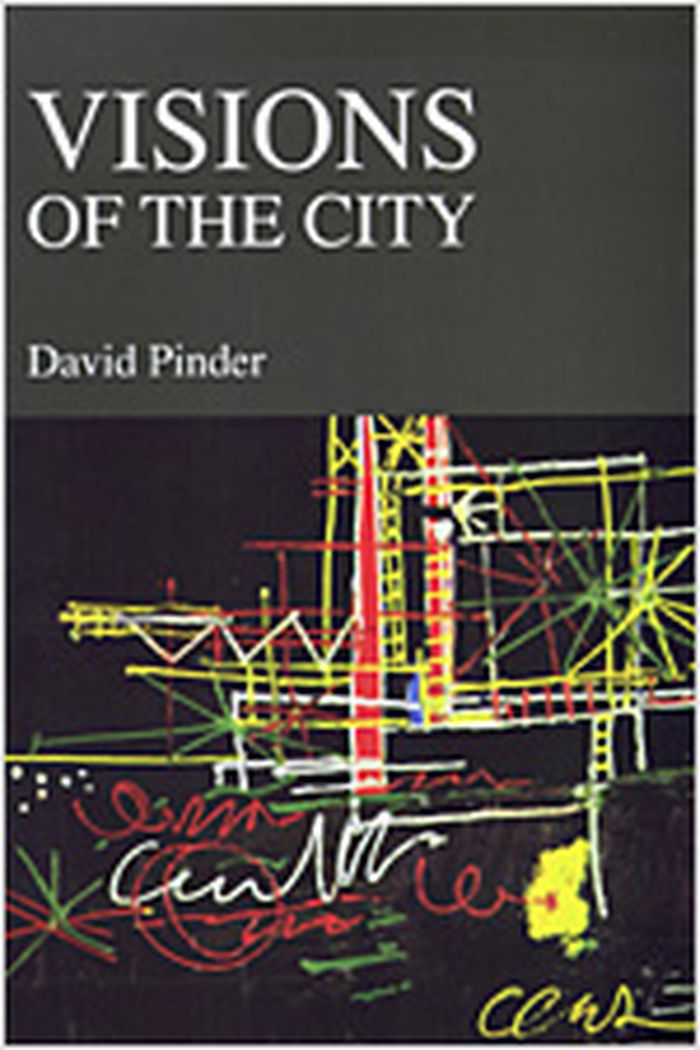
Title:
Visions of the city
Visions of the city
Actions:
Price:
$46.95
(available to order)
Summary:
"Visions of the city" is a dramatic history of utopian urbanism in the twentieth century. It explores radical demands for new spaces and ways of living, and considers their effects on planning, architecture and struggles to shape urban landscapes. The author critically examines influential utopian approaches to urbanism in western Europe associated with such figures as(...)
$46.95
(available to order)
Summary:
"Visions of the city" is a dramatic history of utopian urbanism in the twentieth century. It explores radical demands for new spaces and ways of living, and considers their effects on planning, architecture and struggles to shape urban landscapes. The author critically examines influential utopian approaches to urbanism in western Europe associated with such figures as(...)
Title:
Visions of the city
Actions:
Price:
$46.95
(available to order)
Summary:
"Visions of the city" is a dramatic history of utopian urbanism in the twentieth century. It explores radical demands for new spaces and ways of living, and considers their effects on planning, architecture and struggles to shape urban landscapes. The author critically examines influential utopian approaches to urbanism in western Europe associated with such figures as Ebenezer Howard and Le Corbusier, uncovering the political interests, desires and anxieties that lay behind their ideal cities. He also investigates avant-garde perspectives from the time that challenged these conceptions of cities, especially from within surrealism. At the heart of this richly illustrated book is an encounter with the explosive ideas of the situationists. Tracing the subversive practices of this avant-garde group and its associates from their explorations of Paris during the 1950s to their alternative visions based on nomadic life and play, David Pinder convincingly explains the significance of their revolutionary attempts to transform urban spaces and everyday life. He addresses in particular Constant's New Babylon, finding within his proposals a still powerful provocation to imagine cities otherwise. The book not only recovers vital moments from past hopes and dreams of modern urbanism. It also contests current claims about the 'end of utopia', arguing that reconsidering earlier projects can play a critical role in developing utopian perspectives today. Through the study of utopian visions, it aims to rekindle elements of utopianism itself.
Visions of the city
Actions:
Price:
$46.95
(available to order)
Summary:
"Visions of the city" is a dramatic history of utopian urbanism in the twentieth century. It explores radical demands for new spaces and ways of living, and considers their effects on planning, architecture and struggles to shape urban landscapes. The author critically examines influential utopian approaches to urbanism in western Europe associated with such figures as Ebenezer Howard and Le Corbusier, uncovering the political interests, desires and anxieties that lay behind their ideal cities. He also investigates avant-garde perspectives from the time that challenged these conceptions of cities, especially from within surrealism. At the heart of this richly illustrated book is an encounter with the explosive ideas of the situationists. Tracing the subversive practices of this avant-garde group and its associates from their explorations of Paris during the 1950s to their alternative visions based on nomadic life and play, David Pinder convincingly explains the significance of their revolutionary attempts to transform urban spaces and everyday life. He addresses in particular Constant's New Babylon, finding within his proposals a still powerful provocation to imagine cities otherwise. The book not only recovers vital moments from past hopes and dreams of modern urbanism. It also contests current claims about the 'end of utopia', arguing that reconsidering earlier projects can play a critical role in developing utopian perspectives today. Through the study of utopian visions, it aims to rekindle elements of utopianism itself.
Form:
books
books
Publication:
January 1900, New York, London
January 1900, New York, London
Subject:
Urban Theory
Urban Theory
Form:
books
books
Price:
$41.99
(available in store)
Summary:
Americans spend, on average, 90 percent of their lives indoors, with two-thirds of that time spent in their homes. Globally, the construction and maintenance of residential buildings account for a staggering portion of carbon emissions. In this timely and fascinating work, architect and urban-planning scholar Stefan Al deftly weaves together archaeology, engineering,(...)
$41.99
(available in store)
Summary:
Americans spend, on average, 90 percent of their lives indoors, with two-thirds of that time spent in their homes. Globally, the construction and maintenance of residential buildings account for a staggering portion of carbon emissions. In this timely and fascinating work, architect and urban-planning scholar Stefan Al deftly weaves together archaeology, engineering,(...)
Title:
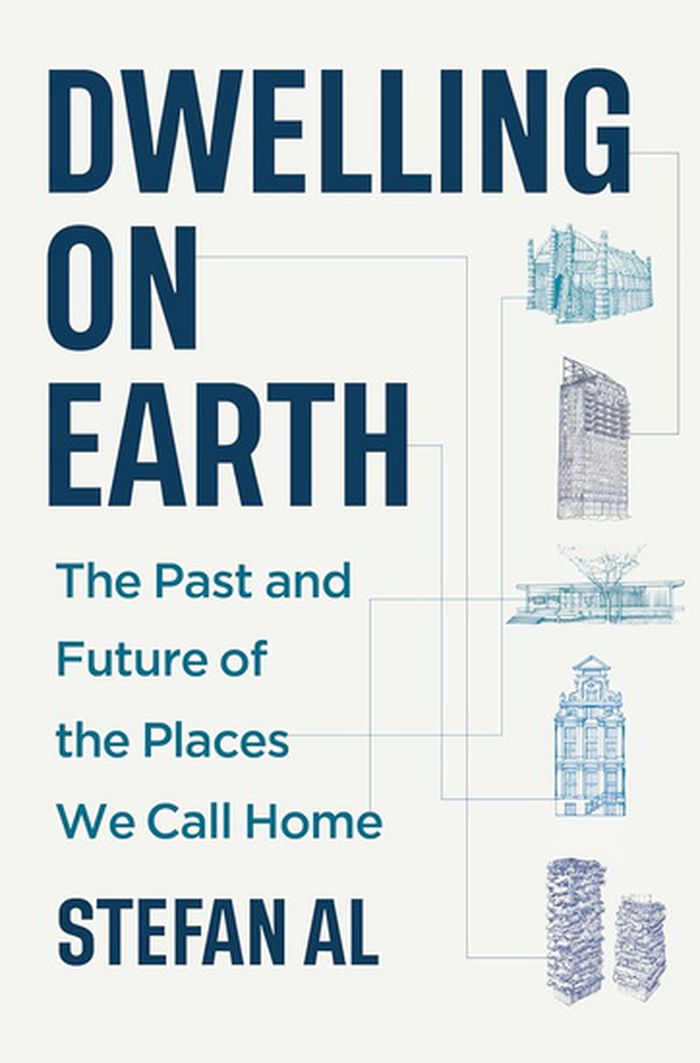
Dwelling on Earth: the past and future of the places we call home
Actions:
Price:
$41.99
(available in store)
Summary:
Americans spend, on average, 90 percent of their lives indoors, with two-thirds of that time spent in their homes. Globally, the construction and maintenance of residential buildings account for a staggering portion of carbon emissions. In this timely and fascinating work, architect and urban-planning scholar Stefan Al deftly weaves together archaeology, engineering, social history, and environmental science to explain how our homes have developed through the ages and in turn shaped civilization and the planet itself. From tiny pit-houses in the Levant and Mesoamerica thousands of years ago to soaring skyscrapers in Dubai, New York, and Shanghai today, ''Dwelling on Earth'' takes readers on a swift and absorbing tour of the evolution of human habitation. Whisking readers from ancient Pompeii to contemporary Hong Kong, industrial-age Liverpool to postwar Levittown, Al shows how our choices in housing have both reflected and affected ideas about gender roles, privacy, and comfort. Discover how seemingly mundane elements—like door-knockers and corridors—have altered everyday interactions, and how material choices have remade the planet's surface. He also confronts the darker side of domesticity, exposing the unintended consequences of our architectural choices across millennia, including smoke-filled Neolithic dwellings, deadly fires in crowded Roman apartment buildings, and worsening social isolation in car-dependent suburbs. Finally, he examines the myths and reality of future housing, including 3D-printed homes and space architecture built by robots.
Dwelling on Earth: the past and future of the places we call home
Actions:
Price:
$41.99
(available in store)
Summary:
Americans spend, on average, 90 percent of their lives indoors, with two-thirds of that time spent in their homes. Globally, the construction and maintenance of residential buildings account for a staggering portion of carbon emissions. In this timely and fascinating work, architect and urban-planning scholar Stefan Al deftly weaves together archaeology, engineering, social history, and environmental science to explain how our homes have developed through the ages and in turn shaped civilization and the planet itself. From tiny pit-houses in the Levant and Mesoamerica thousands of years ago to soaring skyscrapers in Dubai, New York, and Shanghai today, ''Dwelling on Earth'' takes readers on a swift and absorbing tour of the evolution of human habitation. Whisking readers from ancient Pompeii to contemporary Hong Kong, industrial-age Liverpool to postwar Levittown, Al shows how our choices in housing have both reflected and affected ideas about gender roles, privacy, and comfort. Discover how seemingly mundane elements—like door-knockers and corridors—have altered everyday interactions, and how material choices have remade the planet's surface. He also confronts the darker side of domesticity, exposing the unintended consequences of our architectural choices across millennia, including smoke-filled Neolithic dwellings, deadly fires in crowded Roman apartment buildings, and worsening social isolation in car-dependent suburbs. Finally, he examines the myths and reality of future housing, including 3D-printed homes and space architecture built by robots.
Form:
books
books
Publication:
April 2026
April 2026
Subject:
Social
Social


