


26977 Results
Level of archival description:
Series
Series
Title:
Une architecture des humeurs
Une architecture des humeurs
Actions:
Reference number:
AP193.S4
Description:
Series 4, Une architecture des humeurs, 2008-2011, documents the conception and the presentation of exhibition and project Une architecture des humeurs. Presented at Le laboratoire art gallery in Paris between January and May 2010, Une architecture des humeurs is a conceptual, unbuilt, residential urban structure based on a potential future in which contemporary science reads human physiology and chemical balance. The idea is to acquire a chemistry of the “humors”, or the moods and temperament, of future purchasers. Taken as input, the information generates a diversity of habitable morphologies and relationships between them. With this process, the project attempts to make palpable and graspable, through technologies, the emotions of the participants captured via the chemistry of their body. The goal is to gather information on their capacity of adaptation, their level of sympathy and empathy while confronted to a situation or an environment. This information is then analyzed by computational, mathematical, and machinist procedures. This leads to the design and production of an urban structure submitted to the improbable and uncertain protocols produced by emotions, also creating aggregations and layouts that rearticulate the links between the individual and the collective. These structures are calculated following simultaneously incremental and recursive structural optimization protocols resulting in the physicality and morphology of architecture. The layout of the residential units and the structural trajectories are conceived and developed as posterior to the constructs supporting social life and not as an a priori. The structure of each components of the urban structure is generated by a secretion and weaving machine called Viab02. The machine is the second prototype of VIAB which was developed with Robotics Research Lab of the University of Southern California and takes its name from the terms viability and variability. With a process similar to contour crafting, the machine produces bio-cement, a mix between cement and bio-resin, giving form to the adapted residential structures. The records consist largely of images detailing the creative process of the firm, photographs of the exhibition, and 3D models. It also contains animated renderings representing the machine in action and sequences of the construction of the building or the structure. The records include a video orienting the project into François Roche theoretical stance, research as speculation, that can be summarize as the use of technological tools to take a critical and political position through esthetic in order to open new lines of thoughts. AP193.S2 contains updated previous version of the VIAB machine
AP193.S4
Description:
Series 4, Une architecture des humeurs, 2008-2011, documents the conception and the presentation of exhibition and project Une architecture des humeurs. Presented at Le laboratoire art gallery in Paris between January and May 2010, Une architecture des humeurs is a conceptual, unbuilt, residential urban structure based on a potential future in which contemporary science reads human physiology and chemical balance. The idea is to acquire a chemistry of the “humors”, or the moods and temperament, of future purchasers. Taken as input, the information generates a diversity of habitable morphologies and relationships between them. With this process, the project attempts to make palpable and graspable, through technologies, the emotions of the participants captured via the chemistry of their body. The goal is to gather information on their capacity of adaptation, their level of sympathy and empathy while confronted to a situation or an environment. This information is then analyzed by computational, mathematical, and machinist procedures. This leads to the design and production of an urban structure submitted to the improbable and uncertain protocols produced by emotions, also creating aggregations and layouts that rearticulate the links between the individual and the collective. These structures are calculated following simultaneously incremental and recursive structural optimization protocols resulting in the physicality and morphology of architecture. The layout of the residential units and the structural trajectories are conceived and developed as posterior to the constructs supporting social life and not as an a priori. The structure of each components of the urban structure is generated by a secretion and weaving machine called Viab02. The machine is the second prototype of VIAB which was developed with Robotics Research Lab of the University of Southern California and takes its name from the terms viability and variability. With a process similar to contour crafting, the machine produces bio-cement, a mix between cement and bio-resin, giving form to the adapted residential structures. The records consist largely of images detailing the creative process of the firm, photographs of the exhibition, and 3D models. It also contains animated renderings representing the machine in action and sequences of the construction of the building or the structure. The records include a video orienting the project into François Roche theoretical stance, research as speculation, that can be summarize as the use of technological tools to take a critical and political position through esthetic in order to open new lines of thoughts. AP193.S2 contains updated previous version of the VIAB machine
People:
Date:
2008-2011
2008-2011
Title:
Une architecture des humeurs
Actions:
AP193.S4
Description:
Series 4, Une architecture des humeurs, 2008-2011, documents the conception and the presentation of exhibition and project Une architecture des humeurs. Presented at Le laboratoire art gallery in Paris between January and May 2010, Une architecture des humeurs is a conceptual, unbuilt, residential urban structure based on a potential future in which contemporary science reads human physiology and chemical balance. The idea is to acquire a chemistry of the “humors”, or the moods and temperament, of future purchasers. Taken as input, the information generates a diversity of habitable morphologies and relationships between them. With this process, the project attempts to make palpable and graspable, through technologies, the emotions of the participants captured via the chemistry of their body. The goal is to gather information on their capacity of adaptation, their level of sympathy and empathy while confronted to a situation or an environment. This information is then analyzed by computational, mathematical, and machinist procedures. This leads to the design and production of an urban structure submitted to the improbable and uncertain protocols produced by emotions, also creating aggregations and layouts that rearticulate the links between the individual and the collective. These structures are calculated following simultaneously incremental and recursive structural optimization protocols resulting in the physicality and morphology of architecture. The layout of the residential units and the structural trajectories are conceived and developed as posterior to the constructs supporting social life and not as an a priori. The structure of each components of the urban structure is generated by a secretion and weaving machine called Viab02. The machine is the second prototype of VIAB which was developed with Robotics Research Lab of the University of Southern California and takes its name from the terms viability and variability. With a process similar to contour crafting, the machine produces bio-cement, a mix between cement and bio-resin, giving form to the adapted residential structures. The records consist largely of images detailing the creative process of the firm, photographs of the exhibition, and 3D models. It also contains animated renderings representing the machine in action and sequences of the construction of the building or the structure. The records include a video orienting the project into François Roche theoretical stance, research as speculation, that can be summarize as the use of technological tools to take a critical and political position through esthetic in order to open new lines of thoughts. AP193.S2 contains updated previous version of the VIAB machine
Une architecture des humeurs
Actions:
AP193.S4
Description:
Series 4, Une architecture des humeurs, 2008-2011, documents the conception and the presentation of exhibition and project Une architecture des humeurs. Presented at Le laboratoire art gallery in Paris between January and May 2010, Une architecture des humeurs is a conceptual, unbuilt, residential urban structure based on a potential future in which contemporary science reads human physiology and chemical balance. The idea is to acquire a chemistry of the “humors”, or the moods and temperament, of future purchasers. Taken as input, the information generates a diversity of habitable morphologies and relationships between them. With this process, the project attempts to make palpable and graspable, through technologies, the emotions of the participants captured via the chemistry of their body. The goal is to gather information on their capacity of adaptation, their level of sympathy and empathy while confronted to a situation or an environment. This information is then analyzed by computational, mathematical, and machinist procedures. This leads to the design and production of an urban structure submitted to the improbable and uncertain protocols produced by emotions, also creating aggregations and layouts that rearticulate the links between the individual and the collective. These structures are calculated following simultaneously incremental and recursive structural optimization protocols resulting in the physicality and morphology of architecture. The layout of the residential units and the structural trajectories are conceived and developed as posterior to the constructs supporting social life and not as an a priori. The structure of each components of the urban structure is generated by a secretion and weaving machine called Viab02. The machine is the second prototype of VIAB which was developed with Robotics Research Lab of the University of Southern California and takes its name from the terms viability and variability. With a process similar to contour crafting, the machine produces bio-cement, a mix between cement and bio-resin, giving form to the adapted residential structures. The records consist largely of images detailing the creative process of the firm, photographs of the exhibition, and 3D models. It also contains animated renderings representing the machine in action and sequences of the construction of the building or the structure. The records include a video orienting the project into François Roche theoretical stance, research as speculation, that can be summarize as the use of technological tools to take a critical and political position through esthetic in order to open new lines of thoughts. AP193.S2 contains updated previous version of the VIAB machine
Level of archival description:
Series
Series
Date:
2008-2011
2008-2011
People:
Level of archival description:
Project
Project
Title:
Commercial simulation model
Commercial simulation model
Actions:
Reference number:
AP027.S1.D60
Description:
Development of a modelling technique with Conrad Research Corporation that could be used to examine the commercial structure of the City of Ottawa. The essence of this model is the determination of the retail potential of alternative areas throughout the Ottawa area.
AP027.S1.D60
Description:
Development of a modelling technique with Conrad Research Corporation that could be used to examine the commercial structure of the City of Ottawa. The essence of this model is the determination of the retail potential of alternative areas throughout the Ottawa area.
People:
Subject:
urban planning
urban planning
Date:
1972
1972
Title:
Commercial simulation model
Actions:
AP027.S1.D60
Description:
Development of a modelling technique with Conrad Research Corporation that could be used to examine the commercial structure of the City of Ottawa. The essence of this model is the determination of the retail potential of alternative areas throughout the Ottawa area.
Commercial simulation model
Actions:
AP027.S1.D60
Description:
Development of a modelling technique with Conrad Research Corporation that could be used to examine the commercial structure of the City of Ottawa. The essence of this model is the determination of the retail potential of alternative areas throughout the Ottawa area.
Level of archival description:
File 60
File 60
Date:
1972
1972
People:
Subject:
urban planning
urban planning
Level of archival description:
Project
Project
Title:
Teatro-faro a Toronto
Teatro-faro a Toronto
Actions:
Reference number:
AP142.S1.D104
Description:
File documents an executed project titled, "Teatro-faro", erected on the shore of Lake Ontario, in Toronto, Canada. The structure was later dismantled. Material in this file was produced approximately in 1988. File contains design development drawings.
AP142.S1.D104
Description:
File documents an executed project titled, "Teatro-faro", erected on the shore of Lake Ontario, in Toronto, Canada. The structure was later dismantled. Material in this file was produced approximately in 1988. File contains design development drawings.
People:
Date:
[ca. 1988]
[ca. 1988]
Title:
Teatro-faro a Toronto
Actions:
AP142.S1.D104
Description:
File documents an executed project titled, "Teatro-faro", erected on the shore of Lake Ontario, in Toronto, Canada. The structure was later dismantled. Material in this file was produced approximately in 1988. File contains design development drawings.
Teatro-faro a Toronto
Actions:
AP142.S1.D104
Description:
File documents an executed project titled, "Teatro-faro", erected on the shore of Lake Ontario, in Toronto, Canada. The structure was later dismantled. Material in this file was produced approximately in 1988. File contains design development drawings.
Level of archival description:
File 104
File 104
Date:
[ca. 1988]
[ca. 1988]
People:
Level of archival description:
Series
Series
Actions:
Reference number:
AP115.S4
Description:
La série document le dôme géodésique Senneville Barn Dome, dit aussi The Barn Dome. Conçu par la firme Jeffrey Lindsay & Associates, il fut construction en 1954. La série contient une photographie montrant, depuis l'intérieur, la structure géodésique de bois dont l'un des triangles est recouvert d'une membrane de fibre de verre qui enveloppait la structure à l'origine, aujourd'hui disparue et remplacée par des feuilles de métal peint. On aperçoit de plus la silhouette d'un homme travaillant à assembler la structure, vraisemblablement le propriétaire du terrain et client John Hackney, qui a commandé à Jeffrey Lindsay (Montréal, 1924-Los Angeles, 1984), architecte, le dôme en question pour s'en servir comme étable. La photographie est accompagné d'un dossier documentaire contenant des photocopies de documents tirés des archives de Senneville (Plot Plan, Application for Permit to Build, Memorendum) et deux photographies récentes de l'édifice (Robert Duchesnay, photographe, avril 2004).
AP115.S4
Description:
La série document le dôme géodésique Senneville Barn Dome, dit aussi The Barn Dome. Conçu par la firme Jeffrey Lindsay & Associates, il fut construction en 1954. La série contient une photographie montrant, depuis l'intérieur, la structure géodésique de bois dont l'un des triangles est recouvert d'une membrane de fibre de verre qui enveloppait la structure à l'origine, aujourd'hui disparue et remplacée par des feuilles de métal peint. On aperçoit de plus la silhouette d'un homme travaillant à assembler la structure, vraisemblablement le propriétaire du terrain et client John Hackney, qui a commandé à Jeffrey Lindsay (Montréal, 1924-Los Angeles, 1984), architecte, le dôme en question pour s'en servir comme étable. La photographie est accompagné d'un dossier documentaire contenant des photocopies de documents tirés des archives de Senneville (Plot Plan, Application for Permit to Build, Memorendum) et deux photographies récentes de l'édifice (Robert Duchesnay, photographe, avril 2004).
People:
Date:
1954-2004
1954-2004
Title:
Senneville Barn Dome, Senneville, Québec
Actions:
AP115.S4
Description:
La série document le dôme géodésique Senneville Barn Dome, dit aussi The Barn Dome. Conçu par la firme Jeffrey Lindsay & Associates, il fut construction en 1954. La série contient une photographie montrant, depuis l'intérieur, la structure géodésique de bois dont l'un des triangles est recouvert d'une membrane de fibre de verre qui enveloppait la structure à l'origine, aujourd'hui disparue et remplacée par des feuilles de métal peint. On aperçoit de plus la silhouette d'un homme travaillant à assembler la structure, vraisemblablement le propriétaire du terrain et client John Hackney, qui a commandé à Jeffrey Lindsay (Montréal, 1924-Los Angeles, 1984), architecte, le dôme en question pour s'en servir comme étable. La photographie est accompagné d'un dossier documentaire contenant des photocopies de documents tirés des archives de Senneville (Plot Plan, Application for Permit to Build, Memorendum) et deux photographies récentes de l'édifice (Robert Duchesnay, photographe, avril 2004).
Senneville Barn Dome, Senneville, Québec
Actions:
AP115.S4
Description:
La série document le dôme géodésique Senneville Barn Dome, dit aussi The Barn Dome. Conçu par la firme Jeffrey Lindsay & Associates, il fut construction en 1954. La série contient une photographie montrant, depuis l'intérieur, la structure géodésique de bois dont l'un des triangles est recouvert d'une membrane de fibre de verre qui enveloppait la structure à l'origine, aujourd'hui disparue et remplacée par des feuilles de métal peint. On aperçoit de plus la silhouette d'un homme travaillant à assembler la structure, vraisemblablement le propriétaire du terrain et client John Hackney, qui a commandé à Jeffrey Lindsay (Montréal, 1924-Los Angeles, 1984), architecte, le dôme en question pour s'en servir comme étable. La photographie est accompagné d'un dossier documentaire contenant des photocopies de documents tirés des archives de Senneville (Plot Plan, Application for Permit to Build, Memorendum) et deux photographies récentes de l'édifice (Robert Duchesnay, photographe, avril 2004).
Level of archival description:
Série
Série
Date:
1954-2004
1954-2004
People:
Form:
photographs
photographs
Title:
Portrait of Goldsmith
Portrait of Goldsmith
Actions:
Reference number:
ARCH286280
Description:
Note: This photo was used in the CCA exhibition "Myron Goldsmith: Poet of Structure", 1991
ARCH286280
Description:
Note: This photo was used in the CCA exhibition "Myron Goldsmith: Poet of Structure", 1991
People:
Date:
n.d.
n.d.
Title:
Portrait of Goldsmith
Actions:
ARCH286280
Description:
Note: This photo was used in the CCA exhibition "Myron Goldsmith: Poet of Structure", 1991
Portrait of Goldsmith
Actions:
ARCH286280
Description:
Note: This photo was used in the CCA exhibition "Myron Goldsmith: Poet of Structure", 1991
Form:
photographs
photographs
Date:
n.d.
n.d.
People:
Form:
photographs
photographs
Title:
Portrait of Goldsmith
Portrait of Goldsmith
Actions:
Reference number:
ARCH219033
Description:
Note: This photo was used in the CCA exhibition "Myron Goldsmith: Poet of Structure", 1991
ARCH219033
Description:
Note: This photo was used in the CCA exhibition "Myron Goldsmith: Poet of Structure", 1991
People:
Date:
n.d.
n.d.
Title:
Portrait of Goldsmith
Actions:
ARCH219033
Description:
Note: This photo was used in the CCA exhibition "Myron Goldsmith: Poet of Structure", 1991
Portrait of Goldsmith
Actions:
ARCH219033
Description:
Note: This photo was used in the CCA exhibition "Myron Goldsmith: Poet of Structure", 1991
Form:
photographs
photographs
Date:
n.d.
n.d.
People:
Level of archival description:
Project
Project
Title:
BMW Pavilion
BMW Pavilion
Reference number:
AP022.S1.1999.PR03
Description:
File documents an exhibition pavilion with a hydrogen car filling station and a glass structure, Hanover, Germany. This project may have been for the Expo 2000 World Fair held in Hanover. File contains design development drawings.
AP022.S1.1999.PR03
Description:
File documents an exhibition pavilion with a hydrogen car filling station and a glass structure, Hanover, Germany. This project may have been for the Expo 2000 World Fair held in Hanover. File contains design development drawings.
People:
Date:
circa 1999
circa 1999
Title:
BMW Pavilion
Actions:
AP022.S1.1999.PR03
Description:
File documents an exhibition pavilion with a hydrogen car filling station and a glass structure, Hanover, Germany. This project may have been for the Expo 2000 World Fair held in Hanover. File contains design development drawings.
BMW Pavilion
Actions:
AP022.S1.1999.PR03
Description:
File documents an exhibition pavilion with a hydrogen car filling station and a glass structure, Hanover, Germany. This project may have been for the Expo 2000 World Fair held in Hanover. File contains design development drawings.
Level of archival description:
Project
Project
Date:
circa 1999
circa 1999
People:
Level of archival description:
Sub-series
Sub-series
Actions:
Reference number:
AP032.S5.D3
Description:
Colour slides taken by Goldsmith of places and buildings for lectures and teaching. Arranged alphabetically by subject. Includes views of buildings, infra-structure and engineering projects, city-scapes, works by Goldsmith and SOM, and pictures of Goldsmith's family.
AP032.S5.D3
Description:
Colour slides taken by Goldsmith of places and buildings for lectures and teaching. Arranged alphabetically by subject. Includes views of buildings, infra-structure and engineering projects, city-scapes, works by Goldsmith and SOM, and pictures of Goldsmith's family.
People:
Date:
1967-1983
1967-1983
Title:
Architects and Architecture Slides
Actions:
AP032.S5.D3
Description:
Colour slides taken by Goldsmith of places and buildings for lectures and teaching. Arranged alphabetically by subject. Includes views of buildings, infra-structure and engineering projects, city-scapes, works by Goldsmith and SOM, and pictures of Goldsmith's family.
Architects and Architecture Slides
Actions:
AP032.S5.D3
Description:
Colour slides taken by Goldsmith of places and buildings for lectures and teaching. Arranged alphabetically by subject. Includes views of buildings, infra-structure and engineering projects, city-scapes, works by Goldsmith and SOM, and pictures of Goldsmith's family.
Level of archival description:
File 3
File 3
Date:
1967-1983
1967-1983
People:
Form:
photographs
photographs
Actions:
Reference number:
ARCH256546
Description:
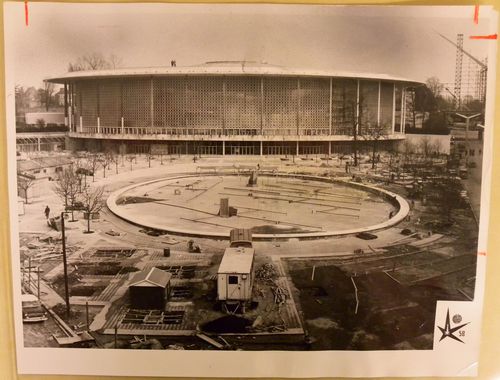
"U.S. pavilion is largest free-span circular structure in existence, more vast that Rome's Colosseum."
ARCH256546
Description:
"U.S. pavilion is largest free-span circular structure in existence, more vast that Rome's Colosseum."
People:
Date:
9 April 1958
9 April 1958
Title:
View of the Pavilion of the United States, Expo 58, Brussels, Belgium
Actions:
ARCH256546
Description:
"U.S. pavilion is largest free-span circular structure in existence, more vast that Rome's Colosseum."
View of the Pavilion of the United States, Expo 58, Brussels, Belgium
Actions:
ARCH256546
Description:
"U.S. pavilion is largest free-span circular structure in existence, more vast that Rome's Colosseum."
Form:
photographs
photographs
Date:
9 April 1958
9 April 1958
People:
Form:
photographs
Quantity:
151 slide(s)
photographs
Quantity:
151 slide(s)
Title:
Transportation
Transportation
Actions:
Reference number:
ARCH218403
Description:
including Bart San Francisco, metro stations Paris, Munich train shed elevated structure and Rome
ARCH218403
Description:
including Bart San Francisco, metro stations Paris, Munich train shed elevated structure and Rome
People:
Title:
Transportation
Actions:
ARCH218403
Description:
including Bart San Francisco, metro stations Paris, Munich train shed elevated structure and Rome
Transportation
Actions:
ARCH218403
Description:
including Bart San Francisco, metro stations Paris, Munich train shed elevated structure and Rome
Form:
photographs
Quantity:
151 slide(s)
photographs
Quantity:
151 slide(s)
People:


