


12622 Results
Form:
textual records
textual records
Title:
DDR - IAUS
DDR - IAUS
Reference number:
ARCH153471
Description:
Address of Rust Welch in The Hague, on a card Membership Campaign - The Drawing Center, submitted to The New York Community Trust; Nov. 1, 1978. Report from the Rockefeller Foundation Training Fellows in Museum Education at the Metropolitan Museum of Art 1974-75. (article on Paul J. Sachs) Description of the exhibition "Musical Manuscripts" by A. Ciniglio Ada V. Ciniglio, "Pioneers in American Museums: Paul J. Sachs", Museum News, September/October 1976, pp 48-51 & 68-71. Curriculum Vitae of Vladimir Paperny Letter from John Burgee to Gerald D. Hines Interest (about conference at the Institute); April 23, 1981. Letter to Peter Eisenman from S.L. Solomon, Harvard University, April 14, 1981. Xerox from the Postmaster about new Zip code of the IAUS Hand notes of Peter Eisenman on yellow paper (Spanish cultural affairs) Memo to Peter Wolf from Peter Eisenman: 1 September 1972 (confirmation of Wolf's nomitation as Chairman of the Board of Fellows). IAUS Alumni news report : 1 page
ARCH153471
Description:
Address of Rust Welch in The Hague, on a card Membership Campaign - The Drawing Center, submitted to The New York Community Trust; Nov. 1, 1978. Report from the Rockefeller Foundation Training Fellows in Museum Education at the Metropolitan Museum of Art 1974-75. (article on Paul J. Sachs) Description of the exhibition "Musical Manuscripts" by A. Ciniglio Ada V. Ciniglio, "Pioneers in American Museums: Paul J. Sachs", Museum News, September/October 1976, pp 48-51 & 68-71. Curriculum Vitae of Vladimir Paperny Letter from John Burgee to Gerald D. Hines Interest (about conference at the Institute); April 23, 1981. Letter to Peter Eisenman from S.L. Solomon, Harvard University, April 14, 1981. Xerox from the Postmaster about new Zip code of the IAUS Hand notes of Peter Eisenman on yellow paper (Spanish cultural affairs) Memo to Peter Wolf from Peter Eisenman: 1 September 1972 (confirmation of Wolf's nomitation as Chairman of the Board of Fellows). IAUS Alumni news report : 1 page
People:
Date:
1968-1978, 1981
1968-1978, 1981
Title:
DDR - IAUS
Actions:
ARCH153471
Description:
Address of Rust Welch in The Hague, on a card Membership Campaign - The Drawing Center, submitted to The New York Community Trust; Nov. 1, 1978. Report from the Rockefeller Foundation Training Fellows in Museum Education at the Metropolitan Museum of Art 1974-75. (article on Paul J. Sachs) Description of the exhibition "Musical Manuscripts" by A. Ciniglio Ada V. Ciniglio, "Pioneers in American Museums: Paul J. Sachs", Museum News, September/October 1976, pp 48-51 & 68-71. Curriculum Vitae of Vladimir Paperny Letter from John Burgee to Gerald D. Hines Interest (about conference at the Institute); April 23, 1981. Letter to Peter Eisenman from S.L. Solomon, Harvard University, April 14, 1981. Xerox from the Postmaster about new Zip code of the IAUS Hand notes of Peter Eisenman on yellow paper (Spanish cultural affairs) Memo to Peter Wolf from Peter Eisenman: 1 September 1972 (confirmation of Wolf's nomitation as Chairman of the Board of Fellows). IAUS Alumni news report : 1 page
DDR - IAUS
Actions:
ARCH153471
Description:
Address of Rust Welch in The Hague, on a card Membership Campaign - The Drawing Center, submitted to The New York Community Trust; Nov. 1, 1978. Report from the Rockefeller Foundation Training Fellows in Museum Education at the Metropolitan Museum of Art 1974-75. (article on Paul J. Sachs) Description of the exhibition "Musical Manuscripts" by A. Ciniglio Ada V. Ciniglio, "Pioneers in American Museums: Paul J. Sachs", Museum News, September/October 1976, pp 48-51 & 68-71. Curriculum Vitae of Vladimir Paperny Letter from John Burgee to Gerald D. Hines Interest (about conference at the Institute); April 23, 1981. Letter to Peter Eisenman from S.L. Solomon, Harvard University, April 14, 1981. Xerox from the Postmaster about new Zip code of the IAUS Hand notes of Peter Eisenman on yellow paper (Spanish cultural affairs) Memo to Peter Wolf from Peter Eisenman: 1 September 1972 (confirmation of Wolf's nomitation as Chairman of the Board of Fellows). IAUS Alumni news report : 1 page
Form:
textual records
textual records
Date:
1968-1978, 1981
1968-1978, 1981
People:
Level of archival description:
Project
Project
Title:
Antas, Porto
Antas, Porto
Actions:
Reference number:
CD034.S1.1974.PR03
Description:
This project series contains reproductions of drawings and photographs displayed in the exhibit to document the Antas neighbourhood, in Porto, Portugal. The exhibit text explained that: ... the SAAL Brigade intervened at the heart of an urban area which then became subject to redevelopments after the construction of the first units. The original proposal and the completed phases contrast the scale of later operations and change the perception of the original project. Nonetheless, the architectural design addressed a difficult terrain, and maintained the specificities of the urban 'ilhas' (islands) by incorporating a vernacular character, which the residents appropriated and transformed even further overtime. (The SAAL Process, Housing in Portugal 1974–76) The project architect Pedro Ramalho worked for SAAL/North with Aires Pereira, Augusto Costa, Francisco M. Lima, José Lencastre, Lídia Costa, Pedro B. Araújo, Teresa Fonseca, Vítor Bastos and the residents' association Antas, that was founded on Septermber 1st, 1975. The first phase of the project included 32 dwellings and the second, 50 dwellings. The operation began in October 1974, with a construction date in October 1975. This project series contains reproductions of design development drawings, implementation plans, axonometric views and photographic material. The original drawings and photographs were produced in 1975 and 1976 and were reproduced in 2015 for the exhibit.
CD034.S1.1974.PR03
Description:
This project series contains reproductions of drawings and photographs displayed in the exhibit to document the Antas neighbourhood, in Porto, Portugal. The exhibit text explained that: ... the SAAL Brigade intervened at the heart of an urban area which then became subject to redevelopments after the construction of the first units. The original proposal and the completed phases contrast the scale of later operations and change the perception of the original project. Nonetheless, the architectural design addressed a difficult terrain, and maintained the specificities of the urban 'ilhas' (islands) by incorporating a vernacular character, which the residents appropriated and transformed even further overtime. (The SAAL Process, Housing in Portugal 1974–76) The project architect Pedro Ramalho worked for SAAL/North with Aires Pereira, Augusto Costa, Francisco M. Lima, José Lencastre, Lídia Costa, Pedro B. Araújo, Teresa Fonseca, Vítor Bastos and the residents' association Antas, that was founded on Septermber 1st, 1975. The first phase of the project included 32 dwellings and the second, 50 dwellings. The operation began in October 1974, with a construction date in October 1975. This project series contains reproductions of design development drawings, implementation plans, axonometric views and photographic material. The original drawings and photographs were produced in 1975 and 1976 and were reproduced in 2015 for the exhibit.
People:
Date:
1975-1976
1975-1976
Title:
Antas, Porto
Actions:
CD034.S1.1974.PR03
Description:
This project series contains reproductions of drawings and photographs displayed in the exhibit to document the Antas neighbourhood, in Porto, Portugal. The exhibit text explained that: ... the SAAL Brigade intervened at the heart of an urban area which then became subject to redevelopments after the construction of the first units. The original proposal and the completed phases contrast the scale of later operations and change the perception of the original project. Nonetheless, the architectural design addressed a difficult terrain, and maintained the specificities of the urban 'ilhas' (islands) by incorporating a vernacular character, which the residents appropriated and transformed even further overtime. (The SAAL Process, Housing in Portugal 1974–76) The project architect Pedro Ramalho worked for SAAL/North with Aires Pereira, Augusto Costa, Francisco M. Lima, José Lencastre, Lídia Costa, Pedro B. Araújo, Teresa Fonseca, Vítor Bastos and the residents' association Antas, that was founded on Septermber 1st, 1975. The first phase of the project included 32 dwellings and the second, 50 dwellings. The operation began in October 1974, with a construction date in October 1975. This project series contains reproductions of design development drawings, implementation plans, axonometric views and photographic material. The original drawings and photographs were produced in 1975 and 1976 and were reproduced in 2015 for the exhibit.
Antas, Porto
Actions:
CD034.S1.1974.PR03
Description:
This project series contains reproductions of drawings and photographs displayed in the exhibit to document the Antas neighbourhood, in Porto, Portugal. The exhibit text explained that: ... the SAAL Brigade intervened at the heart of an urban area which then became subject to redevelopments after the construction of the first units. The original proposal and the completed phases contrast the scale of later operations and change the perception of the original project. Nonetheless, the architectural design addressed a difficult terrain, and maintained the specificities of the urban 'ilhas' (islands) by incorporating a vernacular character, which the residents appropriated and transformed even further overtime. (The SAAL Process, Housing in Portugal 1974–76) The project architect Pedro Ramalho worked for SAAL/North with Aires Pereira, Augusto Costa, Francisco M. Lima, José Lencastre, Lídia Costa, Pedro B. Araújo, Teresa Fonseca, Vítor Bastos and the residents' association Antas, that was founded on Septermber 1st, 1975. The first phase of the project included 32 dwellings and the second, 50 dwellings. The operation began in October 1974, with a construction date in October 1975. This project series contains reproductions of design development drawings, implementation plans, axonometric views and photographic material. The original drawings and photographs were produced in 1975 and 1976 and were reproduced in 2015 for the exhibit.
Level of archival description:
Project
Project
Date:
1975-1976
1975-1976
People:
Level of archival description:
Project
Project
Actions:
Reference number:
AP164.S1.1997.D12
Description:
The subseries documents the show-event base “Fabricaciones / Fabrications,” held at the Museu d'Art Contemporani de Barcelona (MACBA) (February 10th to April 20th, 1998). The firm identified this project as number 110. “Fabrications was an innovative exhibition on architecture conceived and produced jointly by MACBA, MoMA, the Wexner Center for the Arts and the San Francisco Museum of Modern Art. The exhibition presented sixteen life-size architectural interventions, four at each participating center, each produced by a team of architects who explored tectonic issues in a broad sense. The four installations presented at Plaça dels Àngels – the square in front of the MACBA building – explored and modified the surfaces that defined this public space. Vicente Gualla (Barcelona) created an intervention on the façade opposite the Museum, which drew attention to the occupation and the population density that was absent from the buildings in the square. Abalos & Herreros (Madrid) acted upon the façade of the MACBA building itself, cladding and decorating its most monumental elements: the tower and the balcony. Riegler Riewe (Graz) worked with the whole of the square, inscribing a broken horizontal line along the perimeter of the public space. Finally, MVRDV (Rotterdam) acted upon the paving through an evocation of a series of different kinds of sports grounds.” (MACBA website) Documenting the exhibition are design development drawings, correspondence, project descriptions, budgets, notes, and reference, graphic and photographic materials.
AP164.S1.1997.D12
Description:
The subseries documents the show-event base “Fabricaciones / Fabrications,” held at the Museu d'Art Contemporani de Barcelona (MACBA) (February 10th to April 20th, 1998). The firm identified this project as number 110. “Fabrications was an innovative exhibition on architecture conceived and produced jointly by MACBA, MoMA, the Wexner Center for the Arts and the San Francisco Museum of Modern Art. The exhibition presented sixteen life-size architectural interventions, four at each participating center, each produced by a team of architects who explored tectonic issues in a broad sense. The four installations presented at Plaça dels Àngels – the square in front of the MACBA building – explored and modified the surfaces that defined this public space. Vicente Gualla (Barcelona) created an intervention on the façade opposite the Museum, which drew attention to the occupation and the population density that was absent from the buildings in the square. Abalos & Herreros (Madrid) acted upon the façade of the MACBA building itself, cladding and decorating its most monumental elements: the tower and the balcony. Riegler Riewe (Graz) worked with the whole of the square, inscribing a broken horizontal line along the perimeter of the public space. Finally, MVRDV (Rotterdam) acted upon the paving through an evocation of a series of different kinds of sports grounds.” (MACBA website) Documenting the exhibition are design development drawings, correspondence, project descriptions, budgets, notes, and reference, graphic and photographic materials.
People:
Date:
1996-2002
1996-2002
Title:
MACBA [Museu d'Art Contemporani de Barcelona] (1997)
Actions:
AP164.S1.1997.D12
Description:
The subseries documents the show-event base “Fabricaciones / Fabrications,” held at the Museu d'Art Contemporani de Barcelona (MACBA) (February 10th to April 20th, 1998). The firm identified this project as number 110. “Fabrications was an innovative exhibition on architecture conceived and produced jointly by MACBA, MoMA, the Wexner Center for the Arts and the San Francisco Museum of Modern Art. The exhibition presented sixteen life-size architectural interventions, four at each participating center, each produced by a team of architects who explored tectonic issues in a broad sense. The four installations presented at Plaça dels Àngels – the square in front of the MACBA building – explored and modified the surfaces that defined this public space. Vicente Gualla (Barcelona) created an intervention on the façade opposite the Museum, which drew attention to the occupation and the population density that was absent from the buildings in the square. Abalos & Herreros (Madrid) acted upon the façade of the MACBA building itself, cladding and decorating its most monumental elements: the tower and the balcony. Riegler Riewe (Graz) worked with the whole of the square, inscribing a broken horizontal line along the perimeter of the public space. Finally, MVRDV (Rotterdam) acted upon the paving through an evocation of a series of different kinds of sports grounds.” (MACBA website) Documenting the exhibition are design development drawings, correspondence, project descriptions, budgets, notes, and reference, graphic and photographic materials.
MACBA [Museu d'Art Contemporani de Barcelona] (1997)
Actions:
AP164.S1.1997.D12
Description:
The subseries documents the show-event base “Fabricaciones / Fabrications,” held at the Museu d'Art Contemporani de Barcelona (MACBA) (February 10th to April 20th, 1998). The firm identified this project as number 110. “Fabrications was an innovative exhibition on architecture conceived and produced jointly by MACBA, MoMA, the Wexner Center for the Arts and the San Francisco Museum of Modern Art. The exhibition presented sixteen life-size architectural interventions, four at each participating center, each produced by a team of architects who explored tectonic issues in a broad sense. The four installations presented at Plaça dels Àngels – the square in front of the MACBA building – explored and modified the surfaces that defined this public space. Vicente Gualla (Barcelona) created an intervention on the façade opposite the Museum, which drew attention to the occupation and the population density that was absent from the buildings in the square. Abalos & Herreros (Madrid) acted upon the façade of the MACBA building itself, cladding and decorating its most monumental elements: the tower and the balcony. Riegler Riewe (Graz) worked with the whole of the square, inscribing a broken horizontal line along the perimeter of the public space. Finally, MVRDV (Rotterdam) acted upon the paving through an evocation of a series of different kinds of sports grounds.” (MACBA website) Documenting the exhibition are design development drawings, correspondence, project descriptions, budgets, notes, and reference, graphic and photographic materials.
Level of archival description:
Project
Project
Date:
1996-2002
1996-2002
People:
Level of archival description:
Sub-series
Sub-series
Title:
Student work
Student work
Reference number:
AP140.S1.SS1
Description:
Sub-series documents James Stirling's student work, probably from his third to fifth year at the Liverpool School of Architecture in Liverpool, England, from 1947 to 1950, and during his studies at the Association for Planning and Regional Reconstruction in London, England, from 1950 to 1952. A project for a Community Centre for a Small Town in the Middle West was probably produced during a student exchange in New York City, New York in the fall of 1948. Sub-series include projects for a Forest Rangers Lookout Station, a House for an Architect, Organic Chemistry Laboratories, Stirling's thesis project for a Town Centre and Community Centre and a student competition entry for the Merseyside Film Institute. Material in this sub-series was probably produced between 1947 and 1975. The publication drawings for James Stirling's projects were often drawn by Leon Krier, Russell Bevington, or Ulrich Schaad ('British Architecture Today', 1991). Sub-series contains several presentation drawings and panels, publication drawings, a small number of working drawings, photographic materials, a presentation model and Stirling's 1950 bound thesis 'Plan of Town Centre and Development of Community Centre for Newton Aycliffe, Co. Durham'.
AP140.S1.SS1
Description:
Sub-series documents James Stirling's student work, probably from his third to fifth year at the Liverpool School of Architecture in Liverpool, England, from 1947 to 1950, and during his studies at the Association for Planning and Regional Reconstruction in London, England, from 1950 to 1952. A project for a Community Centre for a Small Town in the Middle West was probably produced during a student exchange in New York City, New York in the fall of 1948. Sub-series include projects for a Forest Rangers Lookout Station, a House for an Architect, Organic Chemistry Laboratories, Stirling's thesis project for a Town Centre and Community Centre and a student competition entry for the Merseyside Film Institute. Material in this sub-series was probably produced between 1947 and 1975. The publication drawings for James Stirling's projects were often drawn by Leon Krier, Russell Bevington, or Ulrich Schaad ('British Architecture Today', 1991). Sub-series contains several presentation drawings and panels, publication drawings, a small number of working drawings, photographic materials, a presentation model and Stirling's 1950 bound thesis 'Plan of Town Centre and Development of Community Centre for Newton Aycliffe, Co. Durham'.
People:
Date:
[between 1947? and 1975?], predominant 1947-1952
[between 1947? and 1975?], predominant 1947-1952
Title:
Student work
Actions:
AP140.S1.SS1
Description:
Sub-series documents James Stirling's student work, probably from his third to fifth year at the Liverpool School of Architecture in Liverpool, England, from 1947 to 1950, and during his studies at the Association for Planning and Regional Reconstruction in London, England, from 1950 to 1952. A project for a Community Centre for a Small Town in the Middle West was probably produced during a student exchange in New York City, New York in the fall of 1948. Sub-series include projects for a Forest Rangers Lookout Station, a House for an Architect, Organic Chemistry Laboratories, Stirling's thesis project for a Town Centre and Community Centre and a student competition entry for the Merseyside Film Institute. Material in this sub-series was probably produced between 1947 and 1975. The publication drawings for James Stirling's projects were often drawn by Leon Krier, Russell Bevington, or Ulrich Schaad ('British Architecture Today', 1991). Sub-series contains several presentation drawings and panels, publication drawings, a small number of working drawings, photographic materials, a presentation model and Stirling's 1950 bound thesis 'Plan of Town Centre and Development of Community Centre for Newton Aycliffe, Co. Durham'.
Student work
Actions:
AP140.S1.SS1
Description:
Sub-series documents James Stirling's student work, probably from his third to fifth year at the Liverpool School of Architecture in Liverpool, England, from 1947 to 1950, and during his studies at the Association for Planning and Regional Reconstruction in London, England, from 1950 to 1952. A project for a Community Centre for a Small Town in the Middle West was probably produced during a student exchange in New York City, New York in the fall of 1948. Sub-series include projects for a Forest Rangers Lookout Station, a House for an Architect, Organic Chemistry Laboratories, Stirling's thesis project for a Town Centre and Community Centre and a student competition entry for the Merseyside Film Institute. Material in this sub-series was probably produced between 1947 and 1975. The publication drawings for James Stirling's projects were often drawn by Leon Krier, Russell Bevington, or Ulrich Schaad ('British Architecture Today', 1991). Sub-series contains several presentation drawings and panels, publication drawings, a small number of working drawings, photographic materials, a presentation model and Stirling's 1950 bound thesis 'Plan of Town Centre and Development of Community Centre for Newton Aycliffe, Co. Durham'.
Level of archival description:
Sub-series 1
Sub-series 1
Date:
[between 1947? and 1975?], predominant 1947-1952
[between 1947? and 1975?], predominant 1947-1952
People:
Level of archival description:
Project
Project
Reference number:
CI005.S1.1921.PR1
Description:
German architectural critic, Adolf Behne, requested Oud submit a design for a private house that was to be built for private clients in Berlin-Grünewald in 1921. Although Oud's designs never came to fruition, the project promoted his international reputation, with his designs circulating in lectures and publications. Behn, who maintained a correspondence with Oud, helped introduce Oud to the international scene with a positive review of his designs, including one for Villa Kallenbach. Oud's design was in stark contrast to the prevailing contemporary German aesthetic of Expressionism. Oud created a functional symmetric design for a detached, spacious country dwelling; he placed the building toward the anterior of the site and angled the front away from the street to take advantage of the sunlight and garden space (Taverne et al. 2001, 312-317). Oud made some modifications based on the client's desire to enlarge the ground floor in February, 1922. Project series includes drawings of plans and elevations.
CI005.S1.1921.PR1
Description:
German architectural critic, Adolf Behne, requested Oud submit a design for a private house that was to be built for private clients in Berlin-Grünewald in 1921. Although Oud's designs never came to fruition, the project promoted his international reputation, with his designs circulating in lectures and publications. Behn, who maintained a correspondence with Oud, helped introduce Oud to the international scene with a positive review of his designs, including one for Villa Kallenbach. Oud's design was in stark contrast to the prevailing contemporary German aesthetic of Expressionism. Oud created a functional symmetric design for a detached, spacious country dwelling; he placed the building toward the anterior of the site and angled the front away from the street to take advantage of the sunlight and garden space (Taverne et al. 2001, 312-317). Oud made some modifications based on the client's desire to enlarge the ground floor in February, 1922. Project series includes drawings of plans and elevations.
People:
Date:
1921-1922
1921-1922
Title:
Project for the Kallenbach House, Berlin, Germany (1921-1922)
Actions:
CI005.S1.1921.PR1
Description:
German architectural critic, Adolf Behne, requested Oud submit a design for a private house that was to be built for private clients in Berlin-Grünewald in 1921. Although Oud's designs never came to fruition, the project promoted his international reputation, with his designs circulating in lectures and publications. Behn, who maintained a correspondence with Oud, helped introduce Oud to the international scene with a positive review of his designs, including one for Villa Kallenbach. Oud's design was in stark contrast to the prevailing contemporary German aesthetic of Expressionism. Oud created a functional symmetric design for a detached, spacious country dwelling; he placed the building toward the anterior of the site and angled the front away from the street to take advantage of the sunlight and garden space (Taverne et al. 2001, 312-317). Oud made some modifications based on the client's desire to enlarge the ground floor in February, 1922. Project series includes drawings of plans and elevations.
Project for the Kallenbach House, Berlin, Germany (1921-1922)
Actions:
CI005.S1.1921.PR1
Description:
German architectural critic, Adolf Behne, requested Oud submit a design for a private house that was to be built for private clients in Berlin-Grünewald in 1921. Although Oud's designs never came to fruition, the project promoted his international reputation, with his designs circulating in lectures and publications. Behn, who maintained a correspondence with Oud, helped introduce Oud to the international scene with a positive review of his designs, including one for Villa Kallenbach. Oud's design was in stark contrast to the prevailing contemporary German aesthetic of Expressionism. Oud created a functional symmetric design for a detached, spacious country dwelling; he placed the building toward the anterior of the site and angled the front away from the street to take advantage of the sunlight and garden space (Taverne et al. 2001, 312-317). Oud made some modifications based on the client's desire to enlarge the ground floor in February, 1922. Project series includes drawings of plans and elevations.
Level of archival description:
project
project
Date:
1921-1922
1921-1922
People:
Level of archival description:
Project
Project
Actions:
Reference number:
AP018.S1.1978.PR07
Description:
This project series documents a site study for the new National Gallery of Canada in Ottawa, Ontario in 1978. The office identified the project number as 7809. In 1977, Parkin Architects Planners won a limited architectural competition for their design of the new National Gallery of Canada. The selected site for the competition, next to the Ottawa River, was controversial due to its uneven ground and lack of access to main streets in Ottawa. This project consisted of an extended site study for the construction of that building following the announcement of the competition winner if the original site was to be used. This was a brief urban design study to consider appropriate massing, exterior spaces, access, and vistas to and from the proposed building. It also included studying the best use of land next to the new gallery. The project is recorded through drawings and textual records dating from 1976-1978. The textual records include the predesign programme and schemes, correspondence, notes, meeting reports and research.
AP018.S1.1978.PR07
Description:
This project series documents a site study for the new National Gallery of Canada in Ottawa, Ontario in 1978. The office identified the project number as 7809. In 1977, Parkin Architects Planners won a limited architectural competition for their design of the new National Gallery of Canada. The selected site for the competition, next to the Ottawa River, was controversial due to its uneven ground and lack of access to main streets in Ottawa. This project consisted of an extended site study for the construction of that building following the announcement of the competition winner if the original site was to be used. This was a brief urban design study to consider appropriate massing, exterior spaces, access, and vistas to and from the proposed building. It also included studying the best use of land next to the new gallery. The project is recorded through drawings and textual records dating from 1976-1978. The textual records include the predesign programme and schemes, correspondence, notes, meeting reports and research.
People:
Date:
1976-1978
1976-1978
Title:
National Gallery of Canada, Extended Site Study, Ottawa, Ontario (1978)
Actions:
AP018.S1.1978.PR07
Description:
This project series documents a site study for the new National Gallery of Canada in Ottawa, Ontario in 1978. The office identified the project number as 7809. In 1977, Parkin Architects Planners won a limited architectural competition for their design of the new National Gallery of Canada. The selected site for the competition, next to the Ottawa River, was controversial due to its uneven ground and lack of access to main streets in Ottawa. This project consisted of an extended site study for the construction of that building following the announcement of the competition winner if the original site was to be used. This was a brief urban design study to consider appropriate massing, exterior spaces, access, and vistas to and from the proposed building. It also included studying the best use of land next to the new gallery. The project is recorded through drawings and textual records dating from 1976-1978. The textual records include the predesign programme and schemes, correspondence, notes, meeting reports and research.
National Gallery of Canada, Extended Site Study, Ottawa, Ontario (1978)
Actions:
AP018.S1.1978.PR07
Description:
This project series documents a site study for the new National Gallery of Canada in Ottawa, Ontario in 1978. The office identified the project number as 7809. In 1977, Parkin Architects Planners won a limited architectural competition for their design of the new National Gallery of Canada. The selected site for the competition, next to the Ottawa River, was controversial due to its uneven ground and lack of access to main streets in Ottawa. This project consisted of an extended site study for the construction of that building following the announcement of the competition winner if the original site was to be used. This was a brief urban design study to consider appropriate massing, exterior spaces, access, and vistas to and from the proposed building. It also included studying the best use of land next to the new gallery. The project is recorded through drawings and textual records dating from 1976-1978. The textual records include the predesign programme and schemes, correspondence, notes, meeting reports and research.
Level of archival description:
Project
Project
Date:
1976-1978
1976-1978
People:
Form:
exhibitions
exhibitions
Description:
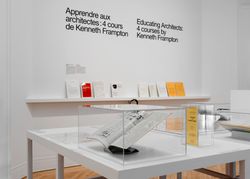
Amid education reform in American schools of architecture in the 1970s, Kenneth Frampton was integral in transforming the curriculum of Columbia University’s Graduate School of Architecture Planning. In particular, he designed and taught what became three core courses: the theory seminar “Comparative Critical Analysis,” the history lectures “Thresholds of Modern(...)
Amid education reform in American schools of architecture in the 1970s, Kenneth Frampton was integral in transforming the curriculum of Columbia University’s Graduate School of Architecture Planning. In particular, he designed and taught what became three core courses: the theory seminar “Comparative Critical Analysis,” the history lectures “Thresholds of Modern(...)
Date:
31 May 2017 to 24 September 2017
31 May 2017 to 24 September 2017
Title:
Educating Architects: Four Courses by Kenneth Frampton
Actions:
Description:
Amid education reform in American schools of architecture in the 1970s, Kenneth Frampton was integral in transforming the curriculum of Columbia University’s Graduate School of Architecture Planning. In particular, he designed and taught what became three core courses: the theory seminar “Comparative Critical Analysis,” the history lectures “Thresholds of Modern(...)
Educating Architects: Four Courses by Kenneth Frampton
Actions:
Description:
Amid education reform in American schools of architecture in the 1970s, Kenneth Frampton was integral in transforming the curriculum of Columbia University’s Graduate School of Architecture Planning. In particular, he designed and taught what became three core courses: the theory seminar “Comparative Critical Analysis,” the history lectures “Thresholds of Modern(...)
Form:
exhibitions
exhibitions
Date:
31 May 2017 to
24 September 2017
31 May 2017 to
24 September 2017
Level of archival description:
Project
Project
Actions:
Reference number:
AP075.S1.2000.PR09
Description:
Project series documents Cornelia Hahn Oberlander's proposal for the landscape projet for the Portside expansion of the Vancouver Convention Centre. Oberlander worked in this project in 2005 with architectural firm Downs, Archambault & Partners Architects and Musson Cattel Mackey Partnership. The team had previously worked together on another project of expansion and redesign of the portiside in the mid-1980s for Canada Place. Like for the previous project, Oberlander's concept design was intended as a way of creating a link between the sea and the city and ease public access to the portside. Oberlander design raised precast planters with a selection of plants and trees adapted to the Burrad Inlet for the promenade. She was also in charge of the landscape design for the terraced roofscape above the new lobby of the Convention Centre, and the planters lining the pedestrian connection to the waterfront walkway. The project series contains design development drawings, including landscape plans, and details for planters, reference drawings of the existing landscape, and working drawings, including landscape plans, irrigation plans, and planting plans. The project is also documented through correspondence, including correspondence with architects, clients, consultants and contractors, Oberlander's concept notes, proposal for the landscape concept, documents related to the plant selection, financial documents, press clippings on the project, and photographs of the planting.
AP075.S1.2000.PR09
Description:
Project series documents Cornelia Hahn Oberlander's proposal for the landscape projet for the Portside expansion of the Vancouver Convention Centre. Oberlander worked in this project in 2005 with architectural firm Downs, Archambault & Partners Architects and Musson Cattel Mackey Partnership. The team had previously worked together on another project of expansion and redesign of the portiside in the mid-1980s for Canada Place. Like for the previous project, Oberlander's concept design was intended as a way of creating a link between the sea and the city and ease public access to the portside. Oberlander design raised precast planters with a selection of plants and trees adapted to the Burrad Inlet for the promenade. She was also in charge of the landscape design for the terraced roofscape above the new lobby of the Convention Centre, and the planters lining the pedestrian connection to the waterfront walkway. The project series contains design development drawings, including landscape plans, and details for planters, reference drawings of the existing landscape, and working drawings, including landscape plans, irrigation plans, and planting plans. The project is also documented through correspondence, including correspondence with architects, clients, consultants and contractors, Oberlander's concept notes, proposal for the landscape concept, documents related to the plant selection, financial documents, press clippings on the project, and photographs of the planting.
People:
Date:
1999-2005
1999-2005
Title:
Vancouver Convention Centre, Portside expansion, British Columbia (2005)
Actions:
AP075.S1.2000.PR09
Description:
Project series documents Cornelia Hahn Oberlander's proposal for the landscape projet for the Portside expansion of the Vancouver Convention Centre. Oberlander worked in this project in 2005 with architectural firm Downs, Archambault & Partners Architects and Musson Cattel Mackey Partnership. The team had previously worked together on another project of expansion and redesign of the portiside in the mid-1980s for Canada Place. Like for the previous project, Oberlander's concept design was intended as a way of creating a link between the sea and the city and ease public access to the portside. Oberlander design raised precast planters with a selection of plants and trees adapted to the Burrad Inlet for the promenade. She was also in charge of the landscape design for the terraced roofscape above the new lobby of the Convention Centre, and the planters lining the pedestrian connection to the waterfront walkway. The project series contains design development drawings, including landscape plans, and details for planters, reference drawings of the existing landscape, and working drawings, including landscape plans, irrigation plans, and planting plans. The project is also documented through correspondence, including correspondence with architects, clients, consultants and contractors, Oberlander's concept notes, proposal for the landscape concept, documents related to the plant selection, financial documents, press clippings on the project, and photographs of the planting.
Vancouver Convention Centre, Portside expansion, British Columbia (2005)
Actions:
AP075.S1.2000.PR09
Description:
Project series documents Cornelia Hahn Oberlander's proposal for the landscape projet for the Portside expansion of the Vancouver Convention Centre. Oberlander worked in this project in 2005 with architectural firm Downs, Archambault & Partners Architects and Musson Cattel Mackey Partnership. The team had previously worked together on another project of expansion and redesign of the portiside in the mid-1980s for Canada Place. Like for the previous project, Oberlander's concept design was intended as a way of creating a link between the sea and the city and ease public access to the portside. Oberlander design raised precast planters with a selection of plants and trees adapted to the Burrad Inlet for the promenade. She was also in charge of the landscape design for the terraced roofscape above the new lobby of the Convention Centre, and the planters lining the pedestrian connection to the waterfront walkway. The project series contains design development drawings, including landscape plans, and details for planters, reference drawings of the existing landscape, and working drawings, including landscape plans, irrigation plans, and planting plans. The project is also documented through correspondence, including correspondence with architects, clients, consultants and contractors, Oberlander's concept notes, proposal for the landscape concept, documents related to the plant selection, financial documents, press clippings on the project, and photographs of the planting.
Level of archival description:
Project
Project
Date:
1999-2005
1999-2005
People:
Level of archival description:
Series
Series
Title:
Projects
Projects
Actions:
Reference number:
AP198.S1
Description:
Series consists of records documenting two of Kivi Sotamaa and OCEAN North’s projects: the Open Arena – Töölö Football Stadium and the Terra Cultura – Jyväskylä Music and Art Centre. Both projects were international architectural competitions worked on concurrently in 1997. The collaborative process around these projects allowed exploring design methods through the usage of digital tools. Records, for the most part, consist of digital files and show the design process for both projects. In discussions with Greg Lynn, Johan Bettum and Kivi Sotamaa have expressed that they had broached Töölö as a landscape and Jyväskylä as a cloud. Altogether, this vision is visible in the digital drawings for both projects, although more predominantly in the Jyväskylä records which also includes detailed plans. For both projects, digital drawings and models were created using CAD software (Microstation, form*Z, 3D Studio). Many drawings were saved exclusively as raster or vector images. Project records include physical drawings. For Töölö, drawings show mainly the work on the shape of the structure and include printouts from CAD drawings. These are partial plans and sections. The records for Jyväskylä include sections and plans of the different levels of the building as well as an annotated sketch. Textual records in Series 2 provide more context for the design process and the creation and use of methodologies such as particle streaming, used in the design process for Jyväskylä, and Channelling Systems, used in the design process for Töölö. Sources: Greg Lynn, ed. Archaeology of the Digital 17: OCEAN North, Jyväskylä Music and Arts Centre, Montréal: Canadian Centre for Architecture, 2017. ePub.
AP198.S1
Description:
Series consists of records documenting two of Kivi Sotamaa and OCEAN North’s projects: the Open Arena – Töölö Football Stadium and the Terra Cultura – Jyväskylä Music and Art Centre. Both projects were international architectural competitions worked on concurrently in 1997. The collaborative process around these projects allowed exploring design methods through the usage of digital tools. Records, for the most part, consist of digital files and show the design process for both projects. In discussions with Greg Lynn, Johan Bettum and Kivi Sotamaa have expressed that they had broached Töölö as a landscape and Jyväskylä as a cloud. Altogether, this vision is visible in the digital drawings for both projects, although more predominantly in the Jyväskylä records which also includes detailed plans. For both projects, digital drawings and models were created using CAD software (Microstation, form*Z, 3D Studio). Many drawings were saved exclusively as raster or vector images. Project records include physical drawings. For Töölö, drawings show mainly the work on the shape of the structure and include printouts from CAD drawings. These are partial plans and sections. The records for Jyväskylä include sections and plans of the different levels of the building as well as an annotated sketch. Textual records in Series 2 provide more context for the design process and the creation and use of methodologies such as particle streaming, used in the design process for Jyväskylä, and Channelling Systems, used in the design process for Töölö. Sources: Greg Lynn, ed. Archaeology of the Digital 17: OCEAN North, Jyväskylä Music and Arts Centre, Montréal: Canadian Centre for Architecture, 2017. ePub.
People:
Date:
1997
1997
Title:
Projects
Actions:
AP198.S1
Description:
Series consists of records documenting two of Kivi Sotamaa and OCEAN North’s projects: the Open Arena – Töölö Football Stadium and the Terra Cultura – Jyväskylä Music and Art Centre. Both projects were international architectural competitions worked on concurrently in 1997. The collaborative process around these projects allowed exploring design methods through the usage of digital tools. Records, for the most part, consist of digital files and show the design process for both projects. In discussions with Greg Lynn, Johan Bettum and Kivi Sotamaa have expressed that they had broached Töölö as a landscape and Jyväskylä as a cloud. Altogether, this vision is visible in the digital drawings for both projects, although more predominantly in the Jyväskylä records which also includes detailed plans. For both projects, digital drawings and models were created using CAD software (Microstation, form*Z, 3D Studio). Many drawings were saved exclusively as raster or vector images. Project records include physical drawings. For Töölö, drawings show mainly the work on the shape of the structure and include printouts from CAD drawings. These are partial plans and sections. The records for Jyväskylä include sections and plans of the different levels of the building as well as an annotated sketch. Textual records in Series 2 provide more context for the design process and the creation and use of methodologies such as particle streaming, used in the design process for Jyväskylä, and Channelling Systems, used in the design process for Töölö. Sources: Greg Lynn, ed. Archaeology of the Digital 17: OCEAN North, Jyväskylä Music and Arts Centre, Montréal: Canadian Centre for Architecture, 2017. ePub.
Projects
Actions:
AP198.S1
Description:
Series consists of records documenting two of Kivi Sotamaa and OCEAN North’s projects: the Open Arena – Töölö Football Stadium and the Terra Cultura – Jyväskylä Music and Art Centre. Both projects were international architectural competitions worked on concurrently in 1997. The collaborative process around these projects allowed exploring design methods through the usage of digital tools. Records, for the most part, consist of digital files and show the design process for both projects. In discussions with Greg Lynn, Johan Bettum and Kivi Sotamaa have expressed that they had broached Töölö as a landscape and Jyväskylä as a cloud. Altogether, this vision is visible in the digital drawings for both projects, although more predominantly in the Jyväskylä records which also includes detailed plans. For both projects, digital drawings and models were created using CAD software (Microstation, form*Z, 3D Studio). Many drawings were saved exclusively as raster or vector images. Project records include physical drawings. For Töölö, drawings show mainly the work on the shape of the structure and include printouts from CAD drawings. These are partial plans and sections. The records for Jyväskylä include sections and plans of the different levels of the building as well as an annotated sketch. Textual records in Series 2 provide more context for the design process and the creation and use of methodologies such as particle streaming, used in the design process for Jyväskylä, and Channelling Systems, used in the design process for Töölö. Sources: Greg Lynn, ed. Archaeology of the Digital 17: OCEAN North, Jyväskylä Music and Arts Centre, Montréal: Canadian Centre for Architecture, 2017. ePub.
Level of archival description:
Series
Series
Date:
1997
1997
People:
Level of archival description:
Project
Project
Actions:
Reference number:
AP075.S1.1960.PR02
Description:
This project series documents Cornelia Hahn Oberlander's landscape project for the McLean Park Rental Housing Project, a low-income housing development spread across four city blocks in the Strathcona neighbourhood, Vancouver. Oberlander worked on this project in the early 1960s. The architectural firm in charge of the project was Underwood McKinley Cameron. The housing development "was comprised of a nine-storey apartment building with one-bedroom apartments and studios, and a series of three- and four-storey maisonettes." [1] As landscape architect, Oberlander worked on the site planning, grading and drainage, as well as the planting plan. She also designed recreational spaces for adults and children. The project series contains five photographs of the project, specifications, a plant list and a reprographic copy of a working drawing. Source: [1] Herrington, Susan. Cornelia Hahn Oberlander: Making the Modern Landscape, University of Virginia Press, 2014, 304 pages, p. 62.
AP075.S1.1960.PR02
Description:
This project series documents Cornelia Hahn Oberlander's landscape project for the McLean Park Rental Housing Project, a low-income housing development spread across four city blocks in the Strathcona neighbourhood, Vancouver. Oberlander worked on this project in the early 1960s. The architectural firm in charge of the project was Underwood McKinley Cameron. The housing development "was comprised of a nine-storey apartment building with one-bedroom apartments and studios, and a series of three- and four-storey maisonettes." [1] As landscape architect, Oberlander worked on the site planning, grading and drainage, as well as the planting plan. She also designed recreational spaces for adults and children. The project series contains five photographs of the project, specifications, a plant list and a reprographic copy of a working drawing. Source: [1] Herrington, Susan. Cornelia Hahn Oberlander: Making the Modern Landscape, University of Virginia Press, 2014, 304 pages, p. 62.
People:
Date:
1960-1963
1960-1963
Title:
McLean Park Rental Housing Project, Vancouver, British Columbia (1960-1963)
Actions:
AP075.S1.1960.PR02
Description:
This project series documents Cornelia Hahn Oberlander's landscape project for the McLean Park Rental Housing Project, a low-income housing development spread across four city blocks in the Strathcona neighbourhood, Vancouver. Oberlander worked on this project in the early 1960s. The architectural firm in charge of the project was Underwood McKinley Cameron. The housing development "was comprised of a nine-storey apartment building with one-bedroom apartments and studios, and a series of three- and four-storey maisonettes." [1] As landscape architect, Oberlander worked on the site planning, grading and drainage, as well as the planting plan. She also designed recreational spaces for adults and children. The project series contains five photographs of the project, specifications, a plant list and a reprographic copy of a working drawing. Source: [1] Herrington, Susan. Cornelia Hahn Oberlander: Making the Modern Landscape, University of Virginia Press, 2014, 304 pages, p. 62.
McLean Park Rental Housing Project, Vancouver, British Columbia (1960-1963)
Actions:
AP075.S1.1960.PR02
Description:
This project series documents Cornelia Hahn Oberlander's landscape project for the McLean Park Rental Housing Project, a low-income housing development spread across four city blocks in the Strathcona neighbourhood, Vancouver. Oberlander worked on this project in the early 1960s. The architectural firm in charge of the project was Underwood McKinley Cameron. The housing development "was comprised of a nine-storey apartment building with one-bedroom apartments and studios, and a series of three- and four-storey maisonettes." [1] As landscape architect, Oberlander worked on the site planning, grading and drainage, as well as the planting plan. She also designed recreational spaces for adults and children. The project series contains five photographs of the project, specifications, a plant list and a reprographic copy of a working drawing. Source: [1] Herrington, Susan. Cornelia Hahn Oberlander: Making the Modern Landscape, University of Virginia Press, 2014, 304 pages, p. 62.
Level of archival description:
Project
Project
Date:
1960-1963
1960-1963
People:


