


1150 Results
Form:
books
books
Price:
$44.95
(available to order)
Summary:
The age of information, media, and virtuality is transforming every aspect of human experience. Questions that have long haunted the philosophical imagination are becoming urgent practical concerns: Where does the natural end and the artificial begin? Is there a difference between the material and the immaterial? In his new work, Mark C. Taylor extends his ongoing(...)
$44.95
(available to order)
Summary:
The age of information, media, and virtuality is transforming every aspect of human experience. Questions that have long haunted the philosophical imagination are becoming urgent practical concerns: Where does the natural end and the artificial begin? Is there a difference between the material and the immaterial? In his new work, Mark C. Taylor extends his ongoing(...)
Title:
Hiding
Actions:
Price:
$44.95
(available to order)
Summary:
The age of information, media, and virtuality is transforming every aspect of human experience. Questions that have long haunted the philosophical imagination are becoming urgent practical concerns: Where does the natural end and the artificial begin? Is there a difference between the material and the immaterial? In his new work, Mark C. Taylor extends his ongoing investigation of postmodern worlds by critically examining a wide range of contemporary cultural practices. Nothing defines postmodernism so well as its refusal of depth, its emphasis on appearance and spectacle, its tendency to collapse a three-dimensional world in which image and reality are distinct into a two-dimensional world in which they merge. The postmodern world, Taylor argues, is a world of surfaces, and the postmodern condition is one of profound superficiality. For many cultural commentators, postmodernism's inescapable play of surfaces is cause for despair. Taylor, on the other hand, shows that the disappearance of depth in postmodern culture is actually a liberation repleat with creative possibilities. Taylor introduces readers to a popular culture in which detectives--the postmodern heroes of Paul Auster and Dennis Potter--lift surfaces only to find more surfaces, and in which fashion advertising plays transparency against hiding. Taylor looks at the contemporary preoccupation with body piercing and tattooing, and asks whether these practices actually reveal or conceal. Phrenology and skin diseases, the "religious" architecture of Las Vegas, the limitless spread of computer networks--all are brought within the scope of Taylor's brilliant analysis. Postmodernism, he shows, has given us a new sense of the superficial, one in which the issue is not the absence of meaning but its uncontrollable, ecstatic proliferation. Embodying the very tendencies it analyzes, Hiding is unique. Conceived and developed with well-known designers Michael Rock and Susan Sellars, this work transgresses the boundary that customarily separates graphic design from the story within a text. The product of nearly three decades of reflection and writing, Hiding opens a window on contemporary culture. To follow the remarkable course Taylor charts is to see both our present and past differently and to encounter a future as disorienting as it is alluring. Conceived and developed with designers Michael Rock and Susan Sellers.
Hiding
Actions:
Price:
$44.95
(available to order)
Summary:
The age of information, media, and virtuality is transforming every aspect of human experience. Questions that have long haunted the philosophical imagination are becoming urgent practical concerns: Where does the natural end and the artificial begin? Is there a difference between the material and the immaterial? In his new work, Mark C. Taylor extends his ongoing investigation of postmodern worlds by critically examining a wide range of contemporary cultural practices. Nothing defines postmodernism so well as its refusal of depth, its emphasis on appearance and spectacle, its tendency to collapse a three-dimensional world in which image and reality are distinct into a two-dimensional world in which they merge. The postmodern world, Taylor argues, is a world of surfaces, and the postmodern condition is one of profound superficiality. For many cultural commentators, postmodernism's inescapable play of surfaces is cause for despair. Taylor, on the other hand, shows that the disappearance of depth in postmodern culture is actually a liberation repleat with creative possibilities. Taylor introduces readers to a popular culture in which detectives--the postmodern heroes of Paul Auster and Dennis Potter--lift surfaces only to find more surfaces, and in which fashion advertising plays transparency against hiding. Taylor looks at the contemporary preoccupation with body piercing and tattooing, and asks whether these practices actually reveal or conceal. Phrenology and skin diseases, the "religious" architecture of Las Vegas, the limitless spread of computer networks--all are brought within the scope of Taylor's brilliant analysis. Postmodernism, he shows, has given us a new sense of the superficial, one in which the issue is not the absence of meaning but its uncontrollable, ecstatic proliferation. Embodying the very tendencies it analyzes, Hiding is unique. Conceived and developed with well-known designers Michael Rock and Susan Sellars, this work transgresses the boundary that customarily separates graphic design from the story within a text. The product of nearly three decades of reflection and writing, Hiding opens a window on contemporary culture. To follow the remarkable course Taylor charts is to see both our present and past differently and to encounter a future as disorienting as it is alluring. Conceived and developed with designers Michael Rock and Susan Sellers.
Form:
books
books
Publication:
October 1997, Chicago
October 1997, Chicago
Subject:
Architectural Theory
Architectural Theory
Form:
books
books
Actions:
Holdings:
Description:
vi, 301 pages : illustrations ; 24 cm
Description:
vi, 301 pages : illustrations ; 24 cm
Author:
Subject:
Publication:
Toronto ; Buffalo : University of Toronto Press, ©1990.
Toronto ; Buffalo : University of Toronto Press, ©1990.
Title:
Housing the homeless and poor : new partnerships among the private, public, and third sectors / edited by George Fallis, Alex Murray.
Actions:
Holdings:
Description:
vi, 301 pages : illustrations ; 24 cm
Housing the homeless and poor : new partnerships among the private, public, and third sectors / edited by George Fallis, Alex Murray.
Actions:
Holdings:
Description:
vi, 301 pages : illustrations ; 24 cm
Form:
books
books
Publication:
Toronto ; Buffalo : University of Toronto Press, ©1990.
Toronto ; Buffalo : University of Toronto Press, ©1990.
Author:
Subject:
Form:
books
books
Actions:
Holdings:
Description:
481 pages : illustrations, maps ; 23 cm.
Description:
481 pages : illustrations, maps ; 23 cm.
Author:
Subject:
Publication:
Ann Arbor : University of Michigan Press, ©1996.
Ann Arbor : University of Michigan Press, ©1996.
Title:
The geography of identity / edited by Patricia Yaeger.
Actions:
Holdings:
Description:
481 pages : illustrations, maps ; 23 cm.
The geography of identity / edited by Patricia Yaeger.
Actions:
Holdings:
Description:
481 pages : illustrations, maps ; 23 cm.
Form:
books
books
Publication:
Ann Arbor : University of Michigan Press, ©1996.
Ann Arbor : University of Michigan Press, ©1996.
Author:
Subject:
Form:
books
books
Title:
1000 Chairs
1000 Chairs
Actions:
Price:
$17.95
(available to order)
Summary:
More than any other piece of furniture, the chair has been subjected to the wildest dreams of the designers. The particular curve of a back-rest, or the twist of a leg, the angle of a seat or the colour of the entire artefact all reflect the stylistic consciousness of each era. From Gerrit Rietveld and Alvar Aalto via Verner Panton to Eva Zeisel; from Art Nouveau to(...)
$17.95
(available to order)
Summary:
More than any other piece of furniture, the chair has been subjected to the wildest dreams of the designers. The particular curve of a back-rest, or the twist of a leg, the angle of a seat or the colour of the entire artefact all reflect the stylistic consciousness of each era. From Gerrit Rietveld and Alvar Aalto via Verner Panton to Eva Zeisel; from Art Nouveau to(...)
Title:
1000 Chairs
Actions:
Price:
$17.95
(available to order)
Summary:
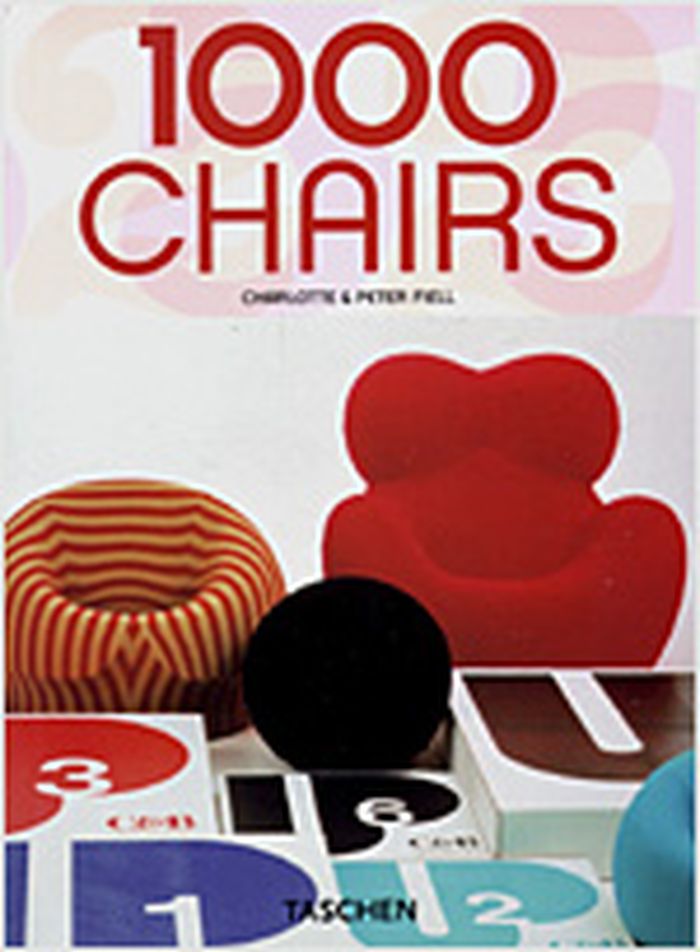
More than any other piece of furniture, the chair has been subjected to the wildest dreams of the designers. The particular curve of a back-rest, or the twist of a leg, the angle of a seat or the colour of the entire artefact all reflect the stylistic consciousness of each era. From Gerrit Rietveld and Alvar Aalto via Verner Panton to Eva Zeisel; from Art Nouveau to International Style, from Pop Art to Postmodernism, the phenomenon of the chair is so complex that it requires a reference work as comprehensive as this to do it full justice. They are all here: Thonet's bentwood chairs and Hoffmann's sitting-machines, Marcel Breuer's Wassily chair and Ron Arad's avant-garde armchairs. The book, a slightly abbreviated version of our classic title "1000 Chairs", devotes one page to each chair, displayed on its own as pure form, with biographical and historical information about the chairs and their designers. A special treat for anyone who loves design and a must for collectors!
1000 Chairs
Actions:
Price:
$17.95
(available to order)
Summary:
More than any other piece of furniture, the chair has been subjected to the wildest dreams of the designers. The particular curve of a back-rest, or the twist of a leg, the angle of a seat or the colour of the entire artefact all reflect the stylistic consciousness of each era. From Gerrit Rietveld and Alvar Aalto via Verner Panton to Eva Zeisel; from Art Nouveau to International Style, from Pop Art to Postmodernism, the phenomenon of the chair is so complex that it requires a reference work as comprehensive as this to do it full justice. They are all here: Thonet's bentwood chairs and Hoffmann's sitting-machines, Marcel Breuer's Wassily chair and Ron Arad's avant-garde armchairs. The book, a slightly abbreviated version of our classic title "1000 Chairs", devotes one page to each chair, displayed on its own as pure form, with biographical and historical information about the chairs and their designers. A special treat for anyone who loves design and a must for collectors!
Form:
books
books
Publication:
May 2005, Cologne
May 2005, Cologne
Subject:
Interior Design
Interior Design
Form:
books
books
Actions:
Price:
$99.00
(available in store)
Summary:
Hermann & Valentiny first came to public attention in the 1980s with their villa in the Rauchstrasse, a part of the International Building Exhibition in Berlin, when postmodernism was at its peak in Europe. Since then the office which is based in Vienna and Remerschen has built in Austria, Luxembourg and Germany, and its architecture has progressed in both form and(...)
$99.00
(available in store)
Summary:
Hermann & Valentiny first came to public attention in the 1980s with their villa in the Rauchstrasse, a part of the International Building Exhibition in Berlin, when postmodernism was at its peak in Europe. Since then the office which is based in Vienna and Remerschen has built in Austria, Luxembourg and Germany, and its architecture has progressed in both form and(...)
Subject:
Architecture Monographs
Architecture Monographs
Publication:
May 2001, Basel / Boston / Berlin
May 2001, Basel / Boston / Berlin
Title:
Hermann & Valentiny and partners : jetz / now
Actions:
Price:
$99.00
(available in store)
Summary:
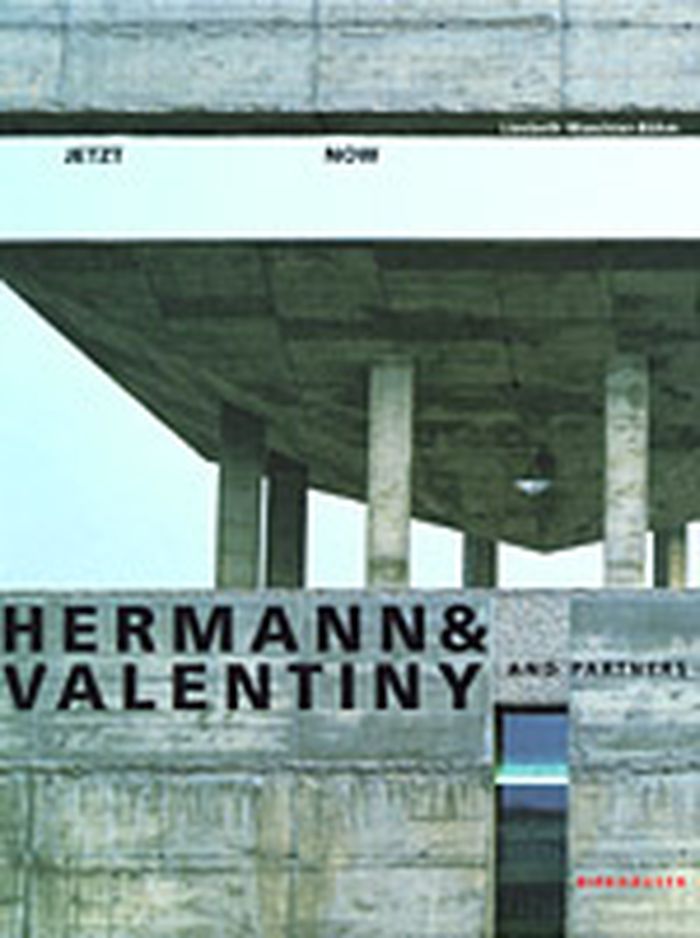
Hermann & Valentiny first came to public attention in the 1980s with their villa in the Rauchstrasse, a part of the International Building Exhibition in Berlin, when postmodernism was at its peak in Europe. Since then the office which is based in Vienna and Remerschen has built in Austria, Luxembourg and Germany, and its architecture has progressed in both form and content. Representing Luxembourg at the architecture biennale in Venice, Hermann & Valentiny reveal how architecture and art can be successfully combined. This up-to-date report "Now" illustrates how conceptual questions and a comparatively restricted choice of materials dominate the work of Hermann & Valentiny. Wherever possible they use concrete to replace plaster; glass maintains its unique role; metal mesh acts as a membrane, allowing historical architecture to shimmer through. Moreover, colour has a special function in their architecture. Not just black and white, but also tomato red, melon yellow, peppermint green... Finally, the book reveals the architects' general concepts which incorporate the living, the natural surroundings in the plans.
Hermann & Valentiny and partners : jetz / now
Actions:
Price:
$99.00
(available in store)
Summary:
Hermann & Valentiny first came to public attention in the 1980s with their villa in the Rauchstrasse, a part of the International Building Exhibition in Berlin, when postmodernism was at its peak in Europe. Since then the office which is based in Vienna and Remerschen has built in Austria, Luxembourg and Germany, and its architecture has progressed in both form and content. Representing Luxembourg at the architecture biennale in Venice, Hermann & Valentiny reveal how architecture and art can be successfully combined. This up-to-date report "Now" illustrates how conceptual questions and a comparatively restricted choice of materials dominate the work of Hermann & Valentiny. Wherever possible they use concrete to replace plaster; glass maintains its unique role; metal mesh acts as a membrane, allowing historical architecture to shimmer through. Moreover, colour has a special function in their architecture. Not just black and white, but also tomato red, melon yellow, peppermint green... Finally, the book reveals the architects' general concepts which incorporate the living, the natural surroundings in the plans.
Form:
books
books
Publication:
May 2001, Basel / Boston / Berlin
May 2001, Basel / Boston / Berlin
Subject:
Architecture Monographs
Architecture Monographs
Form:
books
books
Price:
$58.50
(available to order)
Summary:
The Uses of Photography examines a network of artists who were active in Southern California between the late 1960s and early 1980s and whose experiments with photography opened the medium to a profusion of new strategies and subjects. These artists introduced urgent social issues and themes of everyday life into the seemingly neutral territory of conceptual art, through(...)
$58.50
(available to order)
Summary:
The Uses of Photography examines a network of artists who were active in Southern California between the late 1960s and early 1980s and whose experiments with photography opened the medium to a profusion of new strategies and subjects. These artists introduced urgent social issues and themes of everyday life into the seemingly neutral territory of conceptual art, through(...)
Title:
The uses of photography: art, politics and the reinvention of a medium
Actions:
Price:
$58.50
(available to order)
Summary:
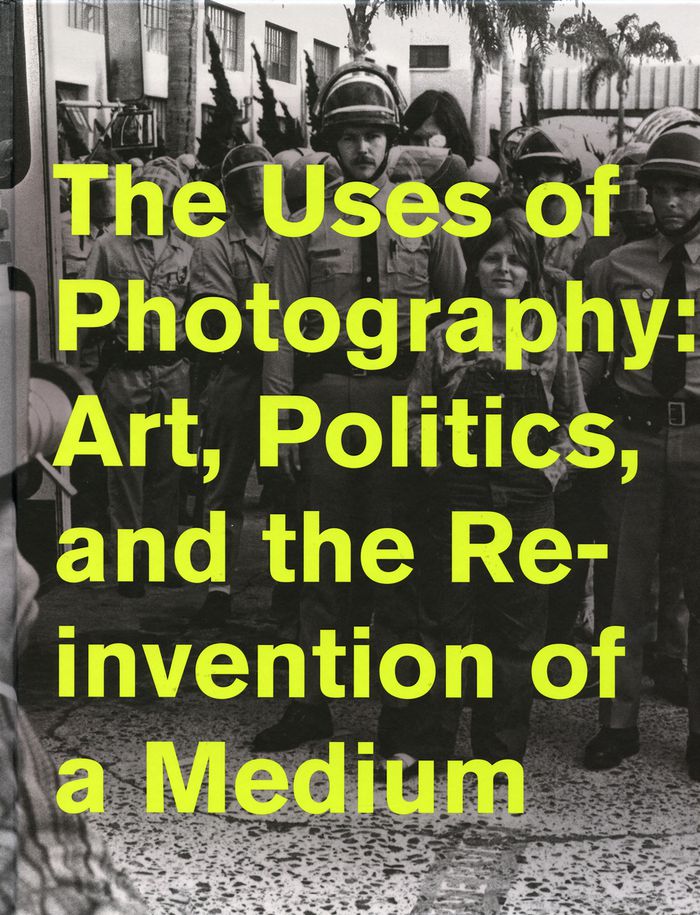
The Uses of Photography examines a network of artists who were active in Southern California between the late 1960s and early 1980s and whose experiments with photography opened the medium to a profusion of new strategies and subjects. These artists introduced urgent social issues and themes of everyday life into the seemingly neutral territory of conceptual art, through photographic works that took on hybrid forms, from books and postcards to video and text-and-image installations. Tracing a crucial history of photoconceptual practice, The Uses of Photography focuses on an artistic community that formed in and around the young University of California San Diego, founded in 1960, and its visual arts department, founded in 1967. Artists such as Eleanor Antin, Allan Kaprow, Fred Lonidier, Martha Rosler, Allan Sekula, and Carrie Mae Weems employed photography and its expanded forms as a means to dismantle modernist autonomy, to contest notions of photographic truth, and to engage in political critique. The work of these artists shaped emergent accounts of postmodernism in the visual arts and their influence is felt throughout the global contemporary art world today.
The uses of photography: art, politics and the reinvention of a medium
Actions:
Price:
$58.50
(available to order)
Summary:
The Uses of Photography examines a network of artists who were active in Southern California between the late 1960s and early 1980s and whose experiments with photography opened the medium to a profusion of new strategies and subjects. These artists introduced urgent social issues and themes of everyday life into the seemingly neutral territory of conceptual art, through photographic works that took on hybrid forms, from books and postcards to video and text-and-image installations. Tracing a crucial history of photoconceptual practice, The Uses of Photography focuses on an artistic community that formed in and around the young University of California San Diego, founded in 1960, and its visual arts department, founded in 1967. Artists such as Eleanor Antin, Allan Kaprow, Fred Lonidier, Martha Rosler, Allan Sekula, and Carrie Mae Weems employed photography and its expanded forms as a means to dismantle modernist autonomy, to contest notions of photographic truth, and to engage in political critique. The work of these artists shaped emergent accounts of postmodernism in the visual arts and their influence is felt throughout the global contemporary art world today.
Form:
books
books
Publication:
September 2016
September 2016
Subject:
Theory of Photography
Theory of Photography
Form:
journals and magazines
journals and magazines
Actions:
Price:
$35.00
(available to order)
Summary:
OASE 90 investigates the expectation behind existing value models in architecture. Many problems in today’s architecture world would vanish if every once in a while it was clearer what is meant by good architecture. The ‘crisis of criticism’, for instance, is a symptom of the impossibility of knowing (or daring to know) what good architecture is. Over the past century,(...)
$35.00
(available to order)
Summary:
OASE 90 investigates the expectation behind existing value models in architecture. Many problems in today’s architecture world would vanish if every once in a while it was clearer what is meant by good architecture. The ‘crisis of criticism’, for instance, is a symptom of the impossibility of knowing (or daring to know) what good architecture is. Over the past century,(...)
Title:
OASE 90: What is good architecture?
Actions:
Price:
$35.00
(available to order)
Summary:
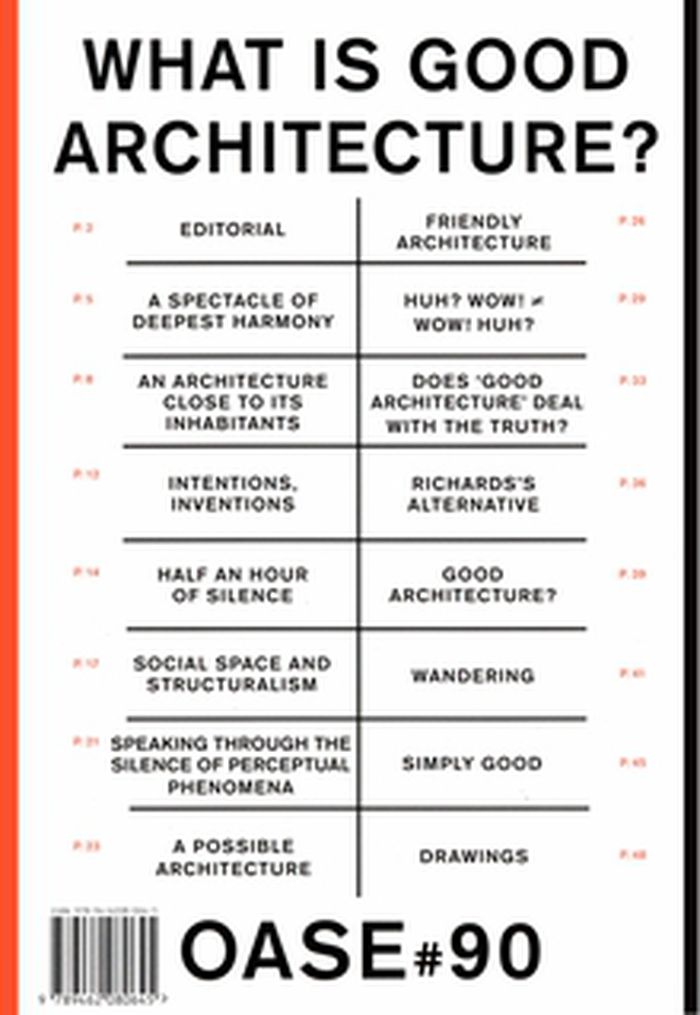
OASE 90 investigates the expectation behind existing value models in architecture. Many problems in today’s architecture world would vanish if every once in a while it was clearer what is meant by good architecture. The ‘crisis of criticism’, for instance, is a symptom of the impossibility of knowing (or daring to know) what good architecture is. Over the past century, models for architecture evaluation such as modernism and postmodernism have been modified by supermodernism and retromodernism, and more recently by sustainability. Nevertheless, it is impossible to work with architecture – in design, theory or history – without making assumptions about criteria for quality. This issue uncovers and makes explicit the assumptions underlying these models, by posing the simple question ‘What is good architecture?’ in different ways and have it answered by people whose ‘main occupation’ is architecture. This issue of OASE can be like a banquet at which each guest selects something entirely different from the menu in a well-reasoned and forthright way – and so keeps the architecture party going.
OASE 90: What is good architecture?
Actions:
Price:
$35.00
(available to order)
Summary:
OASE 90 investigates the expectation behind existing value models in architecture. Many problems in today’s architecture world would vanish if every once in a while it was clearer what is meant by good architecture. The ‘crisis of criticism’, for instance, is a symptom of the impossibility of knowing (or daring to know) what good architecture is. Over the past century, models for architecture evaluation such as modernism and postmodernism have been modified by supermodernism and retromodernism, and more recently by sustainability. Nevertheless, it is impossible to work with architecture – in design, theory or history – without making assumptions about criteria for quality. This issue uncovers and makes explicit the assumptions underlying these models, by posing the simple question ‘What is good architecture?’ in different ways and have it answered by people whose ‘main occupation’ is architecture. This issue of OASE can be like a banquet at which each guest selects something entirely different from the menu in a well-reasoned and forthright way – and so keeps the architecture party going.
Form:
journals and magazines
journals and magazines
Publication:
August 2013
August 2013
Subject:
Magazines
Magazines
Form:
books
books
Title:
The guide to the architecture of Georgia / by Tom Spector ; photography by Susan Owings-Spector.
The guide to the architecture of Georgia / by Tom Spector ; photography by Susan Owings-Spector.
Actions:
Holdings:
Description:
174 pages : illustrations, maps ; 22 cm
Description:
174 pages : illustrations, maps ; 22 cm
Author:
Subject:
Publication:
Columbia, S.C. : University of South Carolina Press, 1993.
Columbia, S.C. : University of South Carolina Press, 1993.
Title:
The guide to the architecture of Georgia / by Tom Spector ; photography by Susan Owings-Spector.
Actions:
Holdings:
Description:
174 pages : illustrations, maps ; 22 cm
The guide to the architecture of Georgia / by Tom Spector ; photography by Susan Owings-Spector.
Actions:
Holdings:
Description:
174 pages : illustrations, maps ; 22 cm
Form:
books
books
Publication:
Columbia, S.C. : University of South Carolina Press, 1993.
Columbia, S.C. : University of South Carolina Press, 1993.
Author:
Subject:
Form:
books
books
Actions:
Holdings:
Description:
xvii, 476 pages : illustrations ; 24 cm
Description:
xvii, 476 pages : illustrations ; 24 cm
Author:
Subject:
Publication:
Cambridge, Mass. : MIT Press, ©2007.
Cambridge, Mass. : MIT Press, ©2007.
Title:
The artwork caught by the tail : Francis Picabia and Dada in Paris / George Baker.
Actions:
Holdings:
Description:
xvii, 476 pages : illustrations ; 24 cm
The artwork caught by the tail : Francis Picabia and Dada in Paris / George Baker.
Actions:
Holdings:
Description:
xvii, 476 pages : illustrations ; 24 cm
Form:
books
books
Publication:
Cambridge, Mass. : MIT Press, ©2007.
Cambridge, Mass. : MIT Press, ©2007.
Author:
Subject:
Form:
books
books
Actions:
Holdings:
Description:
xiv, 285 pages : illustrations, maps ; 24 cm
Description:
xiv, 285 pages : illustrations, maps ; 24 cm
Author:
Subject:
Publication:
Baltimore : Johns Hopkins University Press, ©1993.
Baltimore : Johns Hopkins University Press, ©1993.
Title:
Geography and the human spirit / Anne Buttimer ; with a foreword by Yi-Fu Tuan.
Actions:
Holdings:
Description:
xiv, 285 pages : illustrations, maps ; 24 cm
Geography and the human spirit / Anne Buttimer ; with a foreword by Yi-Fu Tuan.
Actions:
Holdings:
Description:
xiv, 285 pages : illustrations, maps ; 24 cm
Form:
books
books
Publication:
Baltimore : Johns Hopkins University Press, ©1993.
Baltimore : Johns Hopkins University Press, ©1993.
Author:
Subject:


