


7241 Results
Form:
archives
Level of archival description:
Fonds
archives
Level of archival description:
Fonds
Title:
Myron Goldsmith fonds
Myron Goldsmith fonds
Reference number:
AP032
Synopsis:
The Myron Goldsmith fonds consists primarily of 30.4 metres of textual documents, including notebooks, research and reading notes, travel journals, documentation files, correspondence, sketchbooks and personal and office papers. There are also 2,800 original drawings and prints, 10,000 photographs and slides, and 5 architectural models. The material ranges in date from c.1933 to 1996. In shedding light on Goldsmith's student years and working career, the fonds' rich collection of documents also provides material on activities in the architectural profession, architectural education, and architectural and engineering theory and building techniques through the 1940s to the 1990s.
AP032
Synopsis:
The Myron Goldsmith fonds consists primarily of 30.4 metres of textual documents, including notebooks, research and reading notes, travel journals, documentation files, correspondence, sketchbooks and personal and office papers. There are also 2,800 original drawings and prints, 10,000 photographs and slides, and 5 architectural models. The material ranges in date from c.1933 to 1996. In shedding light on Goldsmith's student years and working career, the fonds' rich collection of documents also provides material on activities in the architectural profession, architectural education, and architectural and engineering theory and building techniques through the 1940s to the 1990s.
People:
Date:
1933-1996
1933-1996
Title:
Myron Goldsmith fonds
Actions:
AP032
Synopsis:
The Myron Goldsmith fonds consists primarily of 30.4 metres of textual documents, including notebooks, research and reading notes, travel journals, documentation files, correspondence, sketchbooks and personal and office papers. There are also 2,800 original drawings and prints, 10,000 photographs and slides, and 5 architectural models. The material ranges in date from c.1933 to 1996. In shedding light on Goldsmith's student years and working career, the fonds' rich collection of documents also provides material on activities in the architectural profession, architectural education, and architectural and engineering theory and building techniques through the 1940s to the 1990s.
Myron Goldsmith fonds
Actions:
AP032
Synopsis:
The Myron Goldsmith fonds consists primarily of 30.4 metres of textual documents, including notebooks, research and reading notes, travel journals, documentation files, correspondence, sketchbooks and personal and office papers. There are also 2,800 original drawings and prints, 10,000 photographs and slides, and 5 architectural models. The material ranges in date from c.1933 to 1996. In shedding light on Goldsmith's student years and working career, the fonds' rich collection of documents also provides material on activities in the architectural profession, architectural education, and architectural and engineering theory and building techniques through the 1940s to the 1990s.
Form:
archives
Level of archival description:
Fonds
archives
Level of archival description:
Fonds
Date:
1933-1996
1933-1996
People:
Form:
events
events
Actions:
Description:
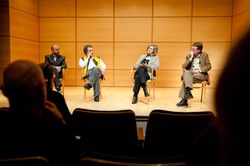
Curatorial practice as it emerged during the twentieth century is no doubt being extensively recast. The tremendous change in the status of the object, of culture, of the various disciplines, or information and education, implies an inevitable transformation of the curator’s role and competences. A renewed interest for curatorial practice has emerged within the field of(...)
Curatorial practice as it emerged during the twentieth century is no doubt being extensively recast. The tremendous change in the status of the object, of culture, of the various disciplines, or information and education, implies an inevitable transformation of the curator’s role and competences. A renewed interest for curatorial practice has emerged within the field of(...)
Location:
Paul Desmarais Theatre
Paul Desmarais Theatre
Date:
11 November 2010 to 13 November 2010
11 November 2010 to 13 November 2010
Title:
The CCA in an Expanding Curatorial Field
Actions:
Description:
Curatorial practice as it emerged during the twentieth century is no doubt being extensively recast. The tremendous change in the status of the object, of culture, of the various disciplines, or information and education, implies an inevitable transformation of the curator’s role and competences. A renewed interest for curatorial practice has emerged within the field of(...)
The CCA in an Expanding Curatorial Field
Actions:
Description:
Curatorial practice as it emerged during the twentieth century is no doubt being extensively recast. The tremendous change in the status of the object, of culture, of the various disciplines, or information and education, implies an inevitable transformation of the curator’s role and competences. A renewed interest for curatorial practice has emerged within the field of(...)
Form:
events
events
Date:
11 November 2010 to
13 November 2010
11 November 2010 to
13 November 2010
Location:
Paul Desmarais Theatre
Paul Desmarais Theatre
Form:
drawings
drawings
Actions:
Reference number:
DR1981:0017:001 R/V
Description:
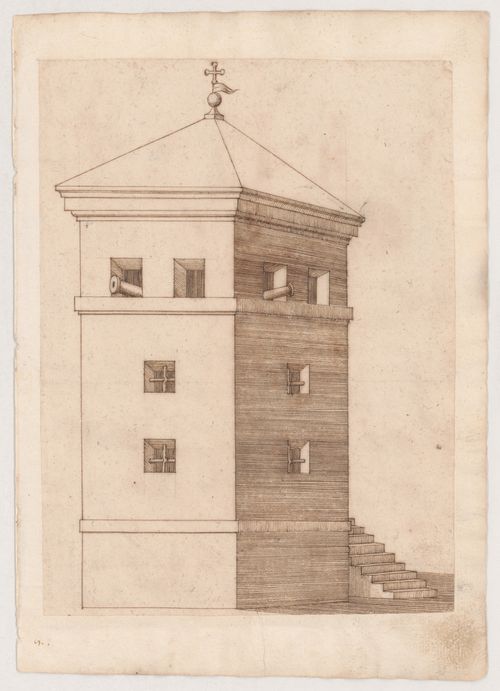
- Most of the drawings in the group DR1981:0017:001 R/V - DR1981:0017:079 R/V are by Luca Danese, with the exception of those by Giovanni Antonio Zani (DR1981:0017:034, DR1981:0017:066 R/V, DR1981:0017:67 R/V and DR1981:0017:069 R/V), and the possible exception of the lower drawing on DR1981:0017:063 R, which bears the inscription, "Giovanni Danese". The Danese drawings include sketches of buildings, fortifications, facades, temporary architecture, locks and bridges as well as maps and designs for escutcheons, facades, temporary architecture, locks and one bridge. Most of these drawings show structures in the area around Comacchio and Ferrara in northeastern Italy, but there are also a number of record drawings made as far south as Rome, and as far north as Venice. In addition, there are plans which were probably not made "in situ" for fortifications at Innsbruck, Austria (DR1981:0017:064 R) and Altenburg (Mosonmagyarovar), Hungary (DR1981:0017:018 R). The drawings range in date between 1629 (DR1981:0017:018 R) and 1641 (DR1981:0017:0017:010 V), with a number of the record drawings made in Rome inscribed "1635". The Zani drawings are undated designs for military storage facilities, including a design for a magazine at Ferrara (DR1981:0017:067 R). Many of the sheets and secondary supports have been inscribed by an unknown contemporary Italian hand, including the drawing DR1981:0017:039 which gives Danese's death date as "1672". The date at which the drawings were bound into an album has not been determined.
DR1981:0017:001 R/V
Description:
- Most of the drawings in the group DR1981:0017:001 R/V - DR1981:0017:079 R/V are by Luca Danese, with the exception of those by Giovanni Antonio Zani (DR1981:0017:034, DR1981:0017:066 R/V, DR1981:0017:67 R/V and DR1981:0017:069 R/V), and the possible exception of the lower drawing on DR1981:0017:063 R, which bears the inscription, "Giovanni Danese". The Danese drawings include sketches of buildings, fortifications, facades, temporary architecture, locks and bridges as well as maps and designs for escutcheons, facades, temporary architecture, locks and one bridge. Most of these drawings show structures in the area around Comacchio and Ferrara in northeastern Italy, but there are also a number of record drawings made as far south as Rome, and as far north as Venice. In addition, there are plans which were probably not made "in situ" for fortifications at Innsbruck, Austria (DR1981:0017:064 R) and Altenburg (Mosonmagyarovar), Hungary (DR1981:0017:018 R). The drawings range in date between 1629 (DR1981:0017:018 R) and 1641 (DR1981:0017:0017:010 V), with a number of the record drawings made in Rome inscribed "1635". The Zani drawings are undated designs for military storage facilities, including a design for a magazine at Ferrara (DR1981:0017:067 R). Many of the sheets and secondary supports have been inscribed by an unknown contemporary Italian hand, including the drawing DR1981:0017:039 which gives Danese's death date as "1672". The date at which the drawings were bound into an album has not been determined.
People:
Subject:
architecture, military
architecture, military
Date:
ca. 1630-1640
ca. 1630-1640
Title:
Elevation of a fortified tower with cannons; verso: View of the Ponte Felice, Borghetto; Offset images of a bridge and an architectural detail
Actions:
DR1981:0017:001 R/V
Description:
- Most of the drawings in the group DR1981:0017:001 R/V - DR1981:0017:079 R/V are by Luca Danese, with the exception of those by Giovanni Antonio Zani (DR1981:0017:034, DR1981:0017:066 R/V, DR1981:0017:67 R/V and DR1981:0017:069 R/V), and the possible exception of the lower drawing on DR1981:0017:063 R, which bears the inscription, "Giovanni Danese". The Danese drawings include sketches of buildings, fortifications, facades, temporary architecture, locks and bridges as well as maps and designs for escutcheons, facades, temporary architecture, locks and one bridge. Most of these drawings show structures in the area around Comacchio and Ferrara in northeastern Italy, but there are also a number of record drawings made as far south as Rome, and as far north as Venice. In addition, there are plans which were probably not made "in situ" for fortifications at Innsbruck, Austria (DR1981:0017:064 R) and Altenburg (Mosonmagyarovar), Hungary (DR1981:0017:018 R). The drawings range in date between 1629 (DR1981:0017:018 R) and 1641 (DR1981:0017:0017:010 V), with a number of the record drawings made in Rome inscribed "1635". The Zani drawings are undated designs for military storage facilities, including a design for a magazine at Ferrara (DR1981:0017:067 R). Many of the sheets and secondary supports have been inscribed by an unknown contemporary Italian hand, including the drawing DR1981:0017:039 which gives Danese's death date as "1672". The date at which the drawings were bound into an album has not been determined.
Elevation of a fortified tower with cannons; verso: View of the Ponte Felice, Borghetto; Offset images of a bridge and an architectural detail
Actions:
DR1981:0017:001 R/V
Description:
- Most of the drawings in the group DR1981:0017:001 R/V - DR1981:0017:079 R/V are by Luca Danese, with the exception of those by Giovanni Antonio Zani (DR1981:0017:034, DR1981:0017:066 R/V, DR1981:0017:67 R/V and DR1981:0017:069 R/V), and the possible exception of the lower drawing on DR1981:0017:063 R, which bears the inscription, "Giovanni Danese". The Danese drawings include sketches of buildings, fortifications, facades, temporary architecture, locks and bridges as well as maps and designs for escutcheons, facades, temporary architecture, locks and one bridge. Most of these drawings show structures in the area around Comacchio and Ferrara in northeastern Italy, but there are also a number of record drawings made as far south as Rome, and as far north as Venice. In addition, there are plans which were probably not made "in situ" for fortifications at Innsbruck, Austria (DR1981:0017:064 R) and Altenburg (Mosonmagyarovar), Hungary (DR1981:0017:018 R). The drawings range in date between 1629 (DR1981:0017:018 R) and 1641 (DR1981:0017:0017:010 V), with a number of the record drawings made in Rome inscribed "1635". The Zani drawings are undated designs for military storage facilities, including a design for a magazine at Ferrara (DR1981:0017:067 R). Many of the sheets and secondary supports have been inscribed by an unknown contemporary Italian hand, including the drawing DR1981:0017:039 which gives Danese's death date as "1672". The date at which the drawings were bound into an album has not been determined.
Form:
drawings
drawings
Date:
ca. 1630-1640
ca. 1630-1640
People:
Subject:
architecture, military
architecture, military
Form:
drawings
drawings
Title:
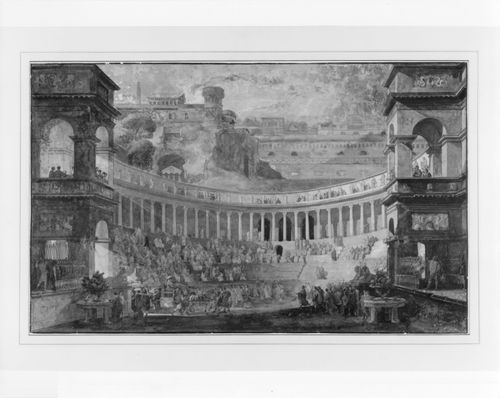
The Triumph of Hannibal
The Triumph of Hannibal
Actions:
Reference number:
DR1984:1641
Description:
- The turbaned figure being carried into the theatre seated on a litter certainly refers to a non-Roman figure, possibly Hannibal. Behind this figure is a theatre and an imaginary town on a hill. The town buildings recall the Sicilian monuments in the 'Voyage pittoresque ou description des royaumes de Naples et de Sicile' published by the Abbé de Saint-Non in Paris between 1781 and 1786. Desprez interrupted his studies at the French Academy in Rome from December 1777 to January 1779 to accompany Dominique Vivant Denon and several other artists to Naples and Sicily in order to make drawings for this publication. The town buildings also recall several buildings Desprez planned in Stockholm while stage designer and architect to Gustavus III of Sweden from 1784 to 1792.
DR1984:1641
Description:
- The turbaned figure being carried into the theatre seated on a litter certainly refers to a non-Roman figure, possibly Hannibal. Behind this figure is a theatre and an imaginary town on a hill. The town buildings recall the Sicilian monuments in the 'Voyage pittoresque ou description des royaumes de Naples et de Sicile' published by the Abbé de Saint-Non in Paris between 1781 and 1786. Desprez interrupted his studies at the French Academy in Rome from December 1777 to January 1779 to accompany Dominique Vivant Denon and several other artists to Naples and Sicily in order to make drawings for this publication. The town buildings also recall several buildings Desprez planned in Stockholm while stage designer and architect to Gustavus III of Sweden from 1784 to 1792.
People:
Subject:
theatre design
theatre design
Date:
ca. 1780-1790
ca. 1780-1790
Title:
The Triumph of Hannibal
Actions:
DR1984:1641
Description:
- The turbaned figure being carried into the theatre seated on a litter certainly refers to a non-Roman figure, possibly Hannibal. Behind this figure is a theatre and an imaginary town on a hill. The town buildings recall the Sicilian monuments in the 'Voyage pittoresque ou description des royaumes de Naples et de Sicile' published by the Abbé de Saint-Non in Paris between 1781 and 1786. Desprez interrupted his studies at the French Academy in Rome from December 1777 to January 1779 to accompany Dominique Vivant Denon and several other artists to Naples and Sicily in order to make drawings for this publication. The town buildings also recall several buildings Desprez planned in Stockholm while stage designer and architect to Gustavus III of Sweden from 1784 to 1792.
The Triumph of Hannibal
Actions:
DR1984:1641
Description:
- The turbaned figure being carried into the theatre seated on a litter certainly refers to a non-Roman figure, possibly Hannibal. Behind this figure is a theatre and an imaginary town on a hill. The town buildings recall the Sicilian monuments in the 'Voyage pittoresque ou description des royaumes de Naples et de Sicile' published by the Abbé de Saint-Non in Paris between 1781 and 1786. Desprez interrupted his studies at the French Academy in Rome from December 1777 to January 1779 to accompany Dominique Vivant Denon and several other artists to Naples and Sicily in order to make drawings for this publication. The town buildings also recall several buildings Desprez planned in Stockholm while stage designer and architect to Gustavus III of Sweden from 1784 to 1792.
Form:
drawings
drawings
Date:
ca. 1780-1790
ca. 1780-1790
People:
Subject:
theatre design
theatre design
Form:
photographs
Quantity:
16 album(s)
photographs
Quantity:
16 album(s)
Actions:
Reference number:
PH1986:0900.01-16
Description:
The 16 albums PH1986:0900.01-.16 comprises 849 photographs and 34 prints of works by Michel Roux-Spitz. The majority of the photographs show projects in Paris and Lyon, France, although Versailles and Fontainebleau, France, Brussels, Belgium, and Rome, Italy also feature. Amongst others, the photographs include views of La Croix-Rousse train station, Villa Weitz, Église Saint-François d'Assise, Salle des Fêtes De La Croix-Rousse, Banque Libre, Manufactures de Glaces de Saint-Gobain, and a housing project in Lyon; Les Galeries Lafayette, Boutique Roger Bal, the atelier de Monsieur Roger Bal, Bijouterie Kepta, a post-office, the Ford Building, Bibliothèque Nationale, Hôtel Roland Bonaparte, and various other buildings in Paris; The Bibliothèque Nationale in Versailles; and other furniture, interiors, fountains, monuments, tombs, vases, models and studies.
PH1986:0900.01-16
Description:
The 16 albums PH1986:0900.01-.16 comprises 849 photographs and 34 prints of works by Michel Roux-Spitz. The majority of the photographs show projects in Paris and Lyon, France, although Versailles and Fontainebleau, France, Brussels, Belgium, and Rome, Italy also feature. Amongst others, the photographs include views of La Croix-Rousse train station, Villa Weitz, Église Saint-François d'Assise, Salle des Fêtes De La Croix-Rousse, Banque Libre, Manufactures de Glaces de Saint-Gobain, and a housing project in Lyon; Les Galeries Lafayette, Boutique Roger Bal, the atelier de Monsieur Roger Bal, Bijouterie Kepta, a post-office, the Ford Building, Bibliothèque Nationale, Hôtel Roland Bonaparte, and various other buildings in Paris; The Bibliothèque Nationale in Versailles; and other furniture, interiors, fountains, monuments, tombs, vases, models and studies.
People:
Subject:
architecture, interior design, ornament, sculpture
architecture, interior design, ornament, sculpture
Date:
1920-1936
1920-1936
Title:
Albums of photographs of projects by Michel Roux-Spitz
Actions:
PH1986:0900.01-16
Description:
The 16 albums PH1986:0900.01-.16 comprises 849 photographs and 34 prints of works by Michel Roux-Spitz. The majority of the photographs show projects in Paris and Lyon, France, although Versailles and Fontainebleau, France, Brussels, Belgium, and Rome, Italy also feature. Amongst others, the photographs include views of La Croix-Rousse train station, Villa Weitz, Église Saint-François d'Assise, Salle des Fêtes De La Croix-Rousse, Banque Libre, Manufactures de Glaces de Saint-Gobain, and a housing project in Lyon; Les Galeries Lafayette, Boutique Roger Bal, the atelier de Monsieur Roger Bal, Bijouterie Kepta, a post-office, the Ford Building, Bibliothèque Nationale, Hôtel Roland Bonaparte, and various other buildings in Paris; The Bibliothèque Nationale in Versailles; and other furniture, interiors, fountains, monuments, tombs, vases, models and studies.
Albums of photographs of projects by Michel Roux-Spitz
Actions:
PH1986:0900.01-16
Description:
The 16 albums PH1986:0900.01-.16 comprises 849 photographs and 34 prints of works by Michel Roux-Spitz. The majority of the photographs show projects in Paris and Lyon, France, although Versailles and Fontainebleau, France, Brussels, Belgium, and Rome, Italy also feature. Amongst others, the photographs include views of La Croix-Rousse train station, Villa Weitz, Église Saint-François d'Assise, Salle des Fêtes De La Croix-Rousse, Banque Libre, Manufactures de Glaces de Saint-Gobain, and a housing project in Lyon; Les Galeries Lafayette, Boutique Roger Bal, the atelier de Monsieur Roger Bal, Bijouterie Kepta, a post-office, the Ford Building, Bibliothèque Nationale, Hôtel Roland Bonaparte, and various other buildings in Paris; The Bibliothèque Nationale in Versailles; and other furniture, interiors, fountains, monuments, tombs, vases, models and studies.
Form:
photographs
Quantity:
16 album(s)
photographs
Quantity:
16 album(s)
Date:
1920-1936
1920-1936
People:
Subject:
architecture, interior design, ornament, sculpture
architecture, interior design, ornament, sculpture
Level of archival description:
Project
Project
Reference number:
AP148.S1.1970.PR02
Description:
The project series documents Poli's work on the Interplanetary Architecture project, which was also made into a film by Superstudio directed by Alessandro Poli (the film is not included in the fonds). The project reflects Poli's deep fascination with the moon landing in 1969. Poli uses this major media event as a catalyst for thinking about a new approach to architecture and tools for design, including the idea that film and the movie camera should become part of the toolset. The project also seems to be in some way a response to Epoch magazine's challenge for a "Primo concorso di architettura nello spazio" (the first architectural competition in space), and includes much imagery and textual references to a new road or architectural links between the earth and other planets, including an earth moon highway. In his storyboard, Poli also makes reference to his earlier Piper project, and some imagery features wheels and an amusement park. The Interplanetary Architecture project was exhibited by Superstudio in Rome in 1972 and featured in "Casabella" magazine in April 1972 (no. 364). The project was also featured in the 2010 CCA exhibition "Other Space Odysseys". In the accompanying CCA publication, Poli describes this project as "a voyage off earthbound routes in quest of architecture unfettered by the urban nightmare, by induced needs or by planning as the only tool for regulating and solving the world's problems" (Poli quoted in Borasi and Zardini, 2010, 110). Poli's work on this project is deeply tied to the Zeno project, which was also featured in this exhibition and is included in this fonds (see AP148.S1.1972.PR01). For the Zeno project, Poli envisioned a dialogue between astronaut Buzz Aldrin and an Italian peasant, Zeno of Riparbella. Poli felt that these two shared a similarity in that both their homes were isolated capsules, one that provided a lens from which to see the rest of the world and understand their place in it. The material in the series includes numerous photomontages and collages of astronauts in space, as well as drawings of plantery shapes and structures. There are also texts, some of which include calculations of distances and diameters of planets, as well as notebooks and sketchbooks, many of which Poli included in a folder he entitled "Storyboard." The series also includes an unsent letter from Poli to Adolfo Natalini which describes how, after the moon landing, everything - the planet, the moon, the stars - is architecture, and that this will necessitate the need for new design tools, such as the movie camera. Some works are signed Alessandro Poli-Superstudio. Source cited: Giovanna Borasi and Mirko Zardini, eds., Other Space Odysseys, Montreal and Baden: Canadian Centre for Architecture/Lars Müller Publishers, 2010.
AP148.S1.1970.PR02
Description:
The project series documents Poli's work on the Interplanetary Architecture project, which was also made into a film by Superstudio directed by Alessandro Poli (the film is not included in the fonds). The project reflects Poli's deep fascination with the moon landing in 1969. Poli uses this major media event as a catalyst for thinking about a new approach to architecture and tools for design, including the idea that film and the movie camera should become part of the toolset. The project also seems to be in some way a response to Epoch magazine's challenge for a "Primo concorso di architettura nello spazio" (the first architectural competition in space), and includes much imagery and textual references to a new road or architectural links between the earth and other planets, including an earth moon highway. In his storyboard, Poli also makes reference to his earlier Piper project, and some imagery features wheels and an amusement park. The Interplanetary Architecture project was exhibited by Superstudio in Rome in 1972 and featured in "Casabella" magazine in April 1972 (no. 364). The project was also featured in the 2010 CCA exhibition "Other Space Odysseys". In the accompanying CCA publication, Poli describes this project as "a voyage off earthbound routes in quest of architecture unfettered by the urban nightmare, by induced needs or by planning as the only tool for regulating and solving the world's problems" (Poli quoted in Borasi and Zardini, 2010, 110). Poli's work on this project is deeply tied to the Zeno project, which was also featured in this exhibition and is included in this fonds (see AP148.S1.1972.PR01). For the Zeno project, Poli envisioned a dialogue between astronaut Buzz Aldrin and an Italian peasant, Zeno of Riparbella. Poli felt that these two shared a similarity in that both their homes were isolated capsules, one that provided a lens from which to see the rest of the world and understand their place in it. The material in the series includes numerous photomontages and collages of astronauts in space, as well as drawings of plantery shapes and structures. There are also texts, some of which include calculations of distances and diameters of planets, as well as notebooks and sketchbooks, many of which Poli included in a folder he entitled "Storyboard." The series also includes an unsent letter from Poli to Adolfo Natalini which describes how, after the moon landing, everything - the planet, the moon, the stars - is architecture, and that this will necessitate the need for new design tools, such as the movie camera. Some works are signed Alessandro Poli-Superstudio. Source cited: Giovanna Borasi and Mirko Zardini, eds., Other Space Odysseys, Montreal and Baden: Canadian Centre for Architecture/Lars Müller Publishers, 2010.
People:
Date:
1969-1971
1969-1971
Title:
Architettura Interplanetaria [Interplanetary Architecture] (1970-1971)
Actions:
AP148.S1.1970.PR02
Description:
The project series documents Poli's work on the Interplanetary Architecture project, which was also made into a film by Superstudio directed by Alessandro Poli (the film is not included in the fonds). The project reflects Poli's deep fascination with the moon landing in 1969. Poli uses this major media event as a catalyst for thinking about a new approach to architecture and tools for design, including the idea that film and the movie camera should become part of the toolset. The project also seems to be in some way a response to Epoch magazine's challenge for a "Primo concorso di architettura nello spazio" (the first architectural competition in space), and includes much imagery and textual references to a new road or architectural links between the earth and other planets, including an earth moon highway. In his storyboard, Poli also makes reference to his earlier Piper project, and some imagery features wheels and an amusement park. The Interplanetary Architecture project was exhibited by Superstudio in Rome in 1972 and featured in "Casabella" magazine in April 1972 (no. 364). The project was also featured in the 2010 CCA exhibition "Other Space Odysseys". In the accompanying CCA publication, Poli describes this project as "a voyage off earthbound routes in quest of architecture unfettered by the urban nightmare, by induced needs or by planning as the only tool for regulating and solving the world's problems" (Poli quoted in Borasi and Zardini, 2010, 110). Poli's work on this project is deeply tied to the Zeno project, which was also featured in this exhibition and is included in this fonds (see AP148.S1.1972.PR01). For the Zeno project, Poli envisioned a dialogue between astronaut Buzz Aldrin and an Italian peasant, Zeno of Riparbella. Poli felt that these two shared a similarity in that both their homes were isolated capsules, one that provided a lens from which to see the rest of the world and understand their place in it. The material in the series includes numerous photomontages and collages of astronauts in space, as well as drawings of plantery shapes and structures. There are also texts, some of which include calculations of distances and diameters of planets, as well as notebooks and sketchbooks, many of which Poli included in a folder he entitled "Storyboard." The series also includes an unsent letter from Poli to Adolfo Natalini which describes how, after the moon landing, everything - the planet, the moon, the stars - is architecture, and that this will necessitate the need for new design tools, such as the movie camera. Some works are signed Alessandro Poli-Superstudio. Source cited: Giovanna Borasi and Mirko Zardini, eds., Other Space Odysseys, Montreal and Baden: Canadian Centre for Architecture/Lars Müller Publishers, 2010.
Architettura Interplanetaria [Interplanetary Architecture] (1970-1971)
Actions:
AP148.S1.1970.PR02
Description:
The project series documents Poli's work on the Interplanetary Architecture project, which was also made into a film by Superstudio directed by Alessandro Poli (the film is not included in the fonds). The project reflects Poli's deep fascination with the moon landing in 1969. Poli uses this major media event as a catalyst for thinking about a new approach to architecture and tools for design, including the idea that film and the movie camera should become part of the toolset. The project also seems to be in some way a response to Epoch magazine's challenge for a "Primo concorso di architettura nello spazio" (the first architectural competition in space), and includes much imagery and textual references to a new road or architectural links between the earth and other planets, including an earth moon highway. In his storyboard, Poli also makes reference to his earlier Piper project, and some imagery features wheels and an amusement park. The Interplanetary Architecture project was exhibited by Superstudio in Rome in 1972 and featured in "Casabella" magazine in April 1972 (no. 364). The project was also featured in the 2010 CCA exhibition "Other Space Odysseys". In the accompanying CCA publication, Poli describes this project as "a voyage off earthbound routes in quest of architecture unfettered by the urban nightmare, by induced needs or by planning as the only tool for regulating and solving the world's problems" (Poli quoted in Borasi and Zardini, 2010, 110). Poli's work on this project is deeply tied to the Zeno project, which was also featured in this exhibition and is included in this fonds (see AP148.S1.1972.PR01). For the Zeno project, Poli envisioned a dialogue between astronaut Buzz Aldrin and an Italian peasant, Zeno of Riparbella. Poli felt that these two shared a similarity in that both their homes were isolated capsules, one that provided a lens from which to see the rest of the world and understand their place in it. The material in the series includes numerous photomontages and collages of astronauts in space, as well as drawings of plantery shapes and structures. There are also texts, some of which include calculations of distances and diameters of planets, as well as notebooks and sketchbooks, many of which Poli included in a folder he entitled "Storyboard." The series also includes an unsent letter from Poli to Adolfo Natalini which describes how, after the moon landing, everything - the planet, the moon, the stars - is architecture, and that this will necessitate the need for new design tools, such as the movie camera. Some works are signed Alessandro Poli-Superstudio. Source cited: Giovanna Borasi and Mirko Zardini, eds., Other Space Odysseys, Montreal and Baden: Canadian Centre for Architecture/Lars Müller Publishers, 2010.
Level of archival description:
Project
Project
Date:
1969-1971
1969-1971
People:
Form:
works of art
works of art
Actions:
Reference number:
DR1988:0427:001-013
Description:
- This album is composed of thirteen architectural prints once in the possession of the stonemason Hans Görg Koch, and possibly assembled by him. The first two prints, DR1988:0427:001 and DR1988:0427:002, are the title page and a print showing examples of the Tuscan order from Rutger Kasemann's 'ARCHITETURA LEHR SEIVLEN BOCHG' of 1615 (Hollstein vol. 16, nos. 1 - 24). The prints DR1988:0427:003 - DR1988:0427:005 and DR1988:0427:007 are elevations and plans of early Baroque church façades in Rome, and the prints DR1988:0427:006 and DR1988:0427:008 - DR1988:0427:013, are orthographic designs for doorframes. The album pages bear three separate watermarks, none of which have been found in the literature: one on the flyleaves, another on the two Kasemann prints, and a third on the eleven prints showing churches and doorframes.
DR1988:0427:001-013
Description:
- This album is composed of thirteen architectural prints once in the possession of the stonemason Hans Görg Koch, and possibly assembled by him. The first two prints, DR1988:0427:001 and DR1988:0427:002, are the title page and a print showing examples of the Tuscan order from Rutger Kasemann's 'ARCHITETURA LEHR SEIVLEN BOCHG' of 1615 (Hollstein vol. 16, nos. 1 - 24). The prints DR1988:0427:003 - DR1988:0427:005 and DR1988:0427:007 are elevations and plans of early Baroque church façades in Rome, and the prints DR1988:0427:006 and DR1988:0427:008 - DR1988:0427:013, are orthographic designs for doorframes. The album pages bear three separate watermarks, none of which have been found in the literature: one on the flyleaves, another on the two Kasemann prints, and a third on the eleven prints showing churches and doorframes.
People:
Date:
ca. 1615-1650
ca. 1615-1650
Title:
Album of architectural prints
Actions:
DR1988:0427:001-013
Description:
- This album is composed of thirteen architectural prints once in the possession of the stonemason Hans Görg Koch, and possibly assembled by him. The first two prints, DR1988:0427:001 and DR1988:0427:002, are the title page and a print showing examples of the Tuscan order from Rutger Kasemann's 'ARCHITETURA LEHR SEIVLEN BOCHG' of 1615 (Hollstein vol. 16, nos. 1 - 24). The prints DR1988:0427:003 - DR1988:0427:005 and DR1988:0427:007 are elevations and plans of early Baroque church façades in Rome, and the prints DR1988:0427:006 and DR1988:0427:008 - DR1988:0427:013, are orthographic designs for doorframes. The album pages bear three separate watermarks, none of which have been found in the literature: one on the flyleaves, another on the two Kasemann prints, and a third on the eleven prints showing churches and doorframes.
Album of architectural prints
Actions:
DR1988:0427:001-013
Description:
- This album is composed of thirteen architectural prints once in the possession of the stonemason Hans Görg Koch, and possibly assembled by him. The first two prints, DR1988:0427:001 and DR1988:0427:002, are the title page and a print showing examples of the Tuscan order from Rutger Kasemann's 'ARCHITETURA LEHR SEIVLEN BOCHG' of 1615 (Hollstein vol. 16, nos. 1 - 24). The prints DR1988:0427:003 - DR1988:0427:005 and DR1988:0427:007 are elevations and plans of early Baroque church façades in Rome, and the prints DR1988:0427:006 and DR1988:0427:008 - DR1988:0427:013, are orthographic designs for doorframes. The album pages bear three separate watermarks, none of which have been found in the literature: one on the flyleaves, another on the two Kasemann prints, and a third on the eleven prints showing churches and doorframes.
Form:
works of art
works of art
Date:
ca. 1615-1650
ca. 1615-1650
People:
Form:
articles
articles

Actions:
Keyword(s):
18th century, 19th century, Antiquité, antiquité, Antiquity, Buffon, Charles de Wailly, Charles-François Viel, Claude-Nicolas Ledoux, dessin, drawing, Etienne-Louis Boullée, Étienne-Louis Boullée, France, French Revolution, Grèce, Greece, hôpital, hospital, Jacques-Germain Soufflot, Jean-Louis Viel de Saint-Maux, Jean-Nicolas-Louis Durand, Lettres d’architecture des anciens et celle des moderns, Panthéon, Paris, Paul Holmquist, Principes de l’ordonnance et de la construction des bâtimens, Renaissance, Révolution française, Rome, Sainte-Geneviève, Vitruve,
18th century, 19th century, Antiquité, antiquité, Antiquity, Buffon, Charles de Wailly, Charles-François Viel, Claude-Nicolas Ledoux, dessin, drawing, Etienne-Louis Boullée, Étienne-Louis Boullée, France, French Revolution, Grèce, Greece, hôpital, hospital, Jacques-Germain Soufflot, Jean-Louis Viel de Saint-Maux, Jean-Nicolas-Louis Durand, Lettres d’architecture des anciens et celle des moderns, Panthéon, Paris, Paul Holmquist, Principes de l’ordonnance et de la construction des bâtimens, Renaissance, Révolution française, Rome, Sainte-Geneviève, Vitruve,
Published:
28 November 2011
28 November 2011
Actions:
Reference number:
PH1986:0900.01
Description:
Album PH1986:0900.01 comprises 92 photographs of fountains, monuments, tombs, vases, models and studies by architect Michel Roux-Spitz. Subjects include: Monument aux Séminaristes français morts à la guerre, Séminaire Français à Rome (1922); Monument aux Morts de Lyon; Monument aux héros de Dixmude à Pierrefeu (Var) (1925); Monument Bokanowski à Toul (1924); Monument aux Morts de Thizy; Monument de la Victoire; Tombeau au cimetière Montparnasse à Paris; Tombeau de la famille Garin à Cholet; Tombeau de la famille Vetter à Lyon (1920-1923); Tombeau Redon; Tombeau de la famille Barral à Lyon; Tombeau de la famille Barras (sic) à Lyon; Monument au poète Camille Roy et à la Chanson Lyonnaise (1924); Fontaine Leriche; Fontaine avec sculpture de Cassou; Fontaine Cours La Reine à l'Exposition des Arts décoratifs 1925 à Paris; Tombeau du Cimetière du Village à l'Exposition des Arts décoratifs 1925 à Paris; Tombeau de la famille Robin. Artists mentioned are the sculptors Delamarre, Renard, C. Cassou, Martial, Leriche, a mosaic by Bouquet, ironwork by Szetlak and lighting by Perzel.
PH1986:0900.01
Description:
Album PH1986:0900.01 comprises 92 photographs of fountains, monuments, tombs, vases, models and studies by architect Michel Roux-Spitz. Subjects include: Monument aux Séminaristes français morts à la guerre, Séminaire Français à Rome (1922); Monument aux Morts de Lyon; Monument aux héros de Dixmude à Pierrefeu (Var) (1925); Monument Bokanowski à Toul (1924); Monument aux Morts de Thizy; Monument de la Victoire; Tombeau au cimetière Montparnasse à Paris; Tombeau de la famille Garin à Cholet; Tombeau de la famille Vetter à Lyon (1920-1923); Tombeau Redon; Tombeau de la famille Barral à Lyon; Tombeau de la famille Barras (sic) à Lyon; Monument au poète Camille Roy et à la Chanson Lyonnaise (1924); Fontaine Leriche; Fontaine avec sculpture de Cassou; Fontaine Cours La Reine à l'Exposition des Arts décoratifs 1925 à Paris; Tombeau du Cimetière du Village à l'Exposition des Arts décoratifs 1925 à Paris; Tombeau de la famille Robin. Artists mentioned are the sculptors Delamarre, Renard, C. Cassou, Martial, Leriche, a mosaic by Bouquet, ironwork by Szetlak and lighting by Perzel.
People:
Subject:
architecture, ornament, sculpture
architecture, ornament, sculpture
Date:
1920-1925
1920-1925
Title:
Fontaines - Monuments - Tombeaux - Vases - 1920-1925
Actions:
PH1986:0900.01
Description:
Album PH1986:0900.01 comprises 92 photographs of fountains, monuments, tombs, vases, models and studies by architect Michel Roux-Spitz. Subjects include: Monument aux Séminaristes français morts à la guerre, Séminaire Français à Rome (1922); Monument aux Morts de Lyon; Monument aux héros de Dixmude à Pierrefeu (Var) (1925); Monument Bokanowski à Toul (1924); Monument aux Morts de Thizy; Monument de la Victoire; Tombeau au cimetière Montparnasse à Paris; Tombeau de la famille Garin à Cholet; Tombeau de la famille Vetter à Lyon (1920-1923); Tombeau Redon; Tombeau de la famille Barral à Lyon; Tombeau de la famille Barras (sic) à Lyon; Monument au poète Camille Roy et à la Chanson Lyonnaise (1924); Fontaine Leriche; Fontaine avec sculpture de Cassou; Fontaine Cours La Reine à l'Exposition des Arts décoratifs 1925 à Paris; Tombeau du Cimetière du Village à l'Exposition des Arts décoratifs 1925 à Paris; Tombeau de la famille Robin. Artists mentioned are the sculptors Delamarre, Renard, C. Cassou, Martial, Leriche, a mosaic by Bouquet, ironwork by Szetlak and lighting by Perzel.
Fontaines - Monuments - Tombeaux - Vases - 1920-1925
Actions:
PH1986:0900.01
Description:
Album PH1986:0900.01 comprises 92 photographs of fountains, monuments, tombs, vases, models and studies by architect Michel Roux-Spitz. Subjects include: Monument aux Séminaristes français morts à la guerre, Séminaire Français à Rome (1922); Monument aux Morts de Lyon; Monument aux héros de Dixmude à Pierrefeu (Var) (1925); Monument Bokanowski à Toul (1924); Monument aux Morts de Thizy; Monument de la Victoire; Tombeau au cimetière Montparnasse à Paris; Tombeau de la famille Garin à Cholet; Tombeau de la famille Vetter à Lyon (1920-1923); Tombeau Redon; Tombeau de la famille Barral à Lyon; Tombeau de la famille Barras (sic) à Lyon; Monument au poète Camille Roy et à la Chanson Lyonnaise (1924); Fontaine Leriche; Fontaine avec sculpture de Cassou; Fontaine Cours La Reine à l'Exposition des Arts décoratifs 1925 à Paris; Tombeau du Cimetière du Village à l'Exposition des Arts décoratifs 1925 à Paris; Tombeau de la famille Robin. Artists mentioned are the sculptors Delamarre, Renard, C. Cassou, Martial, Leriche, a mosaic by Bouquet, ironwork by Szetlak and lighting by Perzel.
Date:
1920-1925
1920-1925
People:
Subject:
architecture, ornament, sculpture
architecture, ornament, sculpture
Form:
textual records
textual records
Actions:
Reference number:
AP197.S3.002
Description:
This box is comprised of personal and professional correspondence, organized in chronological order, from 1984-1990. The box documents Frampton’s career as Ware professor at the Graduate School of Architecture, Planning and Preservation at Columbia University and his related professional activities. Correspondence in this box includes: various offers of teaching positions; requests to write articles, reviews, books and recommendation letters; invitations to teach, attend or present at lectures/symposiums/conferences; and requests to serve on juries such as the American Academy in Rome. Throughout this period, Frampton corresponded with architects, professors, publishers, and editors of various publications such as: Ignasi de Sola-Morales Rubio; Tadao Ando; Rafael Moneo; James Stirling; Marco Frascari; Alvaro Siza; Arata Isozaki; the Casabella; the Progressive Architecture; and Architecture and Urbanism. This correspondence includes Frampton’s invitation to be the Craig Francis Cullinan Visiting Lecturer at the School of Architecture, Rice University; correspondence with Rizzoli International Publications about the Tadao Ando book; correspondence with MIT Press for the Studies in Tectonic Culture publication; and correspondence about critical regionalism.
AP197.S3.002
Description:
This box is comprised of personal and professional correspondence, organized in chronological order, from 1984-1990. The box documents Frampton’s career as Ware professor at the Graduate School of Architecture, Planning and Preservation at Columbia University and his related professional activities. Correspondence in this box includes: various offers of teaching positions; requests to write articles, reviews, books and recommendation letters; invitations to teach, attend or present at lectures/symposiums/conferences; and requests to serve on juries such as the American Academy in Rome. Throughout this period, Frampton corresponded with architects, professors, publishers, and editors of various publications such as: Ignasi de Sola-Morales Rubio; Tadao Ando; Rafael Moneo; James Stirling; Marco Frascari; Alvaro Siza; Arata Isozaki; the Casabella; the Progressive Architecture; and Architecture and Urbanism. This correspondence includes Frampton’s invitation to be the Craig Francis Cullinan Visiting Lecturer at the School of Architecture, Rice University; correspondence with Rizzoli International Publications about the Tadao Ando book; correspondence with MIT Press for the Studies in Tectonic Culture publication; and correspondence about critical regionalism.
People:
Date:
1984-1990
1984-1990
Title:
Personal and professional correspondence from 1984-1990
Actions:
AP197.S3.002
Description:
This box is comprised of personal and professional correspondence, organized in chronological order, from 1984-1990. The box documents Frampton’s career as Ware professor at the Graduate School of Architecture, Planning and Preservation at Columbia University and his related professional activities. Correspondence in this box includes: various offers of teaching positions; requests to write articles, reviews, books and recommendation letters; invitations to teach, attend or present at lectures/symposiums/conferences; and requests to serve on juries such as the American Academy in Rome. Throughout this period, Frampton corresponded with architects, professors, publishers, and editors of various publications such as: Ignasi de Sola-Morales Rubio; Tadao Ando; Rafael Moneo; James Stirling; Marco Frascari; Alvaro Siza; Arata Isozaki; the Casabella; the Progressive Architecture; and Architecture and Urbanism. This correspondence includes Frampton’s invitation to be the Craig Francis Cullinan Visiting Lecturer at the School of Architecture, Rice University; correspondence with Rizzoli International Publications about the Tadao Ando book; correspondence with MIT Press for the Studies in Tectonic Culture publication; and correspondence about critical regionalism.
Personal and professional correspondence from 1984-1990
Actions:
AP197.S3.002
Description:
This box is comprised of personal and professional correspondence, organized in chronological order, from 1984-1990. The box documents Frampton’s career as Ware professor at the Graduate School of Architecture, Planning and Preservation at Columbia University and his related professional activities. Correspondence in this box includes: various offers of teaching positions; requests to write articles, reviews, books and recommendation letters; invitations to teach, attend or present at lectures/symposiums/conferences; and requests to serve on juries such as the American Academy in Rome. Throughout this period, Frampton corresponded with architects, professors, publishers, and editors of various publications such as: Ignasi de Sola-Morales Rubio; Tadao Ando; Rafael Moneo; James Stirling; Marco Frascari; Alvaro Siza; Arata Isozaki; the Casabella; the Progressive Architecture; and Architecture and Urbanism. This correspondence includes Frampton’s invitation to be the Craig Francis Cullinan Visiting Lecturer at the School of Architecture, Rice University; correspondence with Rizzoli International Publications about the Tadao Ando book; correspondence with MIT Press for the Studies in Tectonic Culture publication; and correspondence about critical regionalism.
Form:
textual records
textual records
Date:
1984-1990
1984-1990
People:


