


12622 Results
Level of archival description:
Project
Project
Reference number:
AP056.S1.1988.PR04
Description:
This project series documents the first scheme and final design of The Design Exchange in Toronto from 1988-1994. The office identified the project numbers as 8801 for the first scheme and 9231 for the final design. Although two project numbers were used, materials for each project cannot be clearly separated. This project consisted of the renovation, restauration and expansion of the old Toronto Stock Exchange building, located at the base of the Ernst Young Tower in the Toronto Dominion Centre. The Design Exchange (D/X) was a new cultural institution, dedicated to the economic and cultural promotion of design in the country through exhibits, lectures, banquets, trade shows and other events. With Shirley Blumberg as the partner-in-charge, the art deco style trading floor was restored as an open event space, with the original Charles Comfort murals retained. In order to create harmony between the art deco building and the neo-modernist renovations, bold, linear architectural elements such as stairs, walls, screens and bridges were reiterated throughout the design. A staircase from the trading floor led to an overlooking bridge and created a connection between the trading floor, trading gallery and resource centre. Other areas of the 40,000 square foot building included an exhibit space, café, member's lounge, retail store, seminar rooms and administrative offices. Coloured planes of cobalt blue, chartreuse and ochre were set against a material palette of red oak, cherry, limestone, glass and stainless steel. The project is recorded through drawings and photographs dating from 1988-1994. The drawings are mostly originals and include a large amount of sketches. Also included are plans, elevations, sections, perspectives, details and drawings for custom furnishings. The photographs show the completed interiors of the building.
AP056.S1.1988.PR04
Description:
This project series documents the first scheme and final design of The Design Exchange in Toronto from 1988-1994. The office identified the project numbers as 8801 for the first scheme and 9231 for the final design. Although two project numbers were used, materials for each project cannot be clearly separated. This project consisted of the renovation, restauration and expansion of the old Toronto Stock Exchange building, located at the base of the Ernst Young Tower in the Toronto Dominion Centre. The Design Exchange (D/X) was a new cultural institution, dedicated to the economic and cultural promotion of design in the country through exhibits, lectures, banquets, trade shows and other events. With Shirley Blumberg as the partner-in-charge, the art deco style trading floor was restored as an open event space, with the original Charles Comfort murals retained. In order to create harmony between the art deco building and the neo-modernist renovations, bold, linear architectural elements such as stairs, walls, screens and bridges were reiterated throughout the design. A staircase from the trading floor led to an overlooking bridge and created a connection between the trading floor, trading gallery and resource centre. Other areas of the 40,000 square foot building included an exhibit space, café, member's lounge, retail store, seminar rooms and administrative offices. Coloured planes of cobalt blue, chartreuse and ochre were set against a material palette of red oak, cherry, limestone, glass and stainless steel. The project is recorded through drawings and photographs dating from 1988-1994. The drawings are mostly originals and include a large amount of sketches. Also included are plans, elevations, sections, perspectives, details and drawings for custom furnishings. The photographs show the completed interiors of the building.
People:
Date:
1988-1994
1988-1994
Title:
The Design Exchange, Toronto (1988-1994)
Actions:
AP056.S1.1988.PR04
Description:
This project series documents the first scheme and final design of The Design Exchange in Toronto from 1988-1994. The office identified the project numbers as 8801 for the first scheme and 9231 for the final design. Although two project numbers were used, materials for each project cannot be clearly separated. This project consisted of the renovation, restauration and expansion of the old Toronto Stock Exchange building, located at the base of the Ernst Young Tower in the Toronto Dominion Centre. The Design Exchange (D/X) was a new cultural institution, dedicated to the economic and cultural promotion of design in the country through exhibits, lectures, banquets, trade shows and other events. With Shirley Blumberg as the partner-in-charge, the art deco style trading floor was restored as an open event space, with the original Charles Comfort murals retained. In order to create harmony between the art deco building and the neo-modernist renovations, bold, linear architectural elements such as stairs, walls, screens and bridges were reiterated throughout the design. A staircase from the trading floor led to an overlooking bridge and created a connection between the trading floor, trading gallery and resource centre. Other areas of the 40,000 square foot building included an exhibit space, café, member's lounge, retail store, seminar rooms and administrative offices. Coloured planes of cobalt blue, chartreuse and ochre were set against a material palette of red oak, cherry, limestone, glass and stainless steel. The project is recorded through drawings and photographs dating from 1988-1994. The drawings are mostly originals and include a large amount of sketches. Also included are plans, elevations, sections, perspectives, details and drawings for custom furnishings. The photographs show the completed interiors of the building.
The Design Exchange, Toronto (1988-1994)
Actions:
AP056.S1.1988.PR04
Description:
This project series documents the first scheme and final design of The Design Exchange in Toronto from 1988-1994. The office identified the project numbers as 8801 for the first scheme and 9231 for the final design. Although two project numbers were used, materials for each project cannot be clearly separated. This project consisted of the renovation, restauration and expansion of the old Toronto Stock Exchange building, located at the base of the Ernst Young Tower in the Toronto Dominion Centre. The Design Exchange (D/X) was a new cultural institution, dedicated to the economic and cultural promotion of design in the country through exhibits, lectures, banquets, trade shows and other events. With Shirley Blumberg as the partner-in-charge, the art deco style trading floor was restored as an open event space, with the original Charles Comfort murals retained. In order to create harmony between the art deco building and the neo-modernist renovations, bold, linear architectural elements such as stairs, walls, screens and bridges were reiterated throughout the design. A staircase from the trading floor led to an overlooking bridge and created a connection between the trading floor, trading gallery and resource centre. Other areas of the 40,000 square foot building included an exhibit space, café, member's lounge, retail store, seminar rooms and administrative offices. Coloured planes of cobalt blue, chartreuse and ochre were set against a material palette of red oak, cherry, limestone, glass and stainless steel. The project is recorded through drawings and photographs dating from 1988-1994. The drawings are mostly originals and include a large amount of sketches. Also included are plans, elevations, sections, perspectives, details and drawings for custom furnishings. The photographs show the completed interiors of the building.
Level of archival description:
Project
Project
Date:
1988-1994
1988-1994
People:
Form:
drawings
drawings
Reference number:
DR1988:0390
Description:
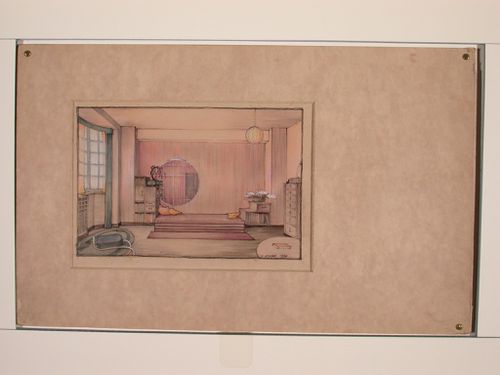
- This drawing shows the interior of a living room, including furniture. Comparison with DR1988:0391 identifies the room as one in Chelsea Cloisters. - The style of many of these drawings and reprographic copies by Henry Hyams (DR1988:0332 - DR1988:0414) suggests that they were possibly for periodical illustrations. Hyams contributed articles to the periodicals 'The Builder' and 'The Architect'. Two objects in the CCA collections can be linked to the article "Music in Stone" published prior to 1926 in 'The Architect'; a reprographic copy (DR1988:0357) and a drawing (DR1988:0364) (Who's Who in Architecture, 161).
DR1988:0390
Description:
- This drawing shows the interior of a living room, including furniture. Comparison with DR1988:0391 identifies the room as one in Chelsea Cloisters. - The style of many of these drawings and reprographic copies by Henry Hyams (DR1988:0332 - DR1988:0414) suggests that they were possibly for periodical illustrations. Hyams contributed articles to the periodicals 'The Builder' and 'The Architect'. Two objects in the CCA collections can be linked to the article "Music in Stone" published prior to 1926 in 'The Architect'; a reprographic copy (DR1988:0357) and a drawing (DR1988:0364) (Who's Who in Architecture, 161).
People:
Subject:
architecture, interior design
architecture, interior design
Date:
1938
1938
Title:
Interior perspective showing a room in Chelsea Cloisters, England
Actions:
DR1988:0390
Description:
- This drawing shows the interior of a living room, including furniture. Comparison with DR1988:0391 identifies the room as one in Chelsea Cloisters. - The style of many of these drawings and reprographic copies by Henry Hyams (DR1988:0332 - DR1988:0414) suggests that they were possibly for periodical illustrations. Hyams contributed articles to the periodicals 'The Builder' and 'The Architect'. Two objects in the CCA collections can be linked to the article "Music in Stone" published prior to 1926 in 'The Architect'; a reprographic copy (DR1988:0357) and a drawing (DR1988:0364) (Who's Who in Architecture, 161).
Interior perspective showing a room in Chelsea Cloisters, England
Actions:
DR1988:0390
Description:
- This drawing shows the interior of a living room, including furniture. Comparison with DR1988:0391 identifies the room as one in Chelsea Cloisters. - The style of many of these drawings and reprographic copies by Henry Hyams (DR1988:0332 - DR1988:0414) suggests that they were possibly for periodical illustrations. Hyams contributed articles to the periodicals 'The Builder' and 'The Architect'. Two objects in the CCA collections can be linked to the article "Music in Stone" published prior to 1926 in 'The Architect'; a reprographic copy (DR1988:0357) and a drawing (DR1988:0364) (Who's Who in Architecture, 161).
Form:
drawings
drawings
Date:
1938
1938
People:
Subject:
architecture, interior design
architecture, interior design
Form:
drawings
drawings
Reference number:
DR1988:0392
Description:
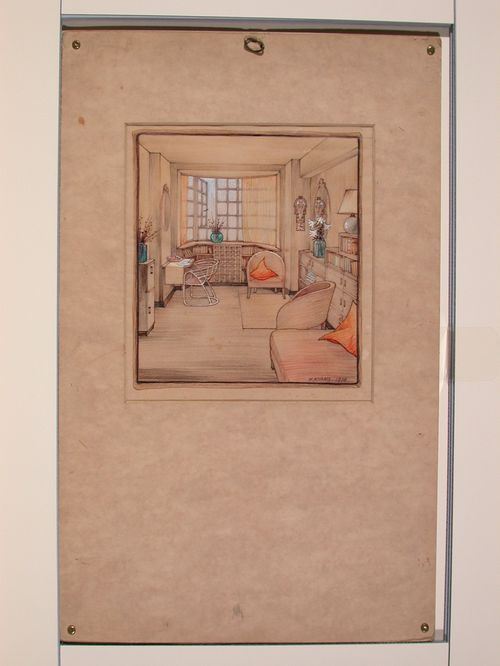
- This drawing shows the interior of a living room, including furniture. Comparison with DR1988:0391 identifies the room as one in Chelsea Cloisters. - The style of many of these drawings and reprographic copies by Henry Hyams (DR1988:0332 - DR1988:0414) suggests that they were possibly for periodical illustrations. Hyams contributed articles to the periodicals 'The Builder' and 'The Architect'. Two objects in the CCA collections can be linked to the article "Music in Stone" published prior to 1926 in 'The Architect'; a reprographic copy (DR1988:0357) and a drawing (DR1988:0364) (Who's Who in Architecture, 161).
DR1988:0392
Description:
- This drawing shows the interior of a living room, including furniture. Comparison with DR1988:0391 identifies the room as one in Chelsea Cloisters. - The style of many of these drawings and reprographic copies by Henry Hyams (DR1988:0332 - DR1988:0414) suggests that they were possibly for periodical illustrations. Hyams contributed articles to the periodicals 'The Builder' and 'The Architect'. Two objects in the CCA collections can be linked to the article "Music in Stone" published prior to 1926 in 'The Architect'; a reprographic copy (DR1988:0357) and a drawing (DR1988:0364) (Who's Who in Architecture, 161).
People:
Subject:
architecture, interior design
architecture, interior design
Date:
1938
1938
Title:
Interior perspective showing a room in Chelsea Cloisters, England
Actions:
DR1988:0392
Description:
- This drawing shows the interior of a living room, including furniture. Comparison with DR1988:0391 identifies the room as one in Chelsea Cloisters. - The style of many of these drawings and reprographic copies by Henry Hyams (DR1988:0332 - DR1988:0414) suggests that they were possibly for periodical illustrations. Hyams contributed articles to the periodicals 'The Builder' and 'The Architect'. Two objects in the CCA collections can be linked to the article "Music in Stone" published prior to 1926 in 'The Architect'; a reprographic copy (DR1988:0357) and a drawing (DR1988:0364) (Who's Who in Architecture, 161).
Interior perspective showing a room in Chelsea Cloisters, England
Actions:
DR1988:0392
Description:
- This drawing shows the interior of a living room, including furniture. Comparison with DR1988:0391 identifies the room as one in Chelsea Cloisters. - The style of many of these drawings and reprographic copies by Henry Hyams (DR1988:0332 - DR1988:0414) suggests that they were possibly for periodical illustrations. Hyams contributed articles to the periodicals 'The Builder' and 'The Architect'. Two objects in the CCA collections can be linked to the article "Music in Stone" published prior to 1926 in 'The Architect'; a reprographic copy (DR1988:0357) and a drawing (DR1988:0364) (Who's Who in Architecture, 161).
Form:
drawings
drawings
Date:
1938
1938
People:
Subject:
architecture, interior design
architecture, interior design
Form:
exhibitions
exhibitions
Title:
1973: Sorry, Out of Gas
1973: Sorry, Out of Gas
Actions:
Description:
1973: Sorry, Out of Gas captures the architectural innovation spurred by the 1973 oil crisis, when the value of oil increased exponentially and triggered economic, political, and social upheaval across the world. Featuring over 350 objects including architectural drawings, photographs, books and pamphlets, archival television footage, and historical artefacts, it maps the(...)
1973: Sorry, Out of Gas captures the architectural innovation spurred by the 1973 oil crisis, when the value of oil increased exponentially and triggered economic, political, and social upheaval across the world. Featuring over 350 objects including architectural drawings, photographs, books and pamphlets, archival television footage, and historical artefacts, it maps the(...)
Date:
7 November 2007 to 20 April 2008
7 November 2007 to 20 April 2008
Title:
1973: Sorry, Out of Gas
Actions:
Description:
1973: Sorry, Out of Gas captures the architectural innovation spurred by the 1973 oil crisis, when the value of oil increased exponentially and triggered economic, political, and social upheaval across the world. Featuring over 350 objects including architectural drawings, photographs, books and pamphlets, archival television footage, and historical artefacts, it maps the(...)
1973: Sorry, Out of Gas
Actions:
Description:
1973: Sorry, Out of Gas captures the architectural innovation spurred by the 1973 oil crisis, when the value of oil increased exponentially and triggered economic, political, and social upheaval across the world. Featuring over 350 objects including architectural drawings, photographs, books and pamphlets, archival television footage, and historical artefacts, it maps the(...)
Form:
exhibitions
exhibitions
Date:
7 November 2007 to
20 April 2008
7 November 2007 to
20 April 2008
Level of archival description:
Project
Project
Reference number:
AP075.S1.1983.PR02
Description:
Project series documents Cornelia Hahn Oberlander's landscape project for the Canadian Chancery on Pennsylvania Avenue, in Washington D.C. Oberlander worked in this project from 1983-1989 with architect Arthur Erickson. Oberlander and Erickson received the National Landscape Award for the project landscape design. The design included a paved courtyard accessible through Pennsylvania Avenue and John Marshall Place Park. Oberlanded connected the park, designed by landscape architect Carol L. Johnson in 1983, to the Chancery site by adding a paving area in place of the closed street separating the two blocks. A terraced façade featuring a hanging garden with trees and roses was design as a way of extending the John Marshall Park up to the roof of the building. The project series contains sketches and working drawings for the landscaping, including planting plans, irrigation plans, planters details, sections and planters irrigation plans, and architectural plans provided for reference use. It also contains photographs of the building and the courtyard landscaping. The project is also documented through textual records, including concept notes by Oberlander, correspondence with clients, architects, suppliers and consultants, specifications, meetings notes, financial documents, promotional material and articles on the project. Source: Herrington, Susan. Cornelia Hahn Oberlander: Making the Modern Landscape, University of Virginia Press, 2014, 304 pages.
AP075.S1.1983.PR02
Description:
Project series documents Cornelia Hahn Oberlander's landscape project for the Canadian Chancery on Pennsylvania Avenue, in Washington D.C. Oberlander worked in this project from 1983-1989 with architect Arthur Erickson. Oberlander and Erickson received the National Landscape Award for the project landscape design. The design included a paved courtyard accessible through Pennsylvania Avenue and John Marshall Place Park. Oberlanded connected the park, designed by landscape architect Carol L. Johnson in 1983, to the Chancery site by adding a paving area in place of the closed street separating the two blocks. A terraced façade featuring a hanging garden with trees and roses was design as a way of extending the John Marshall Park up to the roof of the building. The project series contains sketches and working drawings for the landscaping, including planting plans, irrigation plans, planters details, sections and planters irrigation plans, and architectural plans provided for reference use. It also contains photographs of the building and the courtyard landscaping. The project is also documented through textual records, including concept notes by Oberlander, correspondence with clients, architects, suppliers and consultants, specifications, meetings notes, financial documents, promotional material and articles on the project. Source: Herrington, Susan. Cornelia Hahn Oberlander: Making the Modern Landscape, University of Virginia Press, 2014, 304 pages.
People:
Date:
1983-1990
1983-1990
Title:
Canadian Chancery, Washington D.C. (1983-1990)
Actions:
AP075.S1.1983.PR02
Description:
Project series documents Cornelia Hahn Oberlander's landscape project for the Canadian Chancery on Pennsylvania Avenue, in Washington D.C. Oberlander worked in this project from 1983-1989 with architect Arthur Erickson. Oberlander and Erickson received the National Landscape Award for the project landscape design. The design included a paved courtyard accessible through Pennsylvania Avenue and John Marshall Place Park. Oberlanded connected the park, designed by landscape architect Carol L. Johnson in 1983, to the Chancery site by adding a paving area in place of the closed street separating the two blocks. A terraced façade featuring a hanging garden with trees and roses was design as a way of extending the John Marshall Park up to the roof of the building. The project series contains sketches and working drawings for the landscaping, including planting plans, irrigation plans, planters details, sections and planters irrigation plans, and architectural plans provided for reference use. It also contains photographs of the building and the courtyard landscaping. The project is also documented through textual records, including concept notes by Oberlander, correspondence with clients, architects, suppliers and consultants, specifications, meetings notes, financial documents, promotional material and articles on the project. Source: Herrington, Susan. Cornelia Hahn Oberlander: Making the Modern Landscape, University of Virginia Press, 2014, 304 pages.
Canadian Chancery, Washington D.C. (1983-1990)
Actions:
AP075.S1.1983.PR02
Description:
Project series documents Cornelia Hahn Oberlander's landscape project for the Canadian Chancery on Pennsylvania Avenue, in Washington D.C. Oberlander worked in this project from 1983-1989 with architect Arthur Erickson. Oberlander and Erickson received the National Landscape Award for the project landscape design. The design included a paved courtyard accessible through Pennsylvania Avenue and John Marshall Place Park. Oberlanded connected the park, designed by landscape architect Carol L. Johnson in 1983, to the Chancery site by adding a paving area in place of the closed street separating the two blocks. A terraced façade featuring a hanging garden with trees and roses was design as a way of extending the John Marshall Park up to the roof of the building. The project series contains sketches and working drawings for the landscaping, including planting plans, irrigation plans, planters details, sections and planters irrigation plans, and architectural plans provided for reference use. It also contains photographs of the building and the courtyard landscaping. The project is also documented through textual records, including concept notes by Oberlander, correspondence with clients, architects, suppliers and consultants, specifications, meetings notes, financial documents, promotional material and articles on the project. Source: Herrington, Susan. Cornelia Hahn Oberlander: Making the Modern Landscape, University of Virginia Press, 2014, 304 pages.
Level of archival description:
Project
Project
Date:
1983-1990
1983-1990
People:
Level of archival description:
Project
Project
Actions:
Reference number:
AP075.S1.1999.PR05
Description:
Project series documents Cornelia Hahn Oberlander's landscape project for the garden of Linda Yorke and Gordon Forbes in Vancouver, British Columbia. Oberlander worked on this project in the second half of the 1990s. She worked with architect André Rowland who was in charge of designing an addition to the residence designed in the late 1940s by Ned Pratt from architectural firm Sharp, Thompson, Berwick and & Pratt. The project consisted in redesigning the entire yard and adding a play area for children. Oberlander included terraces next to the addition to the house, planting beds and planters. The play area included a tower house accessible by a rope bridge, a two levels playhouse with wooden porch, a slide, a fireman pole and a ladder, and a small water canal with stone edges and activated by a hand pump. The project series contains landscape sketches, design development drawings, including a landscape concept plan, details, sections and elevations for play area and play structures, and building plans used as reference. The project is also documented through correspondence, including with clients, suppliers and consultants, concept notes by Oberlander, plant lists, financial material, research material, and photographs of the landscaping. Source: Herrington, Susan. Cornelia Hahn Oberlander: Making the Modern Landscape, University of Virginia Press, 2014, 304 pages.
AP075.S1.1999.PR05
Description:
Project series documents Cornelia Hahn Oberlander's landscape project for the garden of Linda Yorke and Gordon Forbes in Vancouver, British Columbia. Oberlander worked on this project in the second half of the 1990s. She worked with architect André Rowland who was in charge of designing an addition to the residence designed in the late 1940s by Ned Pratt from architectural firm Sharp, Thompson, Berwick and & Pratt. The project consisted in redesigning the entire yard and adding a play area for children. Oberlander included terraces next to the addition to the house, planting beds and planters. The play area included a tower house accessible by a rope bridge, a two levels playhouse with wooden porch, a slide, a fireman pole and a ladder, and a small water canal with stone edges and activated by a hand pump. The project series contains landscape sketches, design development drawings, including a landscape concept plan, details, sections and elevations for play area and play structures, and building plans used as reference. The project is also documented through correspondence, including with clients, suppliers and consultants, concept notes by Oberlander, plant lists, financial material, research material, and photographs of the landscaping. Source: Herrington, Susan. Cornelia Hahn Oberlander: Making the Modern Landscape, University of Virginia Press, 2014, 304 pages.
People:
Date:
1947-2006
1947-2006
Title:
Yorke-Forbes Residence, Vancouver, British Columbia (1999)
Actions:
AP075.S1.1999.PR05
Description:
Project series documents Cornelia Hahn Oberlander's landscape project for the garden of Linda Yorke and Gordon Forbes in Vancouver, British Columbia. Oberlander worked on this project in the second half of the 1990s. She worked with architect André Rowland who was in charge of designing an addition to the residence designed in the late 1940s by Ned Pratt from architectural firm Sharp, Thompson, Berwick and & Pratt. The project consisted in redesigning the entire yard and adding a play area for children. Oberlander included terraces next to the addition to the house, planting beds and planters. The play area included a tower house accessible by a rope bridge, a two levels playhouse with wooden porch, a slide, a fireman pole and a ladder, and a small water canal with stone edges and activated by a hand pump. The project series contains landscape sketches, design development drawings, including a landscape concept plan, details, sections and elevations for play area and play structures, and building plans used as reference. The project is also documented through correspondence, including with clients, suppliers and consultants, concept notes by Oberlander, plant lists, financial material, research material, and photographs of the landscaping. Source: Herrington, Susan. Cornelia Hahn Oberlander: Making the Modern Landscape, University of Virginia Press, 2014, 304 pages.
Yorke-Forbes Residence, Vancouver, British Columbia (1999)
Actions:
AP075.S1.1999.PR05
Description:
Project series documents Cornelia Hahn Oberlander's landscape project for the garden of Linda Yorke and Gordon Forbes in Vancouver, British Columbia. Oberlander worked on this project in the second half of the 1990s. She worked with architect André Rowland who was in charge of designing an addition to the residence designed in the late 1940s by Ned Pratt from architectural firm Sharp, Thompson, Berwick and & Pratt. The project consisted in redesigning the entire yard and adding a play area for children. Oberlander included terraces next to the addition to the house, planting beds and planters. The play area included a tower house accessible by a rope bridge, a two levels playhouse with wooden porch, a slide, a fireman pole and a ladder, and a small water canal with stone edges and activated by a hand pump. The project series contains landscape sketches, design development drawings, including a landscape concept plan, details, sections and elevations for play area and play structures, and building plans used as reference. The project is also documented through correspondence, including with clients, suppliers and consultants, concept notes by Oberlander, plant lists, financial material, research material, and photographs of the landscaping. Source: Herrington, Susan. Cornelia Hahn Oberlander: Making the Modern Landscape, University of Virginia Press, 2014, 304 pages.
Level of archival description:
Project
Project
Date:
1947-2006
1947-2006
People:
Level of archival description:
Project
Project
Reference number:
AP178.S1.1983.PR04
Description:
The project series documents the 1983 design entry for the Kulturforum. While the records were held in the office’s archives this project was assigned the number 21/80. The office assigned the date 1983 for this project. This project was a competition entry for the International Architectural Exhibition Berlin competition (International Bauaustellung, IBA, circa 1979-1987), an urban renewal strategy for West Berlin, Germany. Siza also submitted five other entries to the IBA: Görtlitzer Bad swimming pool; Block 70 and 89 (Fränkelufer residential complex); Bonjour Tristesse (Block 121); Block 11-12; and Monument to Gestapo victims. The Kulturforum was a complex of cultural buildings. The site underwent many changes during Nazi Germany and post-war with the construction of the National Library of Staatsbibliothek, designed by Hans Scharoun. Two examples of features that the IBA asked participants to include in their design proposals were to exclude vehicle traffic between the library and national gallery, and to reinterpret the Forum space. Documenting this project are several sketches and studies. There are also plans, elevations, and axonometric drawings of site plans. Siza’s office has indicated on some of the studies that they were possibly not created by Siza. Where this is the case it has been noted with the physical material. Photographs and negatives document the competition site and model, and there are transparencies and slides of drawings. Also included is textual documentation on the competition site and a few letters from members of the Berlin Senate, two of which are from Brigitte Cassirer (later Brigitte Fleck).
AP178.S1.1983.PR04
Description:
The project series documents the 1983 design entry for the Kulturforum. While the records were held in the office’s archives this project was assigned the number 21/80. The office assigned the date 1983 for this project. This project was a competition entry for the International Architectural Exhibition Berlin competition (International Bauaustellung, IBA, circa 1979-1987), an urban renewal strategy for West Berlin, Germany. Siza also submitted five other entries to the IBA: Görtlitzer Bad swimming pool; Block 70 and 89 (Fränkelufer residential complex); Bonjour Tristesse (Block 121); Block 11-12; and Monument to Gestapo victims. The Kulturforum was a complex of cultural buildings. The site underwent many changes during Nazi Germany and post-war with the construction of the National Library of Staatsbibliothek, designed by Hans Scharoun. Two examples of features that the IBA asked participants to include in their design proposals were to exclude vehicle traffic between the library and national gallery, and to reinterpret the Forum space. Documenting this project are several sketches and studies. There are also plans, elevations, and axonometric drawings of site plans. Siza’s office has indicated on some of the studies that they were possibly not created by Siza. Where this is the case it has been noted with the physical material. Photographs and negatives document the competition site and model, and there are transparencies and slides of drawings. Also included is textual documentation on the competition site and a few letters from members of the Berlin Senate, two of which are from Brigitte Cassirer (later Brigitte Fleck).
People:
Date:
1982-2012
1982-2012
Title:
Kulturforum [Kulturforum], Berlin, Germany (1982-1986)
Actions:
AP178.S1.1983.PR04
Description:
The project series documents the 1983 design entry for the Kulturforum. While the records were held in the office’s archives this project was assigned the number 21/80. The office assigned the date 1983 for this project. This project was a competition entry for the International Architectural Exhibition Berlin competition (International Bauaustellung, IBA, circa 1979-1987), an urban renewal strategy for West Berlin, Germany. Siza also submitted five other entries to the IBA: Görtlitzer Bad swimming pool; Block 70 and 89 (Fränkelufer residential complex); Bonjour Tristesse (Block 121); Block 11-12; and Monument to Gestapo victims. The Kulturforum was a complex of cultural buildings. The site underwent many changes during Nazi Germany and post-war with the construction of the National Library of Staatsbibliothek, designed by Hans Scharoun. Two examples of features that the IBA asked participants to include in their design proposals were to exclude vehicle traffic between the library and national gallery, and to reinterpret the Forum space. Documenting this project are several sketches and studies. There are also plans, elevations, and axonometric drawings of site plans. Siza’s office has indicated on some of the studies that they were possibly not created by Siza. Where this is the case it has been noted with the physical material. Photographs and negatives document the competition site and model, and there are transparencies and slides of drawings. Also included is textual documentation on the competition site and a few letters from members of the Berlin Senate, two of which are from Brigitte Cassirer (later Brigitte Fleck).
Kulturforum [Kulturforum], Berlin, Germany (1982-1986)
Actions:
AP178.S1.1983.PR04
Description:
The project series documents the 1983 design entry for the Kulturforum. While the records were held in the office’s archives this project was assigned the number 21/80. The office assigned the date 1983 for this project. This project was a competition entry for the International Architectural Exhibition Berlin competition (International Bauaustellung, IBA, circa 1979-1987), an urban renewal strategy for West Berlin, Germany. Siza also submitted five other entries to the IBA: Görtlitzer Bad swimming pool; Block 70 and 89 (Fränkelufer residential complex); Bonjour Tristesse (Block 121); Block 11-12; and Monument to Gestapo victims. The Kulturforum was a complex of cultural buildings. The site underwent many changes during Nazi Germany and post-war with the construction of the National Library of Staatsbibliothek, designed by Hans Scharoun. Two examples of features that the IBA asked participants to include in their design proposals were to exclude vehicle traffic between the library and national gallery, and to reinterpret the Forum space. Documenting this project are several sketches and studies. There are also plans, elevations, and axonometric drawings of site plans. Siza’s office has indicated on some of the studies that they were possibly not created by Siza. Where this is the case it has been noted with the physical material. Photographs and negatives document the competition site and model, and there are transparencies and slides of drawings. Also included is textual documentation on the competition site and a few letters from members of the Berlin Senate, two of which are from Brigitte Cassirer (later Brigitte Fleck).
Level of archival description:
Project
Project
Date:
1982-2012
1982-2012
People:
Level of archival description:
Project
Project
Actions:
Reference number:
AP018.S1.1962.PR05
Description:
This project series documents the construction of the Toronto-Dominion Bank Building in Toronto in1962. The office identified the project number as 6280. This project consisted of a 56 storey, black steel skyscraper that came to exemplify the age of modernist architecture in Toronto through the introduction of the International Style to the older cityscape. The design of the Toronto-Dominion Bank Centre is almost wholly credited to architect Ludwig Mies van der Rohe. However, John B. Parkin Associates, in joint venture with architecture firm Bregman + Hamann, were the primary architects on the project, with van der Rohe acting as consulting architect. During this era, the Toronto-Dominion Centre included three buildings - two office towers and a single level banking pavilion which was about two-storeys in height. It appears that this project consisted only of the tallest tower, now known as TD Tower, and that the other buildings were completed under different project numbers assigned by the office. The project is recorded through reprographic copies of construction drawings dating from 1966-1968.
AP018.S1.1962.PR05
Description:
This project series documents the construction of the Toronto-Dominion Bank Building in Toronto in1962. The office identified the project number as 6280. This project consisted of a 56 storey, black steel skyscraper that came to exemplify the age of modernist architecture in Toronto through the introduction of the International Style to the older cityscape. The design of the Toronto-Dominion Bank Centre is almost wholly credited to architect Ludwig Mies van der Rohe. However, John B. Parkin Associates, in joint venture with architecture firm Bregman + Hamann, were the primary architects on the project, with van der Rohe acting as consulting architect. During this era, the Toronto-Dominion Centre included three buildings - two office towers and a single level banking pavilion which was about two-storeys in height. It appears that this project consisted only of the tallest tower, now known as TD Tower, and that the other buildings were completed under different project numbers assigned by the office. The project is recorded through reprographic copies of construction drawings dating from 1966-1968.
People:
Date:
1966-1968
1966-1968
Title:
Toronto-Dominion Bank Building, Toronto (1962-1967)
Actions:
AP018.S1.1962.PR05
Description:
This project series documents the construction of the Toronto-Dominion Bank Building in Toronto in1962. The office identified the project number as 6280. This project consisted of a 56 storey, black steel skyscraper that came to exemplify the age of modernist architecture in Toronto through the introduction of the International Style to the older cityscape. The design of the Toronto-Dominion Bank Centre is almost wholly credited to architect Ludwig Mies van der Rohe. However, John B. Parkin Associates, in joint venture with architecture firm Bregman + Hamann, were the primary architects on the project, with van der Rohe acting as consulting architect. During this era, the Toronto-Dominion Centre included three buildings - two office towers and a single level banking pavilion which was about two-storeys in height. It appears that this project consisted only of the tallest tower, now known as TD Tower, and that the other buildings were completed under different project numbers assigned by the office. The project is recorded through reprographic copies of construction drawings dating from 1966-1968.
Toronto-Dominion Bank Building, Toronto (1962-1967)
Actions:
AP018.S1.1962.PR05
Description:
This project series documents the construction of the Toronto-Dominion Bank Building in Toronto in1962. The office identified the project number as 6280. This project consisted of a 56 storey, black steel skyscraper that came to exemplify the age of modernist architecture in Toronto through the introduction of the International Style to the older cityscape. The design of the Toronto-Dominion Bank Centre is almost wholly credited to architect Ludwig Mies van der Rohe. However, John B. Parkin Associates, in joint venture with architecture firm Bregman + Hamann, were the primary architects on the project, with van der Rohe acting as consulting architect. During this era, the Toronto-Dominion Centre included three buildings - two office towers and a single level banking pavilion which was about two-storeys in height. It appears that this project consisted only of the tallest tower, now known as TD Tower, and that the other buildings were completed under different project numbers assigned by the office. The project is recorded through reprographic copies of construction drawings dating from 1966-1968.
Level of archival description:
Project
Project
Date:
1966-1968
1966-1968
People:
Form:
textual records
textual records
Actions:
Reference number:
DR2001:0023
Description:
BFL Software India documents include 1 empty envelope from BFL Software India, photographs of model, site photographs, Report of Atlas of vibrational spectra of liquid crystals (DRCON1999:0015:116:004 1/4), program summary, promotionnal documentation, documentation of the software building, listes of names and furnitures, drawings, clippings, documentation on Idian architecture (Vastu)
DR2001:0023
Description:
BFL Software India documents include 1 empty envelope from BFL Software India, photographs of model, site photographs, Report of Atlas of vibrational spectra of liquid crystals (DRCON1999:0015:116:004 1/4), program summary, promotionnal documentation, documentation of the software building, listes of names and furnitures, drawings, clippings, documentation on Idian architecture (Vastu)
People:
Title:
BFL Software India documents include 1 empty envelope from BFL Software India
Actions:
DR2001:0023
Description:
BFL Software India documents include 1 empty envelope from BFL Software India, photographs of model, site photographs, Report of Atlas of vibrational spectra of liquid crystals (DRCON1999:0015:116:004 1/4), program summary, promotionnal documentation, documentation of the software building, listes of names and furnitures, drawings, clippings, documentation on Idian architecture (Vastu)
BFL Software India documents include 1 empty envelope from BFL Software India
Actions:
DR2001:0023
Description:
BFL Software India documents include 1 empty envelope from BFL Software India, photographs of model, site photographs, Report of Atlas of vibrational spectra of liquid crystals (DRCON1999:0015:116:004 1/4), program summary, promotionnal documentation, documentation of the software building, listes of names and furnitures, drawings, clippings, documentation on Idian architecture (Vastu)
Form:
textual records
textual records
People:
Form:
exhibitions
exhibitions
Title:
Arrivals
Arrivals
Actions:
Description:
Arrivals features gifts to the collection received in honour of Phyllis Lambert’s eightieth birthday. It includes original prints by acclaimed photographers and artists experimenting with the language of photography: Dieter Appelt, Robert Burley, Edward Burtynsky, Giovanni Chiaramonte, Thomas Florschuetz, John Gossage, Guido Guidi, Gordon Matta-Clark (donated by Jane(...)
Arrivals features gifts to the collection received in honour of Phyllis Lambert’s eightieth birthday. It includes original prints by acclaimed photographers and artists experimenting with the language of photography: Dieter Appelt, Robert Burley, Edward Burtynsky, Giovanni Chiaramonte, Thomas Florschuetz, John Gossage, Guido Guidi, Gordon Matta-Clark (donated by Jane(...)
Location:
Hall cases
Hall cases
Date:
24 January 2008 to 23 March 2008
24 January 2008 to 23 March 2008
Title:
Arrivals
Actions:
Description:
Arrivals features gifts to the collection received in honour of Phyllis Lambert’s eightieth birthday. It includes original prints by acclaimed photographers and artists experimenting with the language of photography: Dieter Appelt, Robert Burley, Edward Burtynsky, Giovanni Chiaramonte, Thomas Florschuetz, John Gossage, Guido Guidi, Gordon Matta-Clark (donated by Jane(...)
Arrivals
Actions:
Description:
Arrivals features gifts to the collection received in honour of Phyllis Lambert’s eightieth birthday. It includes original prints by acclaimed photographers and artists experimenting with the language of photography: Dieter Appelt, Robert Burley, Edward Burtynsky, Giovanni Chiaramonte, Thomas Florschuetz, John Gossage, Guido Guidi, Gordon Matta-Clark (donated by Jane(...)
Form:
exhibitions
exhibitions
Date:
24 January 2008 to
23 March 2008
24 January 2008 to
23 March 2008
Location:
Hall cases
Hall cases


