


44145 Results
Level of archival description:
Project
Project
Actions:
Reference number:
AP075.S1.2013.PR01
Description:
Project series documents Cornelia Hahn Oberlander's work as consulting landscape architect for the Ecole Pauline-Johnson playground, located at the corner of Jefferson Street and 21st Street, in West Vancouver, British Columbia. Oberlander worked on this project in 2013-2015 with Susan Herrington as consulting landscape architect and the landscape architectural firm Atelier Anonymus, Landscape. The project consisted in re-imagining and re-designing the school playground to create a creative play environment. Oberlander's proposal included a logs and rocks creative play area, a seating area, and replanting of trees at the end of the playground on the 21st Street side. The project series contains a landscape sketch of the playground by Oberlander, project proposals by the team, correspondence with architects, consultants and contractors, documentation and research material and press.
AP075.S1.2013.PR01
Description:
Project series documents Cornelia Hahn Oberlander's work as consulting landscape architect for the Ecole Pauline-Johnson playground, located at the corner of Jefferson Street and 21st Street, in West Vancouver, British Columbia. Oberlander worked on this project in 2013-2015 with Susan Herrington as consulting landscape architect and the landscape architectural firm Atelier Anonymus, Landscape. The project consisted in re-imagining and re-designing the school playground to create a creative play environment. Oberlander's proposal included a logs and rocks creative play area, a seating area, and replanting of trees at the end of the playground on the 21st Street side. The project series contains a landscape sketch of the playground by Oberlander, project proposals by the team, correspondence with architects, consultants and contractors, documentation and research material and press.
People:
Title:
Ecole Pauline-Johnson, West Vancouver, British Columbia (2013-2015)
Actions:
AP075.S1.2013.PR01
Description:
Project series documents Cornelia Hahn Oberlander's work as consulting landscape architect for the Ecole Pauline-Johnson playground, located at the corner of Jefferson Street and 21st Street, in West Vancouver, British Columbia. Oberlander worked on this project in 2013-2015 with Susan Herrington as consulting landscape architect and the landscape architectural firm Atelier Anonymus, Landscape. The project consisted in re-imagining and re-designing the school playground to create a creative play environment. Oberlander's proposal included a logs and rocks creative play area, a seating area, and replanting of trees at the end of the playground on the 21st Street side. The project series contains a landscape sketch of the playground by Oberlander, project proposals by the team, correspondence with architects, consultants and contractors, documentation and research material and press.
Ecole Pauline-Johnson, West Vancouver, British Columbia (2013-2015)
Actions:
AP075.S1.2013.PR01
Description:
Project series documents Cornelia Hahn Oberlander's work as consulting landscape architect for the Ecole Pauline-Johnson playground, located at the corner of Jefferson Street and 21st Street, in West Vancouver, British Columbia. Oberlander worked on this project in 2013-2015 with Susan Herrington as consulting landscape architect and the landscape architectural firm Atelier Anonymus, Landscape. The project consisted in re-imagining and re-designing the school playground to create a creative play environment. Oberlander's proposal included a logs and rocks creative play area, a seating area, and replanting of trees at the end of the playground on the 21st Street side. The project series contains a landscape sketch of the playground by Oberlander, project proposals by the team, correspondence with architects, consultants and contractors, documentation and research material and press.
Level of archival description:
Project
Project
People:
Level of archival description:
Project
Project
Actions:
Reference number:
AP075.S1.2014.PR01
Description:
Project series documents Cornelia Hahn Oberlander's work as consulting landscape architect for the revitalisation project of the atrium and garden of the Bank of Canada building in Ottawa, Ontario. Oberlander was included in the project in 2014 as consultant after requests from Heritage Canada and others, including Phyllis Lambert, concerned about the conservation of a landmark building and landscape. She worked with architectural firm Busby Perkins+Will who was in charge of the project for the building. The Bank of Canada building and the exterior and interior landscape were originally designed by Arthur Erickson. The project series contains correspondence with architects and consultants, and also correpondence with Heritage Canada about the protection of the interior and exterior landscape. It also contains project proposal presentation booklets by architects, documentation and press.
AP075.S1.2014.PR01
Description:
Project series documents Cornelia Hahn Oberlander's work as consulting landscape architect for the revitalisation project of the atrium and garden of the Bank of Canada building in Ottawa, Ontario. Oberlander was included in the project in 2014 as consultant after requests from Heritage Canada and others, including Phyllis Lambert, concerned about the conservation of a landmark building and landscape. She worked with architectural firm Busby Perkins+Will who was in charge of the project for the building. The Bank of Canada building and the exterior and interior landscape were originally designed by Arthur Erickson. The project series contains correspondence with architects and consultants, and also correpondence with Heritage Canada about the protection of the interior and exterior landscape. It also contains project proposal presentation booklets by architects, documentation and press.
People:
Date:
2013-2015
2013-2015
Title:
Bank of Canada, Ottawa, Ontario (2014)
Actions:
AP075.S1.2014.PR01
Description:
Project series documents Cornelia Hahn Oberlander's work as consulting landscape architect for the revitalisation project of the atrium and garden of the Bank of Canada building in Ottawa, Ontario. Oberlander was included in the project in 2014 as consultant after requests from Heritage Canada and others, including Phyllis Lambert, concerned about the conservation of a landmark building and landscape. She worked with architectural firm Busby Perkins+Will who was in charge of the project for the building. The Bank of Canada building and the exterior and interior landscape were originally designed by Arthur Erickson. The project series contains correspondence with architects and consultants, and also correpondence with Heritage Canada about the protection of the interior and exterior landscape. It also contains project proposal presentation booklets by architects, documentation and press.
Bank of Canada, Ottawa, Ontario (2014)
Actions:
AP075.S1.2014.PR01
Description:
Project series documents Cornelia Hahn Oberlander's work as consulting landscape architect for the revitalisation project of the atrium and garden of the Bank of Canada building in Ottawa, Ontario. Oberlander was included in the project in 2014 as consultant after requests from Heritage Canada and others, including Phyllis Lambert, concerned about the conservation of a landmark building and landscape. She worked with architectural firm Busby Perkins+Will who was in charge of the project for the building. The Bank of Canada building and the exterior and interior landscape were originally designed by Arthur Erickson. The project series contains correspondence with architects and consultants, and also correpondence with Heritage Canada about the protection of the interior and exterior landscape. It also contains project proposal presentation booklets by architects, documentation and press.
Level of archival description:
Project
Project
Date:
2013-2015
2013-2015
People:
Level of archival description:
Project
Project
Actions:
Reference number:
AP075.S1.2012.PR02
Description:
Project series documents Cornelia Hahn Oberlander's work as a consultanh architects for the revitalisation of the green roof and upper floors planters of the Vancouver Public Library, also know as Library Square, on West Georgia Street in Vancouver, British Columbia. Oberlander worked on this project from 2008-2012 with landscape architects firm Enns Gauthier Landscape Architects and architectural firms Safdie Architects and DA Architects + Planners. The project consisted mainly in assessment, maintenance and replanting of trampled area or badly maintained trees. The project series contains a few sketches, working drawings, including higher levels floor plans, sections and site plans, and renderings. The project is also documented through project proposal, specifications, correspondence with architects and consultants, reports, financial document, meetings notes and documentation.
AP075.S1.2012.PR02
Description:
Project series documents Cornelia Hahn Oberlander's work as a consultanh architects for the revitalisation of the green roof and upper floors planters of the Vancouver Public Library, also know as Library Square, on West Georgia Street in Vancouver, British Columbia. Oberlander worked on this project from 2008-2012 with landscape architects firm Enns Gauthier Landscape Architects and architectural firms Safdie Architects and DA Architects + Planners. The project consisted mainly in assessment, maintenance and replanting of trampled area or badly maintained trees. The project series contains a few sketches, working drawings, including higher levels floor plans, sections and site plans, and renderings. The project is also documented through project proposal, specifications, correspondence with architects and consultants, reports, financial document, meetings notes and documentation.
People:
Date:
2001-2018
2001-2018
Title:
Vancouver Public Library green roof, Vancouver, British Columbia (2012)
Actions:
AP075.S1.2012.PR02
Description:
Project series documents Cornelia Hahn Oberlander's work as a consultanh architects for the revitalisation of the green roof and upper floors planters of the Vancouver Public Library, also know as Library Square, on West Georgia Street in Vancouver, British Columbia. Oberlander worked on this project from 2008-2012 with landscape architects firm Enns Gauthier Landscape Architects and architectural firms Safdie Architects and DA Architects + Planners. The project consisted mainly in assessment, maintenance and replanting of trampled area or badly maintained trees. The project series contains a few sketches, working drawings, including higher levels floor plans, sections and site plans, and renderings. The project is also documented through project proposal, specifications, correspondence with architects and consultants, reports, financial document, meetings notes and documentation.
Vancouver Public Library green roof, Vancouver, British Columbia (2012)
Actions:
AP075.S1.2012.PR02
Description:
Project series documents Cornelia Hahn Oberlander's work as a consultanh architects for the revitalisation of the green roof and upper floors planters of the Vancouver Public Library, also know as Library Square, on West Georgia Street in Vancouver, British Columbia. Oberlander worked on this project from 2008-2012 with landscape architects firm Enns Gauthier Landscape Architects and architectural firms Safdie Architects and DA Architects + Planners. The project consisted mainly in assessment, maintenance and replanting of trampled area or badly maintained trees. The project series contains a few sketches, working drawings, including higher levels floor plans, sections and site plans, and renderings. The project is also documented through project proposal, specifications, correspondence with architects and consultants, reports, financial document, meetings notes and documentation.
Level of archival description:
Project
Project
Date:
2001-2018
2001-2018
People:
Level of archival description:
Project
Project
Actions:
Reference number:
AP142.S1.D229
Description:
File documents an unexecuted (?) project for a cultural centre and a park in Bologna, Italy. Material in this file was produced in 1992 and 1993. File contains a conceptual drawing and presentation drawings. File also contains textual records, including drawings, maps, photographs, correspondence, an architect's statement, competition programmes, competition announcements, specifications, estimates, clippings, technical reports, schedules of drawings, labels for drawings, a work schedule, computer printouts, a curriculum vitae for Aldo Rossi, and notes.
AP142.S1.D229
Description:
File documents an unexecuted (?) project for a cultural centre and a park in Bologna, Italy. Material in this file was produced in 1992 and 1993. File contains a conceptual drawing and presentation drawings. File also contains textual records, including drawings, maps, photographs, correspondence, an architect's statement, competition programmes, competition announcements, specifications, estimates, clippings, technical reports, schedules of drawings, labels for drawings, a work schedule, computer printouts, a curriculum vitae for Aldo Rossi, and notes.
People:
Date:
1992-1993
1992-1993
Title:
Parco urbano e polo culturale - istituzionale della manifattura tabacchi, Comune di Bologna
Actions:
AP142.S1.D229
Description:
File documents an unexecuted (?) project for a cultural centre and a park in Bologna, Italy. Material in this file was produced in 1992 and 1993. File contains a conceptual drawing and presentation drawings. File also contains textual records, including drawings, maps, photographs, correspondence, an architect's statement, competition programmes, competition announcements, specifications, estimates, clippings, technical reports, schedules of drawings, labels for drawings, a work schedule, computer printouts, a curriculum vitae for Aldo Rossi, and notes.
Parco urbano e polo culturale - istituzionale della manifattura tabacchi, Comune di Bologna
Actions:
AP142.S1.D229
Description:
File documents an unexecuted (?) project for a cultural centre and a park in Bologna, Italy. Material in this file was produced in 1992 and 1993. File contains a conceptual drawing and presentation drawings. File also contains textual records, including drawings, maps, photographs, correspondence, an architect's statement, competition programmes, competition announcements, specifications, estimates, clippings, technical reports, schedules of drawings, labels for drawings, a work schedule, computer printouts, a curriculum vitae for Aldo Rossi, and notes.
Level of archival description:
File 229
File 229
Date:
1992-1993
1992-1993
People:
Level of archival description:
Project
Project
Actions:
Reference number:
AP142.S1.D63
Description:
File documents a successful competition entry for the southern Friedrichstadt area in Berlin, Germany. Aldo Rossi was commissioned with the design of the entire district but had to work more precisely on the block 10. Material in this file was produced between 1978 and 1985. File contains reference drawings, conceptual drawing, design development drawings and presentation drawings. File also contains textual records including correspondence, a competition programme, a contact sheet, drawings, sketches and photographic material.
AP142.S1.D63
Description:
File documents a successful competition entry for the southern Friedrichstadt area in Berlin, Germany. Aldo Rossi was commissioned with the design of the entire district but had to work more precisely on the block 10. Material in this file was produced between 1978 and 1985. File contains reference drawings, conceptual drawing, design development drawings and presentation drawings. File also contains textual records including correspondence, a competition programme, a contact sheet, drawings, sketches and photographic material.
People:
Date:
1978-1985
1978-1985
Title:
Berlin Südliche Friedrichstadt
Actions:
AP142.S1.D63
Description:
File documents a successful competition entry for the southern Friedrichstadt area in Berlin, Germany. Aldo Rossi was commissioned with the design of the entire district but had to work more precisely on the block 10. Material in this file was produced between 1978 and 1985. File contains reference drawings, conceptual drawing, design development drawings and presentation drawings. File also contains textual records including correspondence, a competition programme, a contact sheet, drawings, sketches and photographic material.
Berlin Südliche Friedrichstadt
Actions:
AP142.S1.D63
Description:
File documents a successful competition entry for the southern Friedrichstadt area in Berlin, Germany. Aldo Rossi was commissioned with the design of the entire district but had to work more precisely on the block 10. Material in this file was produced between 1978 and 1985. File contains reference drawings, conceptual drawing, design development drawings and presentation drawings. File also contains textual records including correspondence, a competition programme, a contact sheet, drawings, sketches and photographic material.
Level of archival description:
File 63
File 63
Date:
1978-1985
1978-1985
People:
Level of archival description:
Project
Project
Actions:
Reference number:
AP206.S1.1982.PR14
Description:
This project series documents a house for Shri Om Prakash Gupta in Model Town, Panipat, India, likely sometime in the 1980s or 1990s. The project consisted of a two-storey home with a barsati on its second level. The home wrapped a courtyard on three sides and had brick jali work along the top of its façade. The project is recorded through a drawing of floor plans, elevations and sections, possibly dating from sometime in the 1980s-1990s.
AP206.S1.1982.PR14
Description:
This project series documents a house for Shri Om Prakash Gupta in Model Town, Panipat, India, likely sometime in the 1980s or 1990s. The project consisted of a two-storey home with a barsati on its second level. The home wrapped a courtyard on three sides and had brick jali work along the top of its façade. The project is recorded through a drawing of floor plans, elevations and sections, possibly dating from sometime in the 1980s-1990s.
People:
Date:
circa 1980s-1990s
circa 1980s-1990s
Title:
House for Shri Om Prakash Gupta, Panipat, India (circa 1980s-1990s)
Actions:
AP206.S1.1982.PR14
Description:
This project series documents a house for Shri Om Prakash Gupta in Model Town, Panipat, India, likely sometime in the 1980s or 1990s. The project consisted of a two-storey home with a barsati on its second level. The home wrapped a courtyard on three sides and had brick jali work along the top of its façade. The project is recorded through a drawing of floor plans, elevations and sections, possibly dating from sometime in the 1980s-1990s.
House for Shri Om Prakash Gupta, Panipat, India (circa 1980s-1990s)
Actions:
AP206.S1.1982.PR14
Description:
This project series documents a house for Shri Om Prakash Gupta in Model Town, Panipat, India, likely sometime in the 1980s or 1990s. The project consisted of a two-storey home with a barsati on its second level. The home wrapped a courtyard on three sides and had brick jali work along the top of its façade. The project is recorded through a drawing of floor plans, elevations and sections, possibly dating from sometime in the 1980s-1990s.
Level of archival description:
Project
Project
Date:
circa 1980s-1990s
circa 1980s-1990s
People:
Level of archival description:
Sub-series
Sub-series
Actions:
Reference number:
AP207.S2.SS05
Description:
The sub-series documents the exhibition "Il polo espositivo: un tema, due architetti. Arata Isozaki, O.M. Ungers", curated by Pettena and presented at the Piazza Santissima Annuziata in Florence in 1988. The exhibition is a study of designs for exhibition spaces by comparing the work of Japanese architect Arata Isozaki and German architect Oswald Mathias Ungers. The sub-series contains research material on Arata Isozaki and Oswald Mathias Ungers and their projects, such as articles and photocopies of publications.
AP207.S2.SS05
Description:
The sub-series documents the exhibition "Il polo espositivo: un tema, due architetti. Arata Isozaki, O.M. Ungers", curated by Pettena and presented at the Piazza Santissima Annuziata in Florence in 1988. The exhibition is a study of designs for exhibition spaces by comparing the work of Japanese architect Arata Isozaki and German architect Oswald Mathias Ungers. The sub-series contains research material on Arata Isozaki and Oswald Mathias Ungers and their projects, such as articles and photocopies of publications.
People:
Date:
circa 1988
circa 1988
Title:
Il polo espositivo: un tema, due architetti. Arata Isozaki, O.M. Ungers (1988)
Actions:
AP207.S2.SS05
Description:
The sub-series documents the exhibition "Il polo espositivo: un tema, due architetti. Arata Isozaki, O.M. Ungers", curated by Pettena and presented at the Piazza Santissima Annuziata in Florence in 1988. The exhibition is a study of designs for exhibition spaces by comparing the work of Japanese architect Arata Isozaki and German architect Oswald Mathias Ungers. The sub-series contains research material on Arata Isozaki and Oswald Mathias Ungers and their projects, such as articles and photocopies of publications.
Il polo espositivo: un tema, due architetti. Arata Isozaki, O.M. Ungers (1988)
Actions:
AP207.S2.SS05
Description:
The sub-series documents the exhibition "Il polo espositivo: un tema, due architetti. Arata Isozaki, O.M. Ungers", curated by Pettena and presented at the Piazza Santissima Annuziata in Florence in 1988. The exhibition is a study of designs for exhibition spaces by comparing the work of Japanese architect Arata Isozaki and German architect Oswald Mathias Ungers. The sub-series contains research material on Arata Isozaki and Oswald Mathias Ungers and their projects, such as articles and photocopies of publications.
Level of archival description:
Subseries
Subseries
Date:
circa 1988
circa 1988
People:
Form:
drawings
drawings
Actions:
Reference number:
DR1987:0366
Description:
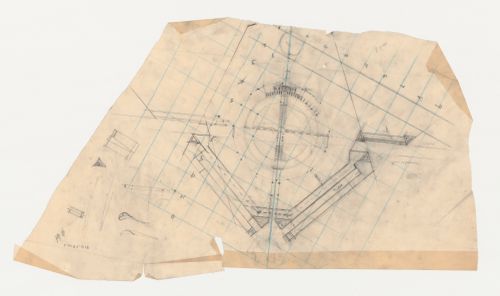
- This drawing includes a large plan which Lloyd Wright used to work out the disposition of buildings for Los Angeles Municipal Airport. The plan is possibly one of a series of preparatory drawings for a perspective view; it has the same blue pencil grid as the preparatory drawing (DR1987:0369). The smaller sketches beside the plan are unidentified.
DR1987:0366
Description:
- This drawing includes a large plan which Lloyd Wright used to work out the disposition of buildings for Los Angeles Municipal Airport. The plan is possibly one of a series of preparatory drawings for a perspective view; it has the same blue pencil grid as the preparatory drawing (DR1987:0369). The smaller sketches beside the plan are unidentified.
People:
Subject:
architecture
architecture
Date:
1929
1929
Title:
Los Angeles Municipal Airport: Plan for terminal buildings and hangars
Actions:
DR1987:0366
Description:
- This drawing includes a large plan which Lloyd Wright used to work out the disposition of buildings for Los Angeles Municipal Airport. The plan is possibly one of a series of preparatory drawings for a perspective view; it has the same blue pencil grid as the preparatory drawing (DR1987:0369). The smaller sketches beside the plan are unidentified.
Los Angeles Municipal Airport: Plan for terminal buildings and hangars
Actions:
DR1987:0366
Description:
- This drawing includes a large plan which Lloyd Wright used to work out the disposition of buildings for Los Angeles Municipal Airport. The plan is possibly one of a series of preparatory drawings for a perspective view; it has the same blue pencil grid as the preparatory drawing (DR1987:0369). The smaller sketches beside the plan are unidentified.
Form:
drawings
drawings
Date:
1929
1929
People:
Subject:
architecture
architecture
Level of archival description:
Project
Project
Reference number:
AP178.S1.2000.PR07
Description:
This project series documents the Fundaçao Miguel Cargaleiro II in Quinta da Soledade, Seixal, Portugal. The building was later named Oficina de Artes Manuel Cargaleiro and was inauguerated in 2014. Siza had originally worked on a project for building the headquarters of Fundaçao Miguel Cargaleiro in Lisbon, Portugal from 1991-1995 but this project was not completed. While the records were held in the office's archives, this project was assigned the number 7/00. The office assigned the dates 2000-2001 to this project. The project was built for the work and artistic activities of Miguel Cargaleiro. The exhibition space is shaped like an "S" and can be subdivided by collapsable panels. Documenting this project are three study models, aerial views of the project site, elevations, photographs of the models, and slides of plans and maps.
AP178.S1.2000.PR07
Description:
This project series documents the Fundaçao Miguel Cargaleiro II in Quinta da Soledade, Seixal, Portugal. The building was later named Oficina de Artes Manuel Cargaleiro and was inauguerated in 2014. Siza had originally worked on a project for building the headquarters of Fundaçao Miguel Cargaleiro in Lisbon, Portugal from 1991-1995 but this project was not completed. While the records were held in the office's archives, this project was assigned the number 7/00. The office assigned the dates 2000-2001 to this project. The project was built for the work and artistic activities of Miguel Cargaleiro. The exhibition space is shaped like an "S" and can be subdivided by collapsable panels. Documenting this project are three study models, aerial views of the project site, elevations, photographs of the models, and slides of plans and maps.
People:
Date:
2000-2001
2000-2001
Title:
Fundaçao Miguel Cargaleiro II [Miguel Cargaleiro Foundation II], Quinta da Soledade, Seixal, Portugal (2000-2001)
Actions:
AP178.S1.2000.PR07
Description:
This project series documents the Fundaçao Miguel Cargaleiro II in Quinta da Soledade, Seixal, Portugal. The building was later named Oficina de Artes Manuel Cargaleiro and was inauguerated in 2014. Siza had originally worked on a project for building the headquarters of Fundaçao Miguel Cargaleiro in Lisbon, Portugal from 1991-1995 but this project was not completed. While the records were held in the office's archives, this project was assigned the number 7/00. The office assigned the dates 2000-2001 to this project. The project was built for the work and artistic activities of Miguel Cargaleiro. The exhibition space is shaped like an "S" and can be subdivided by collapsable panels. Documenting this project are three study models, aerial views of the project site, elevations, photographs of the models, and slides of plans and maps.
Fundaçao Miguel Cargaleiro II [Miguel Cargaleiro Foundation II], Quinta da Soledade, Seixal, Portugal (2000-2001)
Actions:
AP178.S1.2000.PR07
Description:
This project series documents the Fundaçao Miguel Cargaleiro II in Quinta da Soledade, Seixal, Portugal. The building was later named Oficina de Artes Manuel Cargaleiro and was inauguerated in 2014. Siza had originally worked on a project for building the headquarters of Fundaçao Miguel Cargaleiro in Lisbon, Portugal from 1991-1995 but this project was not completed. While the records were held in the office's archives, this project was assigned the number 7/00. The office assigned the dates 2000-2001 to this project. The project was built for the work and artistic activities of Miguel Cargaleiro. The exhibition space is shaped like an "S" and can be subdivided by collapsable panels. Documenting this project are three study models, aerial views of the project site, elevations, photographs of the models, and slides of plans and maps.
Level of archival description:
Project
Project
Date:
2000-2001
2000-2001
People:
Level of archival description:
Project
Project
Reference number:
AP075.S1.2000.PR07
Description:
Project series documents Cornelia Hahn Oberlander's landscape project for the residence of architect Gerald Sheff and his wife Shanitha Kachan on Glen Road in Toronto. Oberlander worked on this project from 1997-2000 with architectural firm Kuwabara, Payne, McKenna, Blumberg Architects. The landscaping project consisted in restoring the grass slope on the side of the driveway leading to the residence, and adding planting, including trees on the around the edge of the property to create more intimacy. The project series contains sketches, design developement drawings, including a landscape section, and working drawings, including site plans, drawing plans and landscape plans. The project series also comprises research material for the project, correspondence, including correspondence with architects and client, and photographs of the existing landscaping and of the construction work.
AP075.S1.2000.PR07
Description:
Project series documents Cornelia Hahn Oberlander's landscape project for the residence of architect Gerald Sheff and his wife Shanitha Kachan on Glen Road in Toronto. Oberlander worked on this project from 1997-2000 with architectural firm Kuwabara, Payne, McKenna, Blumberg Architects. The landscaping project consisted in restoring the grass slope on the side of the driveway leading to the residence, and adding planting, including trees on the around the edge of the property to create more intimacy. The project series contains sketches, design developement drawings, including a landscape section, and working drawings, including site plans, drawing plans and landscape plans. The project series also comprises research material for the project, correspondence, including correspondence with architects and client, and photographs of the existing landscaping and of the construction work.
People:
Date:
2000
2000
Title:
Sheff Residence, Toronto, Ontario (2000)
Actions:
AP075.S1.2000.PR07
Description:
Project series documents Cornelia Hahn Oberlander's landscape project for the residence of architect Gerald Sheff and his wife Shanitha Kachan on Glen Road in Toronto. Oberlander worked on this project from 1997-2000 with architectural firm Kuwabara, Payne, McKenna, Blumberg Architects. The landscaping project consisted in restoring the grass slope on the side of the driveway leading to the residence, and adding planting, including trees on the around the edge of the property to create more intimacy. The project series contains sketches, design developement drawings, including a landscape section, and working drawings, including site plans, drawing plans and landscape plans. The project series also comprises research material for the project, correspondence, including correspondence with architects and client, and photographs of the existing landscaping and of the construction work.
Sheff Residence, Toronto, Ontario (2000)
Actions:
AP075.S1.2000.PR07
Description:
Project series documents Cornelia Hahn Oberlander's landscape project for the residence of architect Gerald Sheff and his wife Shanitha Kachan on Glen Road in Toronto. Oberlander worked on this project from 1997-2000 with architectural firm Kuwabara, Payne, McKenna, Blumberg Architects. The landscaping project consisted in restoring the grass slope on the side of the driveway leading to the residence, and adding planting, including trees on the around the edge of the property to create more intimacy. The project series contains sketches, design developement drawings, including a landscape section, and working drawings, including site plans, drawing plans and landscape plans. The project series also comprises research material for the project, correspondence, including correspondence with architects and client, and photographs of the existing landscaping and of the construction work.
Level of archival description:
Project
Project
Date:
2000
2000
People:


