


144 Results
Form:
books
books

Actions:
Price:
$42.00
(available to order)
Summary:
Drawing on architecture, performance art, history and visual theory, ''In search of African American space'' explores the creative relationship between the African diaspora and social space in America. Illustrated with vintage adverts, maps, posters and architectural plans, and organized thematically, this anthology, edited by Jeffrey Hogrefe and Scott Ruff at the Pratt(...)
$42.00
(available to order)
Summary:
Drawing on architecture, performance art, history and visual theory, ''In search of African American space'' explores the creative relationship between the African diaspora and social space in America. Illustrated with vintage adverts, maps, posters and architectural plans, and organized thematically, this anthology, edited by Jeffrey Hogrefe and Scott Ruff at the Pratt(...)
Subject:
Architectural Theory
Architectural Theory
Publication:
September 2020
September 2020
Title:
In search of African American space: redressing racism
Actions:
Price:
$42.00
(available to order)
Summary:
Drawing on architecture, performance art, history and visual theory, ''In search of African American space'' explores the creative relationship between the African diaspora and social space in America. Illustrated with vintage adverts, maps, posters and architectural plans, and organized thematically, this anthology, edited by Jeffrey Hogrefe and Scott Ruff at the Pratt Institute in New York, is divided into three sections. The anthology is organized thematically, presenting African American space in a broad cultural context. The section ''The monument, memorial, and mundane,'' explores the analytical methods of architects Scott Ruff, Yolande Daniels, Rodney Leon, Elizabeth Kennedy, Sara Caples and Everardo Jefferson, who have dedicated their studies and practices to examining spatial typologies related to the African diaspora. As architects working directly in the afterlife of slavery, conscious of spatial performances of opposition in relationship to architecture, they introduce their own interpretations of African American space from their personal experiences and a dedication to an aspect of practice that has been operating largely outside of the academy.
In search of African American space: redressing racism
Actions:
Price:
$42.00
(available to order)
Summary:
Drawing on architecture, performance art, history and visual theory, ''In search of African American space'' explores the creative relationship between the African diaspora and social space in America. Illustrated with vintage adverts, maps, posters and architectural plans, and organized thematically, this anthology, edited by Jeffrey Hogrefe and Scott Ruff at the Pratt Institute in New York, is divided into three sections. The anthology is organized thematically, presenting African American space in a broad cultural context. The section ''The monument, memorial, and mundane,'' explores the analytical methods of architects Scott Ruff, Yolande Daniels, Rodney Leon, Elizabeth Kennedy, Sara Caples and Everardo Jefferson, who have dedicated their studies and practices to examining spatial typologies related to the African diaspora. As architects working directly in the afterlife of slavery, conscious of spatial performances of opposition in relationship to architecture, they introduce their own interpretations of African American space from their personal experiences and a dedication to an aspect of practice that has been operating largely outside of the academy.
Form:
books
books
Publication:
September 2020
September 2020
Subject:
Architectural Theory
Architectural Theory
Form:
books
books

Actions:
Price:
$36.95
(available to order)
Summary:
Inspired by artists like Edward Curtis and Charles Schulz, who devoted their lives to a single objective, Rudy VanderLans continues his pursuit to create a consistent body of work of postcard-size images, rendering a comprehensive portrait of California in the early part of the 21st century. VanderLans, who is often drawn to places with fantastical names- like Oleander(...)
$36.95
(available to order)
Summary:
Inspired by artists like Edward Curtis and Charles Schulz, who devoted their lives to a single objective, Rudy VanderLans continues his pursuit to create a consistent body of work of postcard-size images, rendering a comprehensive portrait of California in the early part of the 21st century. VanderLans, who is often drawn to places with fantastical names- like Oleander(...)
Title:
Rudy Vanderlans: Oleander sunset
Actions:
Price:
$36.95
(available to order)
Summary:
Inspired by artists like Edward Curtis and Charles Schulz, who devoted their lives to a single objective, Rudy VanderLans continues his pursuit to create a consistent body of work of postcard-size images, rendering a comprehensive portrait of California in the early part of the 21st century. VanderLans, who is often drawn to places with fantastical names- like Oleander Sunset- wanders about California's back roads with eyes wide open. Without theorizing, or searching for subjects, he allows himself to be receptive to the world around him and discovers beauty in the most ordinary locales. Like the men who named the cities and towns he visits, VanderLans makes the mundane seem less so, and in the process shows us what’s been overlooked. "Oleander Sunset" juxtaposes single images on opposing pages, setting up dynamic formal and contextual interactions through contrasting, complementing and reiteration. The book is interspersed with a number of fold-out panoramas, placing the viewer smack in the middle of the author's habitual stamping ground.
Rudy Vanderlans: Oleander sunset
Actions:
Price:
$36.95
(available to order)
Summary:
Inspired by artists like Edward Curtis and Charles Schulz, who devoted their lives to a single objective, Rudy VanderLans continues his pursuit to create a consistent body of work of postcard-size images, rendering a comprehensive portrait of California in the early part of the 21st century. VanderLans, who is often drawn to places with fantastical names- like Oleander Sunset- wanders about California's back roads with eyes wide open. Without theorizing, or searching for subjects, he allows himself to be receptive to the world around him and discovers beauty in the most ordinary locales. Like the men who named the cities and towns he visits, VanderLans makes the mundane seem less so, and in the process shows us what’s been overlooked. "Oleander Sunset" juxtaposes single images on opposing pages, setting up dynamic formal and contextual interactions through contrasting, complementing and reiteration. The book is interspersed with a number of fold-out panoramas, placing the viewer smack in the middle of the author's habitual stamping ground.
Form:
books
books
Publication:
August 2021
August 2021
Subject:
Photography monographs
Photography monographs
Form:
books
books
Title:
Can't and won't
Can't and won't
Actions:
Price:
$30.00
(available to order)
Summary:
Her stories may be literal one-liners: the entirety of “Bloomington” reads, “Now that I have been here for a little while, I can say with confidence that I have never been here before.” Or they may be lengthier investigations of the havoc wreaked by the most mundane disruptions to routine: in “A Small Story About a Small Box of Chocolates,” a professor receives a gift of(...)
$30.00
(available to order)
Summary:
Her stories may be literal one-liners: the entirety of “Bloomington” reads, “Now that I have been here for a little while, I can say with confidence that I have never been here before.” Or they may be lengthier investigations of the havoc wreaked by the most mundane disruptions to routine: in “A Small Story About a Small Box of Chocolates,” a professor receives a gift of(...)
Title:
Can't and won't
Actions:
Price:
$30.00
(available to order)
Summary:
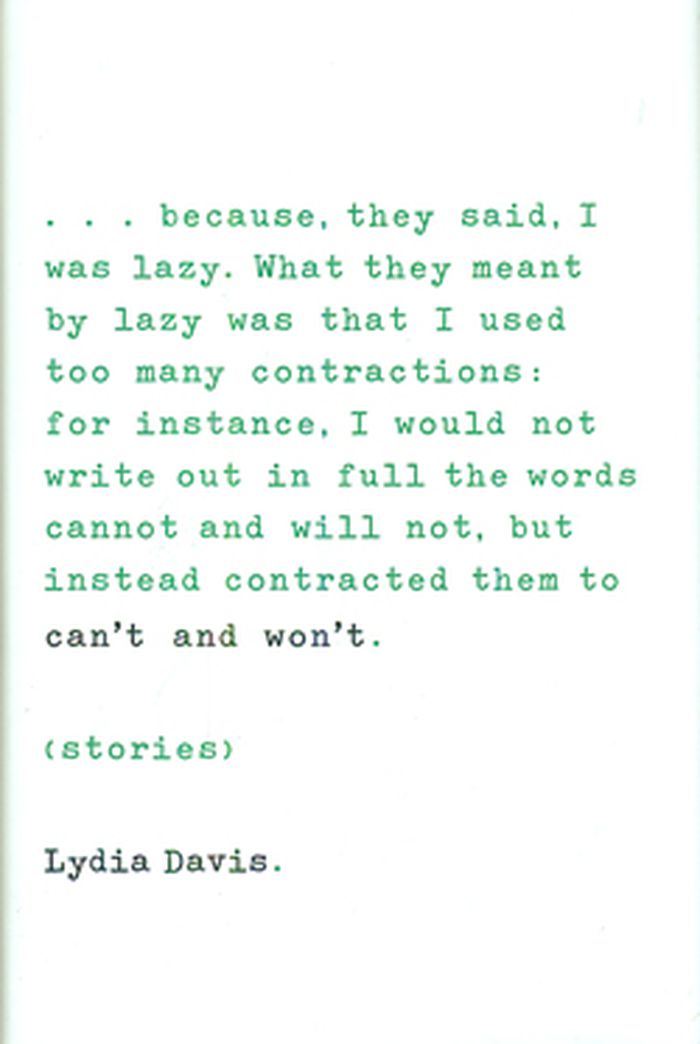
Her stories may be literal one-liners: the entirety of “Bloomington” reads, “Now that I have been here for a little while, I can say with confidence that I have never been here before.” Or they may be lengthier investigations of the havoc wreaked by the most mundane disruptions to routine: in “A Small Story About a Small Box of Chocolates,” a professor receives a gift of thirty-two small chocolates and is paralyzed by the multitude of options she imagines for their consumption. The stories may appear in the form of letters of complaint; they may be extracted from Flaubert’s correspondence; or they may be inspired by the author’s own dreams, or the dreams of friends. What does not vary throughout Can’t and Won’t, Lydia Davis’s fifth collection of stories, is the power of her finely honed prose. Davis is sharply observant; she is wry or witty or poignant. Above all, she is refreshing. Davis writes with bracing candor and sly humor about the quotidian, revealing the mysterious, the foreign, the alienating, and the pleasurable within the predictable patterns of daily life.
Can't and won't
Actions:
Price:
$30.00
(available to order)
Summary:
Her stories may be literal one-liners: the entirety of “Bloomington” reads, “Now that I have been here for a little while, I can say with confidence that I have never been here before.” Or they may be lengthier investigations of the havoc wreaked by the most mundane disruptions to routine: in “A Small Story About a Small Box of Chocolates,” a professor receives a gift of thirty-two small chocolates and is paralyzed by the multitude of options she imagines for their consumption. The stories may appear in the form of letters of complaint; they may be extracted from Flaubert’s correspondence; or they may be inspired by the author’s own dreams, or the dreams of friends. What does not vary throughout Can’t and Won’t, Lydia Davis’s fifth collection of stories, is the power of her finely honed prose. Davis is sharply observant; she is wry or witty or poignant. Above all, she is refreshing. Davis writes with bracing candor and sly humor about the quotidian, revealing the mysterious, the foreign, the alienating, and the pleasurable within the predictable patterns of daily life.
Form:
books
books
Publication:
March 2014
March 2014
Subject:
Architecture and the imaginary
Architecture and the imaginary
Form:
books
books

Price:
$59.95
(available in store)
Summary:
In the 1970s, a void opened at the heart of architecture. In hotels, offices, public buildings, and commercial centers, the atrium emerged globally to challenge the modernist legacies of form and function, altering the pattern and experience of cities. While often appearing at vast scale and to striking effect, the atrium also became omnipresent and mundane. In this(...)
$59.95
(available in store)
Summary:
In the 1970s, a void opened at the heart of architecture. In hotels, offices, public buildings, and commercial centers, the atrium emerged globally to challenge the modernist legacies of form and function, altering the pattern and experience of cities. While often appearing at vast scale and to striking effect, the atrium also became omnipresent and mundane. In this(...)
Title:
Atrium
Actions:
Price:
$59.95
(available in store)
Summary:
In the 1970s, a void opened at the heart of architecture. In hotels, offices, public buildings, and commercial centers, the atrium emerged globally to challenge the modernist legacies of form and function, altering the pattern and experience of cities. While often appearing at vast scale and to striking effect, the atrium also became omnipresent and mundane. In this lively critique, Charles Rice charts the atrium's appearance in the 1970s and its development through the 1980s, as it accompanied profound shifts in the discipline and practice of architecture. During this period, architectural practice especially in the United States and United Kingdom was changing rapidly, due in part to the manifold effects of deregulation. All aspects of the way buildings were designed, developed, regulated, built, managed, and occupied were being reshaped. A practice guided by the progressive tenets of modernism was being turned into a professional service fully integrated within neoliberal social and economic imperatives. As Rice shows, the atrium gives this story a distinct spatial and material figure, one that offers an inside view of architecture in transformation.
Atrium
Actions:
Price:
$59.95
(available in store)
Summary:
In the 1970s, a void opened at the heart of architecture. In hotels, offices, public buildings, and commercial centers, the atrium emerged globally to challenge the modernist legacies of form and function, altering the pattern and experience of cities. While often appearing at vast scale and to striking effect, the atrium also became omnipresent and mundane. In this lively critique, Charles Rice charts the atrium's appearance in the 1970s and its development through the 1980s, as it accompanied profound shifts in the discipline and practice of architecture. During this period, architectural practice especially in the United States and United Kingdom was changing rapidly, due in part to the manifold effects of deregulation. All aspects of the way buildings were designed, developed, regulated, built, managed, and occupied were being reshaped. A practice guided by the progressive tenets of modernism was being turned into a professional service fully integrated within neoliberal social and economic imperatives. As Rice shows, the atrium gives this story a distinct spatial and material figure, one that offers an inside view of architecture in transformation.
Form:
books
books
Publication:
October 2023
October 2023
Subject:
Commercial interiors, Building types
Commercial interiors, Building types
Form:
books
books

Price:
$50.00
(available to order)
Summary:
Equal parts mail art, data visualization, and affectionate correspondence, Dear Data celebrates "the infinitesimal, incomplete, imperfect, yet exquisitely human details of life," in the words of Maria Popova (Brain Pickings), who introduces this charming and graphically powerful book. For one year, Giorgia Lupi, an Italian living in New York, and Stefanie Posavec, an(...)
$50.00
(available to order)
Summary:
Equal parts mail art, data visualization, and affectionate correspondence, Dear Data celebrates "the infinitesimal, incomplete, imperfect, yet exquisitely human details of life," in the words of Maria Popova (Brain Pickings), who introduces this charming and graphically powerful book. For one year, Giorgia Lupi, an Italian living in New York, and Stefanie Posavec, an(...)
Subject:
Graphic Design and Typography
Graphic Design and Typography
Publication:
September 2016
September 2016
Title:
Dear Data
Actions:
Price:
$50.00
(available to order)
Summary:
Equal parts mail art, data visualization, and affectionate correspondence, Dear Data celebrates "the infinitesimal, incomplete, imperfect, yet exquisitely human details of life," in the words of Maria Popova (Brain Pickings), who introduces this charming and graphically powerful book. For one year, Giorgia Lupi, an Italian living in New York, and Stefanie Posavec, an American in London, mapped the particulars of their daily lives as a series of hand-drawn postcards they exchanged via mail weekly---small portraits as full of emotion as they are data, both mundane and magical. Dear Data reproduces in pinpoint detail the full year's set of cards, front and back, providing a remarkable portrait of two artists connected by their attention to the details of their lives---including complaints, distractions, phone addictions, physical contact, and desires. These details illuminate the lives of two remarkable young women and also inspire us to map our own lives, including specific suggestions on what data to draw and how. A captivating and unique book for designers, artists, correspondents, friends, and lovers everywhere.
Dear Data
Actions:
Price:
$50.00
(available to order)
Summary:
Equal parts mail art, data visualization, and affectionate correspondence, Dear Data celebrates "the infinitesimal, incomplete, imperfect, yet exquisitely human details of life," in the words of Maria Popova (Brain Pickings), who introduces this charming and graphically powerful book. For one year, Giorgia Lupi, an Italian living in New York, and Stefanie Posavec, an American in London, mapped the particulars of their daily lives as a series of hand-drawn postcards they exchanged via mail weekly---small portraits as full of emotion as they are data, both mundane and magical. Dear Data reproduces in pinpoint detail the full year's set of cards, front and back, providing a remarkable portrait of two artists connected by their attention to the details of their lives---including complaints, distractions, phone addictions, physical contact, and desires. These details illuminate the lives of two remarkable young women and also inspire us to map our own lives, including specific suggestions on what data to draw and how. A captivating and unique book for designers, artists, correspondents, friends, and lovers everywhere.
Form:
books
books
Publication:
September 2016
September 2016
Subject:
Graphic Design and Typography
Graphic Design and Typography
Form:
books
books

Price:
$42.95
(available to order)
Summary:
The technological innovation and unprecedented physical growth of the cold war era permeated American life in every aspect and at every scale. From the creation of the military-industrial complex and the beginnings of suburban sprawl to the production of the ballpoint pen and the TV dinner, the artifacts of the period are as numerous and diverse as they are familiar. Over(...)
$42.95
(available to order)
Summary:
The technological innovation and unprecedented physical growth of the cold war era permeated American life in every aspect and at every scale. From the creation of the military-industrial complex and the beginnings of suburban sprawl to the production of the ballpoint pen and the TV dinner, the artifacts of the period are as numerous and diverse as they are familiar. Over(...)
Subject:
Architectural Theory
Architectural Theory
Publication:
April 2004, New York
April 2004, New York
Title:
Cold war hothouses : inventing postwar culture, from cockpit to Playboy
Actions:
Price:
$42.95
(available to order)
Summary:
The technological innovation and unprecedented physical growth of the cold war era permeated American life in every aspect and at every scale. From the creation of the military-industrial complex and the beginnings of suburban sprawl to the production of the ballpoint pen and the TV dinner, the artifacts of the period are as numerous and diverse as they are familiar. Over the past half-century, our awe at the advances of postwar society has softened to nostalgia, and our affection for its material culture has clouded our memories of the enormous spatial reorganizations and infrastructural transformations that changed American life forever. "Cold War Hot Houses" casts a clear, even playful, eye on this pivotal time in history, examining topics as diverse as the creation of the interstate highway system and the shopping centre, and the domestication of the national parks as well as the production of such seemingly mundane products as the drive-in theater, aluminum foil, and the king-size bed. The result is a vivid snapshot of American culture that still resonates today.
Cold war hothouses : inventing postwar culture, from cockpit to Playboy
Actions:
Price:
$42.95
(available to order)
Summary:
The technological innovation and unprecedented physical growth of the cold war era permeated American life in every aspect and at every scale. From the creation of the military-industrial complex and the beginnings of suburban sprawl to the production of the ballpoint pen and the TV dinner, the artifacts of the period are as numerous and diverse as they are familiar. Over the past half-century, our awe at the advances of postwar society has softened to nostalgia, and our affection for its material culture has clouded our memories of the enormous spatial reorganizations and infrastructural transformations that changed American life forever. "Cold War Hot Houses" casts a clear, even playful, eye on this pivotal time in history, examining topics as diverse as the creation of the interstate highway system and the shopping centre, and the domestication of the national parks as well as the production of such seemingly mundane products as the drive-in theater, aluminum foil, and the king-size bed. The result is a vivid snapshot of American culture that still resonates today.
Form:
books
books
Publication:
April 2004, New York
April 2004, New York
Subject:
Architectural Theory
Architectural Theory
Form:
books
books
Actions:
Price:
$100.00
(available in store)
Summary:
Acclaimed still-life photographer Doherty pushes his precise visual language to a place of inarticulation and unconscious association, in a bold sequence of singular image arrangements, rhymed and bonded together. Individually, Bobby Doherty’s photographs are quite clear. In front of you, a flower, a drinks can, a courgette, next an alloy wheel. But collectively their(...)
$100.00
(available in store)
Summary:
Acclaimed still-life photographer Doherty pushes his precise visual language to a place of inarticulation and unconscious association, in a bold sequence of singular image arrangements, rhymed and bonded together. Individually, Bobby Doherty’s photographs are quite clear. In front of you, a flower, a drinks can, a courgette, next an alloy wheel. But collectively their(...)
Title:
Bobby Doherty: Dream about nothing
Actions:
Price:
$100.00
(available in store)
Summary:
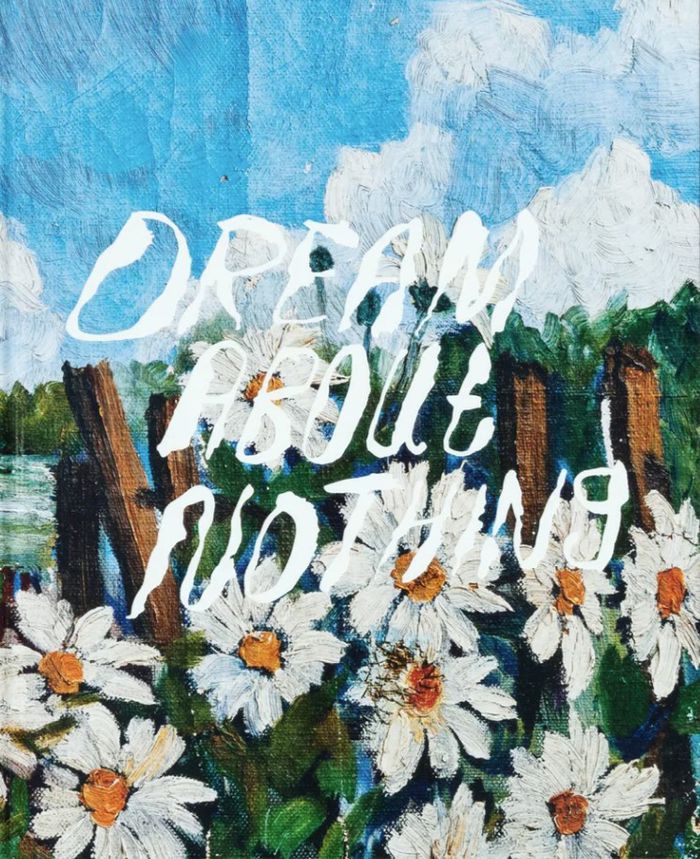
Acclaimed still-life photographer Doherty pushes his precise visual language to a place of inarticulation and unconscious association, in a bold sequence of singular image arrangements, rhymed and bonded together. Individually, Bobby Doherty’s photographs are quite clear. In front of you, a flower, a drinks can, a courgette, next an alloy wheel. But collectively their meanings become distorted. A photo of a popsicle carries a different weight once it is opposite a battered butterfly. But what are you meant to be looking at? Doherty's images attempt to overwhelm the viewer with questions about what we consider mundane, and what we view as special, in order to ask a greater question: one that transcends "why this over that" but instead, "why anything at all?" In "Dream about nothing," Doherty embarks on a more introspective articulation of his remarkably consistent visual practice. He invites us to pull back from the visually-tumbling-image-overload language that much of contemporary still-life and observational photography relents itself to, instead placing, with utmost care and precision, a line of observed things and places before your eyes. What does it all mean?
Bobby Doherty: Dream about nothing
Actions:
Price:
$100.00
(available in store)
Summary:
Acclaimed still-life photographer Doherty pushes his precise visual language to a place of inarticulation and unconscious association, in a bold sequence of singular image arrangements, rhymed and bonded together. Individually, Bobby Doherty’s photographs are quite clear. In front of you, a flower, a drinks can, a courgette, next an alloy wheel. But collectively their meanings become distorted. A photo of a popsicle carries a different weight once it is opposite a battered butterfly. But what are you meant to be looking at? Doherty's images attempt to overwhelm the viewer with questions about what we consider mundane, and what we view as special, in order to ask a greater question: one that transcends "why this over that" but instead, "why anything at all?" In "Dream about nothing," Doherty embarks on a more introspective articulation of his remarkably consistent visual practice. He invites us to pull back from the visually-tumbling-image-overload language that much of contemporary still-life and observational photography relents itself to, instead placing, with utmost care and precision, a line of observed things and places before your eyes. What does it all mean?
Form:
books
books
Publication:
November 2023
November 2023
Subject:
Photography monographs
Photography monographs
Form:
books
books
Price:
$41.99
(available in store)
Summary:
Americans spend, on average, 90 percent of their lives indoors, with two-thirds of that time spent in their homes. Globally, the construction and maintenance of residential buildings account for a staggering portion of carbon emissions. In this timely and fascinating work, architect and urban-planning scholar Stefan Al deftly weaves together archaeology, engineering,(...)
$41.99
(available in store)
Summary:
Americans spend, on average, 90 percent of their lives indoors, with two-thirds of that time spent in their homes. Globally, the construction and maintenance of residential buildings account for a staggering portion of carbon emissions. In this timely and fascinating work, architect and urban-planning scholar Stefan Al deftly weaves together archaeology, engineering,(...)
Title:
Dwelling on Earth: the past and future of the places we call home
Actions:
Price:
$41.99
(available in store)
Summary:
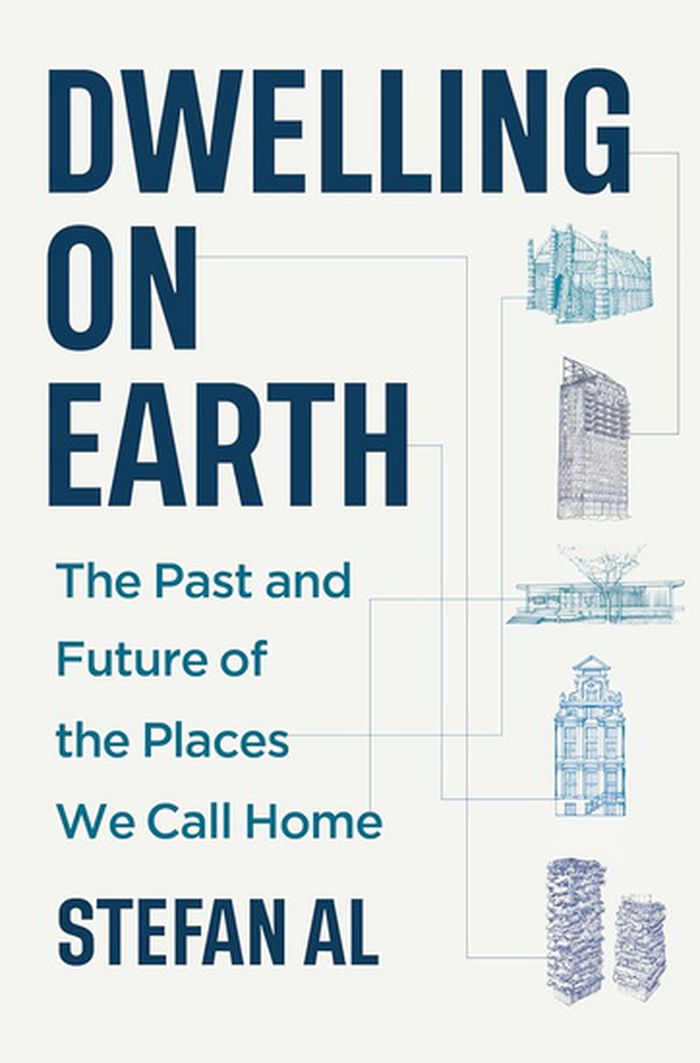
Americans spend, on average, 90 percent of their lives indoors, with two-thirds of that time spent in their homes. Globally, the construction and maintenance of residential buildings account for a staggering portion of carbon emissions. In this timely and fascinating work, architect and urban-planning scholar Stefan Al deftly weaves together archaeology, engineering, social history, and environmental science to explain how our homes have developed through the ages and in turn shaped civilization and the planet itself. From tiny pit-houses in the Levant and Mesoamerica thousands of years ago to soaring skyscrapers in Dubai, New York, and Shanghai today, ''Dwelling on Earth'' takes readers on a swift and absorbing tour of the evolution of human habitation. Whisking readers from ancient Pompeii to contemporary Hong Kong, industrial-age Liverpool to postwar Levittown, Al shows how our choices in housing have both reflected and affected ideas about gender roles, privacy, and comfort. Discover how seemingly mundane elements—like door-knockers and corridors—have altered everyday interactions, and how material choices have remade the planet's surface. He also confronts the darker side of domesticity, exposing the unintended consequences of our architectural choices across millennia, including smoke-filled Neolithic dwellings, deadly fires in crowded Roman apartment buildings, and worsening social isolation in car-dependent suburbs. Finally, he examines the myths and reality of future housing, including 3D-printed homes and space architecture built by robots.
Dwelling on Earth: the past and future of the places we call home
Actions:
Price:
$41.99
(available in store)
Summary:
Americans spend, on average, 90 percent of their lives indoors, with two-thirds of that time spent in their homes. Globally, the construction and maintenance of residential buildings account for a staggering portion of carbon emissions. In this timely and fascinating work, architect and urban-planning scholar Stefan Al deftly weaves together archaeology, engineering, social history, and environmental science to explain how our homes have developed through the ages and in turn shaped civilization and the planet itself. From tiny pit-houses in the Levant and Mesoamerica thousands of years ago to soaring skyscrapers in Dubai, New York, and Shanghai today, ''Dwelling on Earth'' takes readers on a swift and absorbing tour of the evolution of human habitation. Whisking readers from ancient Pompeii to contemporary Hong Kong, industrial-age Liverpool to postwar Levittown, Al shows how our choices in housing have both reflected and affected ideas about gender roles, privacy, and comfort. Discover how seemingly mundane elements—like door-knockers and corridors—have altered everyday interactions, and how material choices have remade the planet's surface. He also confronts the darker side of domesticity, exposing the unintended consequences of our architectural choices across millennia, including smoke-filled Neolithic dwellings, deadly fires in crowded Roman apartment buildings, and worsening social isolation in car-dependent suburbs. Finally, he examines the myths and reality of future housing, including 3D-printed homes and space architecture built by robots.
Form:
books
books
Publication:
April 2026
April 2026
Subject:
Social
Social
Form:
books
books

Title:
The other Venice
The other Venice
Actions:
Price:
$27.95
(available to order)
Summary:
To know a city is to become intimately intertwined with its nooks, crevices, secret passageways, and dark places where its lifeblood flows—and what city has more of those than Venice? In The Other Venice, Predrag Matvejevic ventures past the infamous canals and cobblestone streets of the tourist’s Venice to find the heart of the ancient Italian metropolis. A lyric(...)
$27.95
(available to order)
Summary:
To know a city is to become intimately intertwined with its nooks, crevices, secret passageways, and dark places where its lifeblood flows—and what city has more of those than Venice? In The Other Venice, Predrag Matvejevic ventures past the infamous canals and cobblestone streets of the tourist’s Venice to find the heart of the ancient Italian metropolis. A lyric(...)
Title:
The other Venice
Actions:
Price:
$27.95
(available to order)
Summary:
To know a city is to become intimately intertwined with its nooks, crevices, secret passageways, and dark places where its lifeblood flows—and what city has more of those than Venice? In The Other Venice, Predrag Matvejevic ventures past the infamous canals and cobblestone streets of the tourist’s Venice to find the heart of the ancient Italian metropolis. A lyric re-imagining of the City of Romance, The Other Venice utterly reconfigures the Venetian landscape, as Matvejevic follows both real and imaginary maps, contemporary and historical, to trace out the details of this sensuous city. He probes into what the ancient metropolis means to its people, the nation, and global culture. But he also finds hints of life in the smallest and most mundane details—ancient bridges, rust-flecked boats, wall sculptures, rivers, and piazzas scattered throughout the city. Each has a little-known story and with Matvejevic as our guide, he reveals the stories behind them all. The book carries readers to a Venice that has escaped the eyes of writers, artists, and photographers through the centuries, and Matejevic by turns plays a historian, cartographer, anthropologist, and philologist as he unravels elusive artifacts of time past. Arresting black-and-white photographs by renowned photographer Sarah Quill accompany the text, offering a silent testament to Matvejevic’s pilgrimage. A fascinating and beautifully written guide, The Other Venice reminds us that there is always another mystery to uncover in the city of water and stone.
The other Venice
Actions:
Price:
$27.95
(available to order)
Summary:
To know a city is to become intimately intertwined with its nooks, crevices, secret passageways, and dark places where its lifeblood flows—and what city has more of those than Venice? In The Other Venice, Predrag Matvejevic ventures past the infamous canals and cobblestone streets of the tourist’s Venice to find the heart of the ancient Italian metropolis. A lyric re-imagining of the City of Romance, The Other Venice utterly reconfigures the Venetian landscape, as Matvejevic follows both real and imaginary maps, contemporary and historical, to trace out the details of this sensuous city. He probes into what the ancient metropolis means to its people, the nation, and global culture. But he also finds hints of life in the smallest and most mundane details—ancient bridges, rust-flecked boats, wall sculptures, rivers, and piazzas scattered throughout the city. Each has a little-known story and with Matvejevic as our guide, he reveals the stories behind them all. The book carries readers to a Venice that has escaped the eyes of writers, artists, and photographers through the centuries, and Matejevic by turns plays a historian, cartographer, anthropologist, and philologist as he unravels elusive artifacts of time past. Arresting black-and-white photographs by renowned photographer Sarah Quill accompany the text, offering a silent testament to Matvejevic’s pilgrimage. A fascinating and beautifully written guide, The Other Venice reminds us that there is always another mystery to uncover in the city of water and stone.
Form:
books
books
Publication:
August 2007, London
August 2007, London
Subject:
City Guides
City Guides
Form:
books
books
Actions:
Price:
$44.95
(available to order)
Summary:
For Rebecca Bushnell, English gardening books tell a tale of the human love for plants and our will to make them do as we wish. These books evoke the desires of gardeners: they show us gardeners who, like poets, imagine not just what is but what should be. In particular, the earliest English garden books, such as Thomas Hill’s The Gardeners Labyrinth or Hugh Platt’s(...)
$44.95
(available to order)
Summary:
For Rebecca Bushnell, English gardening books tell a tale of the human love for plants and our will to make them do as we wish. These books evoke the desires of gardeners: they show us gardeners who, like poets, imagine not just what is but what should be. In particular, the earliest English garden books, such as Thomas Hill’s The Gardeners Labyrinth or Hugh Platt’s(...)
Title:
Green desire : imagining early modern English gardens
Actions:
Price:
$44.95
(available to order)
Summary:
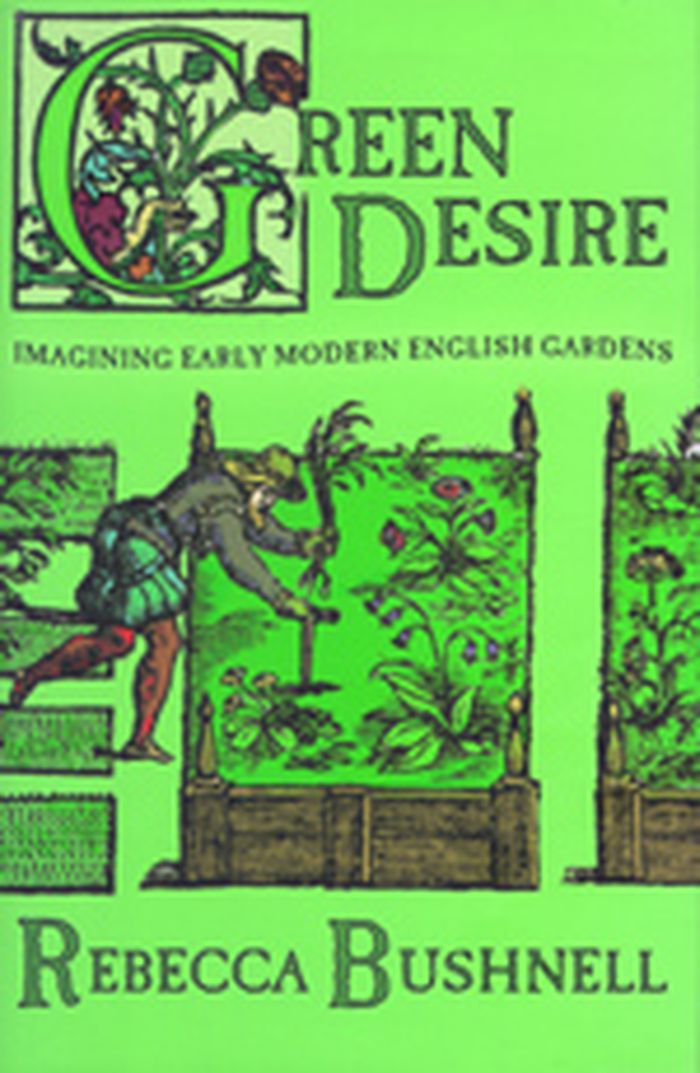
For Rebecca Bushnell, English gardening books tell a tale of the human love for plants and our will to make them do as we wish. These books evoke the desires of gardeners: they show us gardeners who, like poets, imagine not just what is but what should be. In particular, the earliest English garden books, such as Thomas Hill’s The Gardeners Labyrinth or Hugh Platt’s Floraes Paradise, mix magical practices with mundane recipes even when the authors insist that they rely completely on their own experience in these matters. Like early modern “books of secrets,” early gardening manuals often promise the reader power to alter the essential properties of plants: to make the gillyflower double, to change the lily’s hue, or to grow a cherry without a stone. "Green Desire" describes the innovative design of the old manuals, examining how writers and printers marketed them as fiction as well as practical advice for aspiring gardeners. Along with this attention to the delights of reading, it analyzes the strange dignity and pleasure of garden labor and the division of men’s and women’s roles in creating garden art. The book ends by recounting the heated debate over how much people could do to create marvels in their own gardens. For writers and readers alike, these green desires inspired dreams of power and self-improvement, fantasies of beauty achieved without work, and hopes for order in an unpredictable world.
Green desire : imagining early modern English gardens
Actions:
Price:
$44.95
(available to order)
Summary:
For Rebecca Bushnell, English gardening books tell a tale of the human love for plants and our will to make them do as we wish. These books evoke the desires of gardeners: they show us gardeners who, like poets, imagine not just what is but what should be. In particular, the earliest English garden books, such as Thomas Hill’s The Gardeners Labyrinth or Hugh Platt’s Floraes Paradise, mix magical practices with mundane recipes even when the authors insist that they rely completely on their own experience in these matters. Like early modern “books of secrets,” early gardening manuals often promise the reader power to alter the essential properties of plants: to make the gillyflower double, to change the lily’s hue, or to grow a cherry without a stone. "Green Desire" describes the innovative design of the old manuals, examining how writers and printers marketed them as fiction as well as practical advice for aspiring gardeners. Along with this attention to the delights of reading, it analyzes the strange dignity and pleasure of garden labor and the division of men’s and women’s roles in creating garden art. The book ends by recounting the heated debate over how much people could do to create marvels in their own gardens. For writers and readers alike, these green desires inspired dreams of power and self-improvement, fantasies of beauty achieved without work, and hopes for order in an unpredictable world.
Form:
books
books
Publication:
October 2003, Ithaca, New York
October 2003, Ithaca, New York
Subject:
Landscape Theory
Landscape Theory


