


26977 Results
Level of archival description:
Sub-series
Sub-series
Actions:
Reference number:
AP178.S1.1988.PR07.SS6
Description:
This project series documents the restoration of the Leonel building in Lisbon, Portugal. While the records were held in the office’s archives this project was assigned the number 58/80 N19. The office assigned the date 1988-1998 for this project. The construction work includes restorations of windows, doors, façades, painting, stonework, as well as work on the structure and mechanical systems. The Leonel building was part of Bloco A and identified as building 19 in Siza reconstruction plan. Located between the lower and upper part of town, Siza used the building to create a path and an public elevator to link the two parts of Lisbon. Documenting this project subseries are sketches, studies, floor plans, elevations, mechanical drawings, technical drawings, and working drawings. Textual material includes correspondence, minutes of meeting and project documentation. It is important to note that documentation about this project can also be found in subseries Master plans and exterior spaces (AP178.S1.1988.PR07.SS1) and Bloco B (AP178.S1.1988.PR07.SS5).
AP178.S1.1988.PR07.SS6
Description:
This project series documents the restoration of the Leonel building in Lisbon, Portugal. While the records were held in the office’s archives this project was assigned the number 58/80 N19. The office assigned the date 1988-1998 for this project. The construction work includes restorations of windows, doors, façades, painting, stonework, as well as work on the structure and mechanical systems. The Leonel building was part of Bloco A and identified as building 19 in Siza reconstruction plan. Located between the lower and upper part of town, Siza used the building to create a path and an public elevator to link the two parts of Lisbon. Documenting this project subseries are sketches, studies, floor plans, elevations, mechanical drawings, technical drawings, and working drawings. Textual material includes correspondence, minutes of meeting and project documentation. It is important to note that documentation about this project can also be found in subseries Master plans and exterior spaces (AP178.S1.1988.PR07.SS1) and Bloco B (AP178.S1.1988.PR07.SS5).
People:
Date:
1988-2005
1988-2005
Title:
Edifício Leonel, Bloco B, Reconstrução do Chiado [Leonel building, Block B, Reconstruction of the Chiado] Lisbon, Portugal (1988-1998)
Actions:
AP178.S1.1988.PR07.SS6
Description:
This project series documents the restoration of the Leonel building in Lisbon, Portugal. While the records were held in the office’s archives this project was assigned the number 58/80 N19. The office assigned the date 1988-1998 for this project. The construction work includes restorations of windows, doors, façades, painting, stonework, as well as work on the structure and mechanical systems. The Leonel building was part of Bloco A and identified as building 19 in Siza reconstruction plan. Located between the lower and upper part of town, Siza used the building to create a path and an public elevator to link the two parts of Lisbon. Documenting this project subseries are sketches, studies, floor plans, elevations, mechanical drawings, technical drawings, and working drawings. Textual material includes correspondence, minutes of meeting and project documentation. It is important to note that documentation about this project can also be found in subseries Master plans and exterior spaces (AP178.S1.1988.PR07.SS1) and Bloco B (AP178.S1.1988.PR07.SS5).
Edifício Leonel, Bloco B, Reconstrução do Chiado [Leonel building, Block B, Reconstruction of the Chiado] Lisbon, Portugal (1988-1998)
Actions:
AP178.S1.1988.PR07.SS6
Description:
This project series documents the restoration of the Leonel building in Lisbon, Portugal. While the records were held in the office’s archives this project was assigned the number 58/80 N19. The office assigned the date 1988-1998 for this project. The construction work includes restorations of windows, doors, façades, painting, stonework, as well as work on the structure and mechanical systems. The Leonel building was part of Bloco A and identified as building 19 in Siza reconstruction plan. Located between the lower and upper part of town, Siza used the building to create a path and an public elevator to link the two parts of Lisbon. Documenting this project subseries are sketches, studies, floor plans, elevations, mechanical drawings, technical drawings, and working drawings. Textual material includes correspondence, minutes of meeting and project documentation. It is important to note that documentation about this project can also be found in subseries Master plans and exterior spaces (AP178.S1.1988.PR07.SS1) and Bloco B (AP178.S1.1988.PR07.SS5).
Level of archival description:
Project
Project
Date:
1988-2005
1988-2005
People:
Level of archival description:
Project
Project
Reference number:
AP142.S1.D51
Description:
File documents an unexecuted (?) project for re-structuring the Ghetto area in Pesaro, Italy. Material in this file was produced between 1977 and 1980. File contains one design development drawing, presentation drawings and textual records, including correspondence, a programme, building codes, an architect's report and drawings.
AP142.S1.D51
Description:
File documents an unexecuted (?) project for re-structuring the Ghetto area in Pesaro, Italy. Material in this file was produced between 1977 and 1980. File contains one design development drawing, presentation drawings and textual records, including correspondence, a programme, building codes, an architect's report and drawings.
People:
Date:
1977-1980
1977-1980
Title:
Area di intervento unitario del Ghetto di Pesaro
Actions:
AP142.S1.D51
Description:
File documents an unexecuted (?) project for re-structuring the Ghetto area in Pesaro, Italy. Material in this file was produced between 1977 and 1980. File contains one design development drawing, presentation drawings and textual records, including correspondence, a programme, building codes, an architect's report and drawings.
Area di intervento unitario del Ghetto di Pesaro
Actions:
AP142.S1.D51
Description:
File documents an unexecuted (?) project for re-structuring the Ghetto area in Pesaro, Italy. Material in this file was produced between 1977 and 1980. File contains one design development drawing, presentation drawings and textual records, including correspondence, a programme, building codes, an architect's report and drawings.
Level of archival description:
File 51
File 51
Date:
1977-1980
1977-1980
People:
Level of archival description:
Project
Project
Title:
Cannaregio ovest
Cannaregio ovest
Actions:
Reference number:
AP142.S1.D56
Description:
File documents an unexecuted project for re-structuring the Cannaregio West district, in Venice, Italy. The project proposes a solution to the problem of access in Venice and recommands notably the construction of a monumental hotel along the Grand Canal. Material in this file was produced in approximately 1980. File contains presentation drawings.
AP142.S1.D56
Description:
File documents an unexecuted project for re-structuring the Cannaregio West district, in Venice, Italy. The project proposes a solution to the problem of access in Venice and recommands notably the construction of a monumental hotel along the Grand Canal. Material in this file was produced in approximately 1980. File contains presentation drawings.
People:
Date:
[ca. 1980]
[ca. 1980]
Title:
Cannaregio ovest
Actions:
AP142.S1.D56
Description:
File documents an unexecuted project for re-structuring the Cannaregio West district, in Venice, Italy. The project proposes a solution to the problem of access in Venice and recommands notably the construction of a monumental hotel along the Grand Canal. Material in this file was produced in approximately 1980. File contains presentation drawings.
Cannaregio ovest
Actions:
AP142.S1.D56
Description:
File documents an unexecuted project for re-structuring the Cannaregio West district, in Venice, Italy. The project proposes a solution to the problem of access in Venice and recommands notably the construction of a monumental hotel along the Grand Canal. Material in this file was produced in approximately 1980. File contains presentation drawings.
Level of archival description:
File 56
File 56
Date:
[ca. 1980]
[ca. 1980]
People:
Form:
born digital
born digital
Actions:
Reference number:
AP167.S1.SS3.009
Description:
This directory contains chiefly Virtools files and CAD files, including 3DS and Maya. The Virtools files in this directory include player files and supporting files for two objects. The first is titled "keep at contant distance thing," which allows the user to interact with two objects that are constantly kept at a constant distance from one another. The other player file has several versions, all titled "Virtools," which allow the user to experiment with the volume of a Muscle-like structure by moving different vertices within the structure. The Maya files contain various 3D wireframe models, and the 3DS files largely come back as "not found." Original directory name: "75 virtools muscle simulation". Most common file formats: Unidentified, Maya Binary File Format, Plain Text File, 3D Studio, Hypertext Markup Language.
AP167.S1.SS3.009
Description:
This directory contains chiefly Virtools files and CAD files, including 3DS and Maya. The Virtools files in this directory include player files and supporting files for two objects. The first is titled "keep at contant distance thing," which allows the user to interact with two objects that are constantly kept at a constant distance from one another. The other player file has several versions, all titled "Virtools," which allow the user to experiment with the volume of a Muscle-like structure by moving different vertices within the structure. The Maya files contain various 3D wireframe models, and the 3DS files largely come back as "not found." Original directory name: "75 virtools muscle simulation". Most common file formats: Unidentified, Maya Binary File Format, Plain Text File, 3D Studio, Hypertext Markup Language.
People:
Date:
3 March 2003 - 25 June 2003
3 March 2003 - 25 June 2003
Title:
Virtools experimentation with volume and constant distances
Actions:
AP167.S1.SS3.009
Description:
This directory contains chiefly Virtools files and CAD files, including 3DS and Maya. The Virtools files in this directory include player files and supporting files for two objects. The first is titled "keep at contant distance thing," which allows the user to interact with two objects that are constantly kept at a constant distance from one another. The other player file has several versions, all titled "Virtools," which allow the user to experiment with the volume of a Muscle-like structure by moving different vertices within the structure. The Maya files contain various 3D wireframe models, and the 3DS files largely come back as "not found." Original directory name: "75 virtools muscle simulation". Most common file formats: Unidentified, Maya Binary File Format, Plain Text File, 3D Studio, Hypertext Markup Language.
Virtools experimentation with volume and constant distances
Actions:
AP167.S1.SS3.009
Description:
This directory contains chiefly Virtools files and CAD files, including 3DS and Maya. The Virtools files in this directory include player files and supporting files for two objects. The first is titled "keep at contant distance thing," which allows the user to interact with two objects that are constantly kept at a constant distance from one another. The other player file has several versions, all titled "Virtools," which allow the user to experiment with the volume of a Muscle-like structure by moving different vertices within the structure. The Maya files contain various 3D wireframe models, and the 3DS files largely come back as "not found." Original directory name: "75 virtools muscle simulation". Most common file formats: Unidentified, Maya Binary File Format, Plain Text File, 3D Studio, Hypertext Markup Language.
Form:
born digital
born digital
Date:
3 March 2003 - 25 June 2003
3 March 2003 - 25 June 2003
People:
Level of archival description:
Project
Project
Reference number:
AP148.S1.1969.PR01
Description:
This project series features drawings and text, as well as collages on photographs, for a project entitled "Breve racconto di Architettura" by Poli. An inventory provided by Poli was used to identify the dates of these materials. The drawings and text seem to feature a journey on a highway (autostrada), or by plane, as all of the collaged images seem to be views taken from an airplane. These collages feature images of food and structures glued onto images of both rural and urban landscapes. References are made in the text to the Parco urbano Modena, possibly related to Poli's thesis project (see AP148.S1.1970.PR01), as well as to Roland Barthes, and "architettura invisibile".
AP148.S1.1969.PR01
Description:
This project series features drawings and text, as well as collages on photographs, for a project entitled "Breve racconto di Architettura" by Poli. An inventory provided by Poli was used to identify the dates of these materials. The drawings and text seem to feature a journey on a highway (autostrada), or by plane, as all of the collaged images seem to be views taken from an airplane. These collages feature images of food and structures glued onto images of both rural and urban landscapes. References are made in the text to the Parco urbano Modena, possibly related to Poli's thesis project (see AP148.S1.1970.PR01), as well as to Roland Barthes, and "architettura invisibile".
People:
Date:
ca. 1969-1970
ca. 1969-1970
Title:
Breve racconto di Architettura [Brief tale of architecture] (1969-1970)
Actions:
AP148.S1.1969.PR01
Description:
This project series features drawings and text, as well as collages on photographs, for a project entitled "Breve racconto di Architettura" by Poli. An inventory provided by Poli was used to identify the dates of these materials. The drawings and text seem to feature a journey on a highway (autostrada), or by plane, as all of the collaged images seem to be views taken from an airplane. These collages feature images of food and structures glued onto images of both rural and urban landscapes. References are made in the text to the Parco urbano Modena, possibly related to Poli's thesis project (see AP148.S1.1970.PR01), as well as to Roland Barthes, and "architettura invisibile".
Breve racconto di Architettura [Brief tale of architecture] (1969-1970)
Actions:
AP148.S1.1969.PR01
Description:
This project series features drawings and text, as well as collages on photographs, for a project entitled "Breve racconto di Architettura" by Poli. An inventory provided by Poli was used to identify the dates of these materials. The drawings and text seem to feature a journey on a highway (autostrada), or by plane, as all of the collaged images seem to be views taken from an airplane. These collages feature images of food and structures glued onto images of both rural and urban landscapes. References are made in the text to the Parco urbano Modena, possibly related to Poli's thesis project (see AP148.S1.1970.PR01), as well as to Roland Barthes, and "architettura invisibile".
Level of archival description:
Project
Project
Date:
ca. 1969-1970
ca. 1969-1970
People:
Form:
archives
Level of archival description:
Fonds
archives
Level of archival description:
Fonds
Reference number:
AP056
Synopsis:
The Kuwabara Payne McKenna Blumberg fonds documents the architectural projects of the firm from 1984-2003. 125 projects are recorded through drawings, photographs, models, textual records, periodicals and paintings. These projects include built work, proposals and competition entries.
AP056
Synopsis:
The Kuwabara Payne McKenna Blumberg fonds documents the architectural projects of the firm from 1984-2003. 125 projects are recorded through drawings, photographs, models, textual records, periodicals and paintings. These projects include built work, proposals and competition entries.
People:
Date:
1984-2003
1984-2003
Title:
Kuwabara Payne Mckenna Blumberg fonds
Actions:
AP056
Synopsis:
The Kuwabara Payne McKenna Blumberg fonds documents the architectural projects of the firm from 1984-2003. 125 projects are recorded through drawings, photographs, models, textual records, periodicals and paintings. These projects include built work, proposals and competition entries.
Kuwabara Payne Mckenna Blumberg fonds
Actions:
AP056
Synopsis:
The Kuwabara Payne McKenna Blumberg fonds documents the architectural projects of the firm from 1984-2003. 125 projects are recorded through drawings, photographs, models, textual records, periodicals and paintings. These projects include built work, proposals and competition entries.
Form:
archives
Level of archival description:
Fonds
archives
Level of archival description:
Fonds
Date:
1984-2003
1984-2003
People:
Form:
textual records
textual records
Actions:
Reference number:
ARCH401651
Description:
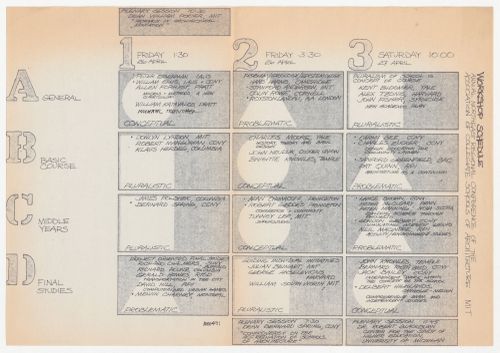
Related to ARCH401650 (structures for periods of seminar meetings)
ARCH401651
Description:
Related to ARCH401650 (structures for periods of seminar meetings)
People:
Date:
1974
1974
Title:
Workshop schedule for the Annual Northeast Regional Conference of the Association of Collegiate Schools of Architecture
Actions:
ARCH401651
Description:
Related to ARCH401650 (structures for periods of seminar meetings)
Workshop schedule for the Annual Northeast Regional Conference of the Association of Collegiate Schools of Architecture
Actions:
ARCH401651
Description:
Related to ARCH401650 (structures for periods of seminar meetings)
Form:
textual records
textual records
Date:
1974
1974
People:
Form:
drawings
drawings
Reference number:
DR1987:0020
Description:
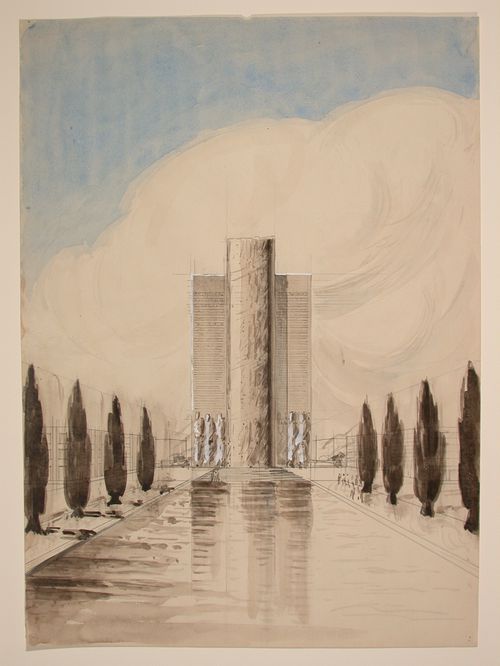
- This drawing is one of four drawings for monumental structures by Pol Gosset, DR1987:0019 - DR1987:0022. All of the structures are enormous in scale and impractical in design.
DR1987:0020
Description:
- This drawing is one of four drawings for monumental structures by Pol Gosset, DR1987:0019 - DR1987:0022. All of the structures are enormous in scale and impractical in design.
People:
Subject:
architecture
architecture
Date:
1930s
1930s
Title:
Design for a monument with two colossal figures and a reflecting pool
Actions:
DR1987:0020
Description:
- This drawing is one of four drawings for monumental structures by Pol Gosset, DR1987:0019 - DR1987:0022. All of the structures are enormous in scale and impractical in design.
Design for a monument with two colossal figures and a reflecting pool
Actions:
DR1987:0020
Description:
- This drawing is one of four drawings for monumental structures by Pol Gosset, DR1987:0019 - DR1987:0022. All of the structures are enormous in scale and impractical in design.
Form:
drawings
drawings
Date:
1930s
1930s
People:
Subject:
architecture
architecture
Level of archival description:
Project
Project
Title:
Rink
Rink
Actions:
Reference number:
AP144.S2.D160
Description:
File documents a consultancy project related to the Channel Tunnel Rail Link (CTRL) running from London to Folkestone, England. Price was commissioned to work in conjunction with engineering and environmental teams to provide input to the aesthetic design of major structures located along the CTRL route. A significant part of the work done on the project relates to a proposal to use a bridge rather than a tunnel on the section of the link crossing the Thames. The bridge would have been built between Gravesend, Kent and Tilbury, Thurrock. Material in this file was produced between 1986 and 1997, but predominantly in 1992. File contains conceptual drawings and textual records.
AP144.S2.D160
Description:
File documents a consultancy project related to the Channel Tunnel Rail Link (CTRL) running from London to Folkestone, England. Price was commissioned to work in conjunction with engineering and environmental teams to provide input to the aesthetic design of major structures located along the CTRL route. A significant part of the work done on the project relates to a proposal to use a bridge rather than a tunnel on the section of the link crossing the Thames. The bridge would have been built between Gravesend, Kent and Tilbury, Thurrock. Material in this file was produced between 1986 and 1997, but predominantly in 1992. File contains conceptual drawings and textual records.
People:
Date:
1986-1997, predominant 1992
1986-1997, predominant 1992
Title:
Rink
Actions:
AP144.S2.D160
Description:
File documents a consultancy project related to the Channel Tunnel Rail Link (CTRL) running from London to Folkestone, England. Price was commissioned to work in conjunction with engineering and environmental teams to provide input to the aesthetic design of major structures located along the CTRL route. A significant part of the work done on the project relates to a proposal to use a bridge rather than a tunnel on the section of the link crossing the Thames. The bridge would have been built between Gravesend, Kent and Tilbury, Thurrock. Material in this file was produced between 1986 and 1997, but predominantly in 1992. File contains conceptual drawings and textual records.
Rink
Actions:
AP144.S2.D160
Description:
File documents a consultancy project related to the Channel Tunnel Rail Link (CTRL) running from London to Folkestone, England. Price was commissioned to work in conjunction with engineering and environmental teams to provide input to the aesthetic design of major structures located along the CTRL route. A significant part of the work done on the project relates to a proposal to use a bridge rather than a tunnel on the section of the link crossing the Thames. The bridge would have been built between Gravesend, Kent and Tilbury, Thurrock. Material in this file was produced between 1986 and 1997, but predominantly in 1992. File contains conceptual drawings and textual records.
Level of archival description:
File 160
File 160
Date:
1986-1997, predominant 1992
1986-1997, predominant 1992
People:
Level of archival description:
Project
Project
Actions:
Reference number:
AP018.S1.1974.PR14
Description:
This project series documents the addition of offices to the research building of Abitibi Power and Paper Company Ltd in Mississauga, Ontario. The office identified the project number as 7416. The project is recorded through drawings and textual records dating from 1974-1980. The majority of the drawings are reprographic copies that show site plans, floor plans, elevations, and structures. Textual records include correspondence with client, contractors, sub-contractors, and consultants, meetings and inspection reports, and change orders. Box AP018.S1.1974.PR14.009 includes an index to the textual records created by the office. The project series also includes a microfilmed version of the contract documents.
AP018.S1.1974.PR14
Description:
This project series documents the addition of offices to the research building of Abitibi Power and Paper Company Ltd in Mississauga, Ontario. The office identified the project number as 7416. The project is recorded through drawings and textual records dating from 1974-1980. The majority of the drawings are reprographic copies that show site plans, floor plans, elevations, and structures. Textual records include correspondence with client, contractors, sub-contractors, and consultants, meetings and inspection reports, and change orders. Box AP018.S1.1974.PR14.009 includes an index to the textual records created by the office. The project series also includes a microfilmed version of the contract documents.
People:
Date:
1974-1980
1974-1980
Title:
Abitibi Power and Paper Company Ltd, Office addition to research building, Mississauga, Ontario (1974)
Actions:
AP018.S1.1974.PR14
Description:
This project series documents the addition of offices to the research building of Abitibi Power and Paper Company Ltd in Mississauga, Ontario. The office identified the project number as 7416. The project is recorded through drawings and textual records dating from 1974-1980. The majority of the drawings are reprographic copies that show site plans, floor plans, elevations, and structures. Textual records include correspondence with client, contractors, sub-contractors, and consultants, meetings and inspection reports, and change orders. Box AP018.S1.1974.PR14.009 includes an index to the textual records created by the office. The project series also includes a microfilmed version of the contract documents.
Abitibi Power and Paper Company Ltd, Office addition to research building, Mississauga, Ontario (1974)
Actions:
AP018.S1.1974.PR14
Description:
This project series documents the addition of offices to the research building of Abitibi Power and Paper Company Ltd in Mississauga, Ontario. The office identified the project number as 7416. The project is recorded through drawings and textual records dating from 1974-1980. The majority of the drawings are reprographic copies that show site plans, floor plans, elevations, and structures. Textual records include correspondence with client, contractors, sub-contractors, and consultants, meetings and inspection reports, and change orders. Box AP018.S1.1974.PR14.009 includes an index to the textual records created by the office. The project series also includes a microfilmed version of the contract documents.
Level of archival description:
Project
Project
Date:
1974-1980
1974-1980
People:


