


26977 Results
Level of archival description:
Sub-series
Sub-series
Reference number:
CI001.S2.D4
Description:
The CCA collection includes albums of drawings for some of Charles Rohault de Fleury's most important public architectural projects, built and unbuilt. They provide valuable insight into his design development process, construction techniques, and flexibility regarding building types and styles, as well as illuminating the larger issues of urban planning and the complex interaction between architect, contractor, and entrepreneur in mid-19th century France. The neo-Moorish Hippodrome National (DR1974:0002:017:001-060) - an ephemeral structure constructed of a wood frame with canvas sheathing- was built adjacent to the Place de l'Étoile in 1845 and destroyed in 1856. The documents and drawings in the album provide a highly detailed and complete overview of the project from the study of historical models to contract drawings. Written documentation, including cost estimates, a contract, daily accounts of construction, entrepreneur's accounts, and correspondence with the principal contractor, is particularly revealing of the working procedures on a large commercial project. In 1855 Charles and Auguste Joseph Pellechet constructed the Chambre des Notaires on the newly transformed Place du Chatelet - the intended centre point of Haussmann's 'Nouveau Paris' (1). The CCA album contains primarily transfer lithographed working and contract drawings signed by the entrepreneurs and/or contractors (DR1974:0002:022:001-021). The plans reflect Charles' sensitive integration of iron and masonry construction, which allowed for abundant fenestration on the side facades, while maintaining the traditional aspects of character and solidity required in a prominent urban building. Charles' approach to the design of more utilitarian structures is indicated in his album of competition drawings for a municipal slaughterhouse submitted to the city of Saint-Germain-en-Laye, 1846-1847 (DR1974:0002:023:001-012). His interpretation of the written programme (included in the album) and the resulting design, is strongly influenced by his father's previous slaughterhouse projects, as well as his own for La Villete, 1835-1836 (see DR1974:0002:014:001-104 in Hubert Rohault de Fleury's Public and Urban Architecture (file CI001.S3.D1)). The pared down Neoclassical style of the slaughterhouse is typical of both Charles and Hubert's utilitarian structures. Charles' largest public urban project outside of Paris was for an unexecuted Hôtel de Prefecture (Departement de la Vienne) and Hôtel de Ville for the city of Poitiers, 1859-1860 (DR1974:0002:020:001-050). The project for the Louis XIIIth style Hotel de Prefecture is fairly complete and includes many working drawings, while the Francis Ist style Hotel de Ville is much less developed and consists primarily of unbound sketches and finished drawings. A site plan indicates that Charles intended the Hôtel de Prefecture and Hôtel de Ville to be located nearly opposite each other and connected by a major thoroughfare. The placement of both structures in the western quarter of the city probably reflects an earlier urban renewal plan proposed by the architects Morandiere et Compaing in 1849. The Hôtel de Prefecture (1864-1868) and Hotel de Ville (1869-1876) were eventually built after designs by Antoine Guerinot, in the same style, and on sites close to those proposed by Charles. Drawings and engravings of antique and contemporary theatres, fountains, honorific monuments, and large public projects by other architects are collected in album DR1974:0002:010:001-048 for reference purposes (some of these may have been collected by his father Hubert). (1) David Van Zanten, "Building Paris: Architectural Institutions and the Transformation of the French Capital, 1830-1870" (Cambridge, Eng.: Cambridge University Press, 1994), p. 235 and pp. 233-241 for the development of the Place du Chatelet.
CI001.S2.D4
Description:
The CCA collection includes albums of drawings for some of Charles Rohault de Fleury's most important public architectural projects, built and unbuilt. They provide valuable insight into his design development process, construction techniques, and flexibility regarding building types and styles, as well as illuminating the larger issues of urban planning and the complex interaction between architect, contractor, and entrepreneur in mid-19th century France. The neo-Moorish Hippodrome National (DR1974:0002:017:001-060) - an ephemeral structure constructed of a wood frame with canvas sheathing- was built adjacent to the Place de l'Étoile in 1845 and destroyed in 1856. The documents and drawings in the album provide a highly detailed and complete overview of the project from the study of historical models to contract drawings. Written documentation, including cost estimates, a contract, daily accounts of construction, entrepreneur's accounts, and correspondence with the principal contractor, is particularly revealing of the working procedures on a large commercial project. In 1855 Charles and Auguste Joseph Pellechet constructed the Chambre des Notaires on the newly transformed Place du Chatelet - the intended centre point of Haussmann's 'Nouveau Paris' (1). The CCA album contains primarily transfer lithographed working and contract drawings signed by the entrepreneurs and/or contractors (DR1974:0002:022:001-021). The plans reflect Charles' sensitive integration of iron and masonry construction, which allowed for abundant fenestration on the side facades, while maintaining the traditional aspects of character and solidity required in a prominent urban building. Charles' approach to the design of more utilitarian structures is indicated in his album of competition drawings for a municipal slaughterhouse submitted to the city of Saint-Germain-en-Laye, 1846-1847 (DR1974:0002:023:001-012). His interpretation of the written programme (included in the album) and the resulting design, is strongly influenced by his father's previous slaughterhouse projects, as well as his own for La Villete, 1835-1836 (see DR1974:0002:014:001-104 in Hubert Rohault de Fleury's Public and Urban Architecture (file CI001.S3.D1)). The pared down Neoclassical style of the slaughterhouse is typical of both Charles and Hubert's utilitarian structures. Charles' largest public urban project outside of Paris was for an unexecuted Hôtel de Prefecture (Departement de la Vienne) and Hôtel de Ville for the city of Poitiers, 1859-1860 (DR1974:0002:020:001-050). The project for the Louis XIIIth style Hotel de Prefecture is fairly complete and includes many working drawings, while the Francis Ist style Hotel de Ville is much less developed and consists primarily of unbound sketches and finished drawings. A site plan indicates that Charles intended the Hôtel de Prefecture and Hôtel de Ville to be located nearly opposite each other and connected by a major thoroughfare. The placement of both structures in the western quarter of the city probably reflects an earlier urban renewal plan proposed by the architects Morandiere et Compaing in 1849. The Hôtel de Prefecture (1864-1868) and Hotel de Ville (1869-1876) were eventually built after designs by Antoine Guerinot, in the same style, and on sites close to those proposed by Charles. Drawings and engravings of antique and contemporary theatres, fountains, honorific monuments, and large public projects by other architects are collected in album DR1974:0002:010:001-048 for reference purposes (some of these may have been collected by his father Hubert). (1) David Van Zanten, "Building Paris: Architectural Institutions and the Transformation of the French Capital, 1830-1870" (Cambridge, Eng.: Cambridge University Press, 1994), p. 235 and pp. 233-241 for the development of the Place du Chatelet.
People:
Date:
[1840-1860]
[1840-1860]
Title:
Public and Urban Architecture
CI001.S2.D4
Description:
The CCA collection includes albums of drawings for some of Charles Rohault de Fleury's most important public architectural projects, built and unbuilt. They provide valuable insight into his design development process, construction techniques, and flexibility regarding building types and styles, as well as illuminating the larger issues of urban planning and the complex interaction between architect, contractor, and entrepreneur in mid-19th century France. The neo-Moorish Hippodrome National (DR1974:0002:017:001-060) - an ephemeral structure constructed of a wood frame with canvas sheathing- was built adjacent to the Place de l'Étoile in 1845 and destroyed in 1856. The documents and drawings in the album provide a highly detailed and complete overview of the project from the study of historical models to contract drawings. Written documentation, including cost estimates, a contract, daily accounts of construction, entrepreneur's accounts, and correspondence with the principal contractor, is particularly revealing of the working procedures on a large commercial project. In 1855 Charles and Auguste Joseph Pellechet constructed the Chambre des Notaires on the newly transformed Place du Chatelet - the intended centre point of Haussmann's 'Nouveau Paris' (1). The CCA album contains primarily transfer lithographed working and contract drawings signed by the entrepreneurs and/or contractors (DR1974:0002:022:001-021). The plans reflect Charles' sensitive integration of iron and masonry construction, which allowed for abundant fenestration on the side facades, while maintaining the traditional aspects of character and solidity required in a prominent urban building. Charles' approach to the design of more utilitarian structures is indicated in his album of competition drawings for a municipal slaughterhouse submitted to the city of Saint-Germain-en-Laye, 1846-1847 (DR1974:0002:023:001-012). His interpretation of the written programme (included in the album) and the resulting design, is strongly influenced by his father's previous slaughterhouse projects, as well as his own for La Villete, 1835-1836 (see DR1974:0002:014:001-104 in Hubert Rohault de Fleury's Public and Urban Architecture (file CI001.S3.D1)). The pared down Neoclassical style of the slaughterhouse is typical of both Charles and Hubert's utilitarian structures. Charles' largest public urban project outside of Paris was for an unexecuted Hôtel de Prefecture (Departement de la Vienne) and Hôtel de Ville for the city of Poitiers, 1859-1860 (DR1974:0002:020:001-050). The project for the Louis XIIIth style Hotel de Prefecture is fairly complete and includes many working drawings, while the Francis Ist style Hotel de Ville is much less developed and consists primarily of unbound sketches and finished drawings. A site plan indicates that Charles intended the Hôtel de Prefecture and Hôtel de Ville to be located nearly opposite each other and connected by a major thoroughfare. The placement of both structures in the western quarter of the city probably reflects an earlier urban renewal plan proposed by the architects Morandiere et Compaing in 1849. The Hôtel de Prefecture (1864-1868) and Hotel de Ville (1869-1876) were eventually built after designs by Antoine Guerinot, in the same style, and on sites close to those proposed by Charles. Drawings and engravings of antique and contemporary theatres, fountains, honorific monuments, and large public projects by other architects are collected in album DR1974:0002:010:001-048 for reference purposes (some of these may have been collected by his father Hubert). (1) David Van Zanten, "Building Paris: Architectural Institutions and the Transformation of the French Capital, 1830-1870" (Cambridge, Eng.: Cambridge University Press, 1994), p. 235 and pp. 233-241 for the development of the Place du Chatelet.
Public and Urban Architecture
CI001.S2.D4
Description:
The CCA collection includes albums of drawings for some of Charles Rohault de Fleury's most important public architectural projects, built and unbuilt. They provide valuable insight into his design development process, construction techniques, and flexibility regarding building types and styles, as well as illuminating the larger issues of urban planning and the complex interaction between architect, contractor, and entrepreneur in mid-19th century France. The neo-Moorish Hippodrome National (DR1974:0002:017:001-060) - an ephemeral structure constructed of a wood frame with canvas sheathing- was built adjacent to the Place de l'Étoile in 1845 and destroyed in 1856. The documents and drawings in the album provide a highly detailed and complete overview of the project from the study of historical models to contract drawings. Written documentation, including cost estimates, a contract, daily accounts of construction, entrepreneur's accounts, and correspondence with the principal contractor, is particularly revealing of the working procedures on a large commercial project. In 1855 Charles and Auguste Joseph Pellechet constructed the Chambre des Notaires on the newly transformed Place du Chatelet - the intended centre point of Haussmann's 'Nouveau Paris' (1). The CCA album contains primarily transfer lithographed working and contract drawings signed by the entrepreneurs and/or contractors (DR1974:0002:022:001-021). The plans reflect Charles' sensitive integration of iron and masonry construction, which allowed for abundant fenestration on the side facades, while maintaining the traditional aspects of character and solidity required in a prominent urban building. Charles' approach to the design of more utilitarian structures is indicated in his album of competition drawings for a municipal slaughterhouse submitted to the city of Saint-Germain-en-Laye, 1846-1847 (DR1974:0002:023:001-012). His interpretation of the written programme (included in the album) and the resulting design, is strongly influenced by his father's previous slaughterhouse projects, as well as his own for La Villete, 1835-1836 (see DR1974:0002:014:001-104 in Hubert Rohault de Fleury's Public and Urban Architecture (file CI001.S3.D1)). The pared down Neoclassical style of the slaughterhouse is typical of both Charles and Hubert's utilitarian structures. Charles' largest public urban project outside of Paris was for an unexecuted Hôtel de Prefecture (Departement de la Vienne) and Hôtel de Ville for the city of Poitiers, 1859-1860 (DR1974:0002:020:001-050). The project for the Louis XIIIth style Hotel de Prefecture is fairly complete and includes many working drawings, while the Francis Ist style Hotel de Ville is much less developed and consists primarily of unbound sketches and finished drawings. A site plan indicates that Charles intended the Hôtel de Prefecture and Hôtel de Ville to be located nearly opposite each other and connected by a major thoroughfare. The placement of both structures in the western quarter of the city probably reflects an earlier urban renewal plan proposed by the architects Morandiere et Compaing in 1849. The Hôtel de Prefecture (1864-1868) and Hotel de Ville (1869-1876) were eventually built after designs by Antoine Guerinot, in the same style, and on sites close to those proposed by Charles. Drawings and engravings of antique and contemporary theatres, fountains, honorific monuments, and large public projects by other architects are collected in album DR1974:0002:010:001-048 for reference purposes (some of these may have been collected by his father Hubert). (1) David Van Zanten, "Building Paris: Architectural Institutions and the Transformation of the French Capital, 1830-1870" (Cambridge, Eng.: Cambridge University Press, 1994), p. 235 and pp. 233-241 for the development of the Place du Chatelet.
Level of archival description:
File 4
File 4
Date:
[1840-1860]
[1840-1860]
People:
Form:
photographs
photographs
Title:
Views of two models
Views of two models
Reference number:
AP140.S2.SS1.D29.P6
Description:
views of two models, one being a site model in wood (not otherwise present in project documents) that shows an earlier design for the service and circulation towers of the office building, the other being a more detailed model for what is probably the final design that shows the office building in section with the external steel structure and splayed glass wall of the front elevation
AP140.S2.SS1.D29.P6
Description:
views of two models, one being a site model in wood (not otherwise present in project documents) that shows an earlier design for the service and circulation towers of the office building, the other being a more detailed model for what is probably the final design that shows the office building in section with the external steel structure and splayed glass wall of the front elevation
People:
Title:
Views of two models
Actions:
AP140.S2.SS1.D29.P6
Description:
views of two models, one being a site model in wood (not otherwise present in project documents) that shows an earlier design for the service and circulation towers of the office building, the other being a more detailed model for what is probably the final design that shows the office building in section with the external steel structure and splayed glass wall of the front elevation
Views of two models
Actions:
AP140.S2.SS1.D29.P6
Description:
views of two models, one being a site model in wood (not otherwise present in project documents) that shows an earlier design for the service and circulation towers of the office building, the other being a more detailed model for what is probably the final design that shows the office building in section with the external steel structure and splayed glass wall of the front elevation
Form:
photographs
photographs
People:
Form:
photographs
photographs
Title:
Views of two models
Views of two models
Actions:
Reference number:
AP140.S2.SS1.D29.P7
Description:
views of two models, one being a site model in wood (not otherwise present in project documents) that shows an earlier design for the service and circulation towers of the office building, the other being a more detailed model for what is probably the final design that shows the office building in section with the external steel structure and splayed glass wall of the front elevation
AP140.S2.SS1.D29.P7
Description:
views of two models, one being a site model in wood (not otherwise present in project documents) that shows an earlier design for the service and circulation towers of the office building, the other being a more detailed model for what is probably the final design that shows the office building in section with the external steel structure and splayed glass wall of the front elevation
People:
Date:
1965
1965
Title:
Views of two models
Actions:
AP140.S2.SS1.D29.P7
Description:
views of two models, one being a site model in wood (not otherwise present in project documents) that shows an earlier design for the service and circulation towers of the office building, the other being a more detailed model for what is probably the final design that shows the office building in section with the external steel structure and splayed glass wall of the front elevation
Views of two models
Actions:
AP140.S2.SS1.D29.P7
Description:
views of two models, one being a site model in wood (not otherwise present in project documents) that shows an earlier design for the service and circulation towers of the office building, the other being a more detailed model for what is probably the final design that shows the office building in section with the external steel structure and splayed glass wall of the front elevation
Form:
photographs
photographs
Date:
1965
1965
People:
Form:
photographs
photographs
Title:
Views of two models
Views of two models
Reference number:
AP140.S2.SS1.D29.P8
Description:
views of two models, one being a site model in wood (not otherwise present in project documents) that shows an earlier design for the service and circulation towers of the office building, the other being a more detailed model for what is probably the final design that shows the office building in section with the external steel structure and splayed glass wall of the front elevation
AP140.S2.SS1.D29.P8
Description:
views of two models, one being a site model in wood (not otherwise present in project documents) that shows an earlier design for the service and circulation towers of the office building, the other being a more detailed model for what is probably the final design that shows the office building in section with the external steel structure and splayed glass wall of the front elevation
People:
Title:
Views of two models
Actions:
AP140.S2.SS1.D29.P8
Description:
views of two models, one being a site model in wood (not otherwise present in project documents) that shows an earlier design for the service and circulation towers of the office building, the other being a more detailed model for what is probably the final design that shows the office building in section with the external steel structure and splayed glass wall of the front elevation
Views of two models
Actions:
AP140.S2.SS1.D29.P8
Description:
views of two models, one being a site model in wood (not otherwise present in project documents) that shows an earlier design for the service and circulation towers of the office building, the other being a more detailed model for what is probably the final design that shows the office building in section with the external steel structure and splayed glass wall of the front elevation
Form:
photographs
photographs
People:
Form:
photographs
photographs
Title:
Views of two models
Views of two models
Actions:
Reference number:
AP140.S2.SS1.D29.P11
Description:
views of two models, one being a site model in wood (not otherwise present in project documents) that shows an earlier design for the service and circulation towers of the office building, the other being a more detailed model for what is probably the final design that shows the office building in section with the external steel structure and splayed glass wall of the front elevation
AP140.S2.SS1.D29.P11
Description:
views of two models, one being a site model in wood (not otherwise present in project documents) that shows an earlier design for the service and circulation towers of the office building, the other being a more detailed model for what is probably the final design that shows the office building in section with the external steel structure and splayed glass wall of the front elevation
People:
Title:
Views of two models
Actions:
AP140.S2.SS1.D29.P11
Description:
views of two models, one being a site model in wood (not otherwise present in project documents) that shows an earlier design for the service and circulation towers of the office building, the other being a more detailed model for what is probably the final design that shows the office building in section with the external steel structure and splayed glass wall of the front elevation
Views of two models
Actions:
AP140.S2.SS1.D29.P11
Description:
views of two models, one being a site model in wood (not otherwise present in project documents) that shows an earlier design for the service and circulation towers of the office building, the other being a more detailed model for what is probably the final design that shows the office building in section with the external steel structure and splayed glass wall of the front elevation
Form:
photographs
photographs
People:
Form:
photographs
photographs
Title:
Views of two models
Views of two models
Actions:
Reference number:
AP140.S2.SS1.D29.P12
Description:
views of two models, one being a site model in wood (not otherwise present in project documents) that shows an earlier design for the service and circulation towers of the office building, the other being a more detailed model for what is probably the final design that shows the office building in section with the external steel structure and splayed glass wall of the front elevation
AP140.S2.SS1.D29.P12
Description:
views of two models, one being a site model in wood (not otherwise present in project documents) that shows an earlier design for the service and circulation towers of the office building, the other being a more detailed model for what is probably the final design that shows the office building in section with the external steel structure and splayed glass wall of the front elevation
People:
Title:
Views of two models
Actions:
AP140.S2.SS1.D29.P12
Description:
views of two models, one being a site model in wood (not otherwise present in project documents) that shows an earlier design for the service and circulation towers of the office building, the other being a more detailed model for what is probably the final design that shows the office building in section with the external steel structure and splayed glass wall of the front elevation
Views of two models
Actions:
AP140.S2.SS1.D29.P12
Description:
views of two models, one being a site model in wood (not otherwise present in project documents) that shows an earlier design for the service and circulation towers of the office building, the other being a more detailed model for what is probably the final design that shows the office building in section with the external steel structure and splayed glass wall of the front elevation
Form:
photographs
photographs
People:
Form:
drawings, textual records
drawings, textual records
Actions:
Reference number:
DR1982:0127 R
Description:
- The drawing apparently depicts a coronation ceremony showing an interior resembling that of St. Peter's, Rome, looking towards the altar. Under the dome there is an elevated throne with a baldachin formed by a huge central crown with swags of red fabric which extend from the crown to the piers at the crossing. The design for a smaller structure which figures below is probably an earlier drawing.
DR1982:0127 R
Description:
- The drawing apparently depicts a coronation ceremony showing an interior resembling that of St. Peter's, Rome, looking towards the altar. Under the dome there is an elevated throne with a baldachin formed by a huge central crown with swags of red fabric which extend from the crown to the piers at the crossing. The design for a smaller structure which figures below is probably an earlier drawing.
People:
Subject:
architecture
architecture
Date:
second half of the 19th century
second half of the 19th century
Title:
Sketch and a manuscript relating to the coronation ceremony of Alberto I
Actions:
DR1982:0127 R
Description:
- The drawing apparently depicts a coronation ceremony showing an interior resembling that of St. Peter's, Rome, looking towards the altar. Under the dome there is an elevated throne with a baldachin formed by a huge central crown with swags of red fabric which extend from the crown to the piers at the crossing. The design for a smaller structure which figures below is probably an earlier drawing.
Sketch and a manuscript relating to the coronation ceremony of Alberto I
Actions:
DR1982:0127 R
Description:
- The drawing apparently depicts a coronation ceremony showing an interior resembling that of St. Peter's, Rome, looking towards the altar. Under the dome there is an elevated throne with a baldachin formed by a huge central crown with swags of red fabric which extend from the crown to the piers at the crossing. The design for a smaller structure which figures below is probably an earlier drawing.
Form:
drawings, textual records
drawings, textual records
Date:
second half of the 19th century
second half of the 19th century
People:
Subject:
architecture
architecture
Form:
drawings
drawings
Actions:
Reference number:
DR1994:0006:006
Description:
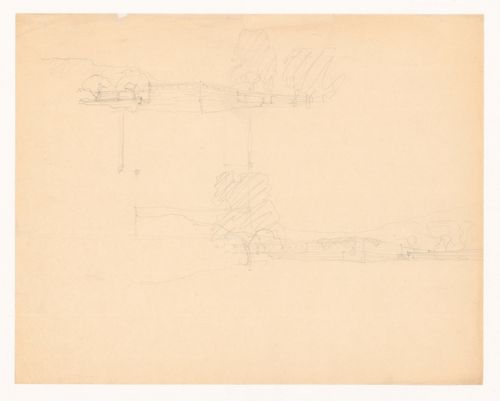
- The perspective sketches correspond with the rough plan, which shows the two wings of the court house and part of the stone wall enclosing the courtyard. The perspective drawing on the lower half of the sheet appears to have been drawn after the plan, which may reflect the architect's approach to the problem: drawing the plan and then working out the relationship between the structure to the site.
DR1994:0006:006
Description:
- The perspective sketches correspond with the rough plan, which shows the two wings of the court house and part of the stone wall enclosing the courtyard. The perspective drawing on the lower half of the sheet appears to have been drawn after the plan, which may reflect the architect's approach to the problem: drawing the plan and then working out the relationship between the structure to the site.
People:
Date:
1934
1934
Title:
Sketch perspectives and sketch plan for Mountain House
Actions:
DR1994:0006:006
Description:
- The perspective sketches correspond with the rough plan, which shows the two wings of the court house and part of the stone wall enclosing the courtyard. The perspective drawing on the lower half of the sheet appears to have been drawn after the plan, which may reflect the architect's approach to the problem: drawing the plan and then working out the relationship between the structure to the site.
Sketch perspectives and sketch plan for Mountain House
Actions:
DR1994:0006:006
Description:
- The perspective sketches correspond with the rough plan, which shows the two wings of the court house and part of the stone wall enclosing the courtyard. The perspective drawing on the lower half of the sheet appears to have been drawn after the plan, which may reflect the architect's approach to the problem: drawing the plan and then working out the relationship between the structure to the site.
Form:
drawings
drawings
Date:
1934
1934
People:
Level of archival description:
Sub-series
Sub-series
Title:
Bloco C, Reconstrução do Chiado [Block C, Reconstruction of the Chiado] Lisbon, Portugal, 1988-1998
Bloco C, Reconstrução do Chiado [Block C, Reconstruction of the Chiado] Lisbon, Portugal, 1988-1998
Actions:
Reference number:
AP178.S1.1988.PR07.SS7
Description:
This project subseries documents Bloco C of the reconstruction of the Chiado in Lisbon, Portugal. The office's archives identified this project as 58/80. The office assigned the dates 1988-1998 for this project. Bloco C was located between Rua Do Crucifixo, Rua Do Carmo, and Rua Nova Do Almada. Bloco C included buildings 1, 2, 3, 4 (Grandes Armazéns do Chiado), 5 (Grandella building), and 6. The construction work for the buildings of Bloco A included the restoration of windows, doors, façades, painting, stonework, as well as work on the structure and mechanical systems. Drawings include studies and working drawings. Textual material includes project documentation and studies. Photographic materials and slides document the buildings prior to the fire, damaged buildings, project site, and construction work. It is important to note that this subseries includes general details of Bloco C, for more specific details see individual building subseries of the Grandella building (AP178.S1.1988.PR07.SS8) and Grandes Armazéns do Chiado (AP178.S1.1988.PR07.SS9).
AP178.S1.1988.PR07.SS7
Description:
This project subseries documents Bloco C of the reconstruction of the Chiado in Lisbon, Portugal. The office's archives identified this project as 58/80. The office assigned the dates 1988-1998 for this project. Bloco C was located between Rua Do Crucifixo, Rua Do Carmo, and Rua Nova Do Almada. Bloco C included buildings 1, 2, 3, 4 (Grandes Armazéns do Chiado), 5 (Grandella building), and 6. The construction work for the buildings of Bloco A included the restoration of windows, doors, façades, painting, stonework, as well as work on the structure and mechanical systems. Drawings include studies and working drawings. Textual material includes project documentation and studies. Photographic materials and slides document the buildings prior to the fire, damaged buildings, project site, and construction work. It is important to note that this subseries includes general details of Bloco C, for more specific details see individual building subseries of the Grandella building (AP178.S1.1988.PR07.SS8) and Grandes Armazéns do Chiado (AP178.S1.1988.PR07.SS9).
People:
Date:
1942-2003
1942-2003
Title:
Bloco C, Reconstrução do Chiado [Block C, Reconstruction of the Chiado] Lisbon, Portugal, 1988-1998
Actions:
AP178.S1.1988.PR07.SS7
Description:
This project subseries documents Bloco C of the reconstruction of the Chiado in Lisbon, Portugal. The office's archives identified this project as 58/80. The office assigned the dates 1988-1998 for this project. Bloco C was located between Rua Do Crucifixo, Rua Do Carmo, and Rua Nova Do Almada. Bloco C included buildings 1, 2, 3, 4 (Grandes Armazéns do Chiado), 5 (Grandella building), and 6. The construction work for the buildings of Bloco A included the restoration of windows, doors, façades, painting, stonework, as well as work on the structure and mechanical systems. Drawings include studies and working drawings. Textual material includes project documentation and studies. Photographic materials and slides document the buildings prior to the fire, damaged buildings, project site, and construction work. It is important to note that this subseries includes general details of Bloco C, for more specific details see individual building subseries of the Grandella building (AP178.S1.1988.PR07.SS8) and Grandes Armazéns do Chiado (AP178.S1.1988.PR07.SS9).
Bloco C, Reconstrução do Chiado [Block C, Reconstruction of the Chiado] Lisbon, Portugal, 1988-1998
Actions:
AP178.S1.1988.PR07.SS7
Description:
This project subseries documents Bloco C of the reconstruction of the Chiado in Lisbon, Portugal. The office's archives identified this project as 58/80. The office assigned the dates 1988-1998 for this project. Bloco C was located between Rua Do Crucifixo, Rua Do Carmo, and Rua Nova Do Almada. Bloco C included buildings 1, 2, 3, 4 (Grandes Armazéns do Chiado), 5 (Grandella building), and 6. The construction work for the buildings of Bloco A included the restoration of windows, doors, façades, painting, stonework, as well as work on the structure and mechanical systems. Drawings include studies and working drawings. Textual material includes project documentation and studies. Photographic materials and slides document the buildings prior to the fire, damaged buildings, project site, and construction work. It is important to note that this subseries includes general details of Bloco C, for more specific details see individual building subseries of the Grandella building (AP178.S1.1988.PR07.SS8) and Grandes Armazéns do Chiado (AP178.S1.1988.PR07.SS9).
Level of archival description:
Project
Project
Date:
1942-2003
1942-2003
People:
Level of archival description:
Project
Project
Reference number:
AP207.S1.2017.PR02
Description:
The project series documents "Architecture Forgiven by Nature", an installation design by Pettena in 2017. The installation consists of an old water tower at the top of a hill in Brufa, covered with a metal grill. The intention is for plants to grow from the grill and hide the tower behind vegetation. The installation also included a staircase hidden behind the metal grill to give access to the top of the tower, so it could be used as a belvedere. "An additional function therefore joins the usual one, as nature helps to integrate a banal architecture into the landscape while also changing it into a place of consciousness and better understanding of both the environment and the art world." [1] The project is also known as "Torre di Brufa". The project series contains a drawing, printouts of digital renderings, plans of the structure surrounding the water tower, and video of Pettena showing the model of the tower. Source: [1] Gianni Pettena website, https://www.giannipettena.it/italiano/opere-1/nat-tower-in-brufa-2017/ (last accessed 28 January 2020)
AP207.S1.2017.PR02
Description:
The project series documents "Architecture Forgiven by Nature", an installation design by Pettena in 2017. The installation consists of an old water tower at the top of a hill in Brufa, covered with a metal grill. The intention is for plants to grow from the grill and hide the tower behind vegetation. The installation also included a staircase hidden behind the metal grill to give access to the top of the tower, so it could be used as a belvedere. "An additional function therefore joins the usual one, as nature helps to integrate a banal architecture into the landscape while also changing it into a place of consciousness and better understanding of both the environment and the art world." [1] The project is also known as "Torre di Brufa". The project series contains a drawing, printouts of digital renderings, plans of the structure surrounding the water tower, and video of Pettena showing the model of the tower. Source: [1] Gianni Pettena website, https://www.giannipettena.it/italiano/opere-1/nat-tower-in-brufa-2017/ (last accessed 28 January 2020)
People:
Date:
2006-2017
2006-2017
Title:
Architecture Forgiven by Nature (2017)
Actions:
AP207.S1.2017.PR02
Description:
The project series documents "Architecture Forgiven by Nature", an installation design by Pettena in 2017. The installation consists of an old water tower at the top of a hill in Brufa, covered with a metal grill. The intention is for plants to grow from the grill and hide the tower behind vegetation. The installation also included a staircase hidden behind the metal grill to give access to the top of the tower, so it could be used as a belvedere. "An additional function therefore joins the usual one, as nature helps to integrate a banal architecture into the landscape while also changing it into a place of consciousness and better understanding of both the environment and the art world." [1] The project is also known as "Torre di Brufa". The project series contains a drawing, printouts of digital renderings, plans of the structure surrounding the water tower, and video of Pettena showing the model of the tower. Source: [1] Gianni Pettena website, https://www.giannipettena.it/italiano/opere-1/nat-tower-in-brufa-2017/ (last accessed 28 January 2020)
Architecture Forgiven by Nature (2017)
Actions:
AP207.S1.2017.PR02
Description:
The project series documents "Architecture Forgiven by Nature", an installation design by Pettena in 2017. The installation consists of an old water tower at the top of a hill in Brufa, covered with a metal grill. The intention is for plants to grow from the grill and hide the tower behind vegetation. The installation also included a staircase hidden behind the metal grill to give access to the top of the tower, so it could be used as a belvedere. "An additional function therefore joins the usual one, as nature helps to integrate a banal architecture into the landscape while also changing it into a place of consciousness and better understanding of both the environment and the art world." [1] The project is also known as "Torre di Brufa". The project series contains a drawing, printouts of digital renderings, plans of the structure surrounding the water tower, and video of Pettena showing the model of the tower. Source: [1] Gianni Pettena website, https://www.giannipettena.it/italiano/opere-1/nat-tower-in-brufa-2017/ (last accessed 28 January 2020)
Level of archival description:
Project
Project
Date:
2006-2017
2006-2017
People:


