photographs
ARCH261981
1967?
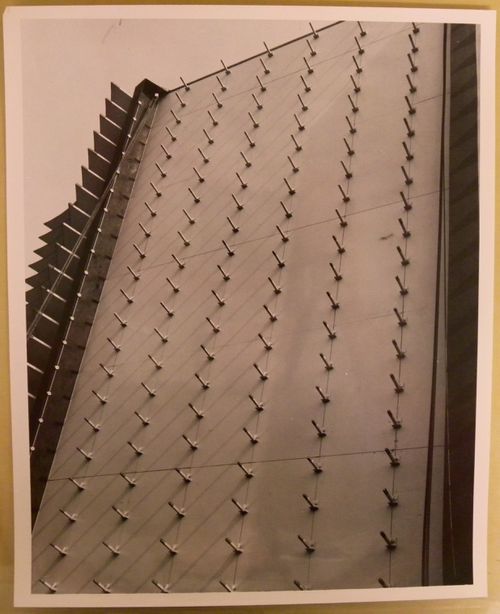
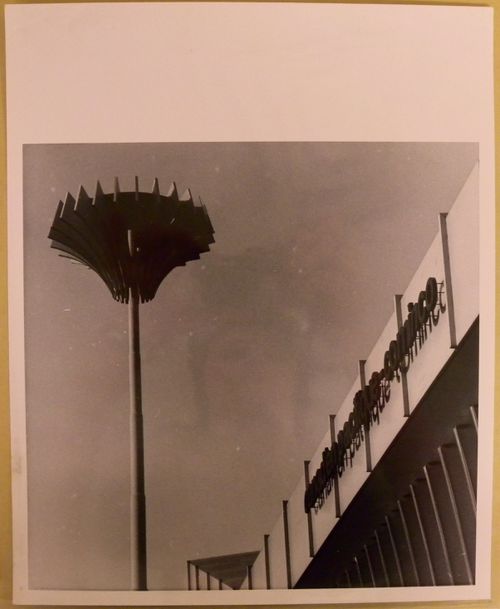
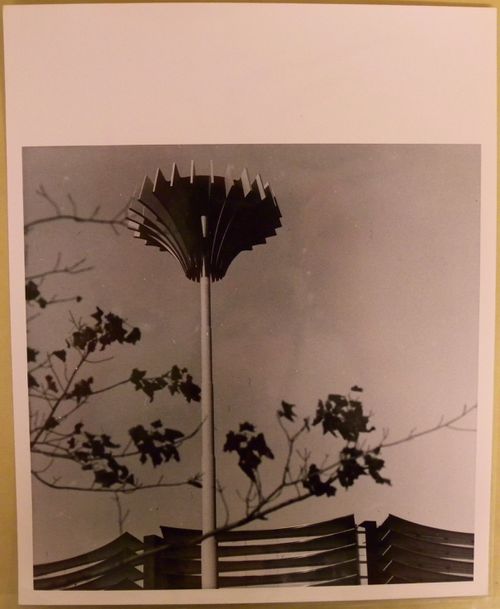
Detail view of at the Kaleidoscope's color strips, Expo 67, Montréal, Québec
Actions:
ARCH261981
photographs
1967?
photographs
ARCH255762
Description:
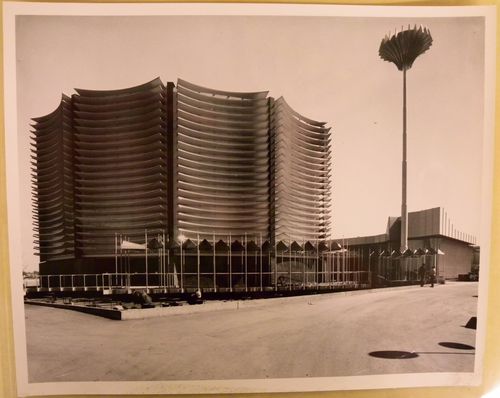
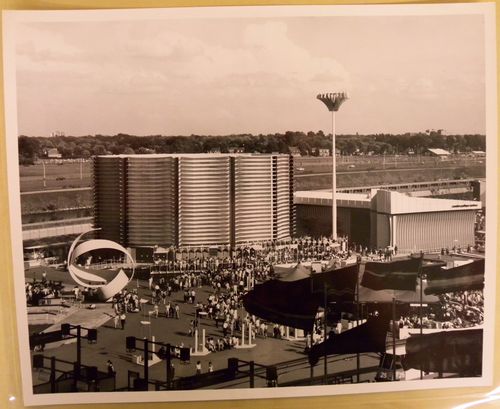
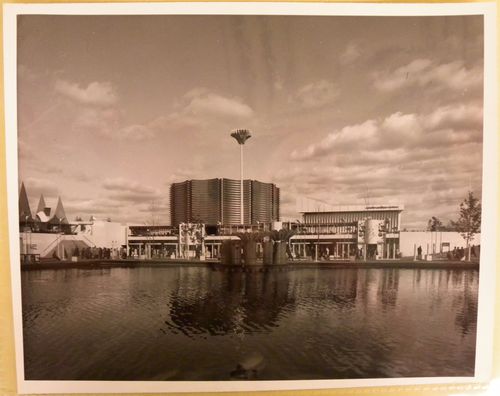
"The 40 ft. high Union Flag feature in position at the top of the tower of Britain's Pavilion at Expo '67. / The 3-dimensional flag designed by F.H.K. Henrion will be illuminated at might to provide a gay and attractive feature on the Expo skyline. / December 1966."--Description.
1966-1967
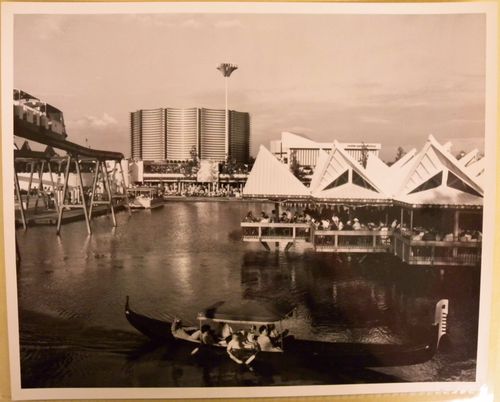
View of the Great Britain Pavilion, Expo 67, Montréal, Québec
Actions:
ARCH255762
Description:
"The 40 ft. high Union Flag feature in position at the top of the tower of Britain's Pavilion at Expo '67. / The 3-dimensional flag designed by F.H.K. Henrion will be illuminated at might to provide a gay and attractive feature on the Expo skyline. / December 1966."--Description.
photographs
1966-1967
drawings, textual records, photographs
AP148.S1.1970.PR01.001.1
Description:
Original folder title: Modena tesi, with "immagini film" noted on the inside. Folder contains various sketches and notes, many of which are numbered, as well as the thesis text Poli and Gherardi submitted to Professor Savioli for their degree at the University of Florence in 1970. A draft of the text is also included. Photographs are also included, which appear to be of a model. The original folder, with a piece of wood along the edge, has been retained. Most of the notes and sketches appear to be in Poli's handwriting, except for a few pages which may be in Gherardi's handwriting.
1969-1970
Degree thesis text and sketches, Competition for urban park, Modena (Folder 1 of 3)
Actions:
AP148.S1.1970.PR01.001.1
Description:
Original folder title: Modena tesi, with "immagini film" noted on the inside. Folder contains various sketches and notes, many of which are numbered, as well as the thesis text Poli and Gherardi submitted to Professor Savioli for their degree at the University of Florence in 1970. A draft of the text is also included. Photographs are also included, which appear to be of a model. The original folder, with a piece of wood along the edge, has been retained. Most of the notes and sketches appear to be in Poli's handwriting, except for a few pages which may be in Gherardi's handwriting.
drawings, textual records, photographs
1969-1970
archives
Level of archival description:
Fonds
Álvaro Siza fonds
AP178
Description:
The Álvaro Siza fonds documents the architectural work of Portuguese architect Álvaro Siza. Records in this fonds document Siza’s projects from 1958-2012, including built and unbuilt designs. A collaborative project was established between the Canadian Centre for Architecture (CCA), Fundação de Serralves, and Fundação Calouste Gulbenkian to allow for international research and access to the archive. The archive is shared by the three institutions with each institution holding different projects while collaborating on the descriptive work and increasing the visibility of the archive. The holdings at both the Fundação de Serralves and Fundação Calouste Gulbenkian focus on Siza’s Portuguese projects, while the portion of the archive held by the CCA mainly includes Siza’s projects abroad. All three institutions are committed to describing the archive and making it accessible for scholarly research. The processing of the Siza archive held by the CCA has been divided into four phases to allow for access to parts of the archive while still in process. For the first, second, and third phases, the processing archivist has described the projects from the fifties, sixties, and seventies, as well as projects for the IBA competition in Berlin, urban renewal projects in The Hague from the eighties, urban plans, museums, and individual houses between 1980 and 2000. The processing archivist has also described approximately 203 sketchbooks. Many of these sketchbooks include sketches related to architectural projects which were processed. The complete list of projects processed by the CCA to date can be found in series AP178.S1. The bulk of the Álvaro Siza fonds is arranged in Series AP178.S1, which contains documentation for over 200 of Siza’s architectural projects. Records in this archive are predominantly from 1970 to 2000. Series AP178.S1 mainly contains conceptual, design development, presentation, and working drawings. Also included are photographic materials, models, born digital records, and textual documentation, which include correspondence, project proposals, and notes. The architect’s creative process is captured in 282 sketchbooks arranged in Series AP178.S2. In all there are approximately 60 000 drawings, 3000 folders of textual documentation, 9.46 linear meters of photographs and negatives, 6,545 slides, 250 CD-ROMS, 101 floppy disks, and 371 models that document the architectural activities of Siza and his office. Among the drawings are sketches by Siza on various items, such as napkins, receipts, envelopes, or on the back of working drawings. The fonds contains several types of architectural projects including residential buildings, museums, universities, urban plans, offices, and city restorations. Of particular significance are the sketchbooks, comprised of sketches for architectural projects, Siza’s travels, people, and animals as well as notes and draft letters. The sketchbooks are organized in chronological order, starting in the late 1970’s to the beginning of the 2000’s. Locations, notes, and dates have also been identified on the front of each sketchbook along with the sketchbook number. The sketchbooks provide a unique perspective of Siza’s use of drawing as part of his work process.
1958-2002
Álvaro Siza fonds
Actions:
AP178
Description:
The Álvaro Siza fonds documents the architectural work of Portuguese architect Álvaro Siza. Records in this fonds document Siza’s projects from 1958-2012, including built and unbuilt designs. A collaborative project was established between the Canadian Centre for Architecture (CCA), Fundação de Serralves, and Fundação Calouste Gulbenkian to allow for international research and access to the archive. The archive is shared by the three institutions with each institution holding different projects while collaborating on the descriptive work and increasing the visibility of the archive. The holdings at both the Fundação de Serralves and Fundação Calouste Gulbenkian focus on Siza’s Portuguese projects, while the portion of the archive held by the CCA mainly includes Siza’s projects abroad. All three institutions are committed to describing the archive and making it accessible for scholarly research. The processing of the Siza archive held by the CCA has been divided into four phases to allow for access to parts of the archive while still in process. For the first, second, and third phases, the processing archivist has described the projects from the fifties, sixties, and seventies, as well as projects for the IBA competition in Berlin, urban renewal projects in The Hague from the eighties, urban plans, museums, and individual houses between 1980 and 2000. The processing archivist has also described approximately 203 sketchbooks. Many of these sketchbooks include sketches related to architectural projects which were processed. The complete list of projects processed by the CCA to date can be found in series AP178.S1. The bulk of the Álvaro Siza fonds is arranged in Series AP178.S1, which contains documentation for over 200 of Siza’s architectural projects. Records in this archive are predominantly from 1970 to 2000. Series AP178.S1 mainly contains conceptual, design development, presentation, and working drawings. Also included are photographic materials, models, born digital records, and textual documentation, which include correspondence, project proposals, and notes. The architect’s creative process is captured in 282 sketchbooks arranged in Series AP178.S2. In all there are approximately 60 000 drawings, 3000 folders of textual documentation, 9.46 linear meters of photographs and negatives, 6,545 slides, 250 CD-ROMS, 101 floppy disks, and 371 models that document the architectural activities of Siza and his office. Among the drawings are sketches by Siza on various items, such as napkins, receipts, envelopes, or on the back of working drawings. The fonds contains several types of architectural projects including residential buildings, museums, universities, urban plans, offices, and city restorations. Of particular significance are the sketchbooks, comprised of sketches for architectural projects, Siza’s travels, people, and animals as well as notes and draft letters. The sketchbooks are organized in chronological order, starting in the late 1970’s to the beginning of the 2000’s. Locations, notes, and dates have also been identified on the front of each sketchbook along with the sketchbook number. The sketchbooks provide a unique perspective of Siza’s use of drawing as part of his work process.
archives
Level of archival description:
Fonds
1958-2002
Project
AP207.S1.2002.PR01
Description:
The project series documents a series of performances entitled "Il Mestiere Dell'Architetto". The first edition was performed by Pettena in Maiano, near Florence in 2002. It consisted of a series of images of Pettena rock climbing that represents the work of the architect "and the role of those who work in the discipline, what is represented here is the need to make choices and at the same time the difficulty of doing so, of taking routes that, while they may appear impassable, are actually the very essence of the artist’s thought and language [...]." [1] Another version was performed in 2004 at the Ex-Meccanotessile complex, in Florence, 2004, and consisted of a series of photographs of a man climbing the interior roof structure of the building. Unlike the 2002 edition of this performance, "not even nature offers its support to those who, despite moving with caution, often find themselves in a situation of impasse." [2] A final version of the performance was created in 2012 by Pettena. The digitally created installation consisted of a gradually fading shape of a climber drawn in leaves that slowly disperse. In this installation, compared to the two previous ones, the architect "seems to find here a solution and ultimate freedom through the final choice of ‘giving in’ to the prevalence of natural environment." [3] The project series contains a sketch and photographs of the 2002 performance, photographs of the 2004 performance, and a drawing for the 2012 performance. Source: [1] Gianni Pettena website, https://www.giannipettena.it/italiano/opere-1/perf-the-craft-2002/ (last accessed 22 January 2020). [2] Gianni Pettena website, https://www.giannipettena.it/italiano/opere-1/perf-the-craft-ii-2004/ (last accessed 22 January 2020). [3] Gianni Pettena website, https://www.giannipettena.it/italiano/opere-1/nat-the-craft-of-the-architect-3-2012/ (last accessed 27 January 2020).
2002-2015
Il Mestiere Dell'Architetto [The Craft of the Architect] (2002)
Actions:
AP207.S1.2002.PR01
Description:
The project series documents a series of performances entitled "Il Mestiere Dell'Architetto". The first edition was performed by Pettena in Maiano, near Florence in 2002. It consisted of a series of images of Pettena rock climbing that represents the work of the architect "and the role of those who work in the discipline, what is represented here is the need to make choices and at the same time the difficulty of doing so, of taking routes that, while they may appear impassable, are actually the very essence of the artist’s thought and language [...]." [1] Another version was performed in 2004 at the Ex-Meccanotessile complex, in Florence, 2004, and consisted of a series of photographs of a man climbing the interior roof structure of the building. Unlike the 2002 edition of this performance, "not even nature offers its support to those who, despite moving with caution, often find themselves in a situation of impasse." [2] A final version of the performance was created in 2012 by Pettena. The digitally created installation consisted of a gradually fading shape of a climber drawn in leaves that slowly disperse. In this installation, compared to the two previous ones, the architect "seems to find here a solution and ultimate freedom through the final choice of ‘giving in’ to the prevalence of natural environment." [3] The project series contains a sketch and photographs of the 2002 performance, photographs of the 2004 performance, and a drawing for the 2012 performance. Source: [1] Gianni Pettena website, https://www.giannipettena.it/italiano/opere-1/perf-the-craft-2002/ (last accessed 22 January 2020). [2] Gianni Pettena website, https://www.giannipettena.it/italiano/opere-1/perf-the-craft-ii-2004/ (last accessed 22 January 2020). [3] Gianni Pettena website, https://www.giannipettena.it/italiano/opere-1/nat-the-craft-of-the-architect-3-2012/ (last accessed 27 January 2020).
Project
2002-2015
Project
Open Arena – Töölö Football Stadium, international competition entry, Helsinki, Finland (1997)
AP194.S1.1997.PR01
Description:
Project records document OCEAN North’s design for their competition entry for the Töölö Football Stadium in Helsinki in 1997. The project was titled Open Arena by OCEAN North. The site for the football stadium was in the Töölö neighbourhood and adjoining the Helsinki Olympic Stadium, located in a park area. OCEAN North’s entry was a building that would integrate with its natural surroundings while being able to accommodate a variety of activities and events. The structure has three topological surfaces that were devised through an iterative process: initial drawings made in Adobe Illustrator, modelling made with form*Z and manually transferred on Plexiglas sections, modifications made on the Plexiglas sections captured back into the CAD drawing, etc. At some point in the design process, the Channelling Systems approach was developed and used to analyze the structure’s dynamic relationship with its surroundings. Records show different stages of the design process and include at least one photograph of the Plexiglas sections referenced above. Digital files are grouped according to their function: Channelling Systems analysis, 2D graft spatial exploration, and plans and sections. There are also libraries of images and textures which may have been used for other drawings and models. Over half of the files are raster or vector images likely created by CAD software. This includes images of renderings. CAD drawings are in the native Microstation format, although one is in form*Z format. Textual records present the project and for the most part are the accompanying documentation for the competition entry, including legends for plans and sections. Timestamps for some of the digital files extend past the date of the competition. It is likely that these dates reflect when files were transferred to the Jaz drive for storage.
1997-2000
Open Arena – Töölö Football Stadium, international competition entry, Helsinki, Finland (1997)
Actions:
AP194.S1.1997.PR01
Description:
Project records document OCEAN North’s design for their competition entry for the Töölö Football Stadium in Helsinki in 1997. The project was titled Open Arena by OCEAN North. The site for the football stadium was in the Töölö neighbourhood and adjoining the Helsinki Olympic Stadium, located in a park area. OCEAN North’s entry was a building that would integrate with its natural surroundings while being able to accommodate a variety of activities and events. The structure has three topological surfaces that were devised through an iterative process: initial drawings made in Adobe Illustrator, modelling made with form*Z and manually transferred on Plexiglas sections, modifications made on the Plexiglas sections captured back into the CAD drawing, etc. At some point in the design process, the Channelling Systems approach was developed and used to analyze the structure’s dynamic relationship with its surroundings. Records show different stages of the design process and include at least one photograph of the Plexiglas sections referenced above. Digital files are grouped according to their function: Channelling Systems analysis, 2D graft spatial exploration, and plans and sections. There are also libraries of images and textures which may have been used for other drawings and models. Over half of the files are raster or vector images likely created by CAD software. This includes images of renderings. CAD drawings are in the native Microstation format, although one is in form*Z format. Textual records present the project and for the most part are the accompanying documentation for the competition entry, including legends for plans and sections. Timestamps for some of the digital files extend past the date of the competition. It is likely that these dates reflect when files were transferred to the Jaz drive for storage.
Project
1997-2000
ARCH260635
ca. 1967
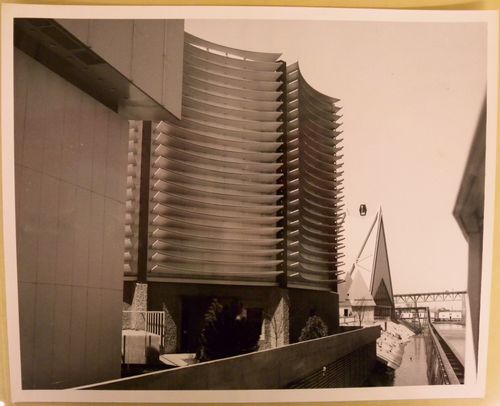
Description of the Pavilion of the Soviet Union, Expo 67, Montréal, Québec
Actions:
ARCH260635
ARCH256269
1967
ARCH256298
1967
ARCH256309
1967