


1559 Results
Form:
books
books
Actions:
Price:
$64.95
(available to order)
Summary:
The potential of electric light as a new building 'material' was recognized in the 1920s and became a useful design tool by the mid-century. Skilful lighting allowed for theatricality, narrative, and a new emphasis on structure and space. "The Structure of Light" tells the story of the career of Richard Kelly, the field's most influential figure. Six historians,(...)
$64.95
(available to order)
Summary:
The potential of electric light as a new building 'material' was recognized in the 1920s and became a useful design tool by the mid-century. Skilful lighting allowed for theatricality, narrative, and a new emphasis on structure and space. "The Structure of Light" tells the story of the career of Richard Kelly, the field's most influential figure. Six historians,(...)
Title:
The structure of light: Richard Kelly and the illumination of modern architecture
Actions:
Price:
$64.95
(available to order)
Summary:
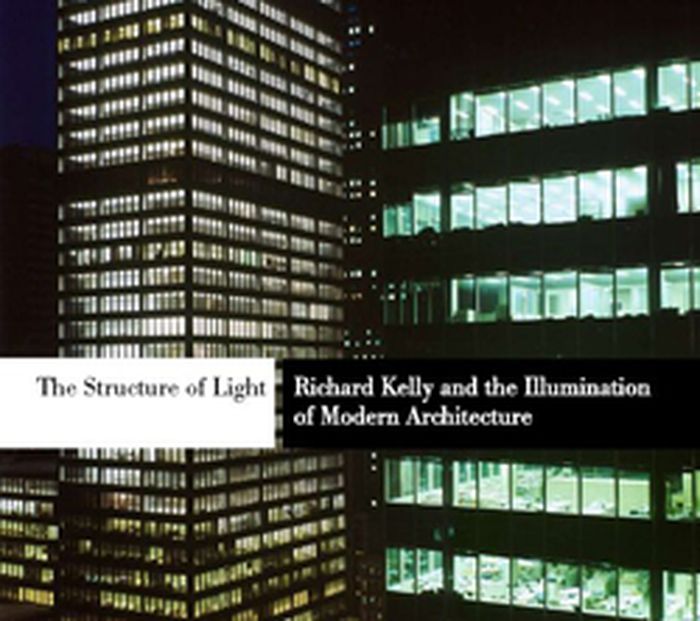
The potential of electric light as a new building 'material' was recognized in the 1920s and became a useful design tool by the mid-century. Skilful lighting allowed for theatricality, narrative, and a new emphasis on structure and space. "The Structure of Light" tells the story of the career of Richard Kelly, the field's most influential figure. Six historians, architects, and practitioners explore Kelly's unparalleled influence on modern architecture and his lighting designs for some of the 20th century's most iconic buildings: Philip Johnson's Glass House; Louis Kahn's Kimbell Art Museum; Eero Saarinen's GM Technical Center; and Mies van der Rohe's Seagram Building, among many others. This publication demonstrates the range of applications, building types, and artistic solutions he employed to achieve a 'nocturnal modernity' that would render buildings evocatively different at night. The survival of Kelly's rich correspondence and extensive diaries allows an in-depth look at the triumphs and uncertainties of a young profession in the making.
The structure of light: Richard Kelly and the illumination of modern architecture
Actions:
Price:
$64.95
(available to order)
Summary:
The potential of electric light as a new building 'material' was recognized in the 1920s and became a useful design tool by the mid-century. Skilful lighting allowed for theatricality, narrative, and a new emphasis on structure and space. "The Structure of Light" tells the story of the career of Richard Kelly, the field's most influential figure. Six historians, architects, and practitioners explore Kelly's unparalleled influence on modern architecture and his lighting designs for some of the 20th century's most iconic buildings: Philip Johnson's Glass House; Louis Kahn's Kimbell Art Museum; Eero Saarinen's GM Technical Center; and Mies van der Rohe's Seagram Building, among many others. This publication demonstrates the range of applications, building types, and artistic solutions he employed to achieve a 'nocturnal modernity' that would render buildings evocatively different at night. The survival of Kelly's rich correspondence and extensive diaries allows an in-depth look at the triumphs and uncertainties of a young profession in the making.
Form:
books
books
Publication:
October 2010
October 2010
Subject:
Architecture Monographs
Architecture Monographs
Form:
books
books
Price:
$49.95
(available to order)
Summary:
Colonial Modern: Aesthetics of the Past, Rebellions for the Future is a reader on the relationship between modernism and the project of modernisation in architecture, as well as the intertwining of both in the context of colonialism and decolonisation. It focuses on the dual topics of the relationship between the post-war aesthetic regime of modernism and the project of(...)
$49.95
(available to order)
Summary:
Colonial Modern: Aesthetics of the Past, Rebellions for the Future is a reader on the relationship between modernism and the project of modernisation in architecture, as well as the intertwining of both in the context of colonialism and decolonisation. It focuses on the dual topics of the relationship between the post-war aesthetic regime of modernism and the project of(...)
Subject:
Modernism
Modernism
Publication:
August 2010
August 2010
Title:
Colonial Modern: Aesthetics of the past, rebellions for the future
Actions:
Price:
$49.95
(available to order)
Summary:
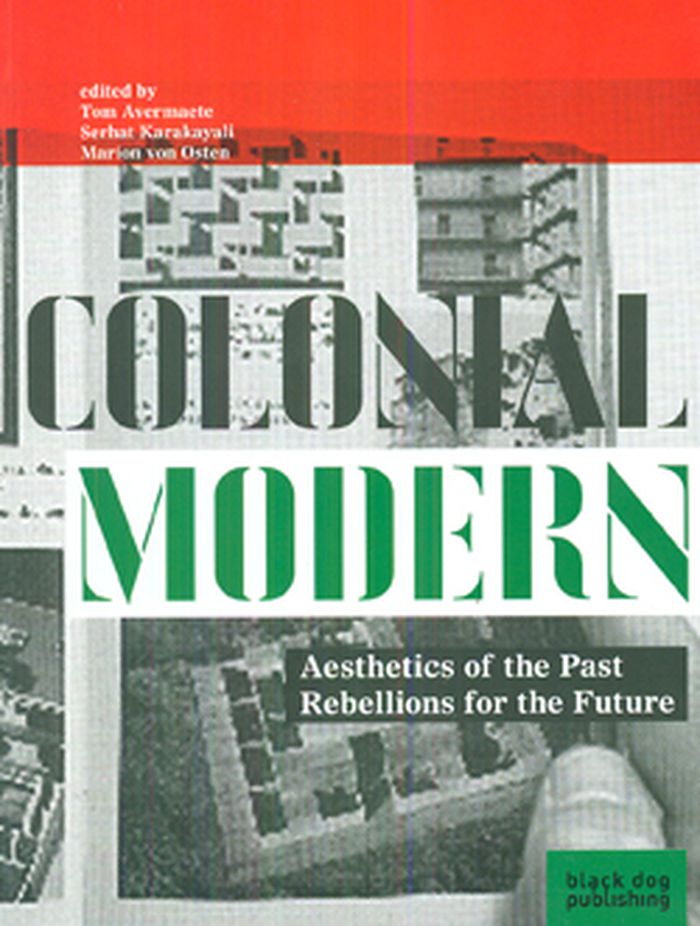
Colonial Modern: Aesthetics of the Past, Rebellions for the Future is a reader on the relationship between modernism and the project of modernisation in architecture, as well as the intertwining of both in the context of colonialism and decolonisation. It focuses on the dual topics of the relationship between the post-war aesthetic regime of modernism and the project of modernization in architecture and urban planning, as well as on the highly charged intertwining of both in the context of colonialism and decolonization. It is based on the exhibition In the Desert of Modernity: Colonial Planning and After , which traced these connected histories of modern architecture and urban planning in colonial northern Africa and Europe, and was first exhibited in 2008 at the Haus der Kulturen der Welt in Berlin, Germany. The book reflects contemporary research into architectural modernism and colonialism, and utilizes the thesis of “negotiated modernism” to initiate new debates on conceptions of modernism and, inevitably, postmodernism in an interdisciplinary context.
Colonial Modern: Aesthetics of the past, rebellions for the future
Actions:
Price:
$49.95
(available to order)
Summary:
Colonial Modern: Aesthetics of the Past, Rebellions for the Future is a reader on the relationship between modernism and the project of modernisation in architecture, as well as the intertwining of both in the context of colonialism and decolonisation. It focuses on the dual topics of the relationship between the post-war aesthetic regime of modernism and the project of modernization in architecture and urban planning, as well as on the highly charged intertwining of both in the context of colonialism and decolonization. It is based on the exhibition In the Desert of Modernity: Colonial Planning and After , which traced these connected histories of modern architecture and urban planning in colonial northern Africa and Europe, and was first exhibited in 2008 at the Haus der Kulturen der Welt in Berlin, Germany. The book reflects contemporary research into architectural modernism and colonialism, and utilizes the thesis of “negotiated modernism” to initiate new debates on conceptions of modernism and, inevitably, postmodernism in an interdisciplinary context.
Form:
books
books
Publication:
August 2010
August 2010
Subject:
Modernism
Modernism
Form:
journals and magazines
journals and magazines
Title:
Cabinet 55: love
Cabinet 55: love
Actions:
Price:
$17.50
(available to order)
Summary:
Love was classically thought to come in four distinct varieties--agape (spiritual love), eros (physical passion), philia (friendship) and storge (familial affection). It might be argued that with modernity, one of these--eros--has come to dominate our landscape, where romance and its obstacles inform so many of our cultural narratives and consumer fantasies. Nonetheless,(...)
$17.50
(available to order)
Summary:
Love was classically thought to come in four distinct varieties--agape (spiritual love), eros (physical passion), philia (friendship) and storge (familial affection). It might be argued that with modernity, one of these--eros--has come to dominate our landscape, where romance and its obstacles inform so many of our cultural narratives and consumer fantasies. Nonetheless,(...)
Title:
Cabinet 55: love
Actions:
Price:
$17.50
(available to order)
Summary:
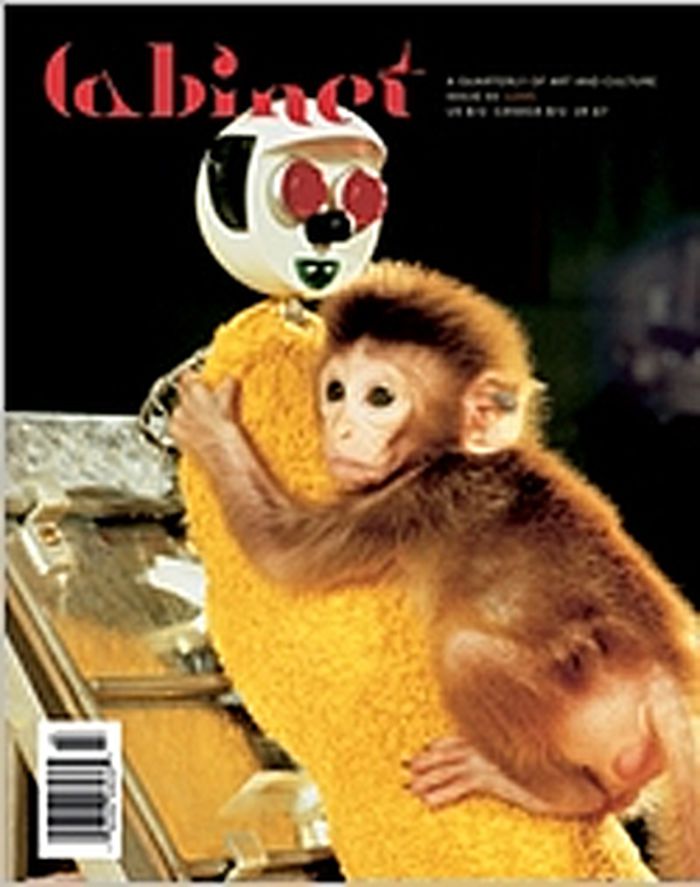
Love was classically thought to come in four distinct varieties--agape (spiritual love), eros (physical passion), philia (friendship) and storge (familial affection). It might be argued that with modernity, one of these--eros--has come to dominate our landscape, where romance and its obstacles inform so many of our cultural narratives and consumer fantasies. Nonetheless, all of these modalities of love continue to structure the relationships that govern human societies. Cabinet issue 55, with a special section on "Love," features Christopher Turner on the "celestial bed" of eighteenth-century proto-sexologist James Graham; Margaret Gordon on epistolary friendships; and Olga Lemerova on the love between humans and their pets. Elsewhere in the issue: Sasha Archibald on the decorative fabric or leather patches worn in the seventeenth century to conceal facial blemishes; D. Graham Burnett on watermarks; and Babak Sadr on how zoos perform annual inventories of their animals, both countable and uncountable.
Cabinet 55: love
Actions:
Price:
$17.50
(available to order)
Summary:
Love was classically thought to come in four distinct varieties--agape (spiritual love), eros (physical passion), philia (friendship) and storge (familial affection). It might be argued that with modernity, one of these--eros--has come to dominate our landscape, where romance and its obstacles inform so many of our cultural narratives and consumer fantasies. Nonetheless, all of these modalities of love continue to structure the relationships that govern human societies. Cabinet issue 55, with a special section on "Love," features Christopher Turner on the "celestial bed" of eighteenth-century proto-sexologist James Graham; Margaret Gordon on epistolary friendships; and Olga Lemerova on the love between humans and their pets. Elsewhere in the issue: Sasha Archibald on the decorative fabric or leather patches worn in the seventeenth century to conceal facial blemishes; D. Graham Burnett on watermarks; and Babak Sadr on how zoos perform annual inventories of their animals, both countable and uncountable.
Form:
journals and magazines
journals and magazines
Publication:
August 2014
August 2014
Subject:
Magazines
Magazines
Form:
books
books
Actions:
Price:
$39.95
(available to order)
Summary:
Photography is one of the principal filters through which we engage the world. The contributors to this volume focus on Walter Benjamin's concept of the optical unconscious to investigate how photography has shaped history, modernity, perception, lived experience, politics, race, and human agency. In essays that range from examinations of Benjamin's and Sigmund Freud's(...)
$39.95
(available to order)
Summary:
Photography is one of the principal filters through which we engage the world. The contributors to this volume focus on Walter Benjamin's concept of the optical unconscious to investigate how photography has shaped history, modernity, perception, lived experience, politics, race, and human agency. In essays that range from examinations of Benjamin's and Sigmund Freud's(...)
Title:
Photography and the optical unconscious
Actions:
Price:
$39.95
(available to order)
Summary:
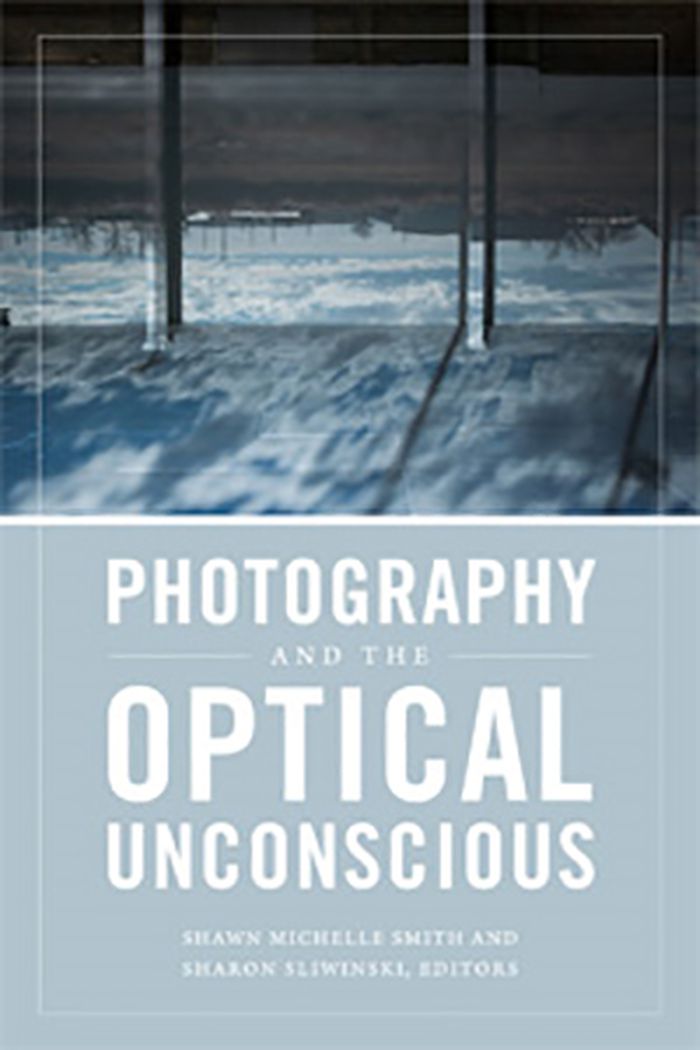
Photography is one of the principal filters through which we engage the world. The contributors to this volume focus on Walter Benjamin's concept of the optical unconscious to investigate how photography has shaped history, modernity, perception, lived experience, politics, race, and human agency. In essays that range from examinations of Benjamin's and Sigmund Freud's writings to the work of Kara Walker and Roland Barthes's famous Winter Garden photograph, the contributors explore what photography can teach us about the nature of the unconscious. They attend to side perceptions, develop latent images, discover things hidden in plain sight, focus on the disavowed, and perceive the slow. Of particular note are the ways race and colonialism have informed photography from its beginning. The volume also contains photographic portfolios by Zoe Leonard, Kelly Wood, and Kristan Horton, whose work speaks to the optical unconscious while demonstrating how photographs communicate on their own terms. The essays and portfolios in Photography and the Optical Unconscious create a collective and sustained assessment of Benjamin's influential concept, opening up new avenues for thinking about photography and the human psyche.
Photography and the optical unconscious
Actions:
Price:
$39.95
(available to order)
Summary:
Photography is one of the principal filters through which we engage the world. The contributors to this volume focus on Walter Benjamin's concept of the optical unconscious to investigate how photography has shaped history, modernity, perception, lived experience, politics, race, and human agency. In essays that range from examinations of Benjamin's and Sigmund Freud's writings to the work of Kara Walker and Roland Barthes's famous Winter Garden photograph, the contributors explore what photography can teach us about the nature of the unconscious. They attend to side perceptions, develop latent images, discover things hidden in plain sight, focus on the disavowed, and perceive the slow. Of particular note are the ways race and colonialism have informed photography from its beginning. The volume also contains photographic portfolios by Zoe Leonard, Kelly Wood, and Kristan Horton, whose work speaks to the optical unconscious while demonstrating how photographs communicate on their own terms. The essays and portfolios in Photography and the Optical Unconscious create a collective and sustained assessment of Benjamin's influential concept, opening up new avenues for thinking about photography and the human psyche.
Form:
books
books
Publication:
May 2017
May 2017
Subject:
Theory of Photography
Theory of Photography
Form:
books
books
Actions:
Price:
$18.95
(available to order)
Summary:
In 2004 and 2005, Antonio Negri held ten workshops at the Collège International de Philosophie in Paris to formulate a new political grammar of the postmodern. Postmodernity, Negri suggests, can be described as a "porcelain workshop": a delicate and fragile construction that could be destroyed through one clumsy act. Looking across twentieth century history, Negri warns(...)
$18.95
(available to order)
Summary:
In 2004 and 2005, Antonio Negri held ten workshops at the Collège International de Philosophie in Paris to formulate a new political grammar of the postmodern. Postmodernity, Negri suggests, can be described as a "porcelain workshop": a delicate and fragile construction that could be destroyed through one clumsy act. Looking across twentieth century history, Negri warns(...)
Title:
The porcelain workshop: for a new grammar of politics
Actions:
Price:
$18.95
(available to order)
Summary:
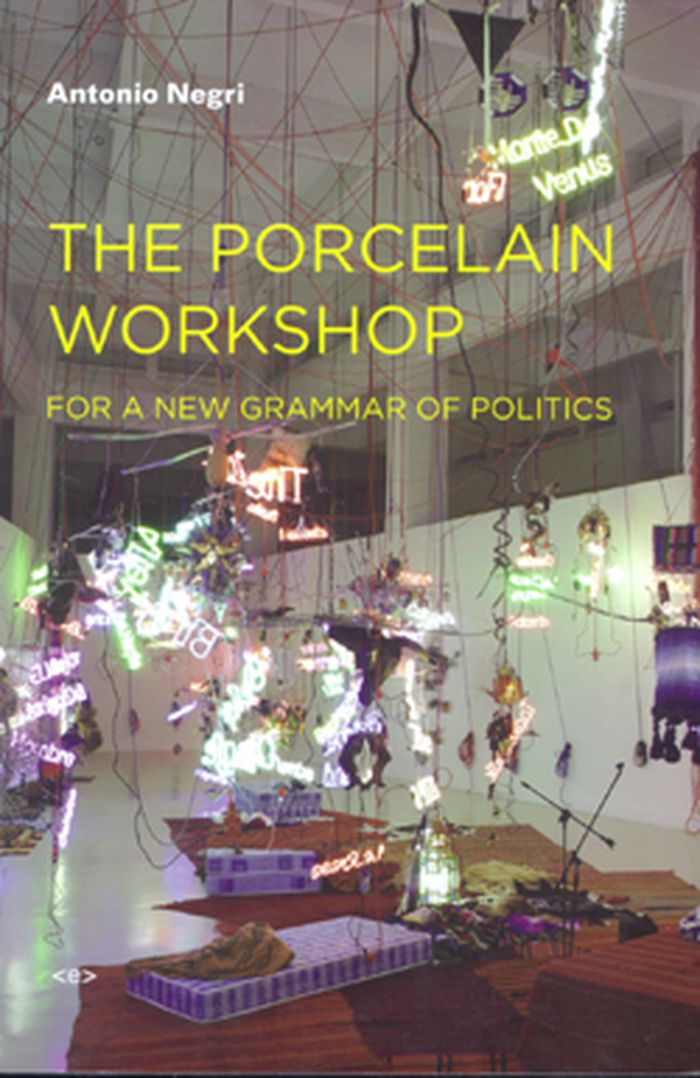
In 2004 and 2005, Antonio Negri held ten workshops at the Collège International de Philosophie in Paris to formulate a new political grammar of the postmodern. Postmodernity, Negri suggests, can be described as a "porcelain workshop": a delicate and fragile construction that could be destroyed through one clumsy act. Looking across twentieth century history, Negri warns that our inability to anticipate future developments has already placed coming generations in serious jeopardy. Describing the years 1917-1968 as the "short century," Negri suggests that by the end of it, all of the familiar markers of modernity (including that of socialism) had lost their relevance. Confronted with an intolerable reality, indignation and the revolutionary will to transform the world have both taken new forms and must be understood anew, free of modernist assumptions. In the impassioned debates recounted in this book, Antonio Negri attempts to describe the formation of an alternative political horizon and looks for a way to define the practices and modes of expression that democracy could take.
The porcelain workshop: for a new grammar of politics
Actions:
Price:
$18.95
(available to order)
Summary:
In 2004 and 2005, Antonio Negri held ten workshops at the Collège International de Philosophie in Paris to formulate a new political grammar of the postmodern. Postmodernity, Negri suggests, can be described as a "porcelain workshop": a delicate and fragile construction that could be destroyed through one clumsy act. Looking across twentieth century history, Negri warns that our inability to anticipate future developments has already placed coming generations in serious jeopardy. Describing the years 1917-1968 as the "short century," Negri suggests that by the end of it, all of the familiar markers of modernity (including that of socialism) had lost their relevance. Confronted with an intolerable reality, indignation and the revolutionary will to transform the world have both taken new forms and must be understood anew, free of modernist assumptions. In the impassioned debates recounted in this book, Antonio Negri attempts to describe the formation of an alternative political horizon and looks for a way to define the practices and modes of expression that democracy could take.
Form:
books
books
Publication:
August 2008, Cambridge, London
August 2008, Cambridge, London
Subject:
Critical Theory
Critical Theory
Form:
books
books
Price:
$31.50
(available to order)
Summary:
For hundreds of years, Ireland has been a testing ground for colonizing techniques. Postcolonial Dublin shows how perpetrators of colonialism have made use of urban planning and architecture to underscore and legitimate ideologies. From suburban development to building facades, the conflict between nationalists and colonialists has inscribed itself on Dublin’s landscape.(...)
$31.50
(available to order)
Summary:
For hundreds of years, Ireland has been a testing ground for colonizing techniques. Postcolonial Dublin shows how perpetrators of colonialism have made use of urban planning and architecture to underscore and legitimate ideologies. From suburban development to building facades, the conflict between nationalists and colonialists has inscribed itself on Dublin’s landscape.(...)
Title:
Postcolonial Dublin : imperial legacies and the built environment
Actions:
Price:
$31.50
(available to order)
Summary:
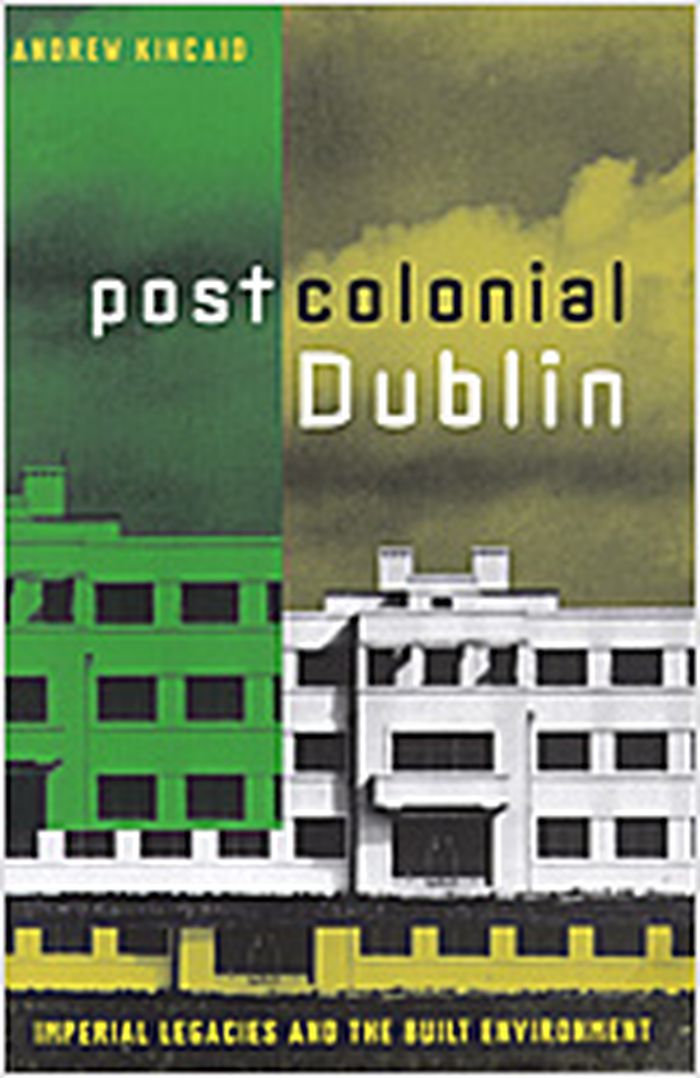
For hundreds of years, Ireland has been a testing ground for colonizing techniques. Postcolonial Dublin shows how perpetrators of colonialism have made use of urban planning and architecture to underscore and legitimate ideologies. From suburban development to building facades, the conflict between nationalists and colonialists has inscribed itself on Dublin’s landscape. Andrew Kincaid illustrates how the architecture and urban planning of Dublin have been integral to debates about nationalism, modernism, and Ireland’s relationship to the rest of the world. Looking at objects such as Londonderry’s Market House, Patrick Abercrombie’s Dublin of the Future, and the urban renewal project of today’s Temple Bar, Kincaid highlights Ireland’s colonial history and the significance of architecture in the evolution of national identity. In doing so, he demonstrates how ideology “spatializes” itself. Postcolonial Dublin engages the prevailing historical representations of Irish nationalism, arguing that the evolving city reflected a debate over who would hold the reins of power. Bringing the tools of literary criticism and postcolonial theory to bear on the field of urban studies, Kincaid places Dublin at the forefront of debates over modernism, modernity, and globalization.
Postcolonial Dublin : imperial legacies and the built environment
Actions:
Price:
$31.50
(available to order)
Summary:
For hundreds of years, Ireland has been a testing ground for colonizing techniques. Postcolonial Dublin shows how perpetrators of colonialism have made use of urban planning and architecture to underscore and legitimate ideologies. From suburban development to building facades, the conflict between nationalists and colonialists has inscribed itself on Dublin’s landscape. Andrew Kincaid illustrates how the architecture and urban planning of Dublin have been integral to debates about nationalism, modernism, and Ireland’s relationship to the rest of the world. Looking at objects such as Londonderry’s Market House, Patrick Abercrombie’s Dublin of the Future, and the urban renewal project of today’s Temple Bar, Kincaid highlights Ireland’s colonial history and the significance of architecture in the evolution of national identity. In doing so, he demonstrates how ideology “spatializes” itself. Postcolonial Dublin engages the prevailing historical representations of Irish nationalism, arguing that the evolving city reflected a debate over who would hold the reins of power. Bringing the tools of literary criticism and postcolonial theory to bear on the field of urban studies, Kincaid places Dublin at the forefront of debates over modernism, modernity, and globalization.
Form:
books
books
Publication:
May 2006, Minneapolis
May 2006, Minneapolis
Subject:
Architecture since 1900, Europe
Architecture since 1900, Europe
Form:
books
books
Actions:
Price:
$28.95
(available to order)
Summary:
Duffy illuminates speed as a logic and genuine pleasure of modernity. He plunges full-throttle into speed's 'adrenaline aesthetics,' offering deft readings of works ranging from F. Scott Fitzgerald's "The Great Gatsby", through J. G. Ballard's "Crash", to the cautionary consumerism of Ralph Nader. He describes how speed changed understandings of space, distance, chance,(...)
$28.95
(available to order)
Summary:
Duffy illuminates speed as a logic and genuine pleasure of modernity. He plunges full-throttle into speed's 'adrenaline aesthetics,' offering deft readings of works ranging from F. Scott Fitzgerald's "The Great Gatsby", through J. G. Ballard's "Crash", to the cautionary consumerism of Ralph Nader. He describes how speed changed understandings of space, distance, chance,(...)
Title:
The speed handbook: velocity, pleasure, modernism
Actions:
Price:
$28.95
(available to order)
Summary:
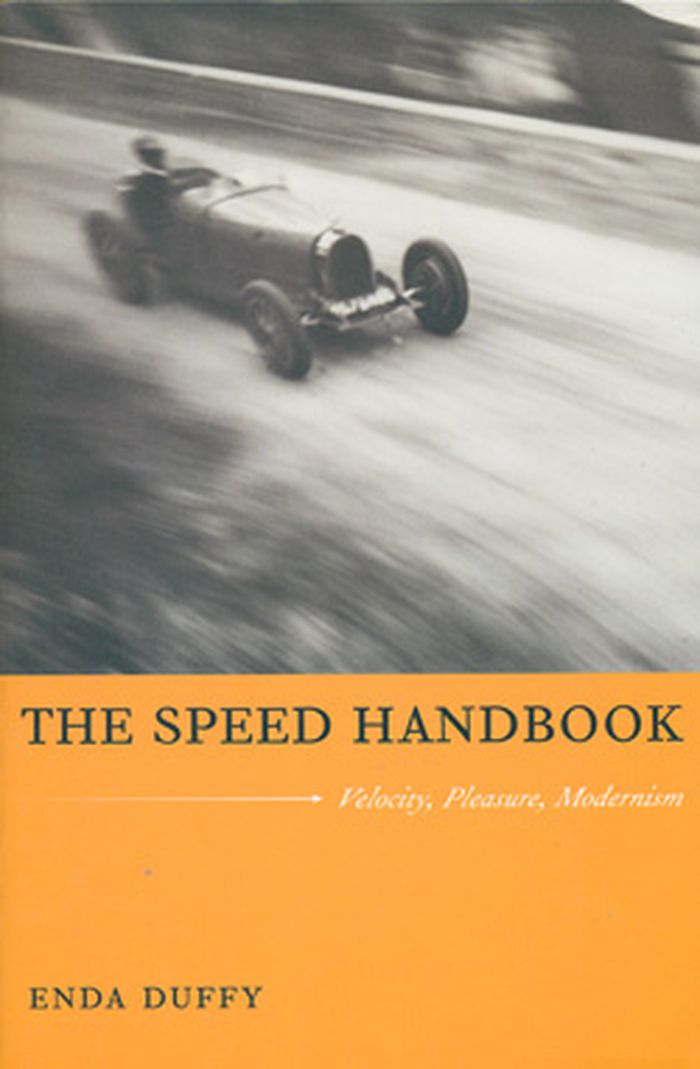
Duffy illuminates speed as a logic and genuine pleasure of modernity. He plunges full-throttle into speed's 'adrenaline aesthetics,' offering deft readings of works ranging from F. Scott Fitzgerald's "The Great Gatsby", through J. G. Ballard's "Crash", to the cautionary consumerism of Ralph Nader. He describes how speed changed understandings of space, distance, chance, and violence; how the experience of speed was commodified in the dawning era of mass consumption; and how people were incited to abhor slowness and desire speed. He examines how they were trained by new media such as the cinema to see, hear, and sense speed, and how speed, demanded of the efficient assembly-line worker, was given back to that worker as the chief thrill of leisure. Assessing speed's political implications, Duffy considers how speed pleasure was offered to citizens based on criteria including their ability to pay and their gender, and how speed quickly became something to be patrolled by governments. Drawing on novels, news reports, photography, advertising, and much more, Duffy provides a breakneck tour through the cultural dynamics of speed.
The speed handbook: velocity, pleasure, modernism
Actions:
Price:
$28.95
(available to order)
Summary:
Duffy illuminates speed as a logic and genuine pleasure of modernity. He plunges full-throttle into speed's 'adrenaline aesthetics,' offering deft readings of works ranging from F. Scott Fitzgerald's "The Great Gatsby", through J. G. Ballard's "Crash", to the cautionary consumerism of Ralph Nader. He describes how speed changed understandings of space, distance, chance, and violence; how the experience of speed was commodified in the dawning era of mass consumption; and how people were incited to abhor slowness and desire speed. He examines how they were trained by new media such as the cinema to see, hear, and sense speed, and how speed, demanded of the efficient assembly-line worker, was given back to that worker as the chief thrill of leisure. Assessing speed's political implications, Duffy considers how speed pleasure was offered to citizens based on criteria including their ability to pay and their gender, and how speed quickly became something to be patrolled by governments. Drawing on novels, news reports, photography, advertising, and much more, Duffy provides a breakneck tour through the cultural dynamics of speed.
Form:
books
books
Publication:
August 2009
August 2009
Subject:
Critical Theory
Critical Theory
Form:
books
books

Price:
$41.95
(available to order)
Summary:
For some 20 years, Kunming, a provincial capital city in China - 3.2 million inhabitants - has been the twin town of the European metropolis Zurich. As a direct result of this partnership, Kunming now has the first inner-city bus line in China, the first large-scale conservation of a historical part of the town, and new concepts for urban development at a regional(...)
$41.95
(available to order)
Summary:
For some 20 years, Kunming, a provincial capital city in China - 3.2 million inhabitants - has been the twin town of the European metropolis Zurich. As a direct result of this partnership, Kunming now has the first inner-city bus line in China, the first large-scale conservation of a historical part of the town, and new concepts for urban development at a regional(...)
Subject:
Contemporary Asian Architecture
Contemporary Asian Architecture
Publication:
September 2002, Basel
September 2002, Basel
Title:
The Kunming project : urban development in China - a dialogue
Actions:
Price:
$41.95
(available to order)
Summary:
For some 20 years, Kunming, a provincial capital city in China - 3.2 million inhabitants - has been the twin town of the European metropolis Zurich. As a direct result of this partnership, Kunming now has the first inner-city bus line in China, the first large-scale conservation of a historical part of the town, and new concepts for urban development at a regional level. This pioneering collaboration between western and Chinese planning teams, and the ways in which urban planning has been managed, are not only significant for Kunming but are of importance for all countries which are interested in sharing the expertise and knowledge of professionals whether they be from East or West, North or South, for countries which wish to benefit from western building practice whilst avoiding their mistakes. The challenge of such joint projects surely lies in the confrontation resulting from the traditional and historical background in large Asian cities together with their sense of modernity which has often surpassed the modern western world not only in terms of progress but also problems. In English and Chinese
The Kunming project : urban development in China - a dialogue
Actions:
Price:
$41.95
(available to order)
Summary:
For some 20 years, Kunming, a provincial capital city in China - 3.2 million inhabitants - has been the twin town of the European metropolis Zurich. As a direct result of this partnership, Kunming now has the first inner-city bus line in China, the first large-scale conservation of a historical part of the town, and new concepts for urban development at a regional level. This pioneering collaboration between western and Chinese planning teams, and the ways in which urban planning has been managed, are not only significant for Kunming but are of importance for all countries which are interested in sharing the expertise and knowledge of professionals whether they be from East or West, North or South, for countries which wish to benefit from western building practice whilst avoiding their mistakes. The challenge of such joint projects surely lies in the confrontation resulting from the traditional and historical background in large Asian cities together with their sense of modernity which has often surpassed the modern western world not only in terms of progress but also problems. In English and Chinese
Form:
books
books
Publication:
September 2002, Basel
September 2002, Basel
Subject:
Contemporary Asian Architecture
Contemporary Asian Architecture
Form:
books
books
Actions:
Price:
$30.00
(available to order)
Summary:
Rome is not only enriched by the works that have led it to be known as the "eternal city", or with those monuments that still preserve the stories of a strong people, such as the Colosseum, the Roman Forum or Castel Sant'Angelo. It is not only the symbolic center of Christianity thanks to St. Peter's Basilica, or the central and figurative hub of the Italian Republic(...)
$30.00
(available to order)
Summary:
Rome is not only enriched by the works that have led it to be known as the "eternal city", or with those monuments that still preserve the stories of a strong people, such as the Colosseum, the Roman Forum or Castel Sant'Angelo. It is not only the symbolic center of Christianity thanks to St. Peter's Basilica, or the central and figurative hub of the Italian Republic(...)
Title:
Rome: on the road architecture guide
Actions:
Price:
$30.00
(available to order)
Summary:
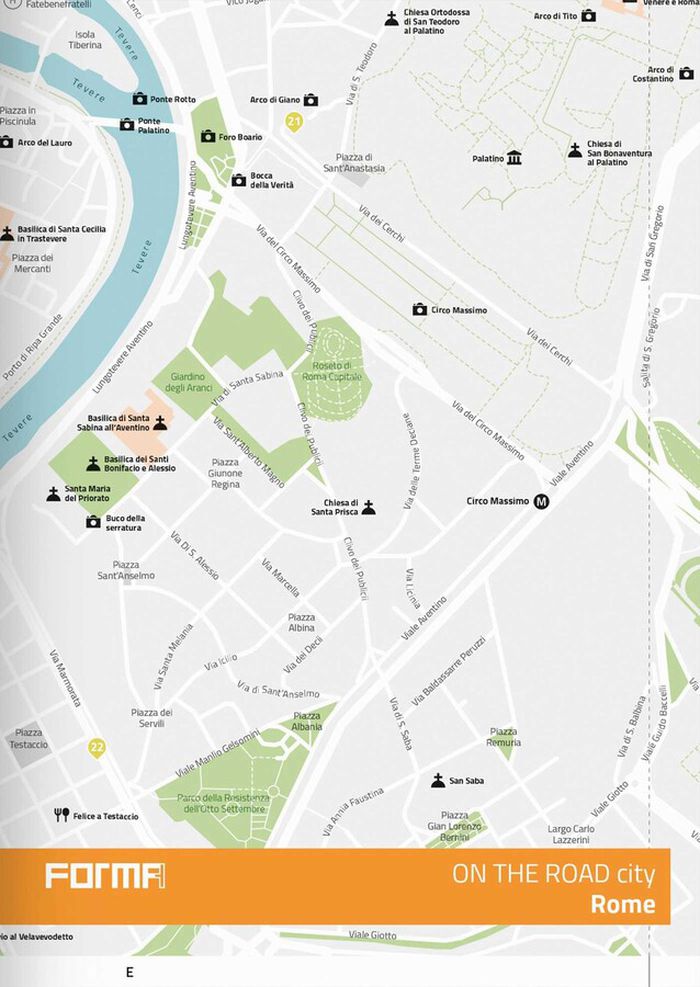
Rome is not only enriched by the works that have led it to be known as the "eternal city", or with those monuments that still preserve the stories of a strong people, such as the Colosseum, the Roman Forum or Castel Sant'Angelo. It is not only the symbolic center of Christianity thanks to St. Peter's Basilica, or the central and figurative hub of the Italian Republic because of the Palazzo del Quirinale. The history, art, and culture of Rome tell the story of a process of restoration and innovation that sees the participation of some timeless places and the birth of other contemporary community services that join those already known to the public. During 1930s, the social and cultural revolution and call for functionality and practicality are represented by impressive modern public and residential works, as well as by major operations from architectural protagonists in the urban change of the capital. Works such as the university city of Sapienza and its institutes, or the EUR district tell the story of the formal transition between modernity and contemporaneity.
Rome: on the road architecture guide
Actions:
Price:
$30.00
(available to order)
Summary:
Rome is not only enriched by the works that have led it to be known as the "eternal city", or with those monuments that still preserve the stories of a strong people, such as the Colosseum, the Roman Forum or Castel Sant'Angelo. It is not only the symbolic center of Christianity thanks to St. Peter's Basilica, or the central and figurative hub of the Italian Republic because of the Palazzo del Quirinale. The history, art, and culture of Rome tell the story of a process of restoration and innovation that sees the participation of some timeless places and the birth of other contemporary community services that join those already known to the public. During 1930s, the social and cultural revolution and call for functionality and practicality are represented by impressive modern public and residential works, as well as by major operations from architectural protagonists in the urban change of the capital. Works such as the university city of Sapienza and its institutes, or the EUR district tell the story of the formal transition between modernity and contemporaneity.
Form:
books
books
Publication:
November 2025
November 2025
Subject:
City Guides
City Guides
Form:
books
books
Actions:
Price:
$22.99
(available to order)
Summary:
"Thinking after Gaza" means recognizing the collapse of universal reason and democracy, the humanistic values that were the famed—and fragile—promise of modernity. But it also means searching for ways to escape the grim future awaiting those born in this disenchanted century: this century that promises to be the last, in which thought has lost all political power and the(...)
$22.99
(available to order)
Summary:
"Thinking after Gaza" means recognizing the collapse of universal reason and democracy, the humanistic values that were the famed—and fragile—promise of modernity. But it also means searching for ways to escape the grim future awaiting those born in this disenchanted century: this century that promises to be the last, in which thought has lost all political power and the(...)
Title:
Thinking Gaza: An essay on ferocity
Actions:
Price:
$22.99
(available to order)
Summary:
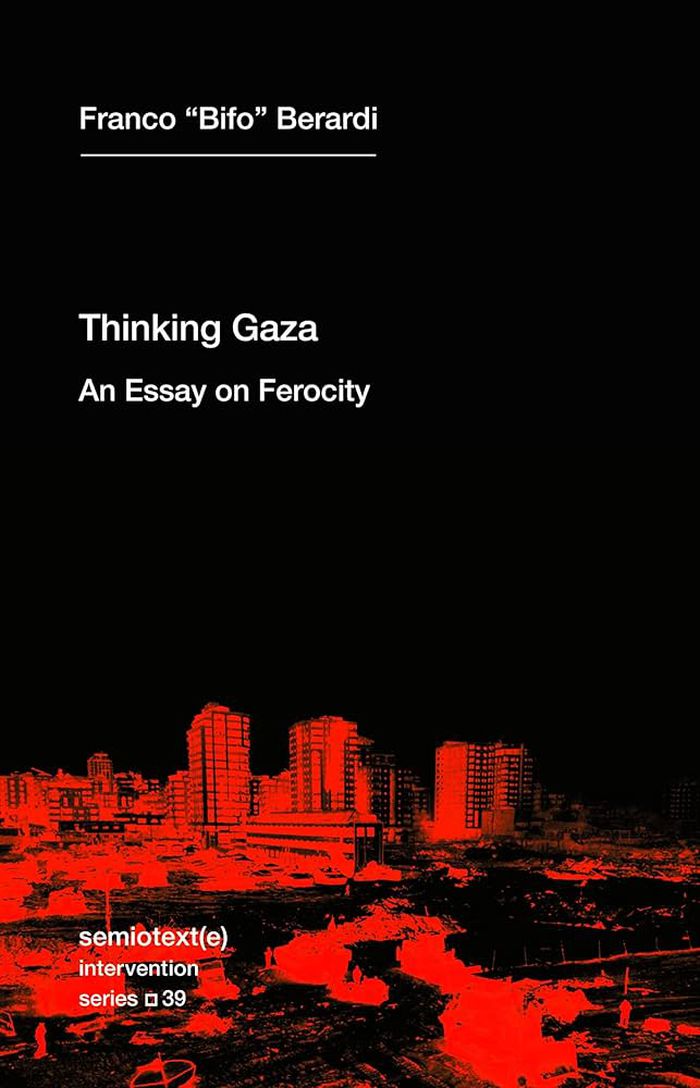
"Thinking after Gaza" means recognizing the collapse of universal reason and democracy, the humanistic values that were the famed—and fragile—promise of modernity. But it also means searching for ways to escape the grim future awaiting those born in this disenchanted century: this century that promises to be the last, in which thought has lost all political power and the survival instinct struggles to withstand the ferocity of techno-military extermination machines. To the generation born in the twilight of Western civilization, we owe this last act of thinking, so as to imagine the desertion of our barbaric present, along pathways that have yet to be illuminated. The latest essay by renowned Italian autonomist theorist Franco “Bifo” Berardi, ''Thinking Gaza'' is a reflection on the multivalent consequences—political, philosophical, civilizational—of the current genocide in Gaza and the West Bank. Bearing sober witness to the conditions on the ground in the Occupied Territories, while tracking the “ferocious optimism” that has replaced Enlightenment ideals, this book is addressed not only to activists but also to pacifist philosophers, historians, and theologians.
Thinking Gaza: An essay on ferocity
Actions:
Price:
$22.99
(available to order)
Summary:
"Thinking after Gaza" means recognizing the collapse of universal reason and democracy, the humanistic values that were the famed—and fragile—promise of modernity. But it also means searching for ways to escape the grim future awaiting those born in this disenchanted century: this century that promises to be the last, in which thought has lost all political power and the survival instinct struggles to withstand the ferocity of techno-military extermination machines. To the generation born in the twilight of Western civilization, we owe this last act of thinking, so as to imagine the desertion of our barbaric present, along pathways that have yet to be illuminated. The latest essay by renowned Italian autonomist theorist Franco “Bifo” Berardi, ''Thinking Gaza'' is a reflection on the multivalent consequences—political, philosophical, civilizational—of the current genocide in Gaza and the West Bank. Bearing sober witness to the conditions on the ground in the Occupied Territories, while tracking the “ferocious optimism” that has replaced Enlightenment ideals, this book is addressed not only to activists but also to pacifist philosophers, historians, and theologians.
Form:
books
books
Publication:
March 2026
March 2026
Subject:
Critical Theory
Critical Theory


