


12611 Results
Form:
events
events
Actions:
Location:
online
online
Date:
5 January 2026 to 10 January 2027
5 January 2026 to 10 January 2027
Form:
events
events
Date:
5 January 2026 to
10 January 2027
5 January 2026 to
10 January 2027
Location:
online
online
Form:
research
research
Actions:
Description:
TD Bank Group-CCA Collection Research Grant Recipients: Margo Beggs (University of Toronto); Luc Lévesque (Université de Montréal); Jasmine Rault (McGill University); Alexis Desgagnés (Université de Montréal); Tsz Yan Ng (McGill University); Dominic Boulerice (McGill University); Rim Ben Fredj (Université de Montréal) CCA Collection Research Grant Recipients: Ila(...)
TD Bank Group-CCA Collection Research Grant Recipients: Margo Beggs (University of Toronto); Luc Lévesque (Université de Montréal); Jasmine Rault (McGill University); Alexis Desgagnés (Université de Montréal); Tsz Yan Ng (McGill University); Dominic Boulerice (McGill University); Rim Ben Fredj (Université de Montréal) CCA Collection Research Grant Recipients: Ila(...)
Date:
April 2006 to November 2006
April 2006 to November 2006
Title:
Doctoral Students Program 2006
Actions:
Description:
TD Bank Group-CCA Collection Research Grant Recipients: Margo Beggs (University of Toronto); Luc Lévesque (Université de Montréal); Jasmine Rault (McGill University); Alexis Desgagnés (Université de Montréal); Tsz Yan Ng (McGill University); Dominic Boulerice (McGill University); Rim Ben Fredj (Université de Montréal) CCA Collection Research Grant Recipients: Ila(...)
Doctoral Students Program 2006
Actions:
Description:
TD Bank Group-CCA Collection Research Grant Recipients: Margo Beggs (University of Toronto); Luc Lévesque (Université de Montréal); Jasmine Rault (McGill University); Alexis Desgagnés (Université de Montréal); Tsz Yan Ng (McGill University); Dominic Boulerice (McGill University); Rim Ben Fredj (Université de Montréal) CCA Collection Research Grant Recipients: Ila(...)
Form:
research
research
Date:
April 2006 to
November 2006
April 2006 to
November 2006
Form:
articles
articles
Actions:
Sofia Nannini
Published:
15 July 2024
15 July 2024
Form:
events
events
Description:
None
None
Date:
1 February 2018
1 February 2018
Form:
events
events
Date:
1 February 2018
1 February 2018
Form:
webpages
webpages
Summary:
The Canadian Centre for Architecture’s collaborative and multidisciplinary research project on architecture’s complex developments in sub-Saharan African countries after independence.
Title:
Centring Africa: Postcolonial Perspectives on Architecture
Actions:
Summary:
Centring Africa: Postcolonial Perspectives on Architecture
Actions:
Summary:
The Canadian Centre for Architecture’s collaborative and multidisciplinary research project on architecture’s complex developments in sub-Saharan African countries after independence.
Form:
webpages
webpages
Form:
exhibitions
exhibitions

Title:
Starting From... The Suburbs
Starting From... The Suburbs
Actions:
Description:
We are more likely today to consider suburbs formless, vacant, or unsustainable compared to the dense social and economic activity of cities. Starting from… The Suburbs looks at the past fifty years of suburban culture through the lens of the CCA Collection’s photography holdings, produced by photographers’ longstanding attraction and aversion to this urban form. The(...)
We are more likely today to consider suburbs formless, vacant, or unsustainable compared to the dense social and economic activity of cities. Starting from… The Suburbs looks at the past fifty years of suburban culture through the lens of the CCA Collection’s photography holdings, produced by photographers’ longstanding attraction and aversion to this urban form. The(...)
Location:
Hall cases
Hall cases
Date:
16 February 2012 to 10 June 2012
16 February 2012 to 10 June 2012
Title:
Starting From... The Suburbs
Actions:
Description:
We are more likely today to consider suburbs formless, vacant, or unsustainable compared to the dense social and economic activity of cities. Starting from… The Suburbs looks at the past fifty years of suburban culture through the lens of the CCA Collection’s photography holdings, produced by photographers’ longstanding attraction and aversion to this urban form. The(...)
Starting From... The Suburbs
Actions:
Description:
We are more likely today to consider suburbs formless, vacant, or unsustainable compared to the dense social and economic activity of cities. Starting from… The Suburbs looks at the past fifty years of suburban culture through the lens of the CCA Collection’s photography holdings, produced by photographers’ longstanding attraction and aversion to this urban form. The(...)
Form:
exhibitions
exhibitions
Date:
16 February 2012 to
10 June 2012
16 February 2012 to
10 June 2012
Location:
Hall cases
Hall cases
Level of archival description:
Project
Project
Reference number:
AP018.S1.1971.PR07
Description:
This project series documents the design and construction of the Health Sciences Complex at Memorial University (MUN) in St. John’s, Newfoundland from 1971-1976. The office identified the project number as 7111. The Health Sciences Complex was built to replace the St. John’s General Hospital. Constructed on MUN’s north campus, the hospital would integrate the university’s medical school to create a teaching hospital. The design included classrooms, labs, and a library for the students. The St. John’s General Hospital and MUN medical school would retain their independence and authority while sharing the space. The proposed design called for a banal building that was always unfinished so that future expansions and changes could be easily accommodated. The project also included the construction of the Utilities Annex building, a separate building to house heating and cooling plants, generators and electrical distribution. Having these facilities in a separate building would allow them to expand the hospital without crucial systems getting in the way. The main expansion envisioned in the scope of this project was the Life Sciences Complex, a university building and hospital connected to the Health Sciences Complex. In the project materials, the project is often referred to as The Health and Life Sciences Complex, although only the Health Sciences Complex was constructed under this project number. The original budget for the project was $60 million, a figure which included the Life Sciences Complex. The project is recorded through drawings, photographic materials, boards of material samples, a painting and textual records dating from 1971-1978. The textual records include correspondence with the client and consultants, meeting minutes and reports, consultancy records, a systems report, food facilities planning records, outline specifications, product catalogues for hospital equipment, research, project proposals, financial documentation and schedules. All of the drawings issued for tender are arranged within the textual materials. There are also two presentation boards, one of a project painting and the other of a photograph of the site model. Box AP018.S1.1971.PR07.049 contains an index to the textual records, which was created by the office.
AP018.S1.1971.PR07
Description:
This project series documents the design and construction of the Health Sciences Complex at Memorial University (MUN) in St. John’s, Newfoundland from 1971-1976. The office identified the project number as 7111. The Health Sciences Complex was built to replace the St. John’s General Hospital. Constructed on MUN’s north campus, the hospital would integrate the university’s medical school to create a teaching hospital. The design included classrooms, labs, and a library for the students. The St. John’s General Hospital and MUN medical school would retain their independence and authority while sharing the space. The proposed design called for a banal building that was always unfinished so that future expansions and changes could be easily accommodated. The project also included the construction of the Utilities Annex building, a separate building to house heating and cooling plants, generators and electrical distribution. Having these facilities in a separate building would allow them to expand the hospital without crucial systems getting in the way. The main expansion envisioned in the scope of this project was the Life Sciences Complex, a university building and hospital connected to the Health Sciences Complex. In the project materials, the project is often referred to as The Health and Life Sciences Complex, although only the Health Sciences Complex was constructed under this project number. The original budget for the project was $60 million, a figure which included the Life Sciences Complex. The project is recorded through drawings, photographic materials, boards of material samples, a painting and textual records dating from 1971-1978. The textual records include correspondence with the client and consultants, meeting minutes and reports, consultancy records, a systems report, food facilities planning records, outline specifications, product catalogues for hospital equipment, research, project proposals, financial documentation and schedules. All of the drawings issued for tender are arranged within the textual materials. There are also two presentation boards, one of a project painting and the other of a photograph of the site model. Box AP018.S1.1971.PR07.049 contains an index to the textual records, which was created by the office.
People:
Date:
1970-1978
1970-1978
Title:
Memorial University of Newfoundland, Health Sciences Complex, St. Johns, Newfoundland (1971-1976)
Actions:
AP018.S1.1971.PR07
Description:
This project series documents the design and construction of the Health Sciences Complex at Memorial University (MUN) in St. John’s, Newfoundland from 1971-1976. The office identified the project number as 7111. The Health Sciences Complex was built to replace the St. John’s General Hospital. Constructed on MUN’s north campus, the hospital would integrate the university’s medical school to create a teaching hospital. The design included classrooms, labs, and a library for the students. The St. John’s General Hospital and MUN medical school would retain their independence and authority while sharing the space. The proposed design called for a banal building that was always unfinished so that future expansions and changes could be easily accommodated. The project also included the construction of the Utilities Annex building, a separate building to house heating and cooling plants, generators and electrical distribution. Having these facilities in a separate building would allow them to expand the hospital without crucial systems getting in the way. The main expansion envisioned in the scope of this project was the Life Sciences Complex, a university building and hospital connected to the Health Sciences Complex. In the project materials, the project is often referred to as The Health and Life Sciences Complex, although only the Health Sciences Complex was constructed under this project number. The original budget for the project was $60 million, a figure which included the Life Sciences Complex. The project is recorded through drawings, photographic materials, boards of material samples, a painting and textual records dating from 1971-1978. The textual records include correspondence with the client and consultants, meeting minutes and reports, consultancy records, a systems report, food facilities planning records, outline specifications, product catalogues for hospital equipment, research, project proposals, financial documentation and schedules. All of the drawings issued for tender are arranged within the textual materials. There are also two presentation boards, one of a project painting and the other of a photograph of the site model. Box AP018.S1.1971.PR07.049 contains an index to the textual records, which was created by the office.
Memorial University of Newfoundland, Health Sciences Complex, St. Johns, Newfoundland (1971-1976)
Actions:
AP018.S1.1971.PR07
Description:
This project series documents the design and construction of the Health Sciences Complex at Memorial University (MUN) in St. John’s, Newfoundland from 1971-1976. The office identified the project number as 7111. The Health Sciences Complex was built to replace the St. John’s General Hospital. Constructed on MUN’s north campus, the hospital would integrate the university’s medical school to create a teaching hospital. The design included classrooms, labs, and a library for the students. The St. John’s General Hospital and MUN medical school would retain their independence and authority while sharing the space. The proposed design called for a banal building that was always unfinished so that future expansions and changes could be easily accommodated. The project also included the construction of the Utilities Annex building, a separate building to house heating and cooling plants, generators and electrical distribution. Having these facilities in a separate building would allow them to expand the hospital without crucial systems getting in the way. The main expansion envisioned in the scope of this project was the Life Sciences Complex, a university building and hospital connected to the Health Sciences Complex. In the project materials, the project is often referred to as The Health and Life Sciences Complex, although only the Health Sciences Complex was constructed under this project number. The original budget for the project was $60 million, a figure which included the Life Sciences Complex. The project is recorded through drawings, photographic materials, boards of material samples, a painting and textual records dating from 1971-1978. The textual records include correspondence with the client and consultants, meeting minutes and reports, consultancy records, a systems report, food facilities planning records, outline specifications, product catalogues for hospital equipment, research, project proposals, financial documentation and schedules. All of the drawings issued for tender are arranged within the textual materials. There are also two presentation boards, one of a project painting and the other of a photograph of the site model. Box AP018.S1.1971.PR07.049 contains an index to the textual records, which was created by the office.
Level of archival description:
Project
Project
Date:
1970-1978
1970-1978
People:
Level of archival description:
Project
Project
Reference number:
AP075.S1.1974.PR01
Description:
Project series documents Cornelia Hahn Oberlander's project for the landscape of Robson Square Provincial Government Complex in Vancouver, British Columbia. Oberlander worked on this project in 1974-1982 with architect Arthur Erickson and architect Bing Thom. The project consisted in designing a new provincial civic complex that included a courthouse and provincial government offices. The initial plan consisted in a 55-storey highrise. Arthur Erickson suggested to lay the building on its side and spread it accross three city blocks (known as Block 51, Block 61 and Block 71) and add a green roof to create linear park. Oberlander's ideas for the landscape concept was to create a space accessible for everyone that will be attractive and interesting in all seasons. Her design consisted in a series of pathways, stairs and terraces, mainly situated on Block 61, and rising gradually up to 30 feets above the Robson street level. The design was intented to "encourage pedestrians to cut accross the urban grid". [1] Planters where included to buildings facades to create a hanging garden using hanging plants. The project series contains design development drawings and working drawings for the landscape design, such as landscape plans, landscape sections, elevations and details, grading and irrigation plans, and planting plans. The drawings includes in this project series also comprises plans of the complex buildings used as reference. The majority of the drawings are reprographic copies. The series also comprises five original sketches by Oberlander. The project is also documented through interior and exterior photographs of the building, photographs of the landscape and various views of the completed complex. The project series also includes textual records, including documents related to the plants selection, specifications, financial documents, concept development notes of Oberlander, correspondence with architects, clients and consultants, documentation and research material, and clippings and articles on Robson Square project. Source: [1] Herrington, Susan. Cornelia Hahn Oberlander: Making the Modern Landscape, University of Virginia Press, 2014, 304 pages. p. 123.
AP075.S1.1974.PR01
Description:
Project series documents Cornelia Hahn Oberlander's project for the landscape of Robson Square Provincial Government Complex in Vancouver, British Columbia. Oberlander worked on this project in 1974-1982 with architect Arthur Erickson and architect Bing Thom. The project consisted in designing a new provincial civic complex that included a courthouse and provincial government offices. The initial plan consisted in a 55-storey highrise. Arthur Erickson suggested to lay the building on its side and spread it accross three city blocks (known as Block 51, Block 61 and Block 71) and add a green roof to create linear park. Oberlander's ideas for the landscape concept was to create a space accessible for everyone that will be attractive and interesting in all seasons. Her design consisted in a series of pathways, stairs and terraces, mainly situated on Block 61, and rising gradually up to 30 feets above the Robson street level. The design was intented to "encourage pedestrians to cut accross the urban grid". [1] Planters where included to buildings facades to create a hanging garden using hanging plants. The project series contains design development drawings and working drawings for the landscape design, such as landscape plans, landscape sections, elevations and details, grading and irrigation plans, and planting plans. The drawings includes in this project series also comprises plans of the complex buildings used as reference. The majority of the drawings are reprographic copies. The series also comprises five original sketches by Oberlander. The project is also documented through interior and exterior photographs of the building, photographs of the landscape and various views of the completed complex. The project series also includes textual records, including documents related to the plants selection, specifications, financial documents, concept development notes of Oberlander, correspondence with architects, clients and consultants, documentation and research material, and clippings and articles on Robson Square project. Source: [1] Herrington, Susan. Cornelia Hahn Oberlander: Making the Modern Landscape, University of Virginia Press, 2014, 304 pages. p. 123.
People:
Date:
1970-1995
1970-1995
Title:
Robson Square Provincial Government Complex, Vancouver, British Columbia (1974-1982)
Actions:
AP075.S1.1974.PR01
Description:
Project series documents Cornelia Hahn Oberlander's project for the landscape of Robson Square Provincial Government Complex in Vancouver, British Columbia. Oberlander worked on this project in 1974-1982 with architect Arthur Erickson and architect Bing Thom. The project consisted in designing a new provincial civic complex that included a courthouse and provincial government offices. The initial plan consisted in a 55-storey highrise. Arthur Erickson suggested to lay the building on its side and spread it accross three city blocks (known as Block 51, Block 61 and Block 71) and add a green roof to create linear park. Oberlander's ideas for the landscape concept was to create a space accessible for everyone that will be attractive and interesting in all seasons. Her design consisted in a series of pathways, stairs and terraces, mainly situated on Block 61, and rising gradually up to 30 feets above the Robson street level. The design was intented to "encourage pedestrians to cut accross the urban grid". [1] Planters where included to buildings facades to create a hanging garden using hanging plants. The project series contains design development drawings and working drawings for the landscape design, such as landscape plans, landscape sections, elevations and details, grading and irrigation plans, and planting plans. The drawings includes in this project series also comprises plans of the complex buildings used as reference. The majority of the drawings are reprographic copies. The series also comprises five original sketches by Oberlander. The project is also documented through interior and exterior photographs of the building, photographs of the landscape and various views of the completed complex. The project series also includes textual records, including documents related to the plants selection, specifications, financial documents, concept development notes of Oberlander, correspondence with architects, clients and consultants, documentation and research material, and clippings and articles on Robson Square project. Source: [1] Herrington, Susan. Cornelia Hahn Oberlander: Making the Modern Landscape, University of Virginia Press, 2014, 304 pages. p. 123.
Robson Square Provincial Government Complex, Vancouver, British Columbia (1974-1982)
Actions:
AP075.S1.1974.PR01
Description:
Project series documents Cornelia Hahn Oberlander's project for the landscape of Robson Square Provincial Government Complex in Vancouver, British Columbia. Oberlander worked on this project in 1974-1982 with architect Arthur Erickson and architect Bing Thom. The project consisted in designing a new provincial civic complex that included a courthouse and provincial government offices. The initial plan consisted in a 55-storey highrise. Arthur Erickson suggested to lay the building on its side and spread it accross three city blocks (known as Block 51, Block 61 and Block 71) and add a green roof to create linear park. Oberlander's ideas for the landscape concept was to create a space accessible for everyone that will be attractive and interesting in all seasons. Her design consisted in a series of pathways, stairs and terraces, mainly situated on Block 61, and rising gradually up to 30 feets above the Robson street level. The design was intented to "encourage pedestrians to cut accross the urban grid". [1] Planters where included to buildings facades to create a hanging garden using hanging plants. The project series contains design development drawings and working drawings for the landscape design, such as landscape plans, landscape sections, elevations and details, grading and irrigation plans, and planting plans. The drawings includes in this project series also comprises plans of the complex buildings used as reference. The majority of the drawings are reprographic copies. The series also comprises five original sketches by Oberlander. The project is also documented through interior and exterior photographs of the building, photographs of the landscape and various views of the completed complex. The project series also includes textual records, including documents related to the plants selection, specifications, financial documents, concept development notes of Oberlander, correspondence with architects, clients and consultants, documentation and research material, and clippings and articles on Robson Square project. Source: [1] Herrington, Susan. Cornelia Hahn Oberlander: Making the Modern Landscape, University of Virginia Press, 2014, 304 pages. p. 123.
Level of archival description:
Project
Project
Date:
1970-1995
1970-1995
People:
Form:
events
events
Title:
Building Knowledge
Building Knowledge
Actions:
Description:
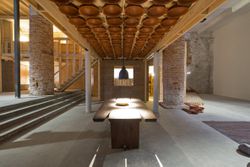
This lecture discusses a range of projects from Anupama Kundoo’s practice, research, and teaching. In these distinct but complementary areas of her work, she attempts to build collective knowledge in collaboration with engineers, masons, craftsmen, infrastructure providers, residents, material suppliers, and all other stakeholders involved in constructing and occupying(...)
This lecture discusses a range of projects from Anupama Kundoo’s practice, research, and teaching. In these distinct but complementary areas of her work, she attempts to build collective knowledge in collaboration with engineers, masons, craftsmen, infrastructure providers, residents, material suppliers, and all other stakeholders involved in constructing and occupying(...)
Location:
Paul-Desmarais Theatre
Paul-Desmarais Theatre
Date:
16 April 2015 , 6pm
16 April 2015 , 6pm
Title:
Building Knowledge
Actions:
Description:
This lecture discusses a range of projects from Anupama Kundoo’s practice, research, and teaching. In these distinct but complementary areas of her work, she attempts to build collective knowledge in collaboration with engineers, masons, craftsmen, infrastructure providers, residents, material suppliers, and all other stakeholders involved in constructing and occupying(...)
Building Knowledge
Actions:
Description:
This lecture discusses a range of projects from Anupama Kundoo’s practice, research, and teaching. In these distinct but complementary areas of her work, she attempts to build collective knowledge in collaboration with engineers, masons, craftsmen, infrastructure providers, residents, material suppliers, and all other stakeholders involved in constructing and occupying(...)
Form:
events
events
Date:
16 April 2015
6pm
16 April 2015
6pm
Location:
Paul-Desmarais Theatre
Paul-Desmarais Theatre
Form:
events
events

Actions:
Description:
Visiting scholar Adam Morton presents his research: Under capitalism, how is space organized in our everyday lives through the streets we walk, the monuments we visit, and the places where we meet? This talk presents the making of modern state space in Mexico through the perspective of a spatial political economy. It will draw on my ongoing research on the production of(...)
Visiting scholar Adam Morton presents his research: Under capitalism, how is space organized in our everyday lives through the streets we walk, the monuments we visit, and the places where we meet? This talk presents the making of modern state space in Mexico through the perspective of a spatial political economy. It will draw on my ongoing research on the production of(...)
Location:
Shaughnessy House
Shaughnessy House
Date:
22 June 2017, 6pm
22 June 2017, 6pm
Title:
Visiting Scholar Seminar: Adam Morton
Actions:
Description:
Visiting scholar Adam Morton presents his research: Under capitalism, how is space organized in our everyday lives through the streets we walk, the monuments we visit, and the places where we meet? This talk presents the making of modern state space in Mexico through the perspective of a spatial political economy. It will draw on my ongoing research on the production of(...)
Visiting Scholar Seminar: Adam Morton
Actions:
Description:
Visiting scholar Adam Morton presents his research: Under capitalism, how is space organized in our everyday lives through the streets we walk, the monuments we visit, and the places where we meet? This talk presents the making of modern state space in Mexico through the perspective of a spatial political economy. It will draw on my ongoing research on the production of(...)
Form:
events
events
Date:
22 June 2017
6pm
22 June 2017
6pm
Location:
Shaughnessy House
Shaughnessy House


