


1537 Results
Form:
books
books
Title:
In the swarm
In the swarm
Actions:
Price:
$18.95
(available to order)
Summary:
Digital communication and social media have taken over our lives. In this contrarian reflection on digitized life, Byung-Chul Han counters the cheerleaders for Twitter revolutions and Facebook activism by arguing that digital communication is in fact responsible for the disintegration of community and public space and is slowly eroding any possibility for real political(...)
$18.95
(available to order)
Summary:
Digital communication and social media have taken over our lives. In this contrarian reflection on digitized life, Byung-Chul Han counters the cheerleaders for Twitter revolutions and Facebook activism by arguing that digital communication is in fact responsible for the disintegration of community and public space and is slowly eroding any possibility for real political(...)
Title:
In the swarm
Actions:
Price:
$18.95
(available to order)
Summary:
Digital communication and social media have taken over our lives. In this contrarian reflection on digitized life, Byung-Chul Han counters the cheerleaders for Twitter revolutions and Facebook activism by arguing that digital communication is in fact responsible for the disintegration of community and public space and is slowly eroding any possibility for real political action and meaningful political discourse. In the predigital, analog era, by the time an angry letter to the editor had been composed, mailed, and received, the immediate agitation had passed. Today, digital communication enables instantaneous, impulsive reaction, meant to express and stir up outrage on the spot. “The shitstorm,” writes Han, ”represents an authentic phenomenon of digital communication.” Meanwhile, the public, the senders and receivers of these communications have become a digital swarm—not a mass, or a crowd, or Negri and Hardt’s antiquated notion of a “multitude,” but a set of isolated individuals incapable of forming a “we,” incapable of calling dominant power relations into question, incapable of formulating a future because of an obsession with the present. The digital swarm is a fragmented entity that can focus on individual persons only in order to make them an object of scandal. Han, one of the most widely read philosophers in Europe today, describes a society in which information has overrun thought, in which the same algorithms are employed by Facebook, the stock market, and the intelligence services. Democracy is under threat because digital communication has made freedom and control indistinguishable. Big Brother has been succeeded by Big Data.
In the swarm
Actions:
Price:
$18.95
(available to order)
Summary:
Digital communication and social media have taken over our lives. In this contrarian reflection on digitized life, Byung-Chul Han counters the cheerleaders for Twitter revolutions and Facebook activism by arguing that digital communication is in fact responsible for the disintegration of community and public space and is slowly eroding any possibility for real political action and meaningful political discourse. In the predigital, analog era, by the time an angry letter to the editor had been composed, mailed, and received, the immediate agitation had passed. Today, digital communication enables instantaneous, impulsive reaction, meant to express and stir up outrage on the spot. “The shitstorm,” writes Han, ”represents an authentic phenomenon of digital communication.” Meanwhile, the public, the senders and receivers of these communications have become a digital swarm—not a mass, or a crowd, or Negri and Hardt’s antiquated notion of a “multitude,” but a set of isolated individuals incapable of forming a “we,” incapable of calling dominant power relations into question, incapable of formulating a future because of an obsession with the present. The digital swarm is a fragmented entity that can focus on individual persons only in order to make them an object of scandal. Han, one of the most widely read philosophers in Europe today, describes a society in which information has overrun thought, in which the same algorithms are employed by Facebook, the stock market, and the intelligence services. Democracy is under threat because digital communication has made freedom and control indistinguishable. Big Brother has been succeeded by Big Data.
Form:
books
books
Publication:
April 2017
April 2017
Subject:
Archive, library and the digital
Archive, library and the digital
Form:
books
books
Actions:
Price:
$39.99
(available to order)
Summary:
Event-Cities 4 is the latest in the Event-Cities series from Bernard Tschumi, documenting recent built and theoretical projects in the context of his evolving views on architecture, urbanism, and design. Event-Cities 4 follows directly from the work of Event-Cities 3, which examined the interaction of architectural content, concept, and context. This volume takes the(...)
$39.99
(available to order)
Summary:
Event-Cities 4 is the latest in the Event-Cities series from Bernard Tschumi, documenting recent built and theoretical projects in the context of his evolving views on architecture, urbanism, and design. Event-Cities 4 follows directly from the work of Event-Cities 3, which examined the interaction of architectural content, concept, and context. This volume takes the(...)
Title:
Bernard Tschumi : event-cities 4, concept - form
Actions:
Price:
$39.99
(available to order)
Summary:
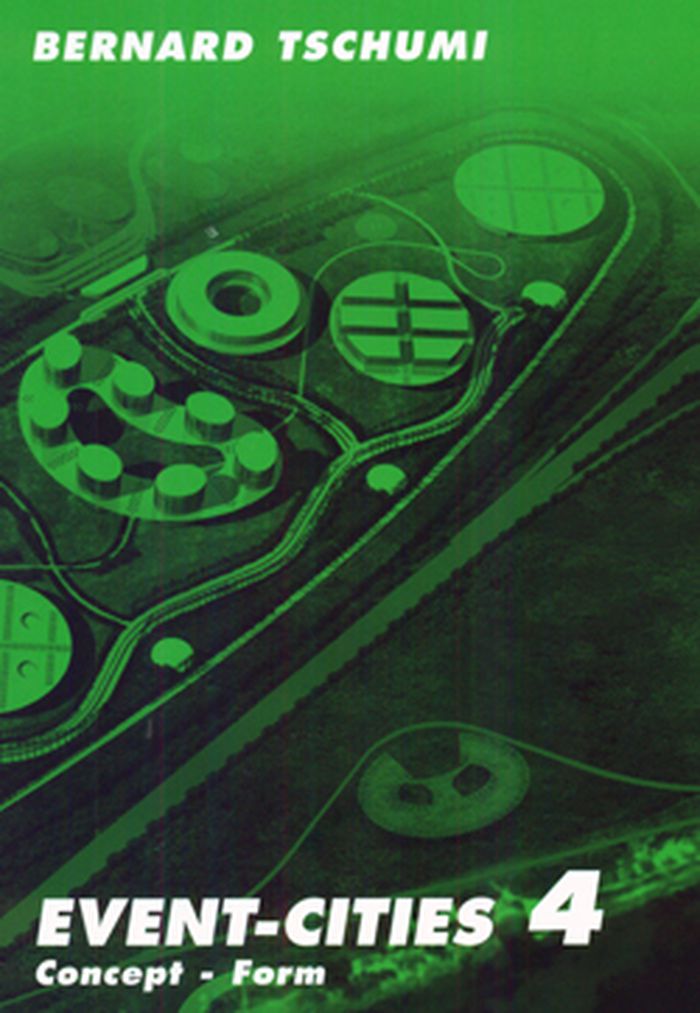
Event-Cities 4 is the latest in the Event-Cities series from Bernard Tschumi, documenting recent built and theoretical projects in the context of his evolving views on architecture, urbanism, and design. Event-Cities 4 follows directly from the work of Event-Cities 3, which examined the interaction of architectural content, concept, and context. This volume takes the interaction a step further, looking at a series of projects for which program or context are insufficient as a generative conceptual strategy, hence requiring a different approach. Tschumi has said, "Over the past years, there is one word I have almost never used, except in order to attack it: 'form.'" In Event-Cities 4, Tschumi introduces the "concept-form": a concept generating a form, or a form generating a concept, so that one reinforces the other. The concept may be programmatic, technological, or social. The form may be singular or multiple, regular or irregular. Concept-forms act as organizing devices or common denominators for the multiple dimensions of programs and their evolution over time, and drive the projects featured in this book. Highlights include master plans for a pair of media-based work spaces and cultural campuses in Singapore and Abu Dhabi; a major master plan for a financial center with 40,000 projected inhabitants in the Dominican Republic; the innovative Blue Residential Tower in New York City; a group of museums and cultural buildings in France, Abu Dhabi, Dubai, and South Korea; a pedestrian bridge in France; and a "multi-programmatic" furniture piece, the TypoLounger. The book contains more than twenty of the Tschumi firm's recent projects.
Bernard Tschumi : event-cities 4, concept - form
Actions:
Price:
$39.99
(available to order)
Summary:
Event-Cities 4 is the latest in the Event-Cities series from Bernard Tschumi, documenting recent built and theoretical projects in the context of his evolving views on architecture, urbanism, and design. Event-Cities 4 follows directly from the work of Event-Cities 3, which examined the interaction of architectural content, concept, and context. This volume takes the interaction a step further, looking at a series of projects for which program or context are insufficient as a generative conceptual strategy, hence requiring a different approach. Tschumi has said, "Over the past years, there is one word I have almost never used, except in order to attack it: 'form.'" In Event-Cities 4, Tschumi introduces the "concept-form": a concept generating a form, or a form generating a concept, so that one reinforces the other. The concept may be programmatic, technological, or social. The form may be singular or multiple, regular or irregular. Concept-forms act as organizing devices or common denominators for the multiple dimensions of programs and their evolution over time, and drive the projects featured in this book. Highlights include master plans for a pair of media-based work spaces and cultural campuses in Singapore and Abu Dhabi; a major master plan for a financial center with 40,000 projected inhabitants in the Dominican Republic; the innovative Blue Residential Tower in New York City; a group of museums and cultural buildings in France, Abu Dhabi, Dubai, and South Korea; a pedestrian bridge in France; and a "multi-programmatic" furniture piece, the TypoLounger. The book contains more than twenty of the Tschumi firm's recent projects.
Form:
books
books
Publication:
September 2010
September 2010
Subject:
Architecture Monographs
Architecture Monographs
Form:
books
books
Title:
The gray cloth
The gray cloth
Actions:
Price:
$44.95
(available to order)
Summary:
The German expressionist, architectural visionary, author, inventor, and artist Paul Scheerbart (1863-1915) wrote several fictional utopian narratives related to glass architecture. In "The Gray Cloth", the first of his novels to be translated into English, Scheerbart uses subtle irony and the structural simplicity of a fairy tale to present the theories of coloured glass(...)
$44.95
(available to order)
Summary:
The German expressionist, architectural visionary, author, inventor, and artist Paul Scheerbart (1863-1915) wrote several fictional utopian narratives related to glass architecture. In "The Gray Cloth", the first of his novels to be translated into English, Scheerbart uses subtle irony and the structural simplicity of a fairy tale to present the theories of coloured glass(...)
Title:
The gray cloth
Actions:
Price:
$44.95
(available to order)
Summary:
The German expressionist, architectural visionary, author, inventor, and artist Paul Scheerbart (1863-1915) wrote several fictional utopian narratives related to glass architecture. In "The Gray Cloth", the first of his novels to be translated into English, Scheerbart uses subtle irony and the structural simplicity of a fairy tale to present the theories of coloured glass outlined in his well-known treatise "Glass Architecture". The novel is set forward in time to the mid-twentieth century. The protagonist, a Swiss architect named Edgar Krug, circumnavigates the globe by airship with his wife, constructing wildly varied, colored-glass buildings. His projects include a high-rise and exhibition/concert hall in Chicago, a retirement complex for air pilots on the Fiji Islands, the structure for an elevated train across a zoological park in northern India, and a suspended residential villa on the Kuria Muria Islands off the coast of Oman in the Arabian Sea. Fearing that his architecture is challenged by the colourfulness of women’s clothing, Krug insists that his wife wear all gray clothing with the addition of ten percent white. This odd demand brings him notoriety and sensationalizes his international building campaign. For the reader, it underlines the confluence of architecture with fashion, gender, and global media. In his introduction John Stuart surveys Scheerbart’s career and role in German avant-garde circles, as well as his architectural and social ideas. He shows how Scheerbart strove to integrate his spiritual and romantic leanings with the modern world, often relying on glass architecture to do so. In addition to discussing the novel’s reception and its rediscovery by contemporary architects and critics, Stuart shows fiction to be a resource for the study of architecture and places "The Gray Cloth" in the context of German Expressionism.
The gray cloth
Actions:
Price:
$44.95
(available to order)
Summary:
The German expressionist, architectural visionary, author, inventor, and artist Paul Scheerbart (1863-1915) wrote several fictional utopian narratives related to glass architecture. In "The Gray Cloth", the first of his novels to be translated into English, Scheerbart uses subtle irony and the structural simplicity of a fairy tale to present the theories of coloured glass outlined in his well-known treatise "Glass Architecture". The novel is set forward in time to the mid-twentieth century. The protagonist, a Swiss architect named Edgar Krug, circumnavigates the globe by airship with his wife, constructing wildly varied, colored-glass buildings. His projects include a high-rise and exhibition/concert hall in Chicago, a retirement complex for air pilots on the Fiji Islands, the structure for an elevated train across a zoological park in northern India, and a suspended residential villa on the Kuria Muria Islands off the coast of Oman in the Arabian Sea. Fearing that his architecture is challenged by the colourfulness of women’s clothing, Krug insists that his wife wear all gray clothing with the addition of ten percent white. This odd demand brings him notoriety and sensationalizes his international building campaign. For the reader, it underlines the confluence of architecture with fashion, gender, and global media. In his introduction John Stuart surveys Scheerbart’s career and role in German avant-garde circles, as well as his architectural and social ideas. He shows how Scheerbart strove to integrate his spiritual and romantic leanings with the modern world, often relying on glass architecture to do so. In addition to discussing the novel’s reception and its rediscovery by contemporary architects and critics, Stuart shows fiction to be a resource for the study of architecture and places "The Gray Cloth" in the context of German Expressionism.
Form:
books
books
Publication:
October 2001, Cambridge, Mass.
October 2001, Cambridge, Mass.
Subject:
Architectural Theory
Architectural Theory
Form:
books
books
Title:
The gray cloth
The gray cloth
Actions:
Price:
$24.95
(available to order)
Summary:
The German expressionist, architectural visionary, author, inventor, and artist Paul Scheerbart (1863-1915) wrote several fictional utopian narratives related to glass architecture. In "The Gray Cloth", the first of his novels to be translated into English, Scheerbart uses subtle irony and the structural simplicity of a fairy tale to present the theories of coloured glass(...)
$24.95
(available to order)
Summary:
The German expressionist, architectural visionary, author, inventor, and artist Paul Scheerbart (1863-1915) wrote several fictional utopian narratives related to glass architecture. In "The Gray Cloth", the first of his novels to be translated into English, Scheerbart uses subtle irony and the structural simplicity of a fairy tale to present the theories of coloured glass(...)
Title:
The gray cloth
Actions:
Price:
$24.95
(available to order)
Summary:
The German expressionist, architectural visionary, author, inventor, and artist Paul Scheerbart (1863-1915) wrote several fictional utopian narratives related to glass architecture. In "The Gray Cloth", the first of his novels to be translated into English, Scheerbart uses subtle irony and the structural simplicity of a fairy tale to present the theories of coloured glass outlined in his well-known treatise "Glass Architecture". The novel is set forward in time to the mid-twentieth century. The protagonist, a Swiss architect named Edgar Krug, circumnavigates the globe by airship with his wife, constructing wildly varied, colored-glass buildings. His projects include a high-rise and exhibition/concert hall in Chicago, a retirement complex for air pilots on the Fiji Islands, the structure for an elevated train across a zoological park in northern India, and a suspended residential villa on the Kuria Muria Islands off the coast of Oman in the Arabian Sea. Fearing that his architecture is challenged by the colourfulness of women’s clothing, Krug insists that his wife wear all gray clothing with the addition of ten percent white. This odd demand brings him notoriety and sensationalizes his international building campaign. For the reader, it underlines the confluence of architecture with fashion, gender, and global media. In his introduction John Stuart surveys Scheerbart’s career and role in German avant-garde circles, as well as his architectural and social ideas. He shows how Scheerbart strove to integrate his spiritual and romantic leanings with the modern world, often relying on glass architecture to do so. In addition to discussing the novel’s reception and its rediscovery by contemporary architects and critics, Stuart shows fiction to be a resource for the study of architecture and places "The Gray Cloth" in the context of German Expressionism.
The gray cloth
Actions:
Price:
$24.95
(available to order)
Summary:
The German expressionist, architectural visionary, author, inventor, and artist Paul Scheerbart (1863-1915) wrote several fictional utopian narratives related to glass architecture. In "The Gray Cloth", the first of his novels to be translated into English, Scheerbart uses subtle irony and the structural simplicity of a fairy tale to present the theories of coloured glass outlined in his well-known treatise "Glass Architecture". The novel is set forward in time to the mid-twentieth century. The protagonist, a Swiss architect named Edgar Krug, circumnavigates the globe by airship with his wife, constructing wildly varied, colored-glass buildings. His projects include a high-rise and exhibition/concert hall in Chicago, a retirement complex for air pilots on the Fiji Islands, the structure for an elevated train across a zoological park in northern India, and a suspended residential villa on the Kuria Muria Islands off the coast of Oman in the Arabian Sea. Fearing that his architecture is challenged by the colourfulness of women’s clothing, Krug insists that his wife wear all gray clothing with the addition of ten percent white. This odd demand brings him notoriety and sensationalizes his international building campaign. For the reader, it underlines the confluence of architecture with fashion, gender, and global media. In his introduction John Stuart surveys Scheerbart’s career and role in German avant-garde circles, as well as his architectural and social ideas. He shows how Scheerbart strove to integrate his spiritual and romantic leanings with the modern world, often relying on glass architecture to do so. In addition to discussing the novel’s reception and its rediscovery by contemporary architects and critics, Stuart shows fiction to be a resource for the study of architecture and places "The Gray Cloth" in the context of German Expressionism.
Form:
books
books
Publication:
October 2003, Cambridge / London
October 2003, Cambridge / London
Subject:
Architectural Theory
Architectural Theory
Form:
books
books
Actions:
Price:
$22.99
(available to order)
Summary:
In 1923, a group of young radical German thinkers and intellectuals came together to at Victoria Alle 7, Frankfurt, determined to explain the workings of the modern world. Among the most prominent members of what became the Frankfurt School were the philosophers Walter Benjamin, Theodor Adorno, Max Horkheimer, and Herbert Marcuse. Not only would they change the way we(...)
$22.99
(available to order)
Summary:
In 1923, a group of young radical German thinkers and intellectuals came together to at Victoria Alle 7, Frankfurt, determined to explain the workings of the modern world. Among the most prominent members of what became the Frankfurt School were the philosophers Walter Benjamin, Theodor Adorno, Max Horkheimer, and Herbert Marcuse. Not only would they change the way we(...)
Title:
Grand Hotel Abyss: the lives of the Frankfurt school
Actions:
Price:
$22.99
(available to order)
Summary:
In 1923, a group of young radical German thinkers and intellectuals came together to at Victoria Alle 7, Frankfurt, determined to explain the workings of the modern world. Among the most prominent members of what became the Frankfurt School were the philosophers Walter Benjamin, Theodor Adorno, Max Horkheimer, and Herbert Marcuse. Not only would they change the way we think, but also the subjects we deem worthy of intellectual investigation. Their lives, like their ideas, profoundly, sometimes tragically, reflected and shaped the shattering events of the twentieth century. "Grand Hotel Abyss" combines biography, philosophy, and storytelling to reveal how the Frankfurt thinkers gathered in hopes of understanding the politics of culture during the rise of fascism. Some of them, forced to escape the horrors of Nazi Germany, later found exile in the United States. Benjamin, with his last great work—the incomplete Arcades Project—in his suitcase, was arrested in Spain and committed suicide when threatened with deportation to Nazi-occupied France. On the other side of the Atlantic, Adorno failed in his bid to become a Hollywood screenwriter, denounced jazz, and even met Charlie Chaplin in Malibu. After the war, there was a resurgence of interest in the School. From the relative comfort of sun-drenched California, Herbert Marcuse wrote the classic One Dimensional Man, which influenced the 1960s counterculture and thinkers such as Angela Davis; while in a tragic coda, Adorno died from a heart attack following confrontations with student radicals in Berlin. By taking popular culture seriously as an object of study—whether it was film, music, ideas, or consumerism—the Frankfurt School elaborated upon the nature and crisis of our mass-produced, mechanised society. Grand Hotel Abyss shows how much these ideas still tell us about our age of social media and runaway consumption.
Grand Hotel Abyss: the lives of the Frankfurt school
Actions:
Price:
$22.99
(available to order)
Summary:
In 1923, a group of young radical German thinkers and intellectuals came together to at Victoria Alle 7, Frankfurt, determined to explain the workings of the modern world. Among the most prominent members of what became the Frankfurt School were the philosophers Walter Benjamin, Theodor Adorno, Max Horkheimer, and Herbert Marcuse. Not only would they change the way we think, but also the subjects we deem worthy of intellectual investigation. Their lives, like their ideas, profoundly, sometimes tragically, reflected and shaped the shattering events of the twentieth century. "Grand Hotel Abyss" combines biography, philosophy, and storytelling to reveal how the Frankfurt thinkers gathered in hopes of understanding the politics of culture during the rise of fascism. Some of them, forced to escape the horrors of Nazi Germany, later found exile in the United States. Benjamin, with his last great work—the incomplete Arcades Project—in his suitcase, was arrested in Spain and committed suicide when threatened with deportation to Nazi-occupied France. On the other side of the Atlantic, Adorno failed in his bid to become a Hollywood screenwriter, denounced jazz, and even met Charlie Chaplin in Malibu. After the war, there was a resurgence of interest in the School. From the relative comfort of sun-drenched California, Herbert Marcuse wrote the classic One Dimensional Man, which influenced the 1960s counterculture and thinkers such as Angela Davis; while in a tragic coda, Adorno died from a heart attack following confrontations with student radicals in Berlin. By taking popular culture seriously as an object of study—whether it was film, music, ideas, or consumerism—the Frankfurt School elaborated upon the nature and crisis of our mass-produced, mechanised society. Grand Hotel Abyss shows how much these ideas still tell us about our age of social media and runaway consumption.
Form:
books
books
Publication:
September 2017
September 2017
Subject:
Critical Theory
Critical Theory
Form:
books
books
Actions:
Price:
$49.95
(available to order)
Summary:
"The great purpose of landscape art is to make us at home in our own country" was the nationalist maxim motivating the Group of Seven's artistic project. The empty landscape paintings of the Group played a significant role in the nationalization of nature in Canada, particularly in the development of ideas about northernness, wilderness, and identity. In this book, John(...)
$49.95
(available to order)
Summary:
"The great purpose of landscape art is to make us at home in our own country" was the nationalist maxim motivating the Group of Seven's artistic project. The empty landscape paintings of the Group played a significant role in the nationalization of nature in Canada, particularly in the development of ideas about northernness, wilderness, and identity. In this book, John(...)
Subject:
Architecture in Canada
Architecture in Canada
Publication:
September 2007, Montreal Kingston
September 2007, Montreal Kingston
Title:
Beyond wilderness : The group of seven, Canadian identity, and contemporary art
Actions:
Price:
$49.95
(available to order)
Summary:
"The great purpose of landscape art is to make us at home in our own country" was the nationalist maxim motivating the Group of Seven's artistic project. The empty landscape paintings of the Group played a significant role in the nationalization of nature in Canada, particularly in the development of ideas about northernness, wilderness, and identity. In this book, John O'Brian and Peter White pick up where the Group of Seven left off. They demonstrate that since the 1960s a growing body of both art and critical writing has looked "beyond wilderness" to re-imagine landscape in a world of vastly altered political, technological, and environmental circumstances. By emphasizing social relationships, changing identity politics, and issues of colonial power and dispossession contemporary artists have produced landscape art that explores what was absent in the work of their predecessors. Beyond Wilderness expands the public understanding of Canadian landscape representation, tracing debates about the place of landscape in Canadian art and the national imagination through the twentieth century to the present. Critical writings from both contemporary and historically significant curators, historians, feminists, media theorists, and cultural critics and exactingly reproduced artworks by contemporary and historical artists are brought together in productive dialogue. Beyond Wilderness explains why landscape art in Canada had to be reinvented, and what forms the reinvention took. Contributors include Benedict Anderson (Cornell), Grant Arnold (Vancouver Art Gallery). Rebecca Belmore, Jody Berland (York), Eleanor Bond (Concordia), Jonathan Bordo (Trent), Douglas Cole, Marlene Creates, Marcia Crosby (Malaspina), Greg Curnoe, Ann Davis (Nickle Arts Museum), Leslie Dawn (Lethbridge), Shawna Dempsey, Christos Dikeakos, Peter Doig, Rosemary Donegan (OCAD), Stan Douglas, Paterson Ewen, Robert Fones, Northrop Frye, Robert Fulford, General Idea, Rodney Graham, Reesa Greenberg, Gu Xiong (British Columbia), Cole Harris (British Columbia), Richard William Hill (Middlesex), Robert Houle, Andrew Hunter (Waterloo), Lynda Jessup (Queen's), Zacharias Kunuk (Igloolik Isuma Productions), Johanne Lamoureux (Montréal), Robert Linsley (Waterloo), Barry Lord (Lord Cultural Resources), Marshall McLuhan, Mike MacDonald, Liz Magor (ECIAD), Lorri Millan, Gerta Moray (Guelph), Roald Nasgaard (Florida State), N.E. Thing Company, Carol Payne (Carleton), Edward Poitras, Dennis Reid (Art Gallery of Ontario), Michel Saulnier, Nancy Shaw (Simon Fraser), Johanne Sloan (Concordia), Michael Snow, Robert Stacey, David Thauberger, Loretta Todd, Esther Trépanier (Québec), Dot Tuer (OCAD), Christopher Varley, Jeff Wall, Paul H. Walton (McMaster), Mel Watkins (Toronto), Scott Watson (British Columbia), Anne Whitelaw (Alberta), Joyce Wieland, Jin-me Yoon (Simon Fraser), Lawrence Paul Yuxweluptun, and Joyce Zemans (York).
Beyond wilderness : The group of seven, Canadian identity, and contemporary art
Actions:
Price:
$49.95
(available to order)
Summary:
"The great purpose of landscape art is to make us at home in our own country" was the nationalist maxim motivating the Group of Seven's artistic project. The empty landscape paintings of the Group played a significant role in the nationalization of nature in Canada, particularly in the development of ideas about northernness, wilderness, and identity. In this book, John O'Brian and Peter White pick up where the Group of Seven left off. They demonstrate that since the 1960s a growing body of both art and critical writing has looked "beyond wilderness" to re-imagine landscape in a world of vastly altered political, technological, and environmental circumstances. By emphasizing social relationships, changing identity politics, and issues of colonial power and dispossession contemporary artists have produced landscape art that explores what was absent in the work of their predecessors. Beyond Wilderness expands the public understanding of Canadian landscape representation, tracing debates about the place of landscape in Canadian art and the national imagination through the twentieth century to the present. Critical writings from both contemporary and historically significant curators, historians, feminists, media theorists, and cultural critics and exactingly reproduced artworks by contemporary and historical artists are brought together in productive dialogue. Beyond Wilderness explains why landscape art in Canada had to be reinvented, and what forms the reinvention took. Contributors include Benedict Anderson (Cornell), Grant Arnold (Vancouver Art Gallery). Rebecca Belmore, Jody Berland (York), Eleanor Bond (Concordia), Jonathan Bordo (Trent), Douglas Cole, Marlene Creates, Marcia Crosby (Malaspina), Greg Curnoe, Ann Davis (Nickle Arts Museum), Leslie Dawn (Lethbridge), Shawna Dempsey, Christos Dikeakos, Peter Doig, Rosemary Donegan (OCAD), Stan Douglas, Paterson Ewen, Robert Fones, Northrop Frye, Robert Fulford, General Idea, Rodney Graham, Reesa Greenberg, Gu Xiong (British Columbia), Cole Harris (British Columbia), Richard William Hill (Middlesex), Robert Houle, Andrew Hunter (Waterloo), Lynda Jessup (Queen's), Zacharias Kunuk (Igloolik Isuma Productions), Johanne Lamoureux (Montréal), Robert Linsley (Waterloo), Barry Lord (Lord Cultural Resources), Marshall McLuhan, Mike MacDonald, Liz Magor (ECIAD), Lorri Millan, Gerta Moray (Guelph), Roald Nasgaard (Florida State), N.E. Thing Company, Carol Payne (Carleton), Edward Poitras, Dennis Reid (Art Gallery of Ontario), Michel Saulnier, Nancy Shaw (Simon Fraser), Johanne Sloan (Concordia), Michael Snow, Robert Stacey, David Thauberger, Loretta Todd, Esther Trépanier (Québec), Dot Tuer (OCAD), Christopher Varley, Jeff Wall, Paul H. Walton (McMaster), Mel Watkins (Toronto), Scott Watson (British Columbia), Anne Whitelaw (Alberta), Joyce Wieland, Jin-me Yoon (Simon Fraser), Lawrence Paul Yuxweluptun, and Joyce Zemans (York).
Form:
books
books
Publication:
September 2007, Montreal Kingston
September 2007, Montreal Kingston
Subject:
Architecture in Canada
Architecture in Canada
Form:
audio
audio
Description:
1 online resource.
Author:
Subject:
Publication:
[Place of publication not identified] : Lateral Addition, 2018.
[Place of publication not identified] : Lateral Addition, 2018.
Title:
June 21, 2018 : Listening for Southwest Key in San Diego.
Actions:
Description:
1 online resource.
June 21, 2018 : Listening for Southwest Key in San Diego.
Actions:
Description:
1 online resource.
Form:
audio
audio
Publication:
[Place of publication not identified] : Lateral Addition, 2018.
[Place of publication not identified] : Lateral Addition, 2018.
Author:
Subject:


