


890 Results
Form:
archives
Level of archival description:
Collection
archives
Level of archival description:
Collection
Title:
Kiran Mukerji Collection
Kiran Mukerji Collection
Actions:
Reference number:
CD038
Synopsis:
The Kiran Mukerji collection contains Kiran Mukerji’s research material on building and design technologies for affordable housing, which consists mostly of publications, and a few textual records the Institut für Tropenbau (Institute for Tropical Building).
CD038
Synopsis:
The Kiran Mukerji collection contains Kiran Mukerji’s research material on building and design technologies for affordable housing, which consists mostly of publications, and a few textual records the Institut für Tropenbau (Institute for Tropical Building).
People:
Date:
1972-2013
1972-2013
Title:
Kiran Mukerji Collection
Actions:
CD038
Synopsis:
The Kiran Mukerji collection contains Kiran Mukerji’s research material on building and design technologies for affordable housing, which consists mostly of publications, and a few textual records the Institut für Tropenbau (Institute for Tropical Building).
Kiran Mukerji Collection
Actions:
CD038
Synopsis:
The Kiran Mukerji collection contains Kiran Mukerji’s research material on building and design technologies for affordable housing, which consists mostly of publications, and a few textual records the Institut für Tropenbau (Institute for Tropical Building).
Form:
archives
Level of archival description:
Collection
archives
Level of archival description:
Collection
Date:
1972-2013
1972-2013
People:
Form:
events
events

Actions:
Description:
Join us on Thursday 1 August as Ignacio G. Galan explores the activist designs developed within this context by disabled individuals in their own spaces of residence. Through select objects from the CCA Collection Ignacio G. Galán will situate the Center of Independent Living’s transformations of the household in relation to shifting discourses and paradigms of(...)
Join us on Thursday 1 August as Ignacio G. Galan explores the activist designs developed within this context by disabled individuals in their own spaces of residence. Through select objects from the CCA Collection Ignacio G. Galán will situate the Center of Independent Living’s transformations of the household in relation to shifting discourses and paradigms of(...)
Date:
1 August 2024, 6pm
1 August 2024, 6pm
Title:
Research Fellow Seminar: Ignacio G. Galán
Actions:
Description:
Join us on Thursday 1 August as Ignacio G. Galan explores the activist designs developed within this context by disabled individuals in their own spaces of residence. Through select objects from the CCA Collection Ignacio G. Galán will situate the Center of Independent Living’s transformations of the household in relation to shifting discourses and paradigms of(...)
Research Fellow Seminar: Ignacio G. Galán
Actions:
Description:
Join us on Thursday 1 August as Ignacio G. Galan explores the activist designs developed within this context by disabled individuals in their own spaces of residence. Through select objects from the CCA Collection Ignacio G. Galán will situate the Center of Independent Living’s transformations of the household in relation to shifting discourses and paradigms of(...)
Form:
events
events
Date:
1 August 2024
6pm
1 August 2024
6pm
Level of archival description:
Project
Project
Reference number:
AP148.S1.1970.PR02
Description:
The project series documents Poli's work on the Interplanetary Architecture project, which was also made into a film by Superstudio directed by Alessandro Poli (the film is not included in the fonds). The project reflects Poli's deep fascination with the moon landing in 1969. Poli uses this major media event as a catalyst for thinking about a new approach to architecture and tools for design, including the idea that film and the movie camera should become part of the toolset. The project also seems to be in some way a response to Epoch magazine's challenge for a "Primo concorso di architettura nello spazio" (the first architectural competition in space), and includes much imagery and textual references to a new road or architectural links between the earth and other planets, including an earth moon highway. In his storyboard, Poli also makes reference to his earlier Piper project, and some imagery features wheels and an amusement park. The Interplanetary Architecture project was exhibited by Superstudio in Rome in 1972 and featured in "Casabella" magazine in April 1972 (no. 364). The project was also featured in the 2010 CCA exhibition "Other Space Odysseys". In the accompanying CCA publication, Poli describes this project as "a voyage off earthbound routes in quest of architecture unfettered by the urban nightmare, by induced needs or by planning as the only tool for regulating and solving the world's problems" (Poli quoted in Borasi and Zardini, 2010, 110). Poli's work on this project is deeply tied to the Zeno project, which was also featured in this exhibition and is included in this fonds (see AP148.S1.1972.PR01). For the Zeno project, Poli envisioned a dialogue between astronaut Buzz Aldrin and an Italian peasant, Zeno of Riparbella. Poli felt that these two shared a similarity in that both their homes were isolated capsules, one that provided a lens from which to see the rest of the world and understand their place in it. The material in the series includes numerous photomontages and collages of astronauts in space, as well as drawings of plantery shapes and structures. There are also texts, some of which include calculations of distances and diameters of planets, as well as notebooks and sketchbooks, many of which Poli included in a folder he entitled "Storyboard." The series also includes an unsent letter from Poli to Adolfo Natalini which describes how, after the moon landing, everything - the planet, the moon, the stars - is architecture, and that this will necessitate the need for new design tools, such as the movie camera. Some works are signed Alessandro Poli-Superstudio. Source cited: Giovanna Borasi and Mirko Zardini, eds., Other Space Odysseys, Montreal and Baden: Canadian Centre for Architecture/Lars Müller Publishers, 2010.
AP148.S1.1970.PR02
Description:
The project series documents Poli's work on the Interplanetary Architecture project, which was also made into a film by Superstudio directed by Alessandro Poli (the film is not included in the fonds). The project reflects Poli's deep fascination with the moon landing in 1969. Poli uses this major media event as a catalyst for thinking about a new approach to architecture and tools for design, including the idea that film and the movie camera should become part of the toolset. The project also seems to be in some way a response to Epoch magazine's challenge for a "Primo concorso di architettura nello spazio" (the first architectural competition in space), and includes much imagery and textual references to a new road or architectural links between the earth and other planets, including an earth moon highway. In his storyboard, Poli also makes reference to his earlier Piper project, and some imagery features wheels and an amusement park. The Interplanetary Architecture project was exhibited by Superstudio in Rome in 1972 and featured in "Casabella" magazine in April 1972 (no. 364). The project was also featured in the 2010 CCA exhibition "Other Space Odysseys". In the accompanying CCA publication, Poli describes this project as "a voyage off earthbound routes in quest of architecture unfettered by the urban nightmare, by induced needs or by planning as the only tool for regulating and solving the world's problems" (Poli quoted in Borasi and Zardini, 2010, 110). Poli's work on this project is deeply tied to the Zeno project, which was also featured in this exhibition and is included in this fonds (see AP148.S1.1972.PR01). For the Zeno project, Poli envisioned a dialogue between astronaut Buzz Aldrin and an Italian peasant, Zeno of Riparbella. Poli felt that these two shared a similarity in that both their homes were isolated capsules, one that provided a lens from which to see the rest of the world and understand their place in it. The material in the series includes numerous photomontages and collages of astronauts in space, as well as drawings of plantery shapes and structures. There are also texts, some of which include calculations of distances and diameters of planets, as well as notebooks and sketchbooks, many of which Poli included in a folder he entitled "Storyboard." The series also includes an unsent letter from Poli to Adolfo Natalini which describes how, after the moon landing, everything - the planet, the moon, the stars - is architecture, and that this will necessitate the need for new design tools, such as the movie camera. Some works are signed Alessandro Poli-Superstudio. Source cited: Giovanna Borasi and Mirko Zardini, eds., Other Space Odysseys, Montreal and Baden: Canadian Centre for Architecture/Lars Müller Publishers, 2010.
People:
Date:
1969-1971
1969-1971
Title:
Architettura Interplanetaria [Interplanetary Architecture] (1970-1971)
Actions:
AP148.S1.1970.PR02
Description:
The project series documents Poli's work on the Interplanetary Architecture project, which was also made into a film by Superstudio directed by Alessandro Poli (the film is not included in the fonds). The project reflects Poli's deep fascination with the moon landing in 1969. Poli uses this major media event as a catalyst for thinking about a new approach to architecture and tools for design, including the idea that film and the movie camera should become part of the toolset. The project also seems to be in some way a response to Epoch magazine's challenge for a "Primo concorso di architettura nello spazio" (the first architectural competition in space), and includes much imagery and textual references to a new road or architectural links between the earth and other planets, including an earth moon highway. In his storyboard, Poli also makes reference to his earlier Piper project, and some imagery features wheels and an amusement park. The Interplanetary Architecture project was exhibited by Superstudio in Rome in 1972 and featured in "Casabella" magazine in April 1972 (no. 364). The project was also featured in the 2010 CCA exhibition "Other Space Odysseys". In the accompanying CCA publication, Poli describes this project as "a voyage off earthbound routes in quest of architecture unfettered by the urban nightmare, by induced needs or by planning as the only tool for regulating and solving the world's problems" (Poli quoted in Borasi and Zardini, 2010, 110). Poli's work on this project is deeply tied to the Zeno project, which was also featured in this exhibition and is included in this fonds (see AP148.S1.1972.PR01). For the Zeno project, Poli envisioned a dialogue between astronaut Buzz Aldrin and an Italian peasant, Zeno of Riparbella. Poli felt that these two shared a similarity in that both their homes were isolated capsules, one that provided a lens from which to see the rest of the world and understand their place in it. The material in the series includes numerous photomontages and collages of astronauts in space, as well as drawings of plantery shapes and structures. There are also texts, some of which include calculations of distances and diameters of planets, as well as notebooks and sketchbooks, many of which Poli included in a folder he entitled "Storyboard." The series also includes an unsent letter from Poli to Adolfo Natalini which describes how, after the moon landing, everything - the planet, the moon, the stars - is architecture, and that this will necessitate the need for new design tools, such as the movie camera. Some works are signed Alessandro Poli-Superstudio. Source cited: Giovanna Borasi and Mirko Zardini, eds., Other Space Odysseys, Montreal and Baden: Canadian Centre for Architecture/Lars Müller Publishers, 2010.
Architettura Interplanetaria [Interplanetary Architecture] (1970-1971)
Actions:
AP148.S1.1970.PR02
Description:
The project series documents Poli's work on the Interplanetary Architecture project, which was also made into a film by Superstudio directed by Alessandro Poli (the film is not included in the fonds). The project reflects Poli's deep fascination with the moon landing in 1969. Poli uses this major media event as a catalyst for thinking about a new approach to architecture and tools for design, including the idea that film and the movie camera should become part of the toolset. The project also seems to be in some way a response to Epoch magazine's challenge for a "Primo concorso di architettura nello spazio" (the first architectural competition in space), and includes much imagery and textual references to a new road or architectural links between the earth and other planets, including an earth moon highway. In his storyboard, Poli also makes reference to his earlier Piper project, and some imagery features wheels and an amusement park. The Interplanetary Architecture project was exhibited by Superstudio in Rome in 1972 and featured in "Casabella" magazine in April 1972 (no. 364). The project was also featured in the 2010 CCA exhibition "Other Space Odysseys". In the accompanying CCA publication, Poli describes this project as "a voyage off earthbound routes in quest of architecture unfettered by the urban nightmare, by induced needs or by planning as the only tool for regulating and solving the world's problems" (Poli quoted in Borasi and Zardini, 2010, 110). Poli's work on this project is deeply tied to the Zeno project, which was also featured in this exhibition and is included in this fonds (see AP148.S1.1972.PR01). For the Zeno project, Poli envisioned a dialogue between astronaut Buzz Aldrin and an Italian peasant, Zeno of Riparbella. Poli felt that these two shared a similarity in that both their homes were isolated capsules, one that provided a lens from which to see the rest of the world and understand their place in it. The material in the series includes numerous photomontages and collages of astronauts in space, as well as drawings of plantery shapes and structures. There are also texts, some of which include calculations of distances and diameters of planets, as well as notebooks and sketchbooks, many of which Poli included in a folder he entitled "Storyboard." The series also includes an unsent letter from Poli to Adolfo Natalini which describes how, after the moon landing, everything - the planet, the moon, the stars - is architecture, and that this will necessitate the need for new design tools, such as the movie camera. Some works are signed Alessandro Poli-Superstudio. Source cited: Giovanna Borasi and Mirko Zardini, eds., Other Space Odysseys, Montreal and Baden: Canadian Centre for Architecture/Lars Müller Publishers, 2010.
Level of archival description:
Project
Project
Date:
1969-1971
1969-1971
People:
Form:
archives
Level of archival description:
Fonds
archives
Level of archival description:
Fonds
Title:
Ábalos & Herreros fonds
Ábalos & Herreros fonds
Reference number:
AP164
Synopsis:
The Ábalos&Herreros fonds documents the activities of the architectural firm Ábalos&Herreros, founded by architects Iñaki Ábalos and Juan Herreros. The archive primarily consists of drawings, photographic materials and textual documentation, and covers the existance of the firm from 1985 to 2008. The concentration of the firm's work was produced in the city of Madrid and the Community of Madrid where the firm maintained its head office. However, the archive also documents projects for other Spanish autonomous communities as well as for other countries such as Portugal, Germany, the United States, and Brazil.
AP164
Synopsis:
The Ábalos&Herreros fonds documents the activities of the architectural firm Ábalos&Herreros, founded by architects Iñaki Ábalos and Juan Herreros. The archive primarily consists of drawings, photographic materials and textual documentation, and covers the existance of the firm from 1985 to 2008. The concentration of the firm's work was produced in the city of Madrid and the Community of Madrid where the firm maintained its head office. However, the archive also documents projects for other Spanish autonomous communities as well as for other countries such as Portugal, Germany, the United States, and Brazil.
People:
Date:
1920-2009
1920-2009
Title:
Ábalos & Herreros fonds
Actions:
AP164
Synopsis:
The Ábalos&Herreros fonds documents the activities of the architectural firm Ábalos&Herreros, founded by architects Iñaki Ábalos and Juan Herreros. The archive primarily consists of drawings, photographic materials and textual documentation, and covers the existance of the firm from 1985 to 2008. The concentration of the firm's work was produced in the city of Madrid and the Community of Madrid where the firm maintained its head office. However, the archive also documents projects for other Spanish autonomous communities as well as for other countries such as Portugal, Germany, the United States, and Brazil.
Ábalos & Herreros fonds
Actions:
AP164
Synopsis:
The Ábalos&Herreros fonds documents the activities of the architectural firm Ábalos&Herreros, founded by architects Iñaki Ábalos and Juan Herreros. The archive primarily consists of drawings, photographic materials and textual documentation, and covers the existance of the firm from 1985 to 2008. The concentration of the firm's work was produced in the city of Madrid and the Community of Madrid where the firm maintained its head office. However, the archive also documents projects for other Spanish autonomous communities as well as for other countries such as Portugal, Germany, the United States, and Brazil.
Form:
archives
Level of archival description:
Fonds
archives
Level of archival description:
Fonds
Date:
1920-2009
1920-2009
People:
Form:
archives
Level of archival description:
Fonds
archives
Level of archival description:
Fonds
Reference number:
AP170
Synopsis:
The Mark Goulthorpe HypoSurface project records, 1990-2014, document the design development, technical implementation, exhibition, and marketing of various iterations of the HypoSurface wall. The wall has a “skin” divided up into pixel-like metallic facets manipulated by a network of actuating pistons in order to create images, texts and patterns in dynamic relief. Sensors allow people near the wall to influence its movement. The records include approximately 62,700 digital files, 3 folders of textual documents, and 44 prototype pieces, and a working HypoSurface wall module.
AP170
Synopsis:
The Mark Goulthorpe HypoSurface project records, 1990-2014, document the design development, technical implementation, exhibition, and marketing of various iterations of the HypoSurface wall. The wall has a “skin” divided up into pixel-like metallic facets manipulated by a network of actuating pistons in order to create images, texts and patterns in dynamic relief. Sensors allow people near the wall to influence its movement. The records include approximately 62,700 digital files, 3 folders of textual documents, and 44 prototype pieces, and a working HypoSurface wall module.
People:
Date:
1990 - 2014
1990 - 2014
Title:
Mark Goulthorpe Hyposurface project records
Actions:
AP170
Synopsis:
The Mark Goulthorpe HypoSurface project records, 1990-2014, document the design development, technical implementation, exhibition, and marketing of various iterations of the HypoSurface wall. The wall has a “skin” divided up into pixel-like metallic facets manipulated by a network of actuating pistons in order to create images, texts and patterns in dynamic relief. Sensors allow people near the wall to influence its movement. The records include approximately 62,700 digital files, 3 folders of textual documents, and 44 prototype pieces, and a working HypoSurface wall module.
Mark Goulthorpe Hyposurface project records
Actions:
AP170
Synopsis:
The Mark Goulthorpe HypoSurface project records, 1990-2014, document the design development, technical implementation, exhibition, and marketing of various iterations of the HypoSurface wall. The wall has a “skin” divided up into pixel-like metallic facets manipulated by a network of actuating pistons in order to create images, texts and patterns in dynamic relief. Sensors allow people near the wall to influence its movement. The records include approximately 62,700 digital files, 3 folders of textual documents, and 44 prototype pieces, and a working HypoSurface wall module.
Form:
archives
Level of archival description:
Fonds
archives
Level of archival description:
Fonds
Date:
1990 - 2014
1990 - 2014
People:
Level of archival description:
Series
Series
Reference number:
AP119.S1
Description:
The series contains drawings for Peter Yeadon's architectural narrative for the Prix de Rome entitled "Karl: An Architerctural Narrative." In total eleven sets of digital prints were made, each set contains eighteen sheets. Canadian Centre for Architecture received the third of these eleven sets, which is included in this series. The narrative depicts the experience of a Canadian emigrant becoming a Roman citizen. The drawings represent the following titles: City; Fabric House; Columbarium; Horizon House; House City; Depth House; Colosseum for Vanishing Curiosities; City Gate; Teatro de Tevere; Neptune House; Bath; and Bricolage House. Each drawing is signed by the architect. Also included, are four sketchbooks for 'Karl: An Architerctural Narrative', two print proofs for Bricolage House, and project documentation. The documentation explains each of the titles in the narrative, Yeadon's curriculum vitae, and leaflets for the exhibition "Karl: an architectural narrative" held at the Art Gallery of Windsor, Ontario from August 2001 to January 2002.
AP119.S1
Description:
The series contains drawings for Peter Yeadon's architectural narrative for the Prix de Rome entitled "Karl: An Architerctural Narrative." In total eleven sets of digital prints were made, each set contains eighteen sheets. Canadian Centre for Architecture received the third of these eleven sets, which is included in this series. The narrative depicts the experience of a Canadian emigrant becoming a Roman citizen. The drawings represent the following titles: City; Fabric House; Columbarium; Horizon House; House City; Depth House; Colosseum for Vanishing Curiosities; City Gate; Teatro de Tevere; Neptune House; Bath; and Bricolage House. Each drawing is signed by the architect. Also included, are four sketchbooks for 'Karl: An Architerctural Narrative', two print proofs for Bricolage House, and project documentation. The documentation explains each of the titles in the narrative, Yeadon's curriculum vitae, and leaflets for the exhibition "Karl: an architectural narrative" held at the Art Gallery of Windsor, Ontario from August 2001 to January 2002.
People:
Date:
1998-2002
1998-2002
Title:
Karl: An Architectural Narrative (2000-2002)
Actions:
AP119.S1
Description:
The series contains drawings for Peter Yeadon's architectural narrative for the Prix de Rome entitled "Karl: An Architerctural Narrative." In total eleven sets of digital prints were made, each set contains eighteen sheets. Canadian Centre for Architecture received the third of these eleven sets, which is included in this series. The narrative depicts the experience of a Canadian emigrant becoming a Roman citizen. The drawings represent the following titles: City; Fabric House; Columbarium; Horizon House; House City; Depth House; Colosseum for Vanishing Curiosities; City Gate; Teatro de Tevere; Neptune House; Bath; and Bricolage House. Each drawing is signed by the architect. Also included, are four sketchbooks for 'Karl: An Architerctural Narrative', two print proofs for Bricolage House, and project documentation. The documentation explains each of the titles in the narrative, Yeadon's curriculum vitae, and leaflets for the exhibition "Karl: an architectural narrative" held at the Art Gallery of Windsor, Ontario from August 2001 to January 2002.
Karl: An Architectural Narrative (2000-2002)
Actions:
AP119.S1
Description:
The series contains drawings for Peter Yeadon's architectural narrative for the Prix de Rome entitled "Karl: An Architerctural Narrative." In total eleven sets of digital prints were made, each set contains eighteen sheets. Canadian Centre for Architecture received the third of these eleven sets, which is included in this series. The narrative depicts the experience of a Canadian emigrant becoming a Roman citizen. The drawings represent the following titles: City; Fabric House; Columbarium; Horizon House; House City; Depth House; Colosseum for Vanishing Curiosities; City Gate; Teatro de Tevere; Neptune House; Bath; and Bricolage House. Each drawing is signed by the architect. Also included, are four sketchbooks for 'Karl: An Architerctural Narrative', two print proofs for Bricolage House, and project documentation. The documentation explains each of the titles in the narrative, Yeadon's curriculum vitae, and leaflets for the exhibition "Karl: an architectural narrative" held at the Art Gallery of Windsor, Ontario from August 2001 to January 2002.
Level of archival description:
Series
Series
Date:
1998-2002
1998-2002
People:
Form:
drawings
drawings
Actions:
Reference number:
DR1988:0389
Description:
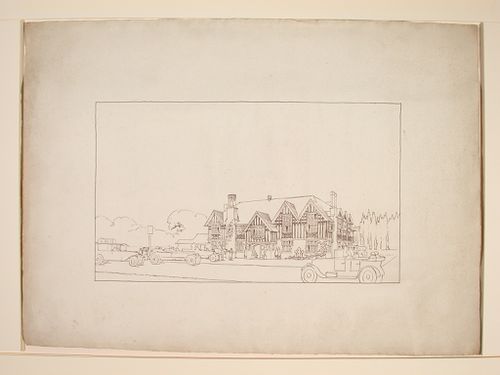
- This rendering shows the project for the Railway Hotel, Pitsea, from across the street, with the inn surrounded by cars and people. - The style of many of these drawings and reprographic copies by Henry Hyams (DR1988:0332 - DR1988:0414) suggests that they were possibly for periodical illustrations. Hyams contributed articles to the periodicals 'The Builder' and 'The Architect'. Two objects in the CCA collections can be linked to the article "Music in Stone" published prior to 1926 in 'The Architect'; a reprographic copy (DR1988:0357) and a drawing (DR1988:0364) (Who's Who in Architecture, 161).
DR1988:0389
Description:
- This rendering shows the project for the Railway Hotel, Pitsea, from across the street, with the inn surrounded by cars and people. - The style of many of these drawings and reprographic copies by Henry Hyams (DR1988:0332 - DR1988:0414) suggests that they were possibly for periodical illustrations. Hyams contributed articles to the periodicals 'The Builder' and 'The Architect'. Two objects in the CCA collections can be linked to the article "Music in Stone" published prior to 1926 in 'The Architect'; a reprographic copy (DR1988:0357) and a drawing (DR1988:0364) (Who's Who in Architecture, 161).
People:
Subject:
architecture
architecture
Date:
printed after 1934
printed after 1934
Title:
Perspectival view showing the Railway Hotel, Pitsea
Actions:
DR1988:0389
Description:
- This rendering shows the project for the Railway Hotel, Pitsea, from across the street, with the inn surrounded by cars and people. - The style of many of these drawings and reprographic copies by Henry Hyams (DR1988:0332 - DR1988:0414) suggests that they were possibly for periodical illustrations. Hyams contributed articles to the periodicals 'The Builder' and 'The Architect'. Two objects in the CCA collections can be linked to the article "Music in Stone" published prior to 1926 in 'The Architect'; a reprographic copy (DR1988:0357) and a drawing (DR1988:0364) (Who's Who in Architecture, 161).
Perspectival view showing the Railway Hotel, Pitsea
Actions:
DR1988:0389
Description:
- This rendering shows the project for the Railway Hotel, Pitsea, from across the street, with the inn surrounded by cars and people. - The style of many of these drawings and reprographic copies by Henry Hyams (DR1988:0332 - DR1988:0414) suggests that they were possibly for periodical illustrations. Hyams contributed articles to the periodicals 'The Builder' and 'The Architect'. Two objects in the CCA collections can be linked to the article "Music in Stone" published prior to 1926 in 'The Architect'; a reprographic copy (DR1988:0357) and a drawing (DR1988:0364) (Who's Who in Architecture, 161).
Form:
drawings
drawings
Date:
printed after 1934
printed after 1934
People:
Subject:
architecture
architecture
Form:
drawings
drawings
Actions:
Reference number:
DR1996:0001
Description:
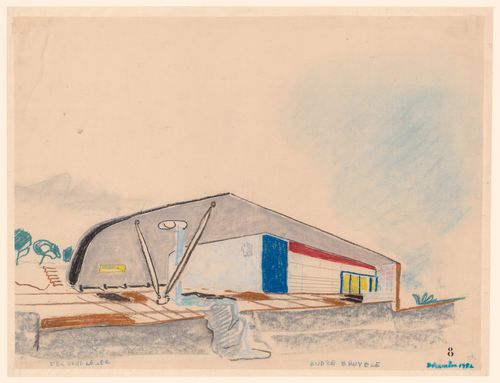
- Two groups of four pastel drawings were originally produced in connection with the Village Polychrome project. The architect André Bruyère had retained one group, while the other was given to the patron and client, Francisco de Assis Chateaubriand Bandeira de Melo, who then donated it to the Sao Paolo Museum of Modern Art. Bruyère subsequently gave one of the four drawings in his group to a friend. The three remaining drawings from Bruyère's group are in the CCA Prints and Drawings collection (DR1996:0001 - DR1996:0003) ("Projet de Village Polychrome, Biot, France").
DR1996:0001
Description:
- Two groups of four pastel drawings were originally produced in connection with the Village Polychrome project. The architect André Bruyère had retained one group, while the other was given to the patron and client, Francisco de Assis Chateaubriand Bandeira de Melo, who then donated it to the Sao Paolo Museum of Modern Art. Bruyère subsequently gave one of the four drawings in his group to a friend. The three remaining drawings from Bruyère's group are in the CCA Prints and Drawings collection (DR1996:0001 - DR1996:0003) ("Projet de Village Polychrome, Biot, France").
People:
Subject:
architecture
architecture
Date:
December 1952
December 1952
Title:
Perspective for a guest villa showing the terrace and the principal and lateral façades, Village Polychrome, near Biot, France
Actions:
DR1996:0001
Description:
- Two groups of four pastel drawings were originally produced in connection with the Village Polychrome project. The architect André Bruyère had retained one group, while the other was given to the patron and client, Francisco de Assis Chateaubriand Bandeira de Melo, who then donated it to the Sao Paolo Museum of Modern Art. Bruyère subsequently gave one of the four drawings in his group to a friend. The three remaining drawings from Bruyère's group are in the CCA Prints and Drawings collection (DR1996:0001 - DR1996:0003) ("Projet de Village Polychrome, Biot, France").
Perspective for a guest villa showing the terrace and the principal and lateral façades, Village Polychrome, near Biot, France
Actions:
DR1996:0001
Description:
- Two groups of four pastel drawings were originally produced in connection with the Village Polychrome project. The architect André Bruyère had retained one group, while the other was given to the patron and client, Francisco de Assis Chateaubriand Bandeira de Melo, who then donated it to the Sao Paolo Museum of Modern Art. Bruyère subsequently gave one of the four drawings in his group to a friend. The three remaining drawings from Bruyère's group are in the CCA Prints and Drawings collection (DR1996:0001 - DR1996:0003) ("Projet de Village Polychrome, Biot, France").
Form:
drawings
drawings
Date:
December 1952
December 1952
People:
Subject:
architecture
architecture
Form:
drawings
drawings
Actions:
Reference number:
DR1996:0003
Description:
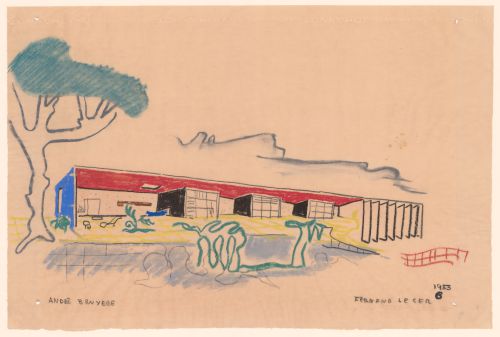
- Two groups of four pastel drawings were originally produced in connection with the Village Polychrome project. The architect André Bruyère had retained one group, while the other was given to the patron and client, Francisco de Assis Chateaubriand Bandeira de Melo, who then donated it to the Sao Paolo Museum of Modern Art. Bruyère subsequently gave one of the four drawings in his group to a friend. The three remaining drawings from Bruyère's group are in the CCA Prints and Drawings collection (DR1996:0001 - DR1996:0003) ("Projet de Village Polychrome, Biot, France").
DR1996:0003
Description:
- Two groups of four pastel drawings were originally produced in connection with the Village Polychrome project. The architect André Bruyère had retained one group, while the other was given to the patron and client, Francisco de Assis Chateaubriand Bandeira de Melo, who then donated it to the Sao Paolo Museum of Modern Art. Bruyère subsequently gave one of the four drawings in his group to a friend. The three remaining drawings from Bruyère's group are in the CCA Prints and Drawings collection (DR1996:0001 - DR1996:0003) ("Projet de Village Polychrome, Biot, France").
People:
Subject:
architecture, urban planning
architecture, urban planning
Date:
1953
1953
Title:
Perspective for a villa with three workshops, Village Polychrome, near Biot, France
Actions:
DR1996:0003
Description:
- Two groups of four pastel drawings were originally produced in connection with the Village Polychrome project. The architect André Bruyère had retained one group, while the other was given to the patron and client, Francisco de Assis Chateaubriand Bandeira de Melo, who then donated it to the Sao Paolo Museum of Modern Art. Bruyère subsequently gave one of the four drawings in his group to a friend. The three remaining drawings from Bruyère's group are in the CCA Prints and Drawings collection (DR1996:0001 - DR1996:0003) ("Projet de Village Polychrome, Biot, France").
Perspective for a villa with three workshops, Village Polychrome, near Biot, France
Actions:
DR1996:0003
Description:
- Two groups of four pastel drawings were originally produced in connection with the Village Polychrome project. The architect André Bruyère had retained one group, while the other was given to the patron and client, Francisco de Assis Chateaubriand Bandeira de Melo, who then donated it to the Sao Paolo Museum of Modern Art. Bruyère subsequently gave one of the four drawings in his group to a friend. The three remaining drawings from Bruyère's group are in the CCA Prints and Drawings collection (DR1996:0001 - DR1996:0003) ("Projet de Village Polychrome, Biot, France").
Form:
drawings
drawings
Date:
1953
1953
People:
Subject:
architecture, urban planning
architecture, urban planning
Form:
drawings
drawings
Reference number:
DR1996:0004
Description:
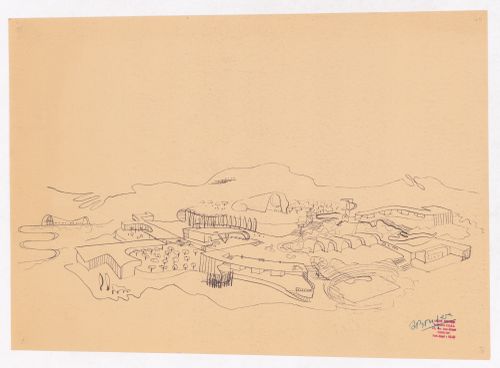
- Two groups of four pastel drawings were originally produced in connection with the Village Polychrome project. The architect André Bruyère had retained one group, while the other was given to the patron and client, Francisco de Assis Chateaubriand Bandeira de Melo, who then donated it to the Sao Paolo Museum of Modern Art. Bruyère subsequently gave one of the four drawings in his group to a friend. The three remaining drawings from Bruyère's group are in the CCA Prints and Drawings collection (DR1996:0001 - DR1996:0003) ("Projet de Village Polychrome, Biot, France").
DR1996:0004
Description:
- Two groups of four pastel drawings were originally produced in connection with the Village Polychrome project. The architect André Bruyère had retained one group, while the other was given to the patron and client, Francisco de Assis Chateaubriand Bandeira de Melo, who then donated it to the Sao Paolo Museum of Modern Art. Bruyère subsequently gave one of the four drawings in his group to a friend. The three remaining drawings from Bruyère's group are in the CCA Prints and Drawings collection (DR1996:0001 - DR1996:0003) ("Projet de Village Polychrome, Biot, France").
People:
Subject:
architecture, urban planning
architecture, urban planning
Date:
1952-1953
1952-1953
Title:
Bird's-eye perspective for Village Polychrome, near Biot, France
Actions:
DR1996:0004
Description:
- Two groups of four pastel drawings were originally produced in connection with the Village Polychrome project. The architect André Bruyère had retained one group, while the other was given to the patron and client, Francisco de Assis Chateaubriand Bandeira de Melo, who then donated it to the Sao Paolo Museum of Modern Art. Bruyère subsequently gave one of the four drawings in his group to a friend. The three remaining drawings from Bruyère's group are in the CCA Prints and Drawings collection (DR1996:0001 - DR1996:0003) ("Projet de Village Polychrome, Biot, France").
Bird's-eye perspective for Village Polychrome, near Biot, France
Actions:
DR1996:0004
Description:
- Two groups of four pastel drawings were originally produced in connection with the Village Polychrome project. The architect André Bruyère had retained one group, while the other was given to the patron and client, Francisco de Assis Chateaubriand Bandeira de Melo, who then donated it to the Sao Paolo Museum of Modern Art. Bruyère subsequently gave one of the four drawings in his group to a friend. The three remaining drawings from Bruyère's group are in the CCA Prints and Drawings collection (DR1996:0001 - DR1996:0003) ("Projet de Village Polychrome, Biot, France").
Form:
drawings
drawings
Date:
1952-1953
1952-1953
People:
Subject:
architecture, urban planning
architecture, urban planning


