


33494 Results
Level of archival description:
Project
Project
Actions:
Reference number:
AP018.S1.1976.PR01
Description:
This project series documents a feasibility study for a hotel and condominium development in Burlington, Ontario in 1976. The office identified the project number as 7601. The project consisted of a study to determine the feasibility of building a hotel and condominium on the historic Brant Inn site, a famous hotel which had closed about a decade previously. The proposed development was approximately 30 storeys with 350 condos, 250 hotel rooms, a convention facility and parking garage. It is unclear from the project materials whether the project was ever built. A project list, created by the office, which accompanied the donation of this fonds referred to this project as Hotel and Condominium Feasibility Study for David S. Owen of Warrick Consultants Limited. The project is recorded through a conference report and presentation boards dating from 1976. The presentation boards show site plans and schemes, while one shows a drawing of the New Brant Inn, prepared by architect Visvalois V. Upenicks.
AP018.S1.1976.PR01
Description:
This project series documents a feasibility study for a hotel and condominium development in Burlington, Ontario in 1976. The office identified the project number as 7601. The project consisted of a study to determine the feasibility of building a hotel and condominium on the historic Brant Inn site, a famous hotel which had closed about a decade previously. The proposed development was approximately 30 storeys with 350 condos, 250 hotel rooms, a convention facility and parking garage. It is unclear from the project materials whether the project was ever built. A project list, created by the office, which accompanied the donation of this fonds referred to this project as Hotel and Condominium Feasibility Study for David S. Owen of Warrick Consultants Limited. The project is recorded through a conference report and presentation boards dating from 1976. The presentation boards show site plans and schemes, while one shows a drawing of the New Brant Inn, prepared by architect Visvalois V. Upenicks.
People:
Date:
1970-1976
1970-1976
Title:
Hotel and Condominium, Feasibility Study, Burlington, Ontario (1976)
Actions:
AP018.S1.1976.PR01
Description:
This project series documents a feasibility study for a hotel and condominium development in Burlington, Ontario in 1976. The office identified the project number as 7601. The project consisted of a study to determine the feasibility of building a hotel and condominium on the historic Brant Inn site, a famous hotel which had closed about a decade previously. The proposed development was approximately 30 storeys with 350 condos, 250 hotel rooms, a convention facility and parking garage. It is unclear from the project materials whether the project was ever built. A project list, created by the office, which accompanied the donation of this fonds referred to this project as Hotel and Condominium Feasibility Study for David S. Owen of Warrick Consultants Limited. The project is recorded through a conference report and presentation boards dating from 1976. The presentation boards show site plans and schemes, while one shows a drawing of the New Brant Inn, prepared by architect Visvalois V. Upenicks.
Hotel and Condominium, Feasibility Study, Burlington, Ontario (1976)
Actions:
AP018.S1.1976.PR01
Description:
This project series documents a feasibility study for a hotel and condominium development in Burlington, Ontario in 1976. The office identified the project number as 7601. The project consisted of a study to determine the feasibility of building a hotel and condominium on the historic Brant Inn site, a famous hotel which had closed about a decade previously. The proposed development was approximately 30 storeys with 350 condos, 250 hotel rooms, a convention facility and parking garage. It is unclear from the project materials whether the project was ever built. A project list, created by the office, which accompanied the donation of this fonds referred to this project as Hotel and Condominium Feasibility Study for David S. Owen of Warrick Consultants Limited. The project is recorded through a conference report and presentation boards dating from 1976. The presentation boards show site plans and schemes, while one shows a drawing of the New Brant Inn, prepared by architect Visvalois V. Upenicks.
Level of archival description:
project
project
Date:
1970-1976
1970-1976
People:
Level of archival description:
Project
Project
Reference number:
AP018.S1.1981.PR19
Description:
This project series documents the Nova Computer Centre in Calgary, Alberta from 1981-1984. The office identified the project number as 8119. This project consisted of a three-storey building with a basement and penthouse, located at 10th Avenue and 15th Street. The building was designed to house the computer equipment of Novalta Properties Ltd., their corporate records, and support staff. The building was separated in two by function with a central atrium in the center. Overall, the project had 131,000 square feet of developable area. The project is recorded through drawings, material samples, and textual records dating from 1981-1984. The drawings include plans, details, elevations and sections. These drawings are marked The Chandler Kennedy Architectural Group, who were the consulting architects on the project. The textual records consist of correspondence, conference and inspection reports, tender documents, cost control and building statistics records, interior design and contractor documentation, certificates of payment, supplementary instructions, change orders, interoffice letters, and specifications.
AP018.S1.1981.PR19
Description:
This project series documents the Nova Computer Centre in Calgary, Alberta from 1981-1984. The office identified the project number as 8119. This project consisted of a three-storey building with a basement and penthouse, located at 10th Avenue and 15th Street. The building was designed to house the computer equipment of Novalta Properties Ltd., their corporate records, and support staff. The building was separated in two by function with a central atrium in the center. Overall, the project had 131,000 square feet of developable area. The project is recorded through drawings, material samples, and textual records dating from 1981-1984. The drawings include plans, details, elevations and sections. These drawings are marked The Chandler Kennedy Architectural Group, who were the consulting architects on the project. The textual records consist of correspondence, conference and inspection reports, tender documents, cost control and building statistics records, interior design and contractor documentation, certificates of payment, supplementary instructions, change orders, interoffice letters, and specifications.
People:
Date:
1981-1984
1981-1984
Title:
Nova Computer Centre, Calgary, Alberta (1981)
Actions:
AP018.S1.1981.PR19
Description:
This project series documents the Nova Computer Centre in Calgary, Alberta from 1981-1984. The office identified the project number as 8119. This project consisted of a three-storey building with a basement and penthouse, located at 10th Avenue and 15th Street. The building was designed to house the computer equipment of Novalta Properties Ltd., their corporate records, and support staff. The building was separated in two by function with a central atrium in the center. Overall, the project had 131,000 square feet of developable area. The project is recorded through drawings, material samples, and textual records dating from 1981-1984. The drawings include plans, details, elevations and sections. These drawings are marked The Chandler Kennedy Architectural Group, who were the consulting architects on the project. The textual records consist of correspondence, conference and inspection reports, tender documents, cost control and building statistics records, interior design and contractor documentation, certificates of payment, supplementary instructions, change orders, interoffice letters, and specifications.
Nova Computer Centre, Calgary, Alberta (1981)
Actions:
AP018.S1.1981.PR19
Description:
This project series documents the Nova Computer Centre in Calgary, Alberta from 1981-1984. The office identified the project number as 8119. This project consisted of a three-storey building with a basement and penthouse, located at 10th Avenue and 15th Street. The building was designed to house the computer equipment of Novalta Properties Ltd., their corporate records, and support staff. The building was separated in two by function with a central atrium in the center. Overall, the project had 131,000 square feet of developable area. The project is recorded through drawings, material samples, and textual records dating from 1981-1984. The drawings include plans, details, elevations and sections. These drawings are marked The Chandler Kennedy Architectural Group, who were the consulting architects on the project. The textual records consist of correspondence, conference and inspection reports, tender documents, cost control and building statistics records, interior design and contractor documentation, certificates of payment, supplementary instructions, change orders, interoffice letters, and specifications.
Level of archival description:
Project
Project
Date:
1981-1984
1981-1984
People:
Level of archival description:
Project
Project
Actions:
Reference number:
AP018.S1.1976.PR03
Description:
This project series documents a Supermarket for the food chain Darrigo's in Toronto, Ontario from 1976-1971. The office identified the project number as 7604. The office also worked on a sub-project as part of this project which they identified as 7604-D. This sub-project appears to be the demolition of an existing building of Darrigo Realty before the constuction of the new one designed by Parkin Architects Planners. The material for this sub-project is also arranged within this project series. The project is recorded through drawings and textual records dating from 1976-1981. The majority of the drawings are reprographic copies of site plans, floor plans, elevations, sections, mechanical, electrical and structural drawings. Textual records includes correspondence with client, contractors, sub-contractors or consultants, also well as tenders, inspection reports, meeting reports and change orders. Box AP018.S1.1976.PR03.001 includes an index to the textual records created by the office.
AP018.S1.1976.PR03
Description:
This project series documents a Supermarket for the food chain Darrigo's in Toronto, Ontario from 1976-1971. The office identified the project number as 7604. The office also worked on a sub-project as part of this project which they identified as 7604-D. This sub-project appears to be the demolition of an existing building of Darrigo Realty before the constuction of the new one designed by Parkin Architects Planners. The material for this sub-project is also arranged within this project series. The project is recorded through drawings and textual records dating from 1976-1981. The majority of the drawings are reprographic copies of site plans, floor plans, elevations, sections, mechanical, electrical and structural drawings. Textual records includes correspondence with client, contractors, sub-contractors or consultants, also well as tenders, inspection reports, meeting reports and change orders. Box AP018.S1.1976.PR03.001 includes an index to the textual records created by the office.
People:
Date:
1976-1981
1976-1981
Title:
Supermarket for Darrigo Realty, Toronto, Ontario (1976)
Actions:
AP018.S1.1976.PR03
Description:
This project series documents a Supermarket for the food chain Darrigo's in Toronto, Ontario from 1976-1971. The office identified the project number as 7604. The office also worked on a sub-project as part of this project which they identified as 7604-D. This sub-project appears to be the demolition of an existing building of Darrigo Realty before the constuction of the new one designed by Parkin Architects Planners. The material for this sub-project is also arranged within this project series. The project is recorded through drawings and textual records dating from 1976-1981. The majority of the drawings are reprographic copies of site plans, floor plans, elevations, sections, mechanical, electrical and structural drawings. Textual records includes correspondence with client, contractors, sub-contractors or consultants, also well as tenders, inspection reports, meeting reports and change orders. Box AP018.S1.1976.PR03.001 includes an index to the textual records created by the office.
Supermarket for Darrigo Realty, Toronto, Ontario (1976)
Actions:
AP018.S1.1976.PR03
Description:
This project series documents a Supermarket for the food chain Darrigo's in Toronto, Ontario from 1976-1971. The office identified the project number as 7604. The office also worked on a sub-project as part of this project which they identified as 7604-D. This sub-project appears to be the demolition of an existing building of Darrigo Realty before the constuction of the new one designed by Parkin Architects Planners. The material for this sub-project is also arranged within this project series. The project is recorded through drawings and textual records dating from 1976-1981. The majority of the drawings are reprographic copies of site plans, floor plans, elevations, sections, mechanical, electrical and structural drawings. Textual records includes correspondence with client, contractors, sub-contractors or consultants, also well as tenders, inspection reports, meeting reports and change orders. Box AP018.S1.1976.PR03.001 includes an index to the textual records created by the office.
Level of archival description:
Project
Project
Date:
1976-1981
1976-1981
People:
Level of archival description:
Project
Project
Actions:
Reference number:
AP018.S1.1978.PR07
Description:
This project series documents a site study for the new National Gallery of Canada in Ottawa, Ontario in 1978. The office identified the project number as 7809. In 1977, Parkin Architects Planners won a limited architectural competition for their design of the new National Gallery of Canada. The selected site for the competition, next to the Ottawa River, was controversial due to its uneven ground and lack of access to main streets in Ottawa. This project consisted of an extended site study for the construction of that building following the announcement of the competition winner if the original site was to be used. This was a brief urban design study to consider appropriate massing, exterior spaces, access, and vistas to and from the proposed building. It also included studying the best use of land next to the new gallery. The project is recorded through drawings and textual records dating from 1976-1978. The textual records include the predesign programme and schemes, correspondence, notes, meeting reports and research.
AP018.S1.1978.PR07
Description:
This project series documents a site study for the new National Gallery of Canada in Ottawa, Ontario in 1978. The office identified the project number as 7809. In 1977, Parkin Architects Planners won a limited architectural competition for their design of the new National Gallery of Canada. The selected site for the competition, next to the Ottawa River, was controversial due to its uneven ground and lack of access to main streets in Ottawa. This project consisted of an extended site study for the construction of that building following the announcement of the competition winner if the original site was to be used. This was a brief urban design study to consider appropriate massing, exterior spaces, access, and vistas to and from the proposed building. It also included studying the best use of land next to the new gallery. The project is recorded through drawings and textual records dating from 1976-1978. The textual records include the predesign programme and schemes, correspondence, notes, meeting reports and research.
People:
Date:
1976-1978
1976-1978
Title:
National Gallery of Canada, Extended Site Study, Ottawa, Ontario (1978)
Actions:
AP018.S1.1978.PR07
Description:
This project series documents a site study for the new National Gallery of Canada in Ottawa, Ontario in 1978. The office identified the project number as 7809. In 1977, Parkin Architects Planners won a limited architectural competition for their design of the new National Gallery of Canada. The selected site for the competition, next to the Ottawa River, was controversial due to its uneven ground and lack of access to main streets in Ottawa. This project consisted of an extended site study for the construction of that building following the announcement of the competition winner if the original site was to be used. This was a brief urban design study to consider appropriate massing, exterior spaces, access, and vistas to and from the proposed building. It also included studying the best use of land next to the new gallery. The project is recorded through drawings and textual records dating from 1976-1978. The textual records include the predesign programme and schemes, correspondence, notes, meeting reports and research.
National Gallery of Canada, Extended Site Study, Ottawa, Ontario (1978)
Actions:
AP018.S1.1978.PR07
Description:
This project series documents a site study for the new National Gallery of Canada in Ottawa, Ontario in 1978. The office identified the project number as 7809. In 1977, Parkin Architects Planners won a limited architectural competition for their design of the new National Gallery of Canada. The selected site for the competition, next to the Ottawa River, was controversial due to its uneven ground and lack of access to main streets in Ottawa. This project consisted of an extended site study for the construction of that building following the announcement of the competition winner if the original site was to be used. This was a brief urban design study to consider appropriate massing, exterior spaces, access, and vistas to and from the proposed building. It also included studying the best use of land next to the new gallery. The project is recorded through drawings and textual records dating from 1976-1978. The textual records include the predesign programme and schemes, correspondence, notes, meeting reports and research.
Level of archival description:
Project
Project
Date:
1976-1978
1976-1978
People:
Level of archival description:
Project
Project
Reference number:
AP178.S1.2000.PR10
Description:
This project series document the Biblioteca da Câmara Municipal de Viana do Castelo in Viana do Castelo, Portugal. While the records were held in the office’s archives this project was assigned the number 11/00. The office assigned the dates 2000-2008 to this project. The project site is located between the Alameda 5 de Outubro and the Lima river. The library was part of the waterfront development plan, directed by Fernando Távora. The development plan included a multiuse pavilion designed by Eduardo Souto de Moura, two office buildings, and an auditorium designed by Tàvora. The architects, with the help of José Bernardo Tavora and Adalberto Dias chose together location. The orthogonal two-story library respects the recommendations of the Portuguese Institute of Book and Libraries (IPLB). This project was realized and won the National Contemporary Architecture Award. Documenting this project are sketches, studies, plans, working drawings, technical drawings, and details. Textual material includes correspondence and project documentation. Photographic material documents construction work and models.
AP178.S1.2000.PR10
Description:
This project series document the Biblioteca da Câmara Municipal de Viana do Castelo in Viana do Castelo, Portugal. While the records were held in the office’s archives this project was assigned the number 11/00. The office assigned the dates 2000-2008 to this project. The project site is located between the Alameda 5 de Outubro and the Lima river. The library was part of the waterfront development plan, directed by Fernando Távora. The development plan included a multiuse pavilion designed by Eduardo Souto de Moura, two office buildings, and an auditorium designed by Tàvora. The architects, with the help of José Bernardo Tavora and Adalberto Dias chose together location. The orthogonal two-story library respects the recommendations of the Portuguese Institute of Book and Libraries (IPLB). This project was realized and won the National Contemporary Architecture Award. Documenting this project are sketches, studies, plans, working drawings, technical drawings, and details. Textual material includes correspondence and project documentation. Photographic material documents construction work and models.
People:
Date:
2000-2008
2000-2008
Title:
Biblioteca da Câmara Municipal de Viana do Castelo [Viana do Castelo Public Library], Viana do Castelo, Portugal (2000-2008)
Actions:
AP178.S1.2000.PR10
Description:
This project series document the Biblioteca da Câmara Municipal de Viana do Castelo in Viana do Castelo, Portugal. While the records were held in the office’s archives this project was assigned the number 11/00. The office assigned the dates 2000-2008 to this project. The project site is located between the Alameda 5 de Outubro and the Lima river. The library was part of the waterfront development plan, directed by Fernando Távora. The development plan included a multiuse pavilion designed by Eduardo Souto de Moura, two office buildings, and an auditorium designed by Tàvora. The architects, with the help of José Bernardo Tavora and Adalberto Dias chose together location. The orthogonal two-story library respects the recommendations of the Portuguese Institute of Book and Libraries (IPLB). This project was realized and won the National Contemporary Architecture Award. Documenting this project are sketches, studies, plans, working drawings, technical drawings, and details. Textual material includes correspondence and project documentation. Photographic material documents construction work and models.
Biblioteca da Câmara Municipal de Viana do Castelo [Viana do Castelo Public Library], Viana do Castelo, Portugal (2000-2008)
Actions:
AP178.S1.2000.PR10
Description:
This project series document the Biblioteca da Câmara Municipal de Viana do Castelo in Viana do Castelo, Portugal. While the records were held in the office’s archives this project was assigned the number 11/00. The office assigned the dates 2000-2008 to this project. The project site is located between the Alameda 5 de Outubro and the Lima river. The library was part of the waterfront development plan, directed by Fernando Távora. The development plan included a multiuse pavilion designed by Eduardo Souto de Moura, two office buildings, and an auditorium designed by Tàvora. The architects, with the help of José Bernardo Tavora and Adalberto Dias chose together location. The orthogonal two-story library respects the recommendations of the Portuguese Institute of Book and Libraries (IPLB). This project was realized and won the National Contemporary Architecture Award. Documenting this project are sketches, studies, plans, working drawings, technical drawings, and details. Textual material includes correspondence and project documentation. Photographic material documents construction work and models.
Level of archival description:
Project
Project
Date:
2000-2008
2000-2008
People:
Level of archival description:
Project
Project
Actions:
Reference number:
AP178.S1.1995.PR12
Description:
This project series documents the design for the Instituto de Biofísica in Hombroich, Germany. While the records were held in the office’s archives this project was assigned the number 69/90. The office assigned the dates 1995-1996 to this project. The project was commissioned by the Insel Hombroich Foundation. Construction started in 1995, but was delayed until 2006. The project site was located on an old military camp and was used by the Foundation as part of a program for architects to build different types of building. The program for the Institute of Biophysics included office spaces, conference rooms, a meditation center, a music center and five guest apartments. Siza's design was kept and used later with a different interior layout for a new Pavilion for the Insel Hombroich Foundation (see project series AP178.S1.2001.PR02 in this fonds). The project was a collaboration with Rudolf Finsterwalder. Documenting this project are studies and working drawings. Textual materials include project documentation, correspondence and a development plan.
AP178.S1.1995.PR12
Description:
This project series documents the design for the Instituto de Biofísica in Hombroich, Germany. While the records were held in the office’s archives this project was assigned the number 69/90. The office assigned the dates 1995-1996 to this project. The project was commissioned by the Insel Hombroich Foundation. Construction started in 1995, but was delayed until 2006. The project site was located on an old military camp and was used by the Foundation as part of a program for architects to build different types of building. The program for the Institute of Biophysics included office spaces, conference rooms, a meditation center, a music center and five guest apartments. Siza's design was kept and used later with a different interior layout for a new Pavilion for the Insel Hombroich Foundation (see project series AP178.S1.2001.PR02 in this fonds). The project was a collaboration with Rudolf Finsterwalder. Documenting this project are studies and working drawings. Textual materials include project documentation, correspondence and a development plan.
People:
Date:
1991-2011
1991-2011
Title:
Instituto de Biofísica [Institute of Biophysics], Hombroich, Germany (1995-1996)
Actions:
AP178.S1.1995.PR12
Description:
This project series documents the design for the Instituto de Biofísica in Hombroich, Germany. While the records were held in the office’s archives this project was assigned the number 69/90. The office assigned the dates 1995-1996 to this project. The project was commissioned by the Insel Hombroich Foundation. Construction started in 1995, but was delayed until 2006. The project site was located on an old military camp and was used by the Foundation as part of a program for architects to build different types of building. The program for the Institute of Biophysics included office spaces, conference rooms, a meditation center, a music center and five guest apartments. Siza's design was kept and used later with a different interior layout for a new Pavilion for the Insel Hombroich Foundation (see project series AP178.S1.2001.PR02 in this fonds). The project was a collaboration with Rudolf Finsterwalder. Documenting this project are studies and working drawings. Textual materials include project documentation, correspondence and a development plan.
Instituto de Biofísica [Institute of Biophysics], Hombroich, Germany (1995-1996)
Actions:
AP178.S1.1995.PR12
Description:
This project series documents the design for the Instituto de Biofísica in Hombroich, Germany. While the records were held in the office’s archives this project was assigned the number 69/90. The office assigned the dates 1995-1996 to this project. The project was commissioned by the Insel Hombroich Foundation. Construction started in 1995, but was delayed until 2006. The project site was located on an old military camp and was used by the Foundation as part of a program for architects to build different types of building. The program for the Institute of Biophysics included office spaces, conference rooms, a meditation center, a music center and five guest apartments. Siza's design was kept and used later with a different interior layout for a new Pavilion for the Insel Hombroich Foundation (see project series AP178.S1.2001.PR02 in this fonds). The project was a collaboration with Rudolf Finsterwalder. Documenting this project are studies and working drawings. Textual materials include project documentation, correspondence and a development plan.
Level of archival description:
Project
Project
Date:
1991-2011
1991-2011
People:
Level of archival description:
Project
Project
Reference number:
AP178.S1.1990.PR04
Description:
This project series documents the Ceramique Terrein Blocos de habitação e escritórios in Maastricht, The Netherlands. While the records were held in the office’s archives this project was assigned the number 6/90 A/B. The office assigned the date 1990 to this project. The project is located in the Ceramique district. The industrial area was revitalized during the nineties with buildings built by international architects, including Aldo Rossi's the Bonnefanten Museum and Jo Coenen's Centre Céramique. The building is divided into three independent buildings: Block 6, Block 7, and Block 8. Block 6 is made up of commercial space on the ground floor and residential units on the other six floors. Block 8 is the biggest unit of the project, with a double tower of 16 storeys. Block 7 is a four-storey building. The project was realized. Documenting this project are sketches and plans. Textual material includes correspondence and technical details. Photographic material documents the project site, construction work, and built project.
AP178.S1.1990.PR04
Description:
This project series documents the Ceramique Terrein Blocos de habitação e escritórios in Maastricht, The Netherlands. While the records were held in the office’s archives this project was assigned the number 6/90 A/B. The office assigned the date 1990 to this project. The project is located in the Ceramique district. The industrial area was revitalized during the nineties with buildings built by international architects, including Aldo Rossi's the Bonnefanten Museum and Jo Coenen's Centre Céramique. The building is divided into three independent buildings: Block 6, Block 7, and Block 8. Block 6 is made up of commercial space on the ground floor and residential units on the other six floors. Block 8 is the biggest unit of the project, with a double tower of 16 storeys. Block 7 is a four-storey building. The project was realized. Documenting this project are sketches and plans. Textual material includes correspondence and technical details. Photographic material documents the project site, construction work, and built project.
People:
Date:
1991-2000
1991-2000
Title:
Ceramique Terrein Blocos de habitação e escritórios [Ceramic Terrain apartments and offices], Maastricht, The Netherlands (1990)
Actions:
AP178.S1.1990.PR04
Description:
This project series documents the Ceramique Terrein Blocos de habitação e escritórios in Maastricht, The Netherlands. While the records were held in the office’s archives this project was assigned the number 6/90 A/B. The office assigned the date 1990 to this project. The project is located in the Ceramique district. The industrial area was revitalized during the nineties with buildings built by international architects, including Aldo Rossi's the Bonnefanten Museum and Jo Coenen's Centre Céramique. The building is divided into three independent buildings: Block 6, Block 7, and Block 8. Block 6 is made up of commercial space on the ground floor and residential units on the other six floors. Block 8 is the biggest unit of the project, with a double tower of 16 storeys. Block 7 is a four-storey building. The project was realized. Documenting this project are sketches and plans. Textual material includes correspondence and technical details. Photographic material documents the project site, construction work, and built project.
Ceramique Terrein Blocos de habitação e escritórios [Ceramic Terrain apartments and offices], Maastricht, The Netherlands (1990)
Actions:
AP178.S1.1990.PR04
Description:
This project series documents the Ceramique Terrein Blocos de habitação e escritórios in Maastricht, The Netherlands. While the records were held in the office’s archives this project was assigned the number 6/90 A/B. The office assigned the date 1990 to this project. The project is located in the Ceramique district. The industrial area was revitalized during the nineties with buildings built by international architects, including Aldo Rossi's the Bonnefanten Museum and Jo Coenen's Centre Céramique. The building is divided into three independent buildings: Block 6, Block 7, and Block 8. Block 6 is made up of commercial space on the ground floor and residential units on the other six floors. Block 8 is the biggest unit of the project, with a double tower of 16 storeys. Block 7 is a four-storey building. The project was realized. Documenting this project are sketches and plans. Textual material includes correspondence and technical details. Photographic material documents the project site, construction work, and built project.
Level of archival description:
Project
Project
Date:
1991-2000
1991-2000
People:
Level of archival description:
Project
Project
Title:
Inter-Action Centre
Inter-Action Centre
Reference number:
AP144.S2.D82
Description:
File documents Inter-Action Centre, a completed project for a community centre commissioned by Ed Berman and the Inter-Action Trust, for a disused site at Talacre Public Open Space in Kentish Town, Camden, London. The construction was divided into two phases. Foundations, steel frame and trusses were constructed first and could be used for open-air community events while funds were being raised for the second phase. Phase II included cladding, fittings, finishes, services prefabricated units, and log cabins. The building was intended as a flexible short life-span building in which the interior spaces would be independent of the roof and exterior walls. Functional areas suggested by Cedric Price include: assembly halls, classrooms, rehearsal rooms, studios, areas for performance, media resources, lounging and dining, and a gym and a nursery. Cedric Price had been engaged by the concepts of flexible architecture, indeterminacy, impermanence, and the fusion of information technology, entertainment, and educational activities in earlier unrealized projects such as Fun Palace (AP144.S2.D46) and Oxford Corner House (AP144.S2.D59). Existing conditions drawings include photographs of the site; reprographic copies of electrical and drainage systems; ordinance surveys of Kentish Town; and landscape and playground layout. Conceptual drawings include sketches of overall massing; diagrammatic plans; drawings and diagrams of site conditions; notes for the structural framework; rendered interior elevations; plans showing impact of site context on building design; diagrammatic sketches of relationship between functional requirements and structural form. Schematic drawings include diagrammatic plans; sections of structural system and exterior wall; cladding details; and axonometric views of supports. Design development drawings and working drawings include plans, elevations, sections, details and axonometric views. Presentation drawings include watercolours and other renderings; reprographic copies, possibly for publication; and perspectives drawings. Some material from this file was published in "Inter-action Centre." 'RIBA Journal'. (November 1977), 458-465; "Intervista A Cedric Price: London Interaction Centre." 'Domus'. (April 1978), 17-21; "Kentish Town West Amalgam, London." 'Architectural Record'. (January 1973), 19; Lyall, Sutherland. 'The State of British Architecture'. (London: Architectural Press, 1980), 107-109; 130 and 'Cedric Price-Works II' (London: Architectural Press, 1984), 54, 62-63. Material in this file was produced between 1964 and 1992, but predominantly between 1970 and 1981. File contains technical drawings that are attributed to the following consultants, contractors, and manufacturers: Coseley Buildings Ltd; H.G. Deacon Ltd; Kayanson Engineers; H.J. Knights & Co. Ltd; Woodcemair; Metal Sections Ltd; Spaceway; Gascoigne, Gush & Dent (Engineering Ltd); UBM Engineering; J. Murphy & Sons Ltd; Maurice Pickering Associates, Architects & Landscape Consultants; David Lee Architect & Landscape Architect; J. Starkie Gardner Ltd; Dibben Structural Engineers; Zisman, Bowyer & Partners; Felix J. Samuely and Partners; Ruberoid Contracts Ltd; Whitbread London Limited; and Portakabin. Paul Hyett and Will Alsop were Cedric Price's main assistants for this project. 'Inter-Action Trust Limited', 'Inter-Action Centre', and 'Talacre Centre Limited' appear as the client(s) at various stages of this project. File contains cartographic materials, conceptual drawings, consultant drawings, design development drawings, models, panels, photographic materials, presentation drawings, an illustration, textual records, and working drawings.
AP144.S2.D82
Description:
File documents Inter-Action Centre, a completed project for a community centre commissioned by Ed Berman and the Inter-Action Trust, for a disused site at Talacre Public Open Space in Kentish Town, Camden, London. The construction was divided into two phases. Foundations, steel frame and trusses were constructed first and could be used for open-air community events while funds were being raised for the second phase. Phase II included cladding, fittings, finishes, services prefabricated units, and log cabins. The building was intended as a flexible short life-span building in which the interior spaces would be independent of the roof and exterior walls. Functional areas suggested by Cedric Price include: assembly halls, classrooms, rehearsal rooms, studios, areas for performance, media resources, lounging and dining, and a gym and a nursery. Cedric Price had been engaged by the concepts of flexible architecture, indeterminacy, impermanence, and the fusion of information technology, entertainment, and educational activities in earlier unrealized projects such as Fun Palace (AP144.S2.D46) and Oxford Corner House (AP144.S2.D59). Existing conditions drawings include photographs of the site; reprographic copies of electrical and drainage systems; ordinance surveys of Kentish Town; and landscape and playground layout. Conceptual drawings include sketches of overall massing; diagrammatic plans; drawings and diagrams of site conditions; notes for the structural framework; rendered interior elevations; plans showing impact of site context on building design; diagrammatic sketches of relationship between functional requirements and structural form. Schematic drawings include diagrammatic plans; sections of structural system and exterior wall; cladding details; and axonometric views of supports. Design development drawings and working drawings include plans, elevations, sections, details and axonometric views. Presentation drawings include watercolours and other renderings; reprographic copies, possibly for publication; and perspectives drawings. Some material from this file was published in "Inter-action Centre." 'RIBA Journal'. (November 1977), 458-465; "Intervista A Cedric Price: London Interaction Centre." 'Domus'. (April 1978), 17-21; "Kentish Town West Amalgam, London." 'Architectural Record'. (January 1973), 19; Lyall, Sutherland. 'The State of British Architecture'. (London: Architectural Press, 1980), 107-109; 130 and 'Cedric Price-Works II' (London: Architectural Press, 1984), 54, 62-63. Material in this file was produced between 1964 and 1992, but predominantly between 1970 and 1981. File contains technical drawings that are attributed to the following consultants, contractors, and manufacturers: Coseley Buildings Ltd; H.G. Deacon Ltd; Kayanson Engineers; H.J. Knights & Co. Ltd; Woodcemair; Metal Sections Ltd; Spaceway; Gascoigne, Gush & Dent (Engineering Ltd); UBM Engineering; J. Murphy & Sons Ltd; Maurice Pickering Associates, Architects & Landscape Consultants; David Lee Architect & Landscape Architect; J. Starkie Gardner Ltd; Dibben Structural Engineers; Zisman, Bowyer & Partners; Felix J. Samuely and Partners; Ruberoid Contracts Ltd; Whitbread London Limited; and Portakabin. Paul Hyett and Will Alsop were Cedric Price's main assistants for this project. 'Inter-Action Trust Limited', 'Inter-Action Centre', and 'Talacre Centre Limited' appear as the client(s) at various stages of this project. File contains cartographic materials, conceptual drawings, consultant drawings, design development drawings, models, panels, photographic materials, presentation drawings, an illustration, textual records, and working drawings.
People:
Date:
1964-1992, predominant 1970-1981
1964-1992, predominant 1970-1981
Title:
Inter-Action Centre
Actions:
AP144.S2.D82
Description:
File documents Inter-Action Centre, a completed project for a community centre commissioned by Ed Berman and the Inter-Action Trust, for a disused site at Talacre Public Open Space in Kentish Town, Camden, London. The construction was divided into two phases. Foundations, steel frame and trusses were constructed first and could be used for open-air community events while funds were being raised for the second phase. Phase II included cladding, fittings, finishes, services prefabricated units, and log cabins. The building was intended as a flexible short life-span building in which the interior spaces would be independent of the roof and exterior walls. Functional areas suggested by Cedric Price include: assembly halls, classrooms, rehearsal rooms, studios, areas for performance, media resources, lounging and dining, and a gym and a nursery. Cedric Price had been engaged by the concepts of flexible architecture, indeterminacy, impermanence, and the fusion of information technology, entertainment, and educational activities in earlier unrealized projects such as Fun Palace (AP144.S2.D46) and Oxford Corner House (AP144.S2.D59). Existing conditions drawings include photographs of the site; reprographic copies of electrical and drainage systems; ordinance surveys of Kentish Town; and landscape and playground layout. Conceptual drawings include sketches of overall massing; diagrammatic plans; drawings and diagrams of site conditions; notes for the structural framework; rendered interior elevations; plans showing impact of site context on building design; diagrammatic sketches of relationship between functional requirements and structural form. Schematic drawings include diagrammatic plans; sections of structural system and exterior wall; cladding details; and axonometric views of supports. Design development drawings and working drawings include plans, elevations, sections, details and axonometric views. Presentation drawings include watercolours and other renderings; reprographic copies, possibly for publication; and perspectives drawings. Some material from this file was published in "Inter-action Centre." 'RIBA Journal'. (November 1977), 458-465; "Intervista A Cedric Price: London Interaction Centre." 'Domus'. (April 1978), 17-21; "Kentish Town West Amalgam, London." 'Architectural Record'. (January 1973), 19; Lyall, Sutherland. 'The State of British Architecture'. (London: Architectural Press, 1980), 107-109; 130 and 'Cedric Price-Works II' (London: Architectural Press, 1984), 54, 62-63. Material in this file was produced between 1964 and 1992, but predominantly between 1970 and 1981. File contains technical drawings that are attributed to the following consultants, contractors, and manufacturers: Coseley Buildings Ltd; H.G. Deacon Ltd; Kayanson Engineers; H.J. Knights & Co. Ltd; Woodcemair; Metal Sections Ltd; Spaceway; Gascoigne, Gush & Dent (Engineering Ltd); UBM Engineering; J. Murphy & Sons Ltd; Maurice Pickering Associates, Architects & Landscape Consultants; David Lee Architect & Landscape Architect; J. Starkie Gardner Ltd; Dibben Structural Engineers; Zisman, Bowyer & Partners; Felix J. Samuely and Partners; Ruberoid Contracts Ltd; Whitbread London Limited; and Portakabin. Paul Hyett and Will Alsop were Cedric Price's main assistants for this project. 'Inter-Action Trust Limited', 'Inter-Action Centre', and 'Talacre Centre Limited' appear as the client(s) at various stages of this project. File contains cartographic materials, conceptual drawings, consultant drawings, design development drawings, models, panels, photographic materials, presentation drawings, an illustration, textual records, and working drawings.
Inter-Action Centre
Actions:
AP144.S2.D82
Description:
File documents Inter-Action Centre, a completed project for a community centre commissioned by Ed Berman and the Inter-Action Trust, for a disused site at Talacre Public Open Space in Kentish Town, Camden, London. The construction was divided into two phases. Foundations, steel frame and trusses were constructed first and could be used for open-air community events while funds were being raised for the second phase. Phase II included cladding, fittings, finishes, services prefabricated units, and log cabins. The building was intended as a flexible short life-span building in which the interior spaces would be independent of the roof and exterior walls. Functional areas suggested by Cedric Price include: assembly halls, classrooms, rehearsal rooms, studios, areas for performance, media resources, lounging and dining, and a gym and a nursery. Cedric Price had been engaged by the concepts of flexible architecture, indeterminacy, impermanence, and the fusion of information technology, entertainment, and educational activities in earlier unrealized projects such as Fun Palace (AP144.S2.D46) and Oxford Corner House (AP144.S2.D59). Existing conditions drawings include photographs of the site; reprographic copies of electrical and drainage systems; ordinance surveys of Kentish Town; and landscape and playground layout. Conceptual drawings include sketches of overall massing; diagrammatic plans; drawings and diagrams of site conditions; notes for the structural framework; rendered interior elevations; plans showing impact of site context on building design; diagrammatic sketches of relationship between functional requirements and structural form. Schematic drawings include diagrammatic plans; sections of structural system and exterior wall; cladding details; and axonometric views of supports. Design development drawings and working drawings include plans, elevations, sections, details and axonometric views. Presentation drawings include watercolours and other renderings; reprographic copies, possibly for publication; and perspectives drawings. Some material from this file was published in "Inter-action Centre." 'RIBA Journal'. (November 1977), 458-465; "Intervista A Cedric Price: London Interaction Centre." 'Domus'. (April 1978), 17-21; "Kentish Town West Amalgam, London." 'Architectural Record'. (January 1973), 19; Lyall, Sutherland. 'The State of British Architecture'. (London: Architectural Press, 1980), 107-109; 130 and 'Cedric Price-Works II' (London: Architectural Press, 1984), 54, 62-63. Material in this file was produced between 1964 and 1992, but predominantly between 1970 and 1981. File contains technical drawings that are attributed to the following consultants, contractors, and manufacturers: Coseley Buildings Ltd; H.G. Deacon Ltd; Kayanson Engineers; H.J. Knights & Co. Ltd; Woodcemair; Metal Sections Ltd; Spaceway; Gascoigne, Gush & Dent (Engineering Ltd); UBM Engineering; J. Murphy & Sons Ltd; Maurice Pickering Associates, Architects & Landscape Consultants; David Lee Architect & Landscape Architect; J. Starkie Gardner Ltd; Dibben Structural Engineers; Zisman, Bowyer & Partners; Felix J. Samuely and Partners; Ruberoid Contracts Ltd; Whitbread London Limited; and Portakabin. Paul Hyett and Will Alsop were Cedric Price's main assistants for this project. 'Inter-Action Trust Limited', 'Inter-Action Centre', and 'Talacre Centre Limited' appear as the client(s) at various stages of this project. File contains cartographic materials, conceptual drawings, consultant drawings, design development drawings, models, panels, photographic materials, presentation drawings, an illustration, textual records, and working drawings.
Level of archival description:
File 82
File 82
Date:
1964-1992, predominant 1970-1981
1964-1992, predominant 1970-1981
People:
Form:
drawings
drawings
Actions:
Reference number:
DR2000:0009
Description:
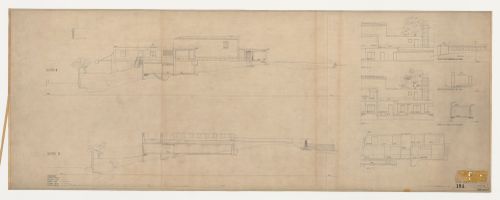
- Section 8 is for the Chapel of Faith, looking south, showing the Way of the Cross walkway, the waiting room and garden for the chapel, the ancillary rooms adjacent to and behind the chapel, the rooms below the main level and the driveway at the rear of the complex. Section 9 is for the columbaria, looking south, showing the stairs of the Way of the Cross walkway and the columbaria. Elevations 10-10 and 11-11 are for the east (rear) façades of the Chapel of Faith and section 12-12 is for the south façade of the ancillary rooms adjacent to the Chapel of the Holy Cross. There are two elevations for the west and north façades and section a-a for a lavatory and there is a sketch by the architect (?) for a pile at u.l. Section cuts 8-12 appear in ground plan DR2000:0007.
DR2000:0009
Description:
- Section 8 is for the Chapel of Faith, looking south, showing the Way of the Cross walkway, the waiting room and garden for the chapel, the ancillary rooms adjacent to and behind the chapel, the rooms below the main level and the driveway at the rear of the complex. Section 9 is for the columbaria, looking south, showing the stairs of the Way of the Cross walkway and the columbaria. Elevations 10-10 and 11-11 are for the east (rear) façades of the Chapel of Faith and section 12-12 is for the south façade of the ancillary rooms adjacent to the Chapel of the Holy Cross. There are two elevations for the west and north façades and section a-a for a lavatory and there is a sketch by the architect (?) for a pile at u.l. Section cuts 8-12 appear in ground plan DR2000:0007.
People:
Subject:
architecture, interior design
architecture, interior design
Date:
1 March 1937
1 March 1937
Title:
Sections 8 to 12 and elevations for a lavatory for the Woodland Crematorium, Woodland Cemetery, Stockholm, Sweden
Actions:
DR2000:0009
Description:
- Section 8 is for the Chapel of Faith, looking south, showing the Way of the Cross walkway, the waiting room and garden for the chapel, the ancillary rooms adjacent to and behind the chapel, the rooms below the main level and the driveway at the rear of the complex. Section 9 is for the columbaria, looking south, showing the stairs of the Way of the Cross walkway and the columbaria. Elevations 10-10 and 11-11 are for the east (rear) façades of the Chapel of Faith and section 12-12 is for the south façade of the ancillary rooms adjacent to the Chapel of the Holy Cross. There are two elevations for the west and north façades and section a-a for a lavatory and there is a sketch by the architect (?) for a pile at u.l. Section cuts 8-12 appear in ground plan DR2000:0007.
Sections 8 to 12 and elevations for a lavatory for the Woodland Crematorium, Woodland Cemetery, Stockholm, Sweden
Actions:
DR2000:0009
Description:
- Section 8 is for the Chapel of Faith, looking south, showing the Way of the Cross walkway, the waiting room and garden for the chapel, the ancillary rooms adjacent to and behind the chapel, the rooms below the main level and the driveway at the rear of the complex. Section 9 is for the columbaria, looking south, showing the stairs of the Way of the Cross walkway and the columbaria. Elevations 10-10 and 11-11 are for the east (rear) façades of the Chapel of Faith and section 12-12 is for the south façade of the ancillary rooms adjacent to the Chapel of the Holy Cross. There are two elevations for the west and north façades and section a-a for a lavatory and there is a sketch by the architect (?) for a pile at u.l. Section cuts 8-12 appear in ground plan DR2000:0007.
Form:
drawings
drawings
Date:
1 March 1937
1 March 1937
People:
Subject:
architecture, interior design
architecture, interior design
Form:
photographs
photographs
Actions:
Reference number:
DR2012:0012:077:001:005
Description:
File containing photographs, printouts, a negative film frame, a stat, and notes related to the following events, locations, and/or projects: - Memo series (5 gelatin silver prints); - Montreal streets (3 gelatin silver prints); - A Kingston construction (2 gelatin silver prints); - Place Desjardins (2 gelatin silver prints); - Beaudry-Leman house, Outremont (1 gelatin silver print); - City of Maisonneuve, former fire station (1 gelatin silver print); - Aerial view of the construction Place Bonaventure (1 gelatin silver print); - The house of an architect (1 gelatin silver print); - Église Notre-Dame-des-Champs, Repentigny (2 gelatin silver prints); - Église Notre-Dame-de-Fatima, Jonquière, (1 gelatin silver print); - Unidentified house (1 gelatin silver print, 1 black-and-white negative); - Pliny on my mind, nos. 1 and 2 (1 gelatin silver print).
DR2012:0012:077:001:005
Description:
File containing photographs, printouts, a negative film frame, a stat, and notes related to the following events, locations, and/or projects: - Memo series (5 gelatin silver prints); - Montreal streets (3 gelatin silver prints); - A Kingston construction (2 gelatin silver prints); - Place Desjardins (2 gelatin silver prints); - Beaudry-Leman house, Outremont (1 gelatin silver print); - City of Maisonneuve, former fire station (1 gelatin silver print); - Aerial view of the construction Place Bonaventure (1 gelatin silver print); - The house of an architect (1 gelatin silver print); - Église Notre-Dame-des-Champs, Repentigny (2 gelatin silver prints); - Église Notre-Dame-de-Fatima, Jonquière, (1 gelatin silver print); - Unidentified house (1 gelatin silver print, 1 black-and-white negative); - Pliny on my mind, nos. 1 and 2 (1 gelatin silver print).
People:
Date:
1964, 1976, 1983
1964, 1976, 1983
Title:
Photographic materials related to events and projects
Actions:
DR2012:0012:077:001:005
Description:
File containing photographs, printouts, a negative film frame, a stat, and notes related to the following events, locations, and/or projects: - Memo series (5 gelatin silver prints); - Montreal streets (3 gelatin silver prints); - A Kingston construction (2 gelatin silver prints); - Place Desjardins (2 gelatin silver prints); - Beaudry-Leman house, Outremont (1 gelatin silver print); - City of Maisonneuve, former fire station (1 gelatin silver print); - Aerial view of the construction Place Bonaventure (1 gelatin silver print); - The house of an architect (1 gelatin silver print); - Église Notre-Dame-des-Champs, Repentigny (2 gelatin silver prints); - Église Notre-Dame-de-Fatima, Jonquière, (1 gelatin silver print); - Unidentified house (1 gelatin silver print, 1 black-and-white negative); - Pliny on my mind, nos. 1 and 2 (1 gelatin silver print).
Photographic materials related to events and projects
Actions:
DR2012:0012:077:001:005
Description:
File containing photographs, printouts, a negative film frame, a stat, and notes related to the following events, locations, and/or projects: - Memo series (5 gelatin silver prints); - Montreal streets (3 gelatin silver prints); - A Kingston construction (2 gelatin silver prints); - Place Desjardins (2 gelatin silver prints); - Beaudry-Leman house, Outremont (1 gelatin silver print); - City of Maisonneuve, former fire station (1 gelatin silver print); - Aerial view of the construction Place Bonaventure (1 gelatin silver print); - The house of an architect (1 gelatin silver print); - Église Notre-Dame-des-Champs, Repentigny (2 gelatin silver prints); - Église Notre-Dame-de-Fatima, Jonquière, (1 gelatin silver print); - Unidentified house (1 gelatin silver print, 1 black-and-white negative); - Pliny on my mind, nos. 1 and 2 (1 gelatin silver print).
Form:
photographs
photographs
Date:
1964, 1976, 1983
1964, 1976, 1983
People:


