


2092 Results
Form:
journals and magazines
journals and magazines
Actions:
Price:
$52.00
(available in store)
Summary:
When Ansgar Schulz first visits Adorf, a small town in Saxony, it is raining. For centuries, freshwater pearl mussels have been fished from the Elster river here; a local heritage museum earmarked for expansion documents their rich history. Watching rainwater trace its way across the existing roofs, the architect imagines the same for the facade of the new building. With(...)
$52.00
(available in store)
Summary:
When Ansgar Schulz first visits Adorf, a small town in Saxony, it is raining. For centuries, freshwater pearl mussels have been fished from the Elster river here; a local heritage museum earmarked for expansion documents their rich history. Watching rainwater trace its way across the existing roofs, the architect imagines the same for the facade of the new building. With(...)
Title:
Detail 7/8 2026: Solid construction
Actions:
Price:
$52.00
(available in store)
Summary:
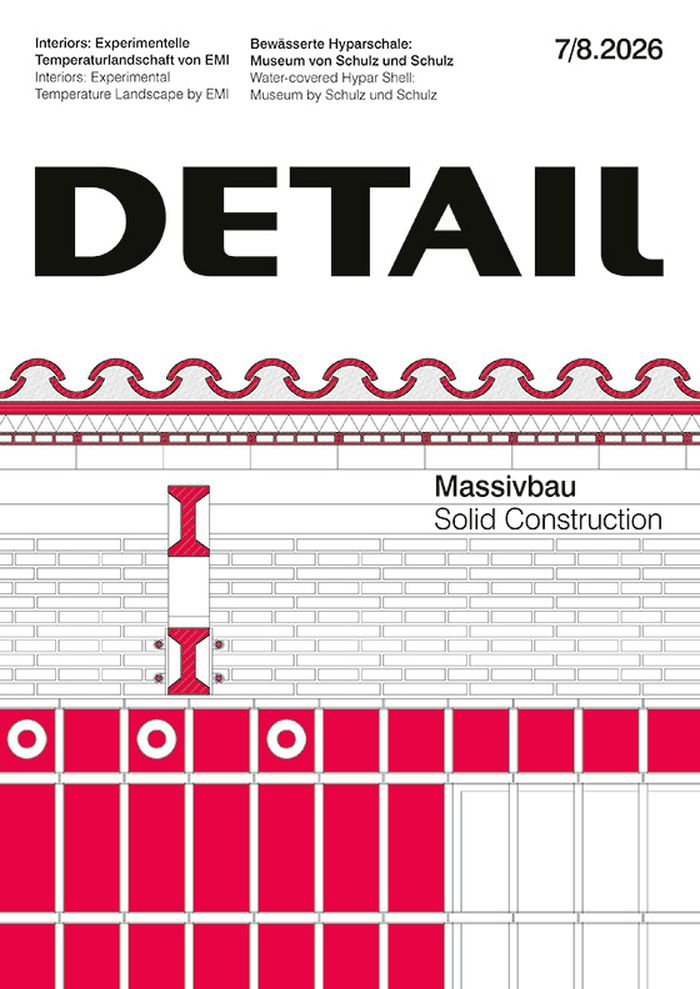
When Ansgar Schulz first visits Adorf, a small town in Saxony, it is raining. For centuries, freshwater pearl mussels have been fished from the Elster river here; a local heritage museum earmarked for expansion documents their rich history. Watching rainwater trace its way across the existing roofs, the architect imagines the same for the facade of the new building. With its double-curved canopy, the Mother-of-Pearl Museum connects two existing structures. Clad in waterproof concrete, the building lets water run quietly down its surface – as if it were always meant to. Outside, the performative detail becomes a sensory echo of the pearl mussels inside. Solid construction is associated with weight, permanence, and immobility. This issue argues otherwise. Hand-pressed bricks, wax-treated rammed earth composed of demolition material, cyclopean concrete from limestone and rubble, hemp lime as a renewable material for the future – each detail explores what masonry can do when it is rethought. Does the heaviest building material have the lightest future?
Detail 7/8 2026: Solid construction
Actions:
Price:
$52.00
(available in store)
Summary:
When Ansgar Schulz first visits Adorf, a small town in Saxony, it is raining. For centuries, freshwater pearl mussels have been fished from the Elster river here; a local heritage museum earmarked for expansion documents their rich history. Watching rainwater trace its way across the existing roofs, the architect imagines the same for the facade of the new building. With its double-curved canopy, the Mother-of-Pearl Museum connects two existing structures. Clad in waterproof concrete, the building lets water run quietly down its surface – as if it were always meant to. Outside, the performative detail becomes a sensory echo of the pearl mussels inside. Solid construction is associated with weight, permanence, and immobility. This issue argues otherwise. Hand-pressed bricks, wax-treated rammed earth composed of demolition material, cyclopean concrete from limestone and rubble, hemp lime as a renewable material for the future – each detail explores what masonry can do when it is rethought. Does the heaviest building material have the lightest future?
Form:
journals and magazines
journals and magazines
Publication:
July 2026
July 2026
Subject:
Magazines
Magazines
Form:
books
books
Actions:
Price:
$37.95
(available in store)
Summary:
Megan Craig and Edward S. Casey provide a collaborative phenomenological exploration of thought in motion, interspersing lively first-person accounts with broader philosophical inquiry. Their investigation, structured around the four ancient elements—water, air, earth, and fire—ranges across swimming, boats, balloons, planes, cars, trains, and other modes of transport.(...)
$37.95
(available in store)
Summary:
Megan Craig and Edward S. Casey provide a collaborative phenomenological exploration of thought in motion, interspersing lively first-person accounts with broader philosophical inquiry. Their investigation, structured around the four ancient elements—water, air, earth, and fire—ranges across swimming, boats, balloons, planes, cars, trains, and other modes of transport.(...)
Title:
Thinking in transit: Explorations of life in motion
Actions:
Price:
$37.95
(available in store)
Summary:
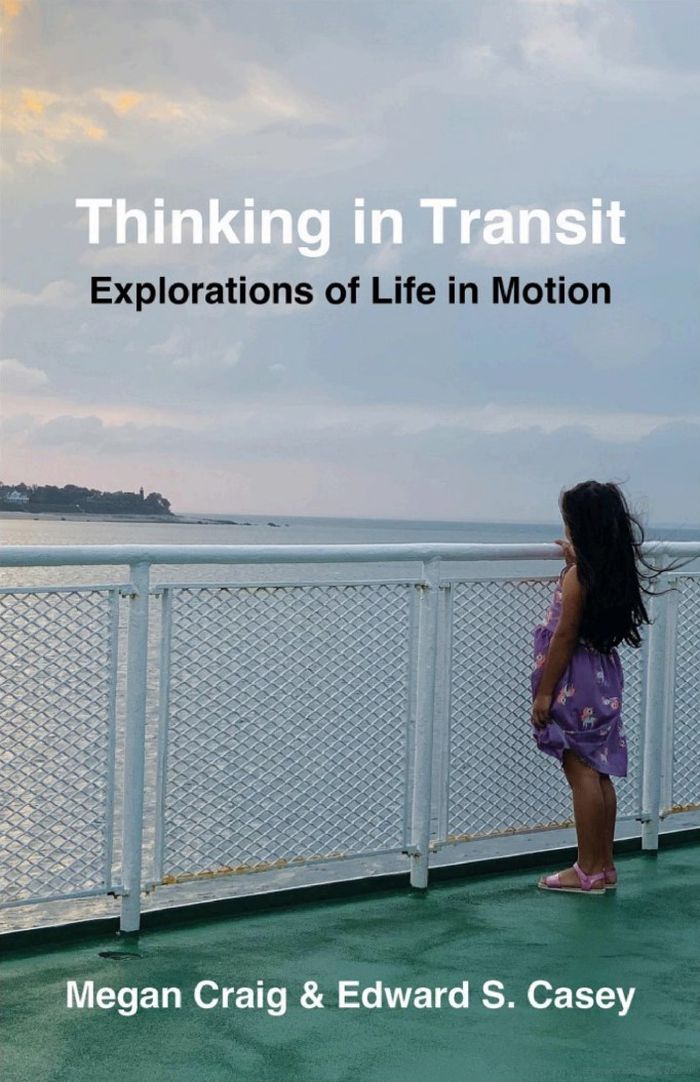
Megan Craig and Edward S. Casey provide a collaborative phenomenological exploration of thought in motion, interspersing lively first-person accounts with broader philosophical inquiry. Their investigation, structured around the four ancient elements—water, air, earth, and fire—ranges across swimming, boats, balloons, planes, cars, trains, and other modes of transport. Craig and Casey invite readers to recall their own experiences of travel and how thinking changes in tandem with shifting environments and whatever conveys a person from place to place. They also consider how changing climates and evolving technologies, with new rhythms and materialities, have shaped human thinking in its many varieties. ''Thinking in Transit'' celebrates forms of movement and motion that carry the body and mind out of their habituated routines. This book urges a change in how philosophers have traditionally framed the setting for serious thought: from the austere, solitary space of a study to populated places of interaction and passage.
Thinking in transit: Explorations of life in motion
Actions:
Price:
$37.95
(available in store)
Summary:
Megan Craig and Edward S. Casey provide a collaborative phenomenological exploration of thought in motion, interspersing lively first-person accounts with broader philosophical inquiry. Their investigation, structured around the four ancient elements—water, air, earth, and fire—ranges across swimming, boats, balloons, planes, cars, trains, and other modes of transport. Craig and Casey invite readers to recall their own experiences of travel and how thinking changes in tandem with shifting environments and whatever conveys a person from place to place. They also consider how changing climates and evolving technologies, with new rhythms and materialities, have shaped human thinking in its many varieties. ''Thinking in Transit'' celebrates forms of movement and motion that carry the body and mind out of their habituated routines. This book urges a change in how philosophers have traditionally framed the setting for serious thought: from the austere, solitary space of a study to populated places of interaction and passage.
Form:
books
books
Publication:
September 2025
September 2025
Subject:
Journeys
Journeys
Form:
books
books
Price:
$38.50
(available in store)
Summary:
In ''The Aesthetics of Ambiguity: Understanding and Addressing Monoculture'' Pascal Gielen and Nav Haq argue that multiculturalism is paradoxically based on monocultural thinking. The publication explores this paradox by exploring monoculture in a variety of contemporary contexts. The book sets out to analyse monoculture using a multifaceted approach, by bringing together(...)
$38.50
(available in store)
Summary:
In ''The Aesthetics of Ambiguity: Understanding and Addressing Monoculture'' Pascal Gielen and Nav Haq argue that multiculturalism is paradoxically based on monocultural thinking. The publication explores this paradox by exploring monoculture in a variety of contemporary contexts. The book sets out to analyse monoculture using a multifaceted approach, by bringing together(...)
Title:
The aesthetics of ambiguity: Understanding and adressing monoculture
Actions:
Price:
$38.50
(available in store)
Summary:
In ''The Aesthetics of Ambiguity: Understanding and Addressing Monoculture'' Pascal Gielen and Nav Haq argue that multiculturalism is paradoxically based on monocultural thinking. The publication explores this paradox by exploring monoculture in a variety of contemporary contexts. The book sets out to analyse monoculture using a multifaceted approach, by bringing together historical, social, cultural and ideological perspectives, using the dual role of art as tool for reconciliation and division in societies. ''The Aesthetics of Ambiguity'' gives stage to artists, thinkers and institutional practices who dare to play with the rules of a broader society and thus generate ambiguity ‘at large’. The book represents a quest for (more) ambiguity in order to avoid rigid borders or black-and-white polarities between cultures, as well as between practices of art and scientific thinking. By doing so, the artists, activists and researchers featured in this book plea for a politics and aesthetics of ambiguity to deal with the complexity of our living together on Earth.
The aesthetics of ambiguity: Understanding and adressing monoculture
Actions:
Price:
$38.50
(available in store)
Summary:
In ''The Aesthetics of Ambiguity: Understanding and Addressing Monoculture'' Pascal Gielen and Nav Haq argue that multiculturalism is paradoxically based on monocultural thinking. The publication explores this paradox by exploring monoculture in a variety of contemporary contexts. The book sets out to analyse monoculture using a multifaceted approach, by bringing together historical, social, cultural and ideological perspectives, using the dual role of art as tool for reconciliation and division in societies. ''The Aesthetics of Ambiguity'' gives stage to artists, thinkers and institutional practices who dare to play with the rules of a broader society and thus generate ambiguity ‘at large’. The book represents a quest for (more) ambiguity in order to avoid rigid borders or black-and-white polarities between cultures, as well as between practices of art and scientific thinking. By doing so, the artists, activists and researchers featured in this book plea for a politics and aesthetics of ambiguity to deal with the complexity of our living together on Earth.
Form:
books
books
Publication:
December 2024
December 2024
Subject:
Art Theory
Art Theory
Form:
books
books
Title:
Midwife of the intellect
Midwife of the intellect
Actions:
Price:
$15.75
(available in store)
Summary:
How could a Rhineland mystic of the 13th century help us better navigate the 21st? In a provocative reading of the work of Meister Eckhart, Peter Sloterdijk offers a compelling answer: What medieval mysticism teaches us is that all there is doesn’t exist per se—everything only exists in relation. For Eckhart, living on Earth is the same as the Holy Trinity: in a(...)
$15.75
(available in store)
Summary:
How could a Rhineland mystic of the 13th century help us better navigate the 21st? In a provocative reading of the work of Meister Eckhart, Peter Sloterdijk offers a compelling answer: What medieval mysticism teaches us is that all there is doesn’t exist per se—everything only exists in relation. For Eckhart, living on Earth is the same as the Holy Trinity: in a(...)
Title:
Midwife of the intellect
Actions:
Price:
$15.75
(available in store)
Summary:
How could a Rhineland mystic of the 13th century help us better navigate the 21st? In a provocative reading of the work of Meister Eckhart, Peter Sloterdijk offers a compelling answer: What medieval mysticism teaches us is that all there is doesn’t exist per se—everything only exists in relation. For Eckhart, living on Earth is the same as the Holy Trinity: in a symbiosis, a form of co-relationship forgotten for too long. The triumph of individualism led to the shared illusion that humans, like everything else on the planet, had an essence, an identity, a being. But nothing could be more false. What everything is, is the others. What everything is, is a shared relationality. We are not alone—we are also all others; we depend on them. In the Anthropocene, when planetary symbiosis has never been more jeopardized, shifting our metaphysics and recalling lessons such as those of Meister Eckhart has become vital.
Midwife of the intellect
Actions:
Price:
$15.75
(available in store)
Summary:
How could a Rhineland mystic of the 13th century help us better navigate the 21st? In a provocative reading of the work of Meister Eckhart, Peter Sloterdijk offers a compelling answer: What medieval mysticism teaches us is that all there is doesn’t exist per se—everything only exists in relation. For Eckhart, living on Earth is the same as the Holy Trinity: in a symbiosis, a form of co-relationship forgotten for too long. The triumph of individualism led to the shared illusion that humans, like everything else on the planet, had an essence, an identity, a being. But nothing could be more false. What everything is, is the others. What everything is, is a shared relationality. We are not alone—we are also all others; we depend on them. In the Anthropocene, when planetary symbiosis has never been more jeopardized, shifting our metaphysics and recalling lessons such as those of Meister Eckhart has become vital.
Form:
books
books
Publication:
November 2025
November 2025
Subject:
Critical Theory
Critical Theory
Form:
books
books
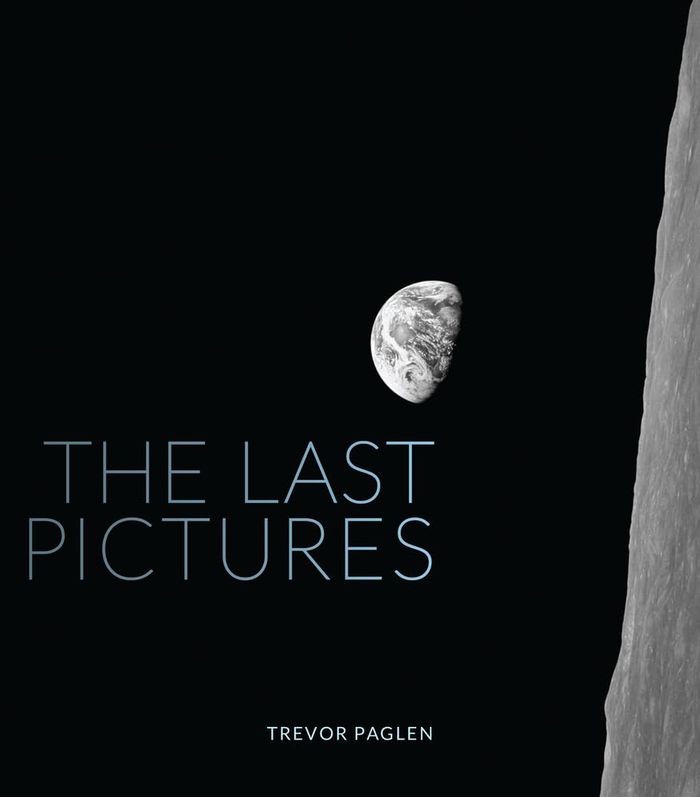
Title:
The last pictures
The last pictures
Actions:
Price:
$52.00
(available in store)
Summary:
Human civilizations' longest lasting artifacts are not the great Pyramids of Giza, nor the cave paintings at Lascaux, but the communications satellites that circle our planet. In a stationary orbit above the equator, the satellites that broadcast our TV signals, route our phone calls, and process our credit card transactions experience no atmospheric drag. Their inert(...)
$52.00
(available in store)
Summary:
Human civilizations' longest lasting artifacts are not the great Pyramids of Giza, nor the cave paintings at Lascaux, but the communications satellites that circle our planet. In a stationary orbit above the equator, the satellites that broadcast our TV signals, route our phone calls, and process our credit card transactions experience no atmospheric drag. Their inert(...)
Title:
The last pictures
Actions:
Price:
$52.00
(available in store)
Summary:
Human civilizations' longest lasting artifacts are not the great Pyramids of Giza, nor the cave paintings at Lascaux, but the communications satellites that circle our planet. In a stationary orbit above the equator, the satellites that broadcast our TV signals, route our phone calls, and process our credit card transactions experience no atmospheric drag. Their inert hulls will continue to drift around Earth until the Sun expands into a red giant and engulfs them about 4.5 billion years from now. he Last Pictures, co-published by Creative Time Books, is rooted in the premise that these communications satellites will ultimately become the cultural and material ruins of the late 20th and early 21st centuries, far outlasting anything else humans have created. Inspired in part by ancient cave paintings, nuclear waste warning signs, and Carl Sagan's Golden Records of the 1970s, artist/geographer and MacArthur "Genius" Fellow Trevor Paglen has developed a collection of one hundred images that will be etched onto an ultra-archival, golden silicon disc.
The last pictures
Actions:
Price:
$52.00
(available in store)
Summary:
Human civilizations' longest lasting artifacts are not the great Pyramids of Giza, nor the cave paintings at Lascaux, but the communications satellites that circle our planet. In a stationary orbit above the equator, the satellites that broadcast our TV signals, route our phone calls, and process our credit card transactions experience no atmospheric drag. Their inert hulls will continue to drift around Earth until the Sun expands into a red giant and engulfs them about 4.5 billion years from now. he Last Pictures, co-published by Creative Time Books, is rooted in the premise that these communications satellites will ultimately become the cultural and material ruins of the late 20th and early 21st centuries, far outlasting anything else humans have created. Inspired in part by ancient cave paintings, nuclear waste warning signs, and Carl Sagan's Golden Records of the 1970s, artist/geographer and MacArthur "Genius" Fellow Trevor Paglen has developed a collection of one hundred images that will be etched onto an ultra-archival, golden silicon disc.
Form:
books
books
Publication:
September 2012
September 2012
Subject:
Art Theory
Art Theory
Form:
books
books
Title:
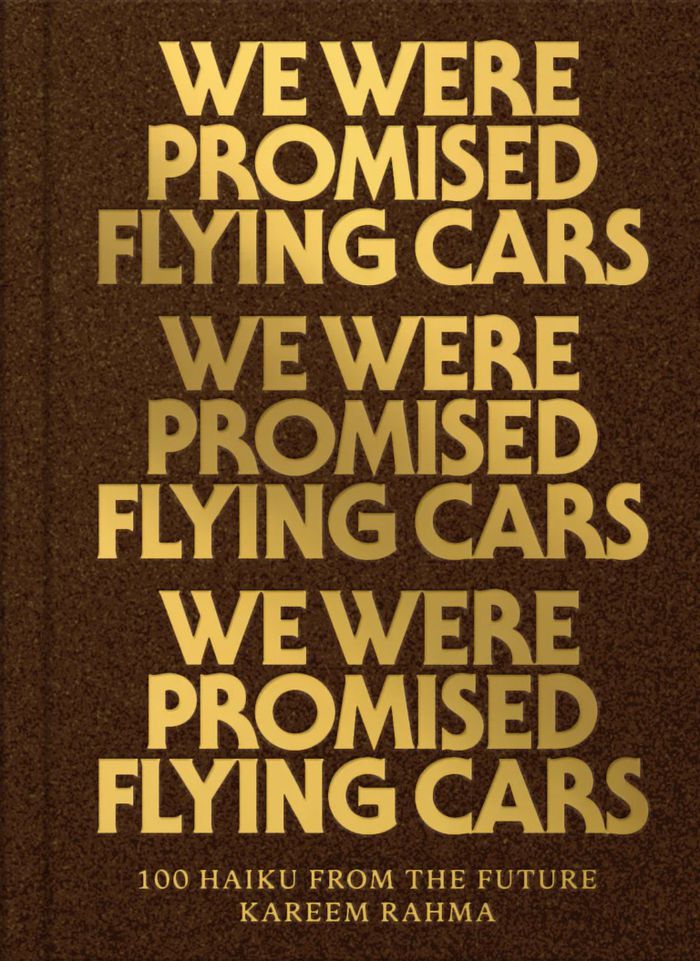
We were promised flying cars
We were promised flying cars
Actions:
Price:
$28.00
(available in store)
Summary:
The debut poetry collection from Arab-American poet Kareem Rahma - formerly of VICE and The New York Times - shows us the future in haiku. Simultaneously a hopeful prayer for change and direct warning to the reader, Rahma makes masterful work of the haiku form to build a very possible future world dominated by corporations, an earth depleted of natural resources, and(...)
$28.00
(available in store)
Summary:
The debut poetry collection from Arab-American poet Kareem Rahma - formerly of VICE and The New York Times - shows us the future in haiku. Simultaneously a hopeful prayer for change and direct warning to the reader, Rahma makes masterful work of the haiku form to build a very possible future world dominated by corporations, an earth depleted of natural resources, and(...)
Title:
We were promised flying cars
Actions:
Price:
$28.00
(available in store)
Summary:
The debut poetry collection from Arab-American poet Kareem Rahma - formerly of VICE and The New York Times - shows us the future in haiku. Simultaneously a hopeful prayer for change and direct warning to the reader, Rahma makes masterful work of the haiku form to build a very possible future world dominated by corporations, an earth depleted of natural resources, and humans turned into zombies, glued to their screens. The future that awaits us is not the one we’ve hoped for or what we were promised, but a terrible culmination of what we’ve done to ourselves. Elegant but caustically humorous, this prophetic vision can be returned to again and again, because even in the darkness, Rahma remains hopeful that we can still keep the promises we made in the past. Paired with Jean-Marc Côté’s nineteenth-century illustrations of an imagined year 2000, ''We Were Promised Flying Cars'' is not just for poetry and science fiction fans, but anyone interested in what tomorrow might look like.
We were promised flying cars
Actions:
Price:
$28.00
(available in store)
Summary:
The debut poetry collection from Arab-American poet Kareem Rahma - formerly of VICE and The New York Times - shows us the future in haiku. Simultaneously a hopeful prayer for change and direct warning to the reader, Rahma makes masterful work of the haiku form to build a very possible future world dominated by corporations, an earth depleted of natural resources, and humans turned into zombies, glued to their screens. The future that awaits us is not the one we’ve hoped for or what we were promised, but a terrible culmination of what we’ve done to ourselves. Elegant but caustically humorous, this prophetic vision can be returned to again and again, because even in the darkness, Rahma remains hopeful that we can still keep the promises we made in the past. Paired with Jean-Marc Côté’s nineteenth-century illustrations of an imagined year 2000, ''We Were Promised Flying Cars'' is not just for poetry and science fiction fans, but anyone interested in what tomorrow might look like.
Form:
books
books
Publication:
November 2025
November 2025
Subject:
Literature and poetry
Literature and poetry
Form:
books
books
Title:
Kai Wiedenhöfer : wall
Kai Wiedenhöfer : wall
Actions:
Price:
$48.00
(available to order)
Summary:
"You cannot shake hands across a nine meter wall", says a Palestinian pensioner who lives in the shadow of the Separation Barrier currently being built by the Israeli government. Since October 2003, photographer Kai Wiedenhöfer, who has been documenting the Israeli-Palestinian conflict for more than a decade, has been meeting with inhabitants of the Occupied Palestinian(...)
$48.00
(available to order)
Summary:
"You cannot shake hands across a nine meter wall", says a Palestinian pensioner who lives in the shadow of the Separation Barrier currently being built by the Israeli government. Since October 2003, photographer Kai Wiedenhöfer, who has been documenting the Israeli-Palestinian conflict for more than a decade, has been meeting with inhabitants of the Occupied Palestinian(...)
Title:
Kai Wiedenhöfer : wall
Actions:
Price:
$48.00
(available to order)
Summary:
"You cannot shake hands across a nine meter wall", says a Palestinian pensioner who lives in the shadow of the Separation Barrier currently being built by the Israeli government. Since October 2003, photographer Kai Wiedenhöfer, who has been documenting the Israeli-Palestinian conflict for more than a decade, has been meeting with inhabitants of the Occupied Palestinian Territories living in the path of the barrier. Every six months, he has been returning to the territories to document the construction of the 650 kilometers of walls, fences, ditches and earth mounds, which form the border between the State of Israel and a future Palestinian entity. The series of images in this book are all 6 x 17 cm panoramics which depict the wall and fragments of life in its shadow. In 1989, the Berlin-based photographer documented the fall of the wall in his own city. Recent German history has convinced Wiedenhöfer that separation barriers offer no realistic solutions to political conflict.
Kai Wiedenhöfer : wall
Actions:
Price:
$48.00
(available to order)
Summary:
"You cannot shake hands across a nine meter wall", says a Palestinian pensioner who lives in the shadow of the Separation Barrier currently being built by the Israeli government. Since October 2003, photographer Kai Wiedenhöfer, who has been documenting the Israeli-Palestinian conflict for more than a decade, has been meeting with inhabitants of the Occupied Palestinian Territories living in the path of the barrier. Every six months, he has been returning to the territories to document the construction of the 650 kilometers of walls, fences, ditches and earth mounds, which form the border between the State of Israel and a future Palestinian entity. The series of images in this book are all 6 x 17 cm panoramics which depict the wall and fragments of life in its shadow. In 1989, the Berlin-based photographer documented the fall of the wall in his own city. Recent German history has convinced Wiedenhöfer that separation barriers offer no realistic solutions to political conflict.
Form:
books
books
Publication:
January 2007, Göttingen
January 2007, Göttingen
Subject:
Photography monographs
Photography monographs
Form:
books
books
Actions:
Price:
$40.95
(available to order)
Summary:
"Patterned Ground" unravels the entangled relationships between nature and culture. Around 100 entries by leading names in new geography and related disciplines focus on various ‘objects’ in the landscape – from beaches to battlefields, bees to horses, police stations to post-offices, trees to tractors. Each piece, written by an expert in the field, explores the way in(...)
$40.95
(available to order)
Summary:
"Patterned Ground" unravels the entangled relationships between nature and culture. Around 100 entries by leading names in new geography and related disciplines focus on various ‘objects’ in the landscape – from beaches to battlefields, bees to horses, police stations to post-offices, trees to tractors. Each piece, written by an expert in the field, explores the way in(...)
Subject:
Urban Theory
Urban Theory
Publication:
March 2004, London
March 2004, London
Title:
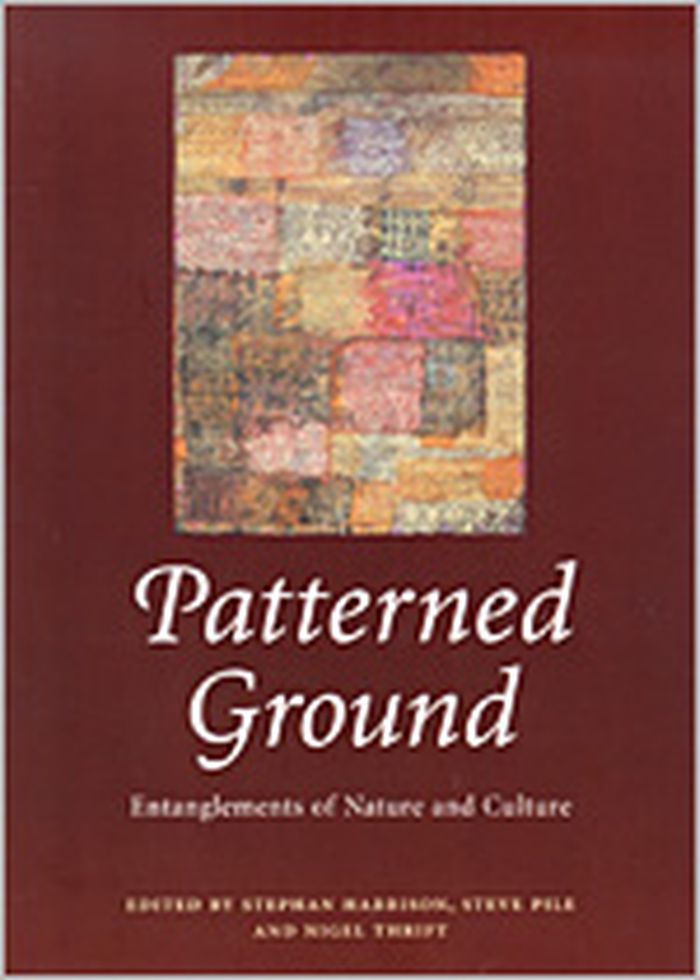
Patterned ground : entanglements of nature and culture
Actions:
Price:
$40.95
(available to order)
Summary:
"Patterned Ground" unravels the entangled relationships between nature and culture. Around 100 entries by leading names in new geography and related disciplines focus on various ‘objects’ in the landscape – from beaches to battlefields, bees to horses, police stations to post-offices, trees to tractors. Each piece, written by an expert in the field, explores the way in which we understand that object and its relationship to the world around it. This book is neither encyclopædia nor dictionary, but a knowledgeable and impassioned engagement with the world. In this sense, it chimes with earlier experiments in understanding the earth and its landscapes, whether these endeavours have been conducted within the sciences, the social sciences or the arts. "Patterned Ground" backtracks from familiar and obvious ways of seeing patterns in the world, and discovers it anew. In this way, it opens up new possibilities for thinking about the relationships between ourselves, objects and the ground on which we walk.
Patterned ground : entanglements of nature and culture
Actions:
Price:
$40.95
(available to order)
Summary:
"Patterned Ground" unravels the entangled relationships between nature and culture. Around 100 entries by leading names in new geography and related disciplines focus on various ‘objects’ in the landscape – from beaches to battlefields, bees to horses, police stations to post-offices, trees to tractors. Each piece, written by an expert in the field, explores the way in which we understand that object and its relationship to the world around it. This book is neither encyclopædia nor dictionary, but a knowledgeable and impassioned engagement with the world. In this sense, it chimes with earlier experiments in understanding the earth and its landscapes, whether these endeavours have been conducted within the sciences, the social sciences or the arts. "Patterned Ground" backtracks from familiar and obvious ways of seeing patterns in the world, and discovers it anew. In this way, it opens up new possibilities for thinking about the relationships between ourselves, objects and the ground on which we walk.
Form:
books
books
Publication:
March 2004, London
March 2004, London
Subject:
Urban Theory
Urban Theory
Form:
books
books
Title:
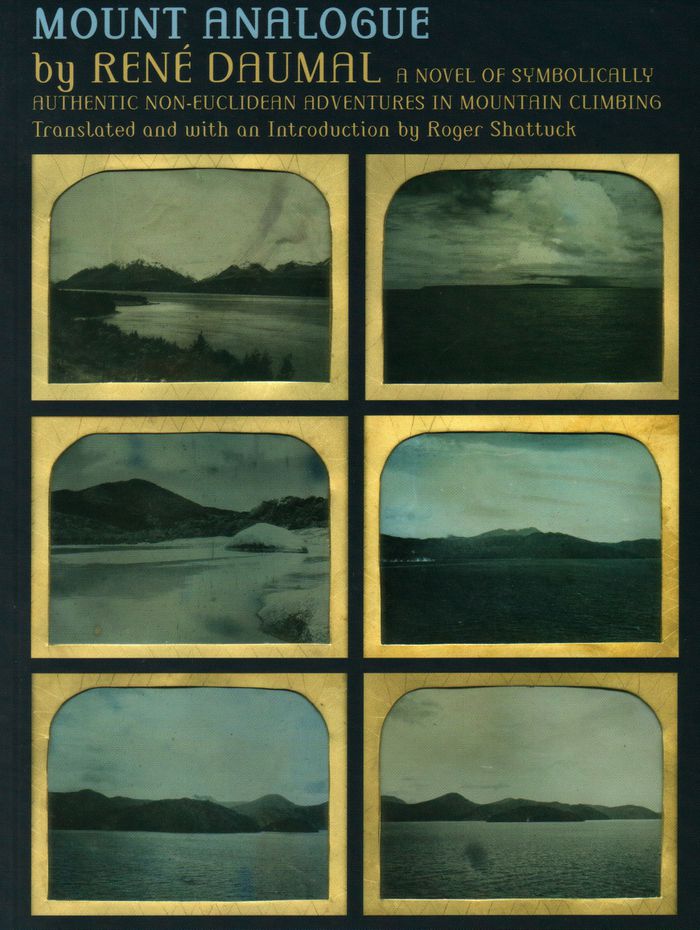
Mount analogue: a novel of symbolically authentic non-Euclidean adventures in mountain climbing
Mount analogue: a novel of symbolically authentic non-Euclidean adventures in mountain climbing
Actions:
Price:
$24.95
(available in store)
Summary:
A beloved cult classic of surrealism, pataphysics and Gurdjieffian mysticism, René Daumal’s ''Mount Analogue'' is the allegorical tale of an expedition to a mountain whose existence can only be deduced, not observed. As its numerous editions (most now rare) over the decades attest, the book has been highly influential: Alejandro Jodorowsky's visionary 1973 film ''The Holy(...)
$24.95
(available in store)
Summary:
A beloved cult classic of surrealism, pataphysics and Gurdjieffian mysticism, René Daumal’s ''Mount Analogue'' is the allegorical tale of an expedition to a mountain whose existence can only be deduced, not observed. As its numerous editions (most now rare) over the decades attest, the book has been highly influential: Alejandro Jodorowsky's visionary 1973 film ''The Holy(...)
Title:
Mount analogue: a novel of symbolically authentic non-Euclidean adventures in mountain climbing
Actions:
Price:
$24.95
(available in store)
Summary:
A beloved cult classic of surrealism, pataphysics and Gurdjieffian mysticism, René Daumal’s ''Mount Analogue'' is the allegorical tale of an expedition to a mountain whose existence can only be deduced, not observed. As its numerous editions (most now rare) over the decades attest, the book has been highly influential: Alejandro Jodorowsky's visionary 1973 film ''The Holy Mountain'' is a loose adaptation of the book, and John Zorn based an eponymous album on it. Left unfinished after Daumal’s death from tuberculosis in 1944—in mid-sentence, as he broke from writing to receive a visitor—''Mount Analogue'' offers a compelling and philosophically resonant chronicle of a group of travelers seeking the titular mountain, based on the symbolic calculations of one Father Sogol (“Logos” spelled backward) and his students. As Daumal writes, “ 'Mount Analogue' is the symbolic mountain—the way that unites Heaven and Earth, a way which must exist in material and human form, otherwise our situation would be without hope.”
Mount analogue: a novel of symbolically authentic non-Euclidean adventures in mountain climbing
Actions:
Price:
$24.95
(available in store)
Summary:
A beloved cult classic of surrealism, pataphysics and Gurdjieffian mysticism, René Daumal’s ''Mount Analogue'' is the allegorical tale of an expedition to a mountain whose existence can only be deduced, not observed. As its numerous editions (most now rare) over the decades attest, the book has been highly influential: Alejandro Jodorowsky's visionary 1973 film ''The Holy Mountain'' is a loose adaptation of the book, and John Zorn based an eponymous album on it. Left unfinished after Daumal’s death from tuberculosis in 1944—in mid-sentence, as he broke from writing to receive a visitor—''Mount Analogue'' offers a compelling and philosophically resonant chronicle of a group of travelers seeking the titular mountain, based on the symbolic calculations of one Father Sogol (“Logos” spelled backward) and his students. As Daumal writes, “ 'Mount Analogue' is the symbolic mountain—the way that unites Heaven and Earth, a way which must exist in material and human form, otherwise our situation would be without hope.”
Form:
books
books
Publication:
September 2019
September 2019
Subject:
Literature and poetry
Literature and poetry
Form:
journals and magazines
journals and magazines
Price:
$20.00
(available to order)
Summary:
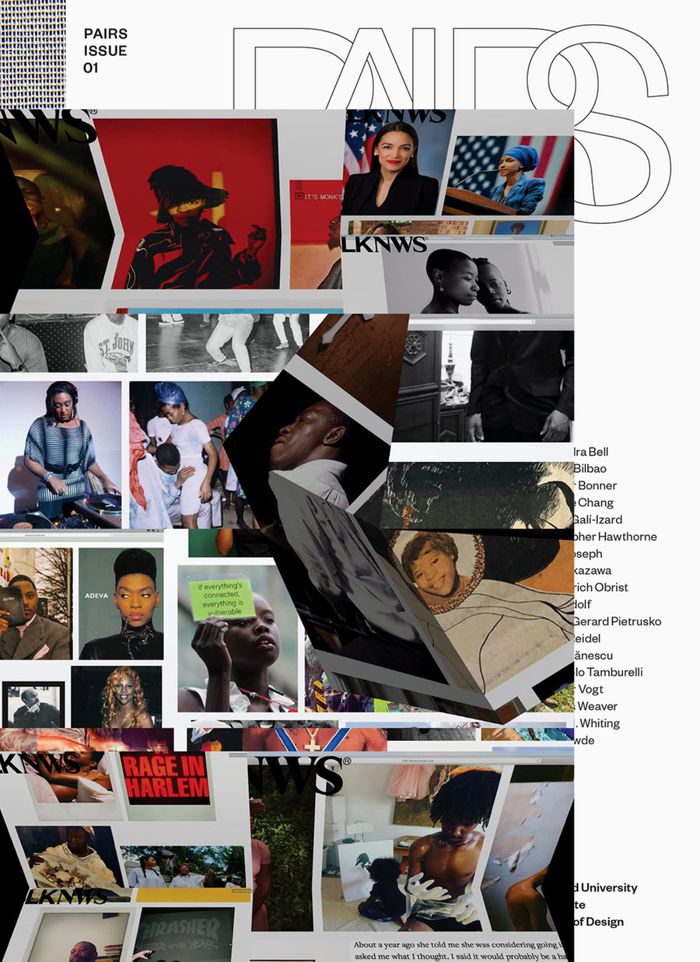
''Pairs'' is a student-led journal at the Harvard GSD dedicated to conversations about design that are down to earth and unguarded. Each issue is conceptualized by an editorial team that proposes guests and objects to be in dialogue with one another. ''Pairs'' is non-thematic, meant instead for provisional thoughts and ideas in progress. Each issue seeks to organize a(...)
$20.00
(available to order)
Summary:
''Pairs'' is a student-led journal at the Harvard GSD dedicated to conversations about design that are down to earth and unguarded. Each issue is conceptualized by an editorial team that proposes guests and objects to be in dialogue with one another. ''Pairs'' is non-thematic, meant instead for provisional thoughts and ideas in progress. Each issue seeks to organize a(...)
Title:
Pairs 01
Actions:
Price:
$20.00
(available to order)
Summary:
''Pairs'' is a student-led journal at the Harvard GSD dedicated to conversations about design that are down to earth and unguarded. Each issue is conceptualized by an editorial team that proposes guests and objects to be in dialogue with one another. ''Pairs'' is non-thematic, meant instead for provisional thoughts and ideas in progress. Each issue seeks to organize a diversity of threads and concerns that are perceived to be relevant to our moment. Thus, ''Pairs'' creates a space for understanding and a greater degree of exchange, both between the design disciplines and with a larger public. This inaugural issue of ''Pairs'' contains conversations with designers, academics and critics that take on the present from a variety of perspectives. There are reflections on major personal, disciplinary, or political turning points. There are reevaluations of moments in the past that shed light on social questions at the top of our minds. There are also discussions on gardening, book-making, publishing, and the conversation itself.
Pairs 01
Actions:
Price:
$20.00
(available to order)
Summary:
''Pairs'' is a student-led journal at the Harvard GSD dedicated to conversations about design that are down to earth and unguarded. Each issue is conceptualized by an editorial team that proposes guests and objects to be in dialogue with one another. ''Pairs'' is non-thematic, meant instead for provisional thoughts and ideas in progress. Each issue seeks to organize a diversity of threads and concerns that are perceived to be relevant to our moment. Thus, ''Pairs'' creates a space for understanding and a greater degree of exchange, both between the design disciplines and with a larger public. This inaugural issue of ''Pairs'' contains conversations with designers, academics and critics that take on the present from a variety of perspectives. There are reflections on major personal, disciplinary, or political turning points. There are reevaluations of moments in the past that shed light on social questions at the top of our minds. There are also discussions on gardening, book-making, publishing, and the conversation itself.
Form:
journals and magazines
journals and magazines
Publication:
February 2021
February 2021
Subject:
Magazines
Magazines


