


13023 Results
Form:
photographs
photographs

Actions:
Reference number:
PH1987:0080:032
PH1987:0080:032
People:
Date:
1914-1916
1914-1916
Form:
photographs
photographs
Date:
1914-1916
1914-1916
People:
Level of archival description:
Project
Project
Reference number:
AP140.S2.SS1.D16
Description:
File documents an unexecuted project, the successful entry in a limited competition for three houses for Basil Mavrolean, his two sons and their families in London, England, United Kingdom. Material in this file was produced in 1957 and probably after. File contains a map, presentation drawings, and photographic materials.
AP140.S2.SS1.D16
Description:
File documents an unexecuted project, the successful entry in a limited competition for three houses for Basil Mavrolean, his two sons and their families in London, England, United Kingdom. Material in this file was produced in 1957 and probably after. File contains a map, presentation drawings, and photographic materials.
People:
Date:
circa 1957
circa 1957
Title:
Three Houses for B. Mavrolean Family Competition, London, England, United Kingdom
Actions:
AP140.S2.SS1.D16
Description:
File documents an unexecuted project, the successful entry in a limited competition for three houses for Basil Mavrolean, his two sons and their families in London, England, United Kingdom. Material in this file was produced in 1957 and probably after. File contains a map, presentation drawings, and photographic materials.
Three Houses for B. Mavrolean Family Competition, London, England, United Kingdom
Actions:
AP140.S2.SS1.D16
Description:
File documents an unexecuted project, the successful entry in a limited competition for three houses for Basil Mavrolean, his two sons and their families in London, England, United Kingdom. Material in this file was produced in 1957 and probably after. File contains a map, presentation drawings, and photographic materials.
Level of archival description:
File 16
File 16
Date:
circa 1957
circa 1957
People:
Form:
photographs
photographs
Title:
General view of Saint-Pierre-de-Véronne-à-Pike-River showing the church, houses and farmland, Québec
General view of Saint-Pierre-de-Véronne-à-Pike-River showing the church, houses and farmland, Québec
Actions:
Reference number:
PH1987:1178
PH1987:1178
People:
Subject:
architecture
architecture
Date:
1986
1986
Title:
General view of Saint-Pierre-de-Véronne-à-Pike-River showing the church, houses and farmland, Québec
Actions:
PH1987:1178
General view of Saint-Pierre-de-Véronne-à-Pike-River showing the church, houses and farmland, Québec
Actions:
PH1987:1178
Form:
photographs
photographs
Date:
1986
1986
People:
Subject:
architecture
architecture
Form:
photographs
photographs
Actions:
Reference number:
PH1997:0059
Description:
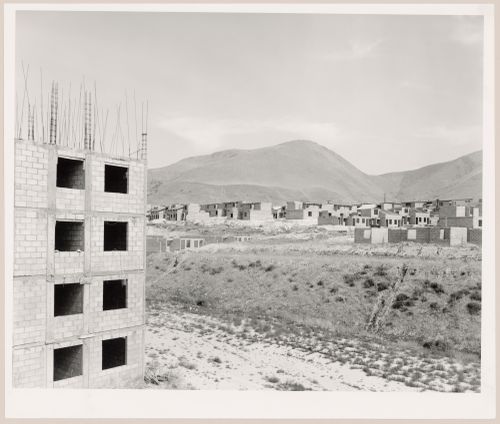
- The series "Running Fence 1997" focuses "on the first 14 miles of the border fence that separates the United States and Mexico, beginning at the Pacific Ocean and ending in the Otay Mountains.... [It] analyzes the "idea" of the border and explores its iconography, the border being a subject that is of extreme importance to the public as the world proceeds towards greater globalization. [Geoffrey] James has written of the project: "[The border fence] was built by the US Army Corps of Engineers in 1994, out of recycled metal landing strip - the most visible symbol of what is known as Operation Gatekeeper. Because the steel sheets are placed in the ground so that their ridges run horizontally, a man can hop over the fence with ease; and no Mexican child ever seems to be impeded from retrieving a soccer ball from US territory. The real barrier to illegal immigration from Mexico into the USA is less visible: hundreds of buried sensors linked to a central computer, nightscopes, helicopters and Border Patrol Agents in white Broncos."" (Evans).
PH1997:0059
Description:
- The series "Running Fence 1997" focuses "on the first 14 miles of the border fence that separates the United States and Mexico, beginning at the Pacific Ocean and ending in the Otay Mountains.... [It] analyzes the "idea" of the border and explores its iconography, the border being a subject that is of extreme importance to the public as the world proceeds towards greater globalization. [Geoffrey] James has written of the project: "[The border fence] was built by the US Army Corps of Engineers in 1994, out of recycled metal landing strip - the most visible symbol of what is known as Operation Gatekeeper. Because the steel sheets are placed in the ground so that their ridges run horizontally, a man can hop over the fence with ease; and no Mexican child ever seems to be impeded from retrieving a soccer ball from US territory. The real barrier to illegal immigration from Mexico into the USA is less visible: hundreds of buried sensors linked to a central computer, nightscopes, helicopters and Border Patrol Agents in white Broncos."" (Evans).
People:
Subject:
architecture, engineering, topographic
architecture, engineering, topographic
Date:
1997
1997
Title:
View of an industrial park under construction with a partially completed building in the foreground and partially completed houses and mountains in the background, Mesa de Otay, Tijuana, Baja California, Mexico
Actions:
PH1997:0059
Description:
- The series "Running Fence 1997" focuses "on the first 14 miles of the border fence that separates the United States and Mexico, beginning at the Pacific Ocean and ending in the Otay Mountains.... [It] analyzes the "idea" of the border and explores its iconography, the border being a subject that is of extreme importance to the public as the world proceeds towards greater globalization. [Geoffrey] James has written of the project: "[The border fence] was built by the US Army Corps of Engineers in 1994, out of recycled metal landing strip - the most visible symbol of what is known as Operation Gatekeeper. Because the steel sheets are placed in the ground so that their ridges run horizontally, a man can hop over the fence with ease; and no Mexican child ever seems to be impeded from retrieving a soccer ball from US territory. The real barrier to illegal immigration from Mexico into the USA is less visible: hundreds of buried sensors linked to a central computer, nightscopes, helicopters and Border Patrol Agents in white Broncos."" (Evans).
View of an industrial park under construction with a partially completed building in the foreground and partially completed houses and mountains in the background, Mesa de Otay, Tijuana, Baja California, Mexico
Actions:
PH1997:0059
Description:
- The series "Running Fence 1997" focuses "on the first 14 miles of the border fence that separates the United States and Mexico, beginning at the Pacific Ocean and ending in the Otay Mountains.... [It] analyzes the "idea" of the border and explores its iconography, the border being a subject that is of extreme importance to the public as the world proceeds towards greater globalization. [Geoffrey] James has written of the project: "[The border fence] was built by the US Army Corps of Engineers in 1994, out of recycled metal landing strip - the most visible symbol of what is known as Operation Gatekeeper. Because the steel sheets are placed in the ground so that their ridges run horizontally, a man can hop over the fence with ease; and no Mexican child ever seems to be impeded from retrieving a soccer ball from US territory. The real barrier to illegal immigration from Mexico into the USA is less visible: hundreds of buried sensors linked to a central computer, nightscopes, helicopters and Border Patrol Agents in white Broncos."" (Evans).
Form:
photographs
photographs
Date:
1997
1997
People:
Subject:
architecture, engineering, topographic
architecture, engineering, topographic
Form:
photographs
photographs
Actions:
Reference number:
PH1997:0061
Description:
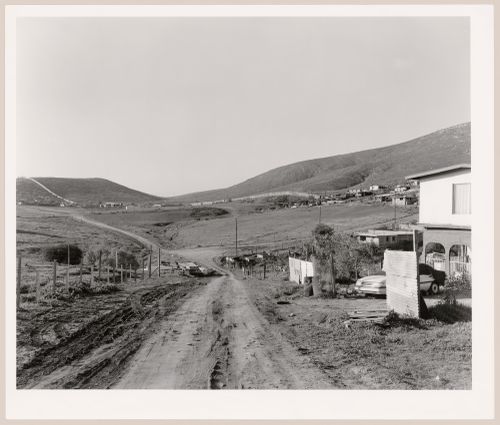
- The series "Running Fence 1997" focuses "on the first 14 miles of the border fence that separates the United States and Mexico, beginning at the Pacific Ocean and ending in the Otay Mountains.... [It] analyzes the "idea" of the border and explores its iconography, the border being a subject that is of extreme importance to the public as the world proceeds towards greater globalization. [Geoffrey] James has written of the project: "[The border fence] was built by the US Army Corps of Engineers in 1994, out of recycled metal landing strip - the most visible symbol of what is known as Operation Gatekeeper. Because the steel sheets are placed in the ground so that their ridges run horizontally, a man can hop over the fence with ease; and no Mexican child ever seems to be impeded from retrieving a soccer ball from US territory. The real barrier to illegal immigration from Mexico into the USA is less visible: hundreds of buried sensors linked to a central computer, nightscopes, helicopters and Border Patrol Agents in white Broncos."" (Evans).
PH1997:0061
Description:
- The series "Running Fence 1997" focuses "on the first 14 miles of the border fence that separates the United States and Mexico, beginning at the Pacific Ocean and ending in the Otay Mountains.... [It] analyzes the "idea" of the border and explores its iconography, the border being a subject that is of extreme importance to the public as the world proceeds towards greater globalization. [Geoffrey] James has written of the project: "[The border fence] was built by the US Army Corps of Engineers in 1994, out of recycled metal landing strip - the most visible symbol of what is known as Operation Gatekeeper. Because the steel sheets are placed in the ground so that their ridges run horizontally, a man can hop over the fence with ease; and no Mexican child ever seems to be impeded from retrieving a soccer ball from US territory. The real barrier to illegal immigration from Mexico into the USA is less visible: hundreds of buried sensors linked to a central computer, nightscopes, helicopters and Border Patrol Agents in white Broncos."" (Evans).
People:
Subject:
architecture, engineering, topographic
architecture, engineering, topographic
Date:
1997
1997
Title:
View of roads and houses with a partial view of the United States-Mexico border fence, Otay Mesa, San Diego County, California, United States, and Tijuana, Baja California, Mexico
Actions:
PH1997:0061
Description:
- The series "Running Fence 1997" focuses "on the first 14 miles of the border fence that separates the United States and Mexico, beginning at the Pacific Ocean and ending in the Otay Mountains.... [It] analyzes the "idea" of the border and explores its iconography, the border being a subject that is of extreme importance to the public as the world proceeds towards greater globalization. [Geoffrey] James has written of the project: "[The border fence] was built by the US Army Corps of Engineers in 1994, out of recycled metal landing strip - the most visible symbol of what is known as Operation Gatekeeper. Because the steel sheets are placed in the ground so that their ridges run horizontally, a man can hop over the fence with ease; and no Mexican child ever seems to be impeded from retrieving a soccer ball from US territory. The real barrier to illegal immigration from Mexico into the USA is less visible: hundreds of buried sensors linked to a central computer, nightscopes, helicopters and Border Patrol Agents in white Broncos."" (Evans).
View of roads and houses with a partial view of the United States-Mexico border fence, Otay Mesa, San Diego County, California, United States, and Tijuana, Baja California, Mexico
Actions:
PH1997:0061
Description:
- The series "Running Fence 1997" focuses "on the first 14 miles of the border fence that separates the United States and Mexico, beginning at the Pacific Ocean and ending in the Otay Mountains.... [It] analyzes the "idea" of the border and explores its iconography, the border being a subject that is of extreme importance to the public as the world proceeds towards greater globalization. [Geoffrey] James has written of the project: "[The border fence] was built by the US Army Corps of Engineers in 1994, out of recycled metal landing strip - the most visible symbol of what is known as Operation Gatekeeper. Because the steel sheets are placed in the ground so that their ridges run horizontally, a man can hop over the fence with ease; and no Mexican child ever seems to be impeded from retrieving a soccer ball from US territory. The real barrier to illegal immigration from Mexico into the USA is less visible: hundreds of buried sensors linked to a central computer, nightscopes, helicopters and Border Patrol Agents in white Broncos."" (Evans).
Form:
photographs
photographs
Date:
1997
1997
People:
Subject:
architecture, engineering, topographic
architecture, engineering, topographic
Form:
textual records
textual records
Reference number:
PHCON2002:0016:001:061
Description:
Text describes Matta-Clark's projects A W-Hole House (1973), Splitting (1974), Bingo (1974) and the costs involved in executing them.
PHCON2002:0016:001:061
Description:
Text describes Matta-Clark's projects A W-Hole House (1973), Splitting (1974), Bingo (1974) and the costs involved in executing them.
People:
Date:
1975
1975
Title:
Text for a publication describing building cuts
Actions:
PHCON2002:0016:001:061
Description:
Text describes Matta-Clark's projects A W-Hole House (1973), Splitting (1974), Bingo (1974) and the costs involved in executing them.
Text for a publication describing building cuts
Actions:
PHCON2002:0016:001:061
Description:
Text describes Matta-Clark's projects A W-Hole House (1973), Splitting (1974), Bingo (1974) and the costs involved in executing them.
Form:
textual records
textual records
Date:
1975
1975
People:
Level of archival description:
Project
Project
Reference number:
AP142.S1.D190
Description:
File documents an unexecuted (?) project for row houses in Barialto, near Casamassima, Bari, Italy. Material in this file was produced in 1994. File contains presentation drawings. File also contains textual records, including drawings and a label for drawings.
AP142.S1.D190
Description:
File documents an unexecuted (?) project for row houses in Barialto, near Casamassima, Bari, Italy. Material in this file was produced in 1994. File contains presentation drawings. File also contains textual records, including drawings and a label for drawings.
People:
Date:
1994
1994
Title:
Case a schiera, Casamassima, Italy
Actions:
AP142.S1.D190
Description:
File documents an unexecuted (?) project for row houses in Barialto, near Casamassima, Bari, Italy. Material in this file was produced in 1994. File contains presentation drawings. File also contains textual records, including drawings and a label for drawings.
Case a schiera, Casamassima, Italy
Actions:
AP142.S1.D190
Description:
File documents an unexecuted (?) project for row houses in Barialto, near Casamassima, Bari, Italy. Material in this file was produced in 1994. File contains presentation drawings. File also contains textual records, including drawings and a label for drawings.
Level of archival description:
File 190
File 190
Date:
1994
1994
People:
Form:
photographs
photographs
Reference number:
PH1982:0346:025
Description:
- This photograph is possibly a reprint by the Stillfried & Andersen photographic studio of a negative by Felice Beato.
PH1982:0346:025
Description:
- This photograph is possibly a reprint by the Stillfried & Andersen photographic studio of a negative by Felice Beato.
People:
Subject:
architecture, landscape architecture
architecture, landscape architecture
Date:
between 1864 and 1872
between 1864 and 1872
Title:
Panoramic view of Edo (now Tokyo) showing houses and gardens, Japan
Actions:
PH1982:0346:025
Description:
- This photograph is possibly a reprint by the Stillfried & Andersen photographic studio of a negative by Felice Beato.
Panoramic view of Edo (now Tokyo) showing houses and gardens, Japan
Actions:
PH1982:0346:025
Description:
- This photograph is possibly a reprint by the Stillfried & Andersen photographic studio of a negative by Felice Beato.
Form:
photographs
photographs
Date:
between 1864 and 1872
between 1864 and 1872
People:
Subject:
architecture, landscape architecture
architecture, landscape architecture
Level of archival description:
Project
Project
Reference number:
AP156.S3.SS2.D6
Description:
Le dossier documente le projet de Pierre Jeanneret pour les Gîtes d'étape, Projet Bhakra-Nangal à Talwara, en Inde, en 1949. Le matériel dans ce dossier a été produit en 1949 Le dossier contient un dessin et une reprographie. File documents Pierre Jeanneret's project for the Rest houses, Bhakra-Nangal Project in Talwara, in India, in 1949. Material in this file was produced in 1949. The file contains a drawing and a reprographic copy.
AP156.S3.SS2.D6
Description:
Le dossier documente le projet de Pierre Jeanneret pour les Gîtes d'étape, Projet Bhakra-Nangal à Talwara, en Inde, en 1949. Le matériel dans ce dossier a été produit en 1949 Le dossier contient un dessin et une reprographie. File documents Pierre Jeanneret's project for the Rest houses, Bhakra-Nangal Project in Talwara, in India, in 1949. Material in this file was produced in 1949. The file contains a drawing and a reprographic copy.
People:
Date:
1949
1949
Title:
Gîtes d’étape, Projet Bhakra-Nangal = Rest houses, Bhakra-Nangal Project
Actions:
AP156.S3.SS2.D6
Description:
Le dossier documente le projet de Pierre Jeanneret pour les Gîtes d'étape, Projet Bhakra-Nangal à Talwara, en Inde, en 1949. Le matériel dans ce dossier a été produit en 1949 Le dossier contient un dessin et une reprographie. File documents Pierre Jeanneret's project for the Rest houses, Bhakra-Nangal Project in Talwara, in India, in 1949. Material in this file was produced in 1949. The file contains a drawing and a reprographic copy.
Gîtes d’étape, Projet Bhakra-Nangal = Rest houses, Bhakra-Nangal Project
Actions:
AP156.S3.SS2.D6
Description:
Le dossier documente le projet de Pierre Jeanneret pour les Gîtes d'étape, Projet Bhakra-Nangal à Talwara, en Inde, en 1949. Le matériel dans ce dossier a été produit en 1949 Le dossier contient un dessin et une reprographie. File documents Pierre Jeanneret's project for the Rest houses, Bhakra-Nangal Project in Talwara, in India, in 1949. Material in this file was produced in 1949. The file contains a drawing and a reprographic copy.
Level of archival description:
Dossier 6
Dossier 6
Date:
1949
1949
People:
Form:
photographs
photographs
Actions:
Reference number:
PH1982:0347:006
PH1982:0347:006
People:
Subject:
architecture, topographic
architecture, topographic
Date:
ca. 1870
ca. 1870
Form:
photographs
photographs
Date:
ca. 1870
ca. 1870
People:
Subject:
architecture, topographic
architecture, topographic


