


44174 Results
Level of archival description:
Project
Project
Title:
Spangen Municipal Housing Scheme, Blocks I & V, Blocks VIII & IX, Rotterdam, Netherlands (1918-1920)
Spangen Municipal Housing Scheme, Blocks I & V, Blocks VIII & IX, Rotterdam, Netherlands (1918-1920)
Actions:
Reference number:
CI005.S1.1918.PR1
Description:
The Spangen Municipal Housing Scheme is a municipal housing project that the Spangen polder undertook with the help of several architects, including Oud. Oud's main contributions were modifications to Blocks I&V and collaboration with artist, Van Doesburg, for the colours. The master plan of The Spangen polder was created by P.Verhagen with H.P. Berlage acting as supervisor. Construction for the first 242 dwellings of Blocks I&V commenced in August 1918. Oud made modifications to a standard floor plan. Oud's main role in designing Blocks I&V was to organize the blocks as a whole and to make small changes to the floor plans, including the position of the windows and doors and the street elevation. For Blocks VIII & IX Oud also worked on the organization of the blocks. For Oud's second design of Blocks VIII &IX the gallery was accessed by the courtyard (Taverne et al. 2001,218-236). Project series includes drawings of plans for Block IX, as well as ground and first floor plans for Blocks I,V,VIII, or IX. Project series also includes photographs of exterior views of Blocks I , V and VIII, and a perspective drawing for Block I.
CI005.S1.1918.PR1
Description:
The Spangen Municipal Housing Scheme is a municipal housing project that the Spangen polder undertook with the help of several architects, including Oud. Oud's main contributions were modifications to Blocks I&V and collaboration with artist, Van Doesburg, for the colours. The master plan of The Spangen polder was created by P.Verhagen with H.P. Berlage acting as supervisor. Construction for the first 242 dwellings of Blocks I&V commenced in August 1918. Oud made modifications to a standard floor plan. Oud's main role in designing Blocks I&V was to organize the blocks as a whole and to make small changes to the floor plans, including the position of the windows and doors and the street elevation. For Blocks VIII & IX Oud also worked on the organization of the blocks. For Oud's second design of Blocks VIII &IX the gallery was accessed by the courtyard (Taverne et al. 2001,218-236). Project series includes drawings of plans for Block IX, as well as ground and first floor plans for Blocks I,V,VIII, or IX. Project series also includes photographs of exterior views of Blocks I , V and VIII, and a perspective drawing for Block I.
People:
Date:
1918-1921
1918-1921
Title:
Spangen Municipal Housing Scheme, Blocks I & V, Blocks VIII & IX, Rotterdam, Netherlands (1918-1920)
Actions:
CI005.S1.1918.PR1
Description:
The Spangen Municipal Housing Scheme is a municipal housing project that the Spangen polder undertook with the help of several architects, including Oud. Oud's main contributions were modifications to Blocks I&V and collaboration with artist, Van Doesburg, for the colours. The master plan of The Spangen polder was created by P.Verhagen with H.P. Berlage acting as supervisor. Construction for the first 242 dwellings of Blocks I&V commenced in August 1918. Oud made modifications to a standard floor plan. Oud's main role in designing Blocks I&V was to organize the blocks as a whole and to make small changes to the floor plans, including the position of the windows and doors and the street elevation. For Blocks VIII & IX Oud also worked on the organization of the blocks. For Oud's second design of Blocks VIII &IX the gallery was accessed by the courtyard (Taverne et al. 2001,218-236). Project series includes drawings of plans for Block IX, as well as ground and first floor plans for Blocks I,V,VIII, or IX. Project series also includes photographs of exterior views of Blocks I , V and VIII, and a perspective drawing for Block I.
Spangen Municipal Housing Scheme, Blocks I & V, Blocks VIII & IX, Rotterdam, Netherlands (1918-1920)
Actions:
CI005.S1.1918.PR1
Description:
The Spangen Municipal Housing Scheme is a municipal housing project that the Spangen polder undertook with the help of several architects, including Oud. Oud's main contributions were modifications to Blocks I&V and collaboration with artist, Van Doesburg, for the colours. The master plan of The Spangen polder was created by P.Verhagen with H.P. Berlage acting as supervisor. Construction for the first 242 dwellings of Blocks I&V commenced in August 1918. Oud made modifications to a standard floor plan. Oud's main role in designing Blocks I&V was to organize the blocks as a whole and to make small changes to the floor plans, including the position of the windows and doors and the street elevation. For Blocks VIII & IX Oud also worked on the organization of the blocks. For Oud's second design of Blocks VIII &IX the gallery was accessed by the courtyard (Taverne et al. 2001,218-236). Project series includes drawings of plans for Block IX, as well as ground and first floor plans for Blocks I,V,VIII, or IX. Project series also includes photographs of exterior views of Blocks I , V and VIII, and a perspective drawing for Block I.
Level of archival description:
project
project
Date:
1918-1921
1918-1921
People:
Level of archival description:
Project
Project
Actions:
Reference number:
AP018.S1.1974.PR24
Description:
This project series documents the design of interiors for the Eaton's of Canada Limited executive offices at 1 Dundas Street West in Toronto from 1974-1976. The office identified the project number as 7431. This project consisted of the office interiors for the 17th and 18th floors of a high-rise building located directly above the Eaton's flagship store, which was attached to the Eaton's Centre mall. The high-rise, its interiors, the Eaton's store and the mall were all constructed simultaneously, with Parkin Architects Planners working on the Eaton's store and office interiors, while architecture firm Craig Zeidler Strong worked on the Eaton's Centre mall and high-rise office building. The project is recorded through drawings, most of which are reprographic copies, photographs and textual records dating from 1975-1976. Arranged within the drawings are some drawings produced for the high-rise building by Craig Zeidler Strong. The textual records contain meeting minutes, specifications, construction documentation and project notebooks. The photographs show the office interiors of various Eaton's executives.
AP018.S1.1974.PR24
Description:
This project series documents the design of interiors for the Eaton's of Canada Limited executive offices at 1 Dundas Street West in Toronto from 1974-1976. The office identified the project number as 7431. This project consisted of the office interiors for the 17th and 18th floors of a high-rise building located directly above the Eaton's flagship store, which was attached to the Eaton's Centre mall. The high-rise, its interiors, the Eaton's store and the mall were all constructed simultaneously, with Parkin Architects Planners working on the Eaton's store and office interiors, while architecture firm Craig Zeidler Strong worked on the Eaton's Centre mall and high-rise office building. The project is recorded through drawings, most of which are reprographic copies, photographs and textual records dating from 1975-1976. Arranged within the drawings are some drawings produced for the high-rise building by Craig Zeidler Strong. The textual records contain meeting minutes, specifications, construction documentation and project notebooks. The photographs show the office interiors of various Eaton's executives.
People:
Date:
1975-1976
1975-1976
Title:
Eaton's of Canada Limited Executive Offices, One Dundas Street West, Toronto (1974-1976)
Actions:
AP018.S1.1974.PR24
Description:
This project series documents the design of interiors for the Eaton's of Canada Limited executive offices at 1 Dundas Street West in Toronto from 1974-1976. The office identified the project number as 7431. This project consisted of the office interiors for the 17th and 18th floors of a high-rise building located directly above the Eaton's flagship store, which was attached to the Eaton's Centre mall. The high-rise, its interiors, the Eaton's store and the mall were all constructed simultaneously, with Parkin Architects Planners working on the Eaton's store and office interiors, while architecture firm Craig Zeidler Strong worked on the Eaton's Centre mall and high-rise office building. The project is recorded through drawings, most of which are reprographic copies, photographs and textual records dating from 1975-1976. Arranged within the drawings are some drawings produced for the high-rise building by Craig Zeidler Strong. The textual records contain meeting minutes, specifications, construction documentation and project notebooks. The photographs show the office interiors of various Eaton's executives.
Eaton's of Canada Limited Executive Offices, One Dundas Street West, Toronto (1974-1976)
Actions:
AP018.S1.1974.PR24
Description:
This project series documents the design of interiors for the Eaton's of Canada Limited executive offices at 1 Dundas Street West in Toronto from 1974-1976. The office identified the project number as 7431. This project consisted of the office interiors for the 17th and 18th floors of a high-rise building located directly above the Eaton's flagship store, which was attached to the Eaton's Centre mall. The high-rise, its interiors, the Eaton's store and the mall were all constructed simultaneously, with Parkin Architects Planners working on the Eaton's store and office interiors, while architecture firm Craig Zeidler Strong worked on the Eaton's Centre mall and high-rise office building. The project is recorded through drawings, most of which are reprographic copies, photographs and textual records dating from 1975-1976. Arranged within the drawings are some drawings produced for the high-rise building by Craig Zeidler Strong. The textual records contain meeting minutes, specifications, construction documentation and project notebooks. The photographs show the office interiors of various Eaton's executives.
Level of archival description:
Project
Project
Date:
1975-1976
1975-1976
People:
Level of archival description:
Project
Project
Actions:
Reference number:
AP075.S1.1988.PR04
Description:
Project series documents Cornelie Hahn Oberlander's landscape project for the Jarvis Residence on Hudson Street in Vancouver, British Columbia. Oberlander worked on the initial landscape project from 1964-1966, and later on renovations of the garden in 1988-1989. The residence was designed by architect Ron Thom, from Thompson Berwick & Pratt Architects and was completed in 1964. The project consisted in creating well sunlit circular wooden deck where the family could gather, especially for breakfast in the morning, with sun-loving vegetation. The garden also integrated elements from Japanese traditional gardens, brought back by the owners of the house after a trip in Japan, including stepping-stones that were arranged to create a path from the house and the beginning of a woodland walk. Project series contains design development drawings, including landscape plans, planting plans and layout plans, and also working drawing, including irragation plans. The project series also comprises photographs of the residence and the garden, and textual records, such as specifications, correspondence with architects and clients, Oberlander's concept notes, and plant lists.
AP075.S1.1988.PR04
Description:
Project series documents Cornelie Hahn Oberlander's landscape project for the Jarvis Residence on Hudson Street in Vancouver, British Columbia. Oberlander worked on the initial landscape project from 1964-1966, and later on renovations of the garden in 1988-1989. The residence was designed by architect Ron Thom, from Thompson Berwick & Pratt Architects and was completed in 1964. The project consisted in creating well sunlit circular wooden deck where the family could gather, especially for breakfast in the morning, with sun-loving vegetation. The garden also integrated elements from Japanese traditional gardens, brought back by the owners of the house after a trip in Japan, including stepping-stones that were arranged to create a path from the house and the beginning of a woodland walk. Project series contains design development drawings, including landscape plans, planting plans and layout plans, and also working drawing, including irragation plans. The project series also comprises photographs of the residence and the garden, and textual records, such as specifications, correspondence with architects and clients, Oberlander's concept notes, and plant lists.
People:
Date:
1966-2004
1966-2004
Title:
Jarvis Residence, Vancouver, British Columbia (1988-1992)
Actions:
AP075.S1.1988.PR04
Description:
Project series documents Cornelie Hahn Oberlander's landscape project for the Jarvis Residence on Hudson Street in Vancouver, British Columbia. Oberlander worked on the initial landscape project from 1964-1966, and later on renovations of the garden in 1988-1989. The residence was designed by architect Ron Thom, from Thompson Berwick & Pratt Architects and was completed in 1964. The project consisted in creating well sunlit circular wooden deck where the family could gather, especially for breakfast in the morning, with sun-loving vegetation. The garden also integrated elements from Japanese traditional gardens, brought back by the owners of the house after a trip in Japan, including stepping-stones that were arranged to create a path from the house and the beginning of a woodland walk. Project series contains design development drawings, including landscape plans, planting plans and layout plans, and also working drawing, including irragation plans. The project series also comprises photographs of the residence and the garden, and textual records, such as specifications, correspondence with architects and clients, Oberlander's concept notes, and plant lists.
Jarvis Residence, Vancouver, British Columbia (1988-1992)
Actions:
AP075.S1.1988.PR04
Description:
Project series documents Cornelie Hahn Oberlander's landscape project for the Jarvis Residence on Hudson Street in Vancouver, British Columbia. Oberlander worked on the initial landscape project from 1964-1966, and later on renovations of the garden in 1988-1989. The residence was designed by architect Ron Thom, from Thompson Berwick & Pratt Architects and was completed in 1964. The project consisted in creating well sunlit circular wooden deck where the family could gather, especially for breakfast in the morning, with sun-loving vegetation. The garden also integrated elements from Japanese traditional gardens, brought back by the owners of the house after a trip in Japan, including stepping-stones that were arranged to create a path from the house and the beginning of a woodland walk. Project series contains design development drawings, including landscape plans, planting plans and layout plans, and also working drawing, including irragation plans. The project series also comprises photographs of the residence and the garden, and textual records, such as specifications, correspondence with architects and clients, Oberlander's concept notes, and plant lists.
Level of archival description:
Project
Project
Date:
1966-2004
1966-2004
People:
Form:
journals and magazines
journals and magazines
Actions:
Reference number:
ARCH268183
Description:
Architecture-bâtiment-construction, no. 93 (Januray 1954) supplement about a planning project by Vincent Rother Architects on which Victor Prus worked as architect for the firm.
ARCH268183
Description:
Architecture-bâtiment-construction, no. 93 (Januray 1954) supplement about a planning project by Vincent Rother Architects on which Victor Prus worked as architect for the firm.
People:
Title:
Architecture-bâtiment-construction
Actions:
ARCH268183
Description:
Architecture-bâtiment-construction, no. 93 (Januray 1954) supplement about a planning project by Vincent Rother Architects on which Victor Prus worked as architect for the firm.
Architecture-bâtiment-construction
Actions:
ARCH268183
Description:
Architecture-bâtiment-construction, no. 93 (Januray 1954) supplement about a planning project by Vincent Rother Architects on which Victor Prus worked as architect for the firm.
Form:
journals and magazines
journals and magazines
People:
Form:
textual records
textual records
Reference number:
ARCH277001
Description:
Group contains the Budget Pricing Updates and the Shoring Excavation Tender for 1151 West Georgia Street, Vancouver, on which Arthur Erickson worked as a design consultant.
ARCH277001
Description:
Group contains the Budget Pricing Updates and the Shoring Excavation Tender for 1151 West Georgia Street, Vancouver, on which Arthur Erickson worked as a design consultant.
People:
Date:
2007-2008
2007-2008
Title:
Budgets, and tender related to various projects
Actions:
ARCH277001
Description:
Group contains the Budget Pricing Updates and the Shoring Excavation Tender for 1151 West Georgia Street, Vancouver, on which Arthur Erickson worked as a design consultant.
Budgets, and tender related to various projects
Actions:
ARCH277001
Description:
Group contains the Budget Pricing Updates and the Shoring Excavation Tender for 1151 West Georgia Street, Vancouver, on which Arthur Erickson worked as a design consultant.
Form:
textual records
textual records
Date:
2007-2008
2007-2008
People:
Form:
photographs
Quantity:
19 photograph(s)
photographs
Quantity:
19 photograph(s)
Reference number:
ARCH269545
Description:
Group consists of photographs of everyday life in Chandigarh, India, predominantly of workers on construction sites.
ARCH269545
Description:
Group consists of photographs of everyday life in Chandigarh, India, predominantly of workers on construction sites.
People:
Date:
ca. 1951-1955
ca. 1951-1955
Title:
Photographs of everyday life at Chandigarh, in India, during constructions
Actions:
ARCH269545
Description:
Group consists of photographs of everyday life in Chandigarh, India, predominantly of workers on construction sites.
Photographs of everyday life at Chandigarh, in India, during constructions
Actions:
ARCH269545
Description:
Group consists of photographs of everyday life in Chandigarh, India, predominantly of workers on construction sites.
Form:
photographs
Quantity:
19 photograph(s)
photographs
Quantity:
19 photograph(s)
Date:
ca. 1951-1955
ca. 1951-1955
People:
Form:
photographs
Quantity:
7 photograph(s)
photographs
Quantity:
7 photograph(s)
Reference number:
ARCH269638
Description:
Group consists photographs of everyday life in Chandigarh, India, predominantly of workers and construction sites.
ARCH269638
Description:
Group consists photographs of everyday life in Chandigarh, India, predominantly of workers and construction sites.
People:
Date:
between 1953 and 1965
between 1953 and 1965
Title:
Photographs of workers and construction sites in Chandigarh, India
Actions:
ARCH269638
Description:
Group consists photographs of everyday life in Chandigarh, India, predominantly of workers and construction sites.
Photographs of workers and construction sites in Chandigarh, India
Actions:
ARCH269638
Description:
Group consists photographs of everyday life in Chandigarh, India, predominantly of workers and construction sites.
Form:
photographs
Quantity:
7 photograph(s)
photographs
Quantity:
7 photograph(s)
Date:
between 1953 and 1965
between 1953 and 1965
People:
Form:
drawings, textual records
drawings, textual records
Actions:
Reference number:
DR2004:0463
Description:
consultants' contract drawings, schematics, schedules, architect's and clerk of works' instructions, correspondence, quotations, and publication
DR2004:0463
Description:
consultants' contract drawings, schematics, schedules, architect's and clerk of works' instructions, correspondence, quotations, and publication
People:
Title:
Consultants' contract drawings, schematics, schedules
Actions:
DR2004:0463
Description:
consultants' contract drawings, schematics, schedules, architect's and clerk of works' instructions, correspondence, quotations, and publication
Consultants' contract drawings, schematics, schedules
Actions:
DR2004:0463
Description:
consultants' contract drawings, schematics, schedules, architect's and clerk of works' instructions, correspondence, quotations, and publication
Form:
drawings, textual records
drawings, textual records
People:
Form:
drawings
drawings
Actions:
Reference number:
ARCH5002
Description:
Escaliers dans les tours est et ouest, mains courantes des escaliers du presbytère, balcon de la chapelle des mariages / Montreal Architectural Iron Works.
ARCH5002
Description:
Escaliers dans les tours est et ouest, mains courantes des escaliers du presbytère, balcon de la chapelle des mariages / Montreal Architectural Iron Works.
People:
Date:
1926
1926
Title:
Détails des escaliers et balcons
Actions:
ARCH5002
Description:
Escaliers dans les tours est et ouest, mains courantes des escaliers du presbytère, balcon de la chapelle des mariages / Montreal Architectural Iron Works.
Détails des escaliers et balcons
Actions:
ARCH5002
Description:
Escaliers dans les tours est et ouest, mains courantes des escaliers du presbytère, balcon de la chapelle des mariages / Montreal Architectural Iron Works.
Form:
drawings
drawings
Date:
1926
1926
People:
Form:
drawings
drawings
Actions:
Reference number:
DR1974:0002:016:001-070
Description:
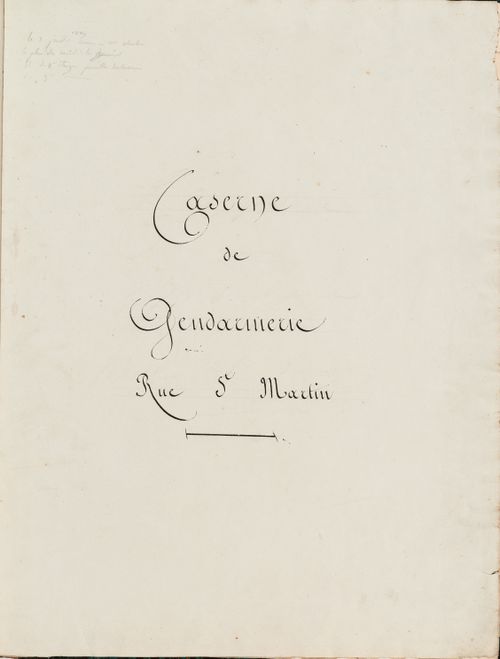
- This album contains mostly highly finished drawings - plans, elevations, and sections - for three gendarmerie barracks in Paris by Hubert Rohault de Fleury: rue du Faubourg-Saint-Martin (1829-1830 ?), rue des Minimes (1823-1825 ?), and rue Mouffetard (1821-1824). Rohault de Fleury's alterations to the Faubourg-Saint-Martin barracks were probably limited to the "2e" and "3e étages" and the sewer system (DR1974:0002:016:001 - DR1974:0002:016:006). It has not been determined whether these alterations were for the initial conversion of the Hôtel des arts into barracks, or for subsequent alterations to the barracks. The drawings for the Minimes barracks are more comprehensive and relate to work on the disposition of the interiors, the enclosing wall, and the entrance gateway (DR1974:0002:016:007 - DR1974:0002:016:022 and DR1974:0002:016:024 - DR1974:0002:016:027). The Mouffetard barracks is the largest and best known of the projects in the album (DR1974:0002:016:023, DR1974:0002:016:028 - DR1974:0002:016:070). It is comprehensively documented and includes: a bidding document for the barracks, plans of the existing Couvent des Augustines de Notre-Dame-de-la-Miséricorde situated on the site, early projects for the barracks of 1821, and the 1824 project which apparently conforms to the barracks as executed. The façades of the Caserne de la Gendarmerie royale, rue Mouffetard, are in the pared-down classical style typical of Hubert's utilitarian structures.
DR1974:0002:016:001-070
Description:
- This album contains mostly highly finished drawings - plans, elevations, and sections - for three gendarmerie barracks in Paris by Hubert Rohault de Fleury: rue du Faubourg-Saint-Martin (1829-1830 ?), rue des Minimes (1823-1825 ?), and rue Mouffetard (1821-1824). Rohault de Fleury's alterations to the Faubourg-Saint-Martin barracks were probably limited to the "2e" and "3e étages" and the sewer system (DR1974:0002:016:001 - DR1974:0002:016:006). It has not been determined whether these alterations were for the initial conversion of the Hôtel des arts into barracks, or for subsequent alterations to the barracks. The drawings for the Minimes barracks are more comprehensive and relate to work on the disposition of the interiors, the enclosing wall, and the entrance gateway (DR1974:0002:016:007 - DR1974:0002:016:022 and DR1974:0002:016:024 - DR1974:0002:016:027). The Mouffetard barracks is the largest and best known of the projects in the album (DR1974:0002:016:023, DR1974:0002:016:028 - DR1974:0002:016:070). It is comprehensively documented and includes: a bidding document for the barracks, plans of the existing Couvent des Augustines de Notre-Dame-de-la-Miséricorde situated on the site, early projects for the barracks of 1821, and the 1824 project which apparently conforms to the barracks as executed. The façades of the Caserne de la Gendarmerie royale, rue Mouffetard, are in the pared-down classical style typical of Hubert's utilitarian structures.
People:
Subject:
architecture
architecture
Date:
drawings executed 1817-1830, manuscript written 1817-1821
drawings executed 1817-1830, manuscript written 1817-1821
Title:
Album of drawings for three gendarmerie barracks: rue du Faubourg-Saint-Martin, rue des Minimes, and rue Mouffetard, Paris
Actions:
DR1974:0002:016:001-070
Description:
- This album contains mostly highly finished drawings - plans, elevations, and sections - for three gendarmerie barracks in Paris by Hubert Rohault de Fleury: rue du Faubourg-Saint-Martin (1829-1830 ?), rue des Minimes (1823-1825 ?), and rue Mouffetard (1821-1824). Rohault de Fleury's alterations to the Faubourg-Saint-Martin barracks were probably limited to the "2e" and "3e étages" and the sewer system (DR1974:0002:016:001 - DR1974:0002:016:006). It has not been determined whether these alterations were for the initial conversion of the Hôtel des arts into barracks, or for subsequent alterations to the barracks. The drawings for the Minimes barracks are more comprehensive and relate to work on the disposition of the interiors, the enclosing wall, and the entrance gateway (DR1974:0002:016:007 - DR1974:0002:016:022 and DR1974:0002:016:024 - DR1974:0002:016:027). The Mouffetard barracks is the largest and best known of the projects in the album (DR1974:0002:016:023, DR1974:0002:016:028 - DR1974:0002:016:070). It is comprehensively documented and includes: a bidding document for the barracks, plans of the existing Couvent des Augustines de Notre-Dame-de-la-Miséricorde situated on the site, early projects for the barracks of 1821, and the 1824 project which apparently conforms to the barracks as executed. The façades of the Caserne de la Gendarmerie royale, rue Mouffetard, are in the pared-down classical style typical of Hubert's utilitarian structures.
Album of drawings for three gendarmerie barracks: rue du Faubourg-Saint-Martin, rue des Minimes, and rue Mouffetard, Paris
Actions:
DR1974:0002:016:001-070
Description:
- This album contains mostly highly finished drawings - plans, elevations, and sections - for three gendarmerie barracks in Paris by Hubert Rohault de Fleury: rue du Faubourg-Saint-Martin (1829-1830 ?), rue des Minimes (1823-1825 ?), and rue Mouffetard (1821-1824). Rohault de Fleury's alterations to the Faubourg-Saint-Martin barracks were probably limited to the "2e" and "3e étages" and the sewer system (DR1974:0002:016:001 - DR1974:0002:016:006). It has not been determined whether these alterations were for the initial conversion of the Hôtel des arts into barracks, or for subsequent alterations to the barracks. The drawings for the Minimes barracks are more comprehensive and relate to work on the disposition of the interiors, the enclosing wall, and the entrance gateway (DR1974:0002:016:007 - DR1974:0002:016:022 and DR1974:0002:016:024 - DR1974:0002:016:027). The Mouffetard barracks is the largest and best known of the projects in the album (DR1974:0002:016:023, DR1974:0002:016:028 - DR1974:0002:016:070). It is comprehensively documented and includes: a bidding document for the barracks, plans of the existing Couvent des Augustines de Notre-Dame-de-la-Miséricorde situated on the site, early projects for the barracks of 1821, and the 1824 project which apparently conforms to the barracks as executed. The façades of the Caserne de la Gendarmerie royale, rue Mouffetard, are in the pared-down classical style typical of Hubert's utilitarian structures.
Form:
drawings
drawings
Date:
drawings executed 1817-1830, manuscript written 1817-1821
drawings executed 1817-1830, manuscript written 1817-1821
People:
Subject:
architecture
architecture


