


33582 Results
Form:
drawings, textual records, works of art
drawings, textual records, works of art
Actions:
Reference number:
DR1974:0002:008:001-077
Description:
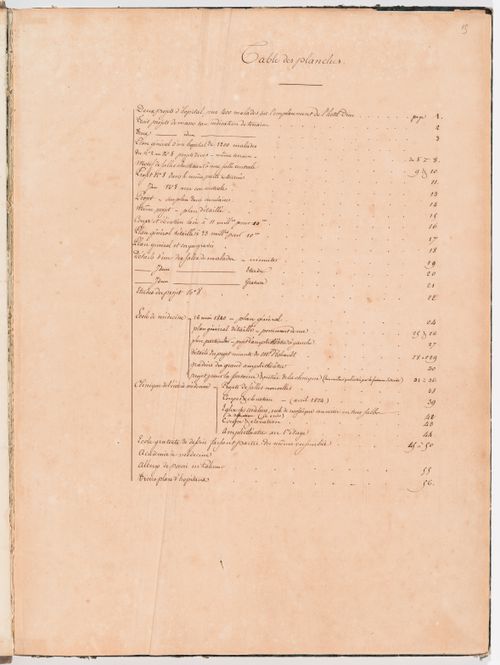
- This album contains prints and drawings - primarily design development and presentation drawings - mainly for projects for ideal hospitals and for the unexecuted redevelopment of the École de médecine and the surrounding area in Paris by Hubert Rohault de Fleury. Projects for ideal hospitals include: two block plans for hospitals for 400 patients on the site of Hôtel-Dieu (DR1974:0002:008:002 - DR1974:0002:008:003); nine site plans coloured with wash for hospitals for varying numbers of patients, eight of which are for a site near the barrière de Monceau (DR1974:0002:008:010 - DR1974:0002:008:014 and DR1974:0002:008:017 - DR1974:0002:008:020); five block plans for hospitals with no site indicated (DR1974:0002:008:004 - DR1974:0002:008:008); and plans, sections and elevations, most coloured with wash or watercolour, for a more developed project for an ideal hospital for 1000 to 1200 patients with no site indicated (DR1974:0002:008:022 - DR1974:0002:008:025, DR1974:0002:008:027 - DR1974:0002:008:028). The five other drawings for hospitals included in this album are apparently related to the nine site plans (DR1974:0002:008:015, DR1974:0002:008:016, DR1974:0002:008:021, DR1974:0002:008:029, and DR1974:0002:008:030). Plans, elevations and sections for the redevelopment of the area surrounding the École de médecine include the addition of a second amphitheatre to the École de médecine, an addition to the Clinique de l'École de médecine, the alteration of the École de mosaïque for use as a salle de dissection, and alterations to the École royale gratuite de dessin (DR1974:0002:008:031 - DR1974:0002:008:064). Also included are several designs for a classically-inspired fountain to be located at the entrance to the Clinique de l'École de médecine (DR1974:0002:008:042 - DR1974:0002:008:049), and drawings for the Académie de médecine, an institution which was probably housed at the École de médecine during this period (DR1974:0002:008:065 - DR1974:0002:008:068). The album includes record drawings of medical buildings by other architects: a presentation drawing of the Albergo dei poveri in Palermo, designed by Orazio Foretto Palermitano; tracings from drawings of a project for Hôtel-Dieu in Paris, designed by Charles-François Viel de Saint-Maux; the 1775 Grand Prix project for an École de médecine designed by Paul Guillaume Lemoine; prints of the the Hospice de la charité in Lyon, designed by Jean Pollet, and two hospital projects in Dijon designed by Paul P. Petit (DR1974:0002:008:069 - DR1974:0002:008:077).
DR1974:0002:008:001-077
Description:
- This album contains prints and drawings - primarily design development and presentation drawings - mainly for projects for ideal hospitals and for the unexecuted redevelopment of the École de médecine and the surrounding area in Paris by Hubert Rohault de Fleury. Projects for ideal hospitals include: two block plans for hospitals for 400 patients on the site of Hôtel-Dieu (DR1974:0002:008:002 - DR1974:0002:008:003); nine site plans coloured with wash for hospitals for varying numbers of patients, eight of which are for a site near the barrière de Monceau (DR1974:0002:008:010 - DR1974:0002:008:014 and DR1974:0002:008:017 - DR1974:0002:008:020); five block plans for hospitals with no site indicated (DR1974:0002:008:004 - DR1974:0002:008:008); and plans, sections and elevations, most coloured with wash or watercolour, for a more developed project for an ideal hospital for 1000 to 1200 patients with no site indicated (DR1974:0002:008:022 - DR1974:0002:008:025, DR1974:0002:008:027 - DR1974:0002:008:028). The five other drawings for hospitals included in this album are apparently related to the nine site plans (DR1974:0002:008:015, DR1974:0002:008:016, DR1974:0002:008:021, DR1974:0002:008:029, and DR1974:0002:008:030). Plans, elevations and sections for the redevelopment of the area surrounding the École de médecine include the addition of a second amphitheatre to the École de médecine, an addition to the Clinique de l'École de médecine, the alteration of the École de mosaïque for use as a salle de dissection, and alterations to the École royale gratuite de dessin (DR1974:0002:008:031 - DR1974:0002:008:064). Also included are several designs for a classically-inspired fountain to be located at the entrance to the Clinique de l'École de médecine (DR1974:0002:008:042 - DR1974:0002:008:049), and drawings for the Académie de médecine, an institution which was probably housed at the École de médecine during this period (DR1974:0002:008:065 - DR1974:0002:008:068). The album includes record drawings of medical buildings by other architects: a presentation drawing of the Albergo dei poveri in Palermo, designed by Orazio Foretto Palermitano; tracings from drawings of a project for Hôtel-Dieu in Paris, designed by Charles-François Viel de Saint-Maux; the 1775 Grand Prix project for an École de médecine designed by Paul Guillaume Lemoine; prints of the the Hospice de la charité in Lyon, designed by Jean Pollet, and two hospital projects in Dijon designed by Paul P. Petit (DR1974:0002:008:069 - DR1974:0002:008:077).
People:
Subject:
architecture, topographic
architecture, topographic
Date:
first half of the 19th century
first half of the 19th century
Title:
Album of drawings and prints for ideal hospitals, drawings for the redevelopment of the École de médecine and the surrounding area, Paris, and record drawings of medical buildings by French and Italian architects
Actions:
DR1974:0002:008:001-077
Description:
- This album contains prints and drawings - primarily design development and presentation drawings - mainly for projects for ideal hospitals and for the unexecuted redevelopment of the École de médecine and the surrounding area in Paris by Hubert Rohault de Fleury. Projects for ideal hospitals include: two block plans for hospitals for 400 patients on the site of Hôtel-Dieu (DR1974:0002:008:002 - DR1974:0002:008:003); nine site plans coloured with wash for hospitals for varying numbers of patients, eight of which are for a site near the barrière de Monceau (DR1974:0002:008:010 - DR1974:0002:008:014 and DR1974:0002:008:017 - DR1974:0002:008:020); five block plans for hospitals with no site indicated (DR1974:0002:008:004 - DR1974:0002:008:008); and plans, sections and elevations, most coloured with wash or watercolour, for a more developed project for an ideal hospital for 1000 to 1200 patients with no site indicated (DR1974:0002:008:022 - DR1974:0002:008:025, DR1974:0002:008:027 - DR1974:0002:008:028). The five other drawings for hospitals included in this album are apparently related to the nine site plans (DR1974:0002:008:015, DR1974:0002:008:016, DR1974:0002:008:021, DR1974:0002:008:029, and DR1974:0002:008:030). Plans, elevations and sections for the redevelopment of the area surrounding the École de médecine include the addition of a second amphitheatre to the École de médecine, an addition to the Clinique de l'École de médecine, the alteration of the École de mosaïque for use as a salle de dissection, and alterations to the École royale gratuite de dessin (DR1974:0002:008:031 - DR1974:0002:008:064). Also included are several designs for a classically-inspired fountain to be located at the entrance to the Clinique de l'École de médecine (DR1974:0002:008:042 - DR1974:0002:008:049), and drawings for the Académie de médecine, an institution which was probably housed at the École de médecine during this period (DR1974:0002:008:065 - DR1974:0002:008:068). The album includes record drawings of medical buildings by other architects: a presentation drawing of the Albergo dei poveri in Palermo, designed by Orazio Foretto Palermitano; tracings from drawings of a project for Hôtel-Dieu in Paris, designed by Charles-François Viel de Saint-Maux; the 1775 Grand Prix project for an École de médecine designed by Paul Guillaume Lemoine; prints of the the Hospice de la charité in Lyon, designed by Jean Pollet, and two hospital projects in Dijon designed by Paul P. Petit (DR1974:0002:008:069 - DR1974:0002:008:077).
Album of drawings and prints for ideal hospitals, drawings for the redevelopment of the École de médecine and the surrounding area, Paris, and record drawings of medical buildings by French and Italian architects
Actions:
DR1974:0002:008:001-077
Description:
- This album contains prints and drawings - primarily design development and presentation drawings - mainly for projects for ideal hospitals and for the unexecuted redevelopment of the École de médecine and the surrounding area in Paris by Hubert Rohault de Fleury. Projects for ideal hospitals include: two block plans for hospitals for 400 patients on the site of Hôtel-Dieu (DR1974:0002:008:002 - DR1974:0002:008:003); nine site plans coloured with wash for hospitals for varying numbers of patients, eight of which are for a site near the barrière de Monceau (DR1974:0002:008:010 - DR1974:0002:008:014 and DR1974:0002:008:017 - DR1974:0002:008:020); five block plans for hospitals with no site indicated (DR1974:0002:008:004 - DR1974:0002:008:008); and plans, sections and elevations, most coloured with wash or watercolour, for a more developed project for an ideal hospital for 1000 to 1200 patients with no site indicated (DR1974:0002:008:022 - DR1974:0002:008:025, DR1974:0002:008:027 - DR1974:0002:008:028). The five other drawings for hospitals included in this album are apparently related to the nine site plans (DR1974:0002:008:015, DR1974:0002:008:016, DR1974:0002:008:021, DR1974:0002:008:029, and DR1974:0002:008:030). Plans, elevations and sections for the redevelopment of the area surrounding the École de médecine include the addition of a second amphitheatre to the École de médecine, an addition to the Clinique de l'École de médecine, the alteration of the École de mosaïque for use as a salle de dissection, and alterations to the École royale gratuite de dessin (DR1974:0002:008:031 - DR1974:0002:008:064). Also included are several designs for a classically-inspired fountain to be located at the entrance to the Clinique de l'École de médecine (DR1974:0002:008:042 - DR1974:0002:008:049), and drawings for the Académie de médecine, an institution which was probably housed at the École de médecine during this period (DR1974:0002:008:065 - DR1974:0002:008:068). The album includes record drawings of medical buildings by other architects: a presentation drawing of the Albergo dei poveri in Palermo, designed by Orazio Foretto Palermitano; tracings from drawings of a project for Hôtel-Dieu in Paris, designed by Charles-François Viel de Saint-Maux; the 1775 Grand Prix project for an École de médecine designed by Paul Guillaume Lemoine; prints of the the Hospice de la charité in Lyon, designed by Jean Pollet, and two hospital projects in Dijon designed by Paul P. Petit (DR1974:0002:008:069 - DR1974:0002:008:077).
Form:
drawings, textual records, works of art
drawings, textual records, works of art
Date:
first half of the 19th century
first half of the 19th century
People:
Subject:
architecture, topographic
architecture, topographic
Level of archival description:
Project
Project
Actions:
Reference number:
AP056.S1.1987.PR02
Description:
This project series documents a competition entry for the design of Ottawa City Hall in Ottawa, Ontario from 1987-1988. The office identified the project number as 8711. This competition for Ottawa's new city hall called for a contemporary building that would integrate the old city hall, originally built in the 1950s and located on Green Island in the Rideau Canal. Set between Sussex Drive and Union Street, this project consisted of 1 building with 6 distinct parts: the old office building, the new office building, the City Room, the Council Chamber, the podium, and the daycare centre. The old office building was the original modernist-style city hall that would now serve as office spaces for civic workers. It would be renovated to create better circulation with the new extension. The new office building, serving a similar function, would sit behind the old one to create an L-shape on half of the perimeter. It had a large civic tower on one end that would serve as an observation deck. The City Room, a three-storey element in the centre of the structure, had a distinctive roof made up of more than a dozen small pyramids. Whitton Hall would be used as a ceremonial space, the building's lobby, a major central assembly hall, and meeting rooms. The council chambers were located in a self-contained rotunda, which also had press offices on the ground floor. The daycare centre consisted of a rectangular pavilion, set on a diagonal axis from the rest of City Hall. All of these elements sat on a raised podium that had landscaped terraces and gardens around the building's exterior. The terrace offered stunning views of the Ottawa cityscape across the canal. The podium contained one level of parking, with two additional levels below ground. This project was conceptualized to have two distinct fronts, one with its formal address on Sussex Drive that had a ceremonial entrance called the Plaza of Nations, and one off Union Street beneath the podium and underneath the Peace Bell. KPMB's entry proposed a building that would integrate with the existing system of green parks and walkways already present on the island. However, this was not the winning design for the competition and the project was eventually realized by architect Moshe Safdie. This project is recorded through drawings, photographs, a model and watercolour paintings dating from 1987-1988. The drawings are mostly originals and include sketches, surveys and site plans, floor plans, elevations, sections, perspectives and axonometrics of the design. There are also a number of presentation panels that show the final competition submission with short texts about the design intention and construction phasing. The watercolours present the building's exterior and photographs show different views of the project model.
AP056.S1.1987.PR02
Description:
This project series documents a competition entry for the design of Ottawa City Hall in Ottawa, Ontario from 1987-1988. The office identified the project number as 8711. This competition for Ottawa's new city hall called for a contemporary building that would integrate the old city hall, originally built in the 1950s and located on Green Island in the Rideau Canal. Set between Sussex Drive and Union Street, this project consisted of 1 building with 6 distinct parts: the old office building, the new office building, the City Room, the Council Chamber, the podium, and the daycare centre. The old office building was the original modernist-style city hall that would now serve as office spaces for civic workers. It would be renovated to create better circulation with the new extension. The new office building, serving a similar function, would sit behind the old one to create an L-shape on half of the perimeter. It had a large civic tower on one end that would serve as an observation deck. The City Room, a three-storey element in the centre of the structure, had a distinctive roof made up of more than a dozen small pyramids. Whitton Hall would be used as a ceremonial space, the building's lobby, a major central assembly hall, and meeting rooms. The council chambers were located in a self-contained rotunda, which also had press offices on the ground floor. The daycare centre consisted of a rectangular pavilion, set on a diagonal axis from the rest of City Hall. All of these elements sat on a raised podium that had landscaped terraces and gardens around the building's exterior. The terrace offered stunning views of the Ottawa cityscape across the canal. The podium contained one level of parking, with two additional levels below ground. This project was conceptualized to have two distinct fronts, one with its formal address on Sussex Drive that had a ceremonial entrance called the Plaza of Nations, and one off Union Street beneath the podium and underneath the Peace Bell. KPMB's entry proposed a building that would integrate with the existing system of green parks and walkways already present on the island. However, this was not the winning design for the competition and the project was eventually realized by architect Moshe Safdie. This project is recorded through drawings, photographs, a model and watercolour paintings dating from 1987-1988. The drawings are mostly originals and include sketches, surveys and site plans, floor plans, elevations, sections, perspectives and axonometrics of the design. There are also a number of presentation panels that show the final competition submission with short texts about the design intention and construction phasing. The watercolours present the building's exterior and photographs show different views of the project model.
People:
Date:
1987-1988
1987-1988
Title:
Ottawa City Hall Competition, Ontario (1987-1988)
Actions:
AP056.S1.1987.PR02
Description:
This project series documents a competition entry for the design of Ottawa City Hall in Ottawa, Ontario from 1987-1988. The office identified the project number as 8711. This competition for Ottawa's new city hall called for a contemporary building that would integrate the old city hall, originally built in the 1950s and located on Green Island in the Rideau Canal. Set between Sussex Drive and Union Street, this project consisted of 1 building with 6 distinct parts: the old office building, the new office building, the City Room, the Council Chamber, the podium, and the daycare centre. The old office building was the original modernist-style city hall that would now serve as office spaces for civic workers. It would be renovated to create better circulation with the new extension. The new office building, serving a similar function, would sit behind the old one to create an L-shape on half of the perimeter. It had a large civic tower on one end that would serve as an observation deck. The City Room, a three-storey element in the centre of the structure, had a distinctive roof made up of more than a dozen small pyramids. Whitton Hall would be used as a ceremonial space, the building's lobby, a major central assembly hall, and meeting rooms. The council chambers were located in a self-contained rotunda, which also had press offices on the ground floor. The daycare centre consisted of a rectangular pavilion, set on a diagonal axis from the rest of City Hall. All of these elements sat on a raised podium that had landscaped terraces and gardens around the building's exterior. The terrace offered stunning views of the Ottawa cityscape across the canal. The podium contained one level of parking, with two additional levels below ground. This project was conceptualized to have two distinct fronts, one with its formal address on Sussex Drive that had a ceremonial entrance called the Plaza of Nations, and one off Union Street beneath the podium and underneath the Peace Bell. KPMB's entry proposed a building that would integrate with the existing system of green parks and walkways already present on the island. However, this was not the winning design for the competition and the project was eventually realized by architect Moshe Safdie. This project is recorded through drawings, photographs, a model and watercolour paintings dating from 1987-1988. The drawings are mostly originals and include sketches, surveys and site plans, floor plans, elevations, sections, perspectives and axonometrics of the design. There are also a number of presentation panels that show the final competition submission with short texts about the design intention and construction phasing. The watercolours present the building's exterior and photographs show different views of the project model.
Ottawa City Hall Competition, Ontario (1987-1988)
Actions:
AP056.S1.1987.PR02
Description:
This project series documents a competition entry for the design of Ottawa City Hall in Ottawa, Ontario from 1987-1988. The office identified the project number as 8711. This competition for Ottawa's new city hall called for a contemporary building that would integrate the old city hall, originally built in the 1950s and located on Green Island in the Rideau Canal. Set between Sussex Drive and Union Street, this project consisted of 1 building with 6 distinct parts: the old office building, the new office building, the City Room, the Council Chamber, the podium, and the daycare centre. The old office building was the original modernist-style city hall that would now serve as office spaces for civic workers. It would be renovated to create better circulation with the new extension. The new office building, serving a similar function, would sit behind the old one to create an L-shape on half of the perimeter. It had a large civic tower on one end that would serve as an observation deck. The City Room, a three-storey element in the centre of the structure, had a distinctive roof made up of more than a dozen small pyramids. Whitton Hall would be used as a ceremonial space, the building's lobby, a major central assembly hall, and meeting rooms. The council chambers were located in a self-contained rotunda, which also had press offices on the ground floor. The daycare centre consisted of a rectangular pavilion, set on a diagonal axis from the rest of City Hall. All of these elements sat on a raised podium that had landscaped terraces and gardens around the building's exterior. The terrace offered stunning views of the Ottawa cityscape across the canal. The podium contained one level of parking, with two additional levels below ground. This project was conceptualized to have two distinct fronts, one with its formal address on Sussex Drive that had a ceremonial entrance called the Plaza of Nations, and one off Union Street beneath the podium and underneath the Peace Bell. KPMB's entry proposed a building that would integrate with the existing system of green parks and walkways already present on the island. However, this was not the winning design for the competition and the project was eventually realized by architect Moshe Safdie. This project is recorded through drawings, photographs, a model and watercolour paintings dating from 1987-1988. The drawings are mostly originals and include sketches, surveys and site plans, floor plans, elevations, sections, perspectives and axonometrics of the design. There are also a number of presentation panels that show the final competition submission with short texts about the design intention and construction phasing. The watercolours present the building's exterior and photographs show different views of the project model.
Level of archival description:
Project
Project
Date:
1987-1988
1987-1988
People:
Level of archival description:
Sub-series
Sub-series
Title:
Domestic Commissions
Domestic Commissions
Reference number:
CI001.S2.D2
Description:
Hubert and Charles Rohault de Fleury received domestic commissions for both urban housing -hôtel particuliers and apartment houses- and rural dwellings -châteaux, country houses and estates. Hubert also executed designs for furniture and garden pavilions. Hubert' work is characterized by restrained classical exteriors and luxurious Empire style interiors; both Charles' exteriors and interiors, especially those for Hôtels Sauvage and Soltykoff, reflect the exuberance of the Second Empire. The CCA albums include drawings from all stages of the design process but with an emphasis on design development drawings. Hubert's albums contain cost calculations and estimates, notes and letters. In general, the drawings by Charles are from a more developed phase of design than Hubert's; Hubert's commissions are more varied than Charles'. Charles' Hôtel Soltykoff (1854)(DR1974:0002:003:001-105) is exemplary of the Second Empire not only in its architectural language, programme and interior decoration, but also its use of mixed stone and iron construction. The album for Hôtel Soltykoff is one of the most comprehensive in the CCA collection. The drawings incorporate several phases of the design process from conceptual ideas to post-construction revisions. Numerous drawings for the structure and exterior ornamentation are included as well as drawings for the embellishment of the interior spaces. The interior drawings are especially interesting for evidence they provide of the palette of colours and ornamental motifs utilized in the Second Empire. Several prints (plates XIX - XXIII) in 'Oeuvre de C. Rohault de Fleury, architecte', which include general plans and elevations (few of which are included in the Hôtel Solytkoff album), are a useful complement to more specific drawings in the album. The Hôtel Sauvage (ca. 1862) album (DR1974:0002:006:001-024) - a set of 24 contract drawings- consists exclusively general plans, sections and elevations. This group of drawings give a good overall sense of both the interior and exterior. Hôtel Sauvage, like Hôtel Soltykoff is also typical of the Second Empire in style and programme. Château de Marcoussis (ca. 1861), for which a group of drawings were acquired in 1986, diverges somewhat in character from the other examples of Charles' domestic works represented in the CCA collection (DR1986:0379 - DR1986:0413). While most of the other houses are strictly classical in planning and design, for Château de Marcoussis, Charles adopted a more romantic asymmetrical château style design. The domestic commissions (1838-1856) in album, DR1974:0002:002:001-094, roughly fall into two categories. The first category consists of single residences - both town and country. The regimentation of plans and façades in the hôtel particular and country houses manifests the continued influence of Durand, yet Charles was also clearly affected by the Second Empire propensity for elaborate façade treatments with decoratively-shaped windows, complex mouldings and extensive rustication. The second category consists of urban apartment building with stores or occasionally offices on the ground floor, apartments, generally two per floor, above and often servants' rooms in the attic. These buildings are articulated in a restrained manner with mouldings, decorative ironwork and some stone ornament.
CI001.S2.D2
Description:
Hubert and Charles Rohault de Fleury received domestic commissions for both urban housing -hôtel particuliers and apartment houses- and rural dwellings -châteaux, country houses and estates. Hubert also executed designs for furniture and garden pavilions. Hubert' work is characterized by restrained classical exteriors and luxurious Empire style interiors; both Charles' exteriors and interiors, especially those for Hôtels Sauvage and Soltykoff, reflect the exuberance of the Second Empire. The CCA albums include drawings from all stages of the design process but with an emphasis on design development drawings. Hubert's albums contain cost calculations and estimates, notes and letters. In general, the drawings by Charles are from a more developed phase of design than Hubert's; Hubert's commissions are more varied than Charles'. Charles' Hôtel Soltykoff (1854)(DR1974:0002:003:001-105) is exemplary of the Second Empire not only in its architectural language, programme and interior decoration, but also its use of mixed stone and iron construction. The album for Hôtel Soltykoff is one of the most comprehensive in the CCA collection. The drawings incorporate several phases of the design process from conceptual ideas to post-construction revisions. Numerous drawings for the structure and exterior ornamentation are included as well as drawings for the embellishment of the interior spaces. The interior drawings are especially interesting for evidence they provide of the palette of colours and ornamental motifs utilized in the Second Empire. Several prints (plates XIX - XXIII) in 'Oeuvre de C. Rohault de Fleury, architecte', which include general plans and elevations (few of which are included in the Hôtel Solytkoff album), are a useful complement to more specific drawings in the album. The Hôtel Sauvage (ca. 1862) album (DR1974:0002:006:001-024) - a set of 24 contract drawings- consists exclusively general plans, sections and elevations. This group of drawings give a good overall sense of both the interior and exterior. Hôtel Sauvage, like Hôtel Soltykoff is also typical of the Second Empire in style and programme. Château de Marcoussis (ca. 1861), for which a group of drawings were acquired in 1986, diverges somewhat in character from the other examples of Charles' domestic works represented in the CCA collection (DR1986:0379 - DR1986:0413). While most of the other houses are strictly classical in planning and design, for Château de Marcoussis, Charles adopted a more romantic asymmetrical château style design. The domestic commissions (1838-1856) in album, DR1974:0002:002:001-094, roughly fall into two categories. The first category consists of single residences - both town and country. The regimentation of plans and façades in the hôtel particular and country houses manifests the continued influence of Durand, yet Charles was also clearly affected by the Second Empire propensity for elaborate façade treatments with decoratively-shaped windows, complex mouldings and extensive rustication. The second category consists of urban apartment building with stores or occasionally offices on the ground floor, apartments, generally two per floor, above and often servants' rooms in the attic. These buildings are articulated in a restrained manner with mouldings, decorative ironwork and some stone ornament.
People:
Date:
[between 1838 and 1861]
[between 1838 and 1861]
Title:
Domestic Commissions
CI001.S2.D2
Description:
Hubert and Charles Rohault de Fleury received domestic commissions for both urban housing -hôtel particuliers and apartment houses- and rural dwellings -châteaux, country houses and estates. Hubert also executed designs for furniture and garden pavilions. Hubert' work is characterized by restrained classical exteriors and luxurious Empire style interiors; both Charles' exteriors and interiors, especially those for Hôtels Sauvage and Soltykoff, reflect the exuberance of the Second Empire. The CCA albums include drawings from all stages of the design process but with an emphasis on design development drawings. Hubert's albums contain cost calculations and estimates, notes and letters. In general, the drawings by Charles are from a more developed phase of design than Hubert's; Hubert's commissions are more varied than Charles'. Charles' Hôtel Soltykoff (1854)(DR1974:0002:003:001-105) is exemplary of the Second Empire not only in its architectural language, programme and interior decoration, but also its use of mixed stone and iron construction. The album for Hôtel Soltykoff is one of the most comprehensive in the CCA collection. The drawings incorporate several phases of the design process from conceptual ideas to post-construction revisions. Numerous drawings for the structure and exterior ornamentation are included as well as drawings for the embellishment of the interior spaces. The interior drawings are especially interesting for evidence they provide of the palette of colours and ornamental motifs utilized in the Second Empire. Several prints (plates XIX - XXIII) in 'Oeuvre de C. Rohault de Fleury, architecte', which include general plans and elevations (few of which are included in the Hôtel Solytkoff album), are a useful complement to more specific drawings in the album. The Hôtel Sauvage (ca. 1862) album (DR1974:0002:006:001-024) - a set of 24 contract drawings- consists exclusively general plans, sections and elevations. This group of drawings give a good overall sense of both the interior and exterior. Hôtel Sauvage, like Hôtel Soltykoff is also typical of the Second Empire in style and programme. Château de Marcoussis (ca. 1861), for which a group of drawings were acquired in 1986, diverges somewhat in character from the other examples of Charles' domestic works represented in the CCA collection (DR1986:0379 - DR1986:0413). While most of the other houses are strictly classical in planning and design, for Château de Marcoussis, Charles adopted a more romantic asymmetrical château style design. The domestic commissions (1838-1856) in album, DR1974:0002:002:001-094, roughly fall into two categories. The first category consists of single residences - both town and country. The regimentation of plans and façades in the hôtel particular and country houses manifests the continued influence of Durand, yet Charles was also clearly affected by the Second Empire propensity for elaborate façade treatments with decoratively-shaped windows, complex mouldings and extensive rustication. The second category consists of urban apartment building with stores or occasionally offices on the ground floor, apartments, generally two per floor, above and often servants' rooms in the attic. These buildings are articulated in a restrained manner with mouldings, decorative ironwork and some stone ornament.
Domestic Commissions
CI001.S2.D2
Description:
Hubert and Charles Rohault de Fleury received domestic commissions for both urban housing -hôtel particuliers and apartment houses- and rural dwellings -châteaux, country houses and estates. Hubert also executed designs for furniture and garden pavilions. Hubert' work is characterized by restrained classical exteriors and luxurious Empire style interiors; both Charles' exteriors and interiors, especially those for Hôtels Sauvage and Soltykoff, reflect the exuberance of the Second Empire. The CCA albums include drawings from all stages of the design process but with an emphasis on design development drawings. Hubert's albums contain cost calculations and estimates, notes and letters. In general, the drawings by Charles are from a more developed phase of design than Hubert's; Hubert's commissions are more varied than Charles'. Charles' Hôtel Soltykoff (1854)(DR1974:0002:003:001-105) is exemplary of the Second Empire not only in its architectural language, programme and interior decoration, but also its use of mixed stone and iron construction. The album for Hôtel Soltykoff is one of the most comprehensive in the CCA collection. The drawings incorporate several phases of the design process from conceptual ideas to post-construction revisions. Numerous drawings for the structure and exterior ornamentation are included as well as drawings for the embellishment of the interior spaces. The interior drawings are especially interesting for evidence they provide of the palette of colours and ornamental motifs utilized in the Second Empire. Several prints (plates XIX - XXIII) in 'Oeuvre de C. Rohault de Fleury, architecte', which include general plans and elevations (few of which are included in the Hôtel Solytkoff album), are a useful complement to more specific drawings in the album. The Hôtel Sauvage (ca. 1862) album (DR1974:0002:006:001-024) - a set of 24 contract drawings- consists exclusively general plans, sections and elevations. This group of drawings give a good overall sense of both the interior and exterior. Hôtel Sauvage, like Hôtel Soltykoff is also typical of the Second Empire in style and programme. Château de Marcoussis (ca. 1861), for which a group of drawings were acquired in 1986, diverges somewhat in character from the other examples of Charles' domestic works represented in the CCA collection (DR1986:0379 - DR1986:0413). While most of the other houses are strictly classical in planning and design, for Château de Marcoussis, Charles adopted a more romantic asymmetrical château style design. The domestic commissions (1838-1856) in album, DR1974:0002:002:001-094, roughly fall into two categories. The first category consists of single residences - both town and country. The regimentation of plans and façades in the hôtel particular and country houses manifests the continued influence of Durand, yet Charles was also clearly affected by the Second Empire propensity for elaborate façade treatments with decoratively-shaped windows, complex mouldings and extensive rustication. The second category consists of urban apartment building with stores or occasionally offices on the ground floor, apartments, generally two per floor, above and often servants' rooms in the attic. These buildings are articulated in a restrained manner with mouldings, decorative ironwork and some stone ornament.
Level of archival description:
File 2
File 2
Date:
[between 1838 and 1861]
[between 1838 and 1861]
People:
Level of archival description:
Project
Project
Title:
Generator
Generator
Reference number:
AP144.S2.D100
Description:
File documents Generator, an unexecuted project for the Gilman Paper Company, at the White Oak Plantation, in Yulee, Florida. After an initial investigation Cedric Price proposed a complex that could accommodate company activities, cultural events, and artist residencies and would provide "a menu of items for individual and group demands of space, control, containment and delight. A place to work, create, think, and stare." ('Architectural Review', Jan. 1980, 16). The design called for timber-framed structures with variable infill panels and cladding, along with screens, to be placed on a grid of concrete pads by cranes with the help of computers in response to users' needs. Conceptual, schematic and design development drawings show grid placement, site layout, landscaping, designs for cubes and components, proposed activities, axonometric views, and design notes with sketches. Development sketches, site plans, and charts include site analysis examining future growth, activity charts, shadow study plans, and axonometric details. Drawings of the structures include: plans, elevations, details, and perspective views for cubes, screens, and cladding; shadow studies for cube variations; and axonometric views of cube arrangements. Other drawings include: site plans and sections; landscaping and parking layouts; plans for circulation patterns; drawings for boardwalks; and electrical and drainage plans. Charts study design validity, activities, networks, project feasibility, component life-cycle, and cube and component placement/construction sequencing. Computer generated printouts by John Frazer, et al show perspective views of cubes from various viewpoints. Two sets of annotated reprographic copies show details for a typical cube and the foundation. Presentation and publication materials include: photographs and reprographic copies of design models; coloured reprographic copies of computer parts and facilities; a coloured air-brushed rendering of cubes and screens by "Jeremie '77"; two perspective renderings; and reprographic copies made from published material. Some material in this file was published in 'Building Design', 23 February 1979; 'Building Design', 9 November 1979; 'Architectural Review' (January 1980), 16-17; 'L'Architecture d'Aujourd'hui', December 1980; 'Techniques et Architecture', December 1980; 'Design', January 1981; 'New Scientist', 19 March 1981; 'Schemes: Cedric Price' (ex. cat.; London: Waddington Galleries, 1981); 'Cedric Price-Works II' (London: Architectural Press, 1984), 90, 92-97. Material in this file was produced between 1959 and 1995, but predominantly between 1976 and 1980. Main consultants for Generator in the United Kingdom include Felix J. Samuely & Partners, consulting engineers; Baker, Wilkins and Smith, quantity surveyors; John Frazer, computer modelling and systems; Sandy Brown Associates, acoustic consultants. Main consultants in the United States include Marvin Boutwell; Law Engineering Testing Company as consulting engineers; and WTCA; Robertson Ward Jr., as architects. Computer printouts in group DR1995:0280:538-552 in Generator (AP144.S2.D100) are attributed to John and Julia Frazer, Art and Design Research, Ulster Polytechnic and the Department of Architecture, Liverpool Polytechnic. Some material in group DR1995:0280:567-576 is attributed to Felix J. Samuely & Partners. File contains conceptual drawings, design, development drawings, presentation drawings, photographic materials, boxes, an artefact, models, and textual records.
AP144.S2.D100
Description:
File documents Generator, an unexecuted project for the Gilman Paper Company, at the White Oak Plantation, in Yulee, Florida. After an initial investigation Cedric Price proposed a complex that could accommodate company activities, cultural events, and artist residencies and would provide "a menu of items for individual and group demands of space, control, containment and delight. A place to work, create, think, and stare." ('Architectural Review', Jan. 1980, 16). The design called for timber-framed structures with variable infill panels and cladding, along with screens, to be placed on a grid of concrete pads by cranes with the help of computers in response to users' needs. Conceptual, schematic and design development drawings show grid placement, site layout, landscaping, designs for cubes and components, proposed activities, axonometric views, and design notes with sketches. Development sketches, site plans, and charts include site analysis examining future growth, activity charts, shadow study plans, and axonometric details. Drawings of the structures include: plans, elevations, details, and perspective views for cubes, screens, and cladding; shadow studies for cube variations; and axonometric views of cube arrangements. Other drawings include: site plans and sections; landscaping and parking layouts; plans for circulation patterns; drawings for boardwalks; and electrical and drainage plans. Charts study design validity, activities, networks, project feasibility, component life-cycle, and cube and component placement/construction sequencing. Computer generated printouts by John Frazer, et al show perspective views of cubes from various viewpoints. Two sets of annotated reprographic copies show details for a typical cube and the foundation. Presentation and publication materials include: photographs and reprographic copies of design models; coloured reprographic copies of computer parts and facilities; a coloured air-brushed rendering of cubes and screens by "Jeremie '77"; two perspective renderings; and reprographic copies made from published material. Some material in this file was published in 'Building Design', 23 February 1979; 'Building Design', 9 November 1979; 'Architectural Review' (January 1980), 16-17; 'L'Architecture d'Aujourd'hui', December 1980; 'Techniques et Architecture', December 1980; 'Design', January 1981; 'New Scientist', 19 March 1981; 'Schemes: Cedric Price' (ex. cat.; London: Waddington Galleries, 1981); 'Cedric Price-Works II' (London: Architectural Press, 1984), 90, 92-97. Material in this file was produced between 1959 and 1995, but predominantly between 1976 and 1980. Main consultants for Generator in the United Kingdom include Felix J. Samuely & Partners, consulting engineers; Baker, Wilkins and Smith, quantity surveyors; John Frazer, computer modelling and systems; Sandy Brown Associates, acoustic consultants. Main consultants in the United States include Marvin Boutwell; Law Engineering Testing Company as consulting engineers; and WTCA; Robertson Ward Jr., as architects. Computer printouts in group DR1995:0280:538-552 in Generator (AP144.S2.D100) are attributed to John and Julia Frazer, Art and Design Research, Ulster Polytechnic and the Department of Architecture, Liverpool Polytechnic. Some material in group DR1995:0280:567-576 is attributed to Felix J. Samuely & Partners. File contains conceptual drawings, design, development drawings, presentation drawings, photographic materials, boxes, an artefact, models, and textual records.
People:
Date:
1959-1995, predominant 1976-1980
1959-1995, predominant 1976-1980
Title:
Generator
Actions:
AP144.S2.D100
Description:
File documents Generator, an unexecuted project for the Gilman Paper Company, at the White Oak Plantation, in Yulee, Florida. After an initial investigation Cedric Price proposed a complex that could accommodate company activities, cultural events, and artist residencies and would provide "a menu of items for individual and group demands of space, control, containment and delight. A place to work, create, think, and stare." ('Architectural Review', Jan. 1980, 16). The design called for timber-framed structures with variable infill panels and cladding, along with screens, to be placed on a grid of concrete pads by cranes with the help of computers in response to users' needs. Conceptual, schematic and design development drawings show grid placement, site layout, landscaping, designs for cubes and components, proposed activities, axonometric views, and design notes with sketches. Development sketches, site plans, and charts include site analysis examining future growth, activity charts, shadow study plans, and axonometric details. Drawings of the structures include: plans, elevations, details, and perspective views for cubes, screens, and cladding; shadow studies for cube variations; and axonometric views of cube arrangements. Other drawings include: site plans and sections; landscaping and parking layouts; plans for circulation patterns; drawings for boardwalks; and electrical and drainage plans. Charts study design validity, activities, networks, project feasibility, component life-cycle, and cube and component placement/construction sequencing. Computer generated printouts by John Frazer, et al show perspective views of cubes from various viewpoints. Two sets of annotated reprographic copies show details for a typical cube and the foundation. Presentation and publication materials include: photographs and reprographic copies of design models; coloured reprographic copies of computer parts and facilities; a coloured air-brushed rendering of cubes and screens by "Jeremie '77"; two perspective renderings; and reprographic copies made from published material. Some material in this file was published in 'Building Design', 23 February 1979; 'Building Design', 9 November 1979; 'Architectural Review' (January 1980), 16-17; 'L'Architecture d'Aujourd'hui', December 1980; 'Techniques et Architecture', December 1980; 'Design', January 1981; 'New Scientist', 19 March 1981; 'Schemes: Cedric Price' (ex. cat.; London: Waddington Galleries, 1981); 'Cedric Price-Works II' (London: Architectural Press, 1984), 90, 92-97. Material in this file was produced between 1959 and 1995, but predominantly between 1976 and 1980. Main consultants for Generator in the United Kingdom include Felix J. Samuely & Partners, consulting engineers; Baker, Wilkins and Smith, quantity surveyors; John Frazer, computer modelling and systems; Sandy Brown Associates, acoustic consultants. Main consultants in the United States include Marvin Boutwell; Law Engineering Testing Company as consulting engineers; and WTCA; Robertson Ward Jr., as architects. Computer printouts in group DR1995:0280:538-552 in Generator (AP144.S2.D100) are attributed to John and Julia Frazer, Art and Design Research, Ulster Polytechnic and the Department of Architecture, Liverpool Polytechnic. Some material in group DR1995:0280:567-576 is attributed to Felix J. Samuely & Partners. File contains conceptual drawings, design, development drawings, presentation drawings, photographic materials, boxes, an artefact, models, and textual records.
Generator
Actions:
AP144.S2.D100
Description:
File documents Generator, an unexecuted project for the Gilman Paper Company, at the White Oak Plantation, in Yulee, Florida. After an initial investigation Cedric Price proposed a complex that could accommodate company activities, cultural events, and artist residencies and would provide "a menu of items for individual and group demands of space, control, containment and delight. A place to work, create, think, and stare." ('Architectural Review', Jan. 1980, 16). The design called for timber-framed structures with variable infill panels and cladding, along with screens, to be placed on a grid of concrete pads by cranes with the help of computers in response to users' needs. Conceptual, schematic and design development drawings show grid placement, site layout, landscaping, designs for cubes and components, proposed activities, axonometric views, and design notes with sketches. Development sketches, site plans, and charts include site analysis examining future growth, activity charts, shadow study plans, and axonometric details. Drawings of the structures include: plans, elevations, details, and perspective views for cubes, screens, and cladding; shadow studies for cube variations; and axonometric views of cube arrangements. Other drawings include: site plans and sections; landscaping and parking layouts; plans for circulation patterns; drawings for boardwalks; and electrical and drainage plans. Charts study design validity, activities, networks, project feasibility, component life-cycle, and cube and component placement/construction sequencing. Computer generated printouts by John Frazer, et al show perspective views of cubes from various viewpoints. Two sets of annotated reprographic copies show details for a typical cube and the foundation. Presentation and publication materials include: photographs and reprographic copies of design models; coloured reprographic copies of computer parts and facilities; a coloured air-brushed rendering of cubes and screens by "Jeremie '77"; two perspective renderings; and reprographic copies made from published material. Some material in this file was published in 'Building Design', 23 February 1979; 'Building Design', 9 November 1979; 'Architectural Review' (January 1980), 16-17; 'L'Architecture d'Aujourd'hui', December 1980; 'Techniques et Architecture', December 1980; 'Design', January 1981; 'New Scientist', 19 March 1981; 'Schemes: Cedric Price' (ex. cat.; London: Waddington Galleries, 1981); 'Cedric Price-Works II' (London: Architectural Press, 1984), 90, 92-97. Material in this file was produced between 1959 and 1995, but predominantly between 1976 and 1980. Main consultants for Generator in the United Kingdom include Felix J. Samuely & Partners, consulting engineers; Baker, Wilkins and Smith, quantity surveyors; John Frazer, computer modelling and systems; Sandy Brown Associates, acoustic consultants. Main consultants in the United States include Marvin Boutwell; Law Engineering Testing Company as consulting engineers; and WTCA; Robertson Ward Jr., as architects. Computer printouts in group DR1995:0280:538-552 in Generator (AP144.S2.D100) are attributed to John and Julia Frazer, Art and Design Research, Ulster Polytechnic and the Department of Architecture, Liverpool Polytechnic. Some material in group DR1995:0280:567-576 is attributed to Felix J. Samuely & Partners. File contains conceptual drawings, design, development drawings, presentation drawings, photographic materials, boxes, an artefact, models, and textual records.
Level of archival description:
File 100
File 100
Date:
1959-1995, predominant 1976-1980
1959-1995, predominant 1976-1980
People:
Form:
textual records
textual records
Actions:
Reference number:
DR1999:0115
Description:
Binders and files of Design Development Resources and Eisenman/Robertson Architects' records of professional correspondence dating between January 1981 and January 1985 for the following 42 projects: 141 5TH AVENUE (E/R #25039, September 1983); 214 EAST 70TH STREET (September 1984); 380 PARK AVENUE (DDR #10235, July 1982); 400 PARK AVENUE (E/R #25035, July 1983 - November 1984); 410 MADISON AVENUE (DDR #10228, June 1982); 575 FIFTH AVENUE (DDR #10266, May 1983); 585 PARK AVENUE (DDR #10229; September 8th, 1982); 599 LEXINGTON (#10267; June - September 1983); 600 LEXINGTON (DDR #10247, October 1982); 650 MADISON (#10260, August 17th, 1983); 880 BROADWAY (E/R #25018, May - June 1982); 885 THIRD (DDR #10220, March, September 1982); AVATAR CYPRESS BLVD (January 1981 - March 1982); AYMONINO (April 13th, 1983); C6-2A STUDY (DDR #10239, September - November 1982); CADILLAC FAIRVIEW (#10208, June 1981 - May 1982); CARNEGIE HALL (DDR #10245, November 12th, 1982); COMMERCIAL BLOCK (# 25019, July 18th, 1984); CUMMINS LOBBY - HOLSET (E/R #25050, June 1984 - January 1985); EQUITABLE TOWERS (#10265, May, June 1983); FAIRFAX METRO (BD #10127, April 26th, 1983); HERALD CENTER (DDR #10257, June 1982, February 1983 - August 1983); HOUSE IV (E/R #10014, March 1983 - April 1984); INTERNATIONAL LAKES (DDR #10201, May 1982 - April 1983, May 1984); LINCOLN TRIANGLE (#10233, July 1982); LINCOLN TRIANGLE (E/R #25037, July 1983); LINCOLN WEST (#10261, August 1983 - September 1984); LUFKIN II (E/R#25051, August 1984); MORRISON STREET (DDR #10101, August 11th, 1982); OLYMPIC PLACE (E/R # 25000, February 1981 - September 1983); POINCIANA CYPRESS (DDR #10202, June 1982); R. L. CLARK CORPPORATION (E/R #25020, March - May 1982); RICHMOND (DDR #10231, May - July 1982); ROCKROSE REZONE (DDR #10224; June 21st 1982); STATLER HILTON (#10264, April 20th, 1983); SUNDANCE (#10275; December 1983 - June 1984); TAUBMAN RESIDENCE (E/R #25040; June 1983 - October 1984); TUFO RESIDENCE (E/R #25001; January 1981 - February 1983); TUFO RESIDENCE (E/R 25046; September 1983 - January 1984); WEST 68TH STREET (DDR #10234; May 1982 - January 1983); WESTCHESTER BUILDING (DDR #10216, January - July 1982); WOODLAND HILLS (DDR #10206; April - December 1982)
DR1999:0115
Description:
Binders and files of Design Development Resources and Eisenman/Robertson Architects' records of professional correspondence dating between January 1981 and January 1985 for the following 42 projects: 141 5TH AVENUE (E/R #25039, September 1983); 214 EAST 70TH STREET (September 1984); 380 PARK AVENUE (DDR #10235, July 1982); 400 PARK AVENUE (E/R #25035, July 1983 - November 1984); 410 MADISON AVENUE (DDR #10228, June 1982); 575 FIFTH AVENUE (DDR #10266, May 1983); 585 PARK AVENUE (DDR #10229; September 8th, 1982); 599 LEXINGTON (#10267; June - September 1983); 600 LEXINGTON (DDR #10247, October 1982); 650 MADISON (#10260, August 17th, 1983); 880 BROADWAY (E/R #25018, May - June 1982); 885 THIRD (DDR #10220, March, September 1982); AVATAR CYPRESS BLVD (January 1981 - March 1982); AYMONINO (April 13th, 1983); C6-2A STUDY (DDR #10239, September - November 1982); CADILLAC FAIRVIEW (#10208, June 1981 - May 1982); CARNEGIE HALL (DDR #10245, November 12th, 1982); COMMERCIAL BLOCK (# 25019, July 18th, 1984); CUMMINS LOBBY - HOLSET (E/R #25050, June 1984 - January 1985); EQUITABLE TOWERS (#10265, May, June 1983); FAIRFAX METRO (BD #10127, April 26th, 1983); HERALD CENTER (DDR #10257, June 1982, February 1983 - August 1983); HOUSE IV (E/R #10014, March 1983 - April 1984); INTERNATIONAL LAKES (DDR #10201, May 1982 - April 1983, May 1984); LINCOLN TRIANGLE (#10233, July 1982); LINCOLN TRIANGLE (E/R #25037, July 1983); LINCOLN WEST (#10261, August 1983 - September 1984); LUFKIN II (E/R#25051, August 1984); MORRISON STREET (DDR #10101, August 11th, 1982); OLYMPIC PLACE (E/R # 25000, February 1981 - September 1983); POINCIANA CYPRESS (DDR #10202, June 1982); R. L. CLARK CORPPORATION (E/R #25020, March - May 1982); RICHMOND (DDR #10231, May - July 1982); ROCKROSE REZONE (DDR #10224; June 21st 1982); STATLER HILTON (#10264, April 20th, 1983); SUNDANCE (#10275; December 1983 - June 1984); TAUBMAN RESIDENCE (E/R #25040; June 1983 - October 1984); TUFO RESIDENCE (E/R #25001; January 1981 - February 1983); TUFO RESIDENCE (E/R 25046; September 1983 - January 1984); WEST 68TH STREET (DDR #10234; May 1982 - January 1983); WESTCHESTER BUILDING (DDR #10216, January - July 1982); WOODLAND HILLS (DDR #10206; April - December 1982)
People:
Title:
Design Development Resources and records of professional correspondence
Actions:
DR1999:0115
Description:
Binders and files of Design Development Resources and Eisenman/Robertson Architects' records of professional correspondence dating between January 1981 and January 1985 for the following 42 projects: 141 5TH AVENUE (E/R #25039, September 1983); 214 EAST 70TH STREET (September 1984); 380 PARK AVENUE (DDR #10235, July 1982); 400 PARK AVENUE (E/R #25035, July 1983 - November 1984); 410 MADISON AVENUE (DDR #10228, June 1982); 575 FIFTH AVENUE (DDR #10266, May 1983); 585 PARK AVENUE (DDR #10229; September 8th, 1982); 599 LEXINGTON (#10267; June - September 1983); 600 LEXINGTON (DDR #10247, October 1982); 650 MADISON (#10260, August 17th, 1983); 880 BROADWAY (E/R #25018, May - June 1982); 885 THIRD (DDR #10220, March, September 1982); AVATAR CYPRESS BLVD (January 1981 - March 1982); AYMONINO (April 13th, 1983); C6-2A STUDY (DDR #10239, September - November 1982); CADILLAC FAIRVIEW (#10208, June 1981 - May 1982); CARNEGIE HALL (DDR #10245, November 12th, 1982); COMMERCIAL BLOCK (# 25019, July 18th, 1984); CUMMINS LOBBY - HOLSET (E/R #25050, June 1984 - January 1985); EQUITABLE TOWERS (#10265, May, June 1983); FAIRFAX METRO (BD #10127, April 26th, 1983); HERALD CENTER (DDR #10257, June 1982, February 1983 - August 1983); HOUSE IV (E/R #10014, March 1983 - April 1984); INTERNATIONAL LAKES (DDR #10201, May 1982 - April 1983, May 1984); LINCOLN TRIANGLE (#10233, July 1982); LINCOLN TRIANGLE (E/R #25037, July 1983); LINCOLN WEST (#10261, August 1983 - September 1984); LUFKIN II (E/R#25051, August 1984); MORRISON STREET (DDR #10101, August 11th, 1982); OLYMPIC PLACE (E/R # 25000, February 1981 - September 1983); POINCIANA CYPRESS (DDR #10202, June 1982); R. L. CLARK CORPPORATION (E/R #25020, March - May 1982); RICHMOND (DDR #10231, May - July 1982); ROCKROSE REZONE (DDR #10224; June 21st 1982); STATLER HILTON (#10264, April 20th, 1983); SUNDANCE (#10275; December 1983 - June 1984); TAUBMAN RESIDENCE (E/R #25040; June 1983 - October 1984); TUFO RESIDENCE (E/R #25001; January 1981 - February 1983); TUFO RESIDENCE (E/R 25046; September 1983 - January 1984); WEST 68TH STREET (DDR #10234; May 1982 - January 1983); WESTCHESTER BUILDING (DDR #10216, January - July 1982); WOODLAND HILLS (DDR #10206; April - December 1982)
Design Development Resources and records of professional correspondence
Actions:
DR1999:0115
Description:
Binders and files of Design Development Resources and Eisenman/Robertson Architects' records of professional correspondence dating between January 1981 and January 1985 for the following 42 projects: 141 5TH AVENUE (E/R #25039, September 1983); 214 EAST 70TH STREET (September 1984); 380 PARK AVENUE (DDR #10235, July 1982); 400 PARK AVENUE (E/R #25035, July 1983 - November 1984); 410 MADISON AVENUE (DDR #10228, June 1982); 575 FIFTH AVENUE (DDR #10266, May 1983); 585 PARK AVENUE (DDR #10229; September 8th, 1982); 599 LEXINGTON (#10267; June - September 1983); 600 LEXINGTON (DDR #10247, October 1982); 650 MADISON (#10260, August 17th, 1983); 880 BROADWAY (E/R #25018, May - June 1982); 885 THIRD (DDR #10220, March, September 1982); AVATAR CYPRESS BLVD (January 1981 - March 1982); AYMONINO (April 13th, 1983); C6-2A STUDY (DDR #10239, September - November 1982); CADILLAC FAIRVIEW (#10208, June 1981 - May 1982); CARNEGIE HALL (DDR #10245, November 12th, 1982); COMMERCIAL BLOCK (# 25019, July 18th, 1984); CUMMINS LOBBY - HOLSET (E/R #25050, June 1984 - January 1985); EQUITABLE TOWERS (#10265, May, June 1983); FAIRFAX METRO (BD #10127, April 26th, 1983); HERALD CENTER (DDR #10257, June 1982, February 1983 - August 1983); HOUSE IV (E/R #10014, March 1983 - April 1984); INTERNATIONAL LAKES (DDR #10201, May 1982 - April 1983, May 1984); LINCOLN TRIANGLE (#10233, July 1982); LINCOLN TRIANGLE (E/R #25037, July 1983); LINCOLN WEST (#10261, August 1983 - September 1984); LUFKIN II (E/R#25051, August 1984); MORRISON STREET (DDR #10101, August 11th, 1982); OLYMPIC PLACE (E/R # 25000, February 1981 - September 1983); POINCIANA CYPRESS (DDR #10202, June 1982); R. L. CLARK CORPPORATION (E/R #25020, March - May 1982); RICHMOND (DDR #10231, May - July 1982); ROCKROSE REZONE (DDR #10224; June 21st 1982); STATLER HILTON (#10264, April 20th, 1983); SUNDANCE (#10275; December 1983 - June 1984); TAUBMAN RESIDENCE (E/R #25040; June 1983 - October 1984); TUFO RESIDENCE (E/R #25001; January 1981 - February 1983); TUFO RESIDENCE (E/R 25046; September 1983 - January 1984); WEST 68TH STREET (DDR #10234; May 1982 - January 1983); WESTCHESTER BUILDING (DDR #10216, January - July 1982); WOODLAND HILLS (DDR #10206; April - December 1982)
Form:
textual records
textual records
People:
Form:
photographs
Quantity:
73 photograph(s)
photographs
Quantity:
73 photograph(s)
Actions:
Reference number:
PH1989:0012:001-073
Description:
- This group of photographs shows 38 views of buildings, 31 photographs of drawings and two photographs of models for buildings in the Soviet Union by Konstantin Melnikov, Ivan Leonidov, the Vesnin family and 25 other architects (PH1989:0012:001-073). Also included are a booklet for an exhibition of works by Melnikov (PH1989:0012:024) and a photograph of an exhibition poster for the 1925 Paris Exhibition of the Decorative Arts (PH1989:0012:023). The buildings represented include government buildings, clubs, residential buildings, and various other types of buildings including an exhibition pavilion, a bus garage, mechanized canteens, a school, and a stadium. There are also photographs of three drawings related to town planning. Four of the government buildings by Leonidov are documented by photographs of competition drawings. - The work of Konstantin Melnikov is represented by seven projects which were all constructed. Photographs of three clubs in Moscow include three photographs and one photograph of a drawing for the Rusakov Club, two photographs of the Burevestnik Factory Club, and a photograph of the Kauchuk Club (club for rubber industry workers). There are eight photographs of the Melnikov residence in Moscow, two of which show the house under construction. Documents related to exhibitions include three photographs, two photographs of drawings and a photograph of a poster for the Soviet Pavilion at the 1925 Paris Exhibition of the Decorative Arts, and a booklet for Melnikov's 1965 exhibition of architectural works, drawings and paintings in Moscow. There are two photographs of the Bakhmet'evski Bus Garage in Moscow. - The work of Ivan Leonidov is represented by one project for stairs for a government building (executed) and photographs of drawings for four architectural competitions for government buildings (all unexecuted), and one unexecuted project for housing. Documents for the five projects for government buildings include four photographs of the stairs to the Ordzhonikidze Sanatorium for the People's Commissariat for Heavy Industry (Narkomtyazhprom) in Kislovodsk; three photographs of drawings for a government office building competition in Alma-Ata; three photographs of drawings for the Film Studio competition (Moscow); three photographs of drawings for the Tsentrosoyuz (Centrosoiuz) Building competition (Moscow); and a photograph of a drawing for the Narkomtiazhprom Building (Building of Heavy Industry) competition (Moscow). There is also a photograph of a drawing for Kliuchiki Housing in Nizhnii Tagil (unexecuted). - The work of Aleksandr, Viktor, and Leonid Vesnin is represented by three unexecuted projects for government buildings in Moscow and one project for a club in Moscow (executed). Documents for the three projects for government buildings in Moscow include: three photographs of drawings for the Central Telegraph Office; a photograph of a drawing for the Palace of Labor; and a photograph of a drawing for the Leningrad Pravda Building. There are five photographs of the ZIL Palace of Culture (club for the Likhachev Automobile Plant workers) in Moscow. - The work of the 25 other architects includes government buildings, clubs, residential buildings, mechanized canteens, an experimental design for a school, a stadium, and photographs of drawings for town planning. Documents for the two government buildings (executed) include: five photographs of the Department of Industry and Planning (Gosprom) buildings in Kharkov, Soviet Union (now Ukraine), and a photograph of a drawing for the First Building of Lensovet (Leningrad Union) in Leningrad (now Saint Petersburg). The two clubs in Moscow are documented by one photograph of the Kozhevnikov (Tanner's) Union Club (unexecuted) and one of the Zuev Club (executed). The two residential buildings are documented by one photograph of the Narkomfin (People's Commissariat for Finance) Apartment Building in Moscow (executed) and one photograph of a drawing for the Airman's Planit (unexecuted). Documents for various other projects include: five photographs of drawings for three mechanized canteens in Leningrad (now Saint Petersburg), including the Vasileostrovskaya Mechanized canteen, Vyborgskaya Mechanized Canteen, and Volodarskaya Mechanized Canteen (all executed); three photographs of drawings for an experimental design for a single-storey school (unexecuted); one photograph of a Dinamo Stadium [?] in Moscow; two photographs of models, one for an "architecton" (Moscow) and one for a housing project with integral collective services in Moscow (both unexecuted). There are also two photographs of site plans for industrial housing and related services for the coal mining town of Bogoslovsk (executed ?) and one for the same subject in Mashinostroiteli [?] (executed ?).
PH1989:0012:001-073
Description:
- This group of photographs shows 38 views of buildings, 31 photographs of drawings and two photographs of models for buildings in the Soviet Union by Konstantin Melnikov, Ivan Leonidov, the Vesnin family and 25 other architects (PH1989:0012:001-073). Also included are a booklet for an exhibition of works by Melnikov (PH1989:0012:024) and a photograph of an exhibition poster for the 1925 Paris Exhibition of the Decorative Arts (PH1989:0012:023). The buildings represented include government buildings, clubs, residential buildings, and various other types of buildings including an exhibition pavilion, a bus garage, mechanized canteens, a school, and a stadium. There are also photographs of three drawings related to town planning. Four of the government buildings by Leonidov are documented by photographs of competition drawings. - The work of Konstantin Melnikov is represented by seven projects which were all constructed. Photographs of three clubs in Moscow include three photographs and one photograph of a drawing for the Rusakov Club, two photographs of the Burevestnik Factory Club, and a photograph of the Kauchuk Club (club for rubber industry workers). There are eight photographs of the Melnikov residence in Moscow, two of which show the house under construction. Documents related to exhibitions include three photographs, two photographs of drawings and a photograph of a poster for the Soviet Pavilion at the 1925 Paris Exhibition of the Decorative Arts, and a booklet for Melnikov's 1965 exhibition of architectural works, drawings and paintings in Moscow. There are two photographs of the Bakhmet'evski Bus Garage in Moscow. - The work of Ivan Leonidov is represented by one project for stairs for a government building (executed) and photographs of drawings for four architectural competitions for government buildings (all unexecuted), and one unexecuted project for housing. Documents for the five projects for government buildings include four photographs of the stairs to the Ordzhonikidze Sanatorium for the People's Commissariat for Heavy Industry (Narkomtyazhprom) in Kislovodsk; three photographs of drawings for a government office building competition in Alma-Ata; three photographs of drawings for the Film Studio competition (Moscow); three photographs of drawings for the Tsentrosoyuz (Centrosoiuz) Building competition (Moscow); and a photograph of a drawing for the Narkomtiazhprom Building (Building of Heavy Industry) competition (Moscow). There is also a photograph of a drawing for Kliuchiki Housing in Nizhnii Tagil (unexecuted). - The work of Aleksandr, Viktor, and Leonid Vesnin is represented by three unexecuted projects for government buildings in Moscow and one project for a club in Moscow (executed). Documents for the three projects for government buildings in Moscow include: three photographs of drawings for the Central Telegraph Office; a photograph of a drawing for the Palace of Labor; and a photograph of a drawing for the Leningrad Pravda Building. There are five photographs of the ZIL Palace of Culture (club for the Likhachev Automobile Plant workers) in Moscow. - The work of the 25 other architects includes government buildings, clubs, residential buildings, mechanized canteens, an experimental design for a school, a stadium, and photographs of drawings for town planning. Documents for the two government buildings (executed) include: five photographs of the Department of Industry and Planning (Gosprom) buildings in Kharkov, Soviet Union (now Ukraine), and a photograph of a drawing for the First Building of Lensovet (Leningrad Union) in Leningrad (now Saint Petersburg). The two clubs in Moscow are documented by one photograph of the Kozhevnikov (Tanner's) Union Club (unexecuted) and one of the Zuev Club (executed). The two residential buildings are documented by one photograph of the Narkomfin (People's Commissariat for Finance) Apartment Building in Moscow (executed) and one photograph of a drawing for the Airman's Planit (unexecuted). Documents for various other projects include: five photographs of drawings for three mechanized canteens in Leningrad (now Saint Petersburg), including the Vasileostrovskaya Mechanized canteen, Vyborgskaya Mechanized Canteen, and Volodarskaya Mechanized Canteen (all executed); three photographs of drawings for an experimental design for a single-storey school (unexecuted); one photograph of a Dinamo Stadium [?] in Moscow; two photographs of models, one for an "architecton" (Moscow) and one for a housing project with integral collective services in Moscow (both unexecuted). There are also two photographs of site plans for industrial housing and related services for the coal mining town of Bogoslovsk (executed ?) and one for the same subject in Mashinostroiteli [?] (executed ?).
People:
Subject:
architecture, portrait
architecture, portrait
Date:
1920-1965 or later
1920-1965 or later
Title:
Photographs of drawings, models and buildings designed by Melnikov, Leonidov, the Vesnin family and other architects, Paris, France and the Soviet Union (now in Kazakhstan, Russia, and Ukraine)
Actions:
PH1989:0012:001-073
Description:
- This group of photographs shows 38 views of buildings, 31 photographs of drawings and two photographs of models for buildings in the Soviet Union by Konstantin Melnikov, Ivan Leonidov, the Vesnin family and 25 other architects (PH1989:0012:001-073). Also included are a booklet for an exhibition of works by Melnikov (PH1989:0012:024) and a photograph of an exhibition poster for the 1925 Paris Exhibition of the Decorative Arts (PH1989:0012:023). The buildings represented include government buildings, clubs, residential buildings, and various other types of buildings including an exhibition pavilion, a bus garage, mechanized canteens, a school, and a stadium. There are also photographs of three drawings related to town planning. Four of the government buildings by Leonidov are documented by photographs of competition drawings. - The work of Konstantin Melnikov is represented by seven projects which were all constructed. Photographs of three clubs in Moscow include three photographs and one photograph of a drawing for the Rusakov Club, two photographs of the Burevestnik Factory Club, and a photograph of the Kauchuk Club (club for rubber industry workers). There are eight photographs of the Melnikov residence in Moscow, two of which show the house under construction. Documents related to exhibitions include three photographs, two photographs of drawings and a photograph of a poster for the Soviet Pavilion at the 1925 Paris Exhibition of the Decorative Arts, and a booklet for Melnikov's 1965 exhibition of architectural works, drawings and paintings in Moscow. There are two photographs of the Bakhmet'evski Bus Garage in Moscow. - The work of Ivan Leonidov is represented by one project for stairs for a government building (executed) and photographs of drawings for four architectural competitions for government buildings (all unexecuted), and one unexecuted project for housing. Documents for the five projects for government buildings include four photographs of the stairs to the Ordzhonikidze Sanatorium for the People's Commissariat for Heavy Industry (Narkomtyazhprom) in Kislovodsk; three photographs of drawings for a government office building competition in Alma-Ata; three photographs of drawings for the Film Studio competition (Moscow); three photographs of drawings for the Tsentrosoyuz (Centrosoiuz) Building competition (Moscow); and a photograph of a drawing for the Narkomtiazhprom Building (Building of Heavy Industry) competition (Moscow). There is also a photograph of a drawing for Kliuchiki Housing in Nizhnii Tagil (unexecuted). - The work of Aleksandr, Viktor, and Leonid Vesnin is represented by three unexecuted projects for government buildings in Moscow and one project for a club in Moscow (executed). Documents for the three projects for government buildings in Moscow include: three photographs of drawings for the Central Telegraph Office; a photograph of a drawing for the Palace of Labor; and a photograph of a drawing for the Leningrad Pravda Building. There are five photographs of the ZIL Palace of Culture (club for the Likhachev Automobile Plant workers) in Moscow. - The work of the 25 other architects includes government buildings, clubs, residential buildings, mechanized canteens, an experimental design for a school, a stadium, and photographs of drawings for town planning. Documents for the two government buildings (executed) include: five photographs of the Department of Industry and Planning (Gosprom) buildings in Kharkov, Soviet Union (now Ukraine), and a photograph of a drawing for the First Building of Lensovet (Leningrad Union) in Leningrad (now Saint Petersburg). The two clubs in Moscow are documented by one photograph of the Kozhevnikov (Tanner's) Union Club (unexecuted) and one of the Zuev Club (executed). The two residential buildings are documented by one photograph of the Narkomfin (People's Commissariat for Finance) Apartment Building in Moscow (executed) and one photograph of a drawing for the Airman's Planit (unexecuted). Documents for various other projects include: five photographs of drawings for three mechanized canteens in Leningrad (now Saint Petersburg), including the Vasileostrovskaya Mechanized canteen, Vyborgskaya Mechanized Canteen, and Volodarskaya Mechanized Canteen (all executed); three photographs of drawings for an experimental design for a single-storey school (unexecuted); one photograph of a Dinamo Stadium [?] in Moscow; two photographs of models, one for an "architecton" (Moscow) and one for a housing project with integral collective services in Moscow (both unexecuted). There are also two photographs of site plans for industrial housing and related services for the coal mining town of Bogoslovsk (executed ?) and one for the same subject in Mashinostroiteli [?] (executed ?).
Photographs of drawings, models and buildings designed by Melnikov, Leonidov, the Vesnin family and other architects, Paris, France and the Soviet Union (now in Kazakhstan, Russia, and Ukraine)
Actions:
PH1989:0012:001-073
Description:
- This group of photographs shows 38 views of buildings, 31 photographs of drawings and two photographs of models for buildings in the Soviet Union by Konstantin Melnikov, Ivan Leonidov, the Vesnin family and 25 other architects (PH1989:0012:001-073). Also included are a booklet for an exhibition of works by Melnikov (PH1989:0012:024) and a photograph of an exhibition poster for the 1925 Paris Exhibition of the Decorative Arts (PH1989:0012:023). The buildings represented include government buildings, clubs, residential buildings, and various other types of buildings including an exhibition pavilion, a bus garage, mechanized canteens, a school, and a stadium. There are also photographs of three drawings related to town planning. Four of the government buildings by Leonidov are documented by photographs of competition drawings. - The work of Konstantin Melnikov is represented by seven projects which were all constructed. Photographs of three clubs in Moscow include three photographs and one photograph of a drawing for the Rusakov Club, two photographs of the Burevestnik Factory Club, and a photograph of the Kauchuk Club (club for rubber industry workers). There are eight photographs of the Melnikov residence in Moscow, two of which show the house under construction. Documents related to exhibitions include three photographs, two photographs of drawings and a photograph of a poster for the Soviet Pavilion at the 1925 Paris Exhibition of the Decorative Arts, and a booklet for Melnikov's 1965 exhibition of architectural works, drawings and paintings in Moscow. There are two photographs of the Bakhmet'evski Bus Garage in Moscow. - The work of Ivan Leonidov is represented by one project for stairs for a government building (executed) and photographs of drawings for four architectural competitions for government buildings (all unexecuted), and one unexecuted project for housing. Documents for the five projects for government buildings include four photographs of the stairs to the Ordzhonikidze Sanatorium for the People's Commissariat for Heavy Industry (Narkomtyazhprom) in Kislovodsk; three photographs of drawings for a government office building competition in Alma-Ata; three photographs of drawings for the Film Studio competition (Moscow); three photographs of drawings for the Tsentrosoyuz (Centrosoiuz) Building competition (Moscow); and a photograph of a drawing for the Narkomtiazhprom Building (Building of Heavy Industry) competition (Moscow). There is also a photograph of a drawing for Kliuchiki Housing in Nizhnii Tagil (unexecuted). - The work of Aleksandr, Viktor, and Leonid Vesnin is represented by three unexecuted projects for government buildings in Moscow and one project for a club in Moscow (executed). Documents for the three projects for government buildings in Moscow include: three photographs of drawings for the Central Telegraph Office; a photograph of a drawing for the Palace of Labor; and a photograph of a drawing for the Leningrad Pravda Building. There are five photographs of the ZIL Palace of Culture (club for the Likhachev Automobile Plant workers) in Moscow. - The work of the 25 other architects includes government buildings, clubs, residential buildings, mechanized canteens, an experimental design for a school, a stadium, and photographs of drawings for town planning. Documents for the two government buildings (executed) include: five photographs of the Department of Industry and Planning (Gosprom) buildings in Kharkov, Soviet Union (now Ukraine), and a photograph of a drawing for the First Building of Lensovet (Leningrad Union) in Leningrad (now Saint Petersburg). The two clubs in Moscow are documented by one photograph of the Kozhevnikov (Tanner's) Union Club (unexecuted) and one of the Zuev Club (executed). The two residential buildings are documented by one photograph of the Narkomfin (People's Commissariat for Finance) Apartment Building in Moscow (executed) and one photograph of a drawing for the Airman's Planit (unexecuted). Documents for various other projects include: five photographs of drawings for three mechanized canteens in Leningrad (now Saint Petersburg), including the Vasileostrovskaya Mechanized canteen, Vyborgskaya Mechanized Canteen, and Volodarskaya Mechanized Canteen (all executed); three photographs of drawings for an experimental design for a single-storey school (unexecuted); one photograph of a Dinamo Stadium [?] in Moscow; two photographs of models, one for an "architecton" (Moscow) and one for a housing project with integral collective services in Moscow (both unexecuted). There are also two photographs of site plans for industrial housing and related services for the coal mining town of Bogoslovsk (executed ?) and one for the same subject in Mashinostroiteli [?] (executed ?).
Form:
photographs
Quantity:
73 photograph(s)
photographs
Quantity:
73 photograph(s)
Date:
1920-1965 or later
1920-1965 or later
People:
Subject:
architecture, portrait
architecture, portrait
Form:
archives
Level of archival description:
Fonds
archives
Level of archival description:
Fonds
Title:
Saucier + Perrotte fonds
Saucier + Perrotte fonds
Reference number:
AP130
Synopsis:
Le Fonds Saucier + Perrotte comprend une sélection de cinq projets d'architecture développés ou réalisés par l'agence en Ontario et au Québec entre 1989 et 2000. Il contient des cahiers d'esquisses, des dessins, des maquettes, des photographies, ainsi que des documents textuels. Ces documents nous renseignent sur la proposition présentée au concours du Kitchener City Hall (Ontario, 1989), et sur la conception de quatre autres projets, ceux-là réalisés, soit le Théâtre du Rideau Vert (reconstruction; Montréal, 1989-1991), le Centre du Théâtre d'Aujourd'hui (Montréal, 1990-1991), la Faculté d'aménagement de l'Université de Montréal (Montréal, 1995-1998) et le Collège Gérald-Godin (Sainte-Geneviève-de-Pierrefonds, 1997-2000).
AP130
Synopsis:
Le Fonds Saucier + Perrotte comprend une sélection de cinq projets d'architecture développés ou réalisés par l'agence en Ontario et au Québec entre 1989 et 2000. Il contient des cahiers d'esquisses, des dessins, des maquettes, des photographies, ainsi que des documents textuels. Ces documents nous renseignent sur la proposition présentée au concours du Kitchener City Hall (Ontario, 1989), et sur la conception de quatre autres projets, ceux-là réalisés, soit le Théâtre du Rideau Vert (reconstruction; Montréal, 1989-1991), le Centre du Théâtre d'Aujourd'hui (Montréal, 1990-1991), la Faculté d'aménagement de l'Université de Montréal (Montréal, 1995-1998) et le Collège Gérald-Godin (Sainte-Geneviève-de-Pierrefonds, 1997-2000).
People:
Date:
1989-2000
1989-2000
Title:
Saucier + Perrotte fonds
Actions:
AP130
Synopsis:
Le Fonds Saucier + Perrotte comprend une sélection de cinq projets d'architecture développés ou réalisés par l'agence en Ontario et au Québec entre 1989 et 2000. Il contient des cahiers d'esquisses, des dessins, des maquettes, des photographies, ainsi que des documents textuels. Ces documents nous renseignent sur la proposition présentée au concours du Kitchener City Hall (Ontario, 1989), et sur la conception de quatre autres projets, ceux-là réalisés, soit le Théâtre du Rideau Vert (reconstruction; Montréal, 1989-1991), le Centre du Théâtre d'Aujourd'hui (Montréal, 1990-1991), la Faculté d'aménagement de l'Université de Montréal (Montréal, 1995-1998) et le Collège Gérald-Godin (Sainte-Geneviève-de-Pierrefonds, 1997-2000).
Saucier + Perrotte fonds
Actions:
AP130
Synopsis:
Le Fonds Saucier + Perrotte comprend une sélection de cinq projets d'architecture développés ou réalisés par l'agence en Ontario et au Québec entre 1989 et 2000. Il contient des cahiers d'esquisses, des dessins, des maquettes, des photographies, ainsi que des documents textuels. Ces documents nous renseignent sur la proposition présentée au concours du Kitchener City Hall (Ontario, 1989), et sur la conception de quatre autres projets, ceux-là réalisés, soit le Théâtre du Rideau Vert (reconstruction; Montréal, 1989-1991), le Centre du Théâtre d'Aujourd'hui (Montréal, 1990-1991), la Faculté d'aménagement de l'Université de Montréal (Montréal, 1995-1998) et le Collège Gérald-Godin (Sainte-Geneviève-de-Pierrefonds, 1997-2000).
Form:
archives
Level of archival description:
Fonds
archives
Level of archival description:
Fonds
Date:
1989-2000
1989-2000
People:
Level of archival description:
Sub-series
Sub-series
Title:
Miscellanea
Miscellanea
Reference number:
CI001.S1.D4
Description:
The three portfolios of "Croquis", originally attributed to Hubert Rohault de Fleury, but probably also including work by Charles, are particularly informative of the range of artistic and architectural interests of these architects. While some of the drawings in these portfolios may be travel sketches or based on travel sketches (Charles is known to have visited some of the locations depicted (1)), the majority are probably copied or adapted from books and prints. In some cases, these sources have been identified. The stylistic range of the drawings is eclectic; in addition to the expected Classical material, Gothic, Romanesque, Islamic, Exotic Revival (namely Etruscan and Egyptian), Renaissance and Baroque periods and styles as well as contemporary 19th century architecture are all represented. The subject matter is equally varied. DR1974:0002:032:001-066, two portfolios, includes arabesque ornament (some from Palazzo del Te and Palazzo Ducal in Mantua (2)), Islamic ornament motifs, tile patterns, Sicilian architectural subjects - mainly church interiors, and stonework and woodwork from Romanesque and Gothic structures . DR1974:0002:031:001-055, three portfolios, contains drawings of classical figures, Christian imagery and architectural sculpture from antique, medieval [?] and 19th century sources, sculpture from the 16th century sepulchral monument of Maximillian I, Italian Classical structures and contemporary classically-inspired subject matter including a number of Parisian fountains and monuments, and several English townhouses. DR1974:0002:030:001-065, four portfolios, includes drawings of Classical, Gothic and Exotic Revival buildings and interiors as well as a number of drawings of non-architectural subject matter including military subjects - fortification, armaments, soldiers, and revolutionary battle scenes - and topographic views. A folder of Italian views and buildings in this portfolio may have been intended for publication. The designs for interiors, Empire furniture, garden structures and several of the buildings are probably original designs by Hubert. (1) A description of Charles' travels based on his sketchbooks held by the Académie d'architecture is found in Académie d'architecture, 'Catalogue des collection' (Paris: Académie d'architecture, 1988) 35-36 and 230-241. (2) These drawings were copied from Wilhelm Zahn, 'Gemalte Ornamente von Julio Romano' (s.l., s.n, ca. 1833)., The three portfolios of "Croquis" were originally attributed to Hubert Rohault de Fleury, but probably also including work by Charles. The source and purpose of many of these drawings is unclear; some may be record drawings and travel sketches or based on travel sketches, but the majority are probably copied or adapted from books and prints. The stylistic range and subject matter of the drawings is broad and eclectic: arabesques, Islamic ornament, stonework and woodwork from Romanesque and Gothic structures (DR1974:0002:032:001-066); classical and Christian imagery, architectural sculpture from antique, medieval [?] and 19th century sources, Italian Classical structures, nineteenth century classically-inspired subject matter (DR1974:0002:031:001-055); non-architectural subject matter including military subjects, topographic views, and Italian views and buildings, possibly intended for publication (DR1974:0002:030:001-065). Portfolio, DR1974:0002:030:001-065 also includes interiors, Empire furniture, garden structures and Classical, Gothic and Exotic Revival buildings, some of which are probably original designs by Hubert Rohault de Fleury. Bibliography: - Bergdoll, Barry. "Hubert Rohault de Fleury: Cinquième Partie: Équisses et Dessins d'Ornament." 'CCA Research Report.' n.d. - Académie d'architecture (France). 'Catalogue des collections' (Paris: L'Academie, 1988), 35-37 and 230-241.
CI001.S1.D4
Description:
The three portfolios of "Croquis", originally attributed to Hubert Rohault de Fleury, but probably also including work by Charles, are particularly informative of the range of artistic and architectural interests of these architects. While some of the drawings in these portfolios may be travel sketches or based on travel sketches (Charles is known to have visited some of the locations depicted (1)), the majority are probably copied or adapted from books and prints. In some cases, these sources have been identified. The stylistic range of the drawings is eclectic; in addition to the expected Classical material, Gothic, Romanesque, Islamic, Exotic Revival (namely Etruscan and Egyptian), Renaissance and Baroque periods and styles as well as contemporary 19th century architecture are all represented. The subject matter is equally varied. DR1974:0002:032:001-066, two portfolios, includes arabesque ornament (some from Palazzo del Te and Palazzo Ducal in Mantua (2)), Islamic ornament motifs, tile patterns, Sicilian architectural subjects - mainly church interiors, and stonework and woodwork from Romanesque and Gothic structures . DR1974:0002:031:001-055, three portfolios, contains drawings of classical figures, Christian imagery and architectural sculpture from antique, medieval [?] and 19th century sources, sculpture from the 16th century sepulchral monument of Maximillian I, Italian Classical structures and contemporary classically-inspired subject matter including a number of Parisian fountains and monuments, and several English townhouses. DR1974:0002:030:001-065, four portfolios, includes drawings of Classical, Gothic and Exotic Revival buildings and interiors as well as a number of drawings of non-architectural subject matter including military subjects - fortification, armaments, soldiers, and revolutionary battle scenes - and topographic views. A folder of Italian views and buildings in this portfolio may have been intended for publication. The designs for interiors, Empire furniture, garden structures and several of the buildings are probably original designs by Hubert. (1) A description of Charles' travels based on his sketchbooks held by the Académie d'architecture is found in Académie d'architecture, 'Catalogue des collection' (Paris: Académie d'architecture, 1988) 35-36 and 230-241. (2) These drawings were copied from Wilhelm Zahn, 'Gemalte Ornamente von Julio Romano' (s.l., s.n, ca. 1833)., The three portfolios of "Croquis" were originally attributed to Hubert Rohault de Fleury, but probably also including work by Charles. The source and purpose of many of these drawings is unclear; some may be record drawings and travel sketches or based on travel sketches, but the majority are probably copied or adapted from books and prints. The stylistic range and subject matter of the drawings is broad and eclectic: arabesques, Islamic ornament, stonework and woodwork from Romanesque and Gothic structures (DR1974:0002:032:001-066); classical and Christian imagery, architectural sculpture from antique, medieval [?] and 19th century sources, Italian Classical structures, nineteenth century classically-inspired subject matter (DR1974:0002:031:001-055); non-architectural subject matter including military subjects, topographic views, and Italian views and buildings, possibly intended for publication (DR1974:0002:030:001-065). Portfolio, DR1974:0002:030:001-065 also includes interiors, Empire furniture, garden structures and Classical, Gothic and Exotic Revival buildings, some of which are probably original designs by Hubert Rohault de Fleury. Bibliography: - Bergdoll, Barry. "Hubert Rohault de Fleury: Cinquième Partie: Équisses et Dessins d'Ornament." 'CCA Research Report.' n.d. - Académie d'architecture (France). 'Catalogue des collections' (Paris: L'Academie, 1988), 35-37 and 230-241.
People:
Date:
[1800-1868]
[1800-1868]
Title:
Miscellanea
CI001.S1.D4
Description:
The three portfolios of "Croquis", originally attributed to Hubert Rohault de Fleury, but probably also including work by Charles, are particularly informative of the range of artistic and architectural interests of these architects. While some of the drawings in these portfolios may be travel sketches or based on travel sketches (Charles is known to have visited some of the locations depicted (1)), the majority are probably copied or adapted from books and prints. In some cases, these sources have been identified. The stylistic range of the drawings is eclectic; in addition to the expected Classical material, Gothic, Romanesque, Islamic, Exotic Revival (namely Etruscan and Egyptian), Renaissance and Baroque periods and styles as well as contemporary 19th century architecture are all represented. The subject matter is equally varied. DR1974:0002:032:001-066, two portfolios, includes arabesque ornament (some from Palazzo del Te and Palazzo Ducal in Mantua (2)), Islamic ornament motifs, tile patterns, Sicilian architectural subjects - mainly church interiors, and stonework and woodwork from Romanesque and Gothic structures . DR1974:0002:031:001-055, three portfolios, contains drawings of classical figures, Christian imagery and architectural sculpture from antique, medieval [?] and 19th century sources, sculpture from the 16th century sepulchral monument of Maximillian I, Italian Classical structures and contemporary classically-inspired subject matter including a number of Parisian fountains and monuments, and several English townhouses. DR1974:0002:030:001-065, four portfolios, includes drawings of Classical, Gothic and Exotic Revival buildings and interiors as well as a number of drawings of non-architectural subject matter including military subjects - fortification, armaments, soldiers, and revolutionary battle scenes - and topographic views. A folder of Italian views and buildings in this portfolio may have been intended for publication. The designs for interiors, Empire furniture, garden structures and several of the buildings are probably original designs by Hubert. (1) A description of Charles' travels based on his sketchbooks held by the Académie d'architecture is found in Académie d'architecture, 'Catalogue des collection' (Paris: Académie d'architecture, 1988) 35-36 and 230-241. (2) These drawings were copied from Wilhelm Zahn, 'Gemalte Ornamente von Julio Romano' (s.l., s.n, ca. 1833)., The three portfolios of "Croquis" were originally attributed to Hubert Rohault de Fleury, but probably also including work by Charles. The source and purpose of many of these drawings is unclear; some may be record drawings and travel sketches or based on travel sketches, but the majority are probably copied or adapted from books and prints. The stylistic range and subject matter of the drawings is broad and eclectic: arabesques, Islamic ornament, stonework and woodwork from Romanesque and Gothic structures (DR1974:0002:032:001-066); classical and Christian imagery, architectural sculpture from antique, medieval [?] and 19th century sources, Italian Classical structures, nineteenth century classically-inspired subject matter (DR1974:0002:031:001-055); non-architectural subject matter including military subjects, topographic views, and Italian views and buildings, possibly intended for publication (DR1974:0002:030:001-065). Portfolio, DR1974:0002:030:001-065 also includes interiors, Empire furniture, garden structures and Classical, Gothic and Exotic Revival buildings, some of which are probably original designs by Hubert Rohault de Fleury. Bibliography: - Bergdoll, Barry. "Hubert Rohault de Fleury: Cinquième Partie: Équisses et Dessins d'Ornament." 'CCA Research Report.' n.d. - Académie d'architecture (France). 'Catalogue des collections' (Paris: L'Academie, 1988), 35-37 and 230-241.
Miscellanea
CI001.S1.D4
Description:
The three portfolios of "Croquis", originally attributed to Hubert Rohault de Fleury, but probably also including work by Charles, are particularly informative of the range of artistic and architectural interests of these architects. While some of the drawings in these portfolios may be travel sketches or based on travel sketches (Charles is known to have visited some of the locations depicted (1)), the majority are probably copied or adapted from books and prints. In some cases, these sources have been identified. The stylistic range of the drawings is eclectic; in addition to the expected Classical material, Gothic, Romanesque, Islamic, Exotic Revival (namely Etruscan and Egyptian), Renaissance and Baroque periods and styles as well as contemporary 19th century architecture are all represented. The subject matter is equally varied. DR1974:0002:032:001-066, two portfolios, includes arabesque ornament (some from Palazzo del Te and Palazzo Ducal in Mantua (2)), Islamic ornament motifs, tile patterns, Sicilian architectural subjects - mainly church interiors, and stonework and woodwork from Romanesque and Gothic structures . DR1974:0002:031:001-055, three portfolios, contains drawings of classical figures, Christian imagery and architectural sculpture from antique, medieval [?] and 19th century sources, sculpture from the 16th century sepulchral monument of Maximillian I, Italian Classical structures and contemporary classically-inspired subject matter including a number of Parisian fountains and monuments, and several English townhouses. DR1974:0002:030:001-065, four portfolios, includes drawings of Classical, Gothic and Exotic Revival buildings and interiors as well as a number of drawings of non-architectural subject matter including military subjects - fortification, armaments, soldiers, and revolutionary battle scenes - and topographic views. A folder of Italian views and buildings in this portfolio may have been intended for publication. The designs for interiors, Empire furniture, garden structures and several of the buildings are probably original designs by Hubert. (1) A description of Charles' travels based on his sketchbooks held by the Académie d'architecture is found in Académie d'architecture, 'Catalogue des collection' (Paris: Académie d'architecture, 1988) 35-36 and 230-241. (2) These drawings were copied from Wilhelm Zahn, 'Gemalte Ornamente von Julio Romano' (s.l., s.n, ca. 1833)., The three portfolios of "Croquis" were originally attributed to Hubert Rohault de Fleury, but probably also including work by Charles. The source and purpose of many of these drawings is unclear; some may be record drawings and travel sketches or based on travel sketches, but the majority are probably copied or adapted from books and prints. The stylistic range and subject matter of the drawings is broad and eclectic: arabesques, Islamic ornament, stonework and woodwork from Romanesque and Gothic structures (DR1974:0002:032:001-066); classical and Christian imagery, architectural sculpture from antique, medieval [?] and 19th century sources, Italian Classical structures, nineteenth century classically-inspired subject matter (DR1974:0002:031:001-055); non-architectural subject matter including military subjects, topographic views, and Italian views and buildings, possibly intended for publication (DR1974:0002:030:001-065). Portfolio, DR1974:0002:030:001-065 also includes interiors, Empire furniture, garden structures and Classical, Gothic and Exotic Revival buildings, some of which are probably original designs by Hubert Rohault de Fleury. Bibliography: - Bergdoll, Barry. "Hubert Rohault de Fleury: Cinquième Partie: Équisses et Dessins d'Ornament." 'CCA Research Report.' n.d. - Académie d'architecture (France). 'Catalogue des collections' (Paris: L'Academie, 1988), 35-37 and 230-241.
Level of archival description:
File 4
File 4
Date:
[1800-1868]
[1800-1868]
People:
Form:
archives
Level of archival description:
Fonds
archives
Level of archival description:
Fonds
Title:
Ray Affleck fonds
Ray Affleck fonds
Actions:
Reference number:
AP088
Synopsis:
The Ray Affleck fonds, 1952-1989, documents Raymond Tait Affleck’s professional career as an associate at Affleck, Desbarats, Dimakopoulos, Lebensold, Michaud, Sise (1958-1970) and a principal at Arcop Associates (1970-1989). The fonds comprises of approximately 370 administrative files that were collected by Affleck’s personal secretaries from 1952 to 1989.
AP088
Synopsis:
The Ray Affleck fonds, 1952-1989, documents Raymond Tait Affleck’s professional career as an associate at Affleck, Desbarats, Dimakopoulos, Lebensold, Michaud, Sise (1958-1970) and a principal at Arcop Associates (1970-1989). The fonds comprises of approximately 370 administrative files that were collected by Affleck’s personal secretaries from 1952 to 1989.
People:
Date:
1952-1989
1952-1989
Title:
Ray Affleck fonds
Actions:
AP088
Synopsis:
The Ray Affleck fonds, 1952-1989, documents Raymond Tait Affleck’s professional career as an associate at Affleck, Desbarats, Dimakopoulos, Lebensold, Michaud, Sise (1958-1970) and a principal at Arcop Associates (1970-1989). The fonds comprises of approximately 370 administrative files that were collected by Affleck’s personal secretaries from 1952 to 1989.
Ray Affleck fonds
Actions:
AP088
Synopsis:
The Ray Affleck fonds, 1952-1989, documents Raymond Tait Affleck’s professional career as an associate at Affleck, Desbarats, Dimakopoulos, Lebensold, Michaud, Sise (1958-1970) and a principal at Arcop Associates (1970-1989). The fonds comprises of approximately 370 administrative files that were collected by Affleck’s personal secretaries from 1952 to 1989.
Form:
archives
Level of archival description:
Fonds
archives
Level of archival description:
Fonds
Date:
1952-1989
1952-1989
People:
Form:
archives
Level of archival description:
Fonds
archives
Level of archival description:
Fonds
Title:
Günter Günschel fonds
Günter Günschel fonds
Reference number:
AP187
Synopsis:
The Günter Günschel fonds documents the architectural work of Günter Günschel. The fonds spans the years 1943 to 2006 and consists of drawings, photographic materials, and textual documentation related to over 50 projects, such as Kristallwucherungen (1953-1988), Geodätische Hallen (1955-1978), Wohnheim in Raumzellenbauweise für das Studentenwerk Göttingen (1969), Stadtquartiere (1977-1988), Emtwurf zur Bebauung der Weserinsel Teerhof in Bremen (1977-1978), and Stühle, Computergrafiken (1998).
AP187
Synopsis:
The Günter Günschel fonds documents the architectural work of Günter Günschel. The fonds spans the years 1943 to 2006 and consists of drawings, photographic materials, and textual documentation related to over 50 projects, such as Kristallwucherungen (1953-1988), Geodätische Hallen (1955-1978), Wohnheim in Raumzellenbauweise für das Studentenwerk Göttingen (1969), Stadtquartiere (1977-1988), Emtwurf zur Bebauung der Weserinsel Teerhof in Bremen (1977-1978), and Stühle, Computergrafiken (1998).
People:
Date:
1943-2006
1943-2006
Title:
Günter Günschel fonds
Actions:
AP187
Synopsis:
The Günter Günschel fonds documents the architectural work of Günter Günschel. The fonds spans the years 1943 to 2006 and consists of drawings, photographic materials, and textual documentation related to over 50 projects, such as Kristallwucherungen (1953-1988), Geodätische Hallen (1955-1978), Wohnheim in Raumzellenbauweise für das Studentenwerk Göttingen (1969), Stadtquartiere (1977-1988), Emtwurf zur Bebauung der Weserinsel Teerhof in Bremen (1977-1978), and Stühle, Computergrafiken (1998).
Günter Günschel fonds
Actions:
AP187
Synopsis:
The Günter Günschel fonds documents the architectural work of Günter Günschel. The fonds spans the years 1943 to 2006 and consists of drawings, photographic materials, and textual documentation related to over 50 projects, such as Kristallwucherungen (1953-1988), Geodätische Hallen (1955-1978), Wohnheim in Raumzellenbauweise für das Studentenwerk Göttingen (1969), Stadtquartiere (1977-1988), Emtwurf zur Bebauung der Weserinsel Teerhof in Bremen (1977-1978), and Stühle, Computergrafiken (1998).
Form:
archives
Level of archival description:
Fonds
archives
Level of archival description:
Fonds
Date:
1943-2006
1943-2006
People:


