


2285 Results
Form:
books
books

Title:
Architects on dwelling
Architects on dwelling
Actions:
Price:
$50.00
(available to order)
Summary:
While most books on architecture focus on the architectural outcome itself, ''Architects on dwelling'' takes a close look at how that outcome is created. To design any kind of dwelling, architects draw on both their reservoir of ideas as well as their own experiences as fellow inhabitants of such structures. This book explores how architects design the places we inhabit(...)
$50.00
(available to order)
Summary:
While most books on architecture focus on the architectural outcome itself, ''Architects on dwelling'' takes a close look at how that outcome is created. To design any kind of dwelling, architects draw on both their reservoir of ideas as well as their own experiences as fellow inhabitants of such structures. This book explores how architects design the places we inhabit(...)
Title:
Architects on dwelling
Actions:
Price:
$50.00
(available to order)
Summary:
While most books on architecture focus on the architectural outcome itself, ''Architects on dwelling'' takes a close look at how that outcome is created. To design any kind of dwelling, architects draw on both their reservoir of ideas as well as their own experiences as fellow inhabitants of such structures. This book explores how architects design the places we inhabit and how those places in turn inform the manner in which we live, in ways beyond lifestyle and personal taste. Through contributions by Stephen Hoey, Henry McKeown & Ian Alexander, James Mitchell, Stacey Philips, Christopher Platt, Adrian Stewart, and Miranda Webster—most of whom are Scotland-based practitioners as well as teachers in The Glasgow School of Art—it reveals the unique values and qualities that inform their design processes. In their essays, they focus mostly on one exemplary building, explaining how and why they design the way they do. Dick van Gameren, Simon Henley, and Graeme Hutton, distinguished experts and themselves architect-educators, place this work within an international context and provide insightful comment about what these design approaches inform us about contemporary design in Scotland. Complemented with a wide range of images, these essays both illuminate the architects’ motivations and inspirations and celebrate their featured works.
Architects on dwelling
Actions:
Price:
$50.00
(available to order)
Summary:
While most books on architecture focus on the architectural outcome itself, ''Architects on dwelling'' takes a close look at how that outcome is created. To design any kind of dwelling, architects draw on both their reservoir of ideas as well as their own experiences as fellow inhabitants of such structures. This book explores how architects design the places we inhabit and how those places in turn inform the manner in which we live, in ways beyond lifestyle and personal taste. Through contributions by Stephen Hoey, Henry McKeown & Ian Alexander, James Mitchell, Stacey Philips, Christopher Platt, Adrian Stewart, and Miranda Webster—most of whom are Scotland-based practitioners as well as teachers in The Glasgow School of Art—it reveals the unique values and qualities that inform their design processes. In their essays, they focus mostly on one exemplary building, explaining how and why they design the way they do. Dick van Gameren, Simon Henley, and Graeme Hutton, distinguished experts and themselves architect-educators, place this work within an international context and provide insightful comment about what these design approaches inform us about contemporary design in Scotland. Complemented with a wide range of images, these essays both illuminate the architects’ motivations and inspirations and celebrate their featured works.
Form:
books
books
Publication:
July 2022
July 2022
Subject:
Architectural Theory
Architectural Theory
Form:
books
books
Actions:
Price:
$41.00
(available to order)
Summary:
Although Hare experienced a significant, if fleeting, degree of professional success, including a solo exhibition at the Museum of Modern Art in 1977, an Aperture monograph, and three Guggenheim fellowships, his work has not received the critical attention it deserves and his extraordinary life story remains obscure. This lack of recognition has much to do with Hare's(...)
$41.00
(available to order)
Summary:
Although Hare experienced a significant, if fleeting, degree of professional success, including a solo exhibition at the Museum of Modern Art in 1977, an Aperture monograph, and three Guggenheim fellowships, his work has not received the critical attention it deserves and his extraordinary life story remains obscure. This lack of recognition has much to do with Hare's(...)
Title:
Quitting your day job: Chauncey Hare's photographic work
Actions:
Price:
$41.00
(available to order)
Summary:
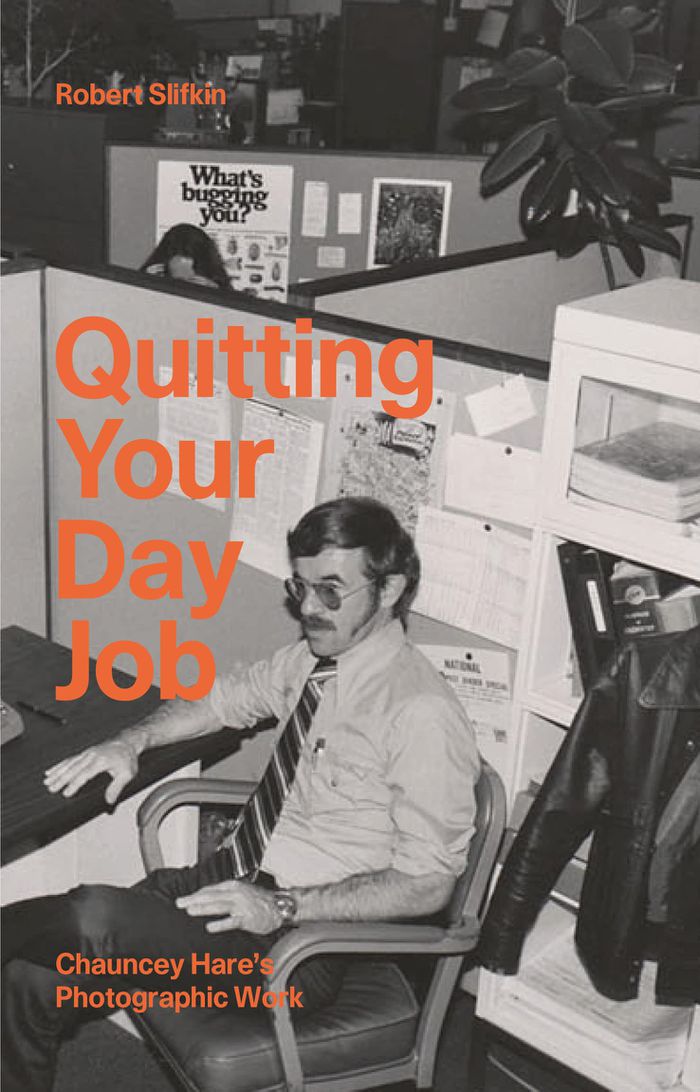
Although Hare experienced a significant, if fleeting, degree of professional success, including a solo exhibition at the Museum of Modern Art in 1977, an Aperture monograph, and three Guggenheim fellowships, his work has not received the critical attention it deserves and his extraordinary life story remains obscure. This lack of recognition has much to do with Hare's fanatical aversion to the commercial realms of the art world even at the height of his professional success. Perhaps his most overt declaration of aesthetic disavowal was his ultimate decision to renounce his identity as an artist in 1985 and pursue a career as a clinical therapist specializing in 'work abuse'. Hare would subsequently donate his entire archive to the Bancroft Library at the University of California with the provision that any reproduction of his work must include a caption that states that the photograph was created ''to protest and warn against the growing domination of working people by multinational corporations and their elite owners and managers.'' ''Quitting your day job'' considers the vexed relation between art and politics that defined Hare's career, drawing upon largely unexamined archival materials, new interviews and analyzing Hare's brilliant and moving photographs alongside the prolix and oftentimes bathetic prefaces he wrote for the three collections of his photographs.
Quitting your day job: Chauncey Hare's photographic work
Actions:
Price:
$41.00
(available to order)
Summary:
Although Hare experienced a significant, if fleeting, degree of professional success, including a solo exhibition at the Museum of Modern Art in 1977, an Aperture monograph, and three Guggenheim fellowships, his work has not received the critical attention it deserves and his extraordinary life story remains obscure. This lack of recognition has much to do with Hare's fanatical aversion to the commercial realms of the art world even at the height of his professional success. Perhaps his most overt declaration of aesthetic disavowal was his ultimate decision to renounce his identity as an artist in 1985 and pursue a career as a clinical therapist specializing in 'work abuse'. Hare would subsequently donate his entire archive to the Bancroft Library at the University of California with the provision that any reproduction of his work must include a caption that states that the photograph was created ''to protest and warn against the growing domination of working people by multinational corporations and their elite owners and managers.'' ''Quitting your day job'' considers the vexed relation between art and politics that defined Hare's career, drawing upon largely unexamined archival materials, new interviews and analyzing Hare's brilliant and moving photographs alongside the prolix and oftentimes bathetic prefaces he wrote for the three collections of his photographs.
Form:
books
books
Publication:
March 2022
March 2022
Subject:
Photography monographs
Photography monographs
Form:
books
books

Actions:
Price:
$22.95
(available to order)
Summary:
Some central questions in the natural and social sciences can’t be answered by controlled laboratory experiments, often considered to be the hallmark of the scientific method. This impossibility holds for any science concerned with the past. In addition, many manipulative experiments, while possible, would be considered immoral or illegal. One has to devise other methods(...)
$22.95
(available to order)
Summary:
Some central questions in the natural and social sciences can’t be answered by controlled laboratory experiments, often considered to be the hallmark of the scientific method. This impossibility holds for any science concerned with the past. In addition, many manipulative experiments, while possible, would be considered immoral or illegal. One has to devise other methods(...)
Title:
Natural experiments of history
Actions:
Price:
$22.95
(available to order)
Summary:
Some central questions in the natural and social sciences can’t be answered by controlled laboratory experiments, often considered to be the hallmark of the scientific method. This impossibility holds for any science concerned with the past. In addition, many manipulative experiments, while possible, would be considered immoral or illegal. One has to devise other methods of observing, describing, and explaining the world. In the historical disciplines, a fruitful approach has been to use natural experiments or the comparative method. This book consists of eight comparative studies drawn from history, archeology, economics, economic history, geography, and political science. The studies cover a spectrum of approaches, ranging from a non-quantitative narrative style in the early chapters to quantitative statistical analyses in the later chapters. The studies range from a simple two-way comparison of Haiti and the Dominican Republic, which share the island of Hispaniola, to comparisons of 81 Pacific islands and 233 areas of India. The societies discussed are contemporary ones, literate societies of recent centuries, and non-literate past societies. Geographically, they include the United States, Mexico, Brazil, western Europe, tropical Africa, India, Siberia, Australia, New Zealand, and other Pacific islands. In an Afterword, the editors discuss how to cope with methodological problems common to these and other natural experiments of history.
Natural experiments of history
Actions:
Price:
$22.95
(available to order)
Summary:
Some central questions in the natural and social sciences can’t be answered by controlled laboratory experiments, often considered to be the hallmark of the scientific method. This impossibility holds for any science concerned with the past. In addition, many manipulative experiments, while possible, would be considered immoral or illegal. One has to devise other methods of observing, describing, and explaining the world. In the historical disciplines, a fruitful approach has been to use natural experiments or the comparative method. This book consists of eight comparative studies drawn from history, archeology, economics, economic history, geography, and political science. The studies cover a spectrum of approaches, ranging from a non-quantitative narrative style in the early chapters to quantitative statistical analyses in the later chapters. The studies range from a simple two-way comparison of Haiti and the Dominican Republic, which share the island of Hispaniola, to comparisons of 81 Pacific islands and 233 areas of India. The societies discussed are contemporary ones, literate societies of recent centuries, and non-literate past societies. Geographically, they include the United States, Mexico, Brazil, western Europe, tropical Africa, India, Siberia, Australia, New Zealand, and other Pacific islands. In an Afterword, the editors discuss how to cope with methodological problems common to these and other natural experiments of history.
Form:
books
books
Publication:
April 2011
April 2011
Subject:
Urban Theory
Urban Theory
Form:
books
books

Actions:
Price:
$50.00
(available in store)
Summary:
Maria Giuseppina Grasso Cannizzo exhibited at the Venice Biennial in 2004 and 2008, and was honored by the Royal Institute of British Architects (RIBA) in 2012. That same year she won a gold medal for her life’s work at the Milan Triennial, and has been nominated twice for the Mies van der Rohe Prize. Nevertheless, she’s still considered an insider’s tip. She lives in(...)
$50.00
(available in store)
Summary:
Maria Giuseppina Grasso Cannizzo exhibited at the Venice Biennial in 2004 and 2008, and was honored by the Royal Institute of British Architects (RIBA) in 2012. That same year she won a gold medal for her life’s work at the Milan Triennial, and has been nominated twice for the Mies van der Rohe Prize. Nevertheless, she’s still considered an insider’s tip. She lives in(...)
Title:
Loose ends : Maria Guiseppina Grasso Cannizzo
Actions:
Price:
$50.00
(available in store)
Summary:
Maria Giuseppina Grasso Cannizzo exhibited at the Venice Biennial in 2004 and 2008, and was honored by the Royal Institute of British Architects (RIBA) in 2012. That same year she won a gold medal for her life’s work at the Milan Triennial, and has been nominated twice for the Mies van der Rohe Prize. Nevertheless, she’s still considered an insider’s tip. She lives in Vittoria, a small city in southern Sicily, where she realizes the majority of her architecture, including many transformations of historical buildings, single and multiple-family housing, or projects such as the control tower in Marina di Ragusa. Grasso Cannizzo’s special design methods are based on her analyses of the urban context and the landscape, as well as her examination of the specific “story” behind each project. She translates the knowledge gained into minimal, self-aware, and sometimes radical concepts, which are ultimately always open to any changes that life and the passage of time may bring. At the same time, this first comprehensive monograph is also a conceptual manifesto by Grasso Cannizzo. Collected in a black box, loose prints provide insight into her most important buildings and make it possible to see the architect’s general design methods.
Loose ends : Maria Guiseppina Grasso Cannizzo
Actions:
Price:
$50.00
(available in store)
Summary:
Maria Giuseppina Grasso Cannizzo exhibited at the Venice Biennial in 2004 and 2008, and was honored by the Royal Institute of British Architects (RIBA) in 2012. That same year she won a gold medal for her life’s work at the Milan Triennial, and has been nominated twice for the Mies van der Rohe Prize. Nevertheless, she’s still considered an insider’s tip. She lives in Vittoria, a small city in southern Sicily, where she realizes the majority of her architecture, including many transformations of historical buildings, single and multiple-family housing, or projects such as the control tower in Marina di Ragusa. Grasso Cannizzo’s special design methods are based on her analyses of the urban context and the landscape, as well as her examination of the specific “story” behind each project. She translates the knowledge gained into minimal, self-aware, and sometimes radical concepts, which are ultimately always open to any changes that life and the passage of time may bring. At the same time, this first comprehensive monograph is also a conceptual manifesto by Grasso Cannizzo. Collected in a black box, loose prints provide insight into her most important buildings and make it possible to see the architect’s general design methods.
Form:
books
books
Publication:
July 2014
July 2014
Subject:
Architecture Monographs
Architecture Monographs
Form:
books
books
Actions:
Price:
$42.00
(available to order)
Summary:
In The Hoarders, Scott Herring provides an in-depth examination of how modern hoarders came into being, from their onset in the late 1930s to the present day. He finds that both the idea of organization and the role of the clutterologist are deeply ingrained in our culture, and that there is a fine line between clutter and deviance in America. Herring introduces us to(...)
$42.00
(available to order)
Summary:
In The Hoarders, Scott Herring provides an in-depth examination of how modern hoarders came into being, from their onset in the late 1930s to the present day. He finds that both the idea of organization and the role of the clutterologist are deeply ingrained in our culture, and that there is a fine line between clutter and deviance in America. Herring introduces us to(...)
Title:
The hoarders : material deviance in Modern American cutlure
Actions:
Price:
$42.00
(available to order)
Summary:
In The Hoarders, Scott Herring provides an in-depth examination of how modern hoarders came into being, from their onset in the late 1930s to the present day. He finds that both the idea of organization and the role of the clutterologist are deeply ingrained in our culture, and that there is a fine line between clutter and deviance in America. Herring introduces us to Jill, whose countertops are piled high with decaying food and whose cabinets are overrun with purchases, while the fly strips hanging from her ceiling are arguably more fly than strip. When Jill spots a decomposing pumpkin about to be jettisoned, she stops, seeing in the rotting, squalid vegetable a special treasure. “I’ve never seen one quite like this before,” she says, and looks to see if any seeds remain. It is from moments like these that Herring builds his questions: What counts as an acceptable material life—and who decides? Is hoarding some sort of inherent deviation of the mind, or a recent historical phenomenon grounded in changing material cultures? Herring opts for the latter, explaining that hoarders attract attention not because they are mentally ill but because they challenge normal modes of material relations.
The hoarders : material deviance in Modern American cutlure
Actions:
Price:
$42.00
(available to order)
Summary:
In The Hoarders, Scott Herring provides an in-depth examination of how modern hoarders came into being, from their onset in the late 1930s to the present day. He finds that both the idea of organization and the role of the clutterologist are deeply ingrained in our culture, and that there is a fine line between clutter and deviance in America. Herring introduces us to Jill, whose countertops are piled high with decaying food and whose cabinets are overrun with purchases, while the fly strips hanging from her ceiling are arguably more fly than strip. When Jill spots a decomposing pumpkin about to be jettisoned, she stops, seeing in the rotting, squalid vegetable a special treasure. “I’ve never seen one quite like this before,” she says, and looks to see if any seeds remain. It is from moments like these that Herring builds his questions: What counts as an acceptable material life—and who decides? Is hoarding some sort of inherent deviation of the mind, or a recent historical phenomenon grounded in changing material cultures? Herring opts for the latter, explaining that hoarders attract attention not because they are mentally ill but because they challenge normal modes of material relations.
Form:
books
books
Publication:
September 2014
September 2014
Subject:
Critical Theory
Critical Theory
Form:
books
books

Actions:
Price:
$15.00
(available to order)
Summary:
How are you involved in the art world? Are you related to any specific scene? What would be the most productive place to present your work? What kind of curators do you like to work with, and why? What does the art market mean for your work? These are some of the questions that have been presented to every artist who has worked with Witte de With, the respected Rotterdam(...)
$15.00
(available to order)
Summary:
How are you involved in the art world? Are you related to any specific scene? What would be the most productive place to present your work? What kind of curators do you like to work with, and why? What does the art market mean for your work? These are some of the questions that have been presented to every artist who has worked with Witte de With, the respected Rotterdam(...)
Subject:
Contemporary Art Monographs
Contemporary Art Monographs
Publication:
March 2008, Rotterdam
March 2008, Rotterdam
Title:
Changing roles artists' personal views and wishes
Actions:
Price:
$15.00
(available to order)
Summary:
How are you involved in the art world? Are you related to any specific scene? What would be the most productive place to present your work? What kind of curators do you like to work with, and why? What does the art market mean for your work? These are some of the questions that have been presented to every artist who has worked with Witte de With, the respected Rotterdam contemporary art center, over the past two years. This publication reflects on the ideas behind the works that the center has shown, and allows artists to voice concerns that are rarely discussed as part of a public initiative. The participants' answers serve as a model, suggesting what roles they need institutions, curators and programs to play. Contributors include Jesper Just, Erik van Lieshout, Sarah Morris and Robin Rhode. Liam Gillick was born in Aylesbury, Great Britain, in 1964 and studied at Hertfordshire College of Art, and Goldsmiths College, London. Often combining text and installation, Gillickis work frequently investigates economics and aesthetics in modern society. A finalist for the Turner Prize in 2002, his work has appeared at Documenta in 1997 and at The Museum of Modern Art, New York in 2003, as well as in numerous solo shows worldwide. He lives and works in London and New York.
Changing roles artists' personal views and wishes
Actions:
Price:
$15.00
(available to order)
Summary:
How are you involved in the art world? Are you related to any specific scene? What would be the most productive place to present your work? What kind of curators do you like to work with, and why? What does the art market mean for your work? These are some of the questions that have been presented to every artist who has worked with Witte de With, the respected Rotterdam contemporary art center, over the past two years. This publication reflects on the ideas behind the works that the center has shown, and allows artists to voice concerns that are rarely discussed as part of a public initiative. The participants' answers serve as a model, suggesting what roles they need institutions, curators and programs to play. Contributors include Jesper Just, Erik van Lieshout, Sarah Morris and Robin Rhode. Liam Gillick was born in Aylesbury, Great Britain, in 1964 and studied at Hertfordshire College of Art, and Goldsmiths College, London. Often combining text and installation, Gillickis work frequently investigates economics and aesthetics in modern society. A finalist for the Turner Prize in 2002, his work has appeared at Documenta in 1997 and at The Museum of Modern Art, New York in 2003, as well as in numerous solo shows worldwide. He lives and works in London and New York.
Form:
books
books
Publication:
March 2008, Rotterdam
March 2008, Rotterdam
Subject:
Contemporary Art Monographs
Contemporary Art Monographs
Form:
books
books
Actions:
Price:
$77.00
(available to order)
Summary:
Inspired by Chekhov's short stories--and by his own contagious joy in the book form--photographer Paul Graham has created A Shimmer of Possibility, comprised of 12 individual books, each a photographic short story of everyday life. Some are simple and linear--a man smokes a cigarette while he waits for a bus in Las Vegas, or the camera tracks an autumn walk in Boston.(...)
$77.00
(available to order)
Summary:
Inspired by Chekhov's short stories--and by his own contagious joy in the book form--photographer Paul Graham has created A Shimmer of Possibility, comprised of 12 individual books, each a photographic short story of everyday life. Some are simple and linear--a man smokes a cigarette while he waits for a bus in Las Vegas, or the camera tracks an autumn walk in Boston.(...)
Title:
Paul Graham: a shimmer of possibility
Actions:
Price:
$77.00
(available to order)
Summary:
Inspired by Chekhov's short stories--and by his own contagious joy in the book form--photographer Paul Graham has created A Shimmer of Possibility, comprised of 12 individual books, each a photographic short story of everyday life. Some are simple and linear--a man smokes a cigarette while he waits for a bus in Las Vegas, or the camera tracks an autumn walk in Boston. Some entwine two, three or four scenes--while a couple carry their shopping home in Texas, a small child dances with a plastic bag in a garden. Some watch a quiet narrative break unexpectedly into a sublime moment--as a man cuts the grass in Pittsburgh it begins to rain, until the low sun breaks through and illuminates each drop. Graham's filmic haikus shun any forceful summation or tidy packaging. Instead, they create the impression of life flowing around and past us while we stand and stare, and make it hard not to share the artist's quiet astonishment with its beauty and grace. The 12 books gathered here are identical in trim size, but vary in length from just a single photograph to 60 pages of images made at one street corner. Paul Graham's work has been widely exhibited and published for 25 years, most recently in the book American Night.
Paul Graham: a shimmer of possibility
Actions:
Price:
$77.00
(available to order)
Summary:
Inspired by Chekhov's short stories--and by his own contagious joy in the book form--photographer Paul Graham has created A Shimmer of Possibility, comprised of 12 individual books, each a photographic short story of everyday life. Some are simple and linear--a man smokes a cigarette while he waits for a bus in Las Vegas, or the camera tracks an autumn walk in Boston. Some entwine two, three or four scenes--while a couple carry their shopping home in Texas, a small child dances with a plastic bag in a garden. Some watch a quiet narrative break unexpectedly into a sublime moment--as a man cuts the grass in Pittsburgh it begins to rain, until the low sun breaks through and illuminates each drop. Graham's filmic haikus shun any forceful summation or tidy packaging. Instead, they create the impression of life flowing around and past us while we stand and stare, and make it hard not to share the artist's quiet astonishment with its beauty and grace. The 12 books gathered here are identical in trim size, but vary in length from just a single photograph to 60 pages of images made at one street corner. Paul Graham's work has been widely exhibited and published for 25 years, most recently in the book American Night.
Form:
books
books
Publication:
January 2009
January 2009
Subject:
Photography monographs
Photography monographs
Form:
journals and magazines
journals and magazines
Actions:
Description:
1 online resource
Author:
Subject:
Publication:
[London] : Graham & Trotman, [London] : Sage Publications
[London] : Graham & Trotman, [London] : Sage Publications
Form:
journals and magazines
journals and magazines
Publication:
[London] : Graham & Trotman, [London] : Sage Publications
[London] : Graham & Trotman, [London] : Sage Publications
Author:
Subject:
Form:
journals and magazines
journals and magazines

Title:
Real Review 16 Autumn 2024
Real Review 16 Autumn 2024
Actions:
Price:
$26.00
(available in store)
Summary:
There is no snow on Mount Fuji. Any hack will tell you the phase change is here, the restructuring of the world is underway. That would be a relief, like a broken fever. But they are wrong. We are still waiting. This period is merely the static on the skin, the rising pressure and building tension before the impending climax of a deluge. We live under a lavender sky,(...)
$26.00
(available in store)
Summary:
There is no snow on Mount Fuji. Any hack will tell you the phase change is here, the restructuring of the world is underway. That would be a relief, like a broken fever. But they are wrong. We are still waiting. This period is merely the static on the skin, the rising pressure and building tension before the impending climax of a deluge. We live under a lavender sky,(...)
Title:
Real Review 16 Autumn 2024
Actions:
Price:
$26.00
(available in store)
Summary:
There is no snow on Mount Fuji. Any hack will tell you the phase change is here, the restructuring of the world is underway. That would be a relief, like a broken fever. But they are wrong. We are still waiting. This period is merely the static on the skin, the rising pressure and building tension before the impending climax of a deluge. We live under a lavender sky, silver and green; this is the time of unsettled air, heavy with that metallic smell of the earth. Soon the wind will awake, driving the rain forward like a cloud of smoke. The tremendous powers by which our lives are encompassed are stirring. How can we prepare for this transformation? We interview professor Jonathan White on the future as a political idea. Artist Dozie Kanu presents a flyer for higher education, while Opioid Crisis Lookbook speculates on semiotics. Peter Saville reviews the mood with Jack Self, who reviews voice notes, moral killing, and the Star Trek universe. Isabelle Bucklow binge-watches tech demos. Satoshi Fujiwara captures law enforcement hardware. Ruba Al-Sweel reviews the non-commercial image, while Martina Rocca and Izzy Farmiloe review the production of culture. Carmen Winant documents the last safe abortion, Felix Mcnamara writes notes on minutiae, John Sunyer attends a run club, plus much more.
Real Review 16 Autumn 2024
Actions:
Price:
$26.00
(available in store)
Summary:
There is no snow on Mount Fuji. Any hack will tell you the phase change is here, the restructuring of the world is underway. That would be a relief, like a broken fever. But they are wrong. We are still waiting. This period is merely the static on the skin, the rising pressure and building tension before the impending climax of a deluge. We live under a lavender sky, silver and green; this is the time of unsettled air, heavy with that metallic smell of the earth. Soon the wind will awake, driving the rain forward like a cloud of smoke. The tremendous powers by which our lives are encompassed are stirring. How can we prepare for this transformation? We interview professor Jonathan White on the future as a political idea. Artist Dozie Kanu presents a flyer for higher education, while Opioid Crisis Lookbook speculates on semiotics. Peter Saville reviews the mood with Jack Self, who reviews voice notes, moral killing, and the Star Trek universe. Isabelle Bucklow binge-watches tech demos. Satoshi Fujiwara captures law enforcement hardware. Ruba Al-Sweel reviews the non-commercial image, while Martina Rocca and Izzy Farmiloe review the production of culture. Carmen Winant documents the last safe abortion, Felix Mcnamara writes notes on minutiae, John Sunyer attends a run club, plus much more.
Form:
journals and magazines
journals and magazines
Publication:
March 2025
March 2025
Subject:
Magazines
Magazines
Form:
books
books
Actions:
Price:
$44.95
(available to order)
Summary:
Why would two talented and employable young graphic designers start up their own practice without any clients, in the midst of a recession, and in a city brimming with world-renowned designers? "Karlssonwilker inc.'s tellmewhy" is the improbable story of such a ventureor act of bravura or insanityon the part of Hjalti Karlsson and Jan Wilker, and offers a telling,(...)
$44.95
(available to order)
Summary:
Why would two talented and employable young graphic designers start up their own practice without any clients, in the midst of a recession, and in a city brimming with world-renowned designers? "Karlssonwilker inc.'s tellmewhy" is the improbable story of such a ventureor act of bravura or insanityon the part of Hjalti Karlsson and Jan Wilker, and offers a telling,(...)
Subject:
Graphic Designers, Monographs
Graphic Designers, Monographs
Publication:
October 2003, New York
October 2003, New York
Title:
Karlssonwilker inc.'s tellmewhy : the first 24 months of a New York design company
Actions:
Price:
$44.95
(available to order)
Summary:
Why would two talented and employable young graphic designers start up their own practice without any clients, in the midst of a recession, and in a city brimming with world-renowned designers? "Karlssonwilker inc.'s tellmewhy" is the improbable story of such a ventureor act of bravura or insanityon the part of Hjalti Karlsson and Jan Wilker, and offers a telling, humorous, and always human insight into the workings of a young startup design studio, showcasing every project they did in their first two years. A book as iconoclastic as their designs, tellmewhy features fresh stories of karlssonwilker's ordinary office and its less-than-romantic tales about rooftop parties, battles with immigration, missed meetings, and money problems. Despite these storiesand because of otherskarlssonwilker has produced an impressive body of design work in two short years. Tellmewhy shows the happy endings, including signage for a Philadelphia restaurant, logo designs for a New York fashion house, and CD packaging for both independent and major music labels. And it presents unrealized designs, like an ad campaign for a TV network. All share the designers' creative and humorous take on design. Karlssonwilker intersperses these examples with its singular illustrated diagrams, faux flow charts linking the partners' biographies, work, social lives, and whatever comes to their unique minds. A foreword by former employer Stefan Sagmeister recalls karlssonwilker's start in his design office.
Karlssonwilker inc.'s tellmewhy : the first 24 months of a New York design company
Actions:
Price:
$44.95
(available to order)
Summary:
Why would two talented and employable young graphic designers start up their own practice without any clients, in the midst of a recession, and in a city brimming with world-renowned designers? "Karlssonwilker inc.'s tellmewhy" is the improbable story of such a ventureor act of bravura or insanityon the part of Hjalti Karlsson and Jan Wilker, and offers a telling, humorous, and always human insight into the workings of a young startup design studio, showcasing every project they did in their first two years. A book as iconoclastic as their designs, tellmewhy features fresh stories of karlssonwilker's ordinary office and its less-than-romantic tales about rooftop parties, battles with immigration, missed meetings, and money problems. Despite these storiesand because of otherskarlssonwilker has produced an impressive body of design work in two short years. Tellmewhy shows the happy endings, including signage for a Philadelphia restaurant, logo designs for a New York fashion house, and CD packaging for both independent and major music labels. And it presents unrealized designs, like an ad campaign for a TV network. All share the designers' creative and humorous take on design. Karlssonwilker intersperses these examples with its singular illustrated diagrams, faux flow charts linking the partners' biographies, work, social lives, and whatever comes to their unique minds. A foreword by former employer Stefan Sagmeister recalls karlssonwilker's start in his design office.
Form:
books
books
Publication:
October 2003, New York
October 2003, New York
Subject:
Graphic Designers, Monographs
Graphic Designers, Monographs


