


2314 Results
Form:
books
books
Actions:
Price:
$34.95
(available to order)
Summary:
Suzaan Boettger offers the first comprehensive history of the Earthworks movement in the United States, providing a fascinating and in-depth analysis of the monumental forms that initiated the broader genre of Land Art. Examining the art, the artists, their dealers and proponents, Boettger interprets Earthworks as a manifestation both of artists' personal stories and of(...)
$34.95
(available to order)
Summary:
Suzaan Boettger offers the first comprehensive history of the Earthworks movement in the United States, providing a fascinating and in-depth analysis of the monumental forms that initiated the broader genre of Land Art. Examining the art, the artists, their dealers and proponents, Boettger interprets Earthworks as a manifestation both of artists' personal stories and of(...)
Title:
Earthworks : art and the landscape of the sixties
Actions:
Price:
$34.95
(available to order)
Summary:
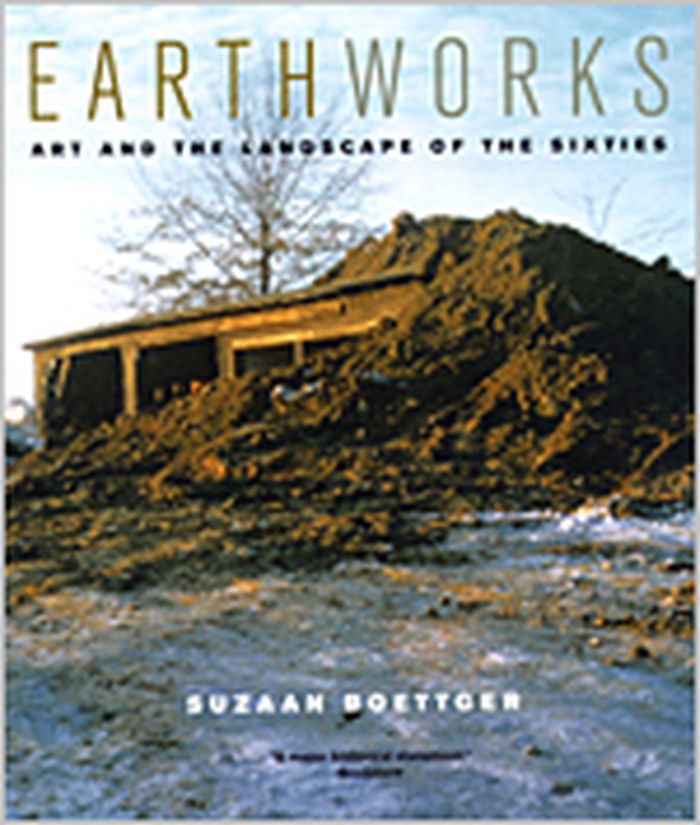
Suzaan Boettger offers the first comprehensive history of the Earthworks movement in the United States, providing a fascinating and in-depth analysis of the monumental forms that initiated the broader genre of Land Art. Examining the art, the artists, their dealers and proponents, Boettger interprets Earthworks as a manifestation both of artists' personal stories and of the late 1960s social and political tumult. Boettger overturns many commonly held notions of Earthworks' origins and intentions. She argues that Robert Smithson's work on the Dallas-Fort Worth airport stimulated his thinking and that his writing about it catalyzed the movement. The visionary environments that followed, often sculpted in expansive and remote western terrains, were idealized by Americans and Europeans alike as displays of cowboy bravado. Boettger identifies earthworkers Michael Heizer, Dennis Oppenheim, Robert Morris, Walter de Maria, and Stephen Kaltenbach as former Californians whose treatment of the landscape reflects a western spirit. Her international purview integrates early work by the Europeans Barry Flanagan, Jan Dibbets, Richard Long, and Pino Pascali as precedents and parallels. Her examination of Earthworks' relationship to the ecology movement perceptively corrects a popular misconception about the artists' goals while acknowledging the social and cultural complexities of the period. Insightful discussions of Carl André, Sol LeWitt, and Claes Oldenburg - in addition to the artists mentioned above - are accompanied by many rare and new photographs of both the art and its creators. Witty, accessible, and scrupulously researched, Earthworks constructs day-to-day chronologies of the development of the artistic movement and its intersections with the larger public events of the time, including specific accounts of galleries, exhibitions, and criticism. Boettger's dynamic social history and psychological insights bring new meaning to this pivotal movement that both embodied and disrupted contemporary notions of art, nature, society, and their relationship to each other.
Earthworks : art and the landscape of the sixties
Actions:
Price:
$34.95
(available to order)
Summary:
Suzaan Boettger offers the first comprehensive history of the Earthworks movement in the United States, providing a fascinating and in-depth analysis of the monumental forms that initiated the broader genre of Land Art. Examining the art, the artists, their dealers and proponents, Boettger interprets Earthworks as a manifestation both of artists' personal stories and of the late 1960s social and political tumult. Boettger overturns many commonly held notions of Earthworks' origins and intentions. She argues that Robert Smithson's work on the Dallas-Fort Worth airport stimulated his thinking and that his writing about it catalyzed the movement. The visionary environments that followed, often sculpted in expansive and remote western terrains, were idealized by Americans and Europeans alike as displays of cowboy bravado. Boettger identifies earthworkers Michael Heizer, Dennis Oppenheim, Robert Morris, Walter de Maria, and Stephen Kaltenbach as former Californians whose treatment of the landscape reflects a western spirit. Her international purview integrates early work by the Europeans Barry Flanagan, Jan Dibbets, Richard Long, and Pino Pascali as precedents and parallels. Her examination of Earthworks' relationship to the ecology movement perceptively corrects a popular misconception about the artists' goals while acknowledging the social and cultural complexities of the period. Insightful discussions of Carl André, Sol LeWitt, and Claes Oldenburg - in addition to the artists mentioned above - are accompanied by many rare and new photographs of both the art and its creators. Witty, accessible, and scrupulously researched, Earthworks constructs day-to-day chronologies of the development of the artistic movement and its intersections with the larger public events of the time, including specific accounts of galleries, exhibitions, and criticism. Boettger's dynamic social history and psychological insights bring new meaning to this pivotal movement that both embodied and disrupted contemporary notions of art, nature, society, and their relationship to each other.
Form:
books
books
Publication:
March 2004, Berkeley
March 2004, Berkeley
Subject:
Contemporary Art Monographs
Contemporary Art Monographs
Form:
books
books
Actions:
Price:
$65.00
(available in store)
Summary:
In the summer of 2018, Ursula Biemann was commissioned to undertake an extended field trip across the South of Colombia. Many surprising developments ensued from this initial journey in the Amazonian rainforest where the histories of colonial conquest and natural science intertwine. Forest Mind is the result of a series of territorial engagements through video-making,(...)
$65.00
(available in store)
Summary:
In the summer of 2018, Ursula Biemann was commissioned to undertake an extended field trip across the South of Colombia. Many surprising developments ensued from this initial journey in the Amazonian rainforest where the histories of colonial conquest and natural science intertwine. Forest Mind is the result of a series of territorial engagements through video-making,(...)
Title:
Forest mind: On the interconnection of all life
Actions:
Price:
$65.00
(available in store)
Summary:
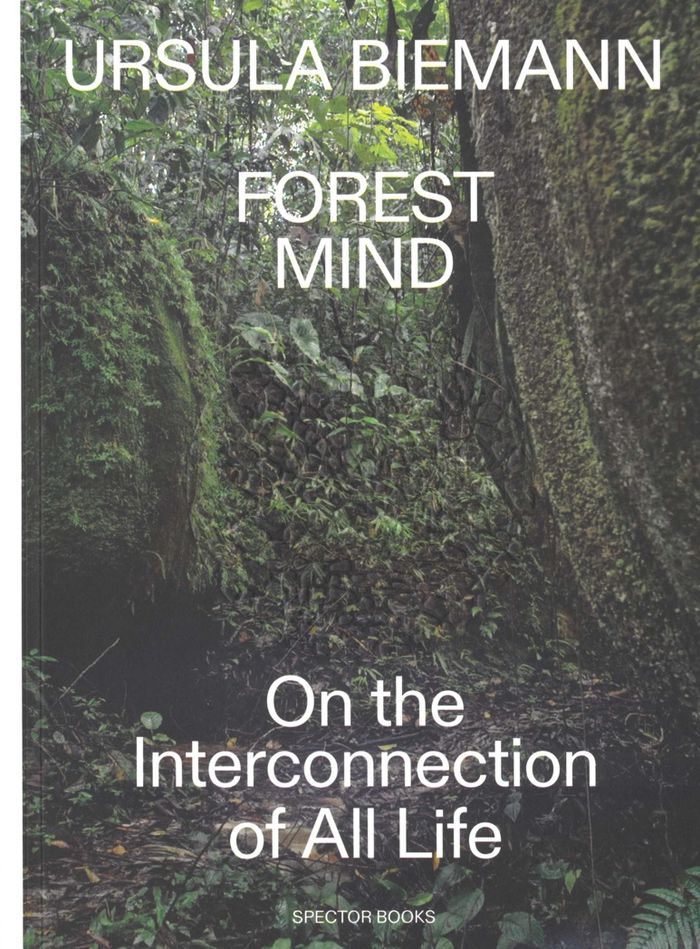
In the summer of 2018, Ursula Biemann was commissioned to undertake an extended field trip across the South of Colombia. Many surprising developments ensued from this initial journey in the Amazonian rainforest where the histories of colonial conquest and natural science intertwine. Forest Mind is the result of a series of territorial engagements through video-making, photography, academic research, personal narrative, and the co-creation of an Indigenous University with the Inga people of Colombia. The explorations focus on the intelligence in nature from both shamanic and scientific perspectives. In these tropical forests, human and nonhuman territorial projects become entangled, calling for new ways of generating knowledge that spur the imagination. The Indigenous science of Ayahuasca as it is practiced by the traditional medics in Amazonia, is largely based in visions evoked by the psychoactive plant. Here, knowing does not only occur from a distance by describing, naming, and exploiting, but as an encounter between minds and worlds. The artist’s research brings to light contemporary Western science that has already been practiced by ancestral medics for millennia, allowing them to interact at the molecular level of DNA. Experimenting with new genetic technologies in collaboration with the ETH lab in Zurich, the visual universe of this project partially derives from biological materials and video-images of the rainforest which were encoded in one and the same DNA strand. In this personal quest, Swiss artist and author Ursula Biemann pursues her long-term inquiry at the intersection of art, ecology and indigenous cosmologies. The artist book presents a biosemiotics project that takes a deep dive into the mechanics of the interconnectedness of all life, and reflects on the active, performative role images play in merging mind and forest.
Forest mind: On the interconnection of all life
Actions:
Price:
$65.00
(available in store)
Summary:
In the summer of 2018, Ursula Biemann was commissioned to undertake an extended field trip across the South of Colombia. Many surprising developments ensued from this initial journey in the Amazonian rainforest where the histories of colonial conquest and natural science intertwine. Forest Mind is the result of a series of territorial engagements through video-making, photography, academic research, personal narrative, and the co-creation of an Indigenous University with the Inga people of Colombia. The explorations focus on the intelligence in nature from both shamanic and scientific perspectives. In these tropical forests, human and nonhuman territorial projects become entangled, calling for new ways of generating knowledge that spur the imagination. The Indigenous science of Ayahuasca as it is practiced by the traditional medics in Amazonia, is largely based in visions evoked by the psychoactive plant. Here, knowing does not only occur from a distance by describing, naming, and exploiting, but as an encounter between minds and worlds. The artist’s research brings to light contemporary Western science that has already been practiced by ancestral medics for millennia, allowing them to interact at the molecular level of DNA. Experimenting with new genetic technologies in collaboration with the ETH lab in Zurich, the visual universe of this project partially derives from biological materials and video-images of the rainforest which were encoded in one and the same DNA strand. In this personal quest, Swiss artist and author Ursula Biemann pursues her long-term inquiry at the intersection of art, ecology and indigenous cosmologies. The artist book presents a biosemiotics project that takes a deep dive into the mechanics of the interconnectedness of all life, and reflects on the active, performative role images play in merging mind and forest.
Form:
books
books
Publication:
October 2022
October 2022
Subject:
Contemporary Art Monographs
Contemporary Art Monographs
Form:
books
books
Title:
Loving the High Line
Loving the High Line
Actions:
Price:
$20.00
(available to order)
Summary:
As an elevated rail line, designed to lift freight trains serving the Hudson River docks above street level circulation, The High Line was originally constructed as material infrastructure for an industrial city. It was closed in 1960s and stood abandoned for the next forty years. In this time organic debris accumulated and decayed, and seeds landed on the newly forming(...)
$20.00
(available to order)
Summary:
As an elevated rail line, designed to lift freight trains serving the Hudson River docks above street level circulation, The High Line was originally constructed as material infrastructure for an industrial city. It was closed in 1960s and stood abandoned for the next forty years. In this time organic debris accumulated and decayed, and seeds landed on the newly forming(...)
Title:
Loving the High Line
Actions:
Price:
$20.00
(available to order)
Summary:
As an elevated rail line, designed to lift freight trains serving the Hudson River docks above street level circulation, The High Line was originally constructed as material infrastructure for an industrial city. It was closed in 1960s and stood abandoned for the next forty years. In this time organic debris accumulated and decayed, and seeds landed on the newly forming soil creating a meadow on the derelict railbed. This microcosmic biome then also became a heterotopic, other space, in the social ecology of the city as an efflorescence of new art forms and underground subcultures flourished in the evacuated post-industrial spaces of Chelsea. These processes would unfold as New York City was being transformed into a global center in an emerging political-economy defined by the integration of finance capital with media and information industries. In this, marginal spaces of the kind that developed in Chelsea, and the cultures that create them, became important sources of new aesthetic and cultural innovation, that offer an exploitable social ground from which to extract semiotic value. As the Bloomberg administration gave shape to this new regime, a project was initiated to convert the High Line into a publicly accessible, linear park. This would be realized through a convoluted process in which the manifold tensions and contradictions of the postmodern city would be dramatically played out and the disjunctions between ideal image regimes and the reality of the material substrates that support them would be brought to light, if only to be newly obscured. The High Line urban park has been both heralded as a definitive model for new urban development, and denounced as a driver, or at least a morbid symptom, of devastating gentrification, and the destructive financialization of urban space. This text, originally published in 2015 as part of the Deconstructing the High Line anthology, edited by Mark Linder and Brian Rosa, tracks a collection of interconnected historical treads that converge in the reconstruction of the High Line, and situates the project within architectural discourse and practice, and social and material conditions with which it struggles to engage.
Loving the High Line
Actions:
Price:
$20.00
(available to order)
Summary:
As an elevated rail line, designed to lift freight trains serving the Hudson River docks above street level circulation, The High Line was originally constructed as material infrastructure for an industrial city. It was closed in 1960s and stood abandoned for the next forty years. In this time organic debris accumulated and decayed, and seeds landed on the newly forming soil creating a meadow on the derelict railbed. This microcosmic biome then also became a heterotopic, other space, in the social ecology of the city as an efflorescence of new art forms and underground subcultures flourished in the evacuated post-industrial spaces of Chelsea. These processes would unfold as New York City was being transformed into a global center in an emerging political-economy defined by the integration of finance capital with media and information industries. In this, marginal spaces of the kind that developed in Chelsea, and the cultures that create them, became important sources of new aesthetic and cultural innovation, that offer an exploitable social ground from which to extract semiotic value. As the Bloomberg administration gave shape to this new regime, a project was initiated to convert the High Line into a publicly accessible, linear park. This would be realized through a convoluted process in which the manifold tensions and contradictions of the postmodern city would be dramatically played out and the disjunctions between ideal image regimes and the reality of the material substrates that support them would be brought to light, if only to be newly obscured. The High Line urban park has been both heralded as a definitive model for new urban development, and denounced as a driver, or at least a morbid symptom, of devastating gentrification, and the destructive financialization of urban space. This text, originally published in 2015 as part of the Deconstructing the High Line anthology, edited by Mark Linder and Brian Rosa, tracks a collection of interconnected historical treads that converge in the reconstruction of the High Line, and situates the project within architectural discourse and practice, and social and material conditions with which it struggles to engage.
Form:
books
books
Publication:
November 2022
November 2022
Subject:
Urban Landscapes
Urban Landscapes
Form:
books
books
Price:
$60.00
(available in store)
Summary:
"Built on sand" is a research-based photographic project by Marcin Piekalkiewicz (PL/NL), in which he examines the social, environmental, and spatial effects of rapid real estate development in Malta. Inspired by Henri Lefebvre’s ideas, the project looks at how capitalism survives by producing and constantly reshaping space. But economic growth, while often celebrated,(...)
$60.00
(available in store)
Summary:
"Built on sand" is a research-based photographic project by Marcin Piekalkiewicz (PL/NL), in which he examines the social, environmental, and spatial effects of rapid real estate development in Malta. Inspired by Henri Lefebvre’s ideas, the project looks at how capitalism survives by producing and constantly reshaping space. But economic growth, while often celebrated,(...)
Publication:
June 2026
June 2026
Title:
Marcin Pierkalkiewicz: Built on sand. On Malta's construction boom
Actions:
Price:
$60.00
(available in store)
Summary:
"Built on sand" is a research-based photographic project by Marcin Piekalkiewicz (PL/NL), in which he examines the social, environmental, and spatial effects of rapid real estate development in Malta. Inspired by Henri Lefebvre’s ideas, the project looks at how capitalism survives by producing and constantly reshaping space. But economic growth, while often celebrated, comes with significant, hidden, costs.
Marcin Pierkalkiewicz: Built on sand. On Malta's construction boom
Actions:
Price:
$60.00
(available in store)
Summary:
"Built on sand" is a research-based photographic project by Marcin Piekalkiewicz (PL/NL), in which he examines the social, environmental, and spatial effects of rapid real estate development in Malta. Inspired by Henri Lefebvre’s ideas, the project looks at how capitalism survives by producing and constantly reshaping space. But economic growth, while often celebrated, comes with significant, hidden, costs.
Form:
books
books
Publication:
June 2026
June 2026


