


29901 Results
Form:
exhibitions
exhibitions
Description:
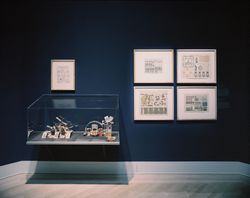
Architecture, though constrained by boundaries of function and structure, is always ultimately an act of the imagination. Potential Architecture: Construction Toys from the CCA Collection explores twenty-one construction toys, made in the hundred years from 1850 to 1950, that were designed to challenge a child’s creativity. The toys illustrate how children learn to invent(...)
Architecture, though constrained by boundaries of function and structure, is always ultimately an act of the imagination. Potential Architecture: Construction Toys from the CCA Collection explores twenty-one construction toys, made in the hundred years from 1850 to 1950, that were designed to challenge a child’s creativity. The toys illustrate how children learn to invent(...)
Location:
Octagonal gallery
Octagonal gallery
Date:
4 December 1991 to 8 March 1992
4 December 1991 to 8 March 1992
Title:
Potential Architecture: Construction Toys from the CCA Collection
Actions:
Description:
Architecture, though constrained by boundaries of function and structure, is always ultimately an act of the imagination. Potential Architecture: Construction Toys from the CCA Collection explores twenty-one construction toys, made in the hundred years from 1850 to 1950, that were designed to challenge a child’s creativity. The toys illustrate how children learn to invent(...)
Potential Architecture: Construction Toys from the CCA Collection
Actions:
Description:
Architecture, though constrained by boundaries of function and structure, is always ultimately an act of the imagination. Potential Architecture: Construction Toys from the CCA Collection explores twenty-one construction toys, made in the hundred years from 1850 to 1950, that were designed to challenge a child’s creativity. The toys illustrate how children learn to invent(...)
Form:
exhibitions
exhibitions
Date:
4 December 1991 to
8 March 1992
4 December 1991 to
8 March 1992
Location:
Octagonal gallery
Octagonal gallery
Level of archival description:
Project
Project
Reference number:
AP018.S1.1960.PR02
Description:
This project series documents the Imperial Oil Ontario region office in North York, Ontario from 1960-1962. The office identified the project number as 6049. This project consisted of a three-storey, 110,000 square foot building located at the corner of Don Mills Road and Eglington Avenue. The front entrance was accessed from a circular driveway off Wynford Drive, with parking lots on either side that held 330 vehicles. The basement level had storage rooms, machine and boiler rooms, a telephone switch gear room and shipping areas. The first floor included food service areas, offices, locker rooms, and a doctor's office complete with x-ray rooms, treatment areas and a quiet room for female employees, among others. The second floor contained administrative areas for accounting, data control and banking, while the third floor contained more offices. The building's frame consisted of a rectangular steel skeleton faced with concrete panels. The ground level was recessed 20 feet to allow for sidewalks around the building. Concrete columns at this level supported the upper two storeys. The landscaped surroundings include long, fountain-spotted reflecting pools. This project won the silver Massey Medal for Architecture in 1964, as well as an honourable distinction at the International Exhibition of Architects VIII Biennial of São Paula in 1965. The project is recorded through drawings, textual records and a photograph dating from 1961-1970. The drawings are mostly reprographic copies that include plans, sections, elevations, details, schedules and electrical, mechanical and structural drawings. The textual records consist of specifications originally arranged with the drawings. The photograph shows the finished buillding.
AP018.S1.1960.PR02
Description:
This project series documents the Imperial Oil Ontario region office in North York, Ontario from 1960-1962. The office identified the project number as 6049. This project consisted of a three-storey, 110,000 square foot building located at the corner of Don Mills Road and Eglington Avenue. The front entrance was accessed from a circular driveway off Wynford Drive, with parking lots on either side that held 330 vehicles. The basement level had storage rooms, machine and boiler rooms, a telephone switch gear room and shipping areas. The first floor included food service areas, offices, locker rooms, and a doctor's office complete with x-ray rooms, treatment areas and a quiet room for female employees, among others. The second floor contained administrative areas for accounting, data control and banking, while the third floor contained more offices. The building's frame consisted of a rectangular steel skeleton faced with concrete panels. The ground level was recessed 20 feet to allow for sidewalks around the building. Concrete columns at this level supported the upper two storeys. The landscaped surroundings include long, fountain-spotted reflecting pools. This project won the silver Massey Medal for Architecture in 1964, as well as an honourable distinction at the International Exhibition of Architects VIII Biennial of São Paula in 1965. The project is recorded through drawings, textual records and a photograph dating from 1961-1970. The drawings are mostly reprographic copies that include plans, sections, elevations, details, schedules and electrical, mechanical and structural drawings. The textual records consist of specifications originally arranged with the drawings. The photograph shows the finished buillding.
People:
Date:
1961 - 1970
1961 - 1970
Title:
Imperial Oil Limited, Ontario Region Office Building, North York (1960-1962)
Actions:
AP018.S1.1960.PR02
Description:
This project series documents the Imperial Oil Ontario region office in North York, Ontario from 1960-1962. The office identified the project number as 6049. This project consisted of a three-storey, 110,000 square foot building located at the corner of Don Mills Road and Eglington Avenue. The front entrance was accessed from a circular driveway off Wynford Drive, with parking lots on either side that held 330 vehicles. The basement level had storage rooms, machine and boiler rooms, a telephone switch gear room and shipping areas. The first floor included food service areas, offices, locker rooms, and a doctor's office complete with x-ray rooms, treatment areas and a quiet room for female employees, among others. The second floor contained administrative areas for accounting, data control and banking, while the third floor contained more offices. The building's frame consisted of a rectangular steel skeleton faced with concrete panels. The ground level was recessed 20 feet to allow for sidewalks around the building. Concrete columns at this level supported the upper two storeys. The landscaped surroundings include long, fountain-spotted reflecting pools. This project won the silver Massey Medal for Architecture in 1964, as well as an honourable distinction at the International Exhibition of Architects VIII Biennial of São Paula in 1965. The project is recorded through drawings, textual records and a photograph dating from 1961-1970. The drawings are mostly reprographic copies that include plans, sections, elevations, details, schedules and electrical, mechanical and structural drawings. The textual records consist of specifications originally arranged with the drawings. The photograph shows the finished buillding.
Imperial Oil Limited, Ontario Region Office Building, North York (1960-1962)
Actions:
AP018.S1.1960.PR02
Description:
This project series documents the Imperial Oil Ontario region office in North York, Ontario from 1960-1962. The office identified the project number as 6049. This project consisted of a three-storey, 110,000 square foot building located at the corner of Don Mills Road and Eglington Avenue. The front entrance was accessed from a circular driveway off Wynford Drive, with parking lots on either side that held 330 vehicles. The basement level had storage rooms, machine and boiler rooms, a telephone switch gear room and shipping areas. The first floor included food service areas, offices, locker rooms, and a doctor's office complete with x-ray rooms, treatment areas and a quiet room for female employees, among others. The second floor contained administrative areas for accounting, data control and banking, while the third floor contained more offices. The building's frame consisted of a rectangular steel skeleton faced with concrete panels. The ground level was recessed 20 feet to allow for sidewalks around the building. Concrete columns at this level supported the upper two storeys. The landscaped surroundings include long, fountain-spotted reflecting pools. This project won the silver Massey Medal for Architecture in 1964, as well as an honourable distinction at the International Exhibition of Architects VIII Biennial of São Paula in 1965. The project is recorded through drawings, textual records and a photograph dating from 1961-1970. The drawings are mostly reprographic copies that include plans, sections, elevations, details, schedules and electrical, mechanical and structural drawings. The textual records consist of specifications originally arranged with the drawings. The photograph shows the finished buillding.
Level of archival description:
Project
Project
Date:
1961 - 1970
1961 - 1970
People:
Form:
textual records
textual records
Actions:
Reference number:
DR2007:0094
Description:
box of textual records containing material including files relating to House I, House II, House III, House X, Peter Eisenman book exhibition at Princeton University (1968), Eisenman personal copies of articles (1919-1939), Eisenman resumes, Eisenman copies of Philip Johnson writings, and notes/transcript of Eisenman 1976 interview with Alessandra Latour and Lauretta Vinciarelli.
DR2007:0094
Description:
box of textual records containing material including files relating to House I, House II, House III, House X, Peter Eisenman book exhibition at Princeton University (1968), Eisenman personal copies of articles (1919-1939), Eisenman resumes, Eisenman copies of Philip Johnson writings, and notes/transcript of Eisenman 1976 interview with Alessandra Latour and Lauretta Vinciarelli.
People:
Title:
Box of textual records containing material including files relating to House I
Actions:
DR2007:0094
Description:
box of textual records containing material including files relating to House I, House II, House III, House X, Peter Eisenman book exhibition at Princeton University (1968), Eisenman personal copies of articles (1919-1939), Eisenman resumes, Eisenman copies of Philip Johnson writings, and notes/transcript of Eisenman 1976 interview with Alessandra Latour and Lauretta Vinciarelli.
Box of textual records containing material including files relating to House I
Actions:
DR2007:0094
Description:
box of textual records containing material including files relating to House I, House II, House III, House X, Peter Eisenman book exhibition at Princeton University (1968), Eisenman personal copies of articles (1919-1939), Eisenman resumes, Eisenman copies of Philip Johnson writings, and notes/transcript of Eisenman 1976 interview with Alessandra Latour and Lauretta Vinciarelli.
Form:
textual records
textual records
People:
Form:
textual records, born digital
textual records, born digital
Title:
Preliminary documentation for the participation of COOP HIMMELB(L)AU at the 2002 Venice Biennale
Preliminary documentation for the participation of COOP HIMMELB(L)AU at the 2002 Venice Biennale
Actions:
Reference number:
AP181.S1.014
Description:
Original directory name: "15_Biennale". File contains a handful of records (presentation notes, PowerPoint presentations, videos) making the case for the presentation of BMW Welt project at the 8th International Architecture Exhibition at the Venice Biennale in 2002. Most common file formats: Microsoft Word Document, Audio/Video Interleaved Format, Microsoft Powerpoint Presentation, Quicktime, Rich Text Format
AP181.S1.014
Description:
Original directory name: "15_Biennale". File contains a handful of records (presentation notes, PowerPoint presentations, videos) making the case for the presentation of BMW Welt project at the 8th International Architecture Exhibition at the Venice Biennale in 2002. Most common file formats: Microsoft Word Document, Audio/Video Interleaved Format, Microsoft Powerpoint Presentation, Quicktime, Rich Text Format
People:
Date:
2002-2003
2002-2003
Title:
Preliminary documentation for the participation of COOP HIMMELB(L)AU at the 2002 Venice Biennale
Actions:
AP181.S1.014
Description:
Original directory name: "15_Biennale". File contains a handful of records (presentation notes, PowerPoint presentations, videos) making the case for the presentation of BMW Welt project at the 8th International Architecture Exhibition at the Venice Biennale in 2002. Most common file formats: Microsoft Word Document, Audio/Video Interleaved Format, Microsoft Powerpoint Presentation, Quicktime, Rich Text Format
Preliminary documentation for the participation of COOP HIMMELB(L)AU at the 2002 Venice Biennale
Actions:
AP181.S1.014
Description:
Original directory name: "15_Biennale". File contains a handful of records (presentation notes, PowerPoint presentations, videos) making the case for the presentation of BMW Welt project at the 8th International Architecture Exhibition at the Venice Biennale in 2002. Most common file formats: Microsoft Word Document, Audio/Video Interleaved Format, Microsoft Powerpoint Presentation, Quicktime, Rich Text Format
Form:
textual records, born digital
textual records, born digital
Date:
2002-2003
2002-2003
People:
Level of archival description:
Series
Series
Title:
Hans and Wassili Luckhardt
Hans and Wassili Luckhardt
Actions:
Reference number:
AP162.S6
Description:
Series documents the contribution of architects Hans Luckhardt and Wasilli Luckhardt to the correspondence circle of Die gläserne Kette, with each writing under the pseudonyms Angkor and Zachen respectively. Born in Berlin in 1880, Hans Luckhardt studied architecture at the Technische Hochschule at Karlsruhe, Germany. In 1919, he joined the Novembergruppe, an exhibiting group of painters, sculptors, architects and musicians, and the Arbeitsrat für Kunst, lead by Bruno Taut. These two groups merged in November 1919. The same year, Luckhardt exhibitied his work at the Ausstellung für unbekannte Architekten and contributed to the organization of the Neues Bauen exhibition the next year. In 1921, Hans Luckhardt began his working collaboration with his brother Wassili. Born in Berlin in 1989, Wassili Luckhardt studied archictecture at the Technische Hochschule at Berlin-Charlottenburg and at the Technische Hochschule in Dresden. He undertook his military service from 1914 to 1918. Like his brother Hans, Wasilli joined the Novembergruppeand the Arbeitsrat für Kunst in 1919 and exhibited his work at the Ausstellung für unbekannte Architekten. During their collaboration, the Luckhardt brothers worked on designs for private commisions and competition schemes including some for Berlin and Hanover (1951-1952). Hans Luckhardt died in 1954 in Bad Wiessee. Wassili Luckhardt continued his work as an architect on various architectural projects. He died in 1972 in Berlin. (Source: Ian Boyd Whyte, Bruno Taut and the Architecture of Activism. Cambridge: Cambridge University Press, 1982) The series comprises part of the correspondence of Hans and Wasilli Luckhardt to the Die gläserne Kette circle, along with related drawings and photographs. The series also includes a photograph of a architectural model for a project by the Luckhart brothers.
AP162.S6
Description:
Series documents the contribution of architects Hans Luckhardt and Wasilli Luckhardt to the correspondence circle of Die gläserne Kette, with each writing under the pseudonyms Angkor and Zachen respectively. Born in Berlin in 1880, Hans Luckhardt studied architecture at the Technische Hochschule at Karlsruhe, Germany. In 1919, he joined the Novembergruppe, an exhibiting group of painters, sculptors, architects and musicians, and the Arbeitsrat für Kunst, lead by Bruno Taut. These two groups merged in November 1919. The same year, Luckhardt exhibitied his work at the Ausstellung für unbekannte Architekten and contributed to the organization of the Neues Bauen exhibition the next year. In 1921, Hans Luckhardt began his working collaboration with his brother Wassili. Born in Berlin in 1989, Wassili Luckhardt studied archictecture at the Technische Hochschule at Berlin-Charlottenburg and at the Technische Hochschule in Dresden. He undertook his military service from 1914 to 1918. Like his brother Hans, Wasilli joined the Novembergruppeand the Arbeitsrat für Kunst in 1919 and exhibited his work at the Ausstellung für unbekannte Architekten. During their collaboration, the Luckhardt brothers worked on designs for private commisions and competition schemes including some for Berlin and Hanover (1951-1952). Hans Luckhardt died in 1954 in Bad Wiessee. Wassili Luckhardt continued his work as an architect on various architectural projects. He died in 1972 in Berlin. (Source: Ian Boyd Whyte, Bruno Taut and the Architecture of Activism. Cambridge: Cambridge University Press, 1982) The series comprises part of the correspondence of Hans and Wasilli Luckhardt to the Die gläserne Kette circle, along with related drawings and photographs. The series also includes a photograph of a architectural model for a project by the Luckhart brothers.
People:
Date:
1919-1920
1919-1920
Title:
Hans and Wassili Luckhardt
Actions:
AP162.S6
Description:
Series documents the contribution of architects Hans Luckhardt and Wasilli Luckhardt to the correspondence circle of Die gläserne Kette, with each writing under the pseudonyms Angkor and Zachen respectively. Born in Berlin in 1880, Hans Luckhardt studied architecture at the Technische Hochschule at Karlsruhe, Germany. In 1919, he joined the Novembergruppe, an exhibiting group of painters, sculptors, architects and musicians, and the Arbeitsrat für Kunst, lead by Bruno Taut. These two groups merged in November 1919. The same year, Luckhardt exhibitied his work at the Ausstellung für unbekannte Architekten and contributed to the organization of the Neues Bauen exhibition the next year. In 1921, Hans Luckhardt began his working collaboration with his brother Wassili. Born in Berlin in 1989, Wassili Luckhardt studied archictecture at the Technische Hochschule at Berlin-Charlottenburg and at the Technische Hochschule in Dresden. He undertook his military service from 1914 to 1918. Like his brother Hans, Wasilli joined the Novembergruppeand the Arbeitsrat für Kunst in 1919 and exhibited his work at the Ausstellung für unbekannte Architekten. During their collaboration, the Luckhardt brothers worked on designs for private commisions and competition schemes including some for Berlin and Hanover (1951-1952). Hans Luckhardt died in 1954 in Bad Wiessee. Wassili Luckhardt continued his work as an architect on various architectural projects. He died in 1972 in Berlin. (Source: Ian Boyd Whyte, Bruno Taut and the Architecture of Activism. Cambridge: Cambridge University Press, 1982) The series comprises part of the correspondence of Hans and Wasilli Luckhardt to the Die gläserne Kette circle, along with related drawings and photographs. The series also includes a photograph of a architectural model for a project by the Luckhart brothers.
Hans and Wassili Luckhardt
Actions:
AP162.S6
Description:
Series documents the contribution of architects Hans Luckhardt and Wasilli Luckhardt to the correspondence circle of Die gläserne Kette, with each writing under the pseudonyms Angkor and Zachen respectively. Born in Berlin in 1880, Hans Luckhardt studied architecture at the Technische Hochschule at Karlsruhe, Germany. In 1919, he joined the Novembergruppe, an exhibiting group of painters, sculptors, architects and musicians, and the Arbeitsrat für Kunst, lead by Bruno Taut. These two groups merged in November 1919. The same year, Luckhardt exhibitied his work at the Ausstellung für unbekannte Architekten and contributed to the organization of the Neues Bauen exhibition the next year. In 1921, Hans Luckhardt began his working collaboration with his brother Wassili. Born in Berlin in 1989, Wassili Luckhardt studied archictecture at the Technische Hochschule at Berlin-Charlottenburg and at the Technische Hochschule in Dresden. He undertook his military service from 1914 to 1918. Like his brother Hans, Wasilli joined the Novembergruppeand the Arbeitsrat für Kunst in 1919 and exhibited his work at the Ausstellung für unbekannte Architekten. During their collaboration, the Luckhardt brothers worked on designs for private commisions and competition schemes including some for Berlin and Hanover (1951-1952). Hans Luckhardt died in 1954 in Bad Wiessee. Wassili Luckhardt continued his work as an architect on various architectural projects. He died in 1972 in Berlin. (Source: Ian Boyd Whyte, Bruno Taut and the Architecture of Activism. Cambridge: Cambridge University Press, 1982) The series comprises part of the correspondence of Hans and Wasilli Luckhardt to the Die gläserne Kette circle, along with related drawings and photographs. The series also includes a photograph of a architectural model for a project by the Luckhart brothers.
Level of archival description:
series
series
Date:
1919-1920
1919-1920
People:
Form:
events
events
Actions:
Description:
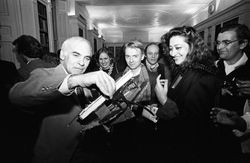
Visiting Scholar Irene Sunwoo presents her research: During the 1970s and 1980s, the Architectural Association (AA) in London tested a “marketplace” model of architectural education that supported an array of theoretical investigations. Exploring issues including politics, phenomenology, semiotics, sustainability, literature, and third-world housing, the school became a(...)
Visiting Scholar Irene Sunwoo presents her research: During the 1970s and 1980s, the Architectural Association (AA) in London tested a “marketplace” model of architectural education that supported an array of theoretical investigations. Exploring issues including politics, phenomenology, semiotics, sustainability, literature, and third-world housing, the school became a(...)
Location:
Shaughnessy House
Shaughnessy House
Date:
27 July 2017, 6pm
27 July 2017, 6pm
Title:
Visiting Scholar Seminar: Irene Sunwoo
Actions:
Description:
Visiting Scholar Irene Sunwoo presents her research: During the 1970s and 1980s, the Architectural Association (AA) in London tested a “marketplace” model of architectural education that supported an array of theoretical investigations. Exploring issues including politics, phenomenology, semiotics, sustainability, literature, and third-world housing, the school became a(...)
Visiting Scholar Seminar: Irene Sunwoo
Actions:
Description:
Visiting Scholar Irene Sunwoo presents her research: During the 1970s and 1980s, the Architectural Association (AA) in London tested a “marketplace” model of architectural education that supported an array of theoretical investigations. Exploring issues including politics, phenomenology, semiotics, sustainability, literature, and third-world housing, the school became a(...)
Form:
events
events
Date:
27 July 2017
6pm
27 July 2017
6pm
Location:
Shaughnessy House
Shaughnessy House
Form:
exhibitions
exhibitions
Title:
Civic Visions, World's Fairs
Civic Visions, World's Fairs
Actions:
Description:
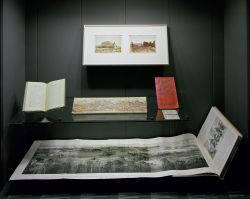
The dazzling energies of world’s fairs are well known —millions of visitors, encyclopaedic displays of goods and ideas, fantastic settings of pavilions and exhibition halls—but the sites that gather the exposition experience into a spatial unity are often overlooked. Civic Visions, World’s Fairs looks at the contribution of site planning to the history of international(...)
The dazzling energies of world’s fairs are well known —millions of visitors, encyclopaedic displays of goods and ideas, fantastic settings of pavilions and exhibition halls—but the sites that gather the exposition experience into a spatial unity are often overlooked. Civic Visions, World’s Fairs looks at the contribution of site planning to the history of international(...)
Location:
Hall cases
Hall cases
Date:
17 March 1993 to 1 August 1993
17 March 1993 to 1 August 1993
Title:
Civic Visions, World's Fairs
Actions:
Description:
The dazzling energies of world’s fairs are well known —millions of visitors, encyclopaedic displays of goods and ideas, fantastic settings of pavilions and exhibition halls—but the sites that gather the exposition experience into a spatial unity are often overlooked. Civic Visions, World’s Fairs looks at the contribution of site planning to the history of international(...)
Civic Visions, World's Fairs
Actions:
Description:
The dazzling energies of world’s fairs are well known —millions of visitors, encyclopaedic displays of goods and ideas, fantastic settings of pavilions and exhibition halls—but the sites that gather the exposition experience into a spatial unity are often overlooked. Civic Visions, World’s Fairs looks at the contribution of site planning to the history of international(...)
Form:
exhibitions
exhibitions
Date:
17 March 1993 to
1 August 1993
17 March 1993 to
1 August 1993
Location:
Hall cases
Hall cases
Form:
drawings
drawings
Reference number:
AP206.S1.1982.PR26.011
Description:
This file documents an unidentified project for a large, arched gateway, likely dating from sometime in the 1980s or 1990s. Identified projects with similar archways include the Guru Jambheshwar University of Science and Technology, Hisar, India (see project series AP206.S1.2000.PR01 in this fonds), and the Exhibition complex, Mysuru, India (see project series AP206.S1.1982.PR01 in this fonds).
AP206.S1.1982.PR26.011
Description:
This file documents an unidentified project for a large, arched gateway, likely dating from sometime in the 1980s or 1990s. Identified projects with similar archways include the Guru Jambheshwar University of Science and Technology, Hisar, India (see project series AP206.S1.2000.PR01 in this fonds), and the Exhibition complex, Mysuru, India (see project series AP206.S1.1982.PR01 in this fonds).
People:
Date:
circa 1980s-1990s
circa 1980s-1990s
Title:
Unidentified project elevation and perspective
Actions:
AP206.S1.1982.PR26.011
Description:
This file documents an unidentified project for a large, arched gateway, likely dating from sometime in the 1980s or 1990s. Identified projects with similar archways include the Guru Jambheshwar University of Science and Technology, Hisar, India (see project series AP206.S1.2000.PR01 in this fonds), and the Exhibition complex, Mysuru, India (see project series AP206.S1.1982.PR01 in this fonds).
Unidentified project elevation and perspective
Actions:
AP206.S1.1982.PR26.011
Description:
This file documents an unidentified project for a large, arched gateway, likely dating from sometime in the 1980s or 1990s. Identified projects with similar archways include the Guru Jambheshwar University of Science and Technology, Hisar, India (see project series AP206.S1.2000.PR01 in this fonds), and the Exhibition complex, Mysuru, India (see project series AP206.S1.1982.PR01 in this fonds).
Form:
drawings
drawings
Date:
circa 1980s-1990s
circa 1980s-1990s
People:
Form:
drawings
drawings
Title:
Column Tower / Tower Column
Column Tower / Tower Column
Actions:
Reference number:
DR2007:0017
Description:
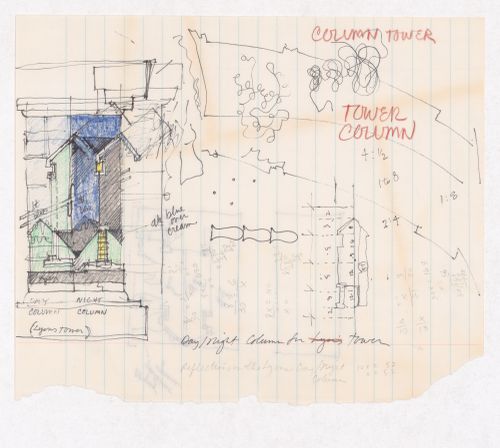
Original sketch for "Lyons Tower" drawing; mixed media on lined paper, 6" x 8". The large final "Lyons Tower" drawing is in the CCA Collections. The realized Lyons Tower project, near Halifax, was published in Larry Richards Works, 1977-1980 (pp. 30-31) and in Domus no. 620, Septembre 1981, p.34. "Lyons Tower" was also exhibited in the 1981 Okanada exhibition in Berlin.
DR2007:0017
Description:
Original sketch for "Lyons Tower" drawing; mixed media on lined paper, 6" x 8". The large final "Lyons Tower" drawing is in the CCA Collections. The realized Lyons Tower project, near Halifax, was published in Larry Richards Works, 1977-1980 (pp. 30-31) and in Domus no. 620, Septembre 1981, p.34. "Lyons Tower" was also exhibited in the 1981 Okanada exhibition in Berlin.
People:
Date:
1979-1980
1979-1980
Title:
Column Tower / Tower Column
Actions:
DR2007:0017
Description:
Original sketch for "Lyons Tower" drawing; mixed media on lined paper, 6" x 8". The large final "Lyons Tower" drawing is in the CCA Collections. The realized Lyons Tower project, near Halifax, was published in Larry Richards Works, 1977-1980 (pp. 30-31) and in Domus no. 620, Septembre 1981, p.34. "Lyons Tower" was also exhibited in the 1981 Okanada exhibition in Berlin.
Column Tower / Tower Column
Actions:
DR2007:0017
Description:
Original sketch for "Lyons Tower" drawing; mixed media on lined paper, 6" x 8". The large final "Lyons Tower" drawing is in the CCA Collections. The realized Lyons Tower project, near Halifax, was published in Larry Richards Works, 1977-1980 (pp. 30-31) and in Domus no. 620, Septembre 1981, p.34. "Lyons Tower" was also exhibited in the 1981 Okanada exhibition in Berlin.
Form:
drawings
drawings
Date:
1979-1980
1979-1980
People:
Level of archival description:
Series
Series
Actions:
Reference number:
AP193.S2
Description:
Series 2, I’ve heard about and Hypnosis chamber, 2004-2006, relates to the conception of the urban structure “I’ve heard about”. The records contain algorithmically-generated images, renderings, pictures of models and exhibitions. There are also photographs of the contour crafting process, 3D models and animated renderings illustrating the construction process of the structure. The project is a conceptual, unbuilt project that is meant to be a habitable organism, an adaptive landscape in a constant state of evolution. By means of transitory scenarios in which the operational mode is entropy and uncertainty, it develops open algorithms based on growth scripts permeable not only to human expressions, but also to the most discrete data such as the chemical emissions (for example due to stress or anxiety) of those who inhabit it. The chemical information is harvested through nanoreceptors feeding the VIAB machine with information. This biostructure becomes the visible part of human contingencies and their negotiation in real time. The structure is conceptualized to be in constant construction through the VIAB machine which is also a constituent of the structure itself. It secretes fiber cement, shaping the landscape where it is located and through which it moves. It generates the reticular structure using a process modelled on contour crafting. The VIAB machine was developed with Robotics Research Lab of the University of Southern California and takes its name from the terms viability and variability. R&Sie(n) considers that due to its mode of emergence “I’ve heard about” fabrication is not subjugated to any political power. Hypnosis chamber is a component of “I’ve heard about”. It consists of an indoor chamber, which was realized as a full-scale sample constructed through automated machinery. The chamber is situated as a part of the whole urban structure presented by “I’ve heard about,” and its goal is to immerse the audience into the project, into a fictional environment only reachable by hypnosis. In this context, hypnosis is a way to help citizens escape from their social condition and experience the new condition of citizenship imagined in “I’ve heard about”, where democracy is re-evaluated as a process of self-determination. Both parts of the projects were shown in contemporary art museums. First at Musée d’art de la ville de Paris in Paris (2005), the Hypnotic chamber is permanently on view at Towada Art Center in Towanda, Japan. AP193.S4 contains a video orienting the project into François Roche theoretical stance, research as speculation, that can be summarize as the use of technological tools to take a critical and political position through esthetic in order to open new lines of thoughts. AP193.S4 contains an updated version of the VIAB machine
AP193.S2
Description:
Series 2, I’ve heard about and Hypnosis chamber, 2004-2006, relates to the conception of the urban structure “I’ve heard about”. The records contain algorithmically-generated images, renderings, pictures of models and exhibitions. There are also photographs of the contour crafting process, 3D models and animated renderings illustrating the construction process of the structure. The project is a conceptual, unbuilt project that is meant to be a habitable organism, an adaptive landscape in a constant state of evolution. By means of transitory scenarios in which the operational mode is entropy and uncertainty, it develops open algorithms based on growth scripts permeable not only to human expressions, but also to the most discrete data such as the chemical emissions (for example due to stress or anxiety) of those who inhabit it. The chemical information is harvested through nanoreceptors feeding the VIAB machine with information. This biostructure becomes the visible part of human contingencies and their negotiation in real time. The structure is conceptualized to be in constant construction through the VIAB machine which is also a constituent of the structure itself. It secretes fiber cement, shaping the landscape where it is located and through which it moves. It generates the reticular structure using a process modelled on contour crafting. The VIAB machine was developed with Robotics Research Lab of the University of Southern California and takes its name from the terms viability and variability. R&Sie(n) considers that due to its mode of emergence “I’ve heard about” fabrication is not subjugated to any political power. Hypnosis chamber is a component of “I’ve heard about”. It consists of an indoor chamber, which was realized as a full-scale sample constructed through automated machinery. The chamber is situated as a part of the whole urban structure presented by “I’ve heard about,” and its goal is to immerse the audience into the project, into a fictional environment only reachable by hypnosis. In this context, hypnosis is a way to help citizens escape from their social condition and experience the new condition of citizenship imagined in “I’ve heard about”, where democracy is re-evaluated as a process of self-determination. Both parts of the projects were shown in contemporary art museums. First at Musée d’art de la ville de Paris in Paris (2005), the Hypnotic chamber is permanently on view at Towada Art Center in Towanda, Japan. AP193.S4 contains a video orienting the project into François Roche theoretical stance, research as speculation, that can be summarize as the use of technological tools to take a critical and political position through esthetic in order to open new lines of thoughts. AP193.S4 contains an updated version of the VIAB machine
People:
Date:
2004-2006
2004-2006
Title:
I’ve heard about and Hypnosis chamber
Actions:
AP193.S2
Description:
Series 2, I’ve heard about and Hypnosis chamber, 2004-2006, relates to the conception of the urban structure “I’ve heard about”. The records contain algorithmically-generated images, renderings, pictures of models and exhibitions. There are also photographs of the contour crafting process, 3D models and animated renderings illustrating the construction process of the structure. The project is a conceptual, unbuilt project that is meant to be a habitable organism, an adaptive landscape in a constant state of evolution. By means of transitory scenarios in which the operational mode is entropy and uncertainty, it develops open algorithms based on growth scripts permeable not only to human expressions, but also to the most discrete data such as the chemical emissions (for example due to stress or anxiety) of those who inhabit it. The chemical information is harvested through nanoreceptors feeding the VIAB machine with information. This biostructure becomes the visible part of human contingencies and their negotiation in real time. The structure is conceptualized to be in constant construction through the VIAB machine which is also a constituent of the structure itself. It secretes fiber cement, shaping the landscape where it is located and through which it moves. It generates the reticular structure using a process modelled on contour crafting. The VIAB machine was developed with Robotics Research Lab of the University of Southern California and takes its name from the terms viability and variability. R&Sie(n) considers that due to its mode of emergence “I’ve heard about” fabrication is not subjugated to any political power. Hypnosis chamber is a component of “I’ve heard about”. It consists of an indoor chamber, which was realized as a full-scale sample constructed through automated machinery. The chamber is situated as a part of the whole urban structure presented by “I’ve heard about,” and its goal is to immerse the audience into the project, into a fictional environment only reachable by hypnosis. In this context, hypnosis is a way to help citizens escape from their social condition and experience the new condition of citizenship imagined in “I’ve heard about”, where democracy is re-evaluated as a process of self-determination. Both parts of the projects were shown in contemporary art museums. First at Musée d’art de la ville de Paris in Paris (2005), the Hypnotic chamber is permanently on view at Towada Art Center in Towanda, Japan. AP193.S4 contains a video orienting the project into François Roche theoretical stance, research as speculation, that can be summarize as the use of technological tools to take a critical and political position through esthetic in order to open new lines of thoughts. AP193.S4 contains an updated version of the VIAB machine
I’ve heard about and Hypnosis chamber
Actions:
AP193.S2
Description:
Series 2, I’ve heard about and Hypnosis chamber, 2004-2006, relates to the conception of the urban structure “I’ve heard about”. The records contain algorithmically-generated images, renderings, pictures of models and exhibitions. There are also photographs of the contour crafting process, 3D models and animated renderings illustrating the construction process of the structure. The project is a conceptual, unbuilt project that is meant to be a habitable organism, an adaptive landscape in a constant state of evolution. By means of transitory scenarios in which the operational mode is entropy and uncertainty, it develops open algorithms based on growth scripts permeable not only to human expressions, but also to the most discrete data such as the chemical emissions (for example due to stress or anxiety) of those who inhabit it. The chemical information is harvested through nanoreceptors feeding the VIAB machine with information. This biostructure becomes the visible part of human contingencies and their negotiation in real time. The structure is conceptualized to be in constant construction through the VIAB machine which is also a constituent of the structure itself. It secretes fiber cement, shaping the landscape where it is located and through which it moves. It generates the reticular structure using a process modelled on contour crafting. The VIAB machine was developed with Robotics Research Lab of the University of Southern California and takes its name from the terms viability and variability. R&Sie(n) considers that due to its mode of emergence “I’ve heard about” fabrication is not subjugated to any political power. Hypnosis chamber is a component of “I’ve heard about”. It consists of an indoor chamber, which was realized as a full-scale sample constructed through automated machinery. The chamber is situated as a part of the whole urban structure presented by “I’ve heard about,” and its goal is to immerse the audience into the project, into a fictional environment only reachable by hypnosis. In this context, hypnosis is a way to help citizens escape from their social condition and experience the new condition of citizenship imagined in “I’ve heard about”, where democracy is re-evaluated as a process of self-determination. Both parts of the projects were shown in contemporary art museums. First at Musée d’art de la ville de Paris in Paris (2005), the Hypnotic chamber is permanently on view at Towada Art Center in Towanda, Japan. AP193.S4 contains a video orienting the project into François Roche theoretical stance, research as speculation, that can be summarize as the use of technological tools to take a critical and political position through esthetic in order to open new lines of thoughts. AP193.S4 contains an updated version of the VIAB machine
Level of archival description:
Series
Series
Date:
2004-2006
2004-2006
People:


