


3001 Results
Form:
books
books
Actions:
Price:
$157.00
(available to order)
Summary:
In recent years the Basel architects Herzog & de Meuron have seen several major competitions judged in their favor. Their museum to house the Goetz art collection in Munich, as well as projects to convert new exhibition space for the Tate Gallery in London and redesign the Hypobank quarter of Munich's inner city have earned international acclaim. Now this multi-volume(...)
$157.00
(available to order)
Summary:
In recent years the Basel architects Herzog & de Meuron have seen several major competitions judged in their favor. Their museum to house the Goetz art collection in Munich, as well as projects to convert new exhibition space for the Tate Gallery in London and redesign the Hypobank quarter of Munich's inner city have earned international acclaim. Now this multi-volume(...)
Title:
Herzog & de Meuron 1989-1991 : the complete works volume 2
Actions:
Price:
$157.00
(available to order)
Summary:
In recent years the Basel architects Herzog & de Meuron have seen several major competitions judged in their favor. Their museum to house the Goetz art collection in Munich, as well as projects to convert new exhibition space for the Tate Gallery in London and redesign the Hypobank quarter of Munich's inner city have earned international acclaim. Now this multi-volume Birkhäuser edition is tracing the development of their complete work. Published out of sequence, Volume 2 is the first of this set to appear and spans the years 1989 1991. Included among its 32 projects are the well-known copper-clad signal box and locomotive depot, the repository for the Goetz art collection, the campus dormitory at the University of Dijon, and the Pfaffenholz sports center in St. Louis. Their approach to the building envelope, for all of its sobriety, evidences a richness not normally associated with the leading proponents of the new Swiss architecture. Lessons from early experimentation with imprinted glass and concrete have been adapted for many of their new buildings. Building envelopes, such as for the Cultural Center in Blois, are conceived as "information skins." At the same time, a fastidious examination of the site leads to a critical dialogue with the city. The urban analyses emerging from the large-scale study, "Basel, a City in the Making?", but also the work on the master plans for the university campus at Dijon and the town sector of Sils Cuncas in the upper Engadine form a focal point in this volume.
Herzog & de Meuron 1989-1991 : the complete works volume 2
Actions:
Price:
$157.00
(available to order)
Summary:
In recent years the Basel architects Herzog & de Meuron have seen several major competitions judged in their favor. Their museum to house the Goetz art collection in Munich, as well as projects to convert new exhibition space for the Tate Gallery in London and redesign the Hypobank quarter of Munich's inner city have earned international acclaim. Now this multi-volume Birkhäuser edition is tracing the development of their complete work. Published out of sequence, Volume 2 is the first of this set to appear and spans the years 1989 1991. Included among its 32 projects are the well-known copper-clad signal box and locomotive depot, the repository for the Goetz art collection, the campus dormitory at the University of Dijon, and the Pfaffenholz sports center in St. Louis. Their approach to the building envelope, for all of its sobriety, evidences a richness not normally associated with the leading proponents of the new Swiss architecture. Lessons from early experimentation with imprinted glass and concrete have been adapted for many of their new buildings. Building envelopes, such as for the Cultural Center in Blois, are conceived as "information skins." At the same time, a fastidious examination of the site leads to a critical dialogue with the city. The urban analyses emerging from the large-scale study, "Basel, a City in the Making?", but also the work on the master plans for the university campus at Dijon and the town sector of Sils Cuncas in the upper Engadine form a focal point in this volume.
Form:
books
books
Publication:
September 1996, Basel
September 1996, Basel
Subject:
Architecture Monographs
Architecture Monographs
Form:
books
books
Title:
William Wylie: Carrara
William Wylie: Carrara
Actions:
Price:
$64.95
(available to order)
Summary:
The legendary Cava di Gioia quarry in Carrara, Italy, was the source of the luminous white marble used by Michelangelo, Bernini, Henry Moore, and other renowned sculptors. Carrara, a volume of stunning photographs by William Wylie, reveals that the beauty of the quarry itself can be as alluring as the sculptures carved from its stone. Wylie is the first photographer to(...)
$64.95
(available to order)
Summary:
The legendary Cava di Gioia quarry in Carrara, Italy, was the source of the luminous white marble used by Michelangelo, Bernini, Henry Moore, and other renowned sculptors. Carrara, a volume of stunning photographs by William Wylie, reveals that the beauty of the quarry itself can be as alluring as the sculptures carved from its stone. Wylie is the first photographer to(...)
Title:
William Wylie: Carrara
Actions:
Price:
$64.95
(available to order)
Summary:
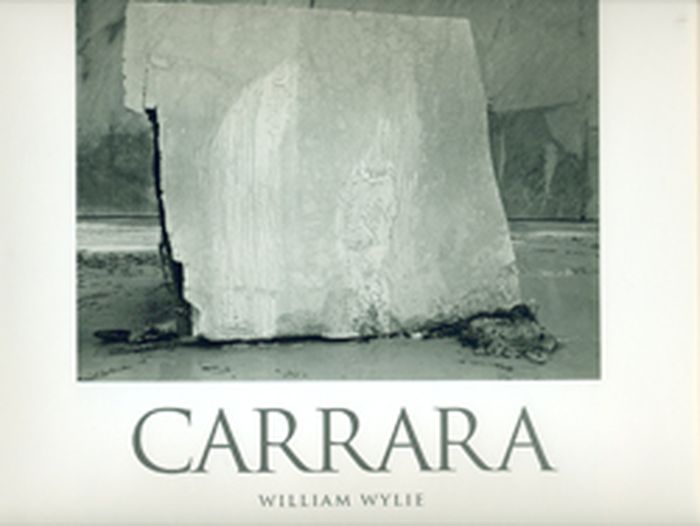
The legendary Cava di Gioia quarry in Carrara, Italy, was the source of the luminous white marble used by Michelangelo, Bernini, Henry Moore, and other renowned sculptors. Carrara, a volume of stunning photographs by William Wylie, reveals that the beauty of the quarry itself can be as alluring as the sculptures carved from its stone. Wylie is the first photographer to document Cava di Gioia since Ilario Besi, early in the twentieth century. For six years, Wylie photographed the changing landscape of the quarry, and his images capture the intense physical scale of the site, the dramatic setting, and the character of the stonecutters, or cavatori, who have worked the quarry for generations. Wylie’s astonishing photographs present a remarkable panorama carved by more than twenty centuries of excavation. As well, his images of the stonecutters are sensitive portraits of men shaped by their occupation, toughened and enlivened by their work.
William Wylie: Carrara
Actions:
Price:
$64.95
(available to order)
Summary:
The legendary Cava di Gioia quarry in Carrara, Italy, was the source of the luminous white marble used by Michelangelo, Bernini, Henry Moore, and other renowned sculptors. Carrara, a volume of stunning photographs by William Wylie, reveals that the beauty of the quarry itself can be as alluring as the sculptures carved from its stone. Wylie is the first photographer to document Cava di Gioia since Ilario Besi, early in the twentieth century. For six years, Wylie photographed the changing landscape of the quarry, and his images capture the intense physical scale of the site, the dramatic setting, and the character of the stonecutters, or cavatori, who have worked the quarry for generations. Wylie’s astonishing photographs present a remarkable panorama carved by more than twenty centuries of excavation. As well, his images of the stonecutters are sensitive portraits of men shaped by their occupation, toughened and enlivened by their work.
Form:
books
books
Publication:
March 2009
March 2009
Form:
books
books
Actions:
Price:
$46.99
(available to order)
Summary:
An in-depth look at the evolution of one of the most engaging and experimental architecture studios today. The ciliary muscle reproduces the effect of a lens and allows the eye to focus or blur vision. The ciliary muscle became the emblem of the critical vision that Diller + Scofidio (+ Renfro) had of their heterogeneous fields of research and experimentation. The(...)
$46.99
(available to order)
Summary:
An in-depth look at the evolution of one of the most engaging and experimental architecture studios today. The ciliary muscle reproduces the effect of a lens and allows the eye to focus or blur vision. The ciliary muscle became the emblem of the critical vision that Diller + Scofidio (+ Renfro) had of their heterogeneous fields of research and experimentation. The(...)
Subject:
Architecture Monographs
Architecture Monographs
Publication:
November 2007, Milan
November 2007, Milan
Title:
Diller + Scofidio (+Renfro) : The Ciliary function, works and projects 1979-2007
Actions:
Price:
$46.99
(available to order)
Summary:
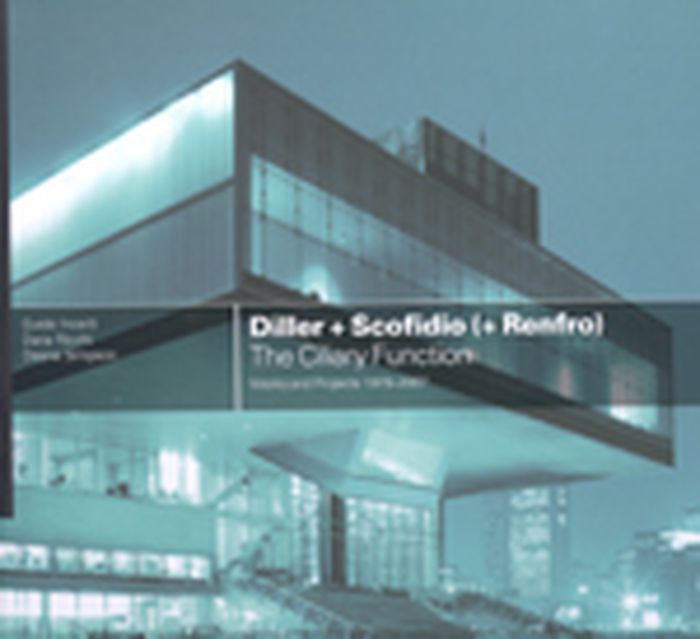
An in-depth look at the evolution of one of the most engaging and experimental architecture studios today. The ciliary muscle reproduces the effect of a lens and allows the eye to focus or blur vision. The ciliary muscle became the emblem of the critical vision that Diller + Scofidio (+ Renfro) had of their heterogeneous fields of research and experimentation. The work of this New York studio owes its notoriety to a genre that challenges the contemporary role of both the architect and architecture. Their interdisciplinary projects range from objects, installations and performances to media and architecture. In recent years they have expanded � with a third partner joining their studio � to embrace projects on an urban scale. Their works, recognised on an international level, include the Blur Building for Swiss Expo 2002, �the brasserie� restaurant in New York, the ICA in Boston, the Lincoln Center and the High-Line, both in New York. Diller + Scofidio (+ Renfro): The Ciliary Function covers their development documenting about twenty works, from the earliest to the most recent. The volume, with a foreword by Reinhold Martin, includes essays investigating the studio�s context, influences and strategies, some interviews with the architects, dossiers on the chronology of their engagements, an itinerary, a scheme showing the evolution and growth of the studio from 1979 to today and a DVD documenting the multimedia and interdisciplinary projects by Diller + Scofidio (+ Renfro).
Diller + Scofidio (+Renfro) : The Ciliary function, works and projects 1979-2007
Actions:
Price:
$46.99
(available to order)
Summary:
An in-depth look at the evolution of one of the most engaging and experimental architecture studios today. The ciliary muscle reproduces the effect of a lens and allows the eye to focus or blur vision. The ciliary muscle became the emblem of the critical vision that Diller + Scofidio (+ Renfro) had of their heterogeneous fields of research and experimentation. The work of this New York studio owes its notoriety to a genre that challenges the contemporary role of both the architect and architecture. Their interdisciplinary projects range from objects, installations and performances to media and architecture. In recent years they have expanded � with a third partner joining their studio � to embrace projects on an urban scale. Their works, recognised on an international level, include the Blur Building for Swiss Expo 2002, �the brasserie� restaurant in New York, the ICA in Boston, the Lincoln Center and the High-Line, both in New York. Diller + Scofidio (+ Renfro): The Ciliary Function covers their development documenting about twenty works, from the earliest to the most recent. The volume, with a foreword by Reinhold Martin, includes essays investigating the studio�s context, influences and strategies, some interviews with the architects, dossiers on the chronology of their engagements, an itinerary, a scheme showing the evolution and growth of the studio from 1979 to today and a DVD documenting the multimedia and interdisciplinary projects by Diller + Scofidio (+ Renfro).
Form:
books
books
Publication:
November 2007, Milan
November 2007, Milan
Subject:
Architecture Monographs
Architecture Monographs
Form:
books
books
Title:
57 pavilions
57 pavilions
Actions:
Price:
$32.95
(available to order)
Summary:
"57 Pavilions" is a 21st century manual documenting architectural design research at PennDesign examining new potentials for part to whole assemblies where experiments in material expression, morphology, performance and culture fuse with advanced digital design processes and fabrication to produce full-scale architectural consequences. Through the presentation of 54(...)
$32.95
(available to order)
Summary:
"57 Pavilions" is a 21st century manual documenting architectural design research at PennDesign examining new potentials for part to whole assemblies where experiments in material expression, morphology, performance and culture fuse with advanced digital design processes and fabrication to produce full-scale architectural consequences. Through the presentation of 54(...)
Title:
57 pavilions
Actions:
Price:
$32.95
(available to order)
Summary:
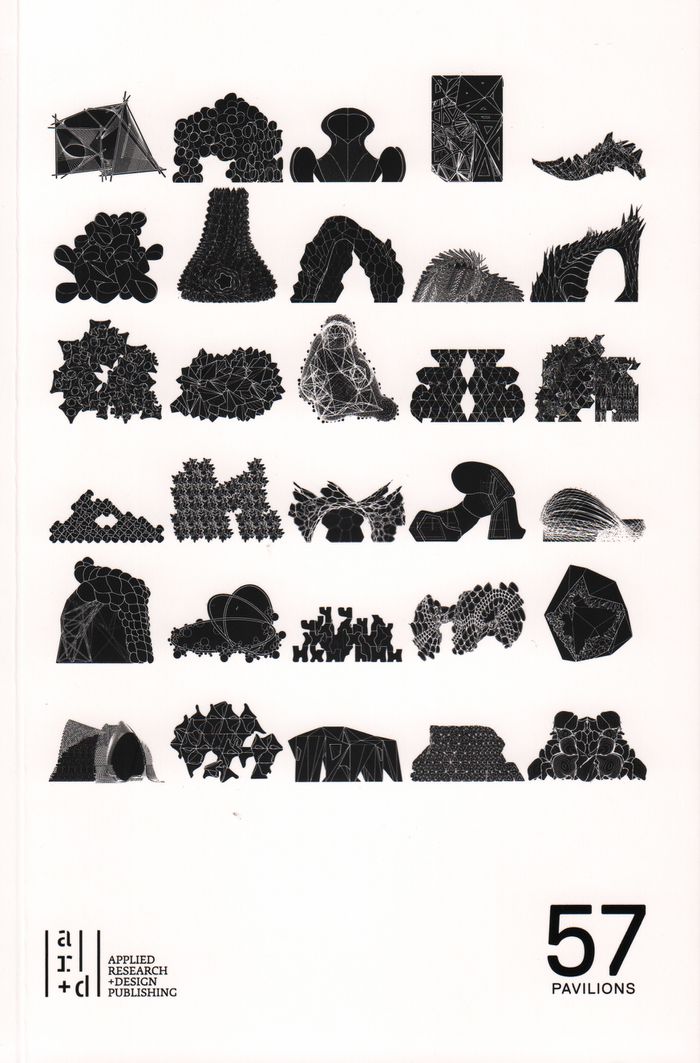
"57 Pavilions" is a 21st century manual documenting architectural design research at PennDesign examining new potentials for part to whole assemblies where experiments in material expression, morphology, performance and culture fuse with advanced digital design processes and fabrication to produce full-scale architectural consequences. Through the presentation of 54 half-scale pavilion projects and three full-scale pavilions a novel approach is laid out for generating higher ordered physical assemblies. The formations produce a new role of parts, material processes, and aggregations yielding a more autonomous character as discrete objects in a larger assembly. As the pavilion research moves into the world in full-scale installations, these new part to whole relationships provoke unexpected engagement with occupants, the environment, and the larger cultural context.
57 pavilions
Actions:
Price:
$32.95
(available to order)
Summary:
"57 Pavilions" is a 21st century manual documenting architectural design research at PennDesign examining new potentials for part to whole assemblies where experiments in material expression, morphology, performance and culture fuse with advanced digital design processes and fabrication to produce full-scale architectural consequences. Through the presentation of 54 half-scale pavilion projects and three full-scale pavilions a novel approach is laid out for generating higher ordered physical assemblies. The formations produce a new role of parts, material processes, and aggregations yielding a more autonomous character as discrete objects in a larger assembly. As the pavilion research moves into the world in full-scale installations, these new part to whole relationships provoke unexpected engagement with occupants, the environment, and the larger cultural context.
Form:
books
books
Publication:
October 2018
October 2018
Subject:
Experimentale architecture
Experimentale architecture
Form:
books
books
Actions:
Price:
$34.00
(available to order)
Summary:
Architecture Without Content is architecture reduced to its very perimeter. The books in the series are the outcome of studios held at EPFL. In Architecture Without Content 16, an interest in Neo-Palladianism has been added to a project that investigates the impact of scale, as Palladianism was a defining factor in the early identification of 'American Architecture.'(...)
$34.00
(available to order)
Summary:
Architecture Without Content is architecture reduced to its very perimeter. The books in the series are the outcome of studios held at EPFL. In Architecture Without Content 16, an interest in Neo-Palladianism has been added to a project that investigates the impact of scale, as Palladianism was a defining factor in the early identification of 'American Architecture.'(...)
Title:
Neon Palladian: Architecture without content 16. Harvard GSD
Actions:
Price:
$34.00
(available to order)
Summary:
Architecture Without Content is architecture reduced to its very perimeter. The books in the series are the outcome of studios held at EPFL. In Architecture Without Content 16, an interest in Neo-Palladianism has been added to a project that investigates the impact of scale, as Palladianism was a defining factor in the early identification of 'American Architecture.' Thus, the studio was both formalistic and pragmatic and tried to inflate Palladian architecture to the scale of the strip: Neon Palladian. In the vast landscape of the United States of America, the scale of food production has always been gigantic. At the same time, it has seldom regained an architectural form similar to that of its most defining orgins. In this book, you will find projects that are organising an aspect of food production. In one way or another, they reconnect to the long-lost virtues of Jefferson's Palladianism.
Neon Palladian: Architecture without content 16. Harvard GSD
Actions:
Price:
$34.00
(available to order)
Summary:
Architecture Without Content is architecture reduced to its very perimeter. The books in the series are the outcome of studios held at EPFL. In Architecture Without Content 16, an interest in Neo-Palladianism has been added to a project that investigates the impact of scale, as Palladianism was a defining factor in the early identification of 'American Architecture.' Thus, the studio was both formalistic and pragmatic and tried to inflate Palladian architecture to the scale of the strip: Neon Palladian. In the vast landscape of the United States of America, the scale of food production has always been gigantic. At the same time, it has seldom regained an architectural form similar to that of its most defining orgins. In this book, you will find projects that are organising an aspect of food production. In one way or another, they reconnect to the long-lost virtues of Jefferson's Palladianism.
Form:
books
books
Publication:
April 2017
April 2017
Subject:
Current Exhibitions
Current Exhibitions
Form:
books
books
Title:
Benthem Crouwel / Zwakman
Benthem Crouwel / Zwakman
Actions:
Price:
$25.95
(available to order)
Summary:
Artist and photographer Edwin Zwakman confuses the viewer by photographing scale models as if they are a real building. Fascinated by this procedure, Benthem Crouwel invited Zwakman to undertake a photographic project featuring the three buildings by this architectural office that are found in the Dutch miniature city of Madurodam: the High Speed Train Bridge over(...)
$25.95
(available to order)
Summary:
Artist and photographer Edwin Zwakman confuses the viewer by photographing scale models as if they are a real building. Fascinated by this procedure, Benthem Crouwel invited Zwakman to undertake a photographic project featuring the three buildings by this architectural office that are found in the Dutch miniature city of Madurodam: the High Speed Train Bridge over(...)
Title:
Benthem Crouwel / Zwakman
Actions:
Price:
$25.95
(available to order)
Summary:
Artist and photographer Edwin Zwakman confuses the viewer by photographing scale models as if they are a real building. Fascinated by this procedure, Benthem Crouwel invited Zwakman to undertake a photographic project featuring the three buildings by this architectural office that are found in the Dutch miniature city of Madurodam: the High Speed Train Bridge over Hollandsch Diep, Schiphol Airport, and the yet to be built Utrecht Central Station. The scale models captured in these pages are simplified, subjected to weather, and populated by merry, slanting miniature people. Further, Zwakman has meticulously sought out, and captured qualities such as transparency, visible construction and harmonious interaction between large scale and the individual that typify the work of the practice
Benthem Crouwel / Zwakman
Actions:
Price:
$25.95
(available to order)
Summary:
Artist and photographer Edwin Zwakman confuses the viewer by photographing scale models as if they are a real building. Fascinated by this procedure, Benthem Crouwel invited Zwakman to undertake a photographic project featuring the three buildings by this architectural office that are found in the Dutch miniature city of Madurodam: the High Speed Train Bridge over Hollandsch Diep, Schiphol Airport, and the yet to be built Utrecht Central Station. The scale models captured in these pages are simplified, subjected to weather, and populated by merry, slanting miniature people. Further, Zwakman has meticulously sought out, and captured qualities such as transparency, visible construction and harmonious interaction between large scale and the individual that typify the work of the practice
Form:
books
books
Publication:
November 2009
November 2009
Subject:
Architecture Monographs
Architecture Monographs
Form:
books
books

Actions:
Price:
$64.95
(available to order)
Summary:
Álvaro’s Siza’s public housing projects, designed at great scale and complexity against the backdrop of the Portuguese Revolution, obliged him to articulate a position that was nuanced and ideologically forceful. Such projects developed over long periods, in response to shifts in policy, funding and political climate. For an architect whose work develops always through(...)
$64.95
(available to order)
Summary:
Álvaro’s Siza’s public housing projects, designed at great scale and complexity against the backdrop of the Portuguese Revolution, obliged him to articulate a position that was nuanced and ideologically forceful. Such projects developed over long periods, in response to shifts in policy, funding and political climate. For an architect whose work develops always through(...)
Title:
Seven early sketchbooks: Álvaro Siza Vieira
Actions:
Price:
$64.95
(available to order)
Summary:
Álvaro’s Siza’s public housing projects, designed at great scale and complexity against the backdrop of the Portuguese Revolution, obliged him to articulate a position that was nuanced and ideologically forceful. Such projects developed over long periods, in response to shifts in policy, funding and political climate. For an architect whose work develops always through the iterative sketch, this challenging process, combined with the scale and cultural ambition of the projects themselves, produced the densest imaginable mass of drawings.
Seven early sketchbooks: Álvaro Siza Vieira
Actions:
Price:
$64.95
(available to order)
Summary:
Álvaro’s Siza’s public housing projects, designed at great scale and complexity against the backdrop of the Portuguese Revolution, obliged him to articulate a position that was nuanced and ideologically forceful. Such projects developed over long periods, in response to shifts in policy, funding and political climate. For an architect whose work develops always through the iterative sketch, this challenging process, combined with the scale and cultural ambition of the projects themselves, produced the densest imaginable mass of drawings.
Form:
books
books
Publication:
July 2018
July 2018
Subject:
Architecture Monographs
Architecture Monographs
Form:
books
books
Title:
Jeff Wall: picture for women
Jeff Wall: picture for women
Actions:
Price:
$18.95
(available to order)
Summary:
Jeff Wall's Picture for Women (1979) marks the transition of photography as an art form from the printed page to the gallery wall. Before this, photographs--from the orthodox photographic work of Walker Evans to the Conceptual photography of Dan Graham--seemed intended for the page even when hung in a gallery. In Picture for Women, a woman looks outward, as if at the(...)
$18.95
(available to order)
Summary:
Jeff Wall's Picture for Women (1979) marks the transition of photography as an art form from the printed page to the gallery wall. Before this, photographs--from the orthodox photographic work of Walker Evans to the Conceptual photography of Dan Graham--seemed intended for the page even when hung in a gallery. In Picture for Women, a woman looks outward, as if at the(...)
Title:
Jeff Wall: picture for women
Actions:
Price:
$18.95
(available to order)
Summary:
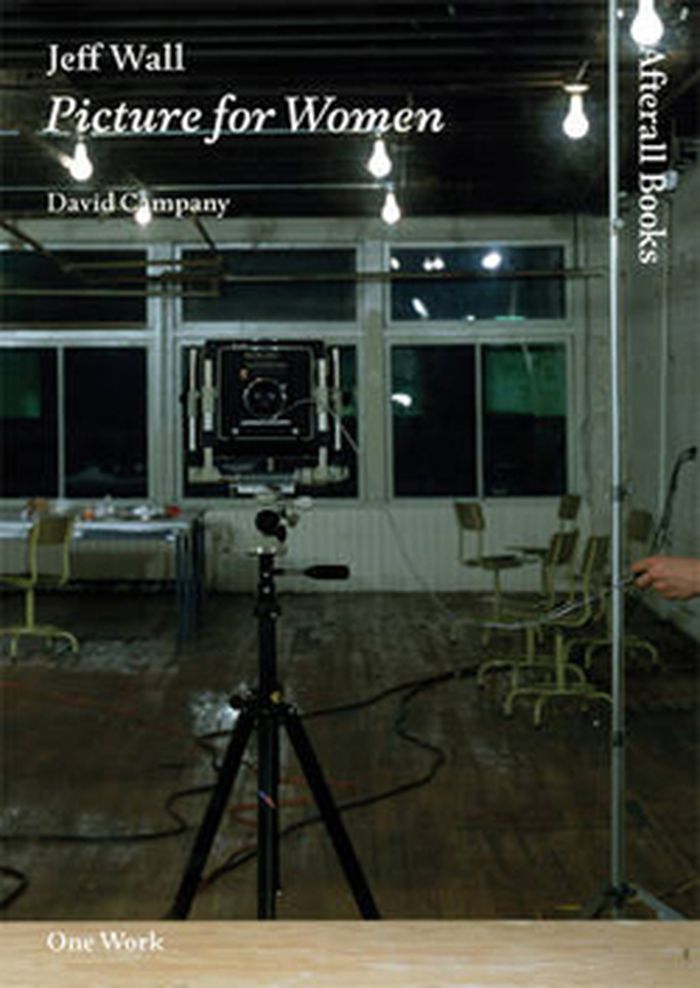
Jeff Wall's Picture for Women (1979) marks the transition of photography as an art form from the printed page to the gallery wall. Before this, photographs--from the orthodox photographic work of Walker Evans to the Conceptual photography of Dan Graham--seemed intended for the page even when hung in a gallery. In Picture for Women, a woman looks outward, as if at the viewer; a camera occupies the center of the photograph; the photographer stands on the right. Modeled on Manet's famous painting Un bar aux Folies-Bergere, in which a barmaid seems to look directly out of the painting, observed by a man on the right, Picture for Women establishes its own art historical genealogy, claiming its rightful position within the canon. Wall's photograph is an ambitious attempt to relate the artistic and spectatorial demands of the late 1970s to a modernist pictorial art that had been too hastily rejected by Conceptualism. In this illustrated study, David Campany offers an account of Wall's move from a Conceptual approach to a reengagement with the idea of a singular (as opposed to serial) picture. He shows that Wall's decision to present his work as a large-scale back-lit transparency, together with his commitment to a singular image, amounted to a radical departure. He contrasts Wall's idea of the photograph as a tableau or "picture," inherited from the history of painting, with the works of the "Pictures Generation" - including Richard Prince, Cindy Sherman, and Jack Goldstein - and argues that Picture for Women is inseparable from the modern fate of the picture in general.
Jeff Wall: picture for women
Actions:
Price:
$18.95
(available to order)
Summary:
Jeff Wall's Picture for Women (1979) marks the transition of photography as an art form from the printed page to the gallery wall. Before this, photographs--from the orthodox photographic work of Walker Evans to the Conceptual photography of Dan Graham--seemed intended for the page even when hung in a gallery. In Picture for Women, a woman looks outward, as if at the viewer; a camera occupies the center of the photograph; the photographer stands on the right. Modeled on Manet's famous painting Un bar aux Folies-Bergere, in which a barmaid seems to look directly out of the painting, observed by a man on the right, Picture for Women establishes its own art historical genealogy, claiming its rightful position within the canon. Wall's photograph is an ambitious attempt to relate the artistic and spectatorial demands of the late 1970s to a modernist pictorial art that had been too hastily rejected by Conceptualism. In this illustrated study, David Campany offers an account of Wall's move from a Conceptual approach to a reengagement with the idea of a singular (as opposed to serial) picture. He shows that Wall's decision to present his work as a large-scale back-lit transparency, together with his commitment to a singular image, amounted to a radical departure. He contrasts Wall's idea of the photograph as a tableau or "picture," inherited from the history of painting, with the works of the "Pictures Generation" - including Richard Prince, Cindy Sherman, and Jack Goldstein - and argues that Picture for Women is inseparable from the modern fate of the picture in general.
Form:
books
books
Publication:
March 2011
March 2011
Form:
books
books
Actions:
Price:
$70.00
(available to order)
Summary:
Each volume analyses the construction process from the first design idea to the call for bids, covering the fundamental design principles and concrete details. The series title, Scale, signifies that the perfect detail is the result of a process through various levels of conception and design, from the abstract to the particular. Although the focus is on communicating(...)
$70.00
(available to order)
Summary:
Each volume analyses the construction process from the first design idea to the call for bids, covering the fundamental design principles and concrete details. The series title, Scale, signifies that the perfect detail is the result of a process through various levels of conception and design, from the abstract to the particular. Although the focus is on communicating(...)
Title:
Open I close, windows, doors, gates, loggias, gilters
Actions:
Price:
$70.00
(available to order)
Summary:
Each volume analyses the construction process from the first design idea to the call for bids, covering the fundamental design principles and concrete details. The series title, Scale, signifies that the perfect detail is the result of a process through various levels of conception and design, from the abstract to the particular. Although the focus is on communicating hands-on constructional know-how, Scale’s innovative presentation does not just simply show solutions, but demonstrates how to develop them. Each volume presents essential information for design and implementation, from the first sketches to details of connectors in a scale of 1:10. Consistency in the plans and drawings, clear hierarchies in the headings and structure, and a clear, easily readable layout with helpful captions simplify the search for specific information, and make Scale volumes ideal for quick, targeted consultation.
Open I close, windows, doors, gates, loggias, gilters
Actions:
Price:
$70.00
(available to order)
Summary:
Each volume analyses the construction process from the first design idea to the call for bids, covering the fundamental design principles and concrete details. The series title, Scale, signifies that the perfect detail is the result of a process through various levels of conception and design, from the abstract to the particular. Although the focus is on communicating hands-on constructional know-how, Scale’s innovative presentation does not just simply show solutions, but demonstrates how to develop them. Each volume presents essential information for design and implementation, from the first sketches to details of connectors in a scale of 1:10. Consistency in the plans and drawings, clear hierarchies in the headings and structure, and a clear, easily readable layout with helpful captions simplify the search for specific information, and make Scale volumes ideal for quick, targeted consultation.
Form:
books
books
Publication:
August 2009
August 2009
Form:
books
books

Title:
Edward Burtynsky : oil
Edward Burtynsky : oil
Actions:
Price:
$150.00
(available to order)
Summary:
Edward Burtynsky's Oil collects a decades' worth of photographing the world's largest oil fields, refineries, freeway interchanges and automobile plants, in an attempt to comprehend the scale of production attending this most politicized of resources. The ideal photographer for this job, Burtynsky locates and documents the sites that urban dwellers never see, and(...)
$150.00
(available to order)
Summary:
Edward Burtynsky's Oil collects a decades' worth of photographing the world's largest oil fields, refineries, freeway interchanges and automobile plants, in an attempt to comprehend the scale of production attending this most politicized of resources. The ideal photographer for this job, Burtynsky locates and documents the sites that urban dwellers never see, and(...)
Title:
Edward Burtynsky : oil
Actions:
Price:
$150.00
(available to order)
Summary:
Edward Burtynsky's Oil collects a decades' worth of photographing the world's largest oil fields, refineries, freeway interchanges and automobile plants, in an attempt to comprehend the scale of production attending this most politicized of resources. The ideal photographer for this job, Burtynsky locates and documents the sites that urban dwellers never see, and questions human accountability. His imagery is vast in both scale and ambition, revealing the apparatus behind the energy we mine from dwindling resources, and the ongoing effects of the industrial revolution.
Edward Burtynsky : oil
Actions:
Price:
$150.00
(available to order)
Summary:
Edward Burtynsky's Oil collects a decades' worth of photographing the world's largest oil fields, refineries, freeway interchanges and automobile plants, in an attempt to comprehend the scale of production attending this most politicized of resources. The ideal photographer for this job, Burtynsky locates and documents the sites that urban dwellers never see, and questions human accountability. His imagery is vast in both scale and ambition, revealing the apparatus behind the energy we mine from dwindling resources, and the ongoing effects of the industrial revolution.
Form:
books
books
Publication:
October 2009
October 2009
Subject:
Photography monographs
Photography monographs


