


2689 Results
Form:
books
books
Price:
$44.95
(available to order)
Summary:
This book attempts to chart the history of art and its interaction with written language. It examines the use of words (or language) in many genres of art – most often painting, but including prints, the book as art, sculpture, installation, and performance. This book asks what does it mean when a painting is 'invaded' by language? How do the two forms converse and(...)
$44.95
(available to order)
Summary:
This book attempts to chart the history of art and its interaction with written language. It examines the use of words (or language) in many genres of art – most often painting, but including prints, the book as art, sculpture, installation, and performance. This book asks what does it mean when a painting is 'invaded' by language? How do the two forms converse and(...)
Title:
Art, word and image : 2,000 years of visual/textual interaction
Actions:
Price:
$44.95
(available to order)
Summary:
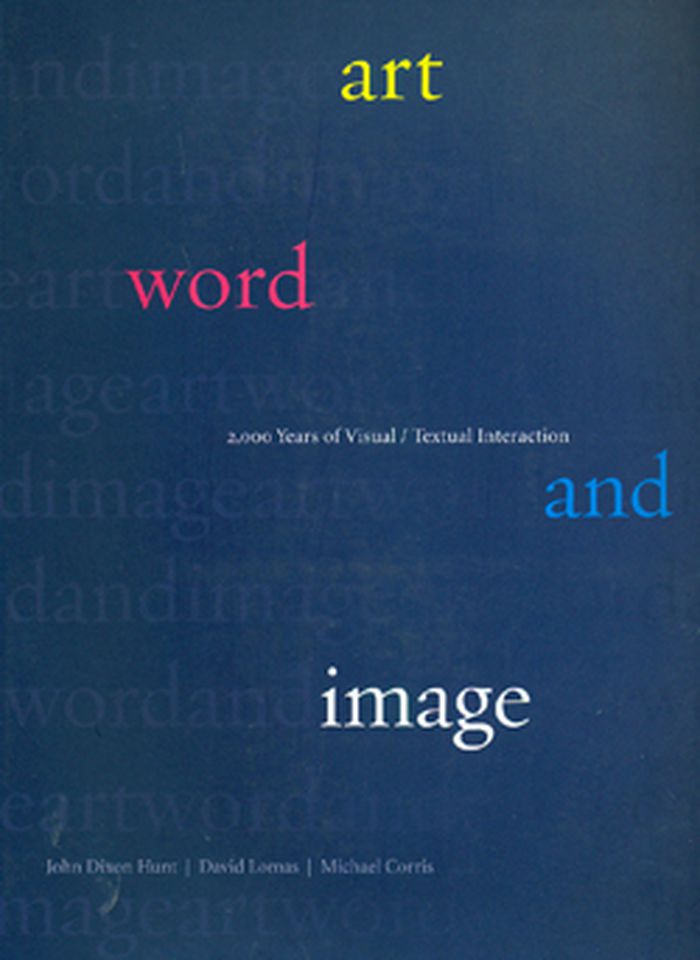
This book attempts to chart the history of art and its interaction with written language. It examines the use of words (or language) in many genres of art – most often painting, but including prints, the book as art, sculpture, installation, and performance. This book asks what does it mean when a painting is 'invaded' by language? How do the two forms converse and combine, and what messages are intended for the viewer? In addition, other important themes that are also addressed include the naming or titling of paintings, the uses of narrative in art, and the literary connections and aspirations of artists. The book is constructed around three wide-ranging essays by John Dixon Hunt, David Lomas and Michael Corris. These essays discuss the use and significance of words in art – from Classical Greece and Assyria, through to the Middle Ages and the Renaissance, to modern times and today’s digital media, where the words and image question has become a central issue. The essays cover a variety of movements (Pre-Raphaelites, Cubists, Surrealists, and Lettrists, for example) and many artists, among them Duchamp, Picasso, Ernst, Twombly, Michaux, Warhol and Kruger. The book also includes ‘spotlight’ essays on artists whose work engages substantially with questions of word and image: Blake, Klee, Schwitters, Haack, Pettibon, McCahon and Walla. With contributions by Jeremy Adler, Stephen Barber, Rex Butler and Laurence Simmons, Michael Corris, John Dixon Hunt, Michael R. Leaman, David Lomas, Joseph Viscomi, Hamza Walker, Barbara Weyandt and Michael White.
Art, word and image : 2,000 years of visual/textual interaction
Actions:
Price:
$44.95
(available to order)
Summary:
This book attempts to chart the history of art and its interaction with written language. It examines the use of words (or language) in many genres of art – most often painting, but including prints, the book as art, sculpture, installation, and performance. This book asks what does it mean when a painting is 'invaded' by language? How do the two forms converse and combine, and what messages are intended for the viewer? In addition, other important themes that are also addressed include the naming or titling of paintings, the uses of narrative in art, and the literary connections and aspirations of artists. The book is constructed around three wide-ranging essays by John Dixon Hunt, David Lomas and Michael Corris. These essays discuss the use and significance of words in art – from Classical Greece and Assyria, through to the Middle Ages and the Renaissance, to modern times and today’s digital media, where the words and image question has become a central issue. The essays cover a variety of movements (Pre-Raphaelites, Cubists, Surrealists, and Lettrists, for example) and many artists, among them Duchamp, Picasso, Ernst, Twombly, Michaux, Warhol and Kruger. The book also includes ‘spotlight’ essays on artists whose work engages substantially with questions of word and image: Blake, Klee, Schwitters, Haack, Pettibon, McCahon and Walla. With contributions by Jeremy Adler, Stephen Barber, Rex Butler and Laurence Simmons, Michael Corris, John Dixon Hunt, Michael R. Leaman, David Lomas, Joseph Viscomi, Hamza Walker, Barbara Weyandt and Michael White.
Form:
books
books
Publication:
September 2011
September 2011
Subject:
Art Theory
Art Theory
Form:
books
books
Actions:
Price:
$55.00
(available to order)
Summary:
The modern poster dates back to around 1870, when color lithography had been sufficiently perfected to permit mass production. Artists such as Toulouse-Lautrec and Jules Chéret were quick to perceive and embrace the possibilities of the poster as a form, as means of disseminating their work and as a source of income. New movements in late nineteenth-century art, such as(...)
$55.00
(available to order)
Summary:
The modern poster dates back to around 1870, when color lithography had been sufficiently perfected to permit mass production. Artists such as Toulouse-Lautrec and Jules Chéret were quick to perceive and embrace the possibilities of the poster as a form, as means of disseminating their work and as a source of income. New movements in late nineteenth-century art, such as(...)
Title:
The European poster 1881-1938
Actions:
Price:
$55.00
(available to order)
Summary:
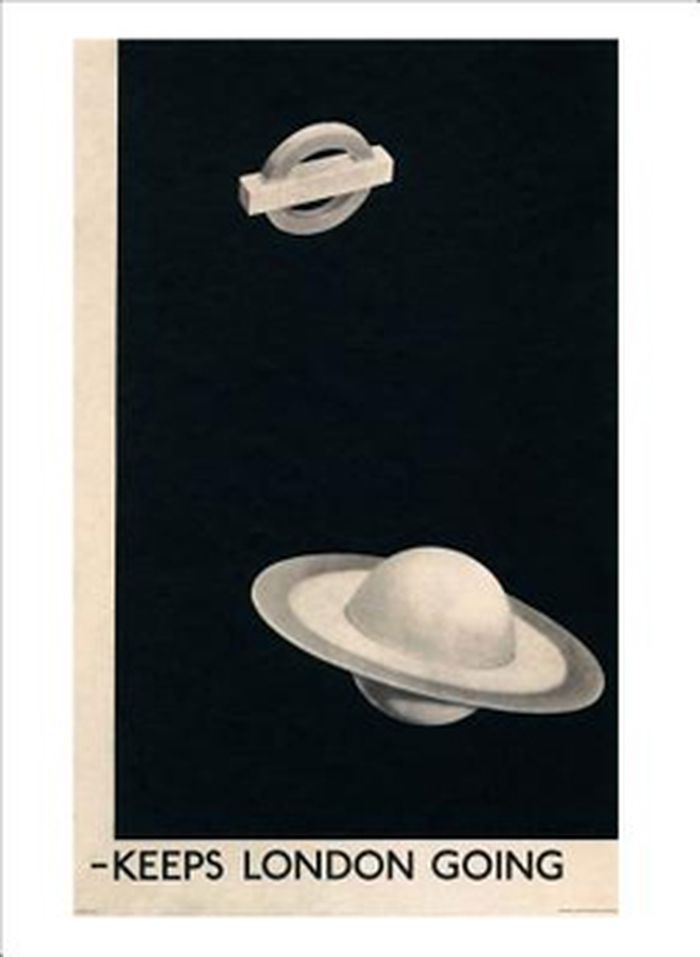
The modern poster dates back to around 1870, when color lithography had been sufficiently perfected to permit mass production. Artists such as Toulouse-Lautrec and Jules Chéret were quick to perceive and embrace the possibilities of the poster as a form, as means of disseminating their work and as a source of income. New movements in late nineteenth-century art, such as Art Nouveau and Symbolism, also adapted their respective styles to commercial demands, and their graphic power was such that major poster surveys were held as early as 1884. Later on, in the early days of the Soviet avant-garde, artists like Rodchenko and Klutsis were also to apply their graphic know-how to the poster form, in the service of a new communist Russia and its booming industries. This boxed volume reproduces 175 posters from the last decades of the nineteenth century to the early twentieth century, loose-leaf and in full color. The works have been gathered by expert Carlos Pérez from European museums and renowned international private collections. An accompanying paperback book, housed within the box, provides an historical overview. Among the 90-plus artists included here are Chéret, Ramón Casas, Toulouse-Lautrec, Pierre Bonnard, Alfons Mucha, Henri Matisse, Cassandre, Paul Colin, Jean Carlu, Giacomo Balla, Herbert Bayer, Otto Baumberger, John Heartfield, Vladimir Lebedev, Alexander Rodchenko, Man Ray, Kurt Schwitters, Oskar Schlemmer, Gustav Klutsis, Robert Béreny and Fortunato Depero.
The European poster 1881-1938
Actions:
Price:
$55.00
(available to order)
Summary:
The modern poster dates back to around 1870, when color lithography had been sufficiently perfected to permit mass production. Artists such as Toulouse-Lautrec and Jules Chéret were quick to perceive and embrace the possibilities of the poster as a form, as means of disseminating their work and as a source of income. New movements in late nineteenth-century art, such as Art Nouveau and Symbolism, also adapted their respective styles to commercial demands, and their graphic power was such that major poster surveys were held as early as 1884. Later on, in the early days of the Soviet avant-garde, artists like Rodchenko and Klutsis were also to apply their graphic know-how to the poster form, in the service of a new communist Russia and its booming industries. This boxed volume reproduces 175 posters from the last decades of the nineteenth century to the early twentieth century, loose-leaf and in full color. The works have been gathered by expert Carlos Pérez from European museums and renowned international private collections. An accompanying paperback book, housed within the box, provides an historical overview. Among the 90-plus artists included here are Chéret, Ramón Casas, Toulouse-Lautrec, Pierre Bonnard, Alfons Mucha, Henri Matisse, Cassandre, Paul Colin, Jean Carlu, Giacomo Balla, Herbert Bayer, Otto Baumberger, John Heartfield, Vladimir Lebedev, Alexander Rodchenko, Man Ray, Kurt Schwitters, Oskar Schlemmer, Gustav Klutsis, Robert Béreny and Fortunato Depero.
Form:
books
books
Publication:
July 2012
July 2012
Subject:
Printed Matter
Printed Matter
Form:
books
books
Actions:
Price:
$60.00
(available to order)
Summary:
Marking the first in a new series of exhibitions, this project from the Louisiana Museum of Modern Art highlights three design studios with biochemistry and biology at the core of their practice. London-based ecoLogicStudio focuses on climate and carbon neutrality, and how photosynthesis can be incorporated into architecture. Atelier LUMA is the research design branch of(...)
$60.00
(available to order)
Summary:
Marking the first in a new series of exhibitions, this project from the Louisiana Museum of Modern Art highlights three design studios with biochemistry and biology at the core of their practice. London-based ecoLogicStudio focuses on climate and carbon neutrality, and how photosynthesis can be incorporated into architecture. Atelier LUMA is the research design branch of(...)
Subject:
Contemporary Architecture
Contemporary Architecture
Publication:
June 2025
June 2025
Title:
Architecture connecting: Living structures
Actions:
Price:
$60.00
(available to order)
Summary:
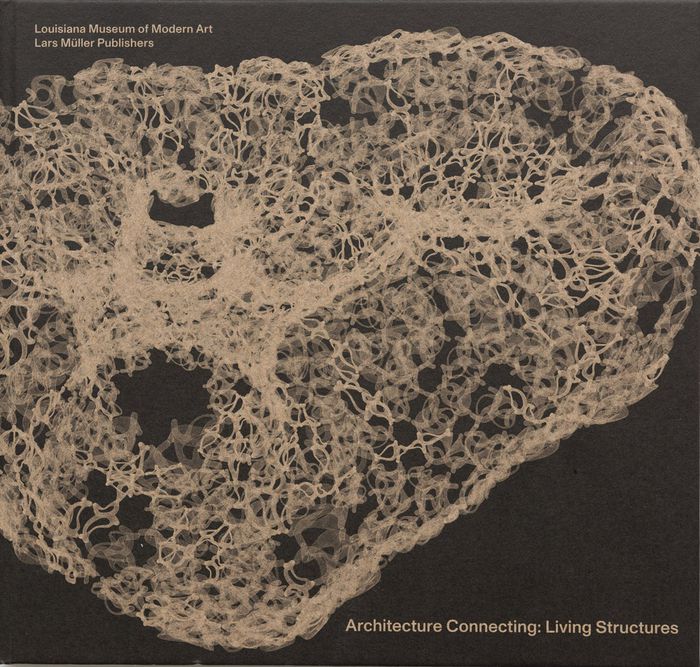
Marking the first in a new series of exhibitions, this project from the Louisiana Museum of Modern Art highlights three design studios with biochemistry and biology at the core of their practice. London-based ecoLogicStudio focuses on climate and carbon neutrality, and how photosynthesis can be incorporated into architecture. Atelier LUMA is the research design branch of LUMA Arles, mapping and identifying the local resources of the unique bioregion of Camargue to build its own studio. Finally, the Ithaca, New York–based Jenny Sabin Studio uses theory and knowledge from biology and mathematics to help develop new digital tools and structures that work in interaction with people and nature. This catalog highlights each firm’s most important projects alongside three conversations between the studio founders and an expert architectural
Architecture connecting: Living structures
Actions:
Price:
$60.00
(available to order)
Summary:
Marking the first in a new series of exhibitions, this project from the Louisiana Museum of Modern Art highlights three design studios with biochemistry and biology at the core of their practice. London-based ecoLogicStudio focuses on climate and carbon neutrality, and how photosynthesis can be incorporated into architecture. Atelier LUMA is the research design branch of LUMA Arles, mapping and identifying the local resources of the unique bioregion of Camargue to build its own studio. Finally, the Ithaca, New York–based Jenny Sabin Studio uses theory and knowledge from biology and mathematics to help develop new digital tools and structures that work in interaction with people and nature. This catalog highlights each firm’s most important projects alongside three conversations between the studio founders and an expert architectural
Form:
books
books
Publication:
June 2025
June 2025
Subject:
Contemporary Architecture
Contemporary Architecture
Form:
books
books

Price:
$46.95
(available to order)
Summary:
In "Tower and Office", Spanish architects Inaki Abalos and Juan Herreros look at the role and impact of advanced building technologies in American architecture since World War II. The war, they claim, marked the end of the first cycle of modernism, challenging the belief that technological progress alone could produce a perpetually better future. At the same time, the war(...)
$46.95
(available to order)
Summary:
In "Tower and Office", Spanish architects Inaki Abalos and Juan Herreros look at the role and impact of advanced building technologies in American architecture since World War II. The war, they claim, marked the end of the first cycle of modernism, challenging the belief that technological progress alone could produce a perpetually better future. At the same time, the war(...)
Publication:
October 2005, Cambridge
October 2005, Cambridge
Title:
Tower and office : from Modernist theory to contemporary practice
Actions:
Price:
$46.95
(available to order)
Summary:
In "Tower and Office", Spanish architects Inaki Abalos and Juan Herreros look at the role and impact of advanced building technologies in American architecture since World War II. The war, they claim, marked the end of the first cycle of modernism, challenging the belief that technological progress alone could produce a perpetually better future. At the same time, the war was the source of powerful new structural models and construction methods. The authors examine the ways these technologies have been inflected over the last half century by more subjective and integrated processes of spatial organization. In the first part of the book, Abalos and Herreros focus on the work of Le Corbusier, revealing the degree of complexity achieved in his interpretation of the modern skyscraper. In the second part, they look at the intersection of technical and cultural determinants in the design of high-rise structures since World War II. Among the issues they consider are the evolution of the load-bearing frame, the impact of high-tech systems on tall buildings, and the transparent building skin. In the third part, they address developments in office design and planning, tracing an evolution from the repetitive and homogeneous office skyscraper to the present-day mixed-use structure. Overall they demonstrate how the objective technical analysis associated with modernist architectural theory has given way in recent building practice to a variety of flexible, pragmatic, and environmental approaches. These, they suggest, have opened the way to new urban and architectural forms.
Tower and office : from Modernist theory to contemporary practice
Actions:
Price:
$46.95
(available to order)
Summary:
In "Tower and Office", Spanish architects Inaki Abalos and Juan Herreros look at the role and impact of advanced building technologies in American architecture since World War II. The war, they claim, marked the end of the first cycle of modernism, challenging the belief that technological progress alone could produce a perpetually better future. At the same time, the war was the source of powerful new structural models and construction methods. The authors examine the ways these technologies have been inflected over the last half century by more subjective and integrated processes of spatial organization. In the first part of the book, Abalos and Herreros focus on the work of Le Corbusier, revealing the degree of complexity achieved in his interpretation of the modern skyscraper. In the second part, they look at the intersection of technical and cultural determinants in the design of high-rise structures since World War II. Among the issues they consider are the evolution of the load-bearing frame, the impact of high-tech systems on tall buildings, and the transparent building skin. In the third part, they address developments in office design and planning, tracing an evolution from the repetitive and homogeneous office skyscraper to the present-day mixed-use structure. Overall they demonstrate how the objective technical analysis associated with modernist architectural theory has given way in recent building practice to a variety of flexible, pragmatic, and environmental approaches. These, they suggest, have opened the way to new urban and architectural forms.
Form:
books
books
Publication:
October 2005, Cambridge
October 2005, Cambridge
Form:
books
books
Title:
Notes on the Underground
Notes on the Underground
Actions:
Price:
$24.95
(available to order)
Summary:
The underground has always played a prominent role in human imaginings, both as a place of refuge and as a source of fear. The late nineteenth century saw a new fascination with the underground as Western societies tried to cope with the pervasive changes of a new social and technological order. In Notes on the Underground, Rosalind Williams takes us inside that critical(...)
$24.95
(available to order)
Summary:
The underground has always played a prominent role in human imaginings, both as a place of refuge and as a source of fear. The late nineteenth century saw a new fascination with the underground as Western societies tried to cope with the pervasive changes of a new social and technological order. In Notes on the Underground, Rosalind Williams takes us inside that critical(...)
Title:
Notes on the Underground
Actions:
Price:
$24.95
(available to order)
Summary:
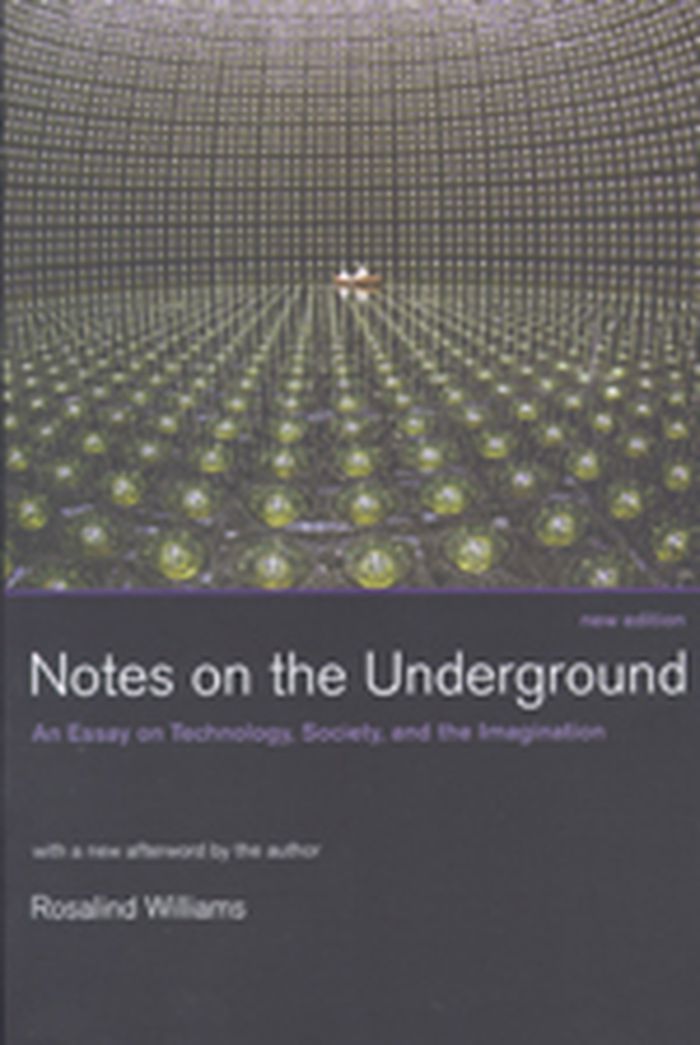
The underground has always played a prominent role in human imaginings, both as a place of refuge and as a source of fear. The late nineteenth century saw a new fascination with the underground as Western societies tried to cope with the pervasive changes of a new social and technological order. In Notes on the Underground, Rosalind Williams takes us inside that critical historical moment, giving equal coverage to actual and imaginary undergrounds. She looks at the real-life invasions of the underground that occurred as modern urban infrastructures of sewers and subways were laid, and at the simultaneous archaeological excavations that were unearthing both human history and the planet’s deep past. She also examines the subterranean stories of Verne, Wells, Forster, Hugo, Bulwer-Lytton, and other writers who proposed alternative visions of the coming technological civilization. Williams argues that these imagined and real underground environments provide models of human life in a world dominated by human presence and offer a prophetic look at today’s technology-dominated society. In a new afterword written for this edition, Williams points out that her book traces the emergence in the nineteenth century of what we would now call an environmental consciousness--an awareness that there will be consequences when humans live in a sealed, finite environment. Today we are more aware than ever of our limited biosphere and how vulnerable it is. Notes on the Underground, now even more than when it first appeared, offers a guide to the human, cultural, and technical consequences of what Williams calls "the human empire on earth."
Notes on the Underground
Actions:
Price:
$24.95
(available to order)
Summary:
The underground has always played a prominent role in human imaginings, both as a place of refuge and as a source of fear. The late nineteenth century saw a new fascination with the underground as Western societies tried to cope with the pervasive changes of a new social and technological order. In Notes on the Underground, Rosalind Williams takes us inside that critical historical moment, giving equal coverage to actual and imaginary undergrounds. She looks at the real-life invasions of the underground that occurred as modern urban infrastructures of sewers and subways were laid, and at the simultaneous archaeological excavations that were unearthing both human history and the planet’s deep past. She also examines the subterranean stories of Verne, Wells, Forster, Hugo, Bulwer-Lytton, and other writers who proposed alternative visions of the coming technological civilization. Williams argues that these imagined and real underground environments provide models of human life in a world dominated by human presence and offer a prophetic look at today’s technology-dominated society. In a new afterword written for this edition, Williams points out that her book traces the emergence in the nineteenth century of what we would now call an environmental consciousness--an awareness that there will be consequences when humans live in a sealed, finite environment. Today we are more aware than ever of our limited biosphere and how vulnerable it is. Notes on the Underground, now even more than when it first appeared, offers a guide to the human, cultural, and technical consequences of what Williams calls "the human empire on earth."
Form:
books
books
Publication:
March 2008, Cambridge
March 2008, Cambridge
Subject:
Architectural Theory
Architectural Theory
Form:
books
books
Actions:
Price:
$60.00
(available to order)
Summary:
The 1931 international colonial exposition in Paris was a demonstration of French colonial policy, colonial architecture and urban planning, and the scientific and philosophical theories that justified colonialism. The exposition displayed the people, material(...)
$60.00
(available to order)
Summary:
The 1931 international colonial exposition in Paris was a demonstration of French colonial policy, colonial architecture and urban planning, and the scientific and philosophical theories that justified colonialism. The exposition displayed the people, material(...)
Subject:
Museums and Universal Exhibitions
Museums and Universal Exhibitions
Publication:
April 2000, Cambridge
April 2000, Cambridge
Title:
Hybrid modernities : architecture and representation at the 1931 colonial exposition, Paris
Actions:
Price:
$60.00
(available to order)
Summary:
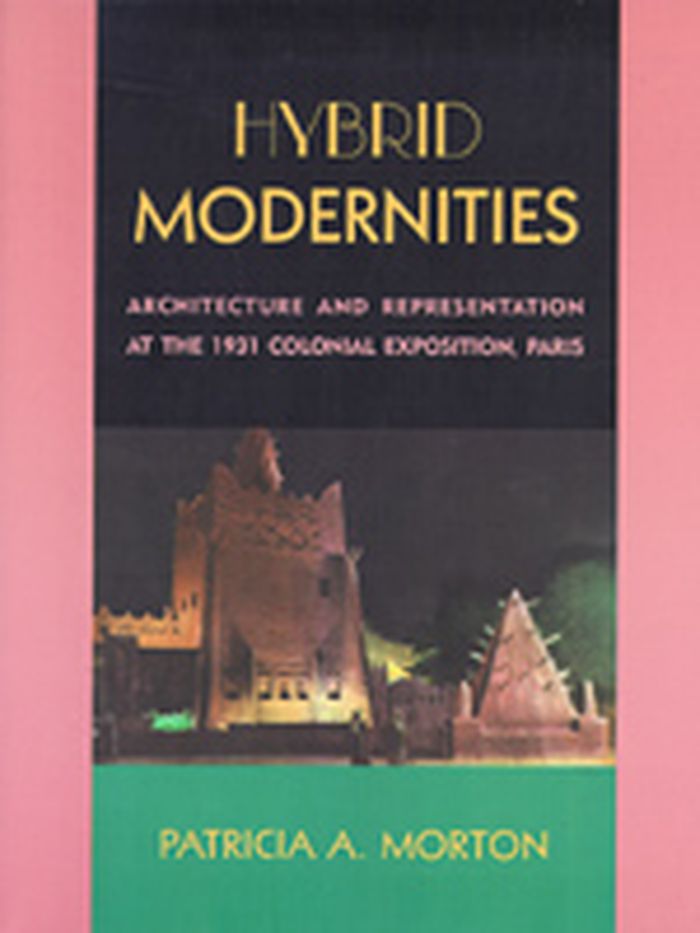
The 1931 international colonial exposition in Paris was a demonstration of French colonial policy, colonial architecture and urban planning, and the scientific and philosophical theories that justified colonialism. The exposition displayed the people, material culture, raw materials, manufactured goods, and arts of the global colonial empires. Yet the event gave a contradictory message of the colonies as the "Orient"--the site of rampant sensuality, decadence, and irrationality--and as the laboratory of Western rationality. In "Hybrid modernities", Patricia Morton shows how the exposition failed to keep colonialism's two spheres separate, instead creating hybrids of French and native culture. At the exposition, French pavilions demonstrated Europe's sophistication in art deco style, while the colonial pavilions were "authentic" native environments for displaying indigenous peoples and artifacts from the colonies. The authenticity of these pavilions' exteriors was contradicted by vaguely exotic interiors filled with didactic exhibition stands and dioramas. Intended to maintain a segregation of colonized and colonizer, the colonial pavilions instead were mixtures of European and native architecture. Anticolonial resistance erupted around the Exposition in the form of protests, anticolonial tracts, and a countercolonial exposition produced by the Surrealists. Thus the Exposition occupied a "middle region" of experience where the norms, rules, and systems of French colonialism both emerged and broke down, unsustainable because of their internal contradictions. As Morton shows, the effort to segregate France and her colonies failed, both at the colonial exposition and in greater France, because it was constantly undermined by the hybrids that modern colonialism itself produced.
Hybrid modernities : architecture and representation at the 1931 colonial exposition, Paris
Actions:
Price:
$60.00
(available to order)
Summary:
The 1931 international colonial exposition in Paris was a demonstration of French colonial policy, colonial architecture and urban planning, and the scientific and philosophical theories that justified colonialism. The exposition displayed the people, material culture, raw materials, manufactured goods, and arts of the global colonial empires. Yet the event gave a contradictory message of the colonies as the "Orient"--the site of rampant sensuality, decadence, and irrationality--and as the laboratory of Western rationality. In "Hybrid modernities", Patricia Morton shows how the exposition failed to keep colonialism's two spheres separate, instead creating hybrids of French and native culture. At the exposition, French pavilions demonstrated Europe's sophistication in art deco style, while the colonial pavilions were "authentic" native environments for displaying indigenous peoples and artifacts from the colonies. The authenticity of these pavilions' exteriors was contradicted by vaguely exotic interiors filled with didactic exhibition stands and dioramas. Intended to maintain a segregation of colonized and colonizer, the colonial pavilions instead were mixtures of European and native architecture. Anticolonial resistance erupted around the Exposition in the form of protests, anticolonial tracts, and a countercolonial exposition produced by the Surrealists. Thus the Exposition occupied a "middle region" of experience where the norms, rules, and systems of French colonialism both emerged and broke down, unsustainable because of their internal contradictions. As Morton shows, the effort to segregate France and her colonies failed, both at the colonial exposition and in greater France, because it was constantly undermined by the hybrids that modern colonialism itself produced.
Form:
books
books
Publication:
April 2000, Cambridge
April 2000, Cambridge
Subject:
Museums and Universal Exhibitions
Museums and Universal Exhibitions
Form:
books
books
Actions:
Price:
$39.95
(available to order)
Summary:
The 1931 international colonial exposition in Paris was a demonstration of French colonial policy, colonial architecture and urban planning, and the scientific and philosophical theories that justified colonialism. The exposition displayed the people, material culture, raw materials,(...)
$39.95
(available to order)
Summary:
The 1931 international colonial exposition in Paris was a demonstration of French colonial policy, colonial architecture and urban planning, and the scientific and philosophical theories that justified colonialism. The exposition displayed the people, material culture, raw materials,(...)
Subject:
Museums and Universal Exhibitions
Museums and Universal Exhibitions
Publication:
April 2003, Cambridge / London
April 2003, Cambridge / London
Title:
Hybrid modernities : architecture and representation at the 1931 colonial exposition, Paris
Actions:
Price:
$39.95
(available to order)
Summary:
The 1931 international colonial exposition in Paris was a demonstration of French colonial policy, colonial architecture and urban planning, and the scientific and philosophical theories that justified colonialism. The exposition displayed the people, material culture, raw materials, manufactured goods, and arts of the global colonial empires. Yet the event gave a contradictory message of the colonies as the "Orient"--the site of rampant sensuality, decadence, and irrationality--and as the laboratory of Western rationality. In "Hybrid modernities", Patricia Morton shows how the exposition failed to keep colonialism's two spheres separate, instead creating hybrids of French and native culture. At the exposition, French pavilions demonstrated Europe's sophistication in art deco style, while the colonial pavilions were "authentic" native environments for displaying indigenous peoples and artifacts from the colonies. The authenticity of these pavilions' exteriors was contradicted by vaguely exotic interiors filled with didactic exhibition stands and dioramas. Intended to maintain a segregation of colonized and colonizer, the colonial pavilions instead were mixtures of European and native architecture. Anticolonial resistance erupted around the Exposition in the form of protests, anticolonial tracts, and a countercolonial exposition produced by the Surrealists. Thus the Exposition occupied a "middle region" of experience where the norms, rules, and systems of French colonialism both emerged and broke down, unsustainable because of their internal contradictions. As Morton shows, the effort to segregate France and her colonies failed, both at the colonial exposition and in greater France, because it was constantly undermined by the hybrids that modern colonialism itself produced.
Hybrid modernities : architecture and representation at the 1931 colonial exposition, Paris
Actions:
Price:
$39.95
(available to order)
Summary:
The 1931 international colonial exposition in Paris was a demonstration of French colonial policy, colonial architecture and urban planning, and the scientific and philosophical theories that justified colonialism. The exposition displayed the people, material culture, raw materials, manufactured goods, and arts of the global colonial empires. Yet the event gave a contradictory message of the colonies as the "Orient"--the site of rampant sensuality, decadence, and irrationality--and as the laboratory of Western rationality. In "Hybrid modernities", Patricia Morton shows how the exposition failed to keep colonialism's two spheres separate, instead creating hybrids of French and native culture. At the exposition, French pavilions demonstrated Europe's sophistication in art deco style, while the colonial pavilions were "authentic" native environments for displaying indigenous peoples and artifacts from the colonies. The authenticity of these pavilions' exteriors was contradicted by vaguely exotic interiors filled with didactic exhibition stands and dioramas. Intended to maintain a segregation of colonized and colonizer, the colonial pavilions instead were mixtures of European and native architecture. Anticolonial resistance erupted around the Exposition in the form of protests, anticolonial tracts, and a countercolonial exposition produced by the Surrealists. Thus the Exposition occupied a "middle region" of experience where the norms, rules, and systems of French colonialism both emerged and broke down, unsustainable because of their internal contradictions. As Morton shows, the effort to segregate France and her colonies failed, both at the colonial exposition and in greater France, because it was constantly undermined by the hybrids that modern colonialism itself produced.
Form:
books
books
Publication:
April 2003, Cambridge / London
April 2003, Cambridge / London
Subject:
Museums and Universal Exhibitions
Museums and Universal Exhibitions
Form:
books
books
Price:
$44.95
(available to order)
Summary:
We experience spaces not only by seeing but also by listening. We can navigate a room in the dark, and "hear" the emptiness of a house without furniture. Our experience of music in a concert hall depends on whether we sit in the front row or under the balcony. The unique acoustics of religious spaces acquire symbolic meaning. Social relationships are strongly influenced(...)
$44.95
(available to order)
Summary:
We experience spaces not only by seeing but also by listening. We can navigate a room in the dark, and "hear" the emptiness of a house without furniture. Our experience of music in a concert hall depends on whether we sit in the front row or under the balcony. The unique acoustics of religious spaces acquire symbolic meaning. Social relationships are strongly influenced(...)
Subject:
Acoustics
Acoustics
Publication:
December 2006, Cambridge / London
December 2006, Cambridge / London
Title:
Spaces speak, are you listening ? Experiencing aural architecture
Actions:
Price:
$44.95
(available to order)
Summary:
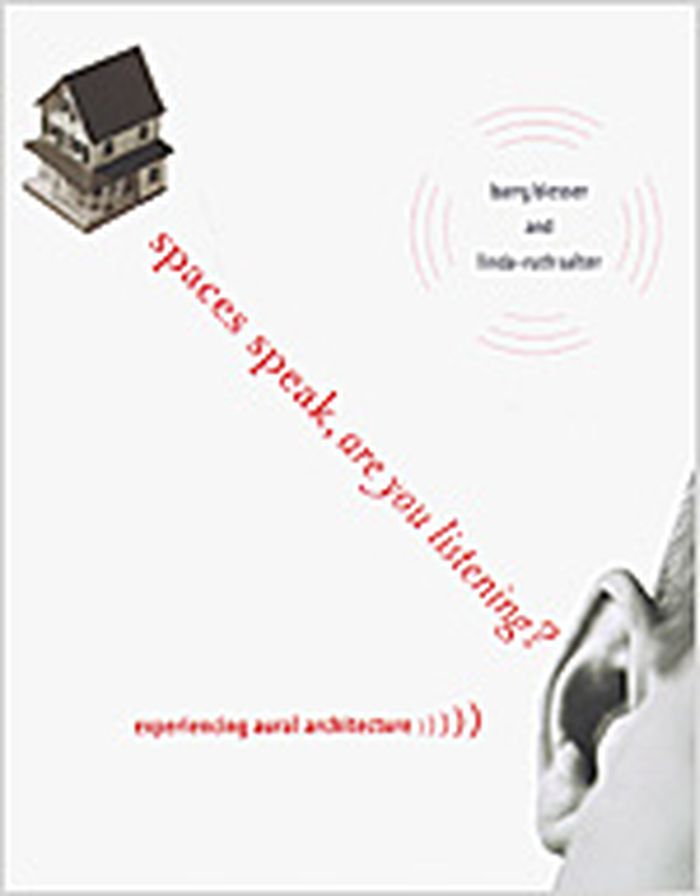
We experience spaces not only by seeing but also by listening. We can navigate a room in the dark, and "hear" the emptiness of a house without furniture. Our experience of music in a concert hall depends on whether we sit in the front row or under the balcony. The unique acoustics of religious spaces acquire symbolic meaning. Social relationships are strongly influenced by the way that space changes sound. In Spaces Speak, Are You Listening?, Barry Blesser and Linda-Ruth Salter examine auditory spatial awareness: experiencing space by attentive listening. Every environment has an aural architecture. The audible attributes of physical space have always contributed to the fabric of human culture, as demonstrated by prehistoric multimedia cave paintings, classical Greek open-air theaters, Gothic cathedrals, acoustic geography of French villages, modern music reproduction, and virtual spaces in home theaters. Auditory spatial awareness is a prism that reveals a culture's attitudes toward hearing and space. Some listeners can learn to "see" objects with their ears, but even without training, we can all hear spatial geometry such as an open door or low ceiling. Integrating contributions from a wide range of disciplines--including architecture, music, acoustics, evolution, anthropology, cognitive psychology, audio engineering, and many others--Spaces Speak, Are You Listening? establishes the concepts and language of aural architecture. These concepts provide an interdisciplinary guide for anyone interested in gaining a better understanding of how space enhances our well-being. Aural architecture is not the exclusive domain of specialists. Accidentally or intentionally, we all function as aural architects.
Spaces speak, are you listening ? Experiencing aural architecture
Actions:
Price:
$44.95
(available to order)
Summary:
We experience spaces not only by seeing but also by listening. We can navigate a room in the dark, and "hear" the emptiness of a house without furniture. Our experience of music in a concert hall depends on whether we sit in the front row or under the balcony. The unique acoustics of religious spaces acquire symbolic meaning. Social relationships are strongly influenced by the way that space changes sound. In Spaces Speak, Are You Listening?, Barry Blesser and Linda-Ruth Salter examine auditory spatial awareness: experiencing space by attentive listening. Every environment has an aural architecture. The audible attributes of physical space have always contributed to the fabric of human culture, as demonstrated by prehistoric multimedia cave paintings, classical Greek open-air theaters, Gothic cathedrals, acoustic geography of French villages, modern music reproduction, and virtual spaces in home theaters. Auditory spatial awareness is a prism that reveals a culture's attitudes toward hearing and space. Some listeners can learn to "see" objects with their ears, but even without training, we can all hear spatial geometry such as an open door or low ceiling. Integrating contributions from a wide range of disciplines--including architecture, music, acoustics, evolution, anthropology, cognitive psychology, audio engineering, and many others--Spaces Speak, Are You Listening? establishes the concepts and language of aural architecture. These concepts provide an interdisciplinary guide for anyone interested in gaining a better understanding of how space enhances our well-being. Aural architecture is not the exclusive domain of specialists. Accidentally or intentionally, we all function as aural architects.
Form:
books
books
Publication:
December 2006, Cambridge / London
December 2006, Cambridge / London
Subject:
Acoustics
Acoustics
Form:
books
books
Actions:
Price:
$45.00
(available in store)
Summary:
Geoffrey James directs his gaze to the in-between spaces and forgotten places that resist the idea of a cohesive national identity. With an equable eye, James documents the ephemeral and the monumental: a demolition derby in Quebec, how an inmate at Kingston Penitentiary has decorated his cell, the Dickensian side door of Massey Hall in Toronto. The photographs in this(...)
$45.00
(available in store)
Summary:
Geoffrey James directs his gaze to the in-between spaces and forgotten places that resist the idea of a cohesive national identity. With an equable eye, James documents the ephemeral and the monumental: a demolition derby in Quebec, how an inmate at Kingston Penitentiary has decorated his cell, the Dickensian side door of Massey Hall in Toronto. The photographs in this(...)
Title:
Geoffrey James: Canadian photographs
Actions:
Price:
$45.00
(available in store)
Summary:
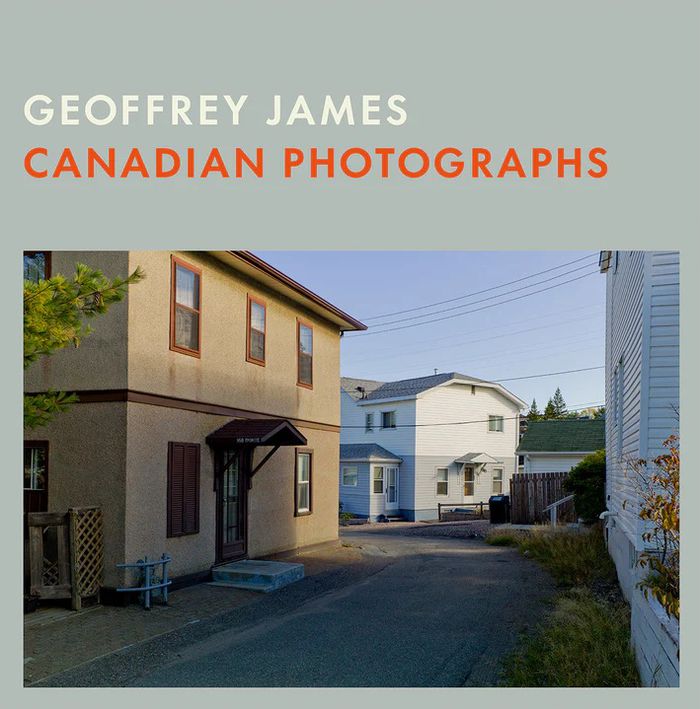
Geoffrey James directs his gaze to the in-between spaces and forgotten places that resist the idea of a cohesive national identity. With an equable eye, James documents the ephemeral and the monumental: a demolition derby in Quebec, how an inmate at Kingston Penitentiary has decorated his cell, the Dickensian side door of Massey Hall in Toronto. The photographs in this collection celebrate the everyday while meditating on the issues James’s adopted home faces: the bifurcation of rural and urban, rapid growth and increasing inequality, and its journey toward truth and reconciliation. Linked by views taken from train windows from British Columbia to Nova Scotia, James’s unofficial portrait of Canada brings into sharp relief the unfinished business of the nation as it lurches into the next century. Canadian Photographs includes a conversation between the photographer and Peter Galassi, former Chief Curator of Photography at the Museum of Modern Art.
Geoffrey James: Canadian photographs
Actions:
Price:
$45.00
(available in store)
Summary:
Geoffrey James directs his gaze to the in-between spaces and forgotten places that resist the idea of a cohesive national identity. With an equable eye, James documents the ephemeral and the monumental: a demolition derby in Quebec, how an inmate at Kingston Penitentiary has decorated his cell, the Dickensian side door of Massey Hall in Toronto. The photographs in this collection celebrate the everyday while meditating on the issues James’s adopted home faces: the bifurcation of rural and urban, rapid growth and increasing inequality, and its journey toward truth and reconciliation. Linked by views taken from train windows from British Columbia to Nova Scotia, James’s unofficial portrait of Canada brings into sharp relief the unfinished business of the nation as it lurches into the next century. Canadian Photographs includes a conversation between the photographer and Peter Galassi, former Chief Curator of Photography at the Museum of Modern Art.
Form:
books
books
Publication:
October 2024
October 2024
Subject:
Photography monographs
Photography monographs
Form:
books
books
Actions:
Price:
$48.50
(available in store)
Summary:
In 1978, Zofia Rydet (1911–97) began work on a monumental project that would come to be known as her ''Sociological Record'': photographing the people of Poland at their homes, she produced an extraordinary archive of around twenty thousand negatives. The undertaking consumed Rydet so completely that she was never able to give it final shape through a book or an art show.(...)
$48.50
(available in store)
Summary:
In 1978, Zofia Rydet (1911–97) began work on a monumental project that would come to be known as her ''Sociological Record'': photographing the people of Poland at their homes, she produced an extraordinary archive of around twenty thousand negatives. The undertaking consumed Rydet so completely that she was never able to give it final shape through a book or an art show.(...)
Title:
Object lessons: Zofia Rydet's 'Sociological record'
Actions:
Price:
$48.50
(available in store)
Summary:
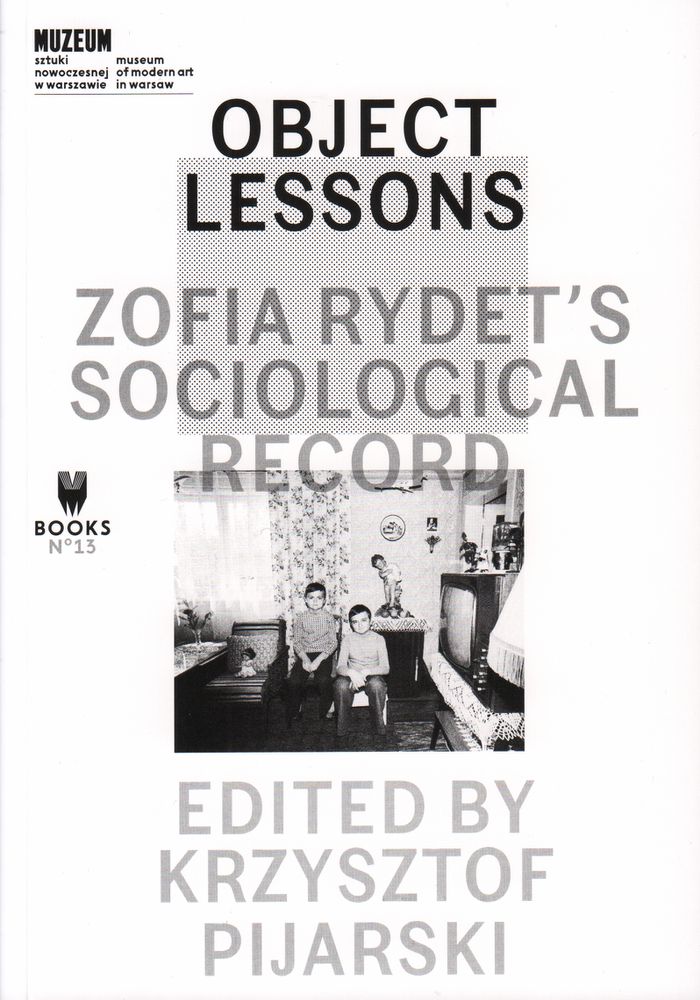
In 1978, Zofia Rydet (1911–97) began work on a monumental project that would come to be known as her ''Sociological Record'': photographing the people of Poland at their homes, she produced an extraordinary archive of around twenty thousand negatives. The undertaking consumed Rydet so completely that she was never able to give it final shape through a book or an art show. ''Object Lessons'', a new volume of essays inspired by an exhibition at the Museum of Modern Art in Warsaw, helps to dispel the myths that have formed around the project in recent years and introduces the photographer to a new global audience. Rydet herself remained unresolved over the question of how to define her work, leaving the viewer to ponder whether her magnum opus is a piece of art or science. What does remain undisputed is that ''Sociological Record'' is a striking testimony of its time.
Object lessons: Zofia Rydet's 'Sociological record'
Actions:
Price:
$48.50
(available in store)
Summary:
In 1978, Zofia Rydet (1911–97) began work on a monumental project that would come to be known as her ''Sociological Record'': photographing the people of Poland at their homes, she produced an extraordinary archive of around twenty thousand negatives. The undertaking consumed Rydet so completely that she was never able to give it final shape through a book or an art show. ''Object Lessons'', a new volume of essays inspired by an exhibition at the Museum of Modern Art in Warsaw, helps to dispel the myths that have formed around the project in recent years and introduces the photographer to a new global audience. Rydet herself remained unresolved over the question of how to define her work, leaving the viewer to ponder whether her magnum opus is a piece of art or science. What does remain undisputed is that ''Sociological Record'' is a striking testimony of its time.
Form:
books
books
Publication:
July 2018
July 2018
Subject:
Theory of Photography
Theory of Photography


