


2056 Results
Level of archival description:
Project
Project
Title:
House, Selsdon
House, Selsdon
Reference number:
AP144.S2.D42
Description:
File documents an unexecuted project for a detached private residence located at Beech Way in Selsdon, Surrey, (now Croydon, part of Greater London), England, for Jean Newlove (Mrs. Jean McColl). The local planning authority refused the project citing aesthetic considerations. The house was to be constructed as a "series of interleaved reinforced concrete trays" supported by columns ("Cedric Price Supplement No. 2", 'Architectural Design', vol. 41, (January 1971), 36). File contains conceptual and design development sketches that explore exterior elevations, stair and glazing details; axonometric drawings and sections that show relationship between floor levels and functions; and framing plans showing the preliminary structural layout. Material in this file was produced between 1962 and 1964. File contains conceptual drawings, design development drawings, presentation drawings, photographic materials, and textual records.
AP144.S2.D42
Description:
File documents an unexecuted project for a detached private residence located at Beech Way in Selsdon, Surrey, (now Croydon, part of Greater London), England, for Jean Newlove (Mrs. Jean McColl). The local planning authority refused the project citing aesthetic considerations. The house was to be constructed as a "series of interleaved reinforced concrete trays" supported by columns ("Cedric Price Supplement No. 2", 'Architectural Design', vol. 41, (January 1971), 36). File contains conceptual and design development sketches that explore exterior elevations, stair and glazing details; axonometric drawings and sections that show relationship between floor levels and functions; and framing plans showing the preliminary structural layout. Material in this file was produced between 1962 and 1964. File contains conceptual drawings, design development drawings, presentation drawings, photographic materials, and textual records.
People:
Date:
1962-1964
1962-1964
Title:
House, Selsdon
Actions:
AP144.S2.D42
Description:
File documents an unexecuted project for a detached private residence located at Beech Way in Selsdon, Surrey, (now Croydon, part of Greater London), England, for Jean Newlove (Mrs. Jean McColl). The local planning authority refused the project citing aesthetic considerations. The house was to be constructed as a "series of interleaved reinforced concrete trays" supported by columns ("Cedric Price Supplement No. 2", 'Architectural Design', vol. 41, (January 1971), 36). File contains conceptual and design development sketches that explore exterior elevations, stair and glazing details; axonometric drawings and sections that show relationship between floor levels and functions; and framing plans showing the preliminary structural layout. Material in this file was produced between 1962 and 1964. File contains conceptual drawings, design development drawings, presentation drawings, photographic materials, and textual records.
House, Selsdon
Actions:
AP144.S2.D42
Description:
File documents an unexecuted project for a detached private residence located at Beech Way in Selsdon, Surrey, (now Croydon, part of Greater London), England, for Jean Newlove (Mrs. Jean McColl). The local planning authority refused the project citing aesthetic considerations. The house was to be constructed as a "series of interleaved reinforced concrete trays" supported by columns ("Cedric Price Supplement No. 2", 'Architectural Design', vol. 41, (January 1971), 36). File contains conceptual and design development sketches that explore exterior elevations, stair and glazing details; axonometric drawings and sections that show relationship between floor levels and functions; and framing plans showing the preliminary structural layout. Material in this file was produced between 1962 and 1964. File contains conceptual drawings, design development drawings, presentation drawings, photographic materials, and textual records.
Level of archival description:
File 42
File 42
Date:
1962-1964
1962-1964
People:
Level of archival description:
Series
Series
Reference number:
AP179.S2
Description:
Series 2, Witte Arts Center, Green Bay, Wisconsin, 2000 – 2002, documents the development of a project (unrealized) by Office d’A in response to a real estate brief for a floor of artists’ studios supported by a street level gallery in Green Bay, Wisconsin. The design for the Witte Arts Center addresses functional architectural concerns like light and circulation through elements such as suspended skylights and an open-air staircase. For the staircase in particular, corbelled brick patterning around the interior stairs creates a distortion of the building’s façade nicknamed “the smile.” The series consists of sketches, drawings and reprographic copies from the pre-design to design development phases of the project, a model, and photographic materials. Textual records in the series include correspondence, meeting notes and vendor catalogues. Digital material consists of CAD drawings, 3D models and renderings, images of the model and drawings, correspondence and other documents.
AP179.S2
Description:
Series 2, Witte Arts Center, Green Bay, Wisconsin, 2000 – 2002, documents the development of a project (unrealized) by Office d’A in response to a real estate brief for a floor of artists’ studios supported by a street level gallery in Green Bay, Wisconsin. The design for the Witte Arts Center addresses functional architectural concerns like light and circulation through elements such as suspended skylights and an open-air staircase. For the staircase in particular, corbelled brick patterning around the interior stairs creates a distortion of the building’s façade nicknamed “the smile.” The series consists of sketches, drawings and reprographic copies from the pre-design to design development phases of the project, a model, and photographic materials. Textual records in the series include correspondence, meeting notes and vendor catalogues. Digital material consists of CAD drawings, 3D models and renderings, images of the model and drawings, correspondence and other documents.
People:
Date:
2000 - 2002
2000 - 2002
Title:
Witte Arts Center, Green Bay, Wisconsin (2000 - 2002)
Actions:
AP179.S2
Description:
Series 2, Witte Arts Center, Green Bay, Wisconsin, 2000 – 2002, documents the development of a project (unrealized) by Office d’A in response to a real estate brief for a floor of artists’ studios supported by a street level gallery in Green Bay, Wisconsin. The design for the Witte Arts Center addresses functional architectural concerns like light and circulation through elements such as suspended skylights and an open-air staircase. For the staircase in particular, corbelled brick patterning around the interior stairs creates a distortion of the building’s façade nicknamed “the smile.” The series consists of sketches, drawings and reprographic copies from the pre-design to design development phases of the project, a model, and photographic materials. Textual records in the series include correspondence, meeting notes and vendor catalogues. Digital material consists of CAD drawings, 3D models and renderings, images of the model and drawings, correspondence and other documents.
Witte Arts Center, Green Bay, Wisconsin (2000 - 2002)
Actions:
AP179.S2
Description:
Series 2, Witte Arts Center, Green Bay, Wisconsin, 2000 – 2002, documents the development of a project (unrealized) by Office d’A in response to a real estate brief for a floor of artists’ studios supported by a street level gallery in Green Bay, Wisconsin. The design for the Witte Arts Center addresses functional architectural concerns like light and circulation through elements such as suspended skylights and an open-air staircase. For the staircase in particular, corbelled brick patterning around the interior stairs creates a distortion of the building’s façade nicknamed “the smile.” The series consists of sketches, drawings and reprographic copies from the pre-design to design development phases of the project, a model, and photographic materials. Textual records in the series include correspondence, meeting notes and vendor catalogues. Digital material consists of CAD drawings, 3D models and renderings, images of the model and drawings, correspondence and other documents.
Level of archival description:
Series
Series
Date:
2000 - 2002
2000 - 2002
People:
Form:
drawings
drawings
Title:
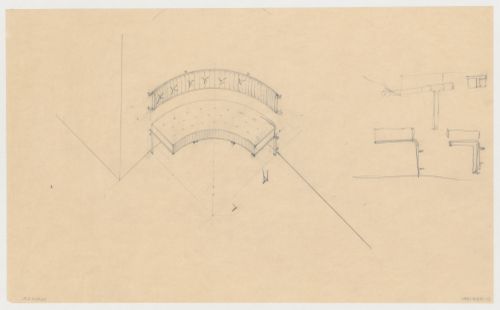
Axonometric and details for a built-in hall bench for Villa Allegonda, Katwijk aan Zee, Netherlands
Axonometric and details for a built-in hall bench for Villa Allegonda, Katwijk aan Zee, Netherlands
Actions:
Reference number:
DR1984:0148
Description:
- The built-in curved bench and headrest shown in this drawing are for the ground floor hall of Villa Allegonda. Detail drawings for the bench supports appear at upper right and centre right.
DR1984:0148
Description:
- The built-in curved bench and headrest shown in this drawing are for the ground floor hall of Villa Allegonda. Detail drawings for the bench supports appear at upper right and centre right.
People:
Subject:
interior design
interior design
Date:
1931
1931
Title:
Axonometric and details for a built-in hall bench for Villa Allegonda, Katwijk aan Zee, Netherlands
Actions:
DR1984:0148
Description:
- The built-in curved bench and headrest shown in this drawing are for the ground floor hall of Villa Allegonda. Detail drawings for the bench supports appear at upper right and centre right.
Axonometric and details for a built-in hall bench for Villa Allegonda, Katwijk aan Zee, Netherlands
Actions:
DR1984:0148
Description:
- The built-in curved bench and headrest shown in this drawing are for the ground floor hall of Villa Allegonda. Detail drawings for the bench supports appear at upper right and centre right.
Form:
drawings
drawings
Date:
1931
1931
People:
Subject:
interior design
interior design
Form:
drawings
drawings
Title:
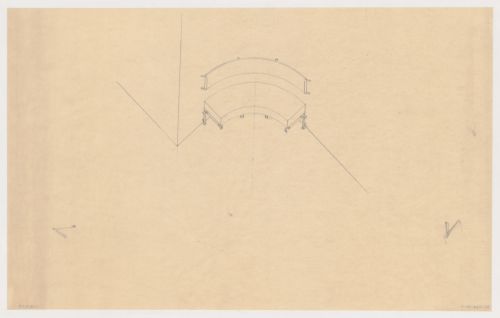
Axonometric and details for a built-in hall bench for Villa Allegonda, Katwijk aan Zee, Netherlands
Axonometric and details for a built-in hall bench for Villa Allegonda, Katwijk aan Zee, Netherlands
Actions:
Reference number:
DR1984:0151
Description:
- The built-in curved bench and headrest shown in this drawing are for the ground floor hall of Villa Allegonda. Detail drawings for the bench supports appear at lower left and lower right.
DR1984:0151
Description:
- The built-in curved bench and headrest shown in this drawing are for the ground floor hall of Villa Allegonda. Detail drawings for the bench supports appear at lower left and lower right.
People:
Subject:
interior design
interior design
Date:
1931
1931
Title:
Axonometric and details for a built-in hall bench for Villa Allegonda, Katwijk aan Zee, Netherlands
Actions:
DR1984:0151
Description:
- The built-in curved bench and headrest shown in this drawing are for the ground floor hall of Villa Allegonda. Detail drawings for the bench supports appear at lower left and lower right.
Axonometric and details for a built-in hall bench for Villa Allegonda, Katwijk aan Zee, Netherlands
Actions:
DR1984:0151
Description:
- The built-in curved bench and headrest shown in this drawing are for the ground floor hall of Villa Allegonda. Detail drawings for the bench supports appear at lower left and lower right.
Form:
drawings
drawings
Date:
1931
1931
People:
Subject:
interior design
interior design
Form:
events
events
Actions:
Description:
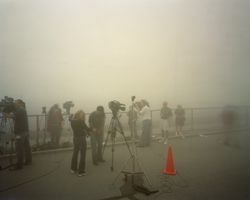
Robert Burley, CCA Mellon Senior Fellow and Assistant Professor at Ryerson University, speaks on “The Architecture of Photography in an Age of Obsolescence.” The CCA Mellon Foundation Senior Fellowship Program was established in 2001 to encourage advanced research in architectural history and thought. With the generous support of The Andrew W. Mellon Foundation,(...)
Robert Burley, CCA Mellon Senior Fellow and Assistant Professor at Ryerson University, speaks on “The Architecture of Photography in an Age of Obsolescence.” The CCA Mellon Foundation Senior Fellowship Program was established in 2001 to encourage advanced research in architectural history and thought. With the generous support of The Andrew W. Mellon Foundation,(...)
Location:
Paul Desmarais Theatre
Paul Desmarais Theatre
Date:
16 September 2010, 6pm
16 September 2010, 6pm
Title:
Robert Burley: The Architecture of Photography in an Age of Obsolescence
Actions:
Description:
Robert Burley, CCA Mellon Senior Fellow and Assistant Professor at Ryerson University, speaks on “The Architecture of Photography in an Age of Obsolescence.” The CCA Mellon Foundation Senior Fellowship Program was established in 2001 to encourage advanced research in architectural history and thought. With the generous support of The Andrew W. Mellon Foundation,(...)
Robert Burley: The Architecture of Photography in an Age of Obsolescence
Actions:
Description:
Robert Burley, CCA Mellon Senior Fellow and Assistant Professor at Ryerson University, speaks on “The Architecture of Photography in an Age of Obsolescence.” The CCA Mellon Foundation Senior Fellowship Program was established in 2001 to encourage advanced research in architectural history and thought. With the generous support of The Andrew W. Mellon Foundation,(...)
Form:
events
events
Date:
16 September 2010
6pm
16 September 2010
6pm
Location:
Paul Desmarais Theatre
Paul Desmarais Theatre
Form:
drawings
drawings

Actions:
Reference number:
DR1987:0062
Description:
General view - This drawing is one of four drawings by Arata Isozaki for the "City in the Air" schemes of 1960-1963. Three of these drawings are studies for the "Clusters in the Air" project of 1960-1962: a sketch showing a general view of the project, DR1987:0117, a more finished version of the same view, DR1987:0062, and a three-stage sketch showing trees becoming a forest, DR1987:0116. The sketch of trees demonstrates the principal idea behind the "Clusters in the Air" project; enormous supports (trunks) support passageways (branches) to which living units (leaves) are gradually added. The trees develope side by side, with branches of different trees joining up, creating a "forest" (Isozaki 1992, 20-23, 29). the subject of the fourth drawing, DR1987:0061, is unclear although it is possibly a conceptual drawing for the Marunouchi Project of 1963, a proposal for a "City in the Air" in the central business district of Tokyo (Isozaki 1992, 27, 29). All four drawings are executed on sheets perforated with square holes for insertion into a spiral notebook.
DR1987:0062
Description:
General view - This drawing is one of four drawings by Arata Isozaki for the "City in the Air" schemes of 1960-1963. Three of these drawings are studies for the "Clusters in the Air" project of 1960-1962: a sketch showing a general view of the project, DR1987:0117, a more finished version of the same view, DR1987:0062, and a three-stage sketch showing trees becoming a forest, DR1987:0116. The sketch of trees demonstrates the principal idea behind the "Clusters in the Air" project; enormous supports (trunks) support passageways (branches) to which living units (leaves) are gradually added. The trees develope side by side, with branches of different trees joining up, creating a "forest" (Isozaki 1992, 20-23, 29). the subject of the fourth drawing, DR1987:0061, is unclear although it is possibly a conceptual drawing for the Marunouchi Project of 1963, a proposal for a "City in the Air" in the central business district of Tokyo (Isozaki 1992, 27, 29). All four drawings are executed on sheets perforated with square holes for insertion into a spiral notebook.
People:
Subject:
architecture
architecture
Date:
between 1960-1962
between 1960-1962
Title:
Sketch for the Clusters in the Air Project, Tokyo
Actions:
DR1987:0062
Description:
General view - This drawing is one of four drawings by Arata Isozaki for the "City in the Air" schemes of 1960-1963. Three of these drawings are studies for the "Clusters in the Air" project of 1960-1962: a sketch showing a general view of the project, DR1987:0117, a more finished version of the same view, DR1987:0062, and a three-stage sketch showing trees becoming a forest, DR1987:0116. The sketch of trees demonstrates the principal idea behind the "Clusters in the Air" project; enormous supports (trunks) support passageways (branches) to which living units (leaves) are gradually added. The trees develope side by side, with branches of different trees joining up, creating a "forest" (Isozaki 1992, 20-23, 29). the subject of the fourth drawing, DR1987:0061, is unclear although it is possibly a conceptual drawing for the Marunouchi Project of 1963, a proposal for a "City in the Air" in the central business district of Tokyo (Isozaki 1992, 27, 29). All four drawings are executed on sheets perforated with square holes for insertion into a spiral notebook.
Sketch for the Clusters in the Air Project, Tokyo
Actions:
DR1987:0062
Description:
General view - This drawing is one of four drawings by Arata Isozaki for the "City in the Air" schemes of 1960-1963. Three of these drawings are studies for the "Clusters in the Air" project of 1960-1962: a sketch showing a general view of the project, DR1987:0117, a more finished version of the same view, DR1987:0062, and a three-stage sketch showing trees becoming a forest, DR1987:0116. The sketch of trees demonstrates the principal idea behind the "Clusters in the Air" project; enormous supports (trunks) support passageways (branches) to which living units (leaves) are gradually added. The trees develope side by side, with branches of different trees joining up, creating a "forest" (Isozaki 1992, 20-23, 29). the subject of the fourth drawing, DR1987:0061, is unclear although it is possibly a conceptual drawing for the Marunouchi Project of 1963, a proposal for a "City in the Air" in the central business district of Tokyo (Isozaki 1992, 27, 29). All four drawings are executed on sheets perforated with square holes for insertion into a spiral notebook.
Form:
drawings
drawings
Date:
between 1960-1962
between 1960-1962
People:
Subject:
architecture
architecture
Form:
drawings
drawings
Actions:
Reference number:
DR1987:0116
Description:
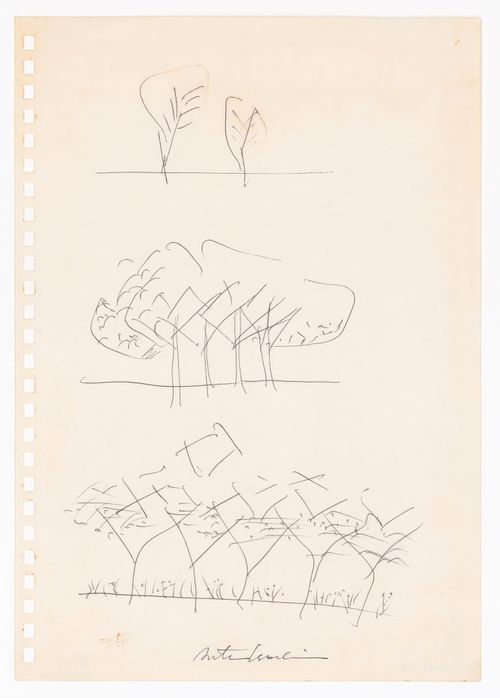
- This drawing is one of four drawings by Arata Isozaki for the "City in the Air" schemes of 1960-1963. Three of these drawings are studies for the "Clusters in the Air" project of 1960-1962: a sketch showing a general view of the project, DR1987:0117, a more finished version of the same view, DR1987:0062, and a three-stage sketch showing trees becoming a forest, DR1987:0116. The sketch of trees demonstrates the principal idea behind the "Clusters in the Air" project; enormous supports (trunks) support passageways (branches) to which living units (leaves) are gradually added. The trees develope side by side, with branches of different trees joining up, creating a "forest" (Isozaki 1992, 20-23, 29). The subject of the fourth drawing, DR1987:0061, is unclear although it is possibly a conceptual drawing for the Marunouchi Project of 1963, a proposal for a "City in the Air" in the central business district of Tokyo (Isozaki 1992, 27, 29). All four drawings are executed on sheets perforated with square holes for insertion into a spiral notebook.
DR1987:0116
Description:
- This drawing is one of four drawings by Arata Isozaki for the "City in the Air" schemes of 1960-1963. Three of these drawings are studies for the "Clusters in the Air" project of 1960-1962: a sketch showing a general view of the project, DR1987:0117, a more finished version of the same view, DR1987:0062, and a three-stage sketch showing trees becoming a forest, DR1987:0116. The sketch of trees demonstrates the principal idea behind the "Clusters in the Air" project; enormous supports (trunks) support passageways (branches) to which living units (leaves) are gradually added. The trees develope side by side, with branches of different trees joining up, creating a "forest" (Isozaki 1992, 20-23, 29). The subject of the fourth drawing, DR1987:0061, is unclear although it is possibly a conceptual drawing for the Marunouchi Project of 1963, a proposal for a "City in the Air" in the central business district of Tokyo (Isozaki 1992, 27, 29). All four drawings are executed on sheets perforated with square holes for insertion into a spiral notebook.
People:
Subject:
architecture
architecture
Date:
between 1960-1962
between 1960-1962
Title:
Sketch of a grouping of trees for the Clusters in the Air Project, Tokyo
Actions:
DR1987:0116
Description:
- This drawing is one of four drawings by Arata Isozaki for the "City in the Air" schemes of 1960-1963. Three of these drawings are studies for the "Clusters in the Air" project of 1960-1962: a sketch showing a general view of the project, DR1987:0117, a more finished version of the same view, DR1987:0062, and a three-stage sketch showing trees becoming a forest, DR1987:0116. The sketch of trees demonstrates the principal idea behind the "Clusters in the Air" project; enormous supports (trunks) support passageways (branches) to which living units (leaves) are gradually added. The trees develope side by side, with branches of different trees joining up, creating a "forest" (Isozaki 1992, 20-23, 29). The subject of the fourth drawing, DR1987:0061, is unclear although it is possibly a conceptual drawing for the Marunouchi Project of 1963, a proposal for a "City in the Air" in the central business district of Tokyo (Isozaki 1992, 27, 29). All four drawings are executed on sheets perforated with square holes for insertion into a spiral notebook.
Sketch of a grouping of trees for the Clusters in the Air Project, Tokyo
Actions:
DR1987:0116
Description:
- This drawing is one of four drawings by Arata Isozaki for the "City in the Air" schemes of 1960-1963. Three of these drawings are studies for the "Clusters in the Air" project of 1960-1962: a sketch showing a general view of the project, DR1987:0117, a more finished version of the same view, DR1987:0062, and a three-stage sketch showing trees becoming a forest, DR1987:0116. The sketch of trees demonstrates the principal idea behind the "Clusters in the Air" project; enormous supports (trunks) support passageways (branches) to which living units (leaves) are gradually added. The trees develope side by side, with branches of different trees joining up, creating a "forest" (Isozaki 1992, 20-23, 29). The subject of the fourth drawing, DR1987:0061, is unclear although it is possibly a conceptual drawing for the Marunouchi Project of 1963, a proposal for a "City in the Air" in the central business district of Tokyo (Isozaki 1992, 27, 29). All four drawings are executed on sheets perforated with square holes for insertion into a spiral notebook.
Form:
drawings
drawings
Date:
between 1960-1962
between 1960-1962
People:
Subject:
architecture
architecture
Form:
drawings
drawings
Reference number:
DR1987:0117
Description:
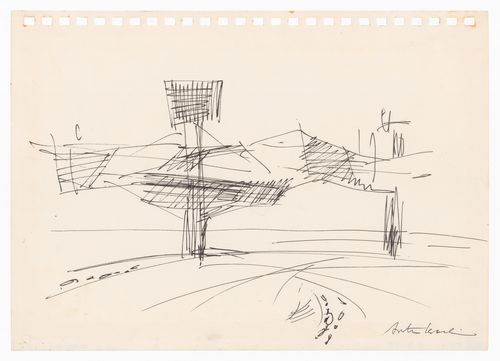
- This drawing is one of four drawings by Arata Isozaki for the "City in the Air" schemes of 1960-1963. Three of these drawings are studies for the "Clusters in the Air" project of 1960-1962: a sketch showing a general view of the project, DR1987:0117, a more finished version of the same view, DR1987:0062, and a three-stage sketch showing trees becoming a forest, DR1987:0116. The sketch of trees demonstrates the principal idea behind the "Clusters in the Air" project; enormous supports (trunks) support passageways (branches) to which living units (leaves) are gradually added. The trees develope side by side, with branches of different trees joining up, creating a "forest" (Isozaki 1992, 20-23, 29). The subject of the fourth drawing, DR1987:0061, is unclear although it is possibly a conceptual drawing for the Marunouchi Project of 1963, a proposal for a "City in the Air" in the central business district of Tokyo (Isozaki 1992, 27, 29). All four drawings are executed on sheets perforated with square holes for insertion into a spiral notebook.
DR1987:0117
Description:
- This drawing is one of four drawings by Arata Isozaki for the "City in the Air" schemes of 1960-1963. Three of these drawings are studies for the "Clusters in the Air" project of 1960-1962: a sketch showing a general view of the project, DR1987:0117, a more finished version of the same view, DR1987:0062, and a three-stage sketch showing trees becoming a forest, DR1987:0116. The sketch of trees demonstrates the principal idea behind the "Clusters in the Air" project; enormous supports (trunks) support passageways (branches) to which living units (leaves) are gradually added. The trees develope side by side, with branches of different trees joining up, creating a "forest" (Isozaki 1992, 20-23, 29). The subject of the fourth drawing, DR1987:0061, is unclear although it is possibly a conceptual drawing for the Marunouchi Project of 1963, a proposal for a "City in the Air" in the central business district of Tokyo (Isozaki 1992, 27, 29). All four drawings are executed on sheets perforated with square holes for insertion into a spiral notebook.
People:
Subject:
architecture
architecture
Date:
between 1960-1962
between 1960-1962
Title:
Sketch for the Clusters in the Air Project, Tokyo: General view
Actions:
DR1987:0117
Description:
- This drawing is one of four drawings by Arata Isozaki for the "City in the Air" schemes of 1960-1963. Three of these drawings are studies for the "Clusters in the Air" project of 1960-1962: a sketch showing a general view of the project, DR1987:0117, a more finished version of the same view, DR1987:0062, and a three-stage sketch showing trees becoming a forest, DR1987:0116. The sketch of trees demonstrates the principal idea behind the "Clusters in the Air" project; enormous supports (trunks) support passageways (branches) to which living units (leaves) are gradually added. The trees develope side by side, with branches of different trees joining up, creating a "forest" (Isozaki 1992, 20-23, 29). The subject of the fourth drawing, DR1987:0061, is unclear although it is possibly a conceptual drawing for the Marunouchi Project of 1963, a proposal for a "City in the Air" in the central business district of Tokyo (Isozaki 1992, 27, 29). All four drawings are executed on sheets perforated with square holes for insertion into a spiral notebook.
Sketch for the Clusters in the Air Project, Tokyo: General view
Actions:
DR1987:0117
Description:
- This drawing is one of four drawings by Arata Isozaki for the "City in the Air" schemes of 1960-1963. Three of these drawings are studies for the "Clusters in the Air" project of 1960-1962: a sketch showing a general view of the project, DR1987:0117, a more finished version of the same view, DR1987:0062, and a three-stage sketch showing trees becoming a forest, DR1987:0116. The sketch of trees demonstrates the principal idea behind the "Clusters in the Air" project; enormous supports (trunks) support passageways (branches) to which living units (leaves) are gradually added. The trees develope side by side, with branches of different trees joining up, creating a "forest" (Isozaki 1992, 20-23, 29). The subject of the fourth drawing, DR1987:0061, is unclear although it is possibly a conceptual drawing for the Marunouchi Project of 1963, a proposal for a "City in the Air" in the central business district of Tokyo (Isozaki 1992, 27, 29). All four drawings are executed on sheets perforated with square holes for insertion into a spiral notebook.
Form:
drawings
drawings
Date:
between 1960-1962
between 1960-1962
People:
Subject:
architecture
architecture
Form:
exhibitions
exhibitions
Title:
Toy Town
Toy Town
Actions:
Description:
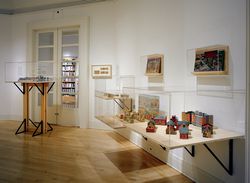
Toy Town explores how villages, towns, and cities have been represented in toys from Europe and North America. Drawn from CCA’s collection of architectural toys and games, the twenty-nine toys reflect shifting social values and different approaches to the design, organisation, and planning of communities in the nineteenth and twentieth centuries. Toy Town is the sixth in(...)
Toy Town explores how villages, towns, and cities have been represented in toys from Europe and North America. Drawn from CCA’s collection of architectural toys and games, the twenty-nine toys reflect shifting social values and different approaches to the design, organisation, and planning of communities in the nineteenth and twentieth centuries. Toy Town is the sixth in(...)
Location:
Octagonal gallery
Octagonal gallery
Date:
22 October 1997 to 31 May 1998
22 October 1997 to 31 May 1998
Title:
Toy Town
Actions:
Description:
Toy Town explores how villages, towns, and cities have been represented in toys from Europe and North America. Drawn from CCA’s collection of architectural toys and games, the twenty-nine toys reflect shifting social values and different approaches to the design, organisation, and planning of communities in the nineteenth and twentieth centuries. Toy Town is the sixth in(...)
Toy Town
Actions:
Description:
Toy Town explores how villages, towns, and cities have been represented in toys from Europe and North America. Drawn from CCA’s collection of architectural toys and games, the twenty-nine toys reflect shifting social values and different approaches to the design, organisation, and planning of communities in the nineteenth and twentieth centuries. Toy Town is the sixth in(...)
Form:
exhibitions
exhibitions
Date:
22 October 1997 to
31 May 1998
22 October 1997 to
31 May 1998
Location:
Octagonal gallery
Octagonal gallery
Form:
drawings
drawings
Title:
Plan for a Court House
Plan for a Court House
Actions:
Reference number:
DR1987:0258
Description:
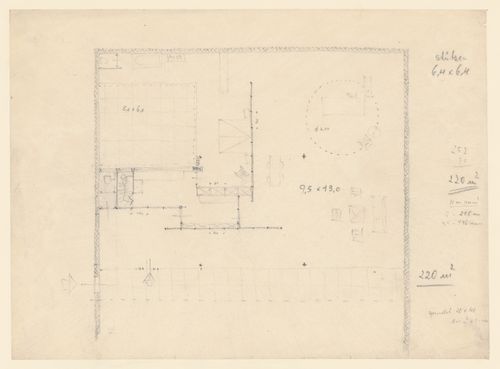
- This drawing is one of a group of eight studies for Court Houses (houses incorporating courtyards) by Mies van der Rohe, ca. 1935. These drawings are mounted in pairs on cardboard secondary supports.
DR1987:0258
Description:
- This drawing is one of a group of eight studies for Court Houses (houses incorporating courtyards) by Mies van der Rohe, ca. 1935. These drawings are mounted in pairs on cardboard secondary supports.
People:
Subject:
architecture
architecture
Date:
ca. 1935
ca. 1935
Title:
Plan for a Court House
Actions:
DR1987:0258
Description:
- This drawing is one of a group of eight studies for Court Houses (houses incorporating courtyards) by Mies van der Rohe, ca. 1935. These drawings are mounted in pairs on cardboard secondary supports.
Plan for a Court House
Actions:
DR1987:0258
Description:
- This drawing is one of a group of eight studies for Court Houses (houses incorporating courtyards) by Mies van der Rohe, ca. 1935. These drawings are mounted in pairs on cardboard secondary supports.
Form:
drawings
drawings
Date:
ca. 1935
ca. 1935
People:
Subject:
architecture
architecture


