


3997 Results
Form:
books
books
Actions:
Holdings:
Description:
48 unnumbered pages : chiefly illustrations (some color) ; 25 cm
Description:
48 unnumbered pages : chiefly illustrations (some color) ; 25 cm
Author:
Subject:
Publication:
New York, N.Y. : Aperture Book, ©1986.
New York, N.Y. : Aperture Book, ©1986.
Title:
The Capitol in Albany / photos. by William Clift [and others] ; pref. by Mario M. Cuomo, Warren M. Anderson, Stanley Fink ; essays by William Kennedy.
Actions:
Holdings:
Description:
48 unnumbered pages : chiefly illustrations (some color) ; 25 cm
The Capitol in Albany / photos. by William Clift [and others] ; pref. by Mario M. Cuomo, Warren M. Anderson, Stanley Fink ; essays by William Kennedy.
Actions:
Holdings:
Description:
48 unnumbered pages : chiefly illustrations (some color) ; 25 cm
Form:
books
books
Publication:
New York, N.Y. : Aperture Book, ©1986.
New York, N.Y. : Aperture Book, ©1986.
Author:
Subject:
Form:
books
books
Actions:
Description:
1 online resource.
Author:
Subject:
Publication:
[Place of publication not identified] : Hajar Press, 2021.
[Place of publication not identified] : Hajar Press, 2021.
Form:
books
books
Publication:
[Place of publication not identified] : Hajar Press, 2021.
[Place of publication not identified] : Hajar Press, 2021.
Author:
Subject:
Form:
audio
audio
Title:
DOWNSTREAM.
DOWNSTREAM.
Actions:
Description:
1 online resource.
Author:
Subject:
Publication:
[Place of publication not identified] : New Models, 2019.
[Place of publication not identified] : New Models, 2019.
Form:
audio
audio
Publication:
[Place of publication not identified] : New Models, 2019.
[Place of publication not identified] : New Models, 2019.
Author:
Subject:
Form:
audio
audio
Title:
Anna M. Szaflarski.
Anna M. Szaflarski.
Actions:
Description:
1 online resource.
Author:
Subject:
Publication:
[Place of publication not identified] : Broken Dimanche Press, 2020., [Place of publication not identified] : Tropez, 2020.
[Place of publication not identified] : Broken Dimanche Press, 2020., [Place of publication not identified] : Tropez, 2020.
Form:
audio
audio
Publication:
[Place of publication not identified] : Broken Dimanche Press, 2020., [Place of publication not identified] : Tropez, 2020.
[Place of publication not identified] : Broken Dimanche Press, 2020., [Place of publication not identified] : Tropez, 2020.
Author:
Subject:
Form:
books
books
Holdings:
Description:
423 pages : color illustrations ; 28 cm
Description:
423 pages : color illustrations ; 28 cm
Author:
Subject:
Publication:
Basel : Birkhäuser, [2019]
Basel : Birkhäuser, [2019]
Title:
OMA/Rem Koolhaas : a critical reader / Christophe Van Gerrewey (ed.).
Actions:
Holdings:
Description:
423 pages : color illustrations ; 28 cm
OMA/Rem Koolhaas : a critical reader / Christophe Van Gerrewey (ed.).
Actions:
Holdings:
Description:
423 pages : color illustrations ; 28 cm
Form:
books
books
Publication:
Basel : Birkhäuser, [2019]
Basel : Birkhäuser, [2019]
Author:
Subject:
Form:
books
books
Title:
A guidebook to contemporary architecture in Toronto / Margaret Goodfellow and Phil Goodfellow.
A guidebook to contemporary architecture in Toronto / Margaret Goodfellow and Phil Goodfellow.
Actions:
Holdings:
Description:
191 pages : illustrations (some color), maps ; 17 cm
Description:
191 pages : illustrations (some color), maps ; 17 cm
Author:
Subject:
Publication:
Vancouver : Douglas & McIntyre, 2010.
Vancouver : Douglas & McIntyre, 2010.
Title:
A guidebook to contemporary architecture in Toronto / Margaret Goodfellow and Phil Goodfellow.
Actions:
Holdings:
Description:
191 pages : illustrations (some color), maps ; 17 cm
A guidebook to contemporary architecture in Toronto / Margaret Goodfellow and Phil Goodfellow.
Actions:
Holdings:
Description:
191 pages : illustrations (some color), maps ; 17 cm
Form:
books
books
Publication:
Vancouver : Douglas & McIntyre, 2010.
Vancouver : Douglas & McIntyre, 2010.
Author:
Subject:
Form:
books
books
Actions:
Holdings:
Description:
120 pages : illustrations (some color) ; 26 cm
Description:
120 pages : illustrations (some color) ; 26 cm
Author:
Subject:
Publication:
London : Merrell Holberton Publishers, 1998.
London : Merrell Holberton Publishers, 1998.
Title:
Italy in the age of Turner : "the garden of the world" / Cecilia Powell.
Actions:
Holdings:
Description:
120 pages : illustrations (some color) ; 26 cm
Italy in the age of Turner : "the garden of the world" / Cecilia Powell.
Actions:
Holdings:
Description:
120 pages : illustrations (some color) ; 26 cm
Form:
books
books
Publication:
London : Merrell Holberton Publishers, 1998.
London : Merrell Holberton Publishers, 1998.
Author:
Subject:
Form:
books
books

Actions:
Price:
$25.95
(available to order)
Summary:
We surround ourselves with material things that are invested with memories but can only stand for what we have lost. Physical objects—such as one’s own body—situate and define us; yet at the same time they are fundamentally indifferent to us. The melancholy of this rift is a rich source of inspiration for artists. Peter Schwenger deftly weaves together philosophical(...)
$25.95
(available to order)
Summary:
We surround ourselves with material things that are invested with memories but can only stand for what we have lost. Physical objects—such as one’s own body—situate and define us; yet at the same time they are fundamentally indifferent to us. The melancholy of this rift is a rich source of inspiration for artists. Peter Schwenger deftly weaves together philosophical(...)
Title:
The tears of things : Melancholy and physical objects
Actions:
Price:
$25.95
(available to order)
Summary:
We surround ourselves with material things that are invested with memories but can only stand for what we have lost. Physical objects—such as one’s own body—situate and define us; yet at the same time they are fundamentally indifferent to us. The melancholy of this rift is a rich source of inspiration for artists. Peter Schwenger deftly weaves together philosophical and psychoanalytical theory with artistic practice. Concerned in part with the act of collecting, The Tears of Things is itself a collection of exemplary art objects—literary and cultural attempts to control and possess things—including paintings by Georgia O’Keeffe and René Magritte; sculpture by Louise Bourgeois and Marcel Duchamp; Joseph Cornell’s boxes; Edward Gorey’s graphic art; fiction by Virginia Woolf, Georges Perec, and Louise Erdrich; the hallucinatory encyclopedias of Jorge Luis Borges and Luigi Serafini; and the corpse photographs of Joel Peter Witkin. However, these representations of objects perpetually fall short of our aspirations. Schwenger examines what is left over—debris and waste—and asks what art can make of these. What emerges is not an art that reassembles but one that questions what it means to assemble in the first place. Contained in this catalog of waste is that ultimate still life, the cadaver, where the subject-object dichotomy receives its final ironic reconciliation. Peter Schwenger is professor of English at Mount St. Vincent University in Halifax, Nova Scotia. He is the author of Fantasm and Fiction: On Textual Envisioning, Letter Bomb: Nuclear Holocaust and the Exploding Word, and Phallic Critiques: Masculinity and Twentieth-Century Literature.
The tears of things : Melancholy and physical objects
Actions:
Price:
$25.95
(available to order)
Summary:
We surround ourselves with material things that are invested with memories but can only stand for what we have lost. Physical objects—such as one’s own body—situate and define us; yet at the same time they are fundamentally indifferent to us. The melancholy of this rift is a rich source of inspiration for artists. Peter Schwenger deftly weaves together philosophical and psychoanalytical theory with artistic practice. Concerned in part with the act of collecting, The Tears of Things is itself a collection of exemplary art objects—literary and cultural attempts to control and possess things—including paintings by Georgia O’Keeffe and René Magritte; sculpture by Louise Bourgeois and Marcel Duchamp; Joseph Cornell’s boxes; Edward Gorey’s graphic art; fiction by Virginia Woolf, Georges Perec, and Louise Erdrich; the hallucinatory encyclopedias of Jorge Luis Borges and Luigi Serafini; and the corpse photographs of Joel Peter Witkin. However, these representations of objects perpetually fall short of our aspirations. Schwenger examines what is left over—debris and waste—and asks what art can make of these. What emerges is not an art that reassembles but one that questions what it means to assemble in the first place. Contained in this catalog of waste is that ultimate still life, the cadaver, where the subject-object dichotomy receives its final ironic reconciliation. Peter Schwenger is professor of English at Mount St. Vincent University in Halifax, Nova Scotia. He is the author of Fantasm and Fiction: On Textual Envisioning, Letter Bomb: Nuclear Holocaust and the Exploding Word, and Phallic Critiques: Masculinity and Twentieth-Century Literature.
Form:
books
books
Publication:
May 2006, Minnesota
May 2006, Minnesota
Subject:
Architectural Theory
Architectural Theory
Form:
books
books
Actions:
Price:
$31.50
(available to order)
Summary:
Vladimir Nabokov could hear color. As he described it – "perhaps “hearing” is not quite accurate, since the color sensation seems to be produced by the very act of my orally forming a given letter while I imagine its outline. The long a of the English alphabet . . . has for me the tint of weathered wood, but a French a evokes polished ebony. This black group also includes(...)
$31.50
(available to order)
Summary:
Vladimir Nabokov could hear color. As he described it – "perhaps “hearing” is not quite accurate, since the color sensation seems to be produced by the very act of my orally forming a given letter while I imagine its outline. The long a of the English alphabet . . . has for me the tint of weathered wood, but a French a evokes polished ebony. This black group also includes(...)
Subject:
Graphic Designers, Monographs
Graphic Designers, Monographs
Publication:
October 2005, Corte Madera
October 2005, Corte Madera
Title:
Vladimir Nabokov : alphabet in color
Actions:
Price:
$31.50
(available to order)
Summary:
Vladimir Nabokov could hear color. As he described it – "perhaps “hearing” is not quite accurate, since the color sensation seems to be produced by the very act of my orally forming a given letter while I imagine its outline. The long a of the English alphabet . . . has for me the tint of weathered wood, but a French a evokes polished ebony. This black group also includes hard g (vulcanized rubber) and r (a sooty rag being ripped). Oatmeal n, noodle-limp l, and the ivory-backed hand mirror of o take care of the whites". For anyone who has ever wondered how the colors Nabokov heard might manifest themselves visually, "Alphabet in color" is a remarkable journey of discovery. Jean Holabird’s interpretation of the colored alphabets of one of the twentieth century’s literary greats is a revelation. Nabokov saw rich colors in letters and sounds and noted the deficiency of color in literature, praising Gogol as the first Russian writer to truly appreciate yellow and violet. This book masterfully brings to life the charming and vibrant synesthetic colored letters that until now existed only in Nabokov’s mind. In "Alphabet in color" Jean Holabird’s grasp of form and space blends perfectly with Nabokov’s idea that a subtle interaction exists between sound and shape. He saw q as browner than k, while s is not the light blue of c, but a curious mixture of azure and mother-of-pearl. . . . "Dull green, combined somehow with violet, is the best I can do for w".
Vladimir Nabokov : alphabet in color
Actions:
Price:
$31.50
(available to order)
Summary:
Vladimir Nabokov could hear color. As he described it – "perhaps “hearing” is not quite accurate, since the color sensation seems to be produced by the very act of my orally forming a given letter while I imagine its outline. The long a of the English alphabet . . . has for me the tint of weathered wood, but a French a evokes polished ebony. This black group also includes hard g (vulcanized rubber) and r (a sooty rag being ripped). Oatmeal n, noodle-limp l, and the ivory-backed hand mirror of o take care of the whites". For anyone who has ever wondered how the colors Nabokov heard might manifest themselves visually, "Alphabet in color" is a remarkable journey of discovery. Jean Holabird’s interpretation of the colored alphabets of one of the twentieth century’s literary greats is a revelation. Nabokov saw rich colors in letters and sounds and noted the deficiency of color in literature, praising Gogol as the first Russian writer to truly appreciate yellow and violet. This book masterfully brings to life the charming and vibrant synesthetic colored letters that until now existed only in Nabokov’s mind. In "Alphabet in color" Jean Holabird’s grasp of form and space blends perfectly with Nabokov’s idea that a subtle interaction exists between sound and shape. He saw q as browner than k, while s is not the light blue of c, but a curious mixture of azure and mother-of-pearl. . . . "Dull green, combined somehow with violet, is the best I can do for w".
Form:
books
books
Publication:
October 2005, Corte Madera
October 2005, Corte Madera
Subject:
Graphic Designers, Monographs
Graphic Designers, Monographs
Form:
books
books
Title:
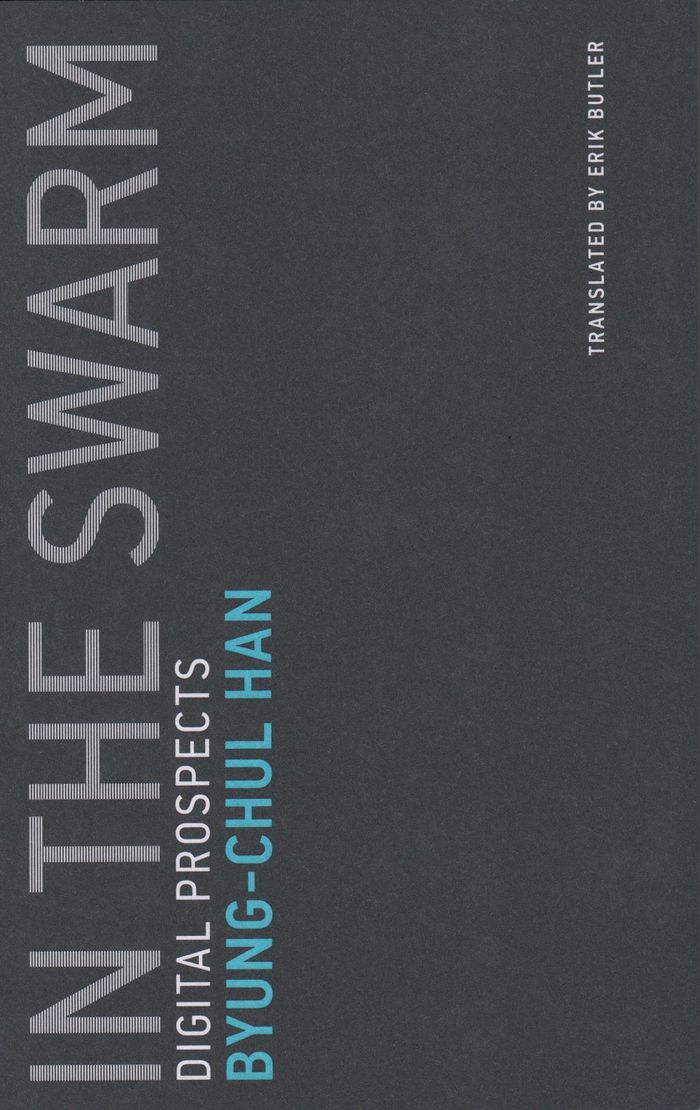
In the swarm
In the swarm
Actions:
Price:
$18.95
(available to order)
Summary:
Digital communication and social media have taken over our lives. In this contrarian reflection on digitized life, Byung-Chul Han counters the cheerleaders for Twitter revolutions and Facebook activism by arguing that digital communication is in fact responsible for the disintegration of community and public space and is slowly eroding any possibility for real political(...)
$18.95
(available to order)
Summary:
Digital communication and social media have taken over our lives. In this contrarian reflection on digitized life, Byung-Chul Han counters the cheerleaders for Twitter revolutions and Facebook activism by arguing that digital communication is in fact responsible for the disintegration of community and public space and is slowly eroding any possibility for real political(...)
Title:
In the swarm
Actions:
Price:
$18.95
(available to order)
Summary:
Digital communication and social media have taken over our lives. In this contrarian reflection on digitized life, Byung-Chul Han counters the cheerleaders for Twitter revolutions and Facebook activism by arguing that digital communication is in fact responsible for the disintegration of community and public space and is slowly eroding any possibility for real political action and meaningful political discourse. In the predigital, analog era, by the time an angry letter to the editor had been composed, mailed, and received, the immediate agitation had passed. Today, digital communication enables instantaneous, impulsive reaction, meant to express and stir up outrage on the spot. “The shitstorm,” writes Han, ”represents an authentic phenomenon of digital communication.” Meanwhile, the public, the senders and receivers of these communications have become a digital swarm—not a mass, or a crowd, or Negri and Hardt’s antiquated notion of a “multitude,” but a set of isolated individuals incapable of forming a “we,” incapable of calling dominant power relations into question, incapable of formulating a future because of an obsession with the present. The digital swarm is a fragmented entity that can focus on individual persons only in order to make them an object of scandal. Han, one of the most widely read philosophers in Europe today, describes a society in which information has overrun thought, in which the same algorithms are employed by Facebook, the stock market, and the intelligence services. Democracy is under threat because digital communication has made freedom and control indistinguishable. Big Brother has been succeeded by Big Data.
In the swarm
Actions:
Price:
$18.95
(available to order)
Summary:
Digital communication and social media have taken over our lives. In this contrarian reflection on digitized life, Byung-Chul Han counters the cheerleaders for Twitter revolutions and Facebook activism by arguing that digital communication is in fact responsible for the disintegration of community and public space and is slowly eroding any possibility for real political action and meaningful political discourse. In the predigital, analog era, by the time an angry letter to the editor had been composed, mailed, and received, the immediate agitation had passed. Today, digital communication enables instantaneous, impulsive reaction, meant to express and stir up outrage on the spot. “The shitstorm,” writes Han, ”represents an authentic phenomenon of digital communication.” Meanwhile, the public, the senders and receivers of these communications have become a digital swarm—not a mass, or a crowd, or Negri and Hardt’s antiquated notion of a “multitude,” but a set of isolated individuals incapable of forming a “we,” incapable of calling dominant power relations into question, incapable of formulating a future because of an obsession with the present. The digital swarm is a fragmented entity that can focus on individual persons only in order to make them an object of scandal. Han, one of the most widely read philosophers in Europe today, describes a society in which information has overrun thought, in which the same algorithms are employed by Facebook, the stock market, and the intelligence services. Democracy is under threat because digital communication has made freedom and control indistinguishable. Big Brother has been succeeded by Big Data.
Form:
books
books
Publication:
April 2017
April 2017
Subject:
Archive, library and the digital
Archive, library and the digital


