


5805 Results
Form:
events
events

Title:
Learning from... Dubai
Learning from... Dubai
Actions:
Description:
Yasser Elsheshtawy presents the second lecture in the series Learning From… the Middle East.Whether presented as a playground for the super-rich, a land of unabashed consumerism, or an exemplary case study for capitalist exploitation – such portrayals ultimately suggest a one-sided dimension of the city of Dubai. The talk will examine the spaces of the everyday, the(...)
Yasser Elsheshtawy presents the second lecture in the series Learning From… the Middle East.Whether presented as a playground for the super-rich, a land of unabashed consumerism, or an exemplary case study for capitalist exploitation – such portrayals ultimately suggest a one-sided dimension of the city of Dubai. The talk will examine the spaces of the everyday, the(...)
Location:
Paul-Desmarais Theatre
Paul-Desmarais Theatre
Date:
29 September 2011 , 7PM
29 September 2011 , 7PM
Title:
Learning from... Dubai
Actions:
Description:
Yasser Elsheshtawy presents the second lecture in the series Learning From… the Middle East.Whether presented as a playground for the super-rich, a land of unabashed consumerism, or an exemplary case study for capitalist exploitation – such portrayals ultimately suggest a one-sided dimension of the city of Dubai. The talk will examine the spaces of the everyday, the(...)
Learning from... Dubai
Actions:
Description:
Yasser Elsheshtawy presents the second lecture in the series Learning From… the Middle East.Whether presented as a playground for the super-rich, a land of unabashed consumerism, or an exemplary case study for capitalist exploitation – such portrayals ultimately suggest a one-sided dimension of the city of Dubai. The talk will examine the spaces of the everyday, the(...)
Form:
events
events
Date:
29 September 2011
7PM
29 September 2011
7PM
Location:
Paul-Desmarais Theatre
Paul-Desmarais Theatre
Level of archival description:
Project
Project
Reference number:
AP206.S1.1975.PR01
Description:
This project series documents Aditya Prakash's proposal for an alternative plan for Chandigarh, India, which came to be known as the Linear City. Prakash began developing and advocating for this idea around the early 1970s. The Linear City had two fundamental ideas at its core. The first was to raise the roadways in Chandigarh (or any future city) 10-12 feet from ground level. This, he proposed, would separate vehicular traffic from pedestrians, eliminating all the hazardous impacts of traffic on daily life. The large part of the drawings for this project show sector plans and city blocks with evenly dispersed roundabout roadways as major transit hubs, wrapping around but high above centres of pedestrian activity that included shops, markets and green spaces. The sale of the land below the roadways would pay for the upheaval. He also recommended building this city only a few sectors deep, but endlessly expanding it length-wise, with a raised canal along one side to provide an additional transportation network and irrigation. The second fundamental idea of this city was the creation of self-sustaining sectors in the city plan, advocating that each neighbourhood should have the infrastructure to provide food and recycling for its residents. He fervently argued for the reimagination of modernist Chandigarh by incorporating sustainable, local traditions - the rural should exist in harmony with the urban. In opposition to Le Corbusier and Pierre Jeanneret, he believed areas for recycling, animal husbandry, and growing food should be incorporated into the fabric of the city.[1] This project is recorded largely through original drawings of city plans, perspectives and axonometric views detailing Prakash's new vision for the city. It seems that many of the perspectives were drawn by family friend Sandeep Virmani, after listening to Prakash's ideas.[2] The project is also recorded through photographs, negatives and slides showing plans and the project model. A small amount of notes and an article on the project are also included. [1]Vikramaditya Prakash, One Continuous Line: Art, Architecture and Urbanism of Aditya Prakash (Ahmedabad, India: Mapin Publishing Pvt. Ltd., 2019), 164-181. [2]Prakash, One Continuous Line, 169.
AP206.S1.1975.PR01
Description:
This project series documents Aditya Prakash's proposal for an alternative plan for Chandigarh, India, which came to be known as the Linear City. Prakash began developing and advocating for this idea around the early 1970s. The Linear City had two fundamental ideas at its core. The first was to raise the roadways in Chandigarh (or any future city) 10-12 feet from ground level. This, he proposed, would separate vehicular traffic from pedestrians, eliminating all the hazardous impacts of traffic on daily life. The large part of the drawings for this project show sector plans and city blocks with evenly dispersed roundabout roadways as major transit hubs, wrapping around but high above centres of pedestrian activity that included shops, markets and green spaces. The sale of the land below the roadways would pay for the upheaval. He also recommended building this city only a few sectors deep, but endlessly expanding it length-wise, with a raised canal along one side to provide an additional transportation network and irrigation. The second fundamental idea of this city was the creation of self-sustaining sectors in the city plan, advocating that each neighbourhood should have the infrastructure to provide food and recycling for its residents. He fervently argued for the reimagination of modernist Chandigarh by incorporating sustainable, local traditions - the rural should exist in harmony with the urban. In opposition to Le Corbusier and Pierre Jeanneret, he believed areas for recycling, animal husbandry, and growing food should be incorporated into the fabric of the city.[1] This project is recorded largely through original drawings of city plans, perspectives and axonometric views detailing Prakash's new vision for the city. It seems that many of the perspectives were drawn by family friend Sandeep Virmani, after listening to Prakash's ideas.[2] The project is also recorded through photographs, negatives and slides showing plans and the project model. A small amount of notes and an article on the project are also included. [1]Vikramaditya Prakash, One Continuous Line: Art, Architecture and Urbanism of Aditya Prakash (Ahmedabad, India: Mapin Publishing Pvt. Ltd., 2019), 164-181. [2]Prakash, One Continuous Line, 169.
People:
Date:
circa 1975-2003
circa 1975-2003
Title:
Linear city, Chandigarh, India (circa 1975-1987)
Actions:
AP206.S1.1975.PR01
Description:
This project series documents Aditya Prakash's proposal for an alternative plan for Chandigarh, India, which came to be known as the Linear City. Prakash began developing and advocating for this idea around the early 1970s. The Linear City had two fundamental ideas at its core. The first was to raise the roadways in Chandigarh (or any future city) 10-12 feet from ground level. This, he proposed, would separate vehicular traffic from pedestrians, eliminating all the hazardous impacts of traffic on daily life. The large part of the drawings for this project show sector plans and city blocks with evenly dispersed roundabout roadways as major transit hubs, wrapping around but high above centres of pedestrian activity that included shops, markets and green spaces. The sale of the land below the roadways would pay for the upheaval. He also recommended building this city only a few sectors deep, but endlessly expanding it length-wise, with a raised canal along one side to provide an additional transportation network and irrigation. The second fundamental idea of this city was the creation of self-sustaining sectors in the city plan, advocating that each neighbourhood should have the infrastructure to provide food and recycling for its residents. He fervently argued for the reimagination of modernist Chandigarh by incorporating sustainable, local traditions - the rural should exist in harmony with the urban. In opposition to Le Corbusier and Pierre Jeanneret, he believed areas for recycling, animal husbandry, and growing food should be incorporated into the fabric of the city.[1] This project is recorded largely through original drawings of city plans, perspectives and axonometric views detailing Prakash's new vision for the city. It seems that many of the perspectives were drawn by family friend Sandeep Virmani, after listening to Prakash's ideas.[2] The project is also recorded through photographs, negatives and slides showing plans and the project model. A small amount of notes and an article on the project are also included. [1]Vikramaditya Prakash, One Continuous Line: Art, Architecture and Urbanism of Aditya Prakash (Ahmedabad, India: Mapin Publishing Pvt. Ltd., 2019), 164-181. [2]Prakash, One Continuous Line, 169.
Linear city, Chandigarh, India (circa 1975-1987)
Actions:
AP206.S1.1975.PR01
Description:
This project series documents Aditya Prakash's proposal for an alternative plan for Chandigarh, India, which came to be known as the Linear City. Prakash began developing and advocating for this idea around the early 1970s. The Linear City had two fundamental ideas at its core. The first was to raise the roadways in Chandigarh (or any future city) 10-12 feet from ground level. This, he proposed, would separate vehicular traffic from pedestrians, eliminating all the hazardous impacts of traffic on daily life. The large part of the drawings for this project show sector plans and city blocks with evenly dispersed roundabout roadways as major transit hubs, wrapping around but high above centres of pedestrian activity that included shops, markets and green spaces. The sale of the land below the roadways would pay for the upheaval. He also recommended building this city only a few sectors deep, but endlessly expanding it length-wise, with a raised canal along one side to provide an additional transportation network and irrigation. The second fundamental idea of this city was the creation of self-sustaining sectors in the city plan, advocating that each neighbourhood should have the infrastructure to provide food and recycling for its residents. He fervently argued for the reimagination of modernist Chandigarh by incorporating sustainable, local traditions - the rural should exist in harmony with the urban. In opposition to Le Corbusier and Pierre Jeanneret, he believed areas for recycling, animal husbandry, and growing food should be incorporated into the fabric of the city.[1] This project is recorded largely through original drawings of city plans, perspectives and axonometric views detailing Prakash's new vision for the city. It seems that many of the perspectives were drawn by family friend Sandeep Virmani, after listening to Prakash's ideas.[2] The project is also recorded through photographs, negatives and slides showing plans and the project model. A small amount of notes and an article on the project are also included. [1]Vikramaditya Prakash, One Continuous Line: Art, Architecture and Urbanism of Aditya Prakash (Ahmedabad, India: Mapin Publishing Pvt. Ltd., 2019), 164-181. [2]Prakash, One Continuous Line, 169.
Level of archival description:
Project
Project
Date:
circa 1975-2003
circa 1975-2003
People:
Form:
drawings
drawings
Actions:
Reference number:
DR1985:0415
Description:
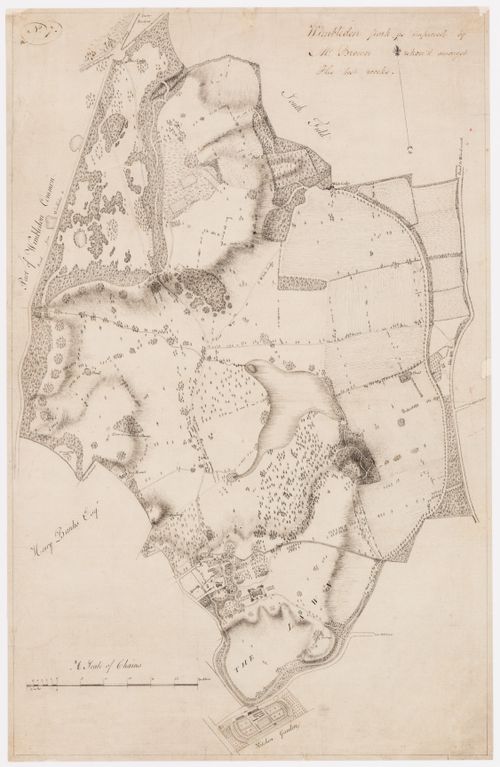
- DR1985:0415 presents a cartographic survey of Wimbledon Park as "improved" in the second half of the eighteenth century. Covering some 1,200 acres, the park as shown in this plan contains all the elements of Capability Brown's mature landscape style: expanses of grass traversed by meandering paths, irregular plantings of trees placed singly and in clumps, and winding streams dammed to create a large, irregular lake near the centre of the property and several small ponds about the periphery. The main house (built 1732-33 for Sarah, the Duchess of Marlborough), its outbuildings, and the village church are shown at the southern end of the park, as is a kitchen garden dating from an earlier period. Roads, lanes, and neighbouring properties are neatly labelled in the draughtsman's hand, and the fall of the land has been indicated in shade lines.
DR1985:0415
Description:
- DR1985:0415 presents a cartographic survey of Wimbledon Park as "improved" in the second half of the eighteenth century. Covering some 1,200 acres, the park as shown in this plan contains all the elements of Capability Brown's mature landscape style: expanses of grass traversed by meandering paths, irregular plantings of trees placed singly and in clumps, and winding streams dammed to create a large, irregular lake near the centre of the property and several small ponds about the periphery. The main house (built 1732-33 for Sarah, the Duchess of Marlborough), its outbuildings, and the village church are shown at the southern end of the park, as is a kitchen garden dating from an earlier period. Roads, lanes, and neighbouring properties are neatly labelled in the draughtsman's hand, and the fall of the land has been indicated in shade lines.
People:
Subject:
landscape architecture, topographic
landscape architecture, topographic
Date:
between 1765 and 1785
between 1765 and 1785
Title:
A survey plan of Wimbledon Park as designed for Lord Spencer by Capability Brown
Actions:
DR1985:0415
Description:
- DR1985:0415 presents a cartographic survey of Wimbledon Park as "improved" in the second half of the eighteenth century. Covering some 1,200 acres, the park as shown in this plan contains all the elements of Capability Brown's mature landscape style: expanses of grass traversed by meandering paths, irregular plantings of trees placed singly and in clumps, and winding streams dammed to create a large, irregular lake near the centre of the property and several small ponds about the periphery. The main house (built 1732-33 for Sarah, the Duchess of Marlborough), its outbuildings, and the village church are shown at the southern end of the park, as is a kitchen garden dating from an earlier period. Roads, lanes, and neighbouring properties are neatly labelled in the draughtsman's hand, and the fall of the land has been indicated in shade lines.
A survey plan of Wimbledon Park as designed for Lord Spencer by Capability Brown
Actions:
DR1985:0415
Description:
- DR1985:0415 presents a cartographic survey of Wimbledon Park as "improved" in the second half of the eighteenth century. Covering some 1,200 acres, the park as shown in this plan contains all the elements of Capability Brown's mature landscape style: expanses of grass traversed by meandering paths, irregular plantings of trees placed singly and in clumps, and winding streams dammed to create a large, irregular lake near the centre of the property and several small ponds about the periphery. The main house (built 1732-33 for Sarah, the Duchess of Marlborough), its outbuildings, and the village church are shown at the southern end of the park, as is a kitchen garden dating from an earlier period. Roads, lanes, and neighbouring properties are neatly labelled in the draughtsman's hand, and the fall of the land has been indicated in shade lines.
Form:
drawings
drawings
Date:
between 1765 and 1785
between 1765 and 1785
People:
Subject:
landscape architecture, topographic
landscape architecture, topographic
Form:
articles
articles
Title:
Living Landscapes
Living Landscapes
Actions:
Robyn Adams, Julia Pingeton, and Marie Pontais reflect on the transitional space of the shoreline
Title:
Living Landscapes
Robyn Adams, Julia Pingeton, and Marie Pontais reflect on the transitional space of the shoreline
Actions:
Living Landscapes
Robyn Adams, Julia Pingeton, and Marie Pontais reflect on the transitional space of the shoreline
Actions:
Form:
archives
Level of archival description:
Fonds
archives
Level of archival description:
Fonds
Reference number:
AP195
Synopsis:
The Zaha Hadid Architects Phaeno Science Centre project records, 1996-2015, consist of approximately 43,800 digital files that document the design and construction of an interactive science museum in Wolfsburg, Germany. Materials related to presentations, publications, events, and the press are also represented. Formats include chiefly CAD files, especially plotter files and AutoCAD drawings, though related text documents and images are also represented. The majority of the records date from 2000 to 2006.
AP195
Synopsis:
The Zaha Hadid Architects Phaeno Science Centre project records, 1996-2015, consist of approximately 43,800 digital files that document the design and construction of an interactive science museum in Wolfsburg, Germany. Materials related to presentations, publications, events, and the press are also represented. Formats include chiefly CAD files, especially plotter files and AutoCAD drawings, though related text documents and images are also represented. The majority of the records date from 2000 to 2006.
People:
Date:
1996 - 2015
1996 - 2015
Title:
Zaha Hadid Architects Phaeno Science Centre project records
Actions:
AP195
Synopsis:
The Zaha Hadid Architects Phaeno Science Centre project records, 1996-2015, consist of approximately 43,800 digital files that document the design and construction of an interactive science museum in Wolfsburg, Germany. Materials related to presentations, publications, events, and the press are also represented. Formats include chiefly CAD files, especially plotter files and AutoCAD drawings, though related text documents and images are also represented. The majority of the records date from 2000 to 2006.
Zaha Hadid Architects Phaeno Science Centre project records
Actions:
AP195
Synopsis:
The Zaha Hadid Architects Phaeno Science Centre project records, 1996-2015, consist of approximately 43,800 digital files that document the design and construction of an interactive science museum in Wolfsburg, Germany. Materials related to presentations, publications, events, and the press are also represented. Formats include chiefly CAD files, especially plotter files and AutoCAD drawings, though related text documents and images are also represented. The majority of the records date from 2000 to 2006.
Form:
archives
Level of archival description:
Fonds
archives
Level of archival description:
Fonds
Date:
1996 - 2015
1996 - 2015
People:
Form:
exhibitions
exhibitions
Actions:
Description:
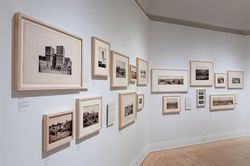
By the latter half of the nineteenth century, several pioneer photographers had travelled to the Middle East and North Africa, bringing back to Europe and North America images that captured the idea of the exotic. Whether in search of Nile temples, the Holy Land or Berber costumes; whether amateurs or pilgrims; whether part of scientific missions or commercial ventures,(...)
By the latter half of the nineteenth century, several pioneer photographers had travelled to the Middle East and North Africa, bringing back to Europe and North America images that captured the idea of the exotic. Whether in search of Nile temples, the Holy Land or Berber costumes; whether amateurs or pilgrims; whether part of scientific missions or commercial ventures,(...)
Location:
Octagonal gallery
Octagonal gallery
Date:
30 January 2014 to 25 May 2014
30 January 2014 to 25 May 2014
Title:
Photographing the Arab City in the Nineteenth Century
Actions:
Description:
By the latter half of the nineteenth century, several pioneer photographers had travelled to the Middle East and North Africa, bringing back to Europe and North America images that captured the idea of the exotic. Whether in search of Nile temples, the Holy Land or Berber costumes; whether amateurs or pilgrims; whether part of scientific missions or commercial ventures,(...)
Photographing the Arab City in the Nineteenth Century
Actions:
Description:
By the latter half of the nineteenth century, several pioneer photographers had travelled to the Middle East and North Africa, bringing back to Europe and North America images that captured the idea of the exotic. Whether in search of Nile temples, the Holy Land or Berber costumes; whether amateurs or pilgrims; whether part of scientific missions or commercial ventures,(...)
Form:
exhibitions
exhibitions
Date:
30 January 2014 to
25 May 2014
30 January 2014 to
25 May 2014
Location:
Octagonal gallery
Octagonal gallery
Form:
drawings
drawings
Actions:
Reference number:
DR2007:0018:002
Description:
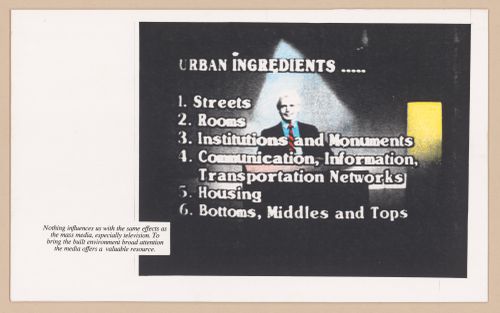
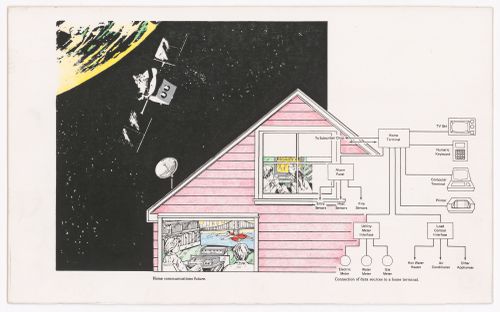
Page bound essay, "The Positive and Negative Influences of Electronic Systems on Architecture", 8 1/2" x 14", April 1983; summary presented at international conference in Warsaw, Poland, spring 1983; essay published as "Enjoying Electronic Mannerisms" in the journal CRIT, Fall 1984, pp. 14-18, as part of a special issue on "The Next Architecture" by Aaron Betsky; essay also published as "Sony Walkman-Adorned Teleriders Moving Through Cable Networks of Computerized Cottage Land, Under the Skies of Overcrowded Orbital Slots: Enjoying Electronic Mannerisms", The Fifth Column, Vo. 5, winter 1984 (Montreal); and parts of this project were discussed by Christopher Hume in The Toronto Star, January 19, 1985. Also, five original collage and colour pencil drawings on illustration board, each 8 1/2" x 14" that were the source of illustrations for the bound essay and the subsequent publications.
DR2007:0018:002
Description:
Page bound essay, "The Positive and Negative Influences of Electronic Systems on Architecture", 8 1/2" x 14", April 1983; summary presented at international conference in Warsaw, Poland, spring 1983; essay published as "Enjoying Electronic Mannerisms" in the journal CRIT, Fall 1984, pp. 14-18, as part of a special issue on "The Next Architecture" by Aaron Betsky; essay also published as "Sony Walkman-Adorned Teleriders Moving Through Cable Networks of Computerized Cottage Land, Under the Skies of Overcrowded Orbital Slots: Enjoying Electronic Mannerisms", The Fifth Column, Vo. 5, winter 1984 (Montreal); and parts of this project were discussed by Christopher Hume in The Toronto Star, January 19, 1985. Also, five original collage and colour pencil drawings on illustration board, each 8 1/2" x 14" that were the source of illustrations for the bound essay and the subsequent publications.
People:
Date:
1983
1983
Title:
Untitled work for the essay "The Positive and Negative Influences of Electronic Systems on Architecture"
Actions:
DR2007:0018:002
Description:
Page bound essay, "The Positive and Negative Influences of Electronic Systems on Architecture", 8 1/2" x 14", April 1983; summary presented at international conference in Warsaw, Poland, spring 1983; essay published as "Enjoying Electronic Mannerisms" in the journal CRIT, Fall 1984, pp. 14-18, as part of a special issue on "The Next Architecture" by Aaron Betsky; essay also published as "Sony Walkman-Adorned Teleriders Moving Through Cable Networks of Computerized Cottage Land, Under the Skies of Overcrowded Orbital Slots: Enjoying Electronic Mannerisms", The Fifth Column, Vo. 5, winter 1984 (Montreal); and parts of this project were discussed by Christopher Hume in The Toronto Star, January 19, 1985. Also, five original collage and colour pencil drawings on illustration board, each 8 1/2" x 14" that were the source of illustrations for the bound essay and the subsequent publications.
Untitled work for the essay "The Positive and Negative Influences of Electronic Systems on Architecture"
Actions:
DR2007:0018:002
Description:
Page bound essay, "The Positive and Negative Influences of Electronic Systems on Architecture", 8 1/2" x 14", April 1983; summary presented at international conference in Warsaw, Poland, spring 1983; essay published as "Enjoying Electronic Mannerisms" in the journal CRIT, Fall 1984, pp. 14-18, as part of a special issue on "The Next Architecture" by Aaron Betsky; essay also published as "Sony Walkman-Adorned Teleriders Moving Through Cable Networks of Computerized Cottage Land, Under the Skies of Overcrowded Orbital Slots: Enjoying Electronic Mannerisms", The Fifth Column, Vo. 5, winter 1984 (Montreal); and parts of this project were discussed by Christopher Hume in The Toronto Star, January 19, 1985. Also, five original collage and colour pencil drawings on illustration board, each 8 1/2" x 14" that were the source of illustrations for the bound essay and the subsequent publications.
Form:
drawings
drawings
Date:
1983
1983
People:
Form:
drawings
drawings
Actions:
Reference number:
DR2007:0018:003
Description:
Page bound essay, "The Positive and Negative Influences of Electronic Systems on Architecture", 8 1/2" x 14", April 1983; summary presented at international conference in Warsaw, Poland, spring 1983; essay published as "Enjoying Electronic Mannerisms" in the journal CRIT, Fall 1984, pp. 14-18, as part of a special issue on "The Next Architecture" by Aaron Betsky; essay also published as "Sony Walkman-Adorned Teleriders Moving Through Cable Networks of Computerized Cottage Land, Under the Skies of Overcrowded Orbital Slots: Enjoying Electronic Mannerisms", The Fifth Column, Vo. 5, winter 1984 (Montreal); and parts of this project were discussed by Christopher Hume in The Toronto Star, January 19, 1985. Also, five original collage and colour pencil drawings on illustration board, each 8 1/2" x 14" that were the source of illustrations for the bound essay and the subsequent publications.
DR2007:0018:003
Description:
Page bound essay, "The Positive and Negative Influences of Electronic Systems on Architecture", 8 1/2" x 14", April 1983; summary presented at international conference in Warsaw, Poland, spring 1983; essay published as "Enjoying Electronic Mannerisms" in the journal CRIT, Fall 1984, pp. 14-18, as part of a special issue on "The Next Architecture" by Aaron Betsky; essay also published as "Sony Walkman-Adorned Teleriders Moving Through Cable Networks of Computerized Cottage Land, Under the Skies of Overcrowded Orbital Slots: Enjoying Electronic Mannerisms", The Fifth Column, Vo. 5, winter 1984 (Montreal); and parts of this project were discussed by Christopher Hume in The Toronto Star, January 19, 1985. Also, five original collage and colour pencil drawings on illustration board, each 8 1/2" x 14" that were the source of illustrations for the bound essay and the subsequent publications.
People:
Date:
1983
1983
Title:
Untitled work for the essay "The Positive and Negative Influences of Electronic Systems on Architecture"
Actions:
DR2007:0018:003
Description:
Page bound essay, "The Positive and Negative Influences of Electronic Systems on Architecture", 8 1/2" x 14", April 1983; summary presented at international conference in Warsaw, Poland, spring 1983; essay published as "Enjoying Electronic Mannerisms" in the journal CRIT, Fall 1984, pp. 14-18, as part of a special issue on "The Next Architecture" by Aaron Betsky; essay also published as "Sony Walkman-Adorned Teleriders Moving Through Cable Networks of Computerized Cottage Land, Under the Skies of Overcrowded Orbital Slots: Enjoying Electronic Mannerisms", The Fifth Column, Vo. 5, winter 1984 (Montreal); and parts of this project were discussed by Christopher Hume in The Toronto Star, January 19, 1985. Also, five original collage and colour pencil drawings on illustration board, each 8 1/2" x 14" that were the source of illustrations for the bound essay and the subsequent publications.
Untitled work for the essay "The Positive and Negative Influences of Electronic Systems on Architecture"
Actions:
DR2007:0018:003
Description:
Page bound essay, "The Positive and Negative Influences of Electronic Systems on Architecture", 8 1/2" x 14", April 1983; summary presented at international conference in Warsaw, Poland, spring 1983; essay published as "Enjoying Electronic Mannerisms" in the journal CRIT, Fall 1984, pp. 14-18, as part of a special issue on "The Next Architecture" by Aaron Betsky; essay also published as "Sony Walkman-Adorned Teleriders Moving Through Cable Networks of Computerized Cottage Land, Under the Skies of Overcrowded Orbital Slots: Enjoying Electronic Mannerisms", The Fifth Column, Vo. 5, winter 1984 (Montreal); and parts of this project were discussed by Christopher Hume in The Toronto Star, January 19, 1985. Also, five original collage and colour pencil drawings on illustration board, each 8 1/2" x 14" that were the source of illustrations for the bound essay and the subsequent publications.
Form:
drawings
drawings
Date:
1983
1983
People:
Form:
textual records
textual records
Actions:
Reference number:
DR2007:0018
Description:
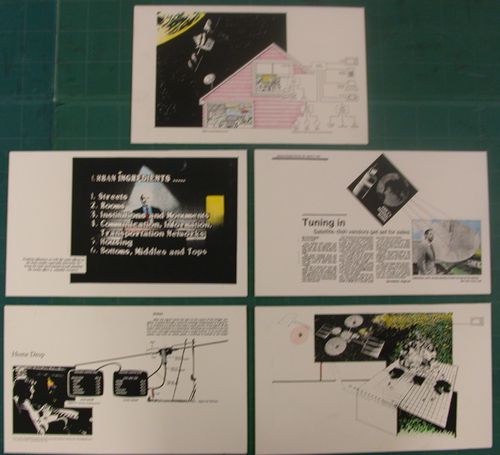
35-page bound essay, "The Positive and Negative Influences of Electronic Systems on Architecture", 8 1/2" x 14", April 1983; summary presented at international conference in Warsaw, Poland, spring 1983; essay published as "Enjoying Electronic Mannerisms" in the journal CRIT, Fall 1984, pp. 14-18, as part of a special issue on "The Next Architecture" by Aaron Betsky; essay also published as "Sony Walkman-Adorned Teleriders Moving Through Cable Networks of Computerized Cottage Land, Under the Skies of Overcrowded Orbital Slots: Enjoying Electronic Mannerisms", The Fifth Column, Vo. 5, winter 1984 (Montreal); and parts of this project were discussed by Christopher Hume in The Toronto Star, January 19, 1985. Also, five original collage and colour pencil drawings on illustration board, each 8 1/2" x 14" that were the source of illustrations for the bound essay and the subsequent publications.
DR2007:0018
Description:
35-page bound essay, "The Positive and Negative Influences of Electronic Systems on Architecture", 8 1/2" x 14", April 1983; summary presented at international conference in Warsaw, Poland, spring 1983; essay published as "Enjoying Electronic Mannerisms" in the journal CRIT, Fall 1984, pp. 14-18, as part of a special issue on "The Next Architecture" by Aaron Betsky; essay also published as "Sony Walkman-Adorned Teleriders Moving Through Cable Networks of Computerized Cottage Land, Under the Skies of Overcrowded Orbital Slots: Enjoying Electronic Mannerisms", The Fifth Column, Vo. 5, winter 1984 (Montreal); and parts of this project were discussed by Christopher Hume in The Toronto Star, January 19, 1985. Also, five original collage and colour pencil drawings on illustration board, each 8 1/2" x 14" that were the source of illustrations for the bound essay and the subsequent publications.
People:
Date:
1983
1983
Title:
The Positive and Negative Influences of Electronic Systems on Architecture, 1983
Actions:
DR2007:0018
Description:
35-page bound essay, "The Positive and Negative Influences of Electronic Systems on Architecture", 8 1/2" x 14", April 1983; summary presented at international conference in Warsaw, Poland, spring 1983; essay published as "Enjoying Electronic Mannerisms" in the journal CRIT, Fall 1984, pp. 14-18, as part of a special issue on "The Next Architecture" by Aaron Betsky; essay also published as "Sony Walkman-Adorned Teleriders Moving Through Cable Networks of Computerized Cottage Land, Under the Skies of Overcrowded Orbital Slots: Enjoying Electronic Mannerisms", The Fifth Column, Vo. 5, winter 1984 (Montreal); and parts of this project were discussed by Christopher Hume in The Toronto Star, January 19, 1985. Also, five original collage and colour pencil drawings on illustration board, each 8 1/2" x 14" that were the source of illustrations for the bound essay and the subsequent publications.
The Positive and Negative Influences of Electronic Systems on Architecture, 1983
Actions:
DR2007:0018
Description:
35-page bound essay, "The Positive and Negative Influences of Electronic Systems on Architecture", 8 1/2" x 14", April 1983; summary presented at international conference in Warsaw, Poland, spring 1983; essay published as "Enjoying Electronic Mannerisms" in the journal CRIT, Fall 1984, pp. 14-18, as part of a special issue on "The Next Architecture" by Aaron Betsky; essay also published as "Sony Walkman-Adorned Teleriders Moving Through Cable Networks of Computerized Cottage Land, Under the Skies of Overcrowded Orbital Slots: Enjoying Electronic Mannerisms", The Fifth Column, Vo. 5, winter 1984 (Montreal); and parts of this project were discussed by Christopher Hume in The Toronto Star, January 19, 1985. Also, five original collage and colour pencil drawings on illustration board, each 8 1/2" x 14" that were the source of illustrations for the bound essay and the subsequent publications.
Form:
textual records
textual records
Date:
1983
1983
People:
Level of archival description:
Project
Project
Title:
House X
House X
Reference number:
AP143.S4.D20
Description:
File documents an unexecuted project for House X, designed for Mr. and Mrs. Arnold Aronoff for a 40-acre site on Lahser Road, Bloomfield Hills, Michigan. The ground floor consists of a kitchen, dining room, breakfast room, laundry room, two powder rooms and two garages. The second floor consists of a master suite with study, two bedrooms, bathroom, family and living rooms, bar, bathhouse and deck. The third floor consists of a solarium, terrace, bedroom and maid's room with bathroom. A swimming pool, tennis court and gatehouse are situated on the grounds. Thirteen schemes were developed for this project: A, A1, B, C, C1, C2, D, E, E1, E2, F, G, H. Only schemes G and H were developed into detailed floor plans. The drawings have been organized by drawing type, because of the subtle variations which characterize each scheme. Eisenman manipulates the four "els" (fragmentary forms - the three-sided portion of a hollow cube - that he introduced in House X to replace the cube, the preferred generating volume of his first five houses) in over 200 conceptual drawings (DR1994:0138:001-0219). There are numerous design development and complete sets of working drawings (design development drawings: DR1994:0138:239-541; working drawings: DR1994:0138:1182-1457). The project was extensively published, and the file includes a number of drawings and models created for exhibition and publication, including photographs of models (DR1994:0138:1481-1501), pieces of the "axonometric model" constructed after the project had been abandoned (DR1994:0138:1458-1476), and coloured paper cut-outs for collages (cut-outs, DR1994:0138:0929-0933 and DR1994:0138:1477-1480; collage: DR1994:0138:0928). The file also includes drawings and reprographic copies for the following projects: a residence for Mr. and Mrs. Aronoff,designed by Irving E. Palmquist, (DR1994:0138:1512-1521); Bernstein House, Mamaroneck, New York, designed by John Hejduk (DR1994:0138:1524-1531); Maison Domino by Le Corbusier (DR1994:0138:0944-0965); and land subdivision and houses for Arnold Aronoff, designed by Eisenman (DR1994:0138:0434-0441). Material in this file was produced between 1960 and 1977. File contains conceptual drawings, design development drawings, photographic materials, presentation drawings, presentation panels, publication drawings, record drawings, schematic drawings, a study model, textual records, and working drawings.
AP143.S4.D20
Description:
File documents an unexecuted project for House X, designed for Mr. and Mrs. Arnold Aronoff for a 40-acre site on Lahser Road, Bloomfield Hills, Michigan. The ground floor consists of a kitchen, dining room, breakfast room, laundry room, two powder rooms and two garages. The second floor consists of a master suite with study, two bedrooms, bathroom, family and living rooms, bar, bathhouse and deck. The third floor consists of a solarium, terrace, bedroom and maid's room with bathroom. A swimming pool, tennis court and gatehouse are situated on the grounds. Thirteen schemes were developed for this project: A, A1, B, C, C1, C2, D, E, E1, E2, F, G, H. Only schemes G and H were developed into detailed floor plans. The drawings have been organized by drawing type, because of the subtle variations which characterize each scheme. Eisenman manipulates the four "els" (fragmentary forms - the three-sided portion of a hollow cube - that he introduced in House X to replace the cube, the preferred generating volume of his first five houses) in over 200 conceptual drawings (DR1994:0138:001-0219). There are numerous design development and complete sets of working drawings (design development drawings: DR1994:0138:239-541; working drawings: DR1994:0138:1182-1457). The project was extensively published, and the file includes a number of drawings and models created for exhibition and publication, including photographs of models (DR1994:0138:1481-1501), pieces of the "axonometric model" constructed after the project had been abandoned (DR1994:0138:1458-1476), and coloured paper cut-outs for collages (cut-outs, DR1994:0138:0929-0933 and DR1994:0138:1477-1480; collage: DR1994:0138:0928). The file also includes drawings and reprographic copies for the following projects: a residence for Mr. and Mrs. Aronoff,designed by Irving E. Palmquist, (DR1994:0138:1512-1521); Bernstein House, Mamaroneck, New York, designed by John Hejduk (DR1994:0138:1524-1531); Maison Domino by Le Corbusier (DR1994:0138:0944-0965); and land subdivision and houses for Arnold Aronoff, designed by Eisenman (DR1994:0138:0434-0441). Material in this file was produced between 1960 and 1977. File contains conceptual drawings, design development drawings, photographic materials, presentation drawings, presentation panels, publication drawings, record drawings, schematic drawings, a study model, textual records, and working drawings.
People:
Date:
1960-1977
1960-1977
Title:
House X
Actions:
AP143.S4.D20
Description:
File documents an unexecuted project for House X, designed for Mr. and Mrs. Arnold Aronoff for a 40-acre site on Lahser Road, Bloomfield Hills, Michigan. The ground floor consists of a kitchen, dining room, breakfast room, laundry room, two powder rooms and two garages. The second floor consists of a master suite with study, two bedrooms, bathroom, family and living rooms, bar, bathhouse and deck. The third floor consists of a solarium, terrace, bedroom and maid's room with bathroom. A swimming pool, tennis court and gatehouse are situated on the grounds. Thirteen schemes were developed for this project: A, A1, B, C, C1, C2, D, E, E1, E2, F, G, H. Only schemes G and H were developed into detailed floor plans. The drawings have been organized by drawing type, because of the subtle variations which characterize each scheme. Eisenman manipulates the four "els" (fragmentary forms - the three-sided portion of a hollow cube - that he introduced in House X to replace the cube, the preferred generating volume of his first five houses) in over 200 conceptual drawings (DR1994:0138:001-0219). There are numerous design development and complete sets of working drawings (design development drawings: DR1994:0138:239-541; working drawings: DR1994:0138:1182-1457). The project was extensively published, and the file includes a number of drawings and models created for exhibition and publication, including photographs of models (DR1994:0138:1481-1501), pieces of the "axonometric model" constructed after the project had been abandoned (DR1994:0138:1458-1476), and coloured paper cut-outs for collages (cut-outs, DR1994:0138:0929-0933 and DR1994:0138:1477-1480; collage: DR1994:0138:0928). The file also includes drawings and reprographic copies for the following projects: a residence for Mr. and Mrs. Aronoff,designed by Irving E. Palmquist, (DR1994:0138:1512-1521); Bernstein House, Mamaroneck, New York, designed by John Hejduk (DR1994:0138:1524-1531); Maison Domino by Le Corbusier (DR1994:0138:0944-0965); and land subdivision and houses for Arnold Aronoff, designed by Eisenman (DR1994:0138:0434-0441). Material in this file was produced between 1960 and 1977. File contains conceptual drawings, design development drawings, photographic materials, presentation drawings, presentation panels, publication drawings, record drawings, schematic drawings, a study model, textual records, and working drawings.
House X
Actions:
AP143.S4.D20
Description:
File documents an unexecuted project for House X, designed for Mr. and Mrs. Arnold Aronoff for a 40-acre site on Lahser Road, Bloomfield Hills, Michigan. The ground floor consists of a kitchen, dining room, breakfast room, laundry room, two powder rooms and two garages. The second floor consists of a master suite with study, two bedrooms, bathroom, family and living rooms, bar, bathhouse and deck. The third floor consists of a solarium, terrace, bedroom and maid's room with bathroom. A swimming pool, tennis court and gatehouse are situated on the grounds. Thirteen schemes were developed for this project: A, A1, B, C, C1, C2, D, E, E1, E2, F, G, H. Only schemes G and H were developed into detailed floor plans. The drawings have been organized by drawing type, because of the subtle variations which characterize each scheme. Eisenman manipulates the four "els" (fragmentary forms - the three-sided portion of a hollow cube - that he introduced in House X to replace the cube, the preferred generating volume of his first five houses) in over 200 conceptual drawings (DR1994:0138:001-0219). There are numerous design development and complete sets of working drawings (design development drawings: DR1994:0138:239-541; working drawings: DR1994:0138:1182-1457). The project was extensively published, and the file includes a number of drawings and models created for exhibition and publication, including photographs of models (DR1994:0138:1481-1501), pieces of the "axonometric model" constructed after the project had been abandoned (DR1994:0138:1458-1476), and coloured paper cut-outs for collages (cut-outs, DR1994:0138:0929-0933 and DR1994:0138:1477-1480; collage: DR1994:0138:0928). The file also includes drawings and reprographic copies for the following projects: a residence for Mr. and Mrs. Aronoff,designed by Irving E. Palmquist, (DR1994:0138:1512-1521); Bernstein House, Mamaroneck, New York, designed by John Hejduk (DR1994:0138:1524-1531); Maison Domino by Le Corbusier (DR1994:0138:0944-0965); and land subdivision and houses for Arnold Aronoff, designed by Eisenman (DR1994:0138:0434-0441). Material in this file was produced between 1960 and 1977. File contains conceptual drawings, design development drawings, photographic materials, presentation drawings, presentation panels, publication drawings, record drawings, schematic drawings, a study model, textual records, and working drawings.
Level of archival description:
File 20
File 20
Date:
1960-1977
1960-1977
People:


