


3141 Results
Form:
textual records
textual records
Actions:
Reference number:
AP197.S3.003
Description:
The box is comprised of correspondence for the years of 1991-1994, organized in alphabetical order by last name, from A-K. The box documents Frampton’s career as Ware professor at the Graduate School of Architecture, Planning and Preservation, Columbia University and his related professional activities. Correspondence in this box includes: offers of teaching positions; requests to write articles, reviews, books and recommendation letters; invitations to teach, present, or attend at lectures/symposiums/conferences; and requests to serve on juries. Throughout this period, Frampton corresponded with architects, professors, publishers, and editors of various publications such as: Botond Bognar; Norman Foster; Yukio Futagawa; Gevork Hartoonian; and the commissioning editor of Phaidon Press Limited, David Jenkins. Correspondence relates to Kenneth Frampton’s involvement/participation in the publication of Hopkins: The Work of Michael Hopkins and Partners; as a lecturer at the Association of Collegiate Schools of Architecture (ASCA) Conference, the Berlage Institute and the École polytechnique fédérale de Lausanne; and as a jury member for the Carlsberg Architectural Prize.
AP197.S3.003
Description:
The box is comprised of correspondence for the years of 1991-1994, organized in alphabetical order by last name, from A-K. The box documents Frampton’s career as Ware professor at the Graduate School of Architecture, Planning and Preservation, Columbia University and his related professional activities. Correspondence in this box includes: offers of teaching positions; requests to write articles, reviews, books and recommendation letters; invitations to teach, present, or attend at lectures/symposiums/conferences; and requests to serve on juries. Throughout this period, Frampton corresponded with architects, professors, publishers, and editors of various publications such as: Botond Bognar; Norman Foster; Yukio Futagawa; Gevork Hartoonian; and the commissioning editor of Phaidon Press Limited, David Jenkins. Correspondence relates to Kenneth Frampton’s involvement/participation in the publication of Hopkins: The Work of Michael Hopkins and Partners; as a lecturer at the Association of Collegiate Schools of Architecture (ASCA) Conference, the Berlage Institute and the École polytechnique fédérale de Lausanne; and as a jury member for the Carlsberg Architectural Prize.
People:
Date:
1991-1994
1991-1994
Title:
Personal and professional correspondence for names A-K from 1991-1994
Actions:
AP197.S3.003
Description:
The box is comprised of correspondence for the years of 1991-1994, organized in alphabetical order by last name, from A-K. The box documents Frampton’s career as Ware professor at the Graduate School of Architecture, Planning and Preservation, Columbia University and his related professional activities. Correspondence in this box includes: offers of teaching positions; requests to write articles, reviews, books and recommendation letters; invitations to teach, present, or attend at lectures/symposiums/conferences; and requests to serve on juries. Throughout this period, Frampton corresponded with architects, professors, publishers, and editors of various publications such as: Botond Bognar; Norman Foster; Yukio Futagawa; Gevork Hartoonian; and the commissioning editor of Phaidon Press Limited, David Jenkins. Correspondence relates to Kenneth Frampton’s involvement/participation in the publication of Hopkins: The Work of Michael Hopkins and Partners; as a lecturer at the Association of Collegiate Schools of Architecture (ASCA) Conference, the Berlage Institute and the École polytechnique fédérale de Lausanne; and as a jury member for the Carlsberg Architectural Prize.
Personal and professional correspondence for names A-K from 1991-1994
Actions:
AP197.S3.003
Description:
The box is comprised of correspondence for the years of 1991-1994, organized in alphabetical order by last name, from A-K. The box documents Frampton’s career as Ware professor at the Graduate School of Architecture, Planning and Preservation, Columbia University and his related professional activities. Correspondence in this box includes: offers of teaching positions; requests to write articles, reviews, books and recommendation letters; invitations to teach, present, or attend at lectures/symposiums/conferences; and requests to serve on juries. Throughout this period, Frampton corresponded with architects, professors, publishers, and editors of various publications such as: Botond Bognar; Norman Foster; Yukio Futagawa; Gevork Hartoonian; and the commissioning editor of Phaidon Press Limited, David Jenkins. Correspondence relates to Kenneth Frampton’s involvement/participation in the publication of Hopkins: The Work of Michael Hopkins and Partners; as a lecturer at the Association of Collegiate Schools of Architecture (ASCA) Conference, the Berlage Institute and the École polytechnique fédérale de Lausanne; and as a jury member for the Carlsberg Architectural Prize.
Form:
textual records
textual records
Date:
1991-1994
1991-1994
People:
Form:
textual records
textual records
Actions:
Reference number:
AP197.S3.005
Description:
The box is comprised of correspondence for the years of 1991-1994, organized in alphabetical order by last name, from U-Z. The last four folders in this box comprises of loose correspondence organized in chronological order, from 1991-1994; this correspondence is not organized in alphabetical order. The box documents Frampton’s career as Ware professor at the Graduate School of Architecture, Planning and Preservation, Columbia University and his related professional activities. Correspondence in this box includes: offers of teaching positions; requests to write articles, reviews, books and recommendation letters; invitations to teach, present, or attend at lectures/symposiums/conferences; and requests to serve on juries. Correspondence relates to Frampton’s participation/involvement in: the “Architecture and legitimacy” conference at the Congress Netherlands Architecture Institute; as part of the International Board of Advisors for the Fundación de Arquitectura Tapatía; in the Chinese translation for the Studies in Tectonic Culture publication; as a visiting professor at the École polytechnique fédérale de Lausanne.
AP197.S3.005
Description:
The box is comprised of correspondence for the years of 1991-1994, organized in alphabetical order by last name, from U-Z. The last four folders in this box comprises of loose correspondence organized in chronological order, from 1991-1994; this correspondence is not organized in alphabetical order. The box documents Frampton’s career as Ware professor at the Graduate School of Architecture, Planning and Preservation, Columbia University and his related professional activities. Correspondence in this box includes: offers of teaching positions; requests to write articles, reviews, books and recommendation letters; invitations to teach, present, or attend at lectures/symposiums/conferences; and requests to serve on juries. Correspondence relates to Frampton’s participation/involvement in: the “Architecture and legitimacy” conference at the Congress Netherlands Architecture Institute; as part of the International Board of Advisors for the Fundación de Arquitectura Tapatía; in the Chinese translation for the Studies in Tectonic Culture publication; as a visiting professor at the École polytechnique fédérale de Lausanne.
People:
Date:
1991-1994
1991-1994
Title:
Personal and professional correspondence for names U-Z from 1991-1994
Actions:
AP197.S3.005
Description:
The box is comprised of correspondence for the years of 1991-1994, organized in alphabetical order by last name, from U-Z. The last four folders in this box comprises of loose correspondence organized in chronological order, from 1991-1994; this correspondence is not organized in alphabetical order. The box documents Frampton’s career as Ware professor at the Graduate School of Architecture, Planning and Preservation, Columbia University and his related professional activities. Correspondence in this box includes: offers of teaching positions; requests to write articles, reviews, books and recommendation letters; invitations to teach, present, or attend at lectures/symposiums/conferences; and requests to serve on juries. Correspondence relates to Frampton’s participation/involvement in: the “Architecture and legitimacy” conference at the Congress Netherlands Architecture Institute; as part of the International Board of Advisors for the Fundación de Arquitectura Tapatía; in the Chinese translation for the Studies in Tectonic Culture publication; as a visiting professor at the École polytechnique fédérale de Lausanne.
Personal and professional correspondence for names U-Z from 1991-1994
Actions:
AP197.S3.005
Description:
The box is comprised of correspondence for the years of 1991-1994, organized in alphabetical order by last name, from U-Z. The last four folders in this box comprises of loose correspondence organized in chronological order, from 1991-1994; this correspondence is not organized in alphabetical order. The box documents Frampton’s career as Ware professor at the Graduate School of Architecture, Planning and Preservation, Columbia University and his related professional activities. Correspondence in this box includes: offers of teaching positions; requests to write articles, reviews, books and recommendation letters; invitations to teach, present, or attend at lectures/symposiums/conferences; and requests to serve on juries. Correspondence relates to Frampton’s participation/involvement in: the “Architecture and legitimacy” conference at the Congress Netherlands Architecture Institute; as part of the International Board of Advisors for the Fundación de Arquitectura Tapatía; in the Chinese translation for the Studies in Tectonic Culture publication; as a visiting professor at the École polytechnique fédérale de Lausanne.
Form:
textual records
textual records
Date:
1991-1994
1991-1994
People:
Form:
textual records
textual records
Actions:
Reference number:
AP197.S3.007
Description:
The box is comprised of correspondence for the years of 1997-1998, organized in chronological order. The box documents Frampton’s career as Ware professor at the Graduate School of Architecture, Planning and Preservation, Columbia University and his related professional activities. Correspondence in this box includes: offers of teaching positions; requests to write articles, reviews, books and recommendation letters; invitations to teach, present, or attend at lectures/symposiums/conferences; and requests to serve on juries. Throughout this period, Frampton corresponded with various architects, professors, publishers, and editors of various publications such as: the Berlage Institute; the Finnish Association of Architect; Università della Svizzera italiana; Kisho Kurakawa; Tadao Ando; Mario Botta; Aurelio Galfetti; the Barragan Foundation; and Steven Holl. Correspondence relating to the following projects can be found in this box: editor of Technology, Place and Architecture: The Jerusalem Seminar in Architecture; and the General Editor of the publication World Architecture: a Critical Mosaic 1900-2000 Vols: 1-10.
AP197.S3.007
Description:
The box is comprised of correspondence for the years of 1997-1998, organized in chronological order. The box documents Frampton’s career as Ware professor at the Graduate School of Architecture, Planning and Preservation, Columbia University and his related professional activities. Correspondence in this box includes: offers of teaching positions; requests to write articles, reviews, books and recommendation letters; invitations to teach, present, or attend at lectures/symposiums/conferences; and requests to serve on juries. Throughout this period, Frampton corresponded with various architects, professors, publishers, and editors of various publications such as: the Berlage Institute; the Finnish Association of Architect; Università della Svizzera italiana; Kisho Kurakawa; Tadao Ando; Mario Botta; Aurelio Galfetti; the Barragan Foundation; and Steven Holl. Correspondence relating to the following projects can be found in this box: editor of Technology, Place and Architecture: The Jerusalem Seminar in Architecture; and the General Editor of the publication World Architecture: a Critical Mosaic 1900-2000 Vols: 1-10.
People:
Date:
1997-1998
1997-1998
Title:
Personal and professional correspondence from 1997-1998
Actions:
AP197.S3.007
Description:
The box is comprised of correspondence for the years of 1997-1998, organized in chronological order. The box documents Frampton’s career as Ware professor at the Graduate School of Architecture, Planning and Preservation, Columbia University and his related professional activities. Correspondence in this box includes: offers of teaching positions; requests to write articles, reviews, books and recommendation letters; invitations to teach, present, or attend at lectures/symposiums/conferences; and requests to serve on juries. Throughout this period, Frampton corresponded with various architects, professors, publishers, and editors of various publications such as: the Berlage Institute; the Finnish Association of Architect; Università della Svizzera italiana; Kisho Kurakawa; Tadao Ando; Mario Botta; Aurelio Galfetti; the Barragan Foundation; and Steven Holl. Correspondence relating to the following projects can be found in this box: editor of Technology, Place and Architecture: The Jerusalem Seminar in Architecture; and the General Editor of the publication World Architecture: a Critical Mosaic 1900-2000 Vols: 1-10.
Personal and professional correspondence from 1997-1998
Actions:
AP197.S3.007
Description:
The box is comprised of correspondence for the years of 1997-1998, organized in chronological order. The box documents Frampton’s career as Ware professor at the Graduate School of Architecture, Planning and Preservation, Columbia University and his related professional activities. Correspondence in this box includes: offers of teaching positions; requests to write articles, reviews, books and recommendation letters; invitations to teach, present, or attend at lectures/symposiums/conferences; and requests to serve on juries. Throughout this period, Frampton corresponded with various architects, professors, publishers, and editors of various publications such as: the Berlage Institute; the Finnish Association of Architect; Università della Svizzera italiana; Kisho Kurakawa; Tadao Ando; Mario Botta; Aurelio Galfetti; the Barragan Foundation; and Steven Holl. Correspondence relating to the following projects can be found in this box: editor of Technology, Place and Architecture: The Jerusalem Seminar in Architecture; and the General Editor of the publication World Architecture: a Critical Mosaic 1900-2000 Vols: 1-10.
Form:
textual records
textual records
Date:
1997-1998
1997-1998
People:
Form:
events
events
Actions:
Description:
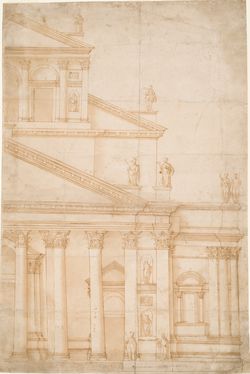
The history of architecture addresses the relationships between spaces, buildings, urban geometries, and social practices—it tells us how an experience of space corresponds to an experience of the world. To this end, this lecture will analyze the sixteenth-century debate around the completion of the facade of the Basilica of San Petronio in Bologna, partially built in the(...)
The history of architecture addresses the relationships between spaces, buildings, urban geometries, and social practices—it tells us how an experience of space corresponds to an experience of the world. To this end, this lecture will analyze the sixteenth-century debate around the completion of the facade of the Basilica of San Petronio in Bologna, partially built in the(...)
Location:
Paul Desmarais Theatre Keyword(s):
Guido Beltramini, church of San Petronio, Bologna, Andrea Palladio, Baldassare Peruzzi, Giacomo da Vignola
Paul Desmarais Theatre Keyword(s):
Guido Beltramini, church of San Petronio, Bologna, Andrea Palladio, Baldassare Peruzzi, Giacomo da Vignola
Date:
5 October 2017, 6:30pm
5 October 2017, 6:30pm
Title:
Guido Beltramini, what was history for patrons and architects in Bologna in 1579?
Actions:
Description:
The history of architecture addresses the relationships between spaces, buildings, urban geometries, and social practices—it tells us how an experience of space corresponds to an experience of the world. To this end, this lecture will analyze the sixteenth-century debate around the completion of the facade of the Basilica of San Petronio in Bologna, partially built in the(...)
Guido Beltramini, what was history for patrons and architects in Bologna in 1579?
Actions:
Description:
The history of architecture addresses the relationships between spaces, buildings, urban geometries, and social practices—it tells us how an experience of space corresponds to an experience of the world. To this end, this lecture will analyze the sixteenth-century debate around the completion of the facade of the Basilica of San Petronio in Bologna, partially built in the(...)
Form:
events
events
Date:
5 October 2017
6:30pm
5 October 2017
6:30pm
Location:
Paul Desmarais Theatre Keyword(s):
Guido Beltramini, church of San Petronio, Bologna, Andrea Palladio, Baldassare Peruzzi, Giacomo da Vignola
Paul Desmarais Theatre Keyword(s):
Guido Beltramini, church of San Petronio, Bologna, Andrea Palladio, Baldassare Peruzzi, Giacomo da Vignola
Form:
textual records
textual records
![Letter from Andy [Grundberg] to Gordon Matta-Clark and Carol Goodden](/img-collection/XaiBXjFngaQ-TacA5IqbFFLbDYk=/500x791/378667.jpg)
Actions:
Reference number:
PHCON2002:0016:002:032
Description:
Letter is dated 19 January. Year unknown. Letter Thanks them for the "Book of Walls".
PHCON2002:0016:002:032
Description:
Letter is dated 19 January. Year unknown. Letter Thanks them for the "Book of Walls".
People:
Date:
1973
1973
Title:
Letter from Andy [Grundberg] to Gordon Matta-Clark and Carol Goodden
Actions:
PHCON2002:0016:002:032
Description:
Letter is dated 19 January. Year unknown. Letter Thanks them for the "Book of Walls".
Letter from Andy [Grundberg] to Gordon Matta-Clark and Carol Goodden
Actions:
PHCON2002:0016:002:032
Description:
Letter is dated 19 January. Year unknown. Letter Thanks them for the "Book of Walls".
Form:
textual records
textual records
Date:
1973
1973
People:
Form:
textual records
textual records
Actions:
Reference number:
DR1995:0235:014
Description:
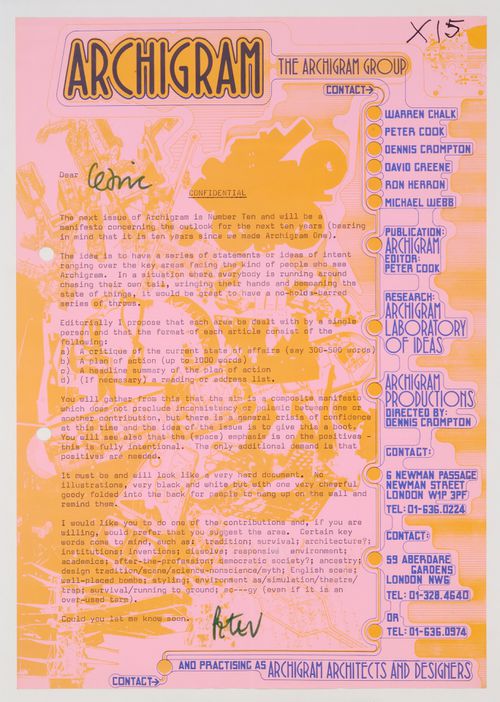
a letter on Archigram letterhead
DR1995:0235:014
Description:
a letter on Archigram letterhead
People:
Date:
ca. 1971
ca. 1971
Title:
Letter from Peter Cook inviting Cedric Price to contribute to Archigram Ten
Actions:
DR1995:0235:014
Description:
a letter on Archigram letterhead
Letter from Peter Cook inviting Cedric Price to contribute to Archigram Ten
Actions:
DR1995:0235:014
Description:
a letter on Archigram letterhead
Form:
textual records
textual records
Date:
ca. 1971
ca. 1971
People:
Form:
textual records
textual records
Actions:
Reference number:
AP197.S3.010
Description:
The box is comprised of correspondence for the year 2001. The box documents Frampton’s career as Ware professor at the Graduate School of Architecture, Planning and Preservation, Columbia University and his related professional activities. Correspondence in this box includes: offers of teaching positions; requests to write articles, reviews, books and recommendation letters; invitations to teach, present, or attend at lectures/symposiums/conferences; and requests to serve on juries. Throughout this period, Frampton corresponded with various universities, architects, professors, publishers, and editors of various publications such as: Yale University; Université de Montréal; Patkau Architects; Tadao Ando; Manuel de Sola-Morales; the Royal Institute of British Architects; ArquitecturaViva; Maki and Associates; and Kisho Kurakawa. Included in this box is correspondence with Oscar Niemeyer and Alvaro Siza in relation to the Michael Blackwood production on both these architects; correspondence about the Aga Khan Award; correspondence about writing an introduction essay to the publication Tadao Ando Light & Water; and correspondence about Frampton’s trip and itinerary to Japan and to meet with Tadao Ando.
AP197.S3.010
Description:
The box is comprised of correspondence for the year 2001. The box documents Frampton’s career as Ware professor at the Graduate School of Architecture, Planning and Preservation, Columbia University and his related professional activities. Correspondence in this box includes: offers of teaching positions; requests to write articles, reviews, books and recommendation letters; invitations to teach, present, or attend at lectures/symposiums/conferences; and requests to serve on juries. Throughout this period, Frampton corresponded with various universities, architects, professors, publishers, and editors of various publications such as: Yale University; Université de Montréal; Patkau Architects; Tadao Ando; Manuel de Sola-Morales; the Royal Institute of British Architects; ArquitecturaViva; Maki and Associates; and Kisho Kurakawa. Included in this box is correspondence with Oscar Niemeyer and Alvaro Siza in relation to the Michael Blackwood production on both these architects; correspondence about the Aga Khan Award; correspondence about writing an introduction essay to the publication Tadao Ando Light & Water; and correspondence about Frampton’s trip and itinerary to Japan and to meet with Tadao Ando.
People:
Date:
2001
2001
Title:
Personal and professional correspondence from 2001
Actions:
AP197.S3.010
Description:
The box is comprised of correspondence for the year 2001. The box documents Frampton’s career as Ware professor at the Graduate School of Architecture, Planning and Preservation, Columbia University and his related professional activities. Correspondence in this box includes: offers of teaching positions; requests to write articles, reviews, books and recommendation letters; invitations to teach, present, or attend at lectures/symposiums/conferences; and requests to serve on juries. Throughout this period, Frampton corresponded with various universities, architects, professors, publishers, and editors of various publications such as: Yale University; Université de Montréal; Patkau Architects; Tadao Ando; Manuel de Sola-Morales; the Royal Institute of British Architects; ArquitecturaViva; Maki and Associates; and Kisho Kurakawa. Included in this box is correspondence with Oscar Niemeyer and Alvaro Siza in relation to the Michael Blackwood production on both these architects; correspondence about the Aga Khan Award; correspondence about writing an introduction essay to the publication Tadao Ando Light & Water; and correspondence about Frampton’s trip and itinerary to Japan and to meet with Tadao Ando.
Personal and professional correspondence from 2001
Actions:
AP197.S3.010
Description:
The box is comprised of correspondence for the year 2001. The box documents Frampton’s career as Ware professor at the Graduate School of Architecture, Planning and Preservation, Columbia University and his related professional activities. Correspondence in this box includes: offers of teaching positions; requests to write articles, reviews, books and recommendation letters; invitations to teach, present, or attend at lectures/symposiums/conferences; and requests to serve on juries. Throughout this period, Frampton corresponded with various universities, architects, professors, publishers, and editors of various publications such as: Yale University; Université de Montréal; Patkau Architects; Tadao Ando; Manuel de Sola-Morales; the Royal Institute of British Architects; ArquitecturaViva; Maki and Associates; and Kisho Kurakawa. Included in this box is correspondence with Oscar Niemeyer and Alvaro Siza in relation to the Michael Blackwood production on both these architects; correspondence about the Aga Khan Award; correspondence about writing an introduction essay to the publication Tadao Ando Light & Water; and correspondence about Frampton’s trip and itinerary to Japan and to meet with Tadao Ando.
Form:
textual records
textual records
Date:
2001
2001
People:
Form:
textual records
textual records
Title:
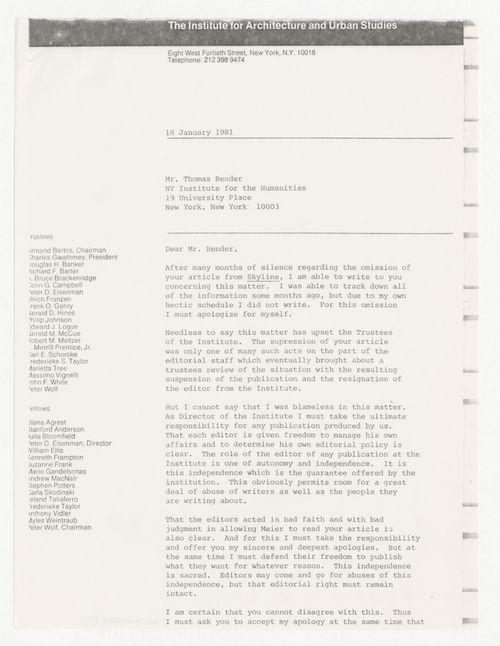
Letter from Peter D. Eisenman to Thomas Bender about retraction of Bender's article from Skyline
Letter from Peter D. Eisenman to Thomas Bender about retraction of Bender's article from Skyline
Actions:
Reference number:
ARCH401683
Description:
Related to ARCH401682 (draft letter from Peter D. Eisenman to Thomas Bender about retraction of Bender's letter from Skyline)
ARCH401683
Description:
Related to ARCH401682 (draft letter from Peter D. Eisenman to Thomas Bender about retraction of Bender's letter from Skyline)
People:
Date:
18 January 1981
18 January 1981
Title:
Letter from Peter D. Eisenman to Thomas Bender about retraction of Bender's article from Skyline
Actions:
ARCH401683
Description:
Related to ARCH401682 (draft letter from Peter D. Eisenman to Thomas Bender about retraction of Bender's letter from Skyline)
Letter from Peter D. Eisenman to Thomas Bender about retraction of Bender's article from Skyline
Actions:
ARCH401683
Description:
Related to ARCH401682 (draft letter from Peter D. Eisenman to Thomas Bender about retraction of Bender's letter from Skyline)
Form:
textual records
textual records
Date:
18 January 1981
18 January 1981
People:
Form:
textual records
textual records
Actions:
Reference number:
AP197.S3.002
Description:
This box is comprised of personal and professional correspondence, organized in chronological order, from 1984-1990. The box documents Frampton’s career as Ware professor at the Graduate School of Architecture, Planning and Preservation at Columbia University and his related professional activities. Correspondence in this box includes: various offers of teaching positions; requests to write articles, reviews, books and recommendation letters; invitations to teach, attend or present at lectures/symposiums/conferences; and requests to serve on juries such as the American Academy in Rome. Throughout this period, Frampton corresponded with architects, professors, publishers, and editors of various publications such as: Ignasi de Sola-Morales Rubio; Tadao Ando; Rafael Moneo; James Stirling; Marco Frascari; Alvaro Siza; Arata Isozaki; the Casabella; the Progressive Architecture; and Architecture and Urbanism. This correspondence includes Frampton’s invitation to be the Craig Francis Cullinan Visiting Lecturer at the School of Architecture, Rice University; correspondence with Rizzoli International Publications about the Tadao Ando book; correspondence with MIT Press for the Studies in Tectonic Culture publication; and correspondence about critical regionalism.
AP197.S3.002
Description:
This box is comprised of personal and professional correspondence, organized in chronological order, from 1984-1990. The box documents Frampton’s career as Ware professor at the Graduate School of Architecture, Planning and Preservation at Columbia University and his related professional activities. Correspondence in this box includes: various offers of teaching positions; requests to write articles, reviews, books and recommendation letters; invitations to teach, attend or present at lectures/symposiums/conferences; and requests to serve on juries such as the American Academy in Rome. Throughout this period, Frampton corresponded with architects, professors, publishers, and editors of various publications such as: Ignasi de Sola-Morales Rubio; Tadao Ando; Rafael Moneo; James Stirling; Marco Frascari; Alvaro Siza; Arata Isozaki; the Casabella; the Progressive Architecture; and Architecture and Urbanism. This correspondence includes Frampton’s invitation to be the Craig Francis Cullinan Visiting Lecturer at the School of Architecture, Rice University; correspondence with Rizzoli International Publications about the Tadao Ando book; correspondence with MIT Press for the Studies in Tectonic Culture publication; and correspondence about critical regionalism.
People:
Date:
1984-1990
1984-1990
Title:
Personal and professional correspondence from 1984-1990
Actions:
AP197.S3.002
Description:
This box is comprised of personal and professional correspondence, organized in chronological order, from 1984-1990. The box documents Frampton’s career as Ware professor at the Graduate School of Architecture, Planning and Preservation at Columbia University and his related professional activities. Correspondence in this box includes: various offers of teaching positions; requests to write articles, reviews, books and recommendation letters; invitations to teach, attend or present at lectures/symposiums/conferences; and requests to serve on juries such as the American Academy in Rome. Throughout this period, Frampton corresponded with architects, professors, publishers, and editors of various publications such as: Ignasi de Sola-Morales Rubio; Tadao Ando; Rafael Moneo; James Stirling; Marco Frascari; Alvaro Siza; Arata Isozaki; the Casabella; the Progressive Architecture; and Architecture and Urbanism. This correspondence includes Frampton’s invitation to be the Craig Francis Cullinan Visiting Lecturer at the School of Architecture, Rice University; correspondence with Rizzoli International Publications about the Tadao Ando book; correspondence with MIT Press for the Studies in Tectonic Culture publication; and correspondence about critical regionalism.
Personal and professional correspondence from 1984-1990
Actions:
AP197.S3.002
Description:
This box is comprised of personal and professional correspondence, organized in chronological order, from 1984-1990. The box documents Frampton’s career as Ware professor at the Graduate School of Architecture, Planning and Preservation at Columbia University and his related professional activities. Correspondence in this box includes: various offers of teaching positions; requests to write articles, reviews, books and recommendation letters; invitations to teach, attend or present at lectures/symposiums/conferences; and requests to serve on juries such as the American Academy in Rome. Throughout this period, Frampton corresponded with architects, professors, publishers, and editors of various publications such as: Ignasi de Sola-Morales Rubio; Tadao Ando; Rafael Moneo; James Stirling; Marco Frascari; Alvaro Siza; Arata Isozaki; the Casabella; the Progressive Architecture; and Architecture and Urbanism. This correspondence includes Frampton’s invitation to be the Craig Francis Cullinan Visiting Lecturer at the School of Architecture, Rice University; correspondence with Rizzoli International Publications about the Tadao Ando book; correspondence with MIT Press for the Studies in Tectonic Culture publication; and correspondence about critical regionalism.
Form:
textual records
textual records
Date:
1984-1990
1984-1990
People:
Form:
drawings
drawings
Actions:
Reference number:
AP140.S2.SS1.D43.P6.5
Description:
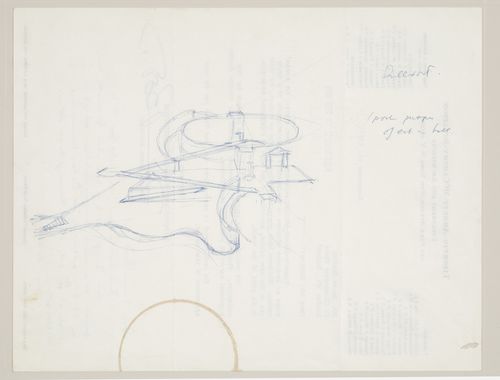
perspective drawing on verso of a letter from Francis Booth, architect, to James Stirling. Letter is dated 15 September 1975
AP140.S2.SS1.D43.P6.5
Description:
perspective drawing on verso of a letter from Francis Booth, architect, to James Stirling. Letter is dated 15 September 1975
People:
Date:
1975
1975
Title:
Nordrhein-Westfalen Museum, Dusseldorf, Germany: sketch perspective
Actions:
AP140.S2.SS1.D43.P6.5
Description:
perspective drawing on verso of a letter from Francis Booth, architect, to James Stirling. Letter is dated 15 September 1975
Nordrhein-Westfalen Museum, Dusseldorf, Germany: sketch perspective
Actions:
AP140.S2.SS1.D43.P6.5
Description:
perspective drawing on verso of a letter from Francis Booth, architect, to James Stirling. Letter is dated 15 September 1975
Form:
drawings
drawings
Date:
1975
1975
People:


