


461 Results
Form:
books
books
Title:
Concrete island / a novel
Concrete island / a novel
Actions:
Price:
$15.00
(available to order)
Summary:
On a day in April, just after three o'clock in the afternoon, Robert Maitland's car crashes over the concrete parapet of a high-speed highway onto the island below, where he is injured and, finally, trapped. What begins as an almost ludicrous predicament soon turns into horror as Maitland—a wickedly modern Robinson Crusoe—realizes that, despite evidence of other(...)
$15.00
(available to order)
Summary:
On a day in April, just after three o'clock in the afternoon, Robert Maitland's car crashes over the concrete parapet of a high-speed highway onto the island below, where he is injured and, finally, trapped. What begins as an almost ludicrous predicament soon turns into horror as Maitland—a wickedly modern Robinson Crusoe—realizes that, despite evidence of other(...)
Title:
Concrete island / a novel
Actions:
Price:
$15.00
(available to order)
Summary:
On a day in April, just after three o'clock in the afternoon, Robert Maitland's car crashes over the concrete parapet of a high-speed highway onto the island below, where he is injured and, finally, trapped. What begins as an almost ludicrous predicament soon turns into horror as Maitland—a wickedly modern Robinson Crusoe—realizes that, despite evidence of other inhabitants, this doomed terrain has become a mirror of his own mind. Seeking the dark outer rim of the everyday, Ballard weaves private catastrophe into an intensely specular allegory.
Concrete island / a novel
Actions:
Price:
$15.00
(available to order)
Summary:
On a day in April, just after three o'clock in the afternoon, Robert Maitland's car crashes over the concrete parapet of a high-speed highway onto the island below, where he is injured and, finally, trapped. What begins as an almost ludicrous predicament soon turns into horror as Maitland—a wickedly modern Robinson Crusoe—realizes that, despite evidence of other inhabitants, this doomed terrain has become a mirror of his own mind. Seeking the dark outer rim of the everyday, Ballard weaves private catastrophe into an intensely specular allegory.
Form:
books
books
Publication:
January 1900
January 1900
Subject:
Urban Theory
Urban Theory
Form:
books
books
Actions:
Price:
$24.95
(available to order)
Summary:
Stroll celebrates Toronto's details at the speed of walking and, in so doing, helps us to better get to know its many neighbourhoods, taking us from well-known spots like the CN Tower and Pearson Airport to the overlooked corners of Scarborough and all the way to the end of the Leslie Street Spit in Lake Ontario. Features thirty-two walks, a flâneur manifesto, a foreword(...)
$24.95
(available to order)
Summary:
Stroll celebrates Toronto's details at the speed of walking and, in so doing, helps us to better get to know its many neighbourhoods, taking us from well-known spots like the CN Tower and Pearson Airport to the overlooked corners of Scarborough and all the way to the end of the Leslie Street Spit in Lake Ontario. Features thirty-two walks, a flâneur manifesto, a foreword(...)
Title:
Stroll: Psychogeographic walking tours of Toronto
Actions:
Price:
$24.95
(available to order)
Summary:
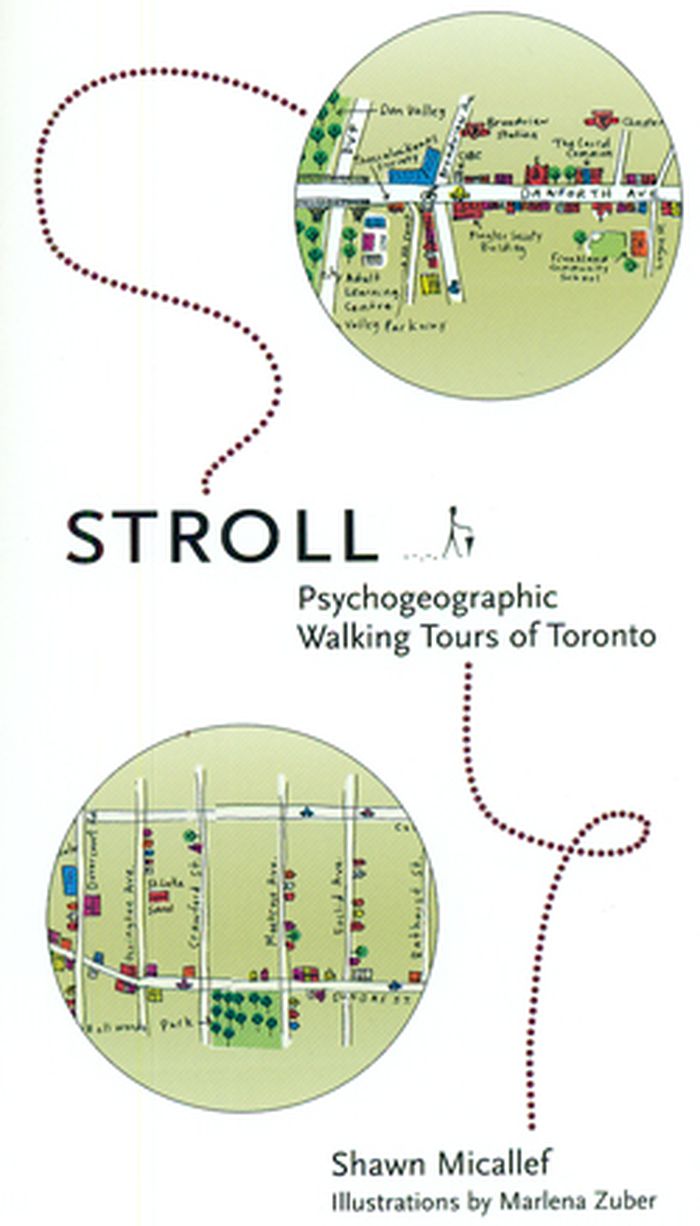
Stroll celebrates Toronto's details at the speed of walking and, in so doing, helps us to better get to know its many neighbourhoods, taking us from well-known spots like the CN Tower and Pearson Airport to the overlooked corners of Scarborough and all the way to the end of the Leslie Street Spit in Lake Ontario. Features thirty-two walks, a flâneur manifesto, a foreword by architecture critic John Bentley Mays, dozens of hand-drawn maps by Marlena Zuber and a full-colour fold-out orientation map of Toronto.
Stroll: Psychogeographic walking tours of Toronto
Actions:
Price:
$24.95
(available to order)
Summary:
Stroll celebrates Toronto's details at the speed of walking and, in so doing, helps us to better get to know its many neighbourhoods, taking us from well-known spots like the CN Tower and Pearson Airport to the overlooked corners of Scarborough and all the way to the end of the Leslie Street Spit in Lake Ontario. Features thirty-two walks, a flâneur manifesto, a foreword by architecture critic John Bentley Mays, dozens of hand-drawn maps by Marlena Zuber and a full-colour fold-out orientation map of Toronto.
Form:
books
books
Publication:
May 2010
May 2010
Subject:
Architecture in Canada
Architecture in Canada
Form:
books
books
Actions:
Price:
$60.00
(available to order)
Summary:
This publication brings together texts on the various art forms that have combined sound and image. The full spectrum of audiovisual art and phenomena is addressed in 35 dictionary entries, and in-depth essays treat overarching aesthetic issues, while individual works--including projects by John Cage and Chicks on Speed--are represented in audiovisual documentation and(...)
$60.00
(available to order)
Summary:
This publication brings together texts on the various art forms that have combined sound and image. The full spectrum of audiovisual art and phenomena is addressed in 35 dictionary entries, and in-depth essays treat overarching aesthetic issues, while individual works--including projects by John Cage and Chicks on Speed--are represented in audiovisual documentation and(...)
Title:
Audiovisuology compendium: see this sound
Actions:
Price:
$60.00
(available to order)
Summary:
This publication brings together texts on the various art forms that have combined sound and image. The full spectrum of audiovisual art and phenomena is addressed in 35 dictionary entries, and in-depth essays treat overarching aesthetic issues, while individual works--including projects by John Cage and Chicks on Speed--are represented in audiovisual documentation and scientific comment. The list of definitions and terms elucidated by various prominent authors includes gesamtkunstwerk, music theatre, animation film, light shows, music videos, sound art, expanded cinema, text-image analogies, synchronization, electronic transformation and software.
Audiovisuology compendium: see this sound
Actions:
Price:
$60.00
(available to order)
Summary:
This publication brings together texts on the various art forms that have combined sound and image. The full spectrum of audiovisual art and phenomena is addressed in 35 dictionary entries, and in-depth essays treat overarching aesthetic issues, while individual works--including projects by John Cage and Chicks on Speed--are represented in audiovisual documentation and scientific comment. The list of definitions and terms elucidated by various prominent authors includes gesamtkunstwerk, music theatre, animation film, light shows, music videos, sound art, expanded cinema, text-image analogies, synchronization, electronic transformation and software.
Form:
books
books
Publication:
July 2010
July 2010
Subject:
Acoustics
Acoustics
Form:
books
books
Title:
Residential towers
Residential towers
Actions:
Price:
$139.95
(available to order)
Summary:
As population growth and urbanization pick up speed worldwide, the need for high-rise, high-density residential architecture is becoming ever more acute. As Residential Towers shows, this branch of architecture is ready for that demand, with creative approaches to meeting the social and architectural challenges inherent in housing a large number of people in a small(...)
$139.95
(available to order)
Summary:
As population growth and urbanization pick up speed worldwide, the need for high-rise, high-density residential architecture is becoming ever more acute. As Residential Towers shows, this branch of architecture is ready for that demand, with creative approaches to meeting the social and architectural challenges inherent in housing a large number of people in a small(...)
Subject:
Collective Housing
Collective Housing
Publication:
November 2015
November 2015
Title:
Residential towers
Actions:
Price:
$139.95
(available to order)
Summary:
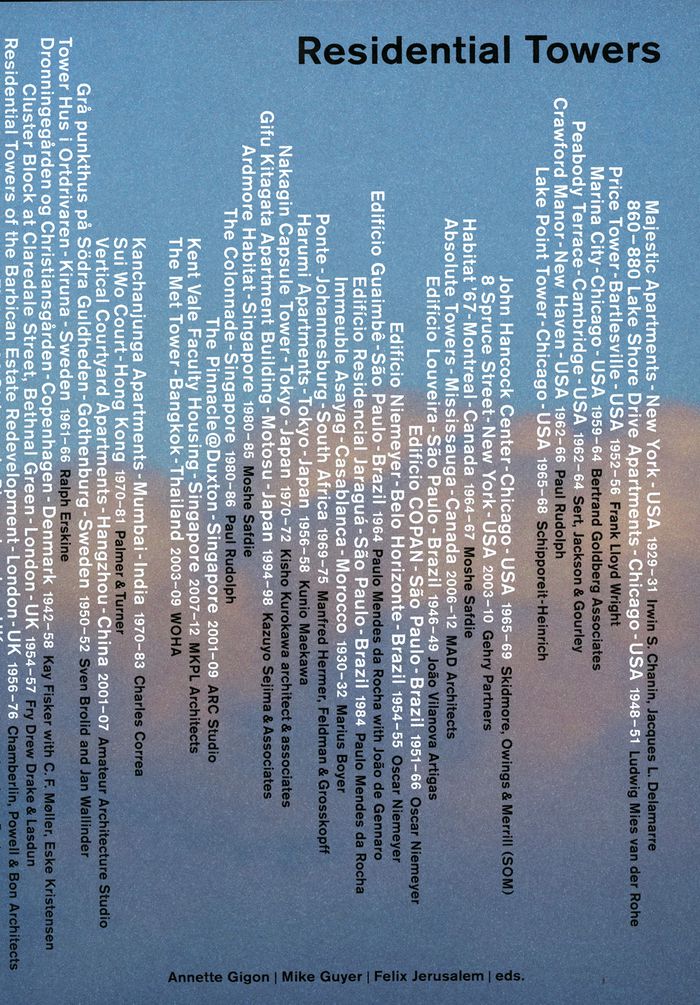
As population growth and urbanization pick up speed worldwide, the need for high-rise, high-density residential architecture is becoming ever more acute. As Residential Towers shows, this branch of architecture is ready for that demand, with creative approaches to meeting the social and architectural challenges inherent in housing a large number of people in a small amount of ground space. Taking readers to cities on five continents, the book presents analyses of eighty architecturally significant tower blocks in a way that makes it possible to compare approaches and see the effects of innovations.
Residential towers
Actions:
Price:
$139.95
(available to order)
Summary:
As population growth and urbanization pick up speed worldwide, the need for high-rise, high-density residential architecture is becoming ever more acute. As Residential Towers shows, this branch of architecture is ready for that demand, with creative approaches to meeting the social and architectural challenges inherent in housing a large number of people in a small amount of ground space. Taking readers to cities on five continents, the book presents analyses of eighty architecturally significant tower blocks in a way that makes it possible to compare approaches and see the effects of innovations.
Form:
books
books
Publication:
November 2015
November 2015
Subject:
Collective Housing
Collective Housing
Form:
books
books
Actions:
Price:
$28.95
(available to order)
Summary:
Sarah Sharma conducted ethnographic research among individuals whose jobs or avocations involve a persistent focus on time: taxi drivers, frequent-flyer business travelers, corporate yoga instructors, devotees of the slow-food and slow-living movements. Based on that research, she develops the concept of "power-chronography" to make visible the entangled and uneven(...)
$28.95
(available to order)
Summary:
Sarah Sharma conducted ethnographic research among individuals whose jobs or avocations involve a persistent focus on time: taxi drivers, frequent-flyer business travelers, corporate yoga instructors, devotees of the slow-food and slow-living movements. Based on that research, she develops the concept of "power-chronography" to make visible the entangled and uneven(...)
Title:
In the meantime: temporality and cultural politics
Actions:
Price:
$28.95
(available to order)
Summary:
Sarah Sharma conducted ethnographic research among individuals whose jobs or avocations involve a persistent focus on time: taxi drivers, frequent-flyer business travelers, corporate yoga instructors, devotees of the slow-food and slow-living movements. Based on that research, she develops the concept of "power-chronography" to make visible the entangled and uneven politics of temporality. Focusing on how people's different relationships to labor configures their experience of time, she argues that both "speed-up" and "slow-down" often function as a form of biopolitical social control necessary to contemporary global capitalism.
In the meantime: temporality and cultural politics
Actions:
Price:
$28.95
(available to order)
Summary:
Sarah Sharma conducted ethnographic research among individuals whose jobs or avocations involve a persistent focus on time: taxi drivers, frequent-flyer business travelers, corporate yoga instructors, devotees of the slow-food and slow-living movements. Based on that research, she develops the concept of "power-chronography" to make visible the entangled and uneven politics of temporality. Focusing on how people's different relationships to labor configures their experience of time, she argues that both "speed-up" and "slow-down" often function as a form of biopolitical social control necessary to contemporary global capitalism.
Form:
books
books
Publication:
February 2014
February 2014
Subject:
Critical Theory
Critical Theory
Form:
books
books
Actions:
Price:
$36.95
(available in store)
Summary:
Aluminum shaped the twentieth century. It enabled high-speed travel and gravity-defying flight. It was the material of a streamlined aesthetic that came to represent modernity. And it became an essential ingredient in industrial and domestic products that ranged from airplanes and cars to designer chairs and artificial Christmas trees. It entered modern homes as(...)
$36.95
(available in store)
Summary:
Aluminum shaped the twentieth century. It enabled high-speed travel and gravity-defying flight. It was the material of a streamlined aesthetic that came to represent modernity. And it became an essential ingredient in industrial and domestic products that ranged from airplanes and cars to designer chairs and artificial Christmas trees. It entered modern homes as(...)
Title:
Aluminium dreams: the making of light modernity
Actions:
Price:
$36.95
(available in store)
Summary:
Aluminum shaped the twentieth century. It enabled high-speed travel and gravity-defying flight. It was the material of a streamlined aesthetic that came to represent modernity. And it became an essential ingredient in industrial and domestic products that ranged from airplanes and cars to designer chairs and artificial Christmas trees. It entered modern homes as packaging, foil, pots and pans and even infiltrated our bodies through food, medicine, and cosmetics. In Aluminum Dreams, Mimi Sheller describes how the materiality and meaning of aluminum transformed modern life and continues to shape the world today.
Aluminium dreams: the making of light modernity
Actions:
Price:
$36.95
(available in store)
Summary:
Aluminum shaped the twentieth century. It enabled high-speed travel and gravity-defying flight. It was the material of a streamlined aesthetic that came to represent modernity. And it became an essential ingredient in industrial and domestic products that ranged from airplanes and cars to designer chairs and artificial Christmas trees. It entered modern homes as packaging, foil, pots and pans and even infiltrated our bodies through food, medicine, and cosmetics. In Aluminum Dreams, Mimi Sheller describes how the materiality and meaning of aluminum transformed modern life and continues to shape the world today.
Form:
books
books
Publication:
March 2014
March 2014
Subject:
Architectural Theory
Architectural Theory
Form:
books
books
Price:
$10.00
(available in store)
Summary:
Le Merle est une publication semi-annuelle qui rassemble des textes et des oeuvres qui ont en commun de jalonner le politique et la formation du Sujet à travers l'art, l'écrit et les pratiques d'exposition. Cette édition du Merle inclut L’anarchisme: ce qu’il signifie réellement (aujourd’hui: un texte de Emma Goldman révisé et abrégé par Heather Davis, La géométrie du(...)
$10.00
(available in store)
Summary:
Le Merle est une publication semi-annuelle qui rassemble des textes et des oeuvres qui ont en commun de jalonner le politique et la formation du Sujet à travers l'art, l'écrit et les pratiques d'exposition. Cette édition du Merle inclut L’anarchisme: ce qu’il signifie réellement (aujourd’hui: un texte de Emma Goldman révisé et abrégé par Heather Davis, La géométrie du(...)
Title:
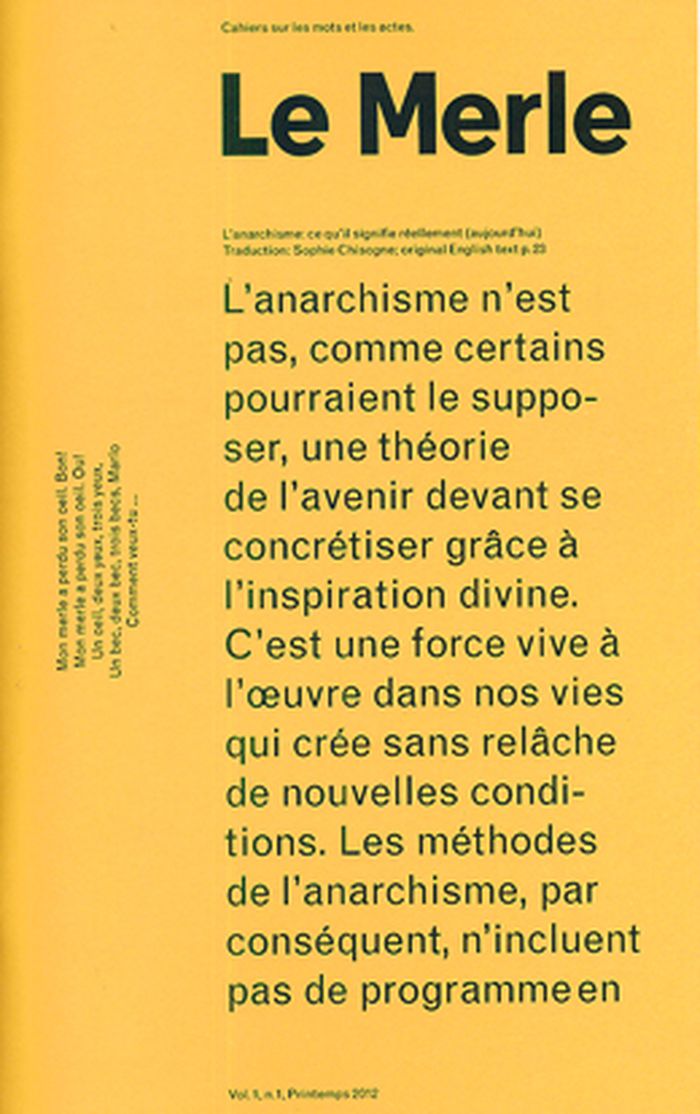
Le Merle: cahiers sur les mots et les actes Vol. 1, n. 1, Printemps 2012
Actions:
Price:
$10.00
(available in store)
Summary:
Le Merle est une publication semi-annuelle qui rassemble des textes et des oeuvres qui ont en commun de jalonner le politique et la formation du Sujet à travers l'art, l'écrit et les pratiques d'exposition. Cette édition du Merle inclut L’anarchisme: ce qu’il signifie réellement (aujourd’hui: un texte de Emma Goldman révisé et abrégé par Heather Davis, La géométrie du hasard par Richard Ibghy & Marilou Lemmens, En entrevue: Le temps de l’oeuvre, le temps de l’acte: Entretien avec Bernard Aspe par Érik Bordeleau, Our Literal Speed par Abbey Shaine Dubin (en anglais), un projet inédit de Simon Brown, Institutional Critique Flair Button* de Charles Gute ainsi qu'un texte de Érik Bordeleau produit dans le cadre de Zoo 2011: Se faire une âme anonyme: Itinéraire pratique. Le Merle is a semiannual publication presenting texts and works that share an interest in delineating the political and the formation of the Subject through art, writing and exhibition practices. This issue includes : Anarchism: What It Really Stands For (Today): Edited and abridged by Heather Davis, The Geometry of Chance by Richard Ibghy & Marilou Lemmens, The Time of the Work, the Time of the Act: an interview with Bernard Aspe, a project by Simon Brown, Our Literal Speed by Abbey Shaine Dubin, Institutional Critique Flair Button* by Charles Gute, To Make One's Soul Anonymous: Practical Itinerary by Érik Bordeleau.
Le Merle: cahiers sur les mots et les actes Vol. 1, n. 1, Printemps 2012
Actions:
Price:
$10.00
(available in store)
Summary:
Le Merle est une publication semi-annuelle qui rassemble des textes et des oeuvres qui ont en commun de jalonner le politique et la formation du Sujet à travers l'art, l'écrit et les pratiques d'exposition. Cette édition du Merle inclut L’anarchisme: ce qu’il signifie réellement (aujourd’hui: un texte de Emma Goldman révisé et abrégé par Heather Davis, La géométrie du hasard par Richard Ibghy & Marilou Lemmens, En entrevue: Le temps de l’oeuvre, le temps de l’acte: Entretien avec Bernard Aspe par Érik Bordeleau, Our Literal Speed par Abbey Shaine Dubin (en anglais), un projet inédit de Simon Brown, Institutional Critique Flair Button* de Charles Gute ainsi qu'un texte de Érik Bordeleau produit dans le cadre de Zoo 2011: Se faire une âme anonyme: Itinéraire pratique. Le Merle is a semiannual publication presenting texts and works that share an interest in delineating the political and the formation of the Subject through art, writing and exhibition practices. This issue includes : Anarchism: What It Really Stands For (Today): Edited and abridged by Heather Davis, The Geometry of Chance by Richard Ibghy & Marilou Lemmens, The Time of the Work, the Time of the Act: an interview with Bernard Aspe, a project by Simon Brown, Our Literal Speed by Abbey Shaine Dubin, Institutional Critique Flair Button* by Charles Gute, To Make One's Soul Anonymous: Practical Itinerary by Érik Bordeleau.
Form:
books
books
Publication:
May 2012
May 2012
Form:
journals and magazines
journals and magazines

Title:
Real Review 15
Real Review 15
Actions:
Price:
$22.50
(available in store)
Summary:
It isn’t the representation of violence in the Gaza Strip that is so disturbing; it is the absence of representation. The grief and despair of a child is penetratingly real. The extreme realism of these events has now driven a wedge between our realities, material and social. The scale and speed of this suffering has destroyed our ability to sustain any belief in the(...)
$22.50
(available in store)
Summary:
It isn’t the representation of violence in the Gaza Strip that is so disturbing; it is the absence of representation. The grief and despair of a child is penetratingly real. The extreme realism of these events has now driven a wedge between our realities, material and social. The scale and speed of this suffering has destroyed our ability to sustain any belief in the(...)
Title:
Real Review 15
Actions:
Price:
$22.50
(available in store)
Summary:
It isn’t the representation of violence in the Gaza Strip that is so disturbing; it is the absence of representation. The grief and despair of a child is penetratingly real. The extreme realism of these events has now driven a wedge between our realities, material and social. The scale and speed of this suffering has destroyed our ability to sustain any belief in the symbolic values of “the international community” and “human rights”. We can no longer even pretend these ideas correlate to any form of reality. This issue of Real Review is dedicated to the current mood, the Phantom of Liberty.
Real Review 15
Actions:
Price:
$22.50
(available in store)
Summary:
It isn’t the representation of violence in the Gaza Strip that is so disturbing; it is the absence of representation. The grief and despair of a child is penetratingly real. The extreme realism of these events has now driven a wedge between our realities, material and social. The scale and speed of this suffering has destroyed our ability to sustain any belief in the symbolic values of “the international community” and “human rights”. We can no longer even pretend these ideas correlate to any form of reality. This issue of Real Review is dedicated to the current mood, the Phantom of Liberty.
Form:
journals and magazines
journals and magazines
Publication:
January 2024
January 2024
Subject:
Magazines
Magazines
Form:
books
books
Actions:
Price:
$100.00
(available to order)
Summary:
Luigi Colani has been making biomorphic streamlined products ever since he graduated from the Sorbonne, in 1953, with a degree in aerodynamics. He has designed everything from cameras and watches to cars and motorcycles. His visionary studies for supersonic transit, high-speed trains, aerodynamic sports equipment, eyewear, and just about everything else have dramatically(...)
$100.00
(available to order)
Summary:
Luigi Colani has been making biomorphic streamlined products ever since he graduated from the Sorbonne, in 1953, with a degree in aerodynamics. He has designed everything from cameras and watches to cars and motorcycles. His visionary studies for supersonic transit, high-speed trains, aerodynamic sports equipment, eyewear, and just about everything else have dramatically(...)
Title:
Colani : the art of shaping the future
Actions:
Price:
$100.00
(available to order)
Summary:
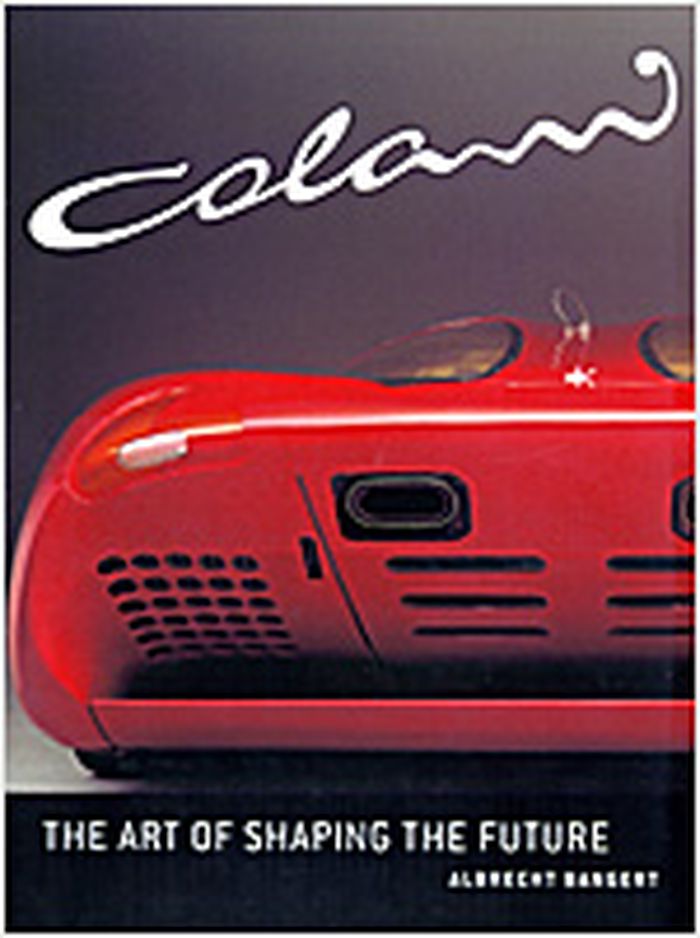
Luigi Colani has been making biomorphic streamlined products ever since he graduated from the Sorbonne, in 1953, with a degree in aerodynamics. He has designed everything from cameras and watches to cars and motorcycles. His visionary studies for supersonic transit, high-speed trains, aerodynamic sports equipment, eyewear, and just about everything else have dramatically altered our designed environment. His design patrons include BMW, Canon, Mazda, NEC, Rosenthal, Sony, VW, and Zeiss. This magnificent volume, beautifully produced with hundreds of drawings and photos, showcases for the first time his wide-ranging oeuvre in the context of international design history.
Colani : the art of shaping the future
Actions:
Price:
$100.00
(available to order)
Summary:
Luigi Colani has been making biomorphic streamlined products ever since he graduated from the Sorbonne, in 1953, with a degree in aerodynamics. He has designed everything from cameras and watches to cars and motorcycles. His visionary studies for supersonic transit, high-speed trains, aerodynamic sports equipment, eyewear, and just about everything else have dramatically altered our designed environment. His design patrons include BMW, Canon, Mazda, NEC, Rosenthal, Sony, VW, and Zeiss. This magnificent volume, beautifully produced with hundreds of drawings and photos, showcases for the first time his wide-ranging oeuvre in the context of international design history.
Form:
books
books
Publication:
September 2005, New York
September 2005, New York
Subject:
Design Monographs
Design Monographs
Form:
books
books
Actions:
Price:
$18.95
(available to order)
Summary:
With increasing intensity, CAAD (Computer Aided Architectural Design) is determining the daily work of today's architectural offices. Computers allow complex designs to be visualised and altered with great speed and accuracy; three-dimensional models can be created with simulation and animation possibilities, and links to the World Wide Web provide access to a flow of(...)
$18.95
(available to order)
Summary:
With increasing intensity, CAAD (Computer Aided Architectural Design) is determining the daily work of today's architectural offices. Computers allow complex designs to be visualised and altered with great speed and accuracy; three-dimensional models can be created with simulation and animation possibilities, and links to the World Wide Web provide access to a flow of(...)
Title:
Information architecture : basis and future of CAAD
Actions:
Price:
$18.95
(available to order)
Summary:
With increasing intensity, CAAD (Computer Aided Architectural Design) is determining the daily work of today's architectural offices. Computers allow complex designs to be visualised and altered with great speed and accuracy; three-dimensional models can be created with simulation and animation possibilities, and links to the World Wide Web provide access to a flow of information. The author develops his thesis that these aspects do not just enable the creative process to be optimised in a quantitative sense but also qualitatively. Alongside the spatial and time dimensions, the new electronic possibilities provide a fifth dimension in architecture.
Information architecture : basis and future of CAAD
Actions:
Price:
$18.95
(available to order)
Summary:
With increasing intensity, CAAD (Computer Aided Architectural Design) is determining the daily work of today's architectural offices. Computers allow complex designs to be visualised and altered with great speed and accuracy; three-dimensional models can be created with simulation and animation possibilities, and links to the World Wide Web provide access to a flow of information. The author develops his thesis that these aspects do not just enable the creative process to be optimised in a quantitative sense but also qualitatively. Alongside the spatial and time dimensions, the new electronic possibilities provide a fifth dimension in architecture.
Form:
books
books
Publication:
October 1999, Basel
October 1999, Basel
Subject:
small format
small format


