


5485 Results
Form:
books
books
Actions:
Holdings:
Description:
412 pages : illustrations (chiefly color) ; 24 cm
Description:
412 pages : illustrations (chiefly color) ; 24 cm
Author:
Subject:
Publication:
Arles : Actes sud ; Paris : Cité de l'architecture et du patrimoine, ©2009.
Arles : Actes sud ; Paris : Cité de l'architecture et du patrimoine, ©2009.
Title:
Habiter écologique : quelles architectures pour une ville durable? / [ouvrage collectif sous la direction de Dominique Gauzin-Müller and others].
Actions:
Holdings:
Description:
412 pages : illustrations (chiefly color) ; 24 cm
Habiter écologique : quelles architectures pour une ville durable? / [ouvrage collectif sous la direction de Dominique Gauzin-Müller and others].
Actions:
Holdings:
Description:
412 pages : illustrations (chiefly color) ; 24 cm
Form:
books
books
Publication:
Arles : Actes sud ; Paris : Cité de l'architecture et du patrimoine, ©2009.
Arles : Actes sud ; Paris : Cité de l'architecture et du patrimoine, ©2009.
Author:
Subject:
Form:
books
books
Actions:
Price:
$31.99
(available to order)
Summary:
Much orthodox economic theory is based on assumptions which are treated as self-evident : supply and demand are regarded as independent entities, the individual is assumed to be a rational agent who knows his interests and how to make decisions corresponding to them, and so on. But one has only to examine an economic transaction closely, as Pierre Bourdieu does here for(...)
$31.99
(available to order)
Summary:
Much orthodox economic theory is based on assumptions which are treated as self-evident : supply and demand are regarded as independent entities, the individual is assumed to be a rational agent who knows his interests and how to make decisions corresponding to them, and so on. But one has only to examine an economic transaction closely, as Pierre Bourdieu does here for(...)
Title:
The social structures of the economy
Actions:
Price:
$31.99
(available to order)
Summary:
Much orthodox economic theory is based on assumptions which are treated as self-evident : supply and demand are regarded as independent entities, the individual is assumed to be a rational agent who knows his interests and how to make decisions corresponding to them, and so on. But one has only to examine an economic transaction closely, as Pierre Bourdieu does here for the buying and selling of houses, to see that these abstract assumptions cannot explain what happens in reality. As Bourdieu shows, the market is constructed by the state, which can decide, for example, whether to promote private housing or collective provision. And the individuals involved in the transaction are immersed in symbolic constructions which constitute, in a strong sense, the value of houses, neighbourhoods and towns. The abstract and illusory nature of the assumptions of orthodox economic theory has been criticised by some economists, but Bourdieu argues that we must go further. Supply, demand, the market and even the buyer and seller are products of a process of social construction, and so-called 'economic' processes can be adequately described only by calling on sociological methods. Instead of seeing the two disciplines in antagonistic terms, it is time to recognize that sociology and economics are in fact part of a single discipline, the object of which is the analysis of social facts, of which economic transactions are in the end merely one aspect.
The social structures of the economy
Actions:
Price:
$31.99
(available to order)
Summary:
Much orthodox economic theory is based on assumptions which are treated as self-evident : supply and demand are regarded as independent entities, the individual is assumed to be a rational agent who knows his interests and how to make decisions corresponding to them, and so on. But one has only to examine an economic transaction closely, as Pierre Bourdieu does here for the buying and selling of houses, to see that these abstract assumptions cannot explain what happens in reality. As Bourdieu shows, the market is constructed by the state, which can decide, for example, whether to promote private housing or collective provision. And the individuals involved in the transaction are immersed in symbolic constructions which constitute, in a strong sense, the value of houses, neighbourhoods and towns. The abstract and illusory nature of the assumptions of orthodox economic theory has been criticised by some economists, but Bourdieu argues that we must go further. Supply, demand, the market and even the buyer and seller are products of a process of social construction, and so-called 'economic' processes can be adequately described only by calling on sociological methods. Instead of seeing the two disciplines in antagonistic terms, it is time to recognize that sociology and economics are in fact part of a single discipline, the object of which is the analysis of social facts, of which economic transactions are in the end merely one aspect.
Form:
books
books
Publication:
January 1900, Cambridge (UK)
January 1900, Cambridge (UK)
Subject:
Critical Theory
Critical Theory
Form:
books
books
Actions:
Price:
$24.95
(available to order)
Summary:
In this new book, Salvatore Settis traces the ways in which we have related to our "classical" past, starting with post-modern American skyscrapers and working his way back through our cultural history to the attitudes of the Greeks and Romans themselves. Settis argues that this obsession with cultural decay, ruins and a "classical" past is specifically European and the(...)
$24.95
(available to order)
Summary:
In this new book, Salvatore Settis traces the ways in which we have related to our "classical" past, starting with post-modern American skyscrapers and working his way back through our cultural history to the attitudes of the Greeks and Romans themselves. Settis argues that this obsession with cultural decay, ruins and a "classical" past is specifically European and the(...)
Subject:
Architectural Theory
Architectural Theory
Publication:
August 2006, Cambridge, Malden (MA)
August 2006, Cambridge, Malden (MA)
Title:
The future of the 'Classical'
Actions:
Price:
$24.95
(available to order)
Summary:
In this new book, Salvatore Settis traces the ways in which we have related to our "classical" past, starting with post-modern American skyscrapers and working his way back through our cultural history to the attitudes of the Greeks and Romans themselves. Settis argues that this obsession with cultural decay, ruins and a "classical" past is specifically European and the product of a collective cultural trauma following the collapse of the Roman Empire. He demonstrates how the idea of the "classical" has changed over the centuries through an unrelenting decay of "classicism" and its equally unrelenting rebirth in an altered form. In the Modern Era this emulation of the "ancients" by the "moderns" was accompanied by new trends: the increasing belief that the former had now been surpassed by the latter, and an increasing preference for the Greek over the Roman. These conflicting interpretations were as much about the future as they were about the past. No civilization can invent itself if it does not have other societies in other times and other places to act as benchmarks. Settis argues that we will be better equipped to mould new generations for the future once we understand that the "classical" is not a dead culture we inherited and for which we can take no credit, but something startling that has to be re-created every day and is a powerful spur to understanding the "other".
The future of the 'Classical'
Actions:
Price:
$24.95
(available to order)
Summary:
In this new book, Salvatore Settis traces the ways in which we have related to our "classical" past, starting with post-modern American skyscrapers and working his way back through our cultural history to the attitudes of the Greeks and Romans themselves. Settis argues that this obsession with cultural decay, ruins and a "classical" past is specifically European and the product of a collective cultural trauma following the collapse of the Roman Empire. He demonstrates how the idea of the "classical" has changed over the centuries through an unrelenting decay of "classicism" and its equally unrelenting rebirth in an altered form. In the Modern Era this emulation of the "ancients" by the "moderns" was accompanied by new trends: the increasing belief that the former had now been surpassed by the latter, and an increasing preference for the Greek over the Roman. These conflicting interpretations were as much about the future as they were about the past. No civilization can invent itself if it does not have other societies in other times and other places to act as benchmarks. Settis argues that we will be better equipped to mould new generations for the future once we understand that the "classical" is not a dead culture we inherited and for which we can take no credit, but something startling that has to be re-created every day and is a powerful spur to understanding the "other".
Form:
books
books
Publication:
August 2006, Cambridge, Malden (MA)
August 2006, Cambridge, Malden (MA)
Subject:
Architectural Theory
Architectural Theory
Form:
books
books
Actions:
Price:
$94.00
(available to order)
Summary:
The art of Anselm Kiefer is rich with references to writers, philosophers, and poets, and his relationship with Paul Celan has been the most complex and intense of these dialogues with the past. Celan's poetry, inextricably linked with the memory of the Holocaust, has haunted Kiefer's work for more than twenty-five years and has influenced him on every level, from the(...)
$94.00
(available to order)
Summary:
The art of Anselm Kiefer is rich with references to writers, philosophers, and poets, and his relationship with Paul Celan has been the most complex and intense of these dialogues with the past. Celan's poetry, inextricably linked with the memory of the Holocaust, has haunted Kiefer's work for more than twenty-five years and has influenced him on every level, from the(...)
Title:
Anselm Kiefer, Paul Celan, Myth, Mourning and Memory
Actions:
Price:
$94.00
(available to order)
Summary:
The art of Anselm Kiefer is rich with references to writers, philosophers, and poets, and his relationship with Paul Celan has been the most complex and intense of these dialogues with the past. Celan's poetry, inextricably linked with the memory of the Holocaust, has haunted Kiefer's work for more than twenty-five years and has influenced him on every level, from the naming of works and exhibitions to the incorporation of symbolic materials from Celan's imagery—sand, straw, hair, and ashes—into his paintings. Like other German artists of his generation, Kiefer began by questioning his own artistic heritage, focusing on the iconographic and mythological elements of German culture that had been taken over by Nazi propaganda, and subsequently repressed and buried deep in the collective unconscious. It was his encounter with Celan's work in the early 1980s that first enabled him to escape from the vicious circle of fascination and disgust at the cultural ties that bound him to the Third Reich, leading him to confront the subject of the Holocaust and Jewish memory as a whole and to embrace this body of traditions within his art. Magnificently illustrated throughout with reproductions of Kiefer's best-known works, this book explores the intricate web of associations between the poet and the painter, a network that is extended to embrace other artistic and literary figures such as Ingeborg Bachmann and Joseph Beuys. 157 illustrations, 140 in color.
Anselm Kiefer, Paul Celan, Myth, Mourning and Memory
Actions:
Price:
$94.00
(available to order)
Summary:
The art of Anselm Kiefer is rich with references to writers, philosophers, and poets, and his relationship with Paul Celan has been the most complex and intense of these dialogues with the past. Celan's poetry, inextricably linked with the memory of the Holocaust, has haunted Kiefer's work for more than twenty-five years and has influenced him on every level, from the naming of works and exhibitions to the incorporation of symbolic materials from Celan's imagery—sand, straw, hair, and ashes—into his paintings. Like other German artists of his generation, Kiefer began by questioning his own artistic heritage, focusing on the iconographic and mythological elements of German culture that had been taken over by Nazi propaganda, and subsequently repressed and buried deep in the collective unconscious. It was his encounter with Celan's work in the early 1980s that first enabled him to escape from the vicious circle of fascination and disgust at the cultural ties that bound him to the Third Reich, leading him to confront the subject of the Holocaust and Jewish memory as a whole and to embrace this body of traditions within his art. Magnificently illustrated throughout with reproductions of Kiefer's best-known works, this book explores the intricate web of associations between the poet and the painter, a network that is extended to embrace other artistic and literary figures such as Ingeborg Bachmann and Joseph Beuys. 157 illustrations, 140 in color.
Form:
books
books
Publication:
August 2007, New York
August 2007, New York
Subject:
Contemporary Art Monographs
Contemporary Art Monographs
Form:
books
books
Actions:
Price:
$97.50
(available to order)
Summary:
In 1919 the Social Democrat city council of Vienna initiated a radical program of reforms designed to reshape the city's infrastructure along socialist lines. The centrepiece and most enduring achievement of "Red" Vienna was the construction of the Wiener (...)
$97.50
(available to order)
Summary:
In 1919 the Social Democrat city council of Vienna initiated a radical program of reforms designed to reshape the city's infrastructure along socialist lines. The centrepiece and most enduring achievement of "Red" Vienna was the construction of the Wiener (...)
Title:
The architecture of red Vienna 1919-1934
Actions:
Price:
$97.50
(available to order)
Summary:
In 1919 the Social Democrat city council of Vienna initiated a radical program of reforms designed to reshape the city's infrastructure along socialist lines. The centrepiece and most enduring achievement of "Red" Vienna was the construction of the Wiener Gemeindebauten, 400 communal housing blocks, distributed throughout the city, in which workers' dwellings were incorporated with kindergartens, libraries, medical clinics, theaters, cooperative stores, and other public facilities. The 64,000 units housed one tenth of the city's population. Throughout this socialist building campaign, however, Austria was ruled by a conservative, clerical, and antisocialist political majority. Thus the architecture of Red Vienna took shape in the midst of highly charged, and often violent, political conflict between left and right. In this book, Eve Blau looks at how that ideological conflict shaped the buildings of Red Vienna--in terms of their programme, spatial conception, language, and use--as well as how political meaning itself is manifested in architecture. She shows how the architecture of Red Vienna constructed meaning in relation to the ideological conflicts that defined Austrian politics in the interwar period--how it was shaped by the conditions of its making, and how it engaged its own codes, practices, and history to stake out a political position in relation to those conditions. Her investigation sheds light both on the complex relationship among political program, architectural practice, and urban history in interwar Vienna, and on the process by which architecture can generate a collective discourse that includes all members of society.
The architecture of red Vienna 1919-1934
Actions:
Price:
$97.50
(available to order)
Summary:
In 1919 the Social Democrat city council of Vienna initiated a radical program of reforms designed to reshape the city's infrastructure along socialist lines. The centrepiece and most enduring achievement of "Red" Vienna was the construction of the Wiener Gemeindebauten, 400 communal housing blocks, distributed throughout the city, in which workers' dwellings were incorporated with kindergartens, libraries, medical clinics, theaters, cooperative stores, and other public facilities. The 64,000 units housed one tenth of the city's population. Throughout this socialist building campaign, however, Austria was ruled by a conservative, clerical, and antisocialist political majority. Thus the architecture of Red Vienna took shape in the midst of highly charged, and often violent, political conflict between left and right. In this book, Eve Blau looks at how that ideological conflict shaped the buildings of Red Vienna--in terms of their programme, spatial conception, language, and use--as well as how political meaning itself is manifested in architecture. She shows how the architecture of Red Vienna constructed meaning in relation to the ideological conflicts that defined Austrian politics in the interwar period--how it was shaped by the conditions of its making, and how it engaged its own codes, practices, and history to stake out a political position in relation to those conditions. Her investigation sheds light both on the complex relationship among political program, architectural practice, and urban history in interwar Vienna, and on the process by which architecture can generate a collective discourse that includes all members of society.
Form:
books
books
Publication:
December 1998, Cambridge, Mass.
December 1998, Cambridge, Mass.
Subject:
Modernism
Modernism
Form:
books
books
Actions:
Price:
$53.95
(available to order)
Summary:
What is it about Times Square that has inspired such attention for well over a century? And how is it that, despite its many changes of character, the place has maintained a unique hold on our collective imagination? In this book, which comes twenty years after her widely acclaimed Times Square Roulette, Lynne Sagalyn masterfully tells the story of profound urban change(...)
$53.95
(available to order)
Summary:
What is it about Times Square that has inspired such attention for well over a century? And how is it that, despite its many changes of character, the place has maintained a unique hold on our collective imagination? In this book, which comes twenty years after her widely acclaimed Times Square Roulette, Lynne Sagalyn masterfully tells the story of profound urban change(...)
Title:
Times Square remade: The dynamics of urban change
Actions:
Price:
$53.95
(available to order)
Summary:
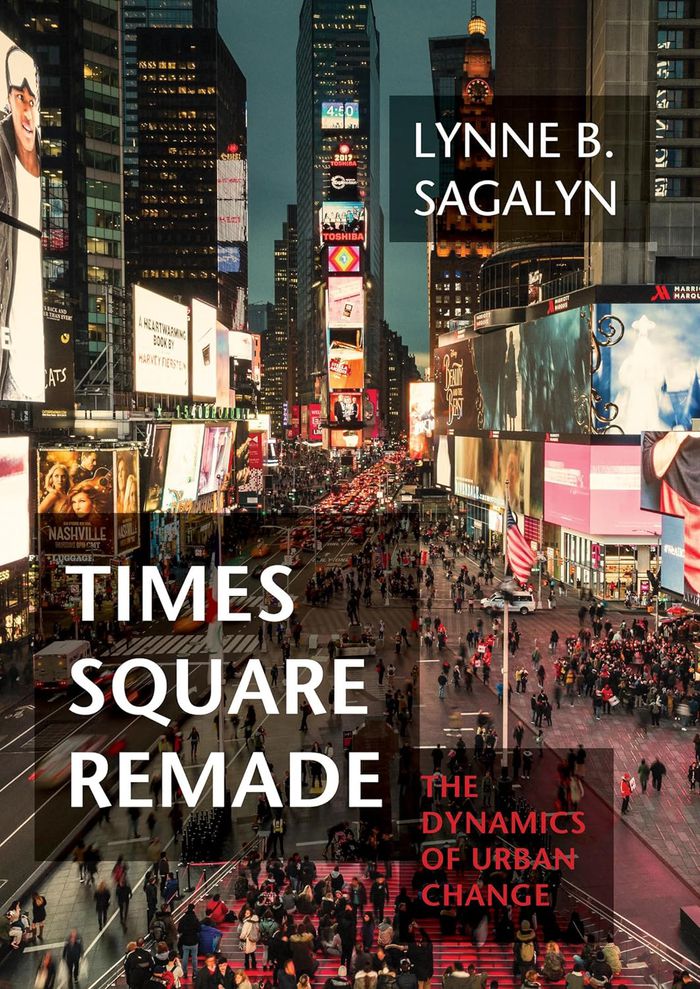
What is it about Times Square that has inspired such attention for well over a century? And how is it that, despite its many changes of character, the place has maintained a unique hold on our collective imagination? In this book, which comes twenty years after her widely acclaimed Times Square Roulette, Lynne Sagalyn masterfully tells the story of profound urban change over decades in the symbolic space that is New York City’s Times Square. Drawing on the history, sociology, and political economy of the place, ''Times Square remade'' examines how the public-private transformation of 42nd Street at Times Square impacted the entertainment district and adjacent neighborhoods, particularly Hell’s Kitchen. Sagalyn chronicles the earliest halcyon days of 42nd Street and Times Square as the nexus of speculation and competitive theater building as well as its darkest days as vice central, and on to the years of aggressive government intervention to cleanse West 42nd Street of pornography and crime. Thematically, the author analyzes the three main forces that have shaped and reshaped Times Square—theater, real estate, and pornography—and explains the politics and economics of what got built and what has been restored or preserved. Accompanied by nearly 160 images, more than half in color, ''Times Square remade'' is a deftly woven narrative of urban transformation that will appeal as much to the general reader and New York City enthusiast as to urbanists, city planners, architects, urban designers, and policymakers.
Times Square remade: The dynamics of urban change
Actions:
Price:
$53.95
(available to order)
Summary:
What is it about Times Square that has inspired such attention for well over a century? And how is it that, despite its many changes of character, the place has maintained a unique hold on our collective imagination? In this book, which comes twenty years after her widely acclaimed Times Square Roulette, Lynne Sagalyn masterfully tells the story of profound urban change over decades in the symbolic space that is New York City’s Times Square. Drawing on the history, sociology, and political economy of the place, ''Times Square remade'' examines how the public-private transformation of 42nd Street at Times Square impacted the entertainment district and adjacent neighborhoods, particularly Hell’s Kitchen. Sagalyn chronicles the earliest halcyon days of 42nd Street and Times Square as the nexus of speculation and competitive theater building as well as its darkest days as vice central, and on to the years of aggressive government intervention to cleanse West 42nd Street of pornography and crime. Thematically, the author analyzes the three main forces that have shaped and reshaped Times Square—theater, real estate, and pornography—and explains the politics and economics of what got built and what has been restored or preserved. Accompanied by nearly 160 images, more than half in color, ''Times Square remade'' is a deftly woven narrative of urban transformation that will appeal as much to the general reader and New York City enthusiast as to urbanists, city planners, architects, urban designers, and policymakers.
Form:
books
books
Publication:
October 2023
October 2023
Subject:
Urban Theory
Urban Theory
Form:
books
books
Actions:
Holdings:
Description:
329 pages, 12 unnumbered pages of plates : illustrations (some color) ; 28 cm
Description:
329 pages, 12 unnumbered pages of plates : illustrations (some color) ; 28 cm
Author:
Subject:
Publication:
Paris : Picard, 1982.
Paris : Picard, 1982.
Title:
Les Gabriel / ouvrage collectif présenté par Michel Gallet et Yves Bottineau.
Actions:
Holdings:
Description:
329 pages, 12 unnumbered pages of plates : illustrations (some color) ; 28 cm
Les Gabriel / ouvrage collectif présenté par Michel Gallet et Yves Bottineau.
Actions:
Holdings:
Description:
329 pages, 12 unnumbered pages of plates : illustrations (some color) ; 28 cm
Form:
books
books
Publication:
Paris : Picard, 1982.
Paris : Picard, 1982.
Author:
Subject:
Form:
books
books
Actions:
Holdings:
Description:
221 pages : illustrations (some color) ; 29 cm
Description:
221 pages : illustrations (some color) ; 29 cm
Author:
Subject:
Publication:
Paris : La Délégation, [1988]
Paris : La Délégation, [1988]
Title:
Trésors d'art sacré à l'ombre du Val-de-Grâce / ouvrage collectif présenté par la Délégation à l'Action artistique de la ville de Paris ; sous la direction de Jacques Charles ; avec le concours de Béatrice de Andia [and others].
Actions:
Holdings:
Description:
221 pages : illustrations (some color) ; 29 cm
Trésors d'art sacré à l'ombre du Val-de-Grâce / ouvrage collectif présenté par la Délégation à l'Action artistique de la ville de Paris ; sous la direction de Jacques Charles ; avec le concours de Béatrice de Andia [and others].
Actions:
Holdings:
Description:
221 pages : illustrations (some color) ; 29 cm
Form:
books
books
Publication:
Paris : La Délégation, [1988]
Paris : La Délégation, [1988]
Author:
Subject:
Form:
books
books
Actions:
Holdings:
Description:
168 p. : ill. ; 27 cm
Description:
168 p. : ill. ; 27 cm
Author:
Subject:
Publication:
Villeneuve d'Ascq : Musée d'art moderne Lille Métropole ; [Paris] : Institut français d'architecture, 2000.
Villeneuve d'Ascq : Musée d'art moderne Lille Métropole ; [Paris] : Institut français d'architecture, 2000.
Title:
Roland Simounet à l'oeuvre : architecture, 1951-1996 / ouvrage collectif sous la direction de Richard Klein.
Actions:
Holdings:
Description:
168 p. : ill. ; 27 cm
Roland Simounet à l'oeuvre : architecture, 1951-1996 / ouvrage collectif sous la direction de Richard Klein.
Actions:
Holdings:
Description:
168 p. : ill. ; 27 cm
Form:
books
books
Publication:
Villeneuve d'Ascq : Musée d'art moderne Lille Métropole ; [Paris] : Institut français d'architecture, 2000.
Villeneuve d'Ascq : Musée d'art moderne Lille Métropole ; [Paris] : Institut français d'architecture, 2000.
Author:
Subject:
Form:
books
books

Actions:
Price:
$62.00
(available to order)
Summary:
Kara Walker is among the most complex and prolific American artists of her generation. Over the past decade, she has gained international recognition for her room-sized tableaux, which depict historical narratives haunted by sexuality, violence and subjugation and are made using the paradoxically genteel eighteenth-century art of cut-paper silhouettes. Set in the(...)
$62.00
(available to order)
Summary:
Kara Walker is among the most complex and prolific American artists of her generation. Over the past decade, she has gained international recognition for her room-sized tableaux, which depict historical narratives haunted by sexuality, violence and subjugation and are made using the paradoxically genteel eighteenth-century art of cut-paper silhouettes. Set in the(...)
Title:
Kara Walker : my complement, my enevy, my oppressor, my love
Actions:
Price:
$62.00
(available to order)
Summary:
Kara Walker is among the most complex and prolific American artists of her generation. Over the past decade, she has gained international recognition for her room-sized tableaux, which depict historical narratives haunted by sexuality, violence and subjugation and are made using the paradoxically genteel eighteenth-century art of cut-paper silhouettes. Set in the antebellum American South, Walker's compositions play off of stereotypes to portray, often grotesquely, life on the plantation, where masters, mistresses and slave men, women and children enact a subverted version of the past in an attempt to reconfigure their status and representation. Over the years, the artist has used drawing, painting, colored-light projections, writing, shadow puppetry, and, most recently, film animation to narrate her tales of romance, sadism, oppression and liberation. Her scenarios thwart conventional readings of a cohesive national history and expose the collective, and ongoing, psychological injury caused by the tragic legacy of slavery. Deploying an acidic sense of humor, Walker examines the dialectics of pleasure and danger, guilt and fulfillment, desire and fear, race and class. This landmark publication, which is sure to win international design awards, accompanies Walker's first major American museum survey. It features critical essays by Philippe Vergne, Sander L. Gilman, Thomas McEvilley, Robert Storr and Kevin Young, as well as an illustrated lexicon of recurring themes and motifs in the artist's most influential installations by Yasmil Raymond, more than 200 full-color images, an extensive exhibition history and bibliography, and a 36-page insert by the artist.
Kara Walker : my complement, my enevy, my oppressor, my love
Actions:
Price:
$62.00
(available to order)
Summary:
Kara Walker is among the most complex and prolific American artists of her generation. Over the past decade, she has gained international recognition for her room-sized tableaux, which depict historical narratives haunted by sexuality, violence and subjugation and are made using the paradoxically genteel eighteenth-century art of cut-paper silhouettes. Set in the antebellum American South, Walker's compositions play off of stereotypes to portray, often grotesquely, life on the plantation, where masters, mistresses and slave men, women and children enact a subverted version of the past in an attempt to reconfigure their status and representation. Over the years, the artist has used drawing, painting, colored-light projections, writing, shadow puppetry, and, most recently, film animation to narrate her tales of romance, sadism, oppression and liberation. Her scenarios thwart conventional readings of a cohesive national history and expose the collective, and ongoing, psychological injury caused by the tragic legacy of slavery. Deploying an acidic sense of humor, Walker examines the dialectics of pleasure and danger, guilt and fulfillment, desire and fear, race and class. This landmark publication, which is sure to win international design awards, accompanies Walker's first major American museum survey. It features critical essays by Philippe Vergne, Sander L. Gilman, Thomas McEvilley, Robert Storr and Kevin Young, as well as an illustrated lexicon of recurring themes and motifs in the artist's most influential installations by Yasmil Raymond, more than 200 full-color images, an extensive exhibition history and bibliography, and a 36-page insert by the artist.
Form:
books
books
Publication:
March 2007, Minneapolis
March 2007, Minneapolis
Subject:
Contemporary Art Monographs
Contemporary Art Monographs


