


5485 Results
Form:
books
books
Price:
$59.95
(available to order)
Summary:
"Suspensions of Perception" is a major historical study of human attention and its volatile role in modern Western culture. It argues that the ways in which we intently look at or listen to anything result from crucial changes in the nature of perception that can be traced back to(...)
$59.95
(available to order)
Summary:
"Suspensions of Perception" is a major historical study of human attention and its volatile role in modern Western culture. It argues that the ways in which we intently look at or listen to anything result from crucial changes in the nature of perception that can be traced back to(...)
Title:
Suspensions of perception : attention, spectacle, and modern culture
Actions:
Price:
$59.95
(available to order)
Summary:
"Suspensions of Perception" is a major historical study of human attention and its volatile role in modern Western culture. It argues that the ways in which we intently look at or listen to anything result from crucial changes in the nature of perception that can be traced back to the second half of the nineteenth century. Focusing on the period from about 1880 to 1905, Jonathan Crary examines the connections between the modernization of subjectivity and the dramatic expansion and industrialization of visual/auditory culture. At the core of his project is the paradoxical nature of modern attention, which was both a fundamental condition of individual freedom, creativity, and experience and a central element in the efficient functioning of economic and disciplinary institutions as well as the emerging spaces of mass consumption and spectacle. Crary approaches these issues through multiple analyses of single works by three key modernist painters--Manet, Seurat, and Cézanne--who each engaged in a singular confrontation with the disruptions, vacancies, and rifts within a perceptual field. Each in his own way discovered that sustained attentiveness, rather than fixing or securing the world, led to perceptual disintegration and loss of presence, and each used this discovery as the basis for a reinvention of representational practices. Suspensions of Perception decisively relocates the problem of aesthetic contemplation within a broader collective encounter with the unstable nature of perception--in psychology, philosophy, neurology, early cinema, and photography. In doing so, it provides a historical framework for understanding the current social crisis of attention amid the accelerating metamorphoses of our contemporary technological culture.
Suspensions of perception : attention, spectacle, and modern culture
Actions:
Price:
$59.95
(available to order)
Summary:
"Suspensions of Perception" is a major historical study of human attention and its volatile role in modern Western culture. It argues that the ways in which we intently look at or listen to anything result from crucial changes in the nature of perception that can be traced back to the second half of the nineteenth century. Focusing on the period from about 1880 to 1905, Jonathan Crary examines the connections between the modernization of subjectivity and the dramatic expansion and industrialization of visual/auditory culture. At the core of his project is the paradoxical nature of modern attention, which was both a fundamental condition of individual freedom, creativity, and experience and a central element in the efficient functioning of economic and disciplinary institutions as well as the emerging spaces of mass consumption and spectacle. Crary approaches these issues through multiple analyses of single works by three key modernist painters--Manet, Seurat, and Cézanne--who each engaged in a singular confrontation with the disruptions, vacancies, and rifts within a perceptual field. Each in his own way discovered that sustained attentiveness, rather than fixing or securing the world, led to perceptual disintegration and loss of presence, and each used this discovery as the basis for a reinvention of representational practices. Suspensions of Perception decisively relocates the problem of aesthetic contemplation within a broader collective encounter with the unstable nature of perception--in psychology, philosophy, neurology, early cinema, and photography. In doing so, it provides a historical framework for understanding the current social crisis of attention amid the accelerating metamorphoses of our contemporary technological culture.
Form:
books
books
Publication:
October 1999, Cambridge
October 1999, Cambridge
Subject:
Architectural Theory
Architectural Theory
Form:
books
books
Price:
$49.95
(available to order)
Summary:
"Suspensions of Perception" is a major historical study of human attention and its volatile role in modern Western culture. It argues that the ways in which we intently look at or listen to anything result from crucial changes in the nature of perception that can be traced back to(...)
$49.95
(available to order)
Summary:
"Suspensions of Perception" is a major historical study of human attention and its volatile role in modern Western culture. It argues that the ways in which we intently look at or listen to anything result from crucial changes in the nature of perception that can be traced back to(...)
Title:
Suspensions of perception: attention, spectacle, and modern culture
Actions:
Price:
$49.95
(available to order)
Summary:
"Suspensions of Perception" is a major historical study of human attention and its volatile role in modern Western culture. It argues that the ways in which we intently look at or listen to anything result from crucial changes in the nature of perception that can be traced back to the second half of the nineteenth century. Focusing on the period from about 1880 to 1905, Jonathan Crary examines the connections between the modernization of subjectivity and the dramatic expansion and industrialization of visual/auditory culture. At the core of his project is the paradoxical nature of modern attention, which was both a fundamental condition of individual freedom, creativity, and experience and a central element in the efficient functioning of economic and disciplinary institutions as well as the emerging spaces of mass consumption and spectacle. Crary approaches these issues through multiple analyses of single works by three key modernist painters--Manet, Seurat, and Cézanne--who each engaged in a singular confrontation with the disruptions, vacancies, and rifts within a perceptual field. Each in his own way discovered that sustained attentiveness, rather than fixing or securing the world, led to perceptual disintegration and loss of presence, and each used this discovery as the basis for a reinvention of representational practices. Suspensions of Perception decisively relocates the problem of aesthetic contemplation within a broader collective encounter with the unstable nature of perception--in psychology, philosophy, neurology, early cinema, and photography. In doing so, it provides a historical framework for understanding the current social crisis of attention amid the accelerating metamorphoses of our contemporary technological culture.
Suspensions of perception: attention, spectacle, and modern culture
Actions:
Price:
$49.95
(available to order)
Summary:
"Suspensions of Perception" is a major historical study of human attention and its volatile role in modern Western culture. It argues that the ways in which we intently look at or listen to anything result from crucial changes in the nature of perception that can be traced back to the second half of the nineteenth century. Focusing on the period from about 1880 to 1905, Jonathan Crary examines the connections between the modernization of subjectivity and the dramatic expansion and industrialization of visual/auditory culture. At the core of his project is the paradoxical nature of modern attention, which was both a fundamental condition of individual freedom, creativity, and experience and a central element in the efficient functioning of economic and disciplinary institutions as well as the emerging spaces of mass consumption and spectacle. Crary approaches these issues through multiple analyses of single works by three key modernist painters--Manet, Seurat, and Cézanne--who each engaged in a singular confrontation with the disruptions, vacancies, and rifts within a perceptual field. Each in his own way discovered that sustained attentiveness, rather than fixing or securing the world, led to perceptual disintegration and loss of presence, and each used this discovery as the basis for a reinvention of representational practices. Suspensions of Perception decisively relocates the problem of aesthetic contemplation within a broader collective encounter with the unstable nature of perception--in psychology, philosophy, neurology, early cinema, and photography. In doing so, it provides a historical framework for understanding the current social crisis of attention amid the accelerating metamorphoses of our contemporary technological culture.
Form:
books
books
Publication:
August 2001, Cambridge
August 2001, Cambridge
Subject:
Architectural Theory
Architectural Theory
Form:
journals and magazines
journals and magazines
Actions:
Price:
$7.50
(available to order)
Summary:
Alors que les célébrations du 400e anniversaire de la ville de Québec vont bon train, Continuité s’intéresse au patrimoine maritime qui porte fièrement autant de bougies. Depuis la découverte des rives du fleuve, une ville a traversé le temps, cumulé des victoires, perdu des batailles, poursuivi son évolution avec son passé pour bagage. Au cœur des festivités, cette(...)
$7.50
(available to order)
Summary:
Alors que les célébrations du 400e anniversaire de la ville de Québec vont bon train, Continuité s’intéresse au patrimoine maritime qui porte fièrement autant de bougies. Depuis la découverte des rives du fleuve, une ville a traversé le temps, cumulé des victoires, perdu des batailles, poursuivi son évolution avec son passé pour bagage. Au cœur des festivités, cette(...)
Title:
Continuité 116: Québec ville maritime
Actions:
Price:
$7.50
(available to order)
Summary:
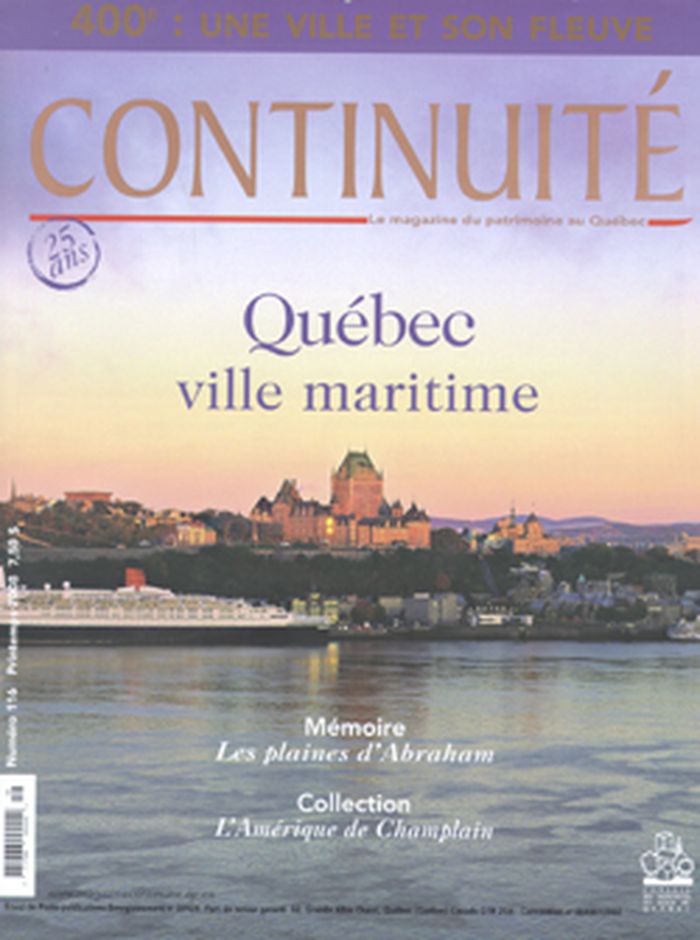
Alors que les célébrations du 400e anniversaire de la ville de Québec vont bon train, Continuité s’intéresse au patrimoine maritime qui porte fièrement autant de bougies. Depuis la découverte des rives du fleuve, une ville a traversé le temps, cumulé des victoires, perdu des batailles, poursuivi son évolution avec son passé pour bagage. Au cœur des festivités, cette histoire devrait être acclamée. Chaque chandelle qui s’allume sur Québec aujourd’hui devrait se souvenir d’une vie sociale et économique qui s’est tissée aux abords du Saint-Laurent, le fleuve pour trame de son histoire et de ses conquêtes. Des gens qui se passionnent pour les traces de vie passée qui résistent encore aux marées se sont tournés vers nous pour nous raconter l’histoire de la ville et de son fleuve. Célébrer ce 400e anniversaire, c’est rendre hommage aux années qui ont battu la mesure pour donner son rythme à la ville d’aujourd’hui. Les auteurs qui ont collaboré au présent numéro partagent avec nous ce qu’ils savent de ce chemin qu’a parcouru Québec depuis ses premiers pas. Et comme c’est fête aujourd’hui, ils offrent pour présent à la ville leurs meilleurs vœux : sauvegarder son lien au fleuve dans la mémoire collective et préserver ce qui subsiste encore de son riche patrimoine maritime. Que reste-t-il de son activité maritime passée, que nous raconte son patrimoine et quelle place occupent ses témoins riverains dans le paysage urbain contemporain ? Nous voilà prêts à souffler les bougies avec la tête pleine de souvenirs ! Caroline Marois Rédactrice en chef
Continuité 116: Québec ville maritime
Actions:
Price:
$7.50
(available to order)
Summary:
Alors que les célébrations du 400e anniversaire de la ville de Québec vont bon train, Continuité s’intéresse au patrimoine maritime qui porte fièrement autant de bougies. Depuis la découverte des rives du fleuve, une ville a traversé le temps, cumulé des victoires, perdu des batailles, poursuivi son évolution avec son passé pour bagage. Au cœur des festivités, cette histoire devrait être acclamée. Chaque chandelle qui s’allume sur Québec aujourd’hui devrait se souvenir d’une vie sociale et économique qui s’est tissée aux abords du Saint-Laurent, le fleuve pour trame de son histoire et de ses conquêtes. Des gens qui se passionnent pour les traces de vie passée qui résistent encore aux marées se sont tournés vers nous pour nous raconter l’histoire de la ville et de son fleuve. Célébrer ce 400e anniversaire, c’est rendre hommage aux années qui ont battu la mesure pour donner son rythme à la ville d’aujourd’hui. Les auteurs qui ont collaboré au présent numéro partagent avec nous ce qu’ils savent de ce chemin qu’a parcouru Québec depuis ses premiers pas. Et comme c’est fête aujourd’hui, ils offrent pour présent à la ville leurs meilleurs vœux : sauvegarder son lien au fleuve dans la mémoire collective et préserver ce qui subsiste encore de son riche patrimoine maritime. Que reste-t-il de son activité maritime passée, que nous raconte son patrimoine et quelle place occupent ses témoins riverains dans le paysage urbain contemporain ? Nous voilà prêts à souffler les bougies avec la tête pleine de souvenirs ! Caroline Marois Rédactrice en chef
Form:
journals and magazines
journals and magazines
Publication:
April 2008, Québec
April 2008, Québec
Subject:
Magazines
Magazines
Form:
books
books
Actions:
Price:
$34.95
(available to order)
Summary:
In this wide-ranging book, renowned philosopher and cultural theorist Peter Sloterdijk examines art in all its rich and varied forms: from music to architecture, light to movement, and design to typography. Moving between the visible and the invisible, the audible and the inaudible, his analyses span the centuries, from ancient civilizations to contemporary Hollywood.(...)
$34.95
(available to order)
Summary:
In this wide-ranging book, renowned philosopher and cultural theorist Peter Sloterdijk examines art in all its rich and varied forms: from music to architecture, light to movement, and design to typography. Moving between the visible and the invisible, the audible and the inaudible, his analyses span the centuries, from ancient civilizations to contemporary Hollywood.(...)
Title:
The aesthetic imperative: writings on art
Actions:
Price:
$34.95
(available to order)
Summary:
In this wide-ranging book, renowned philosopher and cultural theorist Peter Sloterdijk examines art in all its rich and varied forms: from music to architecture, light to movement, and design to typography. Moving between the visible and the invisible, the audible and the inaudible, his analyses span the centuries, from ancient civilizations to contemporary Hollywood. With great verve and insight he considers the key issues that have faced thinkers from Aristotle to Adorno, looking at art in its relation to ethics, epistemology, metaphysics, society, politics, anthropology and the subject.Sloterdijk explores a great variety of topics, including the Greek-Roman invention of postcards, medieval barter with purgatory and relics, the capitalist art market, the black boxes and white cubes of modernism, the rise of world’s fairs in the 19th century, the growth of museum and memorial culture, images of the city and the role of creativity. In doing so, Sloterdijk extends his characteristic method of defamiliarisation to transform the way we look at works of art and movements. His bold and original approach leads us away from the well-trodden paths of conventional art history to develop a theory of aesthetics which rejects strict categorisation, emphasising instead the crucial importance of individual subjectivity as a counter to the latent dangers of collective culture.This sustained collection of reflections, at once playful, serious and provocative, goes to the very heart of Sloterdijk’s enduring philosophical preoccupation with the aesthetic. It will be essential reading for students and scholars of philosophy and aesthetics and will appeal to anyone interested in culture and the arts more generally.
The aesthetic imperative: writings on art
Actions:
Price:
$34.95
(available to order)
Summary:
In this wide-ranging book, renowned philosopher and cultural theorist Peter Sloterdijk examines art in all its rich and varied forms: from music to architecture, light to movement, and design to typography. Moving between the visible and the invisible, the audible and the inaudible, his analyses span the centuries, from ancient civilizations to contemporary Hollywood. With great verve and insight he considers the key issues that have faced thinkers from Aristotle to Adorno, looking at art in its relation to ethics, epistemology, metaphysics, society, politics, anthropology and the subject.Sloterdijk explores a great variety of topics, including the Greek-Roman invention of postcards, medieval barter with purgatory and relics, the capitalist art market, the black boxes and white cubes of modernism, the rise of world’s fairs in the 19th century, the growth of museum and memorial culture, images of the city and the role of creativity. In doing so, Sloterdijk extends his characteristic method of defamiliarisation to transform the way we look at works of art and movements. His bold and original approach leads us away from the well-trodden paths of conventional art history to develop a theory of aesthetics which rejects strict categorisation, emphasising instead the crucial importance of individual subjectivity as a counter to the latent dangers of collective culture.This sustained collection of reflections, at once playful, serious and provocative, goes to the very heart of Sloterdijk’s enduring philosophical preoccupation with the aesthetic. It will be essential reading for students and scholars of philosophy and aesthetics and will appeal to anyone interested in culture and the arts more generally.
Form:
books
books
Publication:
April 2017
April 2017
Subject:
Art Theory
Art Theory
Form:
books
books
Price:
$19.95
(available in store)
Summary:
Now is the phantom chapter to the Invisible Committee's previous book, To Our Friends: a new critique from the anonymous collective that establishes their opposition to the world of capital and its law of labor, addresses current anti-terrorist rhetoric and the ferocious repression that comes with it, and clarifies the end of social democracy and the growing rumors of the(...)
$19.95
(available in store)
Summary:
Now is the phantom chapter to the Invisible Committee's previous book, To Our Friends: a new critique from the anonymous collective that establishes their opposition to the world of capital and its law of labor, addresses current anti-terrorist rhetoric and the ferocious repression that comes with it, and clarifies the end of social democracy and the growing rumors of the(...)
Title:
Now
Actions:
Price:
$19.95
(available in store)
Summary:
Now is the phantom chapter to the Invisible Committee's previous book, To Our Friends: a new critique from the anonymous collective that establishes their opposition to the world of capital and its law of labor, addresses current anti-terrorist rhetoric and the ferocious repression that comes with it, and clarifies the end of social democracy and the growing rumors of the need for a coming “civil war.” Now emerges at a time when the Invisible Committee’s contestation has found echoes throughout the West, with a collapse of trust in the police, an inept weariness on the part of the political system, a growing urgency for opposition, a return of the theme of the Commune, a vanishing distinction between radicals and citizens, and a widespread refusal on the part of the citizen to be governed. As farcical political elections continue to unfold worldwide like a line of tumbling dominoes, and governments increasingly struggle to reclaim a legitimacy that has already slipped out of their grasp, Now clarifies the Invisible Committee’s attitude toward all such elections and their outcome: one of utter indifference. Now proposes a “destituent process” that charts out a different path to be taken, a path of outright refusal that simply ignores elections altogether. It is a path that calls for taking over the world and not taking power, for exploring new forms of life and not a new constitution, and for desertion and silence as alternatives to proclamations and crashes. It is also a call for an unprecedented communism—a communism stronger than nation and country.
Now
Actions:
Price:
$19.95
(available in store)
Summary:
Now is the phantom chapter to the Invisible Committee's previous book, To Our Friends: a new critique from the anonymous collective that establishes their opposition to the world of capital and its law of labor, addresses current anti-terrorist rhetoric and the ferocious repression that comes with it, and clarifies the end of social democracy and the growing rumors of the need for a coming “civil war.” Now emerges at a time when the Invisible Committee’s contestation has found echoes throughout the West, with a collapse of trust in the police, an inept weariness on the part of the political system, a growing urgency for opposition, a return of the theme of the Commune, a vanishing distinction between radicals and citizens, and a widespread refusal on the part of the citizen to be governed. As farcical political elections continue to unfold worldwide like a line of tumbling dominoes, and governments increasingly struggle to reclaim a legitimacy that has already slipped out of their grasp, Now clarifies the Invisible Committee’s attitude toward all such elections and their outcome: one of utter indifference. Now proposes a “destituent process” that charts out a different path to be taken, a path of outright refusal that simply ignores elections altogether. It is a path that calls for taking over the world and not taking power, for exploring new forms of life and not a new constitution, and for desertion and silence as alternatives to proclamations and crashes. It is also a call for an unprecedented communism—a communism stronger than nation and country.
Form:
books
books
Publication:
November 2017
November 2017
Subject:
Critical Theory
Critical Theory
Form:
books
books
Actions:
Price:
$39.00
(available to order)
Summary:
D’où vient le sens de la ville? Pourquoi et en quoi les villes diffèrent-elles les unes des autres? Comment naissent les significations urbaines? Et qu’est-ce que la ville, par delà la mince surface de notre temps présent? Pourquoi la ville s’oppose-t-elle à la nature? Comment la ville des architectes, la ville des poètes, la ville de la publicité, la ville des(...)
$39.00
(available to order)
Summary:
D’où vient le sens de la ville? Pourquoi et en quoi les villes diffèrent-elles les unes des autres? Comment naissent les significations urbaines? Et qu’est-ce que la ville, par delà la mince surface de notre temps présent? Pourquoi la ville s’oppose-t-elle à la nature? Comment la ville des architectes, la ville des poètes, la ville de la publicité, la ville des(...)
Title:
La ville phénomène de représentation
Actions:
Price:
$39.00
(available to order)
Summary:
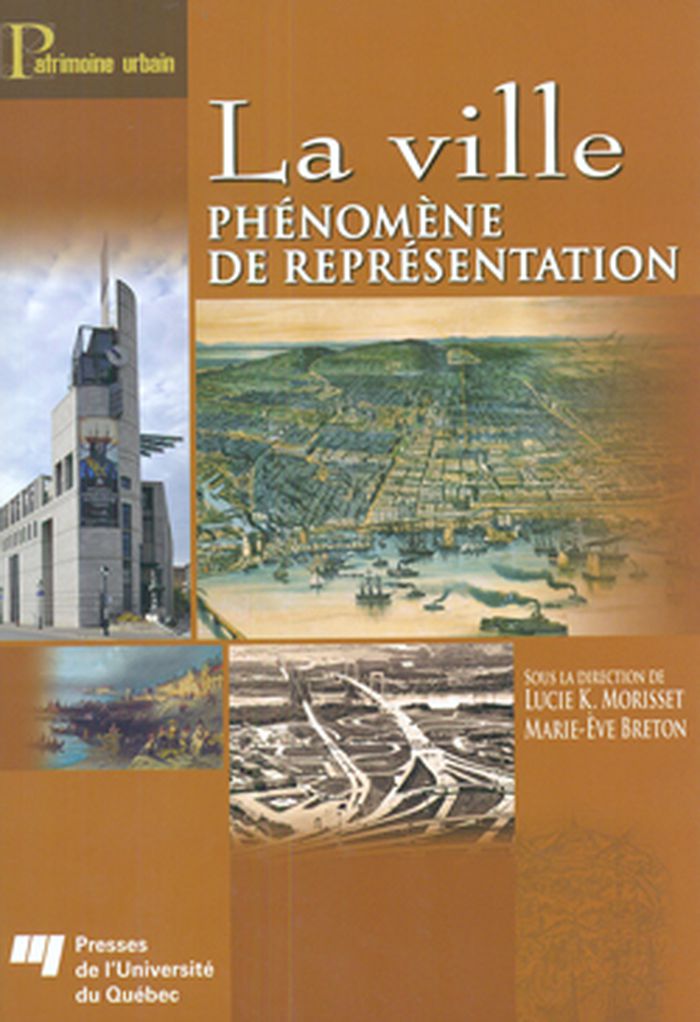
D’où vient le sens de la ville? Pourquoi et en quoi les villes diffèrent-elles les unes des autres? Comment naissent les significations urbaines? Et qu’est-ce que la ville, par delà la mince surface de notre temps présent? Pourquoi la ville s’oppose-t-elle à la nature? Comment la ville des architectes, la ville des poètes, la ville de la publicité, la ville des aménagistes, la ville des chroniqueurs se comparent-elles? Quels sont les liens qui unissent la ville d’aujourd’hui à celle d’autrefois? Cet ouvrage propose quelques perspectives à propos de ces questions. Sous les horizons variés des sciences humaines et des lettres, on y aborde la ville comme un phénomène de représentation, c’est-à-dire comme un artefact culturel logé quelque part entre notre propre conscience et les idéaux de ceux qui l’ont imaginée, de ceux qui l’habitent et de ceux qui l’explorent. Les divers textes réunis dans ces pages s’attardent donc à exposer des approches et des contextes spéculatifs afin de recadrer les questionnements sur la genèse des espaces urbains et sur les relations, d’une part entre les villes et l’identité collective. Pour penser, comprendre et expliquer la ville sous ces dimensions, l’on aborde d’abord quelques considérations épistémologiques, pour interpeller ensuite la ville engendrée par le projet architectural et urbain. Suit l’examen, entre mythe et réalité, de la ville comme idéal variable, voire antinomique dès que l’on considère l’opposition historique entre milieux naturels et urbanisés. L’ouvrage se clôt enfin sur l’invention de la ville comme processus d’investissement de sens des paysages construits.
La ville phénomène de représentation
Actions:
Price:
$39.00
(available to order)
Summary:
D’où vient le sens de la ville? Pourquoi et en quoi les villes diffèrent-elles les unes des autres? Comment naissent les significations urbaines? Et qu’est-ce que la ville, par delà la mince surface de notre temps présent? Pourquoi la ville s’oppose-t-elle à la nature? Comment la ville des architectes, la ville des poètes, la ville de la publicité, la ville des aménagistes, la ville des chroniqueurs se comparent-elles? Quels sont les liens qui unissent la ville d’aujourd’hui à celle d’autrefois? Cet ouvrage propose quelques perspectives à propos de ces questions. Sous les horizons variés des sciences humaines et des lettres, on y aborde la ville comme un phénomène de représentation, c’est-à-dire comme un artefact culturel logé quelque part entre notre propre conscience et les idéaux de ceux qui l’ont imaginée, de ceux qui l’habitent et de ceux qui l’explorent. Les divers textes réunis dans ces pages s’attardent donc à exposer des approches et des contextes spéculatifs afin de recadrer les questionnements sur la genèse des espaces urbains et sur les relations, d’une part entre les villes et l’identité collective. Pour penser, comprendre et expliquer la ville sous ces dimensions, l’on aborde d’abord quelques considérations épistémologiques, pour interpeller ensuite la ville engendrée par le projet architectural et urbain. Suit l’examen, entre mythe et réalité, de la ville comme idéal variable, voire antinomique dès que l’on considère l’opposition historique entre milieux naturels et urbanisés. L’ouvrage se clôt enfin sur l’invention de la ville comme processus d’investissement de sens des paysages construits.
Form:
books
books
Publication:
February 2011
February 2011
Subject:
Urban Theory
Urban Theory
Form:
books
books
Title:
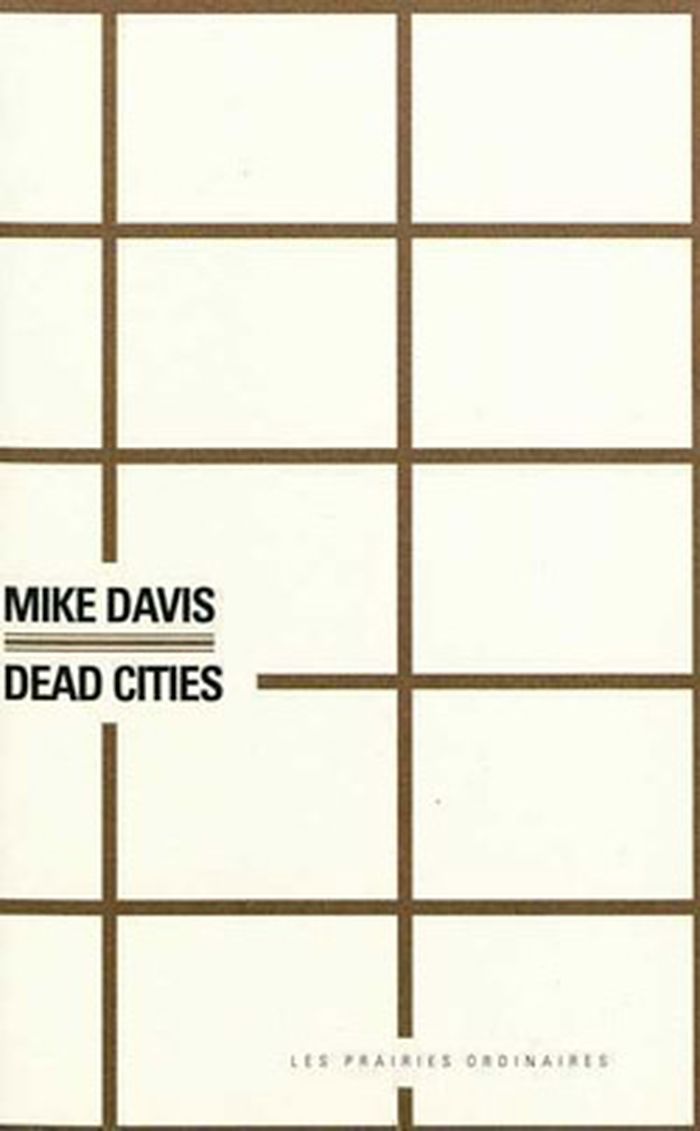
Mike Davis : dead cities
Mike Davis : dead cities
Actions:
Price:
$22.00
(available to order)
Summary:
Une Terre où la nature recouvre peu à peu ses droits sur la ville après la disparition de l'espèce humaine. Une architecture bunkerisée dédiée à la sécurité et au contrôle comme réponse à l'effondrement des Twin Towers. Des répliques d'immeubles allemands et japonais érigées dans le désert de l'Utah pour servir de laboratoire au dernier grand projet du New Deal : la(...)
$22.00
(available to order)
Summary:
Une Terre où la nature recouvre peu à peu ses droits sur la ville après la disparition de l'espèce humaine. Une architecture bunkerisée dédiée à la sécurité et au contrôle comme réponse à l'effondrement des Twin Towers. Des répliques d'immeubles allemands et japonais érigées dans le désert de l'Utah pour servir de laboratoire au dernier grand projet du New Deal : la(...)
Title:
Mike Davis : dead cities
Actions:
Price:
$22.00
(available to order)
Summary:
Une Terre où la nature recouvre peu à peu ses droits sur la ville après la disparition de l'espèce humaine. Une architecture bunkerisée dédiée à la sécurité et au contrôle comme réponse à l'effondrement des Twin Towers. Des répliques d'immeubles allemands et japonais érigées dans le désert de l'Utah pour servir de laboratoire au dernier grand projet du New Deal : la destruction par le feu des villes ennemies. Dévastée par les bombes ou les stylos rouges des spéculateurs immobiliers, la Grande Ville capitaliste s'est révélée particulièrement apte à réaliser certaines prophéties catastrophistes. Dans ce livre, Mike Davis nous montre que, depuis son émergence, elle n'a cessé d'être associée dans l'esprit des hommes au spectre apocalyptique de sa propre destruction. S'inscrivant dans la tradition marxiste d'Ernst Bloch, il affirme que l'aliénation cognitive produite par la mise au ban de la nature dans l'expérience collective a suscité une angoisse constante tout au long du xxe siècle. Dans une veine à la fois mélancolique et optimiste (le système capitaliste n'est qu'un stade de l'histoire humaine appelé à être dépassé), Mike Davis invite donc à une nouvelle science urbaine qui s'appuierait sur la " dialectique ville-nature ". Celle-ci permettrait d'envisager la ville dans la totalité des interactions qu'elle entretient avec son " dehors naturel ", et de déjouer les limites actuelles des études urbaines. Cela passe ici par un travail spéculatif s'appuyant sur une hypothèse - la disparition de l'homme - et sur un extraordinaire corpus littéraire et scientifique, où les espèces végétales et animales dansent sur les cendres de nos villes mortes.
Mike Davis : dead cities
Actions:
Price:
$22.00
(available to order)
Summary:
Une Terre où la nature recouvre peu à peu ses droits sur la ville après la disparition de l'espèce humaine. Une architecture bunkerisée dédiée à la sécurité et au contrôle comme réponse à l'effondrement des Twin Towers. Des répliques d'immeubles allemands et japonais érigées dans le désert de l'Utah pour servir de laboratoire au dernier grand projet du New Deal : la destruction par le feu des villes ennemies. Dévastée par les bombes ou les stylos rouges des spéculateurs immobiliers, la Grande Ville capitaliste s'est révélée particulièrement apte à réaliser certaines prophéties catastrophistes. Dans ce livre, Mike Davis nous montre que, depuis son émergence, elle n'a cessé d'être associée dans l'esprit des hommes au spectre apocalyptique de sa propre destruction. S'inscrivant dans la tradition marxiste d'Ernst Bloch, il affirme que l'aliénation cognitive produite par la mise au ban de la nature dans l'expérience collective a suscité une angoisse constante tout au long du xxe siècle. Dans une veine à la fois mélancolique et optimiste (le système capitaliste n'est qu'un stade de l'histoire humaine appelé à être dépassé), Mike Davis invite donc à une nouvelle science urbaine qui s'appuierait sur la " dialectique ville-nature ". Celle-ci permettrait d'envisager la ville dans la totalité des interactions qu'elle entretient avec son " dehors naturel ", et de déjouer les limites actuelles des études urbaines. Cela passe ici par un travail spéculatif s'appuyant sur une hypothèse - la disparition de l'homme - et sur un extraordinaire corpus littéraire et scientifique, où les espèces végétales et animales dansent sur les cendres de nos villes mortes.
Form:
books
books
Publication:
July 2012
July 2012
Subject:
Urban Theory
Urban Theory
Form:
books
books
Price:
$18.95
(available to order)
Summary:
Why is it so hard to make up our minds? Adam and Eve set the template : do we or don’t we eat the apple? They chose, half-heartedly, and nothing was ever the same again. With this book, Kenneth Weisbrode offers an introduction to the age-old struggle with ambivalence. Ambivalence results from a basic desire to have it both ways. This is only natural - although(...)
$18.95
(available to order)
Summary:
Why is it so hard to make up our minds? Adam and Eve set the template : do we or don’t we eat the apple? They chose, half-heartedly, and nothing was ever the same again. With this book, Kenneth Weisbrode offers an introduction to the age-old struggle with ambivalence. Ambivalence results from a basic desire to have it both ways. This is only natural - although(...)
Title:
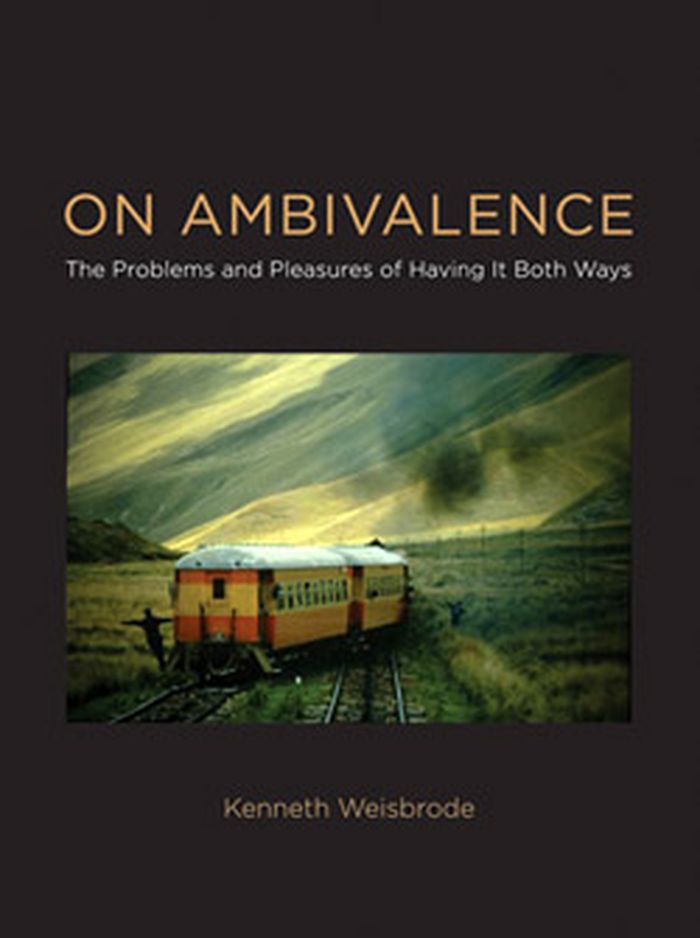
On ambivalence : the problems and pleasures of having it both ways
Actions:
Price:
$18.95
(available to order)
Summary:
Why is it so hard to make up our minds? Adam and Eve set the template : do we or don’t we eat the apple? They chose, half-heartedly, and nothing was ever the same again. With this book, Kenneth Weisbrode offers an introduction to the age-old struggle with ambivalence. Ambivalence results from a basic desire to have it both ways. This is only natural - although insisting upon it against all reason often results not in "both" but in the disappointing "neither." Ambivalence has insinuated itself into our culture as a kind of obligatory reflex, or default position, before practically every choice we make. It affects not only individuals; organizations, societies, and cultures can also be ambivalent. How often have we asked the scornful question, "Are we the Hamlet of nations"? How often have we demanded that our leaders appear decisive, judicious, and stalwart? And how eager have we been to censure them when they hesitate or waver? Weisbrode traces the concept of ambivalence, from the Garden of Eden to Freud and beyond. The Obama era, he says, may be America’s own era of ambivalence: neither red nor blue but a multicolored kaleidoscope. Ambivalence, he argues, need not be destructive. We must learn to distinguish it from its symptoms - selfishness, ambiguity, and indecision - and accept that frustration, guilt, and paralysis felt by individuals need not lead automatically to a collective pathology. Drawing upon examples from philosophy, history, literature, and the social sciences, On Ambivalence is a pocket-sized portrait of a complex human condition.
On ambivalence : the problems and pleasures of having it both ways
Actions:
Price:
$18.95
(available to order)
Summary:
Why is it so hard to make up our minds? Adam and Eve set the template : do we or don’t we eat the apple? They chose, half-heartedly, and nothing was ever the same again. With this book, Kenneth Weisbrode offers an introduction to the age-old struggle with ambivalence. Ambivalence results from a basic desire to have it both ways. This is only natural - although insisting upon it against all reason often results not in "both" but in the disappointing "neither." Ambivalence has insinuated itself into our culture as a kind of obligatory reflex, or default position, before practically every choice we make. It affects not only individuals; organizations, societies, and cultures can also be ambivalent. How often have we asked the scornful question, "Are we the Hamlet of nations"? How often have we demanded that our leaders appear decisive, judicious, and stalwart? And how eager have we been to censure them when they hesitate or waver? Weisbrode traces the concept of ambivalence, from the Garden of Eden to Freud and beyond. The Obama era, he says, may be America’s own era of ambivalence: neither red nor blue but a multicolored kaleidoscope. Ambivalence, he argues, need not be destructive. We must learn to distinguish it from its symptoms - selfishness, ambiguity, and indecision - and accept that frustration, guilt, and paralysis felt by individuals need not lead automatically to a collective pathology. Drawing upon examples from philosophy, history, literature, and the social sciences, On Ambivalence is a pocket-sized portrait of a complex human condition.
Form:
books
books
Publication:
January 2012
January 2012
Subject:
Critical Theory
Critical Theory
Form:
books
books
Title:
Jakob + Macfarlane / Philip Jodidio ; editors, Helen Adedotun, Virginie Maubourguet, Sam Wythe.
Jakob + Macfarlane / Philip Jodidio ; editors, Helen Adedotun, Virginie Maubourguet, Sam Wythe.
Actions:
Holdings:
Description:
303 pages : illustrations (chiefly color), plans, portrait ; 31 cm
Description:
303 pages : illustrations (chiefly color), plans, portrait ; 31 cm
Author:
Subject:
Publication:
Paris : Flammarion, [2020], ©2020
Paris : Flammarion, [2020], ©2020
Title:
Jakob + Macfarlane / Philip Jodidio ; editors, Helen Adedotun, Virginie Maubourguet, Sam Wythe.
Actions:
Holdings:
Description:
303 pages : illustrations (chiefly color), plans, portrait ; 31 cm
Jakob + Macfarlane / Philip Jodidio ; editors, Helen Adedotun, Virginie Maubourguet, Sam Wythe.
Actions:
Holdings:
Description:
303 pages : illustrations (chiefly color), plans, portrait ; 31 cm
Form:
books
books
Publication:
Paris : Flammarion, [2020], ©2020
Paris : Flammarion, [2020], ©2020
Author:
Subject:
Form:
books
books
Actions:
Holdings:
Description:
339 pages : illustrations (some color) ; 29 cm
Description:
339 pages : illustrations (some color) ; 29 cm
Subject:
Publication:
Lausanne : Payot, [1986]
Lausanne : Payot, [1986]
Title:
19-39 : la Suisse romande entre les deux guerres / collectif de recherches de l'Université et musées lausannois.
Actions:
Holdings:
Description:
339 pages : illustrations (some color) ; 29 cm
19-39 : la Suisse romande entre les deux guerres / collectif de recherches de l'Université et musées lausannois.
Actions:
Holdings:
Description:
339 pages : illustrations (some color) ; 29 cm
Form:
books
books
Publication:
Lausanne : Payot, [1986]
Lausanne : Payot, [1986]
Subject:


