


webpages
The Emerging Curator Residency Program offers the opportunity to propose and curate a project at the CCA related to contemporary debates in architecture, urban issues, landscape design, and cultural and social dynamics while doing a residency at the CCA.
Emerging Curator Residency Program
Actions:
Summary:
The Emerging Curator Residency Program offers the opportunity to propose and curate a project at the CCA related to contemporary debates in architecture, urban issues, landscape design, and cultural and social dynamics while doing a residency at the CCA.
webpages
events
As part of the first phase of the CCA’s Mellon Multidisciplinary Research Program, Nick Beech, Timothy Ivison, Simon Sadler and Ben Sweeting discuss their ongoing research into cultural transformation and architecture in postwar Britain:
Shaughnessy House
10 September 2015 , 6PM
British Architecture and the Contestation of Postwar Cultural Consensus
Actions:
Description:
As part of the first phase of the CCA’s Mellon Multidisciplinary Research Program, Nick Beech, Timothy Ivison, Simon Sadler and Ben Sweeting discuss their ongoing research into cultural transformation and architecture in postwar Britain:
events
10 September 2015
6PM
Shaughnessy House
works of art

DR1974:0002:006:001-024
Description:
- This album consists of transfer lithographed contract drawings - mainly plans, but also elevations, sections, and sectional elevations - for Hôtel Sauvage, Paris. The hôtel is U-shaped in plan with two pavilions connected by a monumental entrance hall and staircase which face a central "cours d'honneur". The hôtel's exterior has a rusticated "rez-de-chaussée", mansard roofs, and is embellished with classical features including arched and pedimented windows, pilasters, entablatures, and Corinthian columns. The sectional drawings show lavishly decorated interiors. The revisions and notations on the transfer lithographs of this album suggest that they were probably the architect's copy.
architecture, interior design
printed before 30 March 1861 or before 1 April 1861
Album of transfer lithographs of contract drawings for Hôtel Sauvage, avenue des Champs-Elysées and rue de Chaillot, Paris
Actions:
DR1974:0002:006:001-024
Description:
- This album consists of transfer lithographed contract drawings - mainly plans, but also elevations, sections, and sectional elevations - for Hôtel Sauvage, Paris. The hôtel is U-shaped in plan with two pavilions connected by a monumental entrance hall and staircase which face a central "cours d'honneur". The hôtel's exterior has a rusticated "rez-de-chaussée", mansard roofs, and is embellished with classical features including arched and pedimented windows, pilasters, entablatures, and Corinthian columns. The sectional drawings show lavishly decorated interiors. The revisions and notations on the transfer lithographs of this album suggest that they were probably the architect's copy.
works of art
printed before 30 March 1861 or before 1 April 1861
architecture, interior design
exhibitions
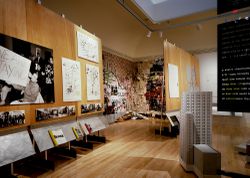
In the 1980s and 1990s, the trend in urban design shifted from the global planning approach—exemplified by the urban master plans of the 1950s and 1960s—to a sector based approach favouring gradual change rather than the rebuilding of cities. Urban Revisions: Current Projects for the Public Realm examines the physical and social space of the city, as seen by contemporary(...)
Main galleries
19 October 1994 to 8 January 1995
Urban Revisions: Current Projects for the Public Realm
Actions:
Description:
In the 1980s and 1990s, the trend in urban design shifted from the global planning approach—exemplified by the urban master plans of the 1950s and 1960s—to a sector based approach favouring gradual change rather than the rebuilding of cities. Urban Revisions: Current Projects for the Public Realm examines the physical and social space of the city, as seen by contemporary(...)
exhibitions
19 October 1994 to
8 January 1995
Main galleries
textual records
Diverses publications
ARCH257361
Description:
Divers sujets et publications : « The Arts and Culture of Québec » (émission avec Arthur Lismer, Emile Vaillancourt, et John Fisher. Cormier est mentionné); « Canadian Unity and Québec » (interview avec Emile Vaillancourt, John Humphrey, et Hugh MacLennan); extraits des Evangiles de saint Matthieu et Saint Jean; « The Basis of Peace » par Brooke Claxton; « Canada's Support of the Army Overseas » par W.L. Mackenzie King (émission); cours d'aéronautique de Pierre Franck; « Sur la langue Araméenne » (extraits par Robert Aron); des textes médicaux divers par Albéric Marin; une page de notes sur Eric Satie par Cormier; 2 photos de Henri Laugier, physiologiste.
entre 1929 et 1946
Diverses publications
Actions:
ARCH257361
Description:
Divers sujets et publications : « The Arts and Culture of Québec » (émission avec Arthur Lismer, Emile Vaillancourt, et John Fisher. Cormier est mentionné); « Canadian Unity and Québec » (interview avec Emile Vaillancourt, John Humphrey, et Hugh MacLennan); extraits des Evangiles de saint Matthieu et Saint Jean; « The Basis of Peace » par Brooke Claxton; « Canada's Support of the Army Overseas » par W.L. Mackenzie King (émission); cours d'aéronautique de Pierre Franck; « Sur la langue Araméenne » (extraits par Robert Aron); des textes médicaux divers par Albéric Marin; une page de notes sur Eric Satie par Cormier; 2 photos de Henri Laugier, physiologiste.
textual records
entre 1929 et 1946
articles
A history of references
events
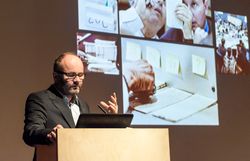
Thomas Demand gives a Mellon lecture describing the limitations but also the strange pre-eminence of models as artefacts. The artist, who has presented mid-career retrospectives at both MOMA and the Neue Nationalgalerie in Berlin, argues that whilst models describe a fragment of our surroundings, it is difficult to prove them wrong.
10 October 2013
Thomas Demand: Models of Perception
Actions:
Description:
Thomas Demand gives a Mellon lecture describing the limitations but also the strange pre-eminence of models as artefacts. The artist, who has presented mid-career retrospectives at both MOMA and the Neue Nationalgalerie in Berlin, argues that whilst models describe a fragment of our surroundings, it is difficult to prove them wrong.
events
10 October 2013
webpages
The Curatorial Internships Program is designed to share the CCA’s expertise with students and young professionals in architecture, the design disciplines, the arts, the humanities, and cultural studies who are interested in exploring editorial and curatorial work in architecture. Selected candidates will have the opportunity to become acquainted with the CCA’s curatorial approach—in particular its Collection, exhibitions, editorial projects, and research programs—through a nine-month internship in Montréal.
Curatorial Internships Program
Actions:
Summary:
The Curatorial Internships Program is designed to share the CCA’s expertise with students and young professionals in architecture, the design disciplines, the arts, the humanities, and cultural studies who are interested in exploring editorial and curatorial work in architecture. Selected candidates will have the opportunity to become acquainted with the CCA’s curatorial approach—in particular its Collection, exhibitions, editorial projects, and research programs—through a nine-month internship in Montréal.
webpages
drawings

DR1981:0029
Description:
This drawing shows a three-story, centrally planned palace. The entry portal at center features paired columns flanking niches with allegorical figures. Above them are empty escutcheons. On the walls on either side of the portal are two larger allegorical sculptural groups. A courtyard separates the entry portal from the palace, which Blondel indicates with an overall gray wash. The ground floor is mostly obscured by the gate, however it includes rectangular windows visible between the gate’s columns. The first level has large, un-mullioned windows which are not completely geometric but have a soft bow at the top. These are interspersed with Corinthian pilasters on either side of a central pavilion. This pavilion projects slightly and includes pairs of Corinthian columns at the corners. Three rounded windows are centered above the portal and atop these is a large triangular pediment with an indistinct sculptural scene roughly sketched at its center. Above the pediment are two reclining allegorical figures supporting a large escutcheon. An attic story includes Corinthian pilasters and two figures at either corner. Two square, un-mullioned windows are visible on either side of the central sculptural group. Perpendicular to the central mass are two wings that signal the palace’s U-shaped plan. These wings appear to follow the orders of the main facade and both levels feature rounded windows with low balustrades. At the top of the flat roof on either side are four pairs of allegorical and mythological figures. Projecting laterally from the main building are two single-story buildings that are likely entrances to the basse-cour (outer courtyard). These out buildings are distinguished from the palace through their rustication. Their portals have triangular pediments with empty escutcheons and lions on either side.
circa 1762
Elevation for a palace project
Actions:
DR1981:0029
Description:
This drawing shows a three-story, centrally planned palace. The entry portal at center features paired columns flanking niches with allegorical figures. Above them are empty escutcheons. On the walls on either side of the portal are two larger allegorical sculptural groups. A courtyard separates the entry portal from the palace, which Blondel indicates with an overall gray wash. The ground floor is mostly obscured by the gate, however it includes rectangular windows visible between the gate’s columns. The first level has large, un-mullioned windows which are not completely geometric but have a soft bow at the top. These are interspersed with Corinthian pilasters on either side of a central pavilion. This pavilion projects slightly and includes pairs of Corinthian columns at the corners. Three rounded windows are centered above the portal and atop these is a large triangular pediment with an indistinct sculptural scene roughly sketched at its center. Above the pediment are two reclining allegorical figures supporting a large escutcheon. An attic story includes Corinthian pilasters and two figures at either corner. Two square, un-mullioned windows are visible on either side of the central sculptural group. Perpendicular to the central mass are two wings that signal the palace’s U-shaped plan. These wings appear to follow the orders of the main facade and both levels feature rounded windows with low balustrades. At the top of the flat roof on either side are four pairs of allegorical and mythological figures. Projecting laterally from the main building are two single-story buildings that are likely entrances to the basse-cour (outer courtyard). These out buildings are distinguished from the palace through their rustication. Their portals have triangular pediments with empty escutcheons and lions on either side.
drawings
circa 1762
exhibitions

During the Second World War, exhibitions and publications played a critical role in the war effort. They were organized internationally as moments of reflection and propaganda, productions of a disciplinary approach to architecture and urban design. This display springs from Jean-Louis Cohen’s research for Architecture in Uniform: Designing and Building for the Second(...)
Hall cases
13 April 2011 to 18 September 2011
A Paper War: Pictures and words, 1939-1945
Actions:
Description:
During the Second World War, exhibitions and publications played a critical role in the war effort. They were organized internationally as moments of reflection and propaganda, productions of a disciplinary approach to architecture and urban design. This display springs from Jean-Louis Cohen’s research for Architecture in Uniform: Designing and Building for the Second(...)
exhibitions
13 April 2011 to
18 September 2011
Hall cases


