


4347 Results
Form:
books
books
Actions:
Price:
$52.95
(available to order)
Summary:
When recession-plagued New York City abandoned its industrial base in the 1970s, performance artists, photographers, and filmmakers found their own mixed uses for the city's run-down lofts, abandoned piers, vacant lots, and deserted streets. Gordon Matta-Clark turned a sanitation pier into the celebrated work Day's End and Betsy Sussler filmed its making; the photographic(...)
$52.95
(available to order)
Summary:
When recession-plagued New York City abandoned its industrial base in the 1970s, performance artists, photographers, and filmmakers found their own mixed uses for the city's run-down lofts, abandoned piers, vacant lots, and deserted streets. Gordon Matta-Clark turned a sanitation pier into the celebrated work Day's End and Betsy Sussler filmed its making; the photographic(...)
Title:
Mixed use, Manhattan : photography and related practices, 1970 to the present
Actions:
Price:
$52.95
(available to order)
Summary:
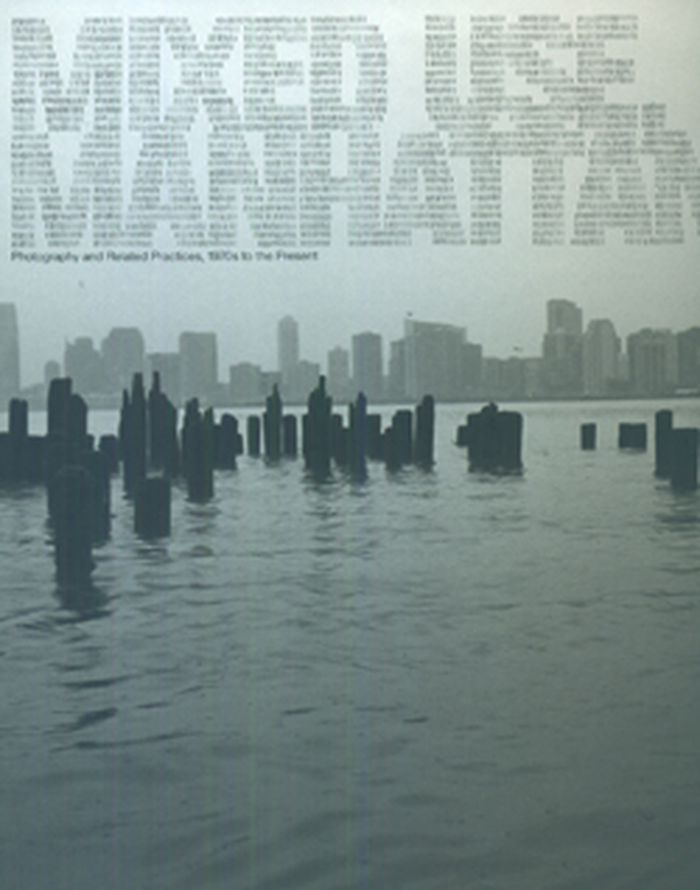
When recession-plagued New York City abandoned its industrial base in the 1970s, performance artists, photographers, and filmmakers found their own mixed uses for the city's run-down lofts, abandoned piers, vacant lots, and deserted streets. Gordon Matta-Clark turned a sanitation pier into the celebrated work Day's End and Betsy Sussler filmed its making; the photographic team Shunk-Kender shot a vast series of images of Willoughby Sharp's Projects: Pier 18 (which included work by Vito Acconci, Mel Bochner, Dan Graham, Matta-Clark, and William Wegman, among others); and Cindy Sherman staged some of her Untitled Film Stills on the streets of Lower Manhattan. This publication documents and illustrates these projects as well as more recent work by artists who continue to engage with the city's public, underground, and improvised spaces. The book (which accompanies a major exhibition) focuses on several important photographic series: Peter Hujar's 1976 nighttime photographs of Manhattan's West Side; Alvin Baltrop's Hudson River pier photographs from 1975-1985, most of which have never before been shown or published; David Wojnarowicz's Rimbaud in New York (1978-1979), the first of Wojnarowicz's works to be published; and several of Zoe Leonard's photographic projects from the late 1990s on. The book includes 70 color and 130 black-and-white images, a chronology of the policy decisions and developments that altered the face of New York City from 1950 to the present; an autobiographical story by David Wojnarowicz; and essays by Johanna Burton, Lytle Shaw, Juan Suarez, and the exhibition's curators, Lynne Cooke and Douglas Crimp.
Mixed use, Manhattan : photography and related practices, 1970 to the present
Actions:
Price:
$52.95
(available to order)
Summary:
When recession-plagued New York City abandoned its industrial base in the 1970s, performance artists, photographers, and filmmakers found their own mixed uses for the city's run-down lofts, abandoned piers, vacant lots, and deserted streets. Gordon Matta-Clark turned a sanitation pier into the celebrated work Day's End and Betsy Sussler filmed its making; the photographic team Shunk-Kender shot a vast series of images of Willoughby Sharp's Projects: Pier 18 (which included work by Vito Acconci, Mel Bochner, Dan Graham, Matta-Clark, and William Wegman, among others); and Cindy Sherman staged some of her Untitled Film Stills on the streets of Lower Manhattan. This publication documents and illustrates these projects as well as more recent work by artists who continue to engage with the city's public, underground, and improvised spaces. The book (which accompanies a major exhibition) focuses on several important photographic series: Peter Hujar's 1976 nighttime photographs of Manhattan's West Side; Alvin Baltrop's Hudson River pier photographs from 1975-1985, most of which have never before been shown or published; David Wojnarowicz's Rimbaud in New York (1978-1979), the first of Wojnarowicz's works to be published; and several of Zoe Leonard's photographic projects from the late 1990s on. The book includes 70 color and 130 black-and-white images, a chronology of the policy decisions and developments that altered the face of New York City from 1950 to the present; an autobiographical story by David Wojnarowicz; and essays by Johanna Burton, Lytle Shaw, Juan Suarez, and the exhibition's curators, Lynne Cooke and Douglas Crimp.
Form:
books
books
Publication:
September 2010
September 2010
Subject:
Public Space
Public Space
Form:
books
books
Actions:
Price:
$90.00
(available to order)
Summary:
Gordon Matta-Clark, scion and rebel, died at 35 in 1978 and has since become a cult figure of late-twentieth-century art. Born in New York and trained in architecture at Cornell, he went on to question the field's conventions in vivid projects that excised holes into existing buildings or assembled deeds to New York City alleys and curbs. As the son of the Chilean-born(...)
$90.00
(available to order)
Summary:
Gordon Matta-Clark, scion and rebel, died at 35 in 1978 and has since become a cult figure of late-twentieth-century art. Born in New York and trained in architecture at Cornell, he went on to question the field's conventions in vivid projects that excised holes into existing buildings or assembled deeds to New York City alleys and curbs. As the son of the Chilean-born(...)
Title:
Gordon Matta-Clark: works and collected writings
Actions:
Price:
$90.00
(available to order)
Summary:
Gordon Matta-Clark, scion and rebel, died at 35 in 1978 and has since become a cult figure of late-twentieth-century art. Born in New York and trained in architecture at Cornell, he went on to question the field's conventions in vivid projects that excised holes into existing buildings or assembled deeds to New York City alleys and curbs. As the son of the Chilean-born Surrealist painter Roberto Matta and Anne Clark, and godson of Marcel Duchamp, with whom he played a regular game of chess in the Village, Matta-Clark had grown up inside the art world, also working an as assistant to mavericks like Dennis Oppenheim and Robert Smithson. His work and words, while sophisticated enough to make him an "artist's artist," and colossal and outgoing enough to draw public attention and affection, were always also grounded in social or political convictions. He addressed not only space and real estate (in other words, housing), but the ultimate in necessity and nourishment, food. His "Pig Roast" under the Brooklyn Bridge offered passersby 500 pork sandwiches, and Food, the artist-staffed restaurant that he opened with dancer Caroline Goodden in SoHo, became a headquarters for that nascent neighborhood in the early 70s. He consistently broke the boundaries between sculpture and architecture, photography and film, performance and installation, and above all the permanent and the transitory. Once in a while he also broke the law. This book, published in celebration of the gradual opening of Matta-Clark's archives at the Canadian Centre for Architecture in Montreal, collects previously unavailable writings, including notecards and notebooks, along with interviews and more than 100 illustrations.
Gordon Matta-Clark: works and collected writings
Actions:
Price:
$90.00
(available to order)
Summary:
Gordon Matta-Clark, scion and rebel, died at 35 in 1978 and has since become a cult figure of late-twentieth-century art. Born in New York and trained in architecture at Cornell, he went on to question the field's conventions in vivid projects that excised holes into existing buildings or assembled deeds to New York City alleys and curbs. As the son of the Chilean-born Surrealist painter Roberto Matta and Anne Clark, and godson of Marcel Duchamp, with whom he played a regular game of chess in the Village, Matta-Clark had grown up inside the art world, also working an as assistant to mavericks like Dennis Oppenheim and Robert Smithson. His work and words, while sophisticated enough to make him an "artist's artist," and colossal and outgoing enough to draw public attention and affection, were always also grounded in social or political convictions. He addressed not only space and real estate (in other words, housing), but the ultimate in necessity and nourishment, food. His "Pig Roast" under the Brooklyn Bridge offered passersby 500 pork sandwiches, and Food, the artist-staffed restaurant that he opened with dancer Caroline Goodden in SoHo, became a headquarters for that nascent neighborhood in the early 70s. He consistently broke the boundaries between sculpture and architecture, photography and film, performance and installation, and above all the permanent and the transitory. Once in a while he also broke the law. This book, published in celebration of the gradual opening of Matta-Clark's archives at the Canadian Centre for Architecture in Montreal, collects previously unavailable writings, including notecards and notebooks, along with interviews and more than 100 illustrations.
Form:
books
books
Publication:
October 2006
October 2006
Subject:
Contemporary Art Monographs
Contemporary Art Monographs
Form:
books
books
Price:
$43.95
(available to order)
Summary:
Pioneering conceptual artist Vito Acconci began his career as a poet. In the 1960s, before beginning his work in performance and video art, Acconci studied at the Iowa Writers Workshop and published poems in journals and chapbooks. Almost all of this work remains unknown; much of it appeared in the self-produced magazines of the Lower East Side's mimeo revolution, and(...)
$43.95
(available to order)
Summary:
Pioneering conceptual artist Vito Acconci began his career as a poet. In the 1960s, before beginning his work in performance and video art, Acconci studied at the Iowa Writers Workshop and published poems in journals and chapbooks. Almost all of this work remains unknown; much of it appeared in the self-produced magazines of the Lower East Side's mimeo revolution, and(...)
Subject:
Contemporary Art Monographs
Contemporary Art Monographs
Publication:
March 2006, Cambridge, Mass.
March 2006, Cambridge, Mass.
Title:
Languages to cover a page : the early writings of Vito Acconci
Actions:
Price:
$43.95
(available to order)
Summary:
Pioneering conceptual artist Vito Acconci began his career as a poet. In the 1960s, before beginning his work in performance and video art, Acconci studied at the Iowa Writers Workshop and published poems in journals and chapbooks. Almost all of this work remains unknown; much of it appeared in the self-produced magazines of the Lower East Side's mimeo revolution, and many other pieces were never published. Language to Cover a Page collects these writings for the first time and not only shows Acconci to be an important experimental writer of the period, but demonstrates the continuity of his early writing with his later work in film, video, and performance. "Language to cover a page" documents a key moment in the unprecedented intersection of artists and poets in the late 1960s - as seen in the Dwan Gallery's series of "Language" shows (1967-1970) and in Acconci's own journal 0 to 9. Indeed, as Acconci moved from the poetry scene to the art world, his poetry became increasingly performative while his artwork was often structured and motivated by linguistic play. Acconci's early writing recalls the work of Samuel Beckett, the deadpan voice of the nouveau roman, and the jump cuts and fraught permutations of the nouvelle vague. Poems in "Language to cover a page" explore the materiality of language ("language as matter and not ideas," as Robert Smithson put it), the physical space of the page, and the physicality of source texts (phonebooks, thesauruses, dictionaries). Other poems take the space of the page as an analogue to performance space or implicate the poem in a network of activity (as in his "Dial-a-Poem" pieces).
Languages to cover a page : the early writings of Vito Acconci
Actions:
Price:
$43.95
(available to order)
Summary:
Pioneering conceptual artist Vito Acconci began his career as a poet. In the 1960s, before beginning his work in performance and video art, Acconci studied at the Iowa Writers Workshop and published poems in journals and chapbooks. Almost all of this work remains unknown; much of it appeared in the self-produced magazines of the Lower East Side's mimeo revolution, and many other pieces were never published. Language to Cover a Page collects these writings for the first time and not only shows Acconci to be an important experimental writer of the period, but demonstrates the continuity of his early writing with his later work in film, video, and performance. "Language to cover a page" documents a key moment in the unprecedented intersection of artists and poets in the late 1960s - as seen in the Dwan Gallery's series of "Language" shows (1967-1970) and in Acconci's own journal 0 to 9. Indeed, as Acconci moved from the poetry scene to the art world, his poetry became increasingly performative while his artwork was often structured and motivated by linguistic play. Acconci's early writing recalls the work of Samuel Beckett, the deadpan voice of the nouveau roman, and the jump cuts and fraught permutations of the nouvelle vague. Poems in "Language to cover a page" explore the materiality of language ("language as matter and not ideas," as Robert Smithson put it), the physical space of the page, and the physicality of source texts (phonebooks, thesauruses, dictionaries). Other poems take the space of the page as an analogue to performance space or implicate the poem in a network of activity (as in his "Dial-a-Poem" pieces).
Form:
books
books
Publication:
March 2006, Cambridge, Mass.
March 2006, Cambridge, Mass.
Subject:
Contemporary Art Monographs
Contemporary Art Monographs
Form:
books
books
Price:
$75.95
(available to order)
Summary:
More than one hundred exhibitions of Frank Lloyd Wright's work were mounted between 1894 and his death in 1959. Wright organized the majority of these exhibitions himself and viewed them as crucial to his self-presentation as his extensive writings. He used them to promote his designs, appeal to new viewers, and persuade his detractors. Wright on Exhibit presents the(...)
$75.95
(available to order)
Summary:
More than one hundred exhibitions of Frank Lloyd Wright's work were mounted between 1894 and his death in 1959. Wright organized the majority of these exhibitions himself and viewed them as crucial to his self-presentation as his extensive writings. He used them to promote his designs, appeal to new viewers, and persuade his detractors. Wright on Exhibit presents the(...)
Title:
Wright on exhibit: Frank Lloyd Wright's architectural exhibitions
Actions:
Price:
$75.95
(available to order)
Summary:
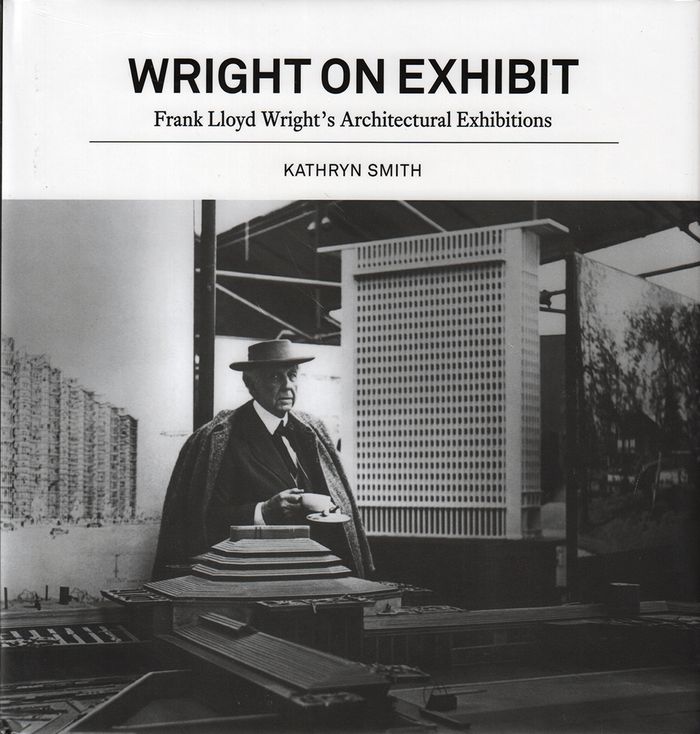
More than one hundred exhibitions of Frank Lloyd Wright's work were mounted between 1894 and his death in 1959. Wright organized the majority of these exhibitions himself and viewed them as crucial to his self-presentation as his extensive writings. He used them to promote his designs, appeal to new viewers, and persuade his detractors. Wright on Exhibit presents the first history of this neglected aspect of the architect’s influential career. Drawing extensively from Wright’s unpublished correspondence, Kathryn Smith challenges the preconceived notion of Wright as a self-promoter who displayed his work in search of money, clients, and fame. She shows how he was an artist-architect projecting an avant-garde program, an innovator who expanded the palette of installation design as technology evolved, and a social activist driven to revolutionize society through design. While Wright’s earliest exhibitions were largely for other architects, by the 1930s he was creating public installations intended to inspire debate and change public perceptions about architecture. The nature of his exhibitions expanded with the times beyond models, drawings, and photographs to include more immersive tools such as slides, film, and even a full-scale structure built especially for his 1953 retrospective at the Guggenheim Museum. Placing Wright’s exhibitions side by side with his writings, Smith shows how integral these exhibitions were to his vision and sheds light on the broader discourse concerning architecture and modernism during the first half of the twentieth century. Wright on Exhibit features color renderings, photos, and plans, as well as a checklist of exhibitions and an illustrated catalog of extant and lost models made under Wright’s supervision.
Wright on exhibit: Frank Lloyd Wright's architectural exhibitions
Actions:
Price:
$75.95
(available to order)
Summary:
More than one hundred exhibitions of Frank Lloyd Wright's work were mounted between 1894 and his death in 1959. Wright organized the majority of these exhibitions himself and viewed them as crucial to his self-presentation as his extensive writings. He used them to promote his designs, appeal to new viewers, and persuade his detractors. Wright on Exhibit presents the first history of this neglected aspect of the architect’s influential career. Drawing extensively from Wright’s unpublished correspondence, Kathryn Smith challenges the preconceived notion of Wright as a self-promoter who displayed his work in search of money, clients, and fame. She shows how he was an artist-architect projecting an avant-garde program, an innovator who expanded the palette of installation design as technology evolved, and a social activist driven to revolutionize society through design. While Wright’s earliest exhibitions were largely for other architects, by the 1930s he was creating public installations intended to inspire debate and change public perceptions about architecture. The nature of his exhibitions expanded with the times beyond models, drawings, and photographs to include more immersive tools such as slides, film, and even a full-scale structure built especially for his 1953 retrospective at the Guggenheim Museum. Placing Wright’s exhibitions side by side with his writings, Smith shows how integral these exhibitions were to his vision and sheds light on the broader discourse concerning architecture and modernism during the first half of the twentieth century. Wright on Exhibit features color renderings, photos, and plans, as well as a checklist of exhibitions and an illustrated catalog of extant and lost models made under Wright’s supervision.
Form:
books
books
Publication:
May 2017
May 2017
Subject:
Architecture Monographs
Architecture Monographs
Form:
books
books
Actions:
Price:
$33.95
(available to order)
Summary:
Mucking around in the messy terrain of American trash, Jani Scandura tells the story of the United States during the Great Depression through evocative and photo-rich portraits of four different locales: Reno, Harlem, Key West, and Hollywood. In investigating these depression-era �dumps,� places that she claims contained and reclaimed the cultural, ideological, and(...)
$33.95
(available to order)
Summary:
Mucking around in the messy terrain of American trash, Jani Scandura tells the story of the United States during the Great Depression through evocative and photo-rich portraits of four different locales: Reno, Harlem, Key West, and Hollywood. In investigating these depression-era �dumps,� places that she claims contained and reclaimed the cultural, ideological, and(...)
Title:
Down in the dumps: place, modernity, american depression
Actions:
Price:
$33.95
(available to order)
Summary:
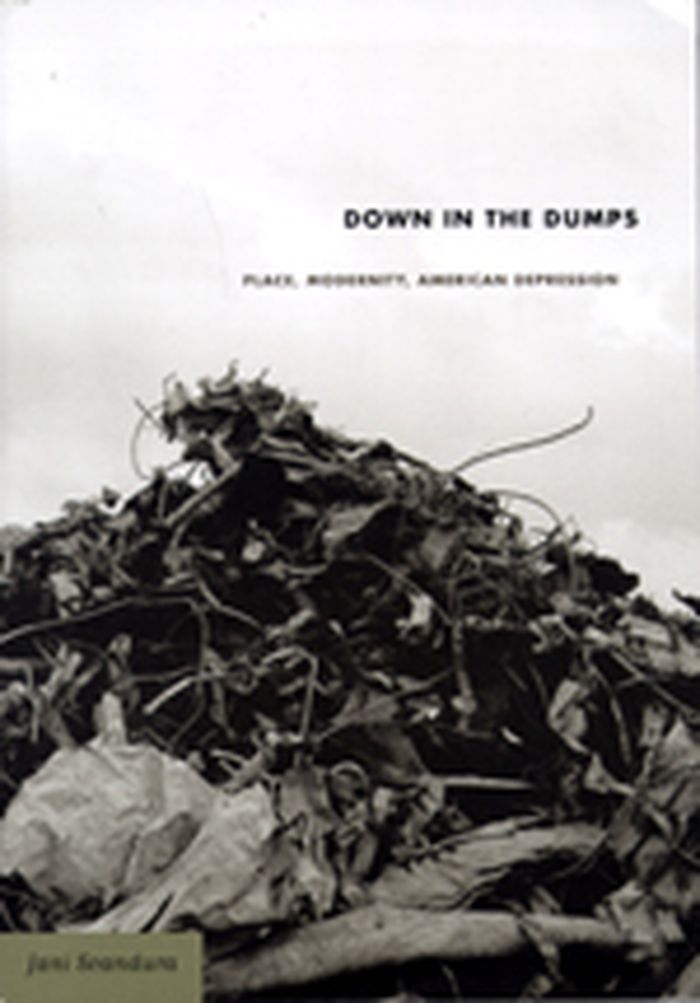
Mucking around in the messy terrain of American trash, Jani Scandura tells the story of the United States during the Great Depression through evocative and photo-rich portraits of four different locales: Reno, Harlem, Key West, and Hollywood. In investigating these depression-era �dumps,� places that she claims contained and reclaimed the cultural, ideological, and material refuse of modern America, Scandura introduces the concept of �depressive modernity,� an enduring affective component of American culture that exposes itself at those moments when the foundational myths of America and progressive modernity�capitalism, democracy, individualism, secularism, utopian aspiration�are thrown into question. Depressive modernity is modernity at a standstill. Such a modernity is not stagnant or fixed, nor immobile, but is constituted by an instantaneous unstaging of desire, territory, language, and memory that reveals itself in the shimmering of place. An interpretive bricolage that draws on an unlikely archive of 1930s detritus�office memos, scribbled manuscripts, scrapbooks, ruined photographs, newspaper clippings, glass eyes, incinerated stage sets, pulp novels, and junk washed ashore�Down in the Dumps escorts its readers through Reno�s 1930s divorce factory, where couples from across the United States came to quickly dissolve matrimonial bonds; Key West�s multilingual salvage economy and the island that became the center of an ideological tug-of-war between the American New Deal government and a politically fraught Caribbean; post-Renaissance Harlem, in the process of memorializing, remembering, grieving and rewriting a modernity that had already passed; and Studio-era Hollywood, Nathanael West�s �dump of dreams,� in which the introduction of sound film and shifts in art direction began to transform how Americans understood place-making and even being itself. A coda on Alcatraz and the Pentagon brings the book into the present, exploring how American Depression comes to bear on post-9/11 America.
Down in the dumps: place, modernity, american depression
Actions:
Price:
$33.95
(available to order)
Summary:
Mucking around in the messy terrain of American trash, Jani Scandura tells the story of the United States during the Great Depression through evocative and photo-rich portraits of four different locales: Reno, Harlem, Key West, and Hollywood. In investigating these depression-era �dumps,� places that she claims contained and reclaimed the cultural, ideological, and material refuse of modern America, Scandura introduces the concept of �depressive modernity,� an enduring affective component of American culture that exposes itself at those moments when the foundational myths of America and progressive modernity�capitalism, democracy, individualism, secularism, utopian aspiration�are thrown into question. Depressive modernity is modernity at a standstill. Such a modernity is not stagnant or fixed, nor immobile, but is constituted by an instantaneous unstaging of desire, territory, language, and memory that reveals itself in the shimmering of place. An interpretive bricolage that draws on an unlikely archive of 1930s detritus�office memos, scribbled manuscripts, scrapbooks, ruined photographs, newspaper clippings, glass eyes, incinerated stage sets, pulp novels, and junk washed ashore�Down in the Dumps escorts its readers through Reno�s 1930s divorce factory, where couples from across the United States came to quickly dissolve matrimonial bonds; Key West�s multilingual salvage economy and the island that became the center of an ideological tug-of-war between the American New Deal government and a politically fraught Caribbean; post-Renaissance Harlem, in the process of memorializing, remembering, grieving and rewriting a modernity that had already passed; and Studio-era Hollywood, Nathanael West�s �dump of dreams,� in which the introduction of sound film and shifts in art direction began to transform how Americans understood place-making and even being itself. A coda on Alcatraz and the Pentagon brings the book into the present, exploring how American Depression comes to bear on post-9/11 America.
Form:
books
books
Publication:
January 2008, Durham, London
January 2008, Durham, London
Subject:
Urban Theory
Urban Theory
Form:
journals and magazines
journals and magazines
Title:
e-flux index #3
e-flux index #3
Actions:
Price:
$65.00
(available in store)
Summary:
Today we are accustomed to the apophatic gesture of free-speech fundamentalists and far-right demagogues, who use the flimsy legal cover of “just asking questions” to broadcast ever more widely the most violent and reactionary forms of hate speech. In resisting this enclosure of thought, art and theory continue to be instructive, if not essential activities. The late(...)
$65.00
(available in store)
Summary:
Today we are accustomed to the apophatic gesture of free-speech fundamentalists and far-right demagogues, who use the flimsy legal cover of “just asking questions” to broadcast ever more widely the most violent and reactionary forms of hate speech. In resisting this enclosure of thought, art and theory continue to be instructive, if not essential activities. The late(...)
Title:
e-flux index #3
Actions:
Price:
$65.00
(available in store)
Summary:
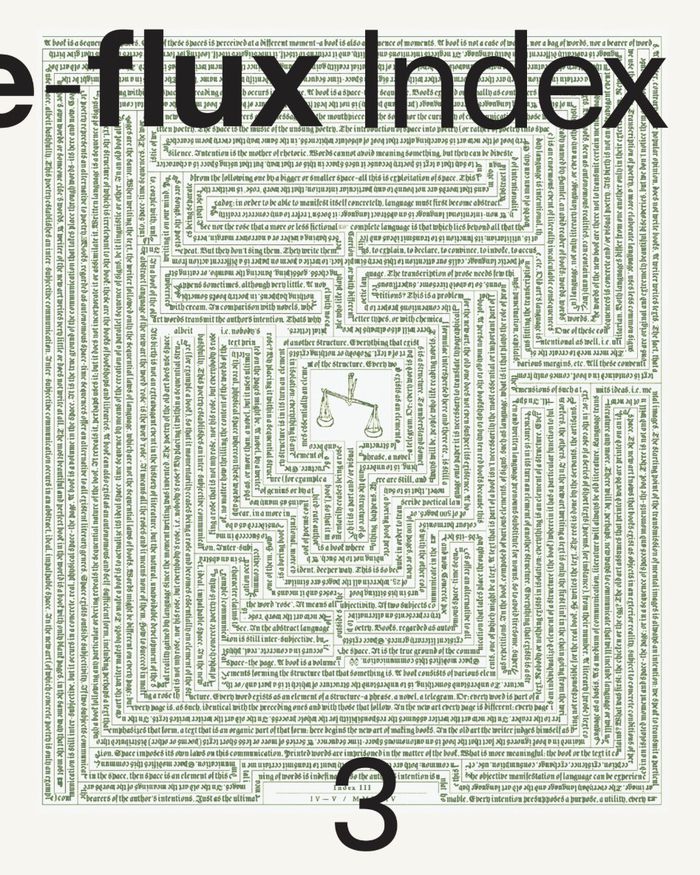
Today we are accustomed to the apophatic gesture of free-speech fundamentalists and far-right demagogues, who use the flimsy legal cover of “just asking questions” to broadcast ever more widely the most violent and reactionary forms of hate speech. In resisting this enclosure of thought, art and theory continue to be instructive, if not essential activities. The late Lawrence Weiner memorably declared that “the purpose of art is to ask questions… it doesn’t answer anybody’s question but gives them the means to answer a particular question at a particular moment.” All the better when those questions can provoke a certain illuminating friction with the contradictions of one’s environment and disrupt the automaticity of one’s learned responses, remaining themselves ambiguous or unanswered—because unanswerable. This third issue of e-flux Index, bringing together all the content commissioned and published by e-flux between April and May 2024, contains many such unexpected and unanswered (or unanswerable) questions across its 76 contributions, each of which cut across and reach beyond existing disciplines and borders: “Who is willing to care?”; “Who is the addressee at the end of the regulated pipelines of the English language?”; “Yes, but is it edible?”; “Why does everyone hate college students?”; “Is some form of suffering the condition for the emergence of an organic type of intelligence?”; “What does it mean to make a film today, in 2024, when most of our image consumption has been transferred to other (smaller) screens and other media?; “How to represent history?”; “Whose lives are worth remembering—or even, living?”; “How is it possible to speak the language of imperial renaissance and decolonization in the same breath?”; “Today is which day of the revolution?”—“Are these all just notes for a poem?”
e-flux index #3
Actions:
Price:
$65.00
(available in store)
Summary:
Today we are accustomed to the apophatic gesture of free-speech fundamentalists and far-right demagogues, who use the flimsy legal cover of “just asking questions” to broadcast ever more widely the most violent and reactionary forms of hate speech. In resisting this enclosure of thought, art and theory continue to be instructive, if not essential activities. The late Lawrence Weiner memorably declared that “the purpose of art is to ask questions… it doesn’t answer anybody’s question but gives them the means to answer a particular question at a particular moment.” All the better when those questions can provoke a certain illuminating friction with the contradictions of one’s environment and disrupt the automaticity of one’s learned responses, remaining themselves ambiguous or unanswered—because unanswerable. This third issue of e-flux Index, bringing together all the content commissioned and published by e-flux between April and May 2024, contains many such unexpected and unanswered (or unanswerable) questions across its 76 contributions, each of which cut across and reach beyond existing disciplines and borders: “Who is willing to care?”; “Who is the addressee at the end of the regulated pipelines of the English language?”; “Yes, but is it edible?”; “Why does everyone hate college students?”; “Is some form of suffering the condition for the emergence of an organic type of intelligence?”; “What does it mean to make a film today, in 2024, when most of our image consumption has been transferred to other (smaller) screens and other media?; “How to represent history?”; “Whose lives are worth remembering—or even, living?”; “How is it possible to speak the language of imperial renaissance and decolonization in the same breath?”; “Today is which day of the revolution?”—“Are these all just notes for a poem?”
Form:
journals and magazines
journals and magazines
Publication:
December 2024
December 2024
Subject:
Magazines
Magazines
Form:
books
books
Actions:
Price:
$71.95
(available to order)
Summary:
Although many people view virtual reality as a totally new phenomenon, it has its foundations in an unrecognized history of immersive images. Indeed, the search for illusionary visual space can be traced back to antiquity. In this book Oliver Grau shows how virtual art fits into the art history of illusion and immersion. He describes the metamorphosis of the concepts of(...)
$71.95
(available to order)
Summary:
Although many people view virtual reality as a totally new phenomenon, it has its foundations in an unrecognized history of immersive images. Indeed, the search for illusionary visual space can be traced back to antiquity. In this book Oliver Grau shows how virtual art fits into the art history of illusion and immersion. He describes the metamorphosis of the concepts of(...)
Title:
Virtual art from illusion to immersion
Actions:
Price:
$71.95
(available to order)
Summary:
Although many people view virtual reality as a totally new phenomenon, it has its foundations in an unrecognized history of immersive images. Indeed, the search for illusionary visual space can be traced back to antiquity. In this book Oliver Grau shows how virtual art fits into the art history of illusion and immersion. He describes the metamorphosis of the concepts of art and the image and relates those concepts to interactive art, interface design, agents, telepresence, and image evolution. Grau retells art history as media history, helping us to understand the phenomenon of virtual reality beyond the hype. Grau shows how each epoch used the technical means available to produce maximum illusion. He discusses frescoes such as those in the Villa dei Misteri in Pompeii and the gardens of the Villa Livia near Primaporta, Renaissance and Baroque illusion spaces, and panoramas, which were the most developed form of illusion achieved through traditional methods of painting and the mass image medium before film. Through a detailed analysis of perhaps the most important German panorama, Anton von Werner's 1883 The Battle of Sedan, Grau shows how immersion produced emotional responses. He traces immersive cinema through Cinerama, Sensorama, Expanded Cinema, 3-D, Omnimax and IMAX, and the head mounted display with its military origins. He also examines those characteristics of virtual reality that distinguish it from earlier forms of illusionary art. His analysis draws on the work of contemporary artists and groups ART+COM, Maurice Benayoun, Charlotte Davies, Monika Fleischmann, Ken Goldberg, Agnes Hegedues, Eduardo Kac, Knowbotic Research, Laurent Mignonneau, Michael Naimark, Simon Penny, Daniela Plewe, Paul Sermon, Jeffrey Shaw, Karl Sims, Christa Sommerer, and Wolfgang Strauss. Grau offers not just a history of illusionary space but also a theoretical framework for analyzing its phenomenologies, functions, and strategies throughout history and into the future.
Virtual art from illusion to immersion
Actions:
Price:
$71.95
(available to order)
Summary:
Although many people view virtual reality as a totally new phenomenon, it has its foundations in an unrecognized history of immersive images. Indeed, the search for illusionary visual space can be traced back to antiquity. In this book Oliver Grau shows how virtual art fits into the art history of illusion and immersion. He describes the metamorphosis of the concepts of art and the image and relates those concepts to interactive art, interface design, agents, telepresence, and image evolution. Grau retells art history as media history, helping us to understand the phenomenon of virtual reality beyond the hype. Grau shows how each epoch used the technical means available to produce maximum illusion. He discusses frescoes such as those in the Villa dei Misteri in Pompeii and the gardens of the Villa Livia near Primaporta, Renaissance and Baroque illusion spaces, and panoramas, which were the most developed form of illusion achieved through traditional methods of painting and the mass image medium before film. Through a detailed analysis of perhaps the most important German panorama, Anton von Werner's 1883 The Battle of Sedan, Grau shows how immersion produced emotional responses. He traces immersive cinema through Cinerama, Sensorama, Expanded Cinema, 3-D, Omnimax and IMAX, and the head mounted display with its military origins. He also examines those characteristics of virtual reality that distinguish it from earlier forms of illusionary art. His analysis draws on the work of contemporary artists and groups ART+COM, Maurice Benayoun, Charlotte Davies, Monika Fleischmann, Ken Goldberg, Agnes Hegedues, Eduardo Kac, Knowbotic Research, Laurent Mignonneau, Michael Naimark, Simon Penny, Daniela Plewe, Paul Sermon, Jeffrey Shaw, Karl Sims, Christa Sommerer, and Wolfgang Strauss. Grau offers not just a history of illusionary space but also a theoretical framework for analyzing its phenomenologies, functions, and strategies throughout history and into the future.
Form:
books
books
Publication:
January 1900, Cambridge, Mass.
January 1900, Cambridge, Mass.
Subject:
Epistemology
Epistemology
Form:
books
books
Actions:
Price:
$24.95
(available to order)
Summary:
Freakier rich people. More suburban art. A venue for new music. Better staplers. An infrastructure for hip-hop. Laneway art. More wi-fi. A more understanding marriage between art and business. Affordable live-work spaces. What would make Toronto a better place for the arts? City Hall proclaimed 2006 the Year of Creativity. ‘Live With Culture’ banners flap over the city.(...)
$24.95
(available to order)
Summary:
Freakier rich people. More suburban art. A venue for new music. Better staplers. An infrastructure for hip-hop. Laneway art. More wi-fi. A more understanding marriage between art and business. Affordable live-work spaces. What would make Toronto a better place for the arts? City Hall proclaimed 2006 the Year of Creativity. ‘Live With Culture’ banners flap over the city.(...)
Subject:
Architecture in Canada
Architecture in Canada
Publication:
November 2006, Toronto
November 2006, Toronto
Title:
The state of the arts: living with culture in Toronto
Actions:
Price:
$24.95
(available to order)
Summary:
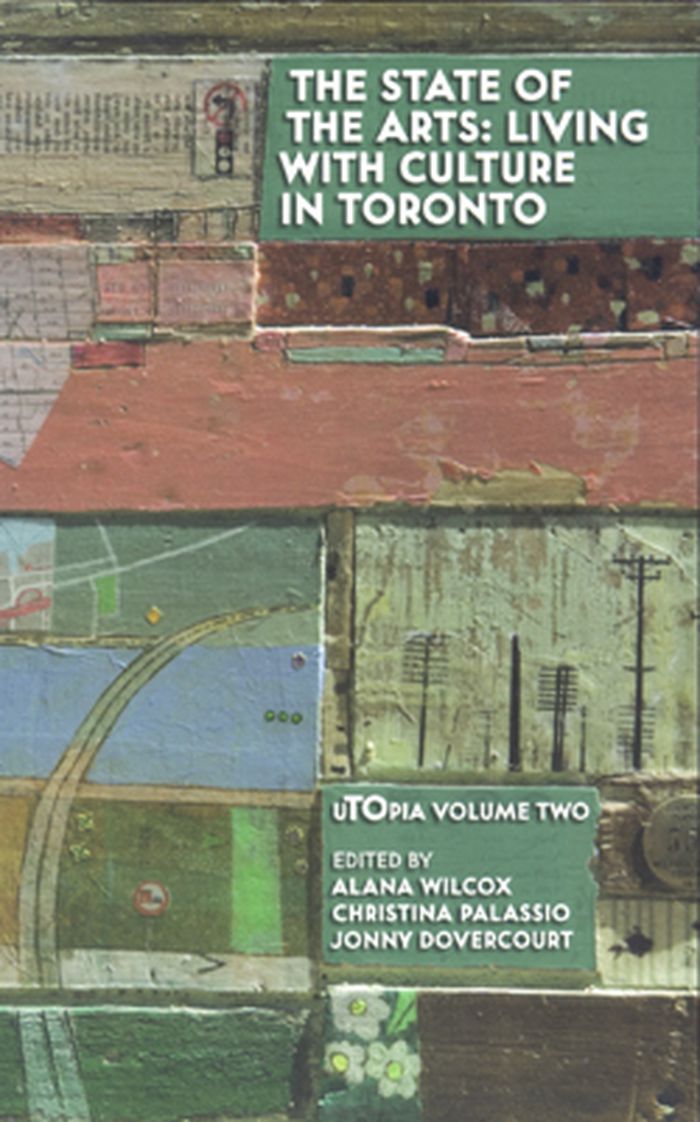
Freakier rich people. More suburban art. A venue for new music. Better staplers. An infrastructure for hip-hop. Laneway art. More wi-fi. A more understanding marriage between art and business. Affordable live-work spaces. What would make Toronto a better place for the arts? City Hall proclaimed 2006 the Year of Creativity. ‘Live With Culture’ banners flap over the city. And across the city, donors are ponying up millions for the ROM and the AGO. Culture’s never had it so good. Right? The State of the Arts explores the Toronto culture scene from every angle, applauding, assailing and arguing about art in our fair burg. The essays consider the big-ticket and the ticket-free, from the CNE to unintentional art. In between, you'll find thoughts on the ’creative city’ and photobloggers, Toronto on film and the fine line between part and art. Taken together the thoughts of these writers, artists and city-builders create a snapshot of culture in T.O. as it grows from ’Toronto the Good’ to ’Toronto the Could’ to ’Toronto the Can-Do.’ Includes sixteen colour pages of eye-level Toronto, and cover art by Susan Szenes. With essays by Sandra Alland, Jason Anderson, Anna Bowness, Stephen Cain, Kate Carraway, Hanna Cho, Brendan Cormier, Natalie De Vito, Liz Forsberg, Mark Fram, Marc Glassman, Katarina Gligorijevic-Collins, Brenda Goldstein, Amy Lavender Harris, Karen Hines, Sarah B. Hood, Christopher Hume, Sam Javanrouh, Dory Kornfeld, Adam Krawesky, More Or Les, John Lorinc, James MacNevin, Claudia McKoy, Brian McLachlan, Ryan McLaren, Shawn Micallef, Jill Murray, Matt O'Sullivan, Christopher Pandolfi, Michael Redhill, Dylan Reid, Damian Rogers, Stuart Ross, Lisa Rundle, Dana Samuel, Nadja Sayej, Susan Szenes, Kevin Temple, Pablo Torres, Gayla Trail, Rannie Turingan, Jason van Eyk, Adam Vaughan, RM Vaughan, Stéphanie Verge, Lisa Whittington-Hill and Carl Wilson.
The state of the arts: living with culture in Toronto
Actions:
Price:
$24.95
(available to order)
Summary:
Freakier rich people. More suburban art. A venue for new music. Better staplers. An infrastructure for hip-hop. Laneway art. More wi-fi. A more understanding marriage between art and business. Affordable live-work spaces. What would make Toronto a better place for the arts? City Hall proclaimed 2006 the Year of Creativity. ‘Live With Culture’ banners flap over the city. And across the city, donors are ponying up millions for the ROM and the AGO. Culture’s never had it so good. Right? The State of the Arts explores the Toronto culture scene from every angle, applauding, assailing and arguing about art in our fair burg. The essays consider the big-ticket and the ticket-free, from the CNE to unintentional art. In between, you'll find thoughts on the ’creative city’ and photobloggers, Toronto on film and the fine line between part and art. Taken together the thoughts of these writers, artists and city-builders create a snapshot of culture in T.O. as it grows from ’Toronto the Good’ to ’Toronto the Could’ to ’Toronto the Can-Do.’ Includes sixteen colour pages of eye-level Toronto, and cover art by Susan Szenes. With essays by Sandra Alland, Jason Anderson, Anna Bowness, Stephen Cain, Kate Carraway, Hanna Cho, Brendan Cormier, Natalie De Vito, Liz Forsberg, Mark Fram, Marc Glassman, Katarina Gligorijevic-Collins, Brenda Goldstein, Amy Lavender Harris, Karen Hines, Sarah B. Hood, Christopher Hume, Sam Javanrouh, Dory Kornfeld, Adam Krawesky, More Or Les, John Lorinc, James MacNevin, Claudia McKoy, Brian McLachlan, Ryan McLaren, Shawn Micallef, Jill Murray, Matt O'Sullivan, Christopher Pandolfi, Michael Redhill, Dylan Reid, Damian Rogers, Stuart Ross, Lisa Rundle, Dana Samuel, Nadja Sayej, Susan Szenes, Kevin Temple, Pablo Torres, Gayla Trail, Rannie Turingan, Jason van Eyk, Adam Vaughan, RM Vaughan, Stéphanie Verge, Lisa Whittington-Hill and Carl Wilson.
Form:
books
books
Publication:
November 2006, Toronto
November 2006, Toronto
Subject:
Architecture in Canada
Architecture in Canada
Form:
books
books
Title:
Humans / Mike Mills
Humans / Mike Mills
Actions:
Price:
$20.00
(available in store)
Summary:
'Humans Manifesto. No plan survives first contact with the enemy. Sometimes being dumb is the only smart alternative. Shy people are secretly egoists. Nothing is real. Everything you see is a dream you project onto the world. Children live out their parents unconscious. The only animals that suffer from anxiety are the ones that associate with humans. I don’t(...)
$20.00
(available in store)
Summary:
'Humans Manifesto. No plan survives first contact with the enemy. Sometimes being dumb is the only smart alternative. Shy people are secretly egoists. Nothing is real. Everything you see is a dream you project onto the world. Children live out their parents unconscious. The only animals that suffer from anxiety are the ones that associate with humans. I don’t(...)
Title:
Humans / Mike Mills
Actions:
Price:
$20.00
(available in store)
Summary:
'Humans Manifesto. No plan survives first contact with the enemy. Sometimes being dumb is the only smart alternative. Shy people are secretly egoists. Nothing is real. Everything you see is a dream you project onto the world. Children live out their parents unconscious. The only animals that suffer from anxiety are the ones that associate with humans. I don’t trust people who are very articulate. The only way to be sane is to embrace your insanity. When you feel guilty about being sad, remember Walt Disney was a manic depressive. Everything I said could be totally wrong.' Mills’ intent is not to make a statement but to ask questions, to make people more curious: “I hope the things I make can grow on people over time. At first it is just a drawing of cracks, then later, after living with the design you have more personal associations with it, it means more things, it becomes more emotional.” Mike Mills is widely renown as a graphic artist and filmmaker. He has been defined as one of the creative visionaries of our times, responsible for album covers and music videos for bands such as the Beastie Boys, Sonic Youth, Beck and Air. Mills has directed various commercials, music videos, and short films and his first feature film, Thumbsucker, adapted by Mills from the homonymous novel by Walter Kirn will be released this fall. As a graphic designer, Mills designed the famous X-Girl logo and shirts graphics, Kim Gordon and Daisy Von Furth’s clothing company, as well as skateboard graphics for Supreme, Stereo and Subliminal. For Marc Jacobs he designed scarves and fabrics, and other fashion related graphics for Esprit and The Gap
Humans / Mike Mills
Actions:
Price:
$20.00
(available in store)
Summary:
'Humans Manifesto. No plan survives first contact with the enemy. Sometimes being dumb is the only smart alternative. Shy people are secretly egoists. Nothing is real. Everything you see is a dream you project onto the world. Children live out their parents unconscious. The only animals that suffer from anxiety are the ones that associate with humans. I don’t trust people who are very articulate. The only way to be sane is to embrace your insanity. When you feel guilty about being sad, remember Walt Disney was a manic depressive. Everything I said could be totally wrong.' Mills’ intent is not to make a statement but to ask questions, to make people more curious: “I hope the things I make can grow on people over time. At first it is just a drawing of cracks, then later, after living with the design you have more personal associations with it, it means more things, it becomes more emotional.” Mike Mills is widely renown as a graphic artist and filmmaker. He has been defined as one of the creative visionaries of our times, responsible for album covers and music videos for bands such as the Beastie Boys, Sonic Youth, Beck and Air. Mills has directed various commercials, music videos, and short films and his first feature film, Thumbsucker, adapted by Mills from the homonymous novel by Walter Kirn will be released this fall. As a graphic designer, Mills designed the famous X-Girl logo and shirts graphics, Kim Gordon and Daisy Von Furth’s clothing company, as well as skateboard graphics for Supreme, Stereo and Subliminal. For Marc Jacobs he designed scarves and fabrics, and other fashion related graphics for Esprit and The Gap
Form:
books
books
Publication:
January 2003, Zürich
January 2003, Zürich
Subject:
Graphic Design and Typography
Graphic Design and Typography
Form:
books
books
Actions:
Price:
$33.95
(available to order)
Summary:
"Fuel" is an idiosyncratic, speculative dictionary of fuels, real and imagined, historical and futuristic, hopeless and utopian. Drawing on literature, film, and scientific treatises--most produced long before "climate change" was in circulation--"Fuel" argues for a distinction between energy (a system of power) and fuel (a substance, which can be thought of as(...)
$33.95
(available to order)
Summary:
"Fuel" is an idiosyncratic, speculative dictionary of fuels, real and imagined, historical and futuristic, hopeless and utopian. Drawing on literature, film, and scientific treatises--most produced long before "climate change" was in circulation--"Fuel" argues for a distinction between energy (a system of power) and fuel (a substance, which can be thought of as(...)
Title:
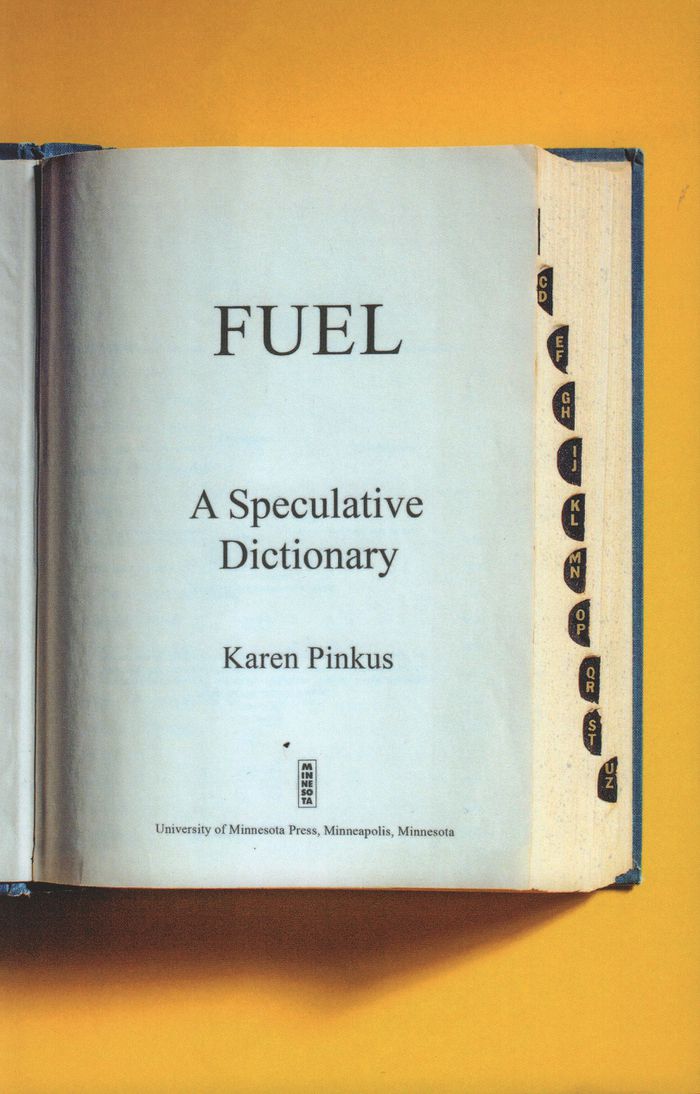
Fuel : a speculative dictionary
Actions:
Price:
$33.95
(available to order)
Summary:
"Fuel" is an idiosyncratic, speculative dictionary of fuels, real and imagined, historical and futuristic, hopeless and utopian. Drawing on literature, film, and scientific treatises--most produced long before "climate change" was in circulation--"Fuel" argues for a distinction between energy (a system of power) and fuel (a substance, which can be thought of as "potentiality") as it endeavors to undo the dream that we can simply switch to renewables and all will be golden. From "Air" to "Zyklon B," entries in this unusual "dictionary" include Algae, Clathrates, Dilithium, Fleece, Goats, Theology, Whale Oil, and many, many more. The tone of the entries ranges as widely as the topics: from historical anecdotes (the Ford Fiesta "boozemobile") to eccentric readings of the classics of "energy lit" ( Germinal and Oil! ); from literary observations (a high octane Odyssey ?) to excursions into literary theory. The dictionary draws from an eccentric canon, including works by Jules Verne, George Eliot's Silas Marner , Paolo Bacigalupi's Windup Girl , and the Tom Cruise vehicle Oblivion , among others. A message from this ambitious project is that energy can be understood as a heterogeneous set of self-mystifying systems or machines that block access to thought as they fascinate us. Fuels emerge as more primal elements that the audience can grasp at various points along the way to consumption/combustion. This dictionary can help scramble our thinking about fuel--not in order to demonize energy and not in order to create a new hierarchy in which certain renewables take over from fossil fuels but instead to open up potential ways of interacting with real and imaginary substances, by wrenching them out of narrative and placing them into an idiosyncratic dictionary to be applied by readers into new narratives.
Fuel : a speculative dictionary
Actions:
Price:
$33.95
(available to order)
Summary:
"Fuel" is an idiosyncratic, speculative dictionary of fuels, real and imagined, historical and futuristic, hopeless and utopian. Drawing on literature, film, and scientific treatises--most produced long before "climate change" was in circulation--"Fuel" argues for a distinction between energy (a system of power) and fuel (a substance, which can be thought of as "potentiality") as it endeavors to undo the dream that we can simply switch to renewables and all will be golden. From "Air" to "Zyklon B," entries in this unusual "dictionary" include Algae, Clathrates, Dilithium, Fleece, Goats, Theology, Whale Oil, and many, many more. The tone of the entries ranges as widely as the topics: from historical anecdotes (the Ford Fiesta "boozemobile") to eccentric readings of the classics of "energy lit" ( Germinal and Oil! ); from literary observations (a high octane Odyssey ?) to excursions into literary theory. The dictionary draws from an eccentric canon, including works by Jules Verne, George Eliot's Silas Marner , Paolo Bacigalupi's Windup Girl , and the Tom Cruise vehicle Oblivion , among others. A message from this ambitious project is that energy can be understood as a heterogeneous set of self-mystifying systems or machines that block access to thought as they fascinate us. Fuels emerge as more primal elements that the audience can grasp at various points along the way to consumption/combustion. This dictionary can help scramble our thinking about fuel--not in order to demonize energy and not in order to create a new hierarchy in which certain renewables take over from fossil fuels but instead to open up potential ways of interacting with real and imaginary substances, by wrenching them out of narrative and placing them into an idiosyncratic dictionary to be applied by readers into new narratives.
Form:
books
books
Publication:
November 2016
November 2016
Subject:
Environment and environmental theory
Environment and environmental theory


