


5707 Results
Form:
textual records
textual records
Actions:
Reference number:
ARCH253907
Description:
draft report: The Community/Airport Economic Development Model: Land Use Compatibility Tables. CAEDM Internal Working Paper V. By CONSAD Research Corporation. August 1971.
ARCH253907
Description:
draft report: The Community/Airport Economic Development Model: Land Use Compatibility Tables. CAEDM Internal Working Paper V. By CONSAD Research Corporation. August 1971.
People:
Date:
1971
1971
Title:
CAEDM - Land Use Compatibility Tables
Actions:
ARCH253907
Description:
draft report: The Community/Airport Economic Development Model: Land Use Compatibility Tables. CAEDM Internal Working Paper V. By CONSAD Research Corporation. August 1971.
CAEDM - Land Use Compatibility Tables
Actions:
ARCH253907
Description:
draft report: The Community/Airport Economic Development Model: Land Use Compatibility Tables. CAEDM Internal Working Paper V. By CONSAD Research Corporation. August 1971.
Form:
textual records
textual records
Date:
1971
1971
People:
Form:
textual records
textual records
Actions:
Reference number:
ARCH273108
Description:
File contains predominantly textual records relating to the Community Planning Association of Canada/American Society of Planning Officials1975 Joint Planning Conference. File also includes negatives.
ARCH273108
Description:
File contains predominantly textual records relating to the Community Planning Association of Canada/American Society of Planning Officials1975 Joint Planning Conference. File also includes negatives.
People:
Date:
1974-1975
1974-1975
Title:
ASPO conference planning and notes
Actions:
ARCH273108
Description:
File contains predominantly textual records relating to the Community Planning Association of Canada/American Society of Planning Officials1975 Joint Planning Conference. File also includes negatives.
ASPO conference planning and notes
Actions:
ARCH273108
Description:
File contains predominantly textual records relating to the Community Planning Association of Canada/American Society of Planning Officials1975 Joint Planning Conference. File also includes negatives.
Form:
textual records
textual records
Date:
1974-1975
1974-1975
People:
Form:
textual records
textual records
Title:
CAEDM - Interim Report
CAEDM - Interim Report
Actions:
Reference number:
ARCH253893
Description:
annotated draft report: The Community Airport Economic Development Model. Interim Report. By CONSAD Research Corporation, for Federal Aviation Administration. U.S. Department of Transportation. September 1971. bound
ARCH253893
Description:
annotated draft report: The Community Airport Economic Development Model. Interim Report. By CONSAD Research Corporation, for Federal Aviation Administration. U.S. Department of Transportation. September 1971. bound
People:
Date:
1971
1971
Title:
CAEDM - Interim Report
Actions:
ARCH253893
Description:
annotated draft report: The Community Airport Economic Development Model. Interim Report. By CONSAD Research Corporation, for Federal Aviation Administration. U.S. Department of Transportation. September 1971. bound
CAEDM - Interim Report
Actions:
ARCH253893
Description:
annotated draft report: The Community Airport Economic Development Model. Interim Report. By CONSAD Research Corporation, for Federal Aviation Administration. U.S. Department of Transportation. September 1971. bound
Form:
textual records
textual records
Date:
1971
1971
People:
Form:
photographs
photographs
Actions:
Reference number:
ARCH259591
Description:
Photo prints of Simon Fraser University, University of Lethbridge, Graham House, Canadian Pavilion Expo '70, Macmillan Bloedel Office Building, Man and the Community Pavilion Expo '67
ARCH259591
Description:
Photo prints of Simon Fraser University, University of Lethbridge, Graham House, Canadian Pavilion Expo '70, Macmillan Bloedel Office Building, Man and the Community Pavilion Expo '67
People:
Title:
Projects photographs for promotion
Actions:
ARCH259591
Description:
Photo prints of Simon Fraser University, University of Lethbridge, Graham House, Canadian Pavilion Expo '70, Macmillan Bloedel Office Building, Man and the Community Pavilion Expo '67
Projects photographs for promotion
Actions:
ARCH259591
Description:
Photo prints of Simon Fraser University, University of Lethbridge, Graham House, Canadian Pavilion Expo '70, Macmillan Bloedel Office Building, Man and the Community Pavilion Expo '67
Form:
photographs
photographs
People:
Form:
textual records
textual records
Actions:
Reference number:
ARCH255165
Description:
correspondence and documentation files - concerning Bunker Hill joint venture agreement; list of issues, considerations, and implicationgs of surrounding site; informational Development Offering, from the Community Redevelopment Agency.
ARCH255165
Description:
correspondence and documentation files - concerning Bunker Hill joint venture agreement; list of issues, considerations, and implicationgs of surrounding site; informational Development Offering, from the Community Redevelopment Agency.
People:
Date:
1979
1979
Title:
Correspondence and documentation files
Actions:
ARCH255165
Description:
correspondence and documentation files - concerning Bunker Hill joint venture agreement; list of issues, considerations, and implicationgs of surrounding site; informational Development Offering, from the Community Redevelopment Agency.
Correspondence and documentation files
Actions:
ARCH255165
Description:
correspondence and documentation files - concerning Bunker Hill joint venture agreement; list of issues, considerations, and implicationgs of surrounding site; informational Development Offering, from the Community Redevelopment Agency.
Form:
textual records
textual records
Date:
1979
1979
People:
Form:
drawings
drawings
Actions:
Reference number:
AP140.S1.SS1.D8.P1.1
Description:
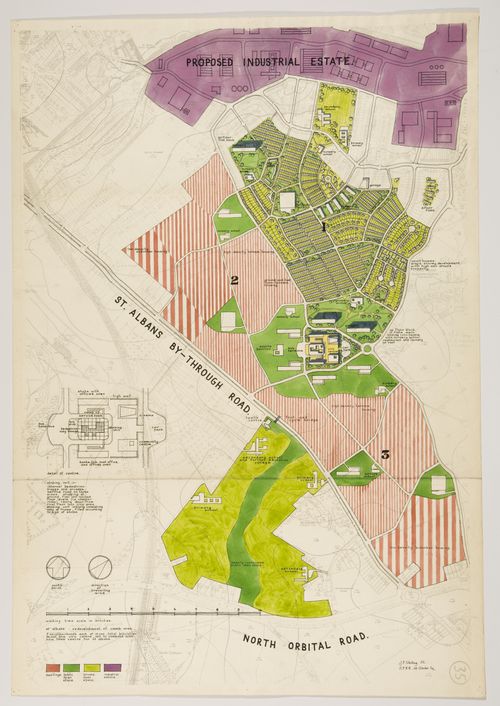
rendered plan for three neighbourhoods and a civic centre, including different housing types, site plan for the civic centre including a pedestrian shopping plaza, community centre and cinema, bus terminus and car park
AP140.S1.SS1.D8.P1.1
Description:
rendered plan for three neighbourhoods and a civic centre, including different housing types, site plan for the civic centre including a pedestrian shopping plaza, community centre and cinema, bus terminus and car park
People:
Date:
1952
1952
Title:
Redevelopment of Camp Area, Saint Albans, England: site plan
Actions:
AP140.S1.SS1.D8.P1.1
Description:
rendered plan for three neighbourhoods and a civic centre, including different housing types, site plan for the civic centre including a pedestrian shopping plaza, community centre and cinema, bus terminus and car park
Redevelopment of Camp Area, Saint Albans, England: site plan
Actions:
AP140.S1.SS1.D8.P1.1
Description:
rendered plan for three neighbourhoods and a civic centre, including different housing types, site plan for the civic centre including a pedestrian shopping plaza, community centre and cinema, bus terminus and car park
Form:
drawings
drawings
Date:
1952
1952
People:
Form:
textual records
textual records
Actions:
Reference number:
ARCH253895
Description:
draft report: Community/Airport Economic Development Model. Volume II Application to Dulles International Airport. By CONSAD Research Corporation, for Federal Aviation Administration. U.S. Department of Transportation. April 1972.
ARCH253895
Description:
draft report: Community/Airport Economic Development Model. Volume II Application to Dulles International Airport. By CONSAD Research Corporation, for Federal Aviation Administration. U.S. Department of Transportation. April 1972.
People:
Date:
1972
1972
Title:
CAEDM - Vol. II - Application to Dulles International Airport
Actions:
ARCH253895
Description:
draft report: Community/Airport Economic Development Model. Volume II Application to Dulles International Airport. By CONSAD Research Corporation, for Federal Aviation Administration. U.S. Department of Transportation. April 1972.
CAEDM - Vol. II - Application to Dulles International Airport
Actions:
ARCH253895
Description:
draft report: Community/Airport Economic Development Model. Volume II Application to Dulles International Airport. By CONSAD Research Corporation, for Federal Aviation Administration. U.S. Department of Transportation. April 1972.
Form:
textual records
textual records
Date:
1972
1972
People:
Level of archival description:
Sub-series
Sub-series
Reference number:
CI001.S1.D3
Description:
The urban and public architecture of Hubert Rohault de Fleury is insightful concerning both the stylistic directions of utilitarian architecture in France and the structure and role of the government architectural services (1) in the Empire and the Restoration. The drawings in the CCA collection depict built and unbuilt projects undertaken in the context of Hubert's positions in the government architectural services as well as private commissions. Hubert's principal official positions related to three branches of the French government: the Préfecture de la police, the Conseil général des hospices and the Conseil des Bâtiments Civils, a "division" of the Ministère de l'interieur. Hubert's work for the Préfecture de la police (which was also responsible for the gendarmerie and the sapeurs-pompiers barracks) is represented in the CCA collection by projects for four gendarmerie barracks (1821-1830) and alterations to the Préfecture de la Police (1833 ?) and nearby prison in Paris (1819)(DR1974:0002:016:001-070 / DR1974:0002:011:001-089 and DR1974:0002: 015:001-070). The drawings in these albums emphasize the planning (or re-arrangement) of the interior spaces. The album for the Préfecture de la police also includes record drawings for prisons in England and France as background material for Hubert's work and/or related to reports for the Conseil des Bâtiments Civils, which had an active role in the design of prisons throughout France during the early years of the nineteenth century (2). Although the CCA collection has no drawings directly related to Hubert's position as the architecte des hospices (3), drawings and prints are included for his earlier ideal hospitals (ca. 1810) (DR1974:0002:008:001-077). These projects continue the late 17th and 18th century tradition of monumental geometrically laid-out ideal hospitals. This album also contains prints and drawings of medical buildings by other architects (probably reference material), and drawings of Hubert's unexecuted proposal for the re-development of the École de médecine (Paris) and the surrounding buildings and urban spaces. Hubert was the architecte de l'École de medicine (4); a position that probably related to his work for the Ministère d'Interieur, which would have been responsible for this building. In general, Hubert's role and responsibilities within the Ministère de l'interieur and the associated Conseil de Bâtiment Civils (especially prior to his appointment to the position of inspecteur gènèral in 1830) are the least clear of his government positions. In addition to the École de medicine album, two other albums contain projects relating to the Ministère de l'Interieur: two proposals for Place Louis XV commissioned by the Ministre de l'interieur, Duc Decazes in 1821 (DR1974:0002:037:001-031), and drawings for the conversion or renovation of several Parisian hôtel particuliers (probably between 1810 and ca. 1820) including those used by the Ministère de l'interieur, Ministère de la Guerre and the Ministère des affaires étrangères (DR1974:0002;011:001-089). On other government commission of significance is represented in the CCA collection. In 1819, Hubert Rohault de Fleury in collaboration with Etienne Hyppolite Godde was commissioned to direct the restoration of the Thermes de Julien located under the Hôtel de Cluny. The CCA collection includes several letters and drawings, and a report related to this commission (DR1974:0002 :037:001-031). Hubert's private urban projects, mostly commissioned by private entrepreneurs or societies, were concerned with the expansion of the infrastructure of Paris and the surrounding communities as well as, to some extent, larger issues of urban development. One album contains projects dating from between 1819 and 1836 related horses - an essential part of 19th century urban life (5): a stud-farm (Haras de Madrid, Bois de Boulogne), an auction house and an infirmary (Clos St. Charles, Clos d'équarrissage, fôret de Bondy) and three slaughterhouses (Plaine de Grenelle, an unnamed project and La Villete (6))(DR1974:0002:014:001-104). These album also includes developmental studies for a new quartier of Paris - Nouveau Quartier Poissonière (the site of today's 10e arrondissement). A second album (ca. 1825) includes designs for a "maison de blanchisseur", an "entrepot de vins" with adjacent "guingette" and designs for structures at Parc de Clichy - a reservoir, a washhouse and a manège (DR1974:0002:009:001-079) (7). The drawings in these albums are particularly informative regarding the materials, structures and mechanical systems utilized. As with most of his government commissions, for these buildings, Hubert adopted a sparse architectural syntax of pared-down classical motifs and regimented plans grounded in the ideas of Durand and commonly used in utilitarian buildings during the 19th century. (1) These are discussed in some detail in Chapter 2 of David Van Zanten, 'Building Paris' (Cambridge: Cambridge University Press, 1994). (2) Van Zanten, 'Building Paris', 51-52. (3) The Cabinet des Estampes at the Musée Carnavalet in Paris has drawings related to Hubert's work for the Conseil général des hospices. (4) Evidence of this position is based on inscriptions on drawings in album, DR1974:0002:008:001-77. (5) Bergdoll, 4. (6) The La Villete slaughterhouse was designed by Charles Rohault de Fleury. (7) The source(s) of these commissions is unknown.
CI001.S1.D3
Description:
The urban and public architecture of Hubert Rohault de Fleury is insightful concerning both the stylistic directions of utilitarian architecture in France and the structure and role of the government architectural services (1) in the Empire and the Restoration. The drawings in the CCA collection depict built and unbuilt projects undertaken in the context of Hubert's positions in the government architectural services as well as private commissions. Hubert's principal official positions related to three branches of the French government: the Préfecture de la police, the Conseil général des hospices and the Conseil des Bâtiments Civils, a "division" of the Ministère de l'interieur. Hubert's work for the Préfecture de la police (which was also responsible for the gendarmerie and the sapeurs-pompiers barracks) is represented in the CCA collection by projects for four gendarmerie barracks (1821-1830) and alterations to the Préfecture de la Police (1833 ?) and nearby prison in Paris (1819)(DR1974:0002:016:001-070 / DR1974:0002:011:001-089 and DR1974:0002: 015:001-070). The drawings in these albums emphasize the planning (or re-arrangement) of the interior spaces. The album for the Préfecture de la police also includes record drawings for prisons in England and France as background material for Hubert's work and/or related to reports for the Conseil des Bâtiments Civils, which had an active role in the design of prisons throughout France during the early years of the nineteenth century (2). Although the CCA collection has no drawings directly related to Hubert's position as the architecte des hospices (3), drawings and prints are included for his earlier ideal hospitals (ca. 1810) (DR1974:0002:008:001-077). These projects continue the late 17th and 18th century tradition of monumental geometrically laid-out ideal hospitals. This album also contains prints and drawings of medical buildings by other architects (probably reference material), and drawings of Hubert's unexecuted proposal for the re-development of the École de médecine (Paris) and the surrounding buildings and urban spaces. Hubert was the architecte de l'École de medicine (4); a position that probably related to his work for the Ministère d'Interieur, which would have been responsible for this building. In general, Hubert's role and responsibilities within the Ministère de l'interieur and the associated Conseil de Bâtiment Civils (especially prior to his appointment to the position of inspecteur gènèral in 1830) are the least clear of his government positions. In addition to the École de medicine album, two other albums contain projects relating to the Ministère de l'Interieur: two proposals for Place Louis XV commissioned by the Ministre de l'interieur, Duc Decazes in 1821 (DR1974:0002:037:001-031), and drawings for the conversion or renovation of several Parisian hôtel particuliers (probably between 1810 and ca. 1820) including those used by the Ministère de l'interieur, Ministère de la Guerre and the Ministère des affaires étrangères (DR1974:0002;011:001-089). On other government commission of significance is represented in the CCA collection. In 1819, Hubert Rohault de Fleury in collaboration with Etienne Hyppolite Godde was commissioned to direct the restoration of the Thermes de Julien located under the Hôtel de Cluny. The CCA collection includes several letters and drawings, and a report related to this commission (DR1974:0002 :037:001-031). Hubert's private urban projects, mostly commissioned by private entrepreneurs or societies, were concerned with the expansion of the infrastructure of Paris and the surrounding communities as well as, to some extent, larger issues of urban development. One album contains projects dating from between 1819 and 1836 related horses - an essential part of 19th century urban life (5): a stud-farm (Haras de Madrid, Bois de Boulogne), an auction house and an infirmary (Clos St. Charles, Clos d'équarrissage, fôret de Bondy) and three slaughterhouses (Plaine de Grenelle, an unnamed project and La Villete (6))(DR1974:0002:014:001-104). These album also includes developmental studies for a new quartier of Paris - Nouveau Quartier Poissonière (the site of today's 10e arrondissement). A second album (ca. 1825) includes designs for a "maison de blanchisseur", an "entrepot de vins" with adjacent "guingette" and designs for structures at Parc de Clichy - a reservoir, a washhouse and a manège (DR1974:0002:009:001-079) (7). The drawings in these albums are particularly informative regarding the materials, structures and mechanical systems utilized. As with most of his government commissions, for these buildings, Hubert adopted a sparse architectural syntax of pared-down classical motifs and regimented plans grounded in the ideas of Durand and commonly used in utilitarian buildings during the 19th century. (1) These are discussed in some detail in Chapter 2 of David Van Zanten, 'Building Paris' (Cambridge: Cambridge University Press, 1994). (2) Van Zanten, 'Building Paris', 51-52. (3) The Cabinet des Estampes at the Musée Carnavalet in Paris has drawings related to Hubert's work for the Conseil général des hospices. (4) Evidence of this position is based on inscriptions on drawings in album, DR1974:0002:008:001-77. (5) Bergdoll, 4. (6) The La Villete slaughterhouse was designed by Charles Rohault de Fleury. (7) The source(s) of these commissions is unknown.
People:
Date:
1754-1875
1754-1875
Title:
Public and Urban architecture
CI001.S1.D3
Description:
The urban and public architecture of Hubert Rohault de Fleury is insightful concerning both the stylistic directions of utilitarian architecture in France and the structure and role of the government architectural services (1) in the Empire and the Restoration. The drawings in the CCA collection depict built and unbuilt projects undertaken in the context of Hubert's positions in the government architectural services as well as private commissions. Hubert's principal official positions related to three branches of the French government: the Préfecture de la police, the Conseil général des hospices and the Conseil des Bâtiments Civils, a "division" of the Ministère de l'interieur. Hubert's work for the Préfecture de la police (which was also responsible for the gendarmerie and the sapeurs-pompiers barracks) is represented in the CCA collection by projects for four gendarmerie barracks (1821-1830) and alterations to the Préfecture de la Police (1833 ?) and nearby prison in Paris (1819)(DR1974:0002:016:001-070 / DR1974:0002:011:001-089 and DR1974:0002: 015:001-070). The drawings in these albums emphasize the planning (or re-arrangement) of the interior spaces. The album for the Préfecture de la police also includes record drawings for prisons in England and France as background material for Hubert's work and/or related to reports for the Conseil des Bâtiments Civils, which had an active role in the design of prisons throughout France during the early years of the nineteenth century (2). Although the CCA collection has no drawings directly related to Hubert's position as the architecte des hospices (3), drawings and prints are included for his earlier ideal hospitals (ca. 1810) (DR1974:0002:008:001-077). These projects continue the late 17th and 18th century tradition of monumental geometrically laid-out ideal hospitals. This album also contains prints and drawings of medical buildings by other architects (probably reference material), and drawings of Hubert's unexecuted proposal for the re-development of the École de médecine (Paris) and the surrounding buildings and urban spaces. Hubert was the architecte de l'École de medicine (4); a position that probably related to his work for the Ministère d'Interieur, which would have been responsible for this building. In general, Hubert's role and responsibilities within the Ministère de l'interieur and the associated Conseil de Bâtiment Civils (especially prior to his appointment to the position of inspecteur gènèral in 1830) are the least clear of his government positions. In addition to the École de medicine album, two other albums contain projects relating to the Ministère de l'Interieur: two proposals for Place Louis XV commissioned by the Ministre de l'interieur, Duc Decazes in 1821 (DR1974:0002:037:001-031), and drawings for the conversion or renovation of several Parisian hôtel particuliers (probably between 1810 and ca. 1820) including those used by the Ministère de l'interieur, Ministère de la Guerre and the Ministère des affaires étrangères (DR1974:0002;011:001-089). On other government commission of significance is represented in the CCA collection. In 1819, Hubert Rohault de Fleury in collaboration with Etienne Hyppolite Godde was commissioned to direct the restoration of the Thermes de Julien located under the Hôtel de Cluny. The CCA collection includes several letters and drawings, and a report related to this commission (DR1974:0002 :037:001-031). Hubert's private urban projects, mostly commissioned by private entrepreneurs or societies, were concerned with the expansion of the infrastructure of Paris and the surrounding communities as well as, to some extent, larger issues of urban development. One album contains projects dating from between 1819 and 1836 related horses - an essential part of 19th century urban life (5): a stud-farm (Haras de Madrid, Bois de Boulogne), an auction house and an infirmary (Clos St. Charles, Clos d'équarrissage, fôret de Bondy) and three slaughterhouses (Plaine de Grenelle, an unnamed project and La Villete (6))(DR1974:0002:014:001-104). These album also includes developmental studies for a new quartier of Paris - Nouveau Quartier Poissonière (the site of today's 10e arrondissement). A second album (ca. 1825) includes designs for a "maison de blanchisseur", an "entrepot de vins" with adjacent "guingette" and designs for structures at Parc de Clichy - a reservoir, a washhouse and a manège (DR1974:0002:009:001-079) (7). The drawings in these albums are particularly informative regarding the materials, structures and mechanical systems utilized. As with most of his government commissions, for these buildings, Hubert adopted a sparse architectural syntax of pared-down classical motifs and regimented plans grounded in the ideas of Durand and commonly used in utilitarian buildings during the 19th century. (1) These are discussed in some detail in Chapter 2 of David Van Zanten, 'Building Paris' (Cambridge: Cambridge University Press, 1994). (2) Van Zanten, 'Building Paris', 51-52. (3) The Cabinet des Estampes at the Musée Carnavalet in Paris has drawings related to Hubert's work for the Conseil général des hospices. (4) Evidence of this position is based on inscriptions on drawings in album, DR1974:0002:008:001-77. (5) Bergdoll, 4. (6) The La Villete slaughterhouse was designed by Charles Rohault de Fleury. (7) The source(s) of these commissions is unknown.
Public and Urban architecture
CI001.S1.D3
Description:
The urban and public architecture of Hubert Rohault de Fleury is insightful concerning both the stylistic directions of utilitarian architecture in France and the structure and role of the government architectural services (1) in the Empire and the Restoration. The drawings in the CCA collection depict built and unbuilt projects undertaken in the context of Hubert's positions in the government architectural services as well as private commissions. Hubert's principal official positions related to three branches of the French government: the Préfecture de la police, the Conseil général des hospices and the Conseil des Bâtiments Civils, a "division" of the Ministère de l'interieur. Hubert's work for the Préfecture de la police (which was also responsible for the gendarmerie and the sapeurs-pompiers barracks) is represented in the CCA collection by projects for four gendarmerie barracks (1821-1830) and alterations to the Préfecture de la Police (1833 ?) and nearby prison in Paris (1819)(DR1974:0002:016:001-070 / DR1974:0002:011:001-089 and DR1974:0002: 015:001-070). The drawings in these albums emphasize the planning (or re-arrangement) of the interior spaces. The album for the Préfecture de la police also includes record drawings for prisons in England and France as background material for Hubert's work and/or related to reports for the Conseil des Bâtiments Civils, which had an active role in the design of prisons throughout France during the early years of the nineteenth century (2). Although the CCA collection has no drawings directly related to Hubert's position as the architecte des hospices (3), drawings and prints are included for his earlier ideal hospitals (ca. 1810) (DR1974:0002:008:001-077). These projects continue the late 17th and 18th century tradition of monumental geometrically laid-out ideal hospitals. This album also contains prints and drawings of medical buildings by other architects (probably reference material), and drawings of Hubert's unexecuted proposal for the re-development of the École de médecine (Paris) and the surrounding buildings and urban spaces. Hubert was the architecte de l'École de medicine (4); a position that probably related to his work for the Ministère d'Interieur, which would have been responsible for this building. In general, Hubert's role and responsibilities within the Ministère de l'interieur and the associated Conseil de Bâtiment Civils (especially prior to his appointment to the position of inspecteur gènèral in 1830) are the least clear of his government positions. In addition to the École de medicine album, two other albums contain projects relating to the Ministère de l'Interieur: two proposals for Place Louis XV commissioned by the Ministre de l'interieur, Duc Decazes in 1821 (DR1974:0002:037:001-031), and drawings for the conversion or renovation of several Parisian hôtel particuliers (probably between 1810 and ca. 1820) including those used by the Ministère de l'interieur, Ministère de la Guerre and the Ministère des affaires étrangères (DR1974:0002;011:001-089). On other government commission of significance is represented in the CCA collection. In 1819, Hubert Rohault de Fleury in collaboration with Etienne Hyppolite Godde was commissioned to direct the restoration of the Thermes de Julien located under the Hôtel de Cluny. The CCA collection includes several letters and drawings, and a report related to this commission (DR1974:0002 :037:001-031). Hubert's private urban projects, mostly commissioned by private entrepreneurs or societies, were concerned with the expansion of the infrastructure of Paris and the surrounding communities as well as, to some extent, larger issues of urban development. One album contains projects dating from between 1819 and 1836 related horses - an essential part of 19th century urban life (5): a stud-farm (Haras de Madrid, Bois de Boulogne), an auction house and an infirmary (Clos St. Charles, Clos d'équarrissage, fôret de Bondy) and three slaughterhouses (Plaine de Grenelle, an unnamed project and La Villete (6))(DR1974:0002:014:001-104). These album also includes developmental studies for a new quartier of Paris - Nouveau Quartier Poissonière (the site of today's 10e arrondissement). A second album (ca. 1825) includes designs for a "maison de blanchisseur", an "entrepot de vins" with adjacent "guingette" and designs for structures at Parc de Clichy - a reservoir, a washhouse and a manège (DR1974:0002:009:001-079) (7). The drawings in these albums are particularly informative regarding the materials, structures and mechanical systems utilized. As with most of his government commissions, for these buildings, Hubert adopted a sparse architectural syntax of pared-down classical motifs and regimented plans grounded in the ideas of Durand and commonly used in utilitarian buildings during the 19th century. (1) These are discussed in some detail in Chapter 2 of David Van Zanten, 'Building Paris' (Cambridge: Cambridge University Press, 1994). (2) Van Zanten, 'Building Paris', 51-52. (3) The Cabinet des Estampes at the Musée Carnavalet in Paris has drawings related to Hubert's work for the Conseil général des hospices. (4) Evidence of this position is based on inscriptions on drawings in album, DR1974:0002:008:001-77. (5) Bergdoll, 4. (6) The La Villete slaughterhouse was designed by Charles Rohault de Fleury. (7) The source(s) of these commissions is unknown.
Level of archival description:
File 3
File 3
Date:
1754-1875
1754-1875
People:
Form:
drawings, textual records
drawings, textual records
Reference number:
DR2004:0280
Description:
includes 5 folders that contain course brochures, minutes of meetings, clippings, notes, draft report, press releases, sketches, schedules, conference programmes, census report, transportation and land use study, statistics, newspapers, correspondence, invoice, publication titled 'Oakland Community College Annual Report - The Future: Thinkbelt with Think-links' (1967), report by Cedric Price titled 'Oakland Community College: An Investigation into Educational Servicing' (1968), application forms, budget, and presentation notes
DR2004:0280
Description:
includes 5 folders that contain course brochures, minutes of meetings, clippings, notes, draft report, press releases, sketches, schedules, conference programmes, census report, transportation and land use study, statistics, newspapers, correspondence, invoice, publication titled 'Oakland Community College Annual Report - The Future: Thinkbelt with Think-links' (1967), report by Cedric Price titled 'Oakland Community College: An Investigation into Educational Servicing' (1968), application forms, budget, and presentation notes
People:
Title:
Course brochures, minutes of meetings, clippings, notes, draft report, press releases, sketches
Actions:
DR2004:0280
Description:
includes 5 folders that contain course brochures, minutes of meetings, clippings, notes, draft report, press releases, sketches, schedules, conference programmes, census report, transportation and land use study, statistics, newspapers, correspondence, invoice, publication titled 'Oakland Community College Annual Report - The Future: Thinkbelt with Think-links' (1967), report by Cedric Price titled 'Oakland Community College: An Investigation into Educational Servicing' (1968), application forms, budget, and presentation notes
Course brochures, minutes of meetings, clippings, notes, draft report, press releases, sketches
Actions:
DR2004:0280
Description:
includes 5 folders that contain course brochures, minutes of meetings, clippings, notes, draft report, press releases, sketches, schedules, conference programmes, census report, transportation and land use study, statistics, newspapers, correspondence, invoice, publication titled 'Oakland Community College Annual Report - The Future: Thinkbelt with Think-links' (1967), report by Cedric Price titled 'Oakland Community College: An Investigation into Educational Servicing' (1968), application forms, budget, and presentation notes
Form:
drawings, textual records
drawings, textual records
People:
Form:
articles
articles
Title:
Neighbours at Altitude
Neighbours at Altitude
Actions:
Ella Eßlinger on artist residencies at the Fruka Pass


