


510 Results
Form:
books
books
Price:
$24.95
(available to order)
Summary:
«Modernist photography» re-examines the classic period of 20th-century photography using new critical approaches to consider five recurrent visual themes during the years 1915 to 1945. These themes cut across such stylistic movements as Pictorialism, Surrealism, and the New Vision, and include the transformation of objects, experimental images of the body, visions of the(...)
$24.95
(available to order)
Summary:
«Modernist photography» re-examines the classic period of 20th-century photography using new critical approaches to consider five recurrent visual themes during the years 1915 to 1945. These themes cut across such stylistic movements as Pictorialism, Surrealism, and the New Vision, and include the transformation of objects, experimental images of the body, visions of the(...)
Publication:
November 2005, New York
November 2005, New York
Title:
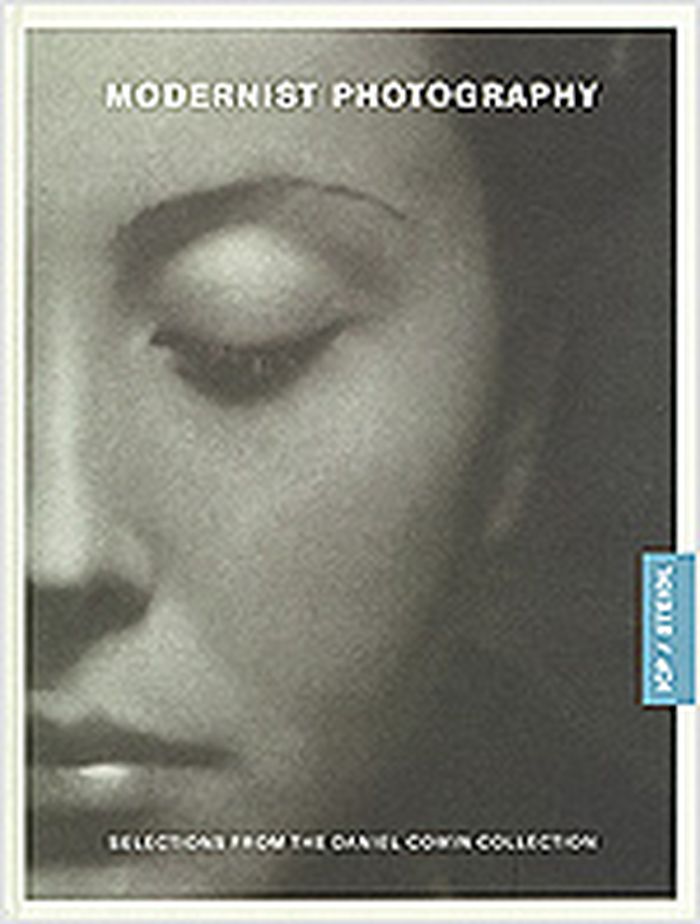
Modernist photography : selections from the Daniel Cowin collection
Actions:
Price:
$24.95
(available to order)
Summary:
«Modernist photography» re-examines the classic period of 20th-century photography using new critical approaches to consider five recurrent visual themes during the years 1915 to 1945. These themes cut across such stylistic movements as Pictorialism, Surrealism, and the New Vision, and include the transformation of objects, experimental images of the body, visions of the city, the industrialization of the countryside, and experimental directions in poster design and typography. This thematic approach fosters new perspectives on such key photographers as Bernice Abbott, Brassaï, Walker Evans, Raoul Hausmann, Dorothea Lange, Gordon Parks and Man Ray and emphasizes the interactions between European and American practitioners. The catalogue includes chapters on each of the five themes by ICP Curators Christopher Phillips and Vanessa Rocco. It is based on a selection of 70 works from the Daniel Cowin Collection. The collection of about 1,600 images dates from 1860 to 1960 and includes a range of processes and formats--postcards, stereographs, carte-de-vistes, tintypes, albumen prints, and gelatin silver prints.
Modernist photography : selections from the Daniel Cowin collection
Actions:
Price:
$24.95
(available to order)
Summary:
«Modernist photography» re-examines the classic period of 20th-century photography using new critical approaches to consider five recurrent visual themes during the years 1915 to 1945. These themes cut across such stylistic movements as Pictorialism, Surrealism, and the New Vision, and include the transformation of objects, experimental images of the body, visions of the city, the industrialization of the countryside, and experimental directions in poster design and typography. This thematic approach fosters new perspectives on such key photographers as Bernice Abbott, Brassaï, Walker Evans, Raoul Hausmann, Dorothea Lange, Gordon Parks and Man Ray and emphasizes the interactions between European and American practitioners. The catalogue includes chapters on each of the five themes by ICP Curators Christopher Phillips and Vanessa Rocco. It is based on a selection of 70 works from the Daniel Cowin Collection. The collection of about 1,600 images dates from 1860 to 1960 and includes a range of processes and formats--postcards, stereographs, carte-de-vistes, tintypes, albumen prints, and gelatin silver prints.
Form:
books
books
Publication:
November 2005, New York
November 2005, New York
Form:
books
books
Actions:
Price:
$220.00
(available in store)
Summary:
Coinciding with a major retrospective exhibition at MAXXI, Rome, ''Col tempo, 1956–2024'' provides a complete and long-awaited retrospective of the career of Guido Guidi, sequenced by the artist himself in his typically illuminating, associative style. The book begins with some of the earliest photographs Guidi made, aged fifteen, in the countryside around his home in(...)
$220.00
(available in store)
Summary:
Coinciding with a major retrospective exhibition at MAXXI, Rome, ''Col tempo, 1956–2024'' provides a complete and long-awaited retrospective of the career of Guido Guidi, sequenced by the artist himself in his typically illuminating, associative style. The book begins with some of the earliest photographs Guidi made, aged fifteen, in the countryside around his home in(...)
Title:
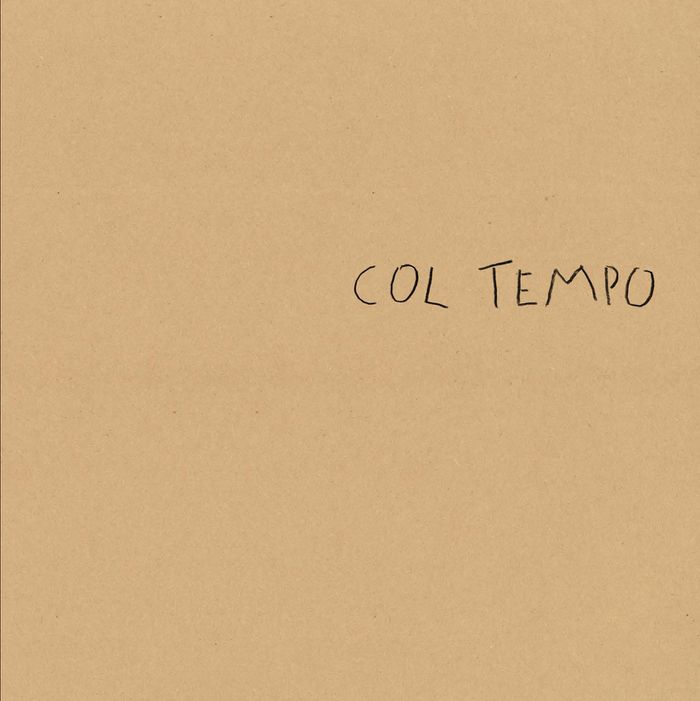
Guido Guidi: Col Tempo, 1956-2024
Actions:
Price:
$220.00
(available in store)
Summary:
Coinciding with a major retrospective exhibition at MAXXI, Rome, ''Col tempo, 1956–2024'' provides a complete and long-awaited retrospective of the career of Guido Guidi, sequenced by the artist himself in his typically illuminating, associative style. The book begins with some of the earliest photographs Guidi made, aged fifteen, in the countryside around his home in Cesena in the Italian region of Romagna. The sequence that follows, covering almost seventy years, encompasses a wide range of styles, forms, and approaches as it traces the evolution of one of the most important voices in contemporary photography. It includes journeys to the USA, Russia, Turkey, and Portugal, and studies of the works of architects including Carlo Scarpa, Mies van der Rohe, and Le Corbusier. Consistently, though, it returns to the modest agricultural landscapes where Guidi was born and still lives and works today, among which he has developed the revelatory visual language for which he is celebrated as a modern master.
Guido Guidi: Col Tempo, 1956-2024
Actions:
Price:
$220.00
(available in store)
Summary:
Coinciding with a major retrospective exhibition at MAXXI, Rome, ''Col tempo, 1956–2024'' provides a complete and long-awaited retrospective of the career of Guido Guidi, sequenced by the artist himself in his typically illuminating, associative style. The book begins with some of the earliest photographs Guidi made, aged fifteen, in the countryside around his home in Cesena in the Italian region of Romagna. The sequence that follows, covering almost seventy years, encompasses a wide range of styles, forms, and approaches as it traces the evolution of one of the most important voices in contemporary photography. It includes journeys to the USA, Russia, Turkey, and Portugal, and studies of the works of architects including Carlo Scarpa, Mies van der Rohe, and Le Corbusier. Consistently, though, it returns to the modest agricultural landscapes where Guidi was born and still lives and works today, among which he has developed the revelatory visual language for which he is celebrated as a modern master.
Form:
books
books
Publication:
January 2025
January 2025
Subject:
Photography monographs
Photography monographs
Form:
books
books
Actions:
Price:
$6.99
(available to order)
Summary:
"Rubble" presents key episodes in the world of demolition. Stretching over more than five hundred years of razing and toppling, this story looks back to London’s Great Fire of 1666, where self-deputized wreckers artfully blew houses apart with barrels of gunpowder to halt the furious blaze, and spotlights the advent of dynamite - courtesy of demolition’s patron saint,(...)
$6.99
(available to order)
Summary:
"Rubble" presents key episodes in the world of demolition. Stretching over more than five hundred years of razing and toppling, this story looks back to London’s Great Fire of 1666, where self-deputized wreckers artfully blew houses apart with barrels of gunpowder to halt the furious blaze, and spotlights the advent of dynamite - courtesy of demolition’s patron saint,(...)
Title:
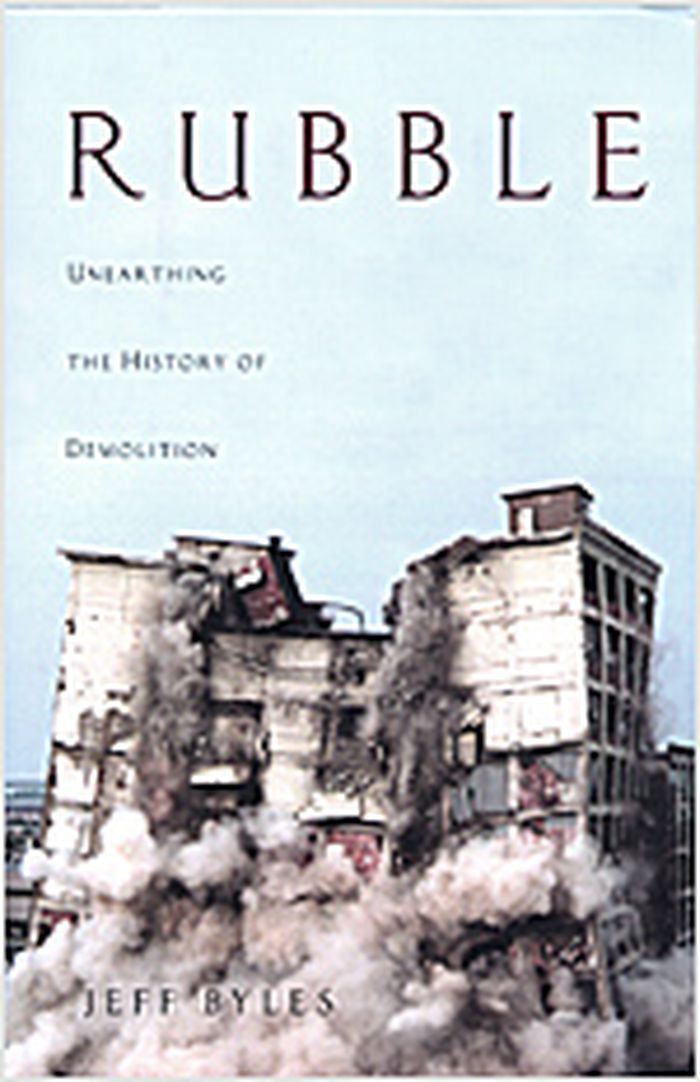
Rubble : unearthing the history of demolition
Actions:
Price:
$6.99
(available to order)
Summary:
"Rubble" presents key episodes in the world of demolition. Stretching over more than five hundred years of razing and toppling, this story looks back to London’s Great Fire of 1666, where self-deputized wreckers artfully blew houses apart with barrels of gunpowder to halt the furious blaze, and spotlights the advent of dynamite - courtesy of demolition’s patron saint, Alfred Nobel - that would later fuel epochal feats of unbuilding such as the implosion of the infamous Pruitt-Igoe housing complex in St. Louis. Rubble also delves beyond these bravura blasts to survey the world-jarring invention of the wrecking ball; the oddly stirring ruin of New York’s old Pennsylvania Station, that potent symbol of the wrecker run amok; and the ever busy bulldozers in places as diverse as Detroit, Berlin, and the British countryside. "Rubble" is also an exploration of what happens when buildings fall, when monuments topple into memory, and when “destructive creativity” tears down to build again.
Rubble : unearthing the history of demolition
Actions:
Price:
$6.99
(available to order)
Summary:
"Rubble" presents key episodes in the world of demolition. Stretching over more than five hundred years of razing and toppling, this story looks back to London’s Great Fire of 1666, where self-deputized wreckers artfully blew houses apart with barrels of gunpowder to halt the furious blaze, and spotlights the advent of dynamite - courtesy of demolition’s patron saint, Alfred Nobel - that would later fuel epochal feats of unbuilding such as the implosion of the infamous Pruitt-Igoe housing complex in St. Louis. Rubble also delves beyond these bravura blasts to survey the world-jarring invention of the wrecking ball; the oddly stirring ruin of New York’s old Pennsylvania Station, that potent symbol of the wrecker run amok; and the ever busy bulldozers in places as diverse as Detroit, Berlin, and the British countryside. "Rubble" is also an exploration of what happens when buildings fall, when monuments topple into memory, and when “destructive creativity” tears down to build again.
Form:
books
books
Publication:
November 2005, New York
November 2005, New York
Subject:
sale books
sale books
Form:
books
books
Actions:
Price:
$95.00
(available to order)
Summary:
Coinciding with a major retrospective exhibition at MAXXI, Rome, ''Col tempo, 1956–2024'' provides a complete and long-awaited retrospective of the career of Guido Guidi, sequenced by the artist himself in his typically illuminating, associative style. The book begins with some of the earliest photographs Guidi made, aged fifteen, in the countryside around his home in(...)
$95.00
(available to order)
Summary:
Coinciding with a major retrospective exhibition at MAXXI, Rome, ''Col tempo, 1956–2024'' provides a complete and long-awaited retrospective of the career of Guido Guidi, sequenced by the artist himself in his typically illuminating, associative style. The book begins with some of the earliest photographs Guidi made, aged fifteen, in the countryside around his home in(...)
Title:
Guido Guidi: Col Tempo, paperback edition
Actions:
Price:
$95.00
(available to order)
Summary:
Coinciding with a major retrospective exhibition at MAXXI, Rome, ''Col tempo, 1956–2024'' provides a complete and long-awaited retrospective of the career of Guido Guidi, sequenced by the artist himself in his typically illuminating, associative style. The book begins with some of the earliest photographs Guidi made, aged fifteen, in the countryside around his home in Cesena in the Italian region of Romagna. The sequence that follows, covering almost seventy years, encompasses a wide range of styles, forms, and approaches as it traces the evolution of one of the most important voices in contemporary photography. It includes journeys to the USA, Russia, Turkey, and Portugal, and studies of the works of architects including Carlo Scarpa, Mies van der Rohe, and Le Corbusier. Consistently, though, it returns to the modest agricultural landscapes where Guidi was born and still lives and works today, among which he has developed the revelatory visual language for which he is celebrated as a modern master.
Guido Guidi: Col Tempo, paperback edition
Actions:
Price:
$95.00
(available to order)
Summary:
Coinciding with a major retrospective exhibition at MAXXI, Rome, ''Col tempo, 1956–2024'' provides a complete and long-awaited retrospective of the career of Guido Guidi, sequenced by the artist himself in his typically illuminating, associative style. The book begins with some of the earliest photographs Guidi made, aged fifteen, in the countryside around his home in Cesena in the Italian region of Romagna. The sequence that follows, covering almost seventy years, encompasses a wide range of styles, forms, and approaches as it traces the evolution of one of the most important voices in contemporary photography. It includes journeys to the USA, Russia, Turkey, and Portugal, and studies of the works of architects including Carlo Scarpa, Mies van der Rohe, and Le Corbusier. Consistently, though, it returns to the modest agricultural landscapes where Guidi was born and still lives and works today, among which he has developed the revelatory visual language for which he is celebrated as a modern master.
Form:
books
books
Publication:
July 2025
July 2025
Subject:
Photography monographs
Photography monographs
Form:
books
books
Actions:
Price:
$29.95
(available to order)
Summary:
Come on a fascinating journey and explore some 300 museums, interpretation sites and exhibition centres across Québec. Whether you’re seeking new attractions for group trips or fun outings with friends and family, you’re sure to find what you’re looking for. Québec’s museums have so much to offer! Whether it’s large or small, in the heart of the city or out in the(...)
$29.95
(available to order)
Summary:
Come on a fascinating journey and explore some 300 museums, interpretation sites and exhibition centres across Québec. Whether you’re seeking new attractions for group trips or fun outings with friends and family, you’re sure to find what you’re looking for. Québec’s museums have so much to offer! Whether it’s large or small, in the heart of the city or out in the(...)
Title:
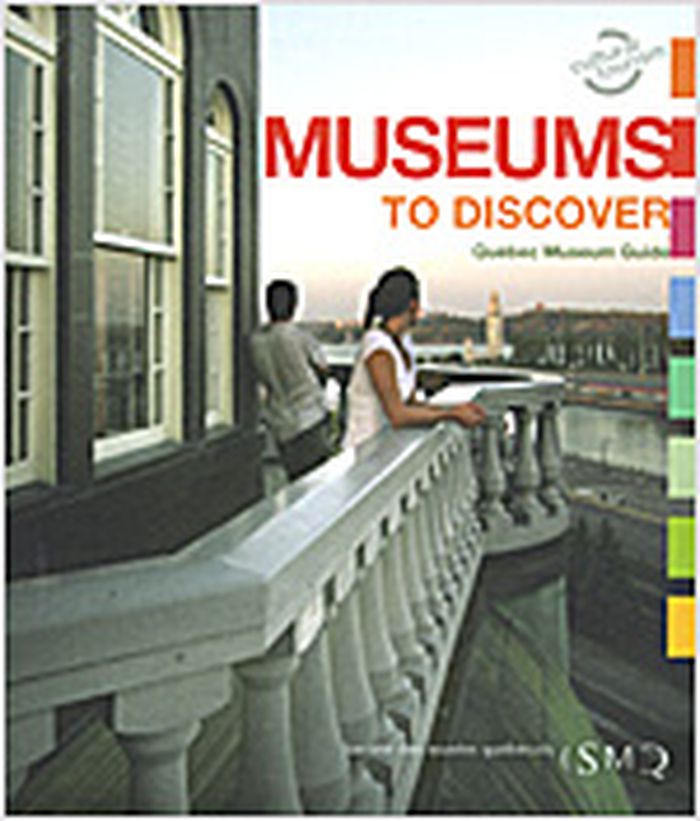
Museums to discover : Québec museum guide
Actions:
Price:
$29.95
(available to order)
Summary:
Come on a fascinating journey and explore some 300 museums, interpretation sites and exhibition centres across Québec. Whether you’re seeking new attractions for group trips or fun outings with friends and family, you’re sure to find what you’re looking for. Québec’s museums have so much to offer! Whether it’s large or small, in the heart of the city or out in the countryside, with a focus on art, history or science, each one offers a gateway to the many pleasures of cultural tourism. You’ll find exhibitions, multimedia shows, guided tours, workshops, garden tours, interpretation trails, even boat rides on the St. Lawrence. Some of them host large-scale events, while others welcome you into an intimate community, but they all promise a medley of ways to enjoy yourself. Afterwards you can enjoy a cup of tea on a charming terrace, unpack your picnic hamper down by the water or visit a thematic gift shop. Take this indispensable guide along whenever you set off to discover Québec’s museums!
Museums to discover : Québec museum guide
Actions:
Price:
$29.95
(available to order)
Summary:
Come on a fascinating journey and explore some 300 museums, interpretation sites and exhibition centres across Québec. Whether you’re seeking new attractions for group trips or fun outings with friends and family, you’re sure to find what you’re looking for. Québec’s museums have so much to offer! Whether it’s large or small, in the heart of the city or out in the countryside, with a focus on art, history or science, each one offers a gateway to the many pleasures of cultural tourism. You’ll find exhibitions, multimedia shows, guided tours, workshops, garden tours, interpretation trails, even boat rides on the St. Lawrence. Some of them host large-scale events, while others welcome you into an intimate community, but they all promise a medley of ways to enjoy yourself. Afterwards you can enjoy a cup of tea on a charming terrace, unpack your picnic hamper down by the water or visit a thematic gift shop. Take this indispensable guide along whenever you set off to discover Québec’s museums!
Form:
books
books
Publication:
July 2006, Montréal
July 2006, Montréal
Subject:
Architecture du Québec
Architecture du Québec
Form:
books
books
Actions:
Price:
$78.00
(available to order)
Summary:
This book presents innovative examples of hidden architecture: buildings that are designed to disappear into their surroundings or hide in plain sight. In the city, hidden buildings are often designed to provide the occupants with privacy and protection from the busy world outside or they can be incorporated into the streetscape to free up space for public use. In the(...)
$78.00
(available to order)
Summary:
This book presents innovative examples of hidden architecture: buildings that are designed to disappear into their surroundings or hide in plain sight. In the city, hidden buildings are often designed to provide the occupants with privacy and protection from the busy world outside or they can be incorporated into the streetscape to free up space for public use. In the(...)
Title:
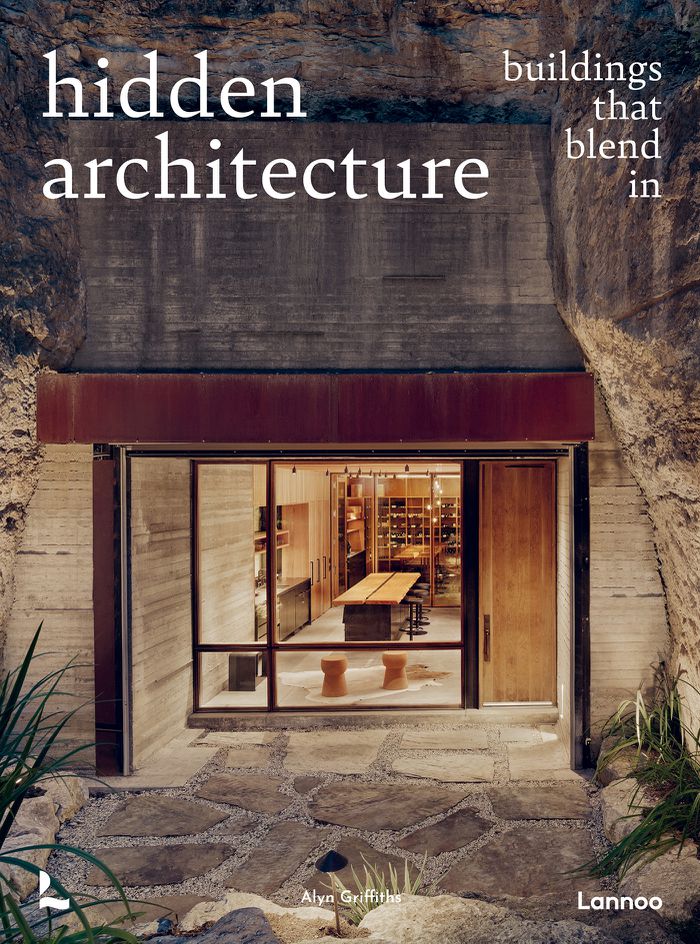
Hidden architecture: buildings that blend in
Actions:
Price:
$78.00
(available to order)
Summary:
This book presents innovative examples of hidden architecture: buildings that are designed to disappear into their surroundings or hide in plain sight. In the city, hidden buildings are often designed to provide the occupants with privacy and protection from the busy world outside or they can be incorporated into the streetscape to free up space for public use. In the countryside, buildings should not spoil a scenic landscape, so they can be designed to become a part of it. Buildings can be buried underground, hidden amongst trees, covered with greenery or even sunk into the sea. They can be clad in mirrors to reflect their surroundings, disappear beneath an urban plaza or be hidden from view on top of another building. Each of these imaginative solutions offers a way for architecture to blend in rather than stand out. ''Hidden architecture'' tells the stories of projects from around the world that are cleverly disguised but still beautifully detailed and outstanding in their execution.
Hidden architecture: buildings that blend in
Actions:
Price:
$78.00
(available to order)
Summary:
This book presents innovative examples of hidden architecture: buildings that are designed to disappear into their surroundings or hide in plain sight. In the city, hidden buildings are often designed to provide the occupants with privacy and protection from the busy world outside or they can be incorporated into the streetscape to free up space for public use. In the countryside, buildings should not spoil a scenic landscape, so they can be designed to become a part of it. Buildings can be buried underground, hidden amongst trees, covered with greenery or even sunk into the sea. They can be clad in mirrors to reflect their surroundings, disappear beneath an urban plaza or be hidden from view on top of another building. Each of these imaginative solutions offers a way for architecture to blend in rather than stand out. ''Hidden architecture'' tells the stories of projects from around the world that are cleverly disguised but still beautifully detailed and outstanding in their execution.
Form:
books
books
Publication:
October 2022
October 2022
Subject:
Contemporary Architecture
Contemporary Architecture
Form:
books
books
Actions:
Price:
$77.95
(available to order)
Summary:
In Humanism and the Urban World, Caspar Pearson offers a profoundly revisionist account of Leon Battista Alberti’s approach to the urban environment as exemplified in the extensive theoretical treatise De re aedificatoria (On the Art of Building in Ten Books), brought mostly to completion in the 1450s, as well as in his larger body of written work. This book explores the(...)
$77.95
(available to order)
Summary:
In Humanism and the Urban World, Caspar Pearson offers a profoundly revisionist account of Leon Battista Alberti’s approach to the urban environment as exemplified in the extensive theoretical treatise De re aedificatoria (On the Art of Building in Ten Books), brought mostly to completion in the 1450s, as well as in his larger body of written work. This book explores the(...)
Title:
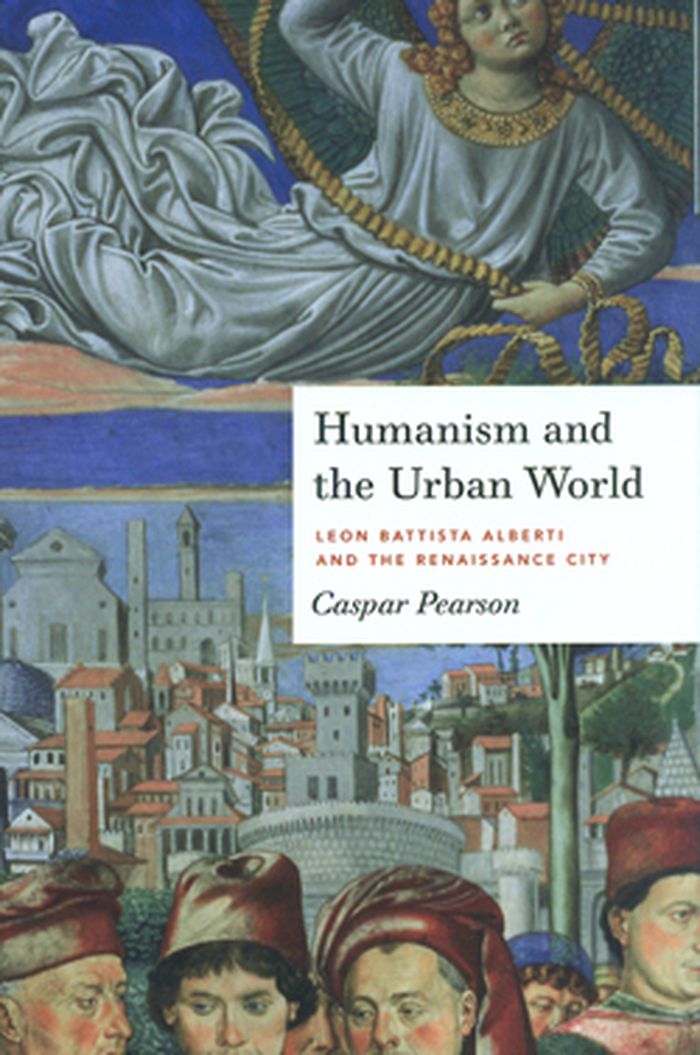
Humanism and the urban world: Leon Battista Alberti and the Renaissance City
Actions:
Price:
$77.95
(available to order)
Summary:
In Humanism and the Urban World, Caspar Pearson offers a profoundly revisionist account of Leon Battista Alberti’s approach to the urban environment as exemplified in the extensive theoretical treatise De re aedificatoria (On the Art of Building in Ten Books), brought mostly to completion in the 1450s, as well as in his larger body of written work. This book explores the ways in which Alberti sought to remedy urban problems, tracing key themes that manifest in De re aedificatoria. Chapters address Alberti’s consideration of the city's possible destruction and the city’s capacity to provide order despite its intrinsic instability; his assessment of a variety of political solutions to that instability; his affinity for the countryside and discussions of the virtues of the active versus the contemplative life; and his theories of aesthetics and beauty, in particular the belief that beauty may affect the soul of an enemy and thus preserve buildings from attack.
Humanism and the urban world: Leon Battista Alberti and the Renaissance City
Actions:
Price:
$77.95
(available to order)
Summary:
In Humanism and the Urban World, Caspar Pearson offers a profoundly revisionist account of Leon Battista Alberti’s approach to the urban environment as exemplified in the extensive theoretical treatise De re aedificatoria (On the Art of Building in Ten Books), brought mostly to completion in the 1450s, as well as in his larger body of written work. This book explores the ways in which Alberti sought to remedy urban problems, tracing key themes that manifest in De re aedificatoria. Chapters address Alberti’s consideration of the city's possible destruction and the city’s capacity to provide order despite its intrinsic instability; his assessment of a variety of political solutions to that instability; his affinity for the countryside and discussions of the virtues of the active versus the contemplative life; and his theories of aesthetics and beauty, in particular the belief that beauty may affect the soul of an enemy and thus preserve buildings from attack.
Form:
books
books
Publication:
August 2011
August 2011
Subject:
History until 1900
History until 1900
Form:
books
books
Actions:
Price:
$32.95
(available to order)
Summary:
Following Italy's unification in 1861, architects, artists, politicians, and literati engaged in volatile debates over the pursuit of national and regional identity. Growing industrialization and urbanization across the country contrasted with the rediscovery of traditionally built forms and objects created by the agrarian peasantry. Pride in Modesty argues that these(...)
$32.95
(available to order)
Summary:
Following Italy's unification in 1861, architects, artists, politicians, and literati engaged in volatile debates over the pursuit of national and regional identity. Growing industrialization and urbanization across the country contrasted with the rediscovery of traditionally built forms and objects created by the agrarian peasantry. Pride in Modesty argues that these(...)
Title:
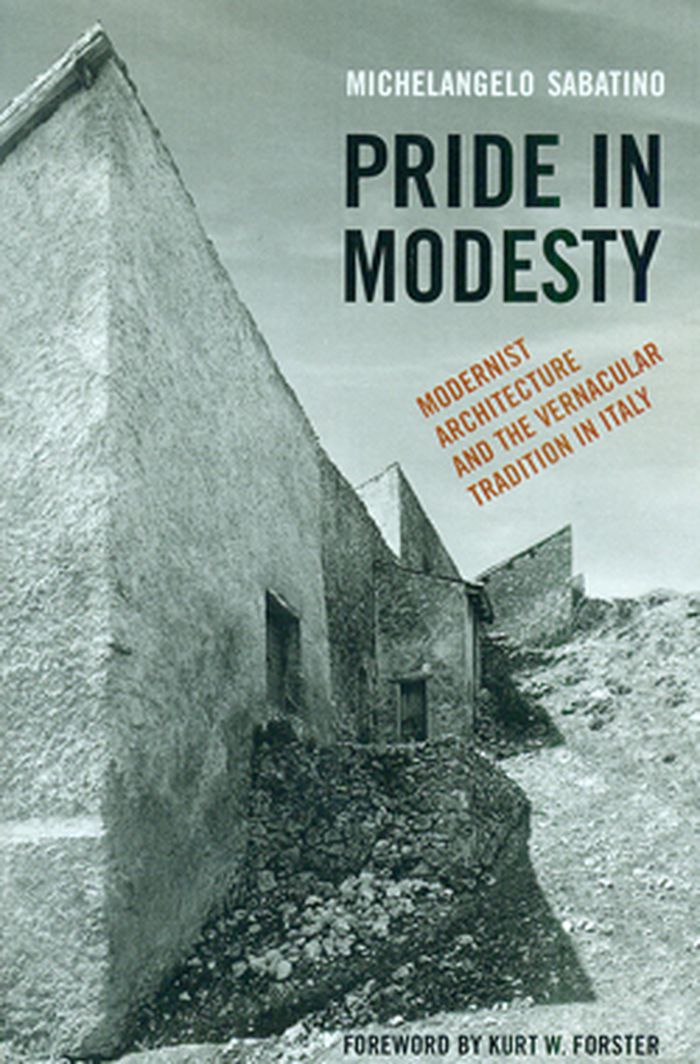
Pride in modesty : modernist architecture and the vernacular tradition in Italy
Actions:
Price:
$32.95
(available to order)
Summary:
Following Italy's unification in 1861, architects, artists, politicians, and literati engaged in volatile debates over the pursuit of national and regional identity. Growing industrialization and urbanization across the country contrasted with the rediscovery of traditionally built forms and objects created by the agrarian peasantry. Pride in Modesty argues that these ordinary, often anonymous, everyday things inspired and transformed Italian art and architecture from the 1920s through the 1970s. Through in-depth examinations of texts, drawings, and buildings, Michelangelo Sabatino finds that the folk traditions of the pre-industrial countryside have provided formal, practical, and poetic inspiration directly affecting both design and construction practices over a period of sixty years and a number of different political regimes. This surprising continuity allows Sabatino to reject the division of Italian history into sharply delimited periods such as Fascist Interwar and Democratic Postwar and to instead emphasize the long, continuous process that transformed pastoral and urban ideals into a new, modernist Italy.
Pride in modesty : modernist architecture and the vernacular tradition in Italy
Actions:
Price:
$32.95
(available to order)
Summary:
Following Italy's unification in 1861, architects, artists, politicians, and literati engaged in volatile debates over the pursuit of national and regional identity. Growing industrialization and urbanization across the country contrasted with the rediscovery of traditionally built forms and objects created by the agrarian peasantry. Pride in Modesty argues that these ordinary, often anonymous, everyday things inspired and transformed Italian art and architecture from the 1920s through the 1970s. Through in-depth examinations of texts, drawings, and buildings, Michelangelo Sabatino finds that the folk traditions of the pre-industrial countryside have provided formal, practical, and poetic inspiration directly affecting both design and construction practices over a period of sixty years and a number of different political regimes. This surprising continuity allows Sabatino to reject the division of Italian history into sharply delimited periods such as Fascist Interwar and Democratic Postwar and to instead emphasize the long, continuous process that transformed pastoral and urban ideals into a new, modernist Italy.
Form:
books
books
Publication:
June 2011
June 2011
Subject:
Architectural Theory
Architectural Theory
Form:
books
books

Title:
Crabgrass crucible: suburban nature and the rise of environmentalism in twintieth-century America
Crabgrass crucible: suburban nature and the rise of environmentalism in twintieth-century America
Actions:
Price:
$52.50
(available in store)
Summary:
Although suburb-building created major environmental problems, Christopher Sellers demonstrates that the environmental movement originated within suburbs--not just in response to unchecked urban sprawl. Drawn to the countryside as early as the late 19th century, new suburbanites turned to taming the wildness of their surroundings. They cultivated a fondness for the(...)
$52.50
(available in store)
Summary:
Although suburb-building created major environmental problems, Christopher Sellers demonstrates that the environmental movement originated within suburbs--not just in response to unchecked urban sprawl. Drawn to the countryside as early as the late 19th century, new suburbanites turned to taming the wildness of their surroundings. They cultivated a fondness for the(...)
Title:
Crabgrass crucible: suburban nature and the rise of environmentalism in twintieth-century America
Actions:
Price:
$52.50
(available in store)
Summary:
Although suburb-building created major environmental problems, Christopher Sellers demonstrates that the environmental movement originated within suburbs--not just in response to unchecked urban sprawl. Drawn to the countryside as early as the late 19th century, new suburbanites turned to taming the wildness of their surroundings. They cultivated a fondness for the natural world around them, and in the decades that followed, they became sensitized to potential threats. Sellers shows how the philosophy, science, and emotions that catalyzed the environmental movement sprang directly from suburbanites' lives and their ideas about nature, as well as the unique ecology of the neighborhoods in which they dwelt. Sellers focuses on the spreading edges of New York and Los Angeles over the middle of the twentieth century to create an intimate portrait of what it was like to live amid suburban nature. As suburbanites learned about their land, became aware of pollution, and saw the forests shrinking around them, the vulnerability of both their bodies and their homes became apparent.
Crabgrass crucible: suburban nature and the rise of environmentalism in twintieth-century America
Actions:
Price:
$52.50
(available in store)
Summary:
Although suburb-building created major environmental problems, Christopher Sellers demonstrates that the environmental movement originated within suburbs--not just in response to unchecked urban sprawl. Drawn to the countryside as early as the late 19th century, new suburbanites turned to taming the wildness of their surroundings. They cultivated a fondness for the natural world around them, and in the decades that followed, they became sensitized to potential threats. Sellers shows how the philosophy, science, and emotions that catalyzed the environmental movement sprang directly from suburbanites' lives and their ideas about nature, as well as the unique ecology of the neighborhoods in which they dwelt. Sellers focuses on the spreading edges of New York and Los Angeles over the middle of the twentieth century to create an intimate portrait of what it was like to live amid suburban nature. As suburbanites learned about their land, became aware of pollution, and saw the forests shrinking around them, the vulnerability of both their bodies and their homes became apparent.
Form:
books
books
Publication:
April 2012
April 2012
Subject:
Urban Landscapes
Urban Landscapes
Form:
books
books
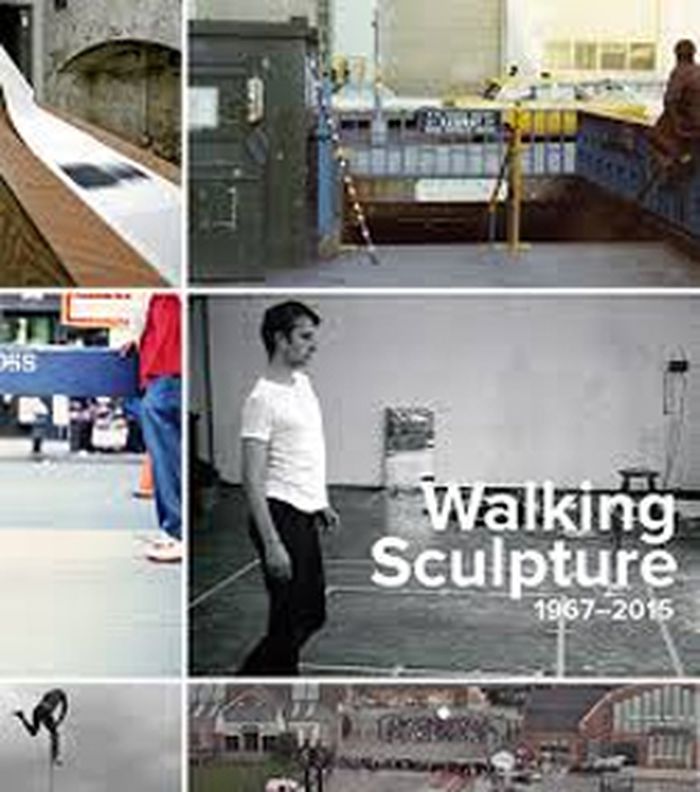
Title:
Walking sculpture: 1967-2015
Walking sculpture: 1967-2015
Actions:
Price:
$34.95
(available to order)
Summary:
Artists have utilized walking as an autonomous form of art, a subject in their work, and as social practice since the early 20th century. Today walking continues to offer a salient means for artists to challenge social, political, and economic orders through a radical remapping of civic space. In this book, Lexi Lee Sullivan traces the history of walking as an aesthetic(...)
$34.95
(available to order)
Summary:
Artists have utilized walking as an autonomous form of art, a subject in their work, and as social practice since the early 20th century. Today walking continues to offer a salient means for artists to challenge social, political, and economic orders through a radical remapping of civic space. In this book, Lexi Lee Sullivan traces the history of walking as an aesthetic(...)
Publication:
May 2015
May 2015
Title:
Walking sculpture: 1967-2015
Actions:
Price:
$34.95
(available to order)
Summary:
Artists have utilized walking as an autonomous form of art, a subject in their work, and as social practice since the early 20th century. Today walking continues to offer a salient means for artists to challenge social, political, and economic orders through a radical remapping of civic space. In this book, Lexi Lee Sullivan traces the history of walking as an aesthetic action from the Dadaists to contemporary ramblers. Titled after Michelangelo Pistoletto’s performance Walking Sculpture, the catalogue features 50 color illustrations ranging from photographs of Yvonne Rainer’s street actions to Francis Alÿs’s fantastical processions, poems by Cole Swensen, and a new project by artist Helen Mirra, who produces poetic meditations on landscape, ecology, and locomotion. Sculpture, film, video, photography, and performance converge to address the multi-disciplinary practice of ambulation through the cityscape and the countryside. For those who hike; march in fundraisers, protests, or parades; walk the dog; stroll in the park; or commute daily, this catalogue will invite new thought into basic human movement.
Walking sculpture: 1967-2015
Actions:
Price:
$34.95
(available to order)
Summary:
Artists have utilized walking as an autonomous form of art, a subject in their work, and as social practice since the early 20th century. Today walking continues to offer a salient means for artists to challenge social, political, and economic orders through a radical remapping of civic space. In this book, Lexi Lee Sullivan traces the history of walking as an aesthetic action from the Dadaists to contemporary ramblers. Titled after Michelangelo Pistoletto’s performance Walking Sculpture, the catalogue features 50 color illustrations ranging from photographs of Yvonne Rainer’s street actions to Francis Alÿs’s fantastical processions, poems by Cole Swensen, and a new project by artist Helen Mirra, who produces poetic meditations on landscape, ecology, and locomotion. Sculpture, film, video, photography, and performance converge to address the multi-disciplinary practice of ambulation through the cityscape and the countryside. For those who hike; march in fundraisers, protests, or parades; walk the dog; stroll in the park; or commute daily, this catalogue will invite new thought into basic human movement.
Form:
books
books
Publication:
May 2015
May 2015


