


4907 Results
Form:
books
books
Title:
Immaterialism
Immaterialism
Actions:
Price:
$13.95
(available in store)
Summary:
What objects exist in the social world and how should we understand them? Is a specific Pizza Hut restaurant as real as the employees, tables, napkins and pizzas of which it is composed, and as real as the Pizza Hut corporation with its headquarters in Wichita, the United States, the planet Earth and the social and economic impact of the restaurant on the lives of its(...)
$13.95
(available in store)
Summary:
What objects exist in the social world and how should we understand them? Is a specific Pizza Hut restaurant as real as the employees, tables, napkins and pizzas of which it is composed, and as real as the Pizza Hut corporation with its headquarters in Wichita, the United States, the planet Earth and the social and economic impact of the restaurant on the lives of its(...)
Title:
Immaterialism
Actions:
Price:
$13.95
(available in store)
Summary:
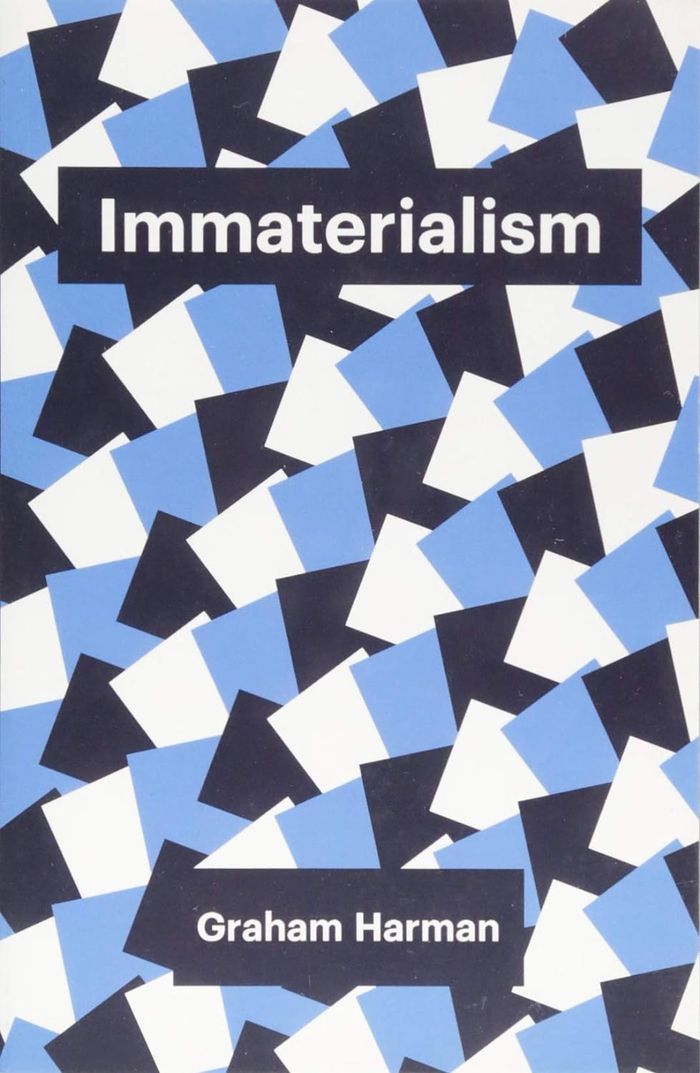
What objects exist in the social world and how should we understand them? Is a specific Pizza Hut restaurant as real as the employees, tables, napkins and pizzas of which it is composed, and as real as the Pizza Hut corporation with its headquarters in Wichita, the United States, the planet Earth and the social and economic impact of the restaurant on the lives of its employees and customers? In this book the founder of object-oriented philosophy develops his approach in order to shed light on the nature and status of objects in social life. While it is often assumed that an interest in objects amounts to a form of materialism, Harman rejects this view and develops instead an "immaterialist" method. By examining the work of leading contemporary thinkers such as Bruno Latour and Levi Bryant, he develops a forceful critique of "actor-network theory." In an extended discussion of Leibniz’s famous example of the Dutch East India Company, Harman argues that this company qualifies for objecthood neither through "what it is" or "what it does," but through its irreducibility to either of these forms. The phases of its life, argues Harman, are not demarcated primarily by dramatic incidents but by moments of symbiosis, a term he draws from the biologist Lynn Margulis. This book provides a key counterpoint to the now ubiquitous social theories of constant change, holistic networks, performative identities, and the construction of things by human practice. It will appeal to anyone interested in cutting-edge debates in philosophy and social and cultural theory.
Immaterialism
Actions:
Price:
$13.95
(available in store)
Summary:
What objects exist in the social world and how should we understand them? Is a specific Pizza Hut restaurant as real as the employees, tables, napkins and pizzas of which it is composed, and as real as the Pizza Hut corporation with its headquarters in Wichita, the United States, the planet Earth and the social and economic impact of the restaurant on the lives of its employees and customers? In this book the founder of object-oriented philosophy develops his approach in order to shed light on the nature and status of objects in social life. While it is often assumed that an interest in objects amounts to a form of materialism, Harman rejects this view and develops instead an "immaterialist" method. By examining the work of leading contemporary thinkers such as Bruno Latour and Levi Bryant, he develops a forceful critique of "actor-network theory." In an extended discussion of Leibniz’s famous example of the Dutch East India Company, Harman argues that this company qualifies for objecthood neither through "what it is" or "what it does," but through its irreducibility to either of these forms. The phases of its life, argues Harman, are not demarcated primarily by dramatic incidents but by moments of symbiosis, a term he draws from the biologist Lynn Margulis. This book provides a key counterpoint to the now ubiquitous social theories of constant change, holistic networks, performative identities, and the construction of things by human practice. It will appeal to anyone interested in cutting-edge debates in philosophy and social and cultural theory.
Form:
books
books
Publication:
February 2016
February 2016
Subject:
Critical Theory
Critical Theory
Form:
books
books
Title:
The city builders : property development in New York and London, 1980-2000 - second edition, revised
The city builders : property development in New York and London, 1980-2000 - second edition, revised
Actions:
Price:
$72.00
(available to order)
Summary:
In the last twenty years, urban centers worldwide have experienced enormous booms and busts as real-estate developers, financial institutions, and public officials first poured resources into physical redevelopment, then watched as the market collapsed before booming again in the 1990s. In this extensively revised edition of her highly regarded The City Builders, Susan(...)
$72.00
(available to order)
Summary:
In the last twenty years, urban centers worldwide have experienced enormous booms and busts as real-estate developers, financial institutions, and public officials first poured resources into physical redevelopment, then watched as the market collapsed before booming again in the 1990s. In this extensively revised edition of her highly regarded The City Builders, Susan(...)
Title:
The city builders : property development in New York and London, 1980-2000 - second edition, revised
Actions:
Price:
$72.00
(available to order)
Summary:
In the last twenty years, urban centers worldwide have experienced enormous booms and busts as real-estate developers, financial institutions, and public officials first poured resources into physical redevelopment, then watched as the market collapsed before booming again in the 1990s. In this extensively revised edition of her highly regarded The City Builders, Susan Fainstein examines major redevelopment efforts in New York and London to uncover the forces behind these investment cycles and the role that public policy can play in moderating market instability. Fainstein chronicles the progress of three development projects in New York (Times Square, downtown Brooklyn, and Battery Park City) and three in London (King's Cross, Spitalfields, and Docklands). Analyzing the political and economic processes underlying physical changes in these two cities during the last two decades, she uncovers the role played by developers' perceptions and strategies in their interactions with both public policy-makers and property markets. This new edition follows each development effort to the present and places the discussion in a newly strengthened theoretical framework. In her investigation of the convergence between London and New York during the 1980s and then the divergence that began in the 1990s, Fainstein traces similarities and differences in the effects of globalization, ideology, and institutional structure in each city's experience. This comparative framework also sheds considerable light on the contributing roles of structure and agency in creating final outcomes. Fainstein concludes by assessing the impact of "theme park" development on the urban fabric and recommending a set of realistic strategies to both redevelop cities and improve the lives of urban residents.
The city builders : property development in New York and London, 1980-2000 - second edition, revised
Actions:
Price:
$72.00
(available to order)
Summary:
In the last twenty years, urban centers worldwide have experienced enormous booms and busts as real-estate developers, financial institutions, and public officials first poured resources into physical redevelopment, then watched as the market collapsed before booming again in the 1990s. In this extensively revised edition of her highly regarded The City Builders, Susan Fainstein examines major redevelopment efforts in New York and London to uncover the forces behind these investment cycles and the role that public policy can play in moderating market instability. Fainstein chronicles the progress of three development projects in New York (Times Square, downtown Brooklyn, and Battery Park City) and three in London (King's Cross, Spitalfields, and Docklands). Analyzing the political and economic processes underlying physical changes in these two cities during the last two decades, she uncovers the role played by developers' perceptions and strategies in their interactions with both public policy-makers and property markets. This new edition follows each development effort to the present and places the discussion in a newly strengthened theoretical framework. In her investigation of the convergence between London and New York during the 1980s and then the divergence that began in the 1990s, Fainstein traces similarities and differences in the effects of globalization, ideology, and institutional structure in each city's experience. This comparative framework also sheds considerable light on the contributing roles of structure and agency in creating final outcomes. Fainstein concludes by assessing the impact of "theme park" development on the urban fabric and recommending a set of realistic strategies to both redevelop cities and improve the lives of urban residents.
Form:
books
books
Publication:
September 2001, Lawrence, Kansas
September 2001, Lawrence, Kansas
Subject:
Urban Theory
Urban Theory
Form:
books
books
Actions:
Price:
$52.50
(available in store)
Summary:
Eating and drinking images may seem like an anomalous notion but, since antiquity, in the European and Mediterranean worlds, people have swallowed down frescoes, icons, engravings, eucharistic hosts stamped with images, heraldic wafers, marzipan figures, and other sculpted dishes. Either specifically made for human consumption or diverted from their original purpose so as(...)
$52.50
(available in store)
Summary:
Eating and drinking images may seem like an anomalous notion but, since antiquity, in the European and Mediterranean worlds, people have swallowed down frescoes, icons, engravings, eucharistic hosts stamped with images, heraldic wafers, marzipan figures, and other sculpted dishes. Either specifically made for human consumption or diverted from their original purpose so as(...)
Title:
Iconophages: A history of ingesting images
Actions:
Price:
$52.50
(available in store)
Summary:
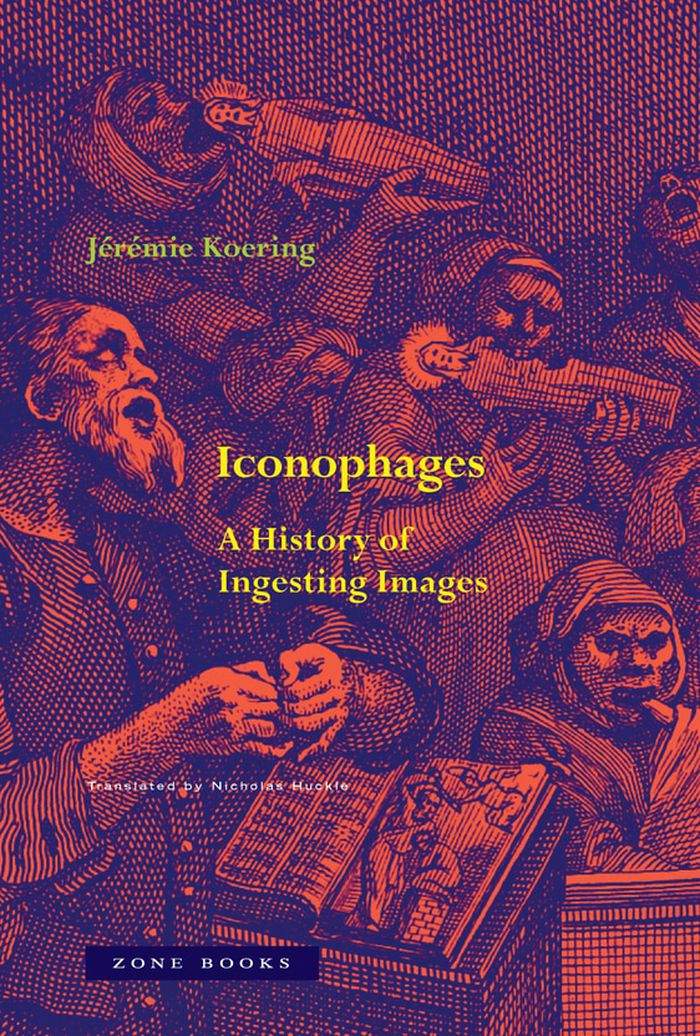
Eating and drinking images may seem like an anomalous notion but, since antiquity, in the European and Mediterranean worlds, people have swallowed down frescoes, icons, engravings, eucharistic hosts stamped with images, heraldic wafers, marzipan figures, and other sculpted dishes. Either specifically made for human consumption or diverted from their original purpose so as to be ingested, these figured artifacts have been not only gazed upon but also incorporated—taken into the body—as solids or liquids. How can we explain such behavior? Why take an image into one’s own body, devouring it at the risk of destroying it, consuming rather than contemplating it wisely from a distance? What structures of the imagination underlie and justify these desires for incorporation? What are the visual configurations offered up to the mouth, and what are their effects? What therapeutic, religious, symbolic, and social functions can we attribute to these forms of relations with icons? These are a few of the questions raised in this investigation into iconophagy. "Iconophages" aims to retrace, for the first time, the history of iconophagy. Jérémie Koering examines this unexplored facet of the history of images through an interdisciplinary approach that ranges across art history, cultural and material history, anthropology, philosophy, and the history of the body and the senses. He analyzes the human investment, in terms of culture and imagination, at stake in this seemingly paradoxical way of experiencing images. Beyond the hidden knowledge unearthed here, these pages bring to light a new way of understanding images, just as they illuminate the occasionally outlandish relations we maintain with them.
Iconophages: A history of ingesting images
Actions:
Price:
$52.50
(available in store)
Summary:
Eating and drinking images may seem like an anomalous notion but, since antiquity, in the European and Mediterranean worlds, people have swallowed down frescoes, icons, engravings, eucharistic hosts stamped with images, heraldic wafers, marzipan figures, and other sculpted dishes. Either specifically made for human consumption or diverted from their original purpose so as to be ingested, these figured artifacts have been not only gazed upon but also incorporated—taken into the body—as solids or liquids. How can we explain such behavior? Why take an image into one’s own body, devouring it at the risk of destroying it, consuming rather than contemplating it wisely from a distance? What structures of the imagination underlie and justify these desires for incorporation? What are the visual configurations offered up to the mouth, and what are their effects? What therapeutic, religious, symbolic, and social functions can we attribute to these forms of relations with icons? These are a few of the questions raised in this investigation into iconophagy. "Iconophages" aims to retrace, for the first time, the history of iconophagy. Jérémie Koering examines this unexplored facet of the history of images through an interdisciplinary approach that ranges across art history, cultural and material history, anthropology, philosophy, and the history of the body and the senses. He analyzes the human investment, in terms of culture and imagination, at stake in this seemingly paradoxical way of experiencing images. Beyond the hidden knowledge unearthed here, these pages bring to light a new way of understanding images, just as they illuminate the occasionally outlandish relations we maintain with them.
Form:
books
books
Publication:
January 2026
January 2026
Subject:
Art Theory
Art Theory
Form:
books
books
Title:
The gothic
The gothic
Actions:
Price:
$23.95
(available to order)
Summary:
This collection of writings examines the pervasive and influential role of "the Gothic" in contemporary visual culture. The contemporary Gothic in art is informed as much by the stock themes of the eighteenth- and nineteenth-century Gothic novel as it is by more recent permutations of the Gothic in horror film theory, Lacanian psychoanalysis, and Goth subcultures. This(...)
$23.95
(available to order)
Summary:
This collection of writings examines the pervasive and influential role of "the Gothic" in contemporary visual culture. The contemporary Gothic in art is informed as much by the stock themes of the eighteenth- and nineteenth-century Gothic novel as it is by more recent permutations of the Gothic in horror film theory, Lacanian psychoanalysis, and Goth subcultures. This(...)
Title:
The gothic
Actions:
Price:
$23.95
(available to order)
Summary:
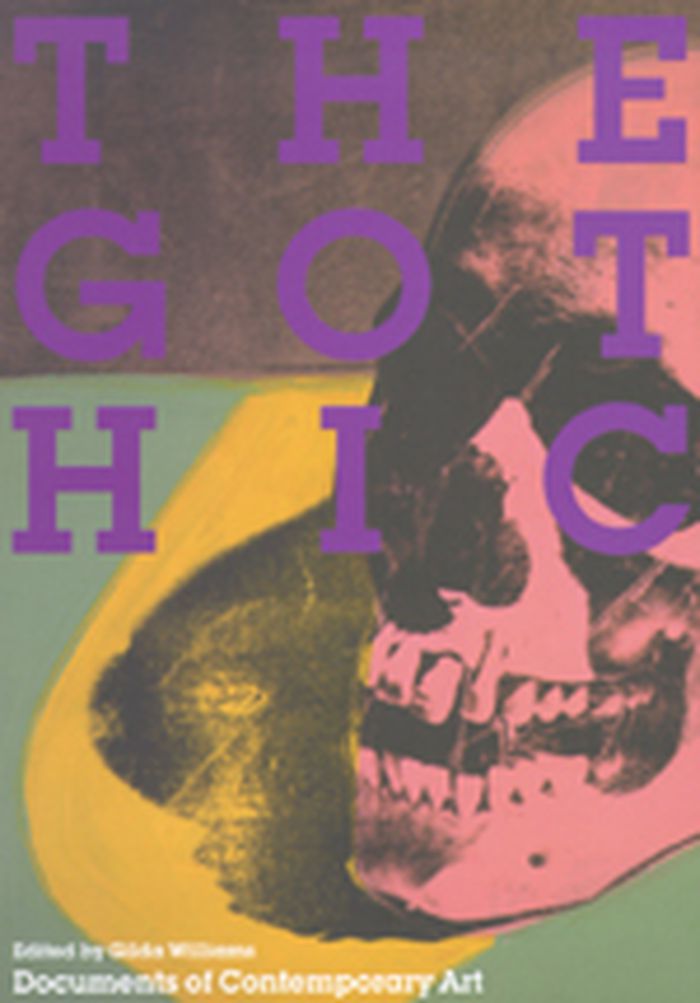
This collection of writings examines the pervasive and influential role of "the Gothic" in contemporary visual culture. The contemporary Gothic in art is informed as much by the stock themes of the eighteenth- and nineteenth-century Gothic novel as it is by more recent permutations of the Gothic in horror film theory, Lacanian psychoanalysis, and Goth subcultures. This reader from London's Whitechapel Gallery brings together artists as different as Matthew Barney, Gregor Schneider, Louise Bourgeois, and Douglas Gordon; its intent is not to use "the Gothic" to group together dissimilar artists but rather to shed light on a particular understanding of their practice. Anthony Vidler looks at ideas of the uncanny to explore Rachel Whiteread's House, and Jeff Wall uses the motif of vampirism to analyze fellow artist Dan Graham's Kammerspell; Hal Foster considers Robert Gober's recent work--laden with Christian symbolism, criticism of America as a nexus of power, and fragmented bodies--as an updated American Gothic, and Kobena Mercer examines the Gothic's depiction of the Other in relation to Michael Jackson's pop video Thriller. Texts by artists including Mike Kelley, Damien Hirst, Tacita Dean, Jonathan Meese, and Catherine Sullivan are complemented by extracts from Walpole's genre-establishing gothic novel The Castle of Otranto, William Gibson, Bret Easton Ellis, and Stephen King, among others, and theoretical writings by such key thinkers as Carol Clover, Beatriz Colomina, Julia Kristeva, Eve Kosofsky Sedgwick, Marina Warner, and Slavoj Zizek. The Gothic provides the first comprehensive overview of the uses of Gothic in contemporary visual culture.
The gothic
Actions:
Price:
$23.95
(available to order)
Summary:
This collection of writings examines the pervasive and influential role of "the Gothic" in contemporary visual culture. The contemporary Gothic in art is informed as much by the stock themes of the eighteenth- and nineteenth-century Gothic novel as it is by more recent permutations of the Gothic in horror film theory, Lacanian psychoanalysis, and Goth subcultures. This reader from London's Whitechapel Gallery brings together artists as different as Matthew Barney, Gregor Schneider, Louise Bourgeois, and Douglas Gordon; its intent is not to use "the Gothic" to group together dissimilar artists but rather to shed light on a particular understanding of their practice. Anthony Vidler looks at ideas of the uncanny to explore Rachel Whiteread's House, and Jeff Wall uses the motif of vampirism to analyze fellow artist Dan Graham's Kammerspell; Hal Foster considers Robert Gober's recent work--laden with Christian symbolism, criticism of America as a nexus of power, and fragmented bodies--as an updated American Gothic, and Kobena Mercer examines the Gothic's depiction of the Other in relation to Michael Jackson's pop video Thriller. Texts by artists including Mike Kelley, Damien Hirst, Tacita Dean, Jonathan Meese, and Catherine Sullivan are complemented by extracts from Walpole's genre-establishing gothic novel The Castle of Otranto, William Gibson, Bret Easton Ellis, and Stephen King, among others, and theoretical writings by such key thinkers as Carol Clover, Beatriz Colomina, Julia Kristeva, Eve Kosofsky Sedgwick, Marina Warner, and Slavoj Zizek. The Gothic provides the first comprehensive overview of the uses of Gothic in contemporary visual culture.
Form:
books
books
Publication:
October 2007, Whitechapel London Cambridge
October 2007, Whitechapel London Cambridge
Subject:
Art Theory
Art Theory
Form:
books
books

Actions:
Price:
$62.00
(available to order)
Summary:
Kara Walker is among the most complex and prolific American artists of her generation. Over the past decade, she has gained international recognition for her room-sized tableaux, which depict historical narratives haunted by sexuality, violence and subjugation and are made using the paradoxically genteel eighteenth-century art of cut-paper silhouettes. Set in the(...)
$62.00
(available to order)
Summary:
Kara Walker is among the most complex and prolific American artists of her generation. Over the past decade, she has gained international recognition for her room-sized tableaux, which depict historical narratives haunted by sexuality, violence and subjugation and are made using the paradoxically genteel eighteenth-century art of cut-paper silhouettes. Set in the(...)
Title:
Kara Walker : my complement, my enevy, my oppressor, my love
Actions:
Price:
$62.00
(available to order)
Summary:
Kara Walker is among the most complex and prolific American artists of her generation. Over the past decade, she has gained international recognition for her room-sized tableaux, which depict historical narratives haunted by sexuality, violence and subjugation and are made using the paradoxically genteel eighteenth-century art of cut-paper silhouettes. Set in the antebellum American South, Walker's compositions play off of stereotypes to portray, often grotesquely, life on the plantation, where masters, mistresses and slave men, women and children enact a subverted version of the past in an attempt to reconfigure their status and representation. Over the years, the artist has used drawing, painting, colored-light projections, writing, shadow puppetry, and, most recently, film animation to narrate her tales of romance, sadism, oppression and liberation. Her scenarios thwart conventional readings of a cohesive national history and expose the collective, and ongoing, psychological injury caused by the tragic legacy of slavery. Deploying an acidic sense of humor, Walker examines the dialectics of pleasure and danger, guilt and fulfillment, desire and fear, race and class. This landmark publication, which is sure to win international design awards, accompanies Walker's first major American museum survey. It features critical essays by Philippe Vergne, Sander L. Gilman, Thomas McEvilley, Robert Storr and Kevin Young, as well as an illustrated lexicon of recurring themes and motifs in the artist's most influential installations by Yasmil Raymond, more than 200 full-color images, an extensive exhibition history and bibliography, and a 36-page insert by the artist.
Kara Walker : my complement, my enevy, my oppressor, my love
Actions:
Price:
$62.00
(available to order)
Summary:
Kara Walker is among the most complex and prolific American artists of her generation. Over the past decade, she has gained international recognition for her room-sized tableaux, which depict historical narratives haunted by sexuality, violence and subjugation and are made using the paradoxically genteel eighteenth-century art of cut-paper silhouettes. Set in the antebellum American South, Walker's compositions play off of stereotypes to portray, often grotesquely, life on the plantation, where masters, mistresses and slave men, women and children enact a subverted version of the past in an attempt to reconfigure their status and representation. Over the years, the artist has used drawing, painting, colored-light projections, writing, shadow puppetry, and, most recently, film animation to narrate her tales of romance, sadism, oppression and liberation. Her scenarios thwart conventional readings of a cohesive national history and expose the collective, and ongoing, psychological injury caused by the tragic legacy of slavery. Deploying an acidic sense of humor, Walker examines the dialectics of pleasure and danger, guilt and fulfillment, desire and fear, race and class. This landmark publication, which is sure to win international design awards, accompanies Walker's first major American museum survey. It features critical essays by Philippe Vergne, Sander L. Gilman, Thomas McEvilley, Robert Storr and Kevin Young, as well as an illustrated lexicon of recurring themes and motifs in the artist's most influential installations by Yasmil Raymond, more than 200 full-color images, an extensive exhibition history and bibliography, and a 36-page insert by the artist.
Form:
books
books
Publication:
March 2007, Minneapolis
March 2007, Minneapolis
Subject:
Contemporary Art Monographs
Contemporary Art Monographs
Form:
books
books
Actions:
Price:
$70.50
(available to order)
Summary:
What is the role of the museum in society today? In this time of fundamental economic and social change, should museums be safe civic spaces or open a floor for challenge and change? Can museums contribute to the economic development of communities? If so, how best to guard against the effects of gentrification so that they do not further limit opportunity for low-income(...)
$70.50
(available to order)
Summary:
What is the role of the museum in society today? In this time of fundamental economic and social change, should museums be safe civic spaces or open a floor for challenge and change? Can museums contribute to the economic development of communities? If so, how best to guard against the effects of gentrification so that they do not further limit opportunity for low-income(...)
Title:
New museums: intentions, expectations, challenges
Actions:
Price:
$70.50
(available to order)
Summary:
What is the role of the museum in society today? In this time of fundamental economic and social change, should museums be safe civic spaces or open a floor for challenge and change? Can museums contribute to the economic development of communities? If so, how best to guard against the effects of gentrification so that they do not further limit opportunity for low-income residents? How should museums respond to concerns about environmental sustainability? These are just a few of the questions museum professionals, planners, and architects must carefully consider when developing plans and choosing a location for a new museum. "New museums" explores these questions by talking to the people behind twenty different museums on six continents, both realized projects and speculative design proposals. Among the museums discussed in the book are the Smithsonian Institute’s National Museum of African American History and Culture in Washington, DC, by Adjaye Associates; the Guggenheim Helsinki by Moreau Kusunoki Architectes; the Comic and Animation Museum in Hangzhou by MVRDV; the Munch Museum in Oslo by Estudio Herreros, the Zeitz Museum of Contemporary Art Africa in Cape Town by Heatherwick Studio; the Long Museum West Bund in Shanghai by Atelier Deshaus; and the recent extension of the Art Gallery of New South Wales in Sydney by SANAA. With more than 250 color illustrations and contributions by leading museum and architecture experts, the book sheds light on current trends and the state-of-the-art technological advances in architecture, while also providing insight into the careful thought and decision processes that go into the development of new museums.
New museums: intentions, expectations, challenges
Actions:
Price:
$70.50
(available to order)
Summary:
What is the role of the museum in society today? In this time of fundamental economic and social change, should museums be safe civic spaces or open a floor for challenge and change? Can museums contribute to the economic development of communities? If so, how best to guard against the effects of gentrification so that they do not further limit opportunity for low-income residents? How should museums respond to concerns about environmental sustainability? These are just a few of the questions museum professionals, planners, and architects must carefully consider when developing plans and choosing a location for a new museum. "New museums" explores these questions by talking to the people behind twenty different museums on six continents, both realized projects and speculative design proposals. Among the museums discussed in the book are the Smithsonian Institute’s National Museum of African American History and Culture in Washington, DC, by Adjaye Associates; the Guggenheim Helsinki by Moreau Kusunoki Architectes; the Comic and Animation Museum in Hangzhou by MVRDV; the Munch Museum in Oslo by Estudio Herreros, the Zeitz Museum of Contemporary Art Africa in Cape Town by Heatherwick Studio; the Long Museum West Bund in Shanghai by Atelier Deshaus; and the recent extension of the Art Gallery of New South Wales in Sydney by SANAA. With more than 250 color illustrations and contributions by leading museum and architecture experts, the book sheds light on current trends and the state-of-the-art technological advances in architecture, while also providing insight into the careful thought and decision processes that go into the development of new museums.
Form:
books
books
Publication:
August 2017
August 2017
Subject:
Museology
Museology
Form:
books
books
Actions:
Price:
$42.00
(available to order)
Summary:
Born in Estonia 1901 and brought to America in 1906, the architect Louis Kahn grew up in poverty in Philadelphia. By the time of his mysterious death in 1974, he was widely recognized as one of the greatest architects of his era. Yet this enormous reputation was based on only a handful of masterpieces, all built during the last fifteen years of his life. Wendy Lesser’s(...)
$42.00
(available to order)
Summary:
Born in Estonia 1901 and brought to America in 1906, the architect Louis Kahn grew up in poverty in Philadelphia. By the time of his mysterious death in 1974, he was widely recognized as one of the greatest architects of his era. Yet this enormous reputation was based on only a handful of masterpieces, all built during the last fifteen years of his life. Wendy Lesser’s(...)
Title:
You say to brick: the life of Louis Kahn
Actions:
Price:
$42.00
(available to order)
Summary:
Born in Estonia 1901 and brought to America in 1906, the architect Louis Kahn grew up in poverty in Philadelphia. By the time of his mysterious death in 1974, he was widely recognized as one of the greatest architects of his era. Yet this enormous reputation was based on only a handful of masterpieces, all built during the last fifteen years of his life. Wendy Lesser’s You Say to Brick: The Life of Louis Kahn is a major exploration of the architect’s life and work. Kahn, perhaps more than any other twentieth-century American architect, was a “public” architect. Rather than focusing on corporate commissions, he devoted himself to designing research facilities, government centers, museums, libraries, and other structures that would serve the public good. But this warm, captivating person, beloved by students and admired by colleagues, was also a secretive man hiding under a series of masks. Kahn himself, however, is not the only complex subject that comes vividly to life in these pages. His signature achievements—like the Salk Institute in La Jolla, the National Assembly Building of Bangladesh, and the Indian Institute of Management in Ahmedabad—can at first seem as enigmatic and beguiling as the man who designed them. In attempts to describe these structures, we are often forced to speak in contradictions and paradoxes: structures that seem at once unmistakably modern and ancient; enormous built spaces that offer a sense of intimate containment; designs in which light itself seems tangible, a raw material as tactile as travertine or Kahn’s beloved concrete.
You say to brick: the life of Louis Kahn
Actions:
Price:
$42.00
(available to order)
Summary:
Born in Estonia 1901 and brought to America in 1906, the architect Louis Kahn grew up in poverty in Philadelphia. By the time of his mysterious death in 1974, he was widely recognized as one of the greatest architects of his era. Yet this enormous reputation was based on only a handful of masterpieces, all built during the last fifteen years of his life. Wendy Lesser’s You Say to Brick: The Life of Louis Kahn is a major exploration of the architect’s life and work. Kahn, perhaps more than any other twentieth-century American architect, was a “public” architect. Rather than focusing on corporate commissions, he devoted himself to designing research facilities, government centers, museums, libraries, and other structures that would serve the public good. But this warm, captivating person, beloved by students and admired by colleagues, was also a secretive man hiding under a series of masks. Kahn himself, however, is not the only complex subject that comes vividly to life in these pages. His signature achievements—like the Salk Institute in La Jolla, the National Assembly Building of Bangladesh, and the Indian Institute of Management in Ahmedabad—can at first seem as enigmatic and beguiling as the man who designed them. In attempts to describe these structures, we are often forced to speak in contradictions and paradoxes: structures that seem at once unmistakably modern and ancient; enormous built spaces that offer a sense of intimate containment; designs in which light itself seems tangible, a raw material as tactile as travertine or Kahn’s beloved concrete.
Form:
books
books
Publication:
March 2017
March 2017
Subject:
Architecture Monographs
Architecture Monographs
Form:
books
books
Actions:
Price:
$34.95
(available to order)
Summary:
In this wide-ranging book, renowned philosopher and cultural theorist Peter Sloterdijk examines art in all its rich and varied forms: from music to architecture, light to movement, and design to typography. Moving between the visible and the invisible, the audible and the inaudible, his analyses span the centuries, from ancient civilizations to contemporary Hollywood.(...)
$34.95
(available to order)
Summary:
In this wide-ranging book, renowned philosopher and cultural theorist Peter Sloterdijk examines art in all its rich and varied forms: from music to architecture, light to movement, and design to typography. Moving between the visible and the invisible, the audible and the inaudible, his analyses span the centuries, from ancient civilizations to contemporary Hollywood.(...)
Title:
The aesthetic imperative: writings on art
Actions:
Price:
$34.95
(available to order)
Summary:
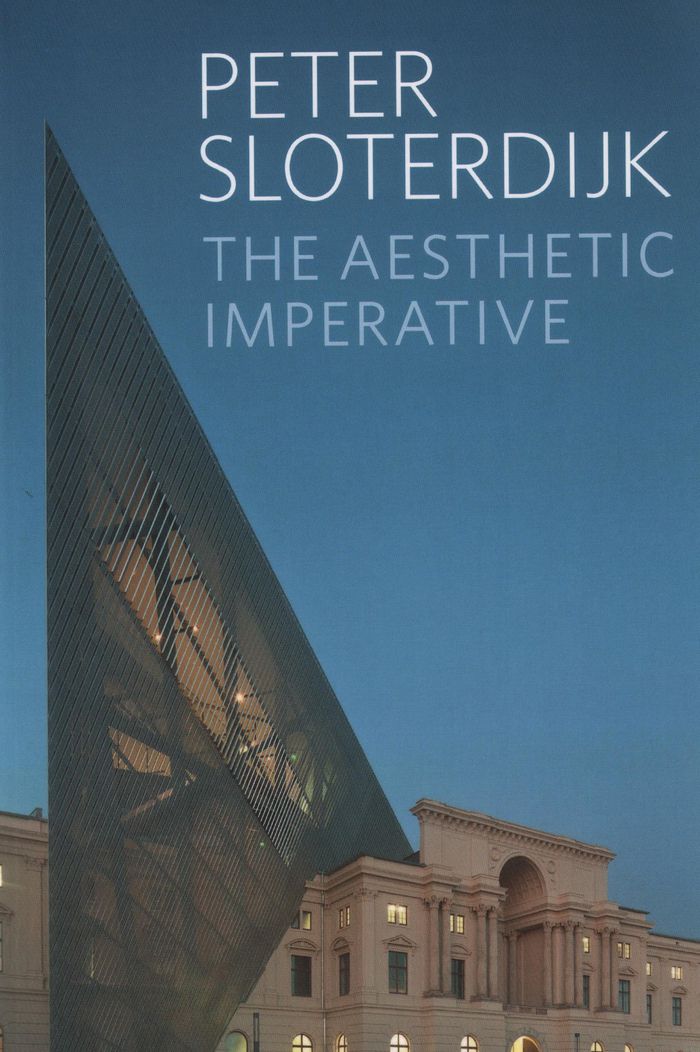
In this wide-ranging book, renowned philosopher and cultural theorist Peter Sloterdijk examines art in all its rich and varied forms: from music to architecture, light to movement, and design to typography. Moving between the visible and the invisible, the audible and the inaudible, his analyses span the centuries, from ancient civilizations to contemporary Hollywood. With great verve and insight he considers the key issues that have faced thinkers from Aristotle to Adorno, looking at art in its relation to ethics, epistemology, metaphysics, society, politics, anthropology and the subject.Sloterdijk explores a great variety of topics, including the Greek-Roman invention of postcards, medieval barter with purgatory and relics, the capitalist art market, the black boxes and white cubes of modernism, the rise of world’s fairs in the 19th century, the growth of museum and memorial culture, images of the city and the role of creativity. In doing so, Sloterdijk extends his characteristic method of defamiliarisation to transform the way we look at works of art and movements. His bold and original approach leads us away from the well-trodden paths of conventional art history to develop a theory of aesthetics which rejects strict categorisation, emphasising instead the crucial importance of individual subjectivity as a counter to the latent dangers of collective culture.This sustained collection of reflections, at once playful, serious and provocative, goes to the very heart of Sloterdijk’s enduring philosophical preoccupation with the aesthetic. It will be essential reading for students and scholars of philosophy and aesthetics and will appeal to anyone interested in culture and the arts more generally.
The aesthetic imperative: writings on art
Actions:
Price:
$34.95
(available to order)
Summary:
In this wide-ranging book, renowned philosopher and cultural theorist Peter Sloterdijk examines art in all its rich and varied forms: from music to architecture, light to movement, and design to typography. Moving between the visible and the invisible, the audible and the inaudible, his analyses span the centuries, from ancient civilizations to contemporary Hollywood. With great verve and insight he considers the key issues that have faced thinkers from Aristotle to Adorno, looking at art in its relation to ethics, epistemology, metaphysics, society, politics, anthropology and the subject.Sloterdijk explores a great variety of topics, including the Greek-Roman invention of postcards, medieval barter with purgatory and relics, the capitalist art market, the black boxes and white cubes of modernism, the rise of world’s fairs in the 19th century, the growth of museum and memorial culture, images of the city and the role of creativity. In doing so, Sloterdijk extends his characteristic method of defamiliarisation to transform the way we look at works of art and movements. His bold and original approach leads us away from the well-trodden paths of conventional art history to develop a theory of aesthetics which rejects strict categorisation, emphasising instead the crucial importance of individual subjectivity as a counter to the latent dangers of collective culture.This sustained collection of reflections, at once playful, serious and provocative, goes to the very heart of Sloterdijk’s enduring philosophical preoccupation with the aesthetic. It will be essential reading for students and scholars of philosophy and aesthetics and will appeal to anyone interested in culture and the arts more generally.
Form:
books
books
Publication:
April 2017
April 2017
Subject:
Art Theory
Art Theory
Form:
books
books
Actions:
Price:
$33.95
(available to order)
Summary:
Judith Butler’s new book shows how an ethic of nonviolence must be connected to a broader political struggle for social equality. Further, it argues that nonviolence is often misunderstood as a passive practice that emanates from a calm region of the soul, or as an individualist ethical relation to existing forms of power. But, in fact, nonviolence is an ethical position(...)
$33.95
(available to order)
Summary:
Judith Butler’s new book shows how an ethic of nonviolence must be connected to a broader political struggle for social equality. Further, it argues that nonviolence is often misunderstood as a passive practice that emanates from a calm region of the soul, or as an individualist ethical relation to existing forms of power. But, in fact, nonviolence is an ethical position(...)
Title:
The force of non violence: the ethical in the political
Actions:
Price:
$33.95
(available to order)
Summary:
Judith Butler’s new book shows how an ethic of nonviolence must be connected to a broader political struggle for social equality. Further, it argues that nonviolence is often misunderstood as a passive practice that emanates from a calm region of the soul, or as an individualist ethical relation to existing forms of power. But, in fact, nonviolence is an ethical position found in the midst of the political field. An aggressive form of nonviolence accepts that hostility is part of our psychic constitution, but values ambivalence as a way of checking the conversion of aggression into violence. One contemporary challenge to a politics of nonviolence points out that there is a difference of opinion on what counts as violence and nonviolence. The distinction between them can be mobilized in the service of ratifying the state’s monopoly on violence. Considering nonviolence as an ethical problem within a political philosophy requires a critique of individualism as well as an understanding of the psychosocial dimensions of violence. Butler draws upon Foucault, Fanon, Freud, and Benjamin to consider how the interdiction against violence fails to include lives regarded as ungrievable. By considering how “racial phantasms” inform justifications of state and administrative violence, Butler tracks how violence is often attributed to those who are most severely exposed to its lethal effects. The struggle for nonviolence is found in movements for social transformation that reframe the grievability of lives in light of social equality and whose ethical claims follow from an insight into the interdependency of life as the basis of social and political equality.
The force of non violence: the ethical in the political
Actions:
Price:
$33.95
(available to order)
Summary:
Judith Butler’s new book shows how an ethic of nonviolence must be connected to a broader political struggle for social equality. Further, it argues that nonviolence is often misunderstood as a passive practice that emanates from a calm region of the soul, or as an individualist ethical relation to existing forms of power. But, in fact, nonviolence is an ethical position found in the midst of the political field. An aggressive form of nonviolence accepts that hostility is part of our psychic constitution, but values ambivalence as a way of checking the conversion of aggression into violence. One contemporary challenge to a politics of nonviolence points out that there is a difference of opinion on what counts as violence and nonviolence. The distinction between them can be mobilized in the service of ratifying the state’s monopoly on violence. Considering nonviolence as an ethical problem within a political philosophy requires a critique of individualism as well as an understanding of the psychosocial dimensions of violence. Butler draws upon Foucault, Fanon, Freud, and Benjamin to consider how the interdiction against violence fails to include lives regarded as ungrievable. By considering how “racial phantasms” inform justifications of state and administrative violence, Butler tracks how violence is often attributed to those who are most severely exposed to its lethal effects. The struggle for nonviolence is found in movements for social transformation that reframe the grievability of lives in light of social equality and whose ethical claims follow from an insight into the interdependency of life as the basis of social and political equality.
Form:
books
books
Publication:
February 2020
February 2020
Subject:
Social
Social
Form:
journals and magazines
journals and magazines
Actions:
Price:
$32.95
(available to order)
Summary:
“Transparency is overrated,” Jacques Herzog asserted roughly a year ago at the opening of the Vitra Schaudepot in Weil am Rhein. Is that really the case? In the present issue, we explore this topic and take stock of the present situation. Admittedly, the emblematic character of transparent architecture has lost much of its relevance since the post-war years – its charisma(...)
$32.95
(available to order)
Summary:
“Transparency is overrated,” Jacques Herzog asserted roughly a year ago at the opening of the Vitra Schaudepot in Weil am Rhein. Is that really the case? In the present issue, we explore this topic and take stock of the present situation. Admittedly, the emblematic character of transparent architecture has lost much of its relevance since the post-war years – its charisma(...)
Title:
Detail 6 2017: glass construction
Actions:
Price:
$32.95
(available to order)
Summary:
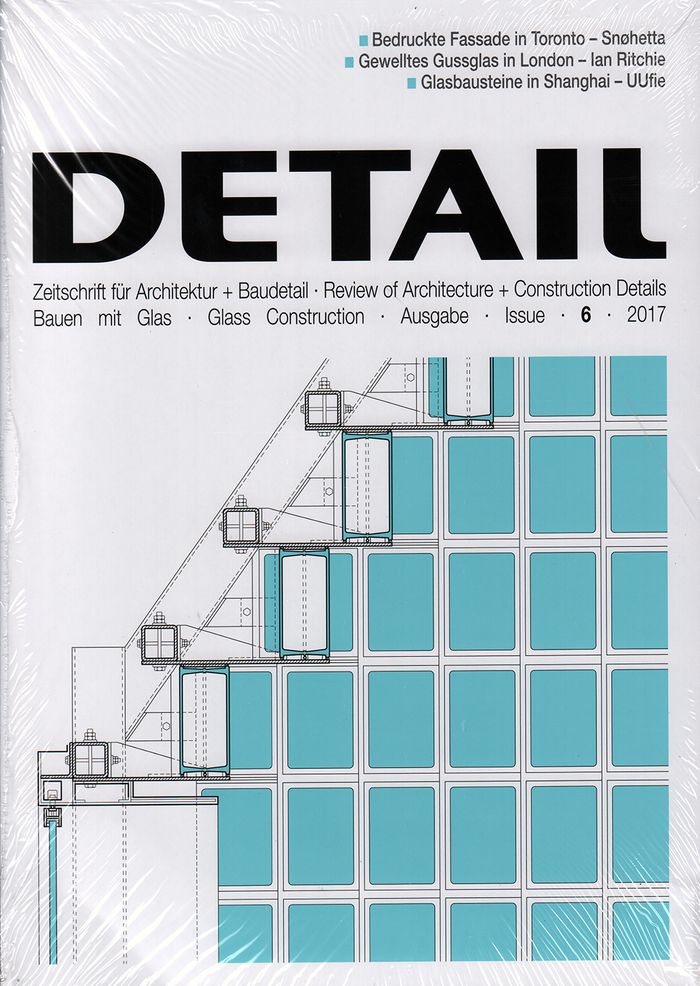
“Transparency is overrated,” Jacques Herzog asserted roughly a year ago at the opening of the Vitra Schaudepot in Weil am Rhein. Is that really the case? In the present issue, we explore this topic and take stock of the present situation. Admittedly, the emblematic character of transparent architecture has lost much of its relevance since the post-war years – its charisma as a symbol of democracy. Yet buildings of glass are far more varied today, and their architecture is in many ways unique. In this issue of Detail, Heide Wessely has selected some groundbreaking schemes. With its printed-glass facade, the Ryerson University structure in Toronto by Snøhetta offers students variously lighted internal spaces, which they, in turn, can use for different study scenarios. With pivoting, printed-glass louvres, the facade of the bank in Nantes by AIA Associés responds to insolation to create a climatic buffer zone. The thermally insulated cast-glass elements in the outer skin of the Sainsbury Wellcome Centre in London by Ian Ritchie Architects screen the interior of the research institute from the street, while allowing diffused, non-glare light into the working spaces. In contrast, the glass pavilion in Manchester and the glazed atrium in Baker Street, London, are functional and restrained extensions to existing buildings. The Discussion section in this issue explores the potential of glass in the many housing towers that are springing up in cities today; and in his Technology article, Kars Haarhuis takes a look at innovative hybrid structures in which concrete or steel are combined with glass in a load-bearing form.
Detail 6 2017: glass construction
Actions:
Price:
$32.95
(available to order)
Summary:
“Transparency is overrated,” Jacques Herzog asserted roughly a year ago at the opening of the Vitra Schaudepot in Weil am Rhein. Is that really the case? In the present issue, we explore this topic and take stock of the present situation. Admittedly, the emblematic character of transparent architecture has lost much of its relevance since the post-war years – its charisma as a symbol of democracy. Yet buildings of glass are far more varied today, and their architecture is in many ways unique. In this issue of Detail, Heide Wessely has selected some groundbreaking schemes. With its printed-glass facade, the Ryerson University structure in Toronto by Snøhetta offers students variously lighted internal spaces, which they, in turn, can use for different study scenarios. With pivoting, printed-glass louvres, the facade of the bank in Nantes by AIA Associés responds to insolation to create a climatic buffer zone. The thermally insulated cast-glass elements in the outer skin of the Sainsbury Wellcome Centre in London by Ian Ritchie Architects screen the interior of the research institute from the street, while allowing diffused, non-glare light into the working spaces. In contrast, the glass pavilion in Manchester and the glazed atrium in Baker Street, London, are functional and restrained extensions to existing buildings. The Discussion section in this issue explores the potential of glass in the many housing towers that are springing up in cities today; and in his Technology article, Kars Haarhuis takes a look at innovative hybrid structures in which concrete or steel are combined with glass in a load-bearing form.
Form:
journals and magazines
journals and magazines
Publication:
June 2017
June 2017
Subject:
Magazines
Magazines


