


818 Results
Form:
books
books
Actions:
Form:
books
books
Publication:
Institute of Network Cultures 2005
Institute of Network Cultures 2005
Form:
books
books
Holdings:
Description:
95 pages : chiefly color illustrations ; 13 x 24 cm
Description:
95 pages : chiefly color illustrations ; 13 x 24 cm
Subject:
- Sternfeld, Joel.,
- Photography, Artistic.,
- Shopping malls United Arab Emirates Dubayy (Emirate) Pictorial works.,
- Interior architecture United Arab Emirates Dubayy (Emirate) Pictorial works.,
- Photographie artistique.,
- Galeries marchandes Émirats arabes unis Dubayy (Émirat) Ouvrages illustrés.,
- Architecture intérieure Émirats arabes unis Dubayy (Émirat) Ouvrages illustrés.,
- art photography.,
- Interior architecture,
- Shopping malls,
- Dubayy (United Arab Emirates : Emirate) Pictorial works.,
- United Arab Emirates Dubayy (Emirate),
- illustrated books.,
- Illustrated works,
- Ouvrages illustrés.
(See more)
Publication:
Göttingen : Steidl, 2010.
Göttingen : Steidl, 2010.
Title:
IDubai / [Joel Sternfeld] ; with an essay by Jonathan Crary.
Actions:
Holdings:
Description:
95 pages : chiefly color illustrations ; 13 x 24 cm
IDubai / [Joel Sternfeld] ; with an essay by Jonathan Crary.
Actions:
Holdings:
Description:
95 pages : chiefly color illustrations ; 13 x 24 cm
Form:
books
books
Publication:
Göttingen : Steidl, 2010.
Göttingen : Steidl, 2010.
Subject:
- Sternfeld, Joel.,
- Photography, Artistic.,
- Shopping malls United Arab Emirates Dubayy (Emirate) Pictorial works.,
- Interior architecture United Arab Emirates Dubayy (Emirate) Pictorial works.,
- Photographie artistique.,
- Galeries marchandes Émirats arabes unis Dubayy (Émirat) Ouvrages illustrés.,
- Architecture intérieure Émirats arabes unis Dubayy (Émirat) Ouvrages illustrés.,
- art photography.,
- Interior architecture,
- Shopping malls,
- Dubayy (United Arab Emirates : Emirate) Pictorial works.,
- United Arab Emirates Dubayy (Emirate),
- illustrated books.,
- Illustrated works,
- Ouvrages illustrés.
(See more)
Form:
books
books
Actions:
Description:
1 online resource
Subject:
- Architectural criticism.,
- Capital movements.,
- Finance.,
- Geopolitics.,
- Historiography.,
- Critique d'architecture.,
- Mouvements de capitaux.,
- Finances.,
- Géopolitique.,
- Historiographie.,
- architectural criticism.,
- finance.,
- geopolitics.,
- historiography.,
- tracts (literary genre),
- Essays,
- Pamphlets,
- Tracts (Ephemera),
- Tracts.
(See more)
Publication:
[Place of publication not identified] : Aggregate Architectural History Collaborative, 2015.
[Place of publication not identified] : Aggregate Architectural History Collaborative, 2015.
Form:
books
books
Publication:
[Place of publication not identified] : Aggregate Architectural History Collaborative, 2015.
[Place of publication not identified] : Aggregate Architectural History Collaborative, 2015.
Subject:
- Architectural criticism.,
- Capital movements.,
- Finance.,
- Geopolitics.,
- Historiography.,
- Critique d'architecture.,
- Mouvements de capitaux.,
- Finances.,
- Géopolitique.,
- Historiographie.,
- architectural criticism.,
- finance.,
- geopolitics.,
- historiography.,
- tracts (literary genre),
- Essays,
- Pamphlets,
- Tracts (Ephemera),
- Tracts.
(See more)
Form:
books
books
Actions:
Description:
1 online resource (220 p.)
Subject:
- Power (Social sciences),
- Power (Philosophy),
- Social control.,
- Electronic surveillance.,
- Capitalism.,
- Activism.,
- Pouvoir (Sciences sociales),
- Pouvoir (Philosophie),
- Contrôle social.,
- Surveillance électronique.,
- Political.,
- PHILOSOPHY.,
- Communism.,
- Political Ideologies.,
- POLITICAL SCIENCE.
(See more)
Publication:
[S.l.]: Watkins Media, 2023.
[S.l.]: Watkins Media, 2023.
Title:
Anti-Oculus : A Philosophy of Escape / Acid Horizon.
Actions:
Description:
1 online resource (220 p.)
Anti-Oculus : A Philosophy of Escape / Acid Horizon.
Actions:
Description:
1 online resource (220 p.)
Form:
books
books
Publication:
[S.l.]: Watkins Media, 2023.
[S.l.]: Watkins Media, 2023.
Subject:
- Power (Social sciences),
- Power (Philosophy),
- Social control.,
- Electronic surveillance.,
- Capitalism.,
- Activism.,
- Pouvoir (Sciences sociales),
- Pouvoir (Philosophie),
- Contrôle social.,
- Surveillance électronique.,
- Political.,
- PHILOSOPHY.,
- Communism.,
- Political Ideologies.,
- POLITICAL SCIENCE.
(See more)
Form:
books
books
Actions:
Price:
$22.95
(available to order)
Summary:
Plus célèbre pour ses motifs floraux que pour son engagement politique, William Morris (1834-1896) consacre pourtant une partie de sa vie à dénoncer les contradictions internes du capitalisme. À travers ses discours, ses utopies politiques ou sa pratique artistique, il alerte sur les effets destructeurs de l’industrialisme, tant écologiques que sociaux. Convaincu que(...)
$22.95
(available to order)
Summary:
Plus célèbre pour ses motifs floraux que pour son engagement politique, William Morris (1834-1896) consacre pourtant une partie de sa vie à dénoncer les contradictions internes du capitalisme. À travers ses discours, ses utopies politiques ou sa pratique artistique, il alerte sur les effets destructeurs de l’industrialisme, tant écologiques que sociaux. Convaincu que(...)
Title:
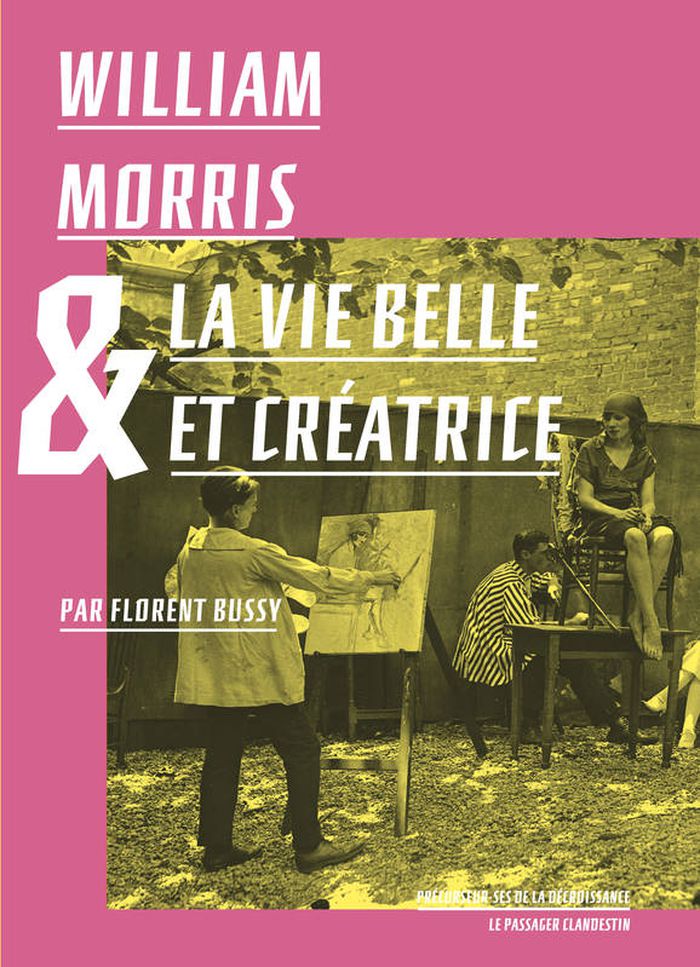
William Morris et la vie belle et créatrice
Actions:
Price:
$22.95
(available to order)
Summary:
Plus célèbre pour ses motifs floraux que pour son engagement politique, William Morris (1834-1896) consacre pourtant une partie de sa vie à dénoncer les contradictions internes du capitalisme. À travers ses discours, ses utopies politiques ou sa pratique artistique, il alerte sur les effets destructeurs de l’industrialisme, tant écologiques que sociaux. Convaincu que la beauté donne sens à l’existence, il appelle à la convivialité, à l’épanouissement personnel et à l’émancipation collective, grâce à la réappropriation des activités créatrices. Florent Bussy nous montre que sa vision d’une société fondée sur le partage plutôt que la concurrence, l’égalité plutôt que la domination, la beauté plutôt que l’artifice, la qualité plutôt que le gaspillage est une source d’inspiration inestimable pour tout projet de transformation sociale radicale.
William Morris et la vie belle et créatrice
Actions:
Price:
$22.95
(available to order)
Summary:
Plus célèbre pour ses motifs floraux que pour son engagement politique, William Morris (1834-1896) consacre pourtant une partie de sa vie à dénoncer les contradictions internes du capitalisme. À travers ses discours, ses utopies politiques ou sa pratique artistique, il alerte sur les effets destructeurs de l’industrialisme, tant écologiques que sociaux. Convaincu que la beauté donne sens à l’existence, il appelle à la convivialité, à l’épanouissement personnel et à l’émancipation collective, grâce à la réappropriation des activités créatrices. Florent Bussy nous montre que sa vision d’une société fondée sur le partage plutôt que la concurrence, l’égalité plutôt que la domination, la beauté plutôt que l’artifice, la qualité plutôt que le gaspillage est une source d’inspiration inestimable pour tout projet de transformation sociale radicale.
Form:
books
books
Publication:
September 2023
September 2023
Subject:
Critical Theory
Critical Theory
Form:
books
books
Actions:
Price:
$47.95
(available in store)
Summary:
Dans cet essai sans concession, Jonathan Crary tord le cou à l'optimisme béat du tout-numérique. L'ère de la connectivité ne renforce pas les liens entre les vivants, elle les dissout pour de bon. Pour l'auteur de 24/7, l'ère numérique doit être identifiée lucidement pour ce qu'elle est : la phase terminale funeste d'un capitalisme mondial et d'un auto-extractivisme(...)
$47.95
(available in store)
Summary:
Dans cet essai sans concession, Jonathan Crary tord le cou à l'optimisme béat du tout-numérique. L'ère de la connectivité ne renforce pas les liens entre les vivants, elle les dissout pour de bon. Pour l'auteur de 24/7, l'ère numérique doit être identifiée lucidement pour ce qu'elle est : la phase terminale funeste d'un capitalisme mondial et d'un auto-extractivisme(...)
Title:
L'écorchement du monde – Pour en finir avec l'ère numérique : vers un monde post-capitaliste
Actions:
Price:
$47.95
(available in store)
Summary:
Dans cet essai sans concession, Jonathan Crary tord le cou à l'optimisme béat du tout-numérique. L'ère de la connectivité ne renforce pas les liens entre les vivants, elle les dissout pour de bon. Pour l'auteur de 24/7, l'ère numérique doit être identifiée lucidement pour ce qu'elle est : la phase terminale funeste d'un capitalisme mondial et d'un auto-extractivisme auquel participent à leur insu les utilisateurs du Net. Pour Crary, il faut cesser de croire que les réseaux sociaux puissent être des espaces de mise en commun, et reconnaître qu'ils participent d'un processus d'isolation et de dépolitisation méthodique. Son brûlot vise à réveiller les consciences, afin de chercher d'autres manières de recréer du lien, et de préserver la planète d'un écocide annoncé.
L'écorchement du monde – Pour en finir avec l'ère numérique : vers un monde post-capitaliste
Actions:
Price:
$47.95
(available in store)
Summary:
Dans cet essai sans concession, Jonathan Crary tord le cou à l'optimisme béat du tout-numérique. L'ère de la connectivité ne renforce pas les liens entre les vivants, elle les dissout pour de bon. Pour l'auteur de 24/7, l'ère numérique doit être identifiée lucidement pour ce qu'elle est : la phase terminale funeste d'un capitalisme mondial et d'un auto-extractivisme auquel participent à leur insu les utilisateurs du Net. Pour Crary, il faut cesser de croire que les réseaux sociaux puissent être des espaces de mise en commun, et reconnaître qu'ils participent d'un processus d'isolation et de dépolitisation méthodique. Son brûlot vise à réveiller les consciences, afin de chercher d'autres manières de recréer du lien, et de préserver la planète d'un écocide annoncé.
Form:
books
books
Publication:
February 2025
February 2025
Subject:
Critical Theory
Critical Theory
Form:
books
books
Title:
Dessin / chantier
Dessin / chantier
Actions:
Price:
$29.95
(available to order)
Summary:
La figure de l'architecte issue de la Renaissance repose sur la séparation du savoir et du faire, de l'artisanat et de l’art mais dans le même temps apparaissent les indices d’une rupture profonde inaugurée par le capitalisme naissant. Dépassant les catégories habituelles, "Dessin/chantier" cherche à analyser comment se produit la valeur dans un monde dominé par la(...)
$29.95
(available to order)
Summary:
La figure de l'architecte issue de la Renaissance repose sur la séparation du savoir et du faire, de l'artisanat et de l’art mais dans le même temps apparaissent les indices d’une rupture profonde inaugurée par le capitalisme naissant. Dépassant les catégories habituelles, "Dessin/chantier" cherche à analyser comment se produit la valeur dans un monde dominé par la(...)
Title:
Dessin / chantier
Actions:
Price:
$29.95
(available to order)
Summary:
La figure de l'architecte issue de la Renaissance repose sur la séparation du savoir et du faire, de l'artisanat et de l’art mais dans le même temps apparaissent les indices d’une rupture profonde inaugurée par le capitalisme naissant. Dépassant les catégories habituelles, "Dessin/chantier" cherche à analyser comment se produit la valeur dans un monde dominé par la marchandise. Le propos tranche par son approche idéologique à l’opposé du libéralisme actuel. L’auteur est marqué par les luttes des années 60 au Brésil, par la violence faite aux ouvriers bâtissant Brasilia. Alors le voici parti à la recherche d’une autre pratique de l’architecture et de son édification, une pratique heureuse passant par un changement radical des rapports de production. Avant-propos de Vincent Michel.
Dessin / chantier
Actions:
Price:
$29.95
(available to order)
Summary:
La figure de l'architecte issue de la Renaissance repose sur la séparation du savoir et du faire, de l'artisanat et de l’art mais dans le même temps apparaissent les indices d’une rupture profonde inaugurée par le capitalisme naissant. Dépassant les catégories habituelles, "Dessin/chantier" cherche à analyser comment se produit la valeur dans un monde dominé par la marchandise. Le propos tranche par son approche idéologique à l’opposé du libéralisme actuel. L’auteur est marqué par les luttes des années 60 au Brésil, par la violence faite aux ouvriers bâtissant Brasilia. Alors le voici parti à la recherche d’une autre pratique de l’architecture et de son édification, une pratique heureuse passant par un changement radical des rapports de production. Avant-propos de Vincent Michel.
Form:
books
books
Publication:
November 2005, Paris
November 2005, Paris
Subject:
Architectural Theory
Architectural Theory
Form:
books
books
Title:
Post-Europe.
Post-Europe.
Actions:
Description:
1 online resource
Subject:
- Border security.,
- Critical theory.,
- Democracy.,
- Economics.,
- Geopolitics.,
- Nationalism.,
- Philosophy.,
- Political science.,
- Sécurité frontalière.,
- Théorie critique.,
- Économie politique.,
- Géopolitique.,
- Nationalisme.,
- Philosophie.,
- Démocratie locale.,
- critical theory (sociological concept),
- economics.,
- geopolitics.,
- nationalism.,
- philosophy.,
- Discursive works.,
- Criticism, interpretation, etc.
(See more)
Publication:
[Place of publication not identified] : Sequence Press, 2024., [Place of publication not identified] : Urbanomic, 2024.
[Place of publication not identified] : Sequence Press, 2024., [Place of publication not identified] : Urbanomic, 2024.
Form:
books
books
Publication:
[Place of publication not identified] : Sequence Press, 2024., [Place of publication not identified] : Urbanomic, 2024.
[Place of publication not identified] : Sequence Press, 2024., [Place of publication not identified] : Urbanomic, 2024.
Subject:
- Border security.,
- Critical theory.,
- Democracy.,
- Economics.,
- Geopolitics.,
- Nationalism.,
- Philosophy.,
- Political science.,
- Sécurité frontalière.,
- Théorie critique.,
- Économie politique.,
- Géopolitique.,
- Nationalisme.,
- Philosophie.,
- Démocratie locale.,
- critical theory (sociological concept),
- economics.,
- geopolitics.,
- nationalism.,
- philosophy.,
- Discursive works.,
- Criticism, interpretation, etc.
(See more)
Form:
books
books
Title:
Memenesia.
Memenesia.
Actions:
Description:
1 online resource
Author:
Subject:
Publication:
[Place of publication not identified] : V2_, 2021.
[Place of publication not identified] : V2_, 2021.
Form:
books
books
Publication:
[Place of publication not identified] : V2_, 2021.
[Place of publication not identified] : V2_, 2021.
Form:
books
books
Actions:
Holdings:
Description:
viii, 271 pages : illustrations (some colored), maps ; 26 cm
Description:
viii, 271 pages : illustrations (some colored), maps ; 26 cm
Subject:
- Markets Italy To 1500.,
- Marketplaces Italy To 1500.,
- Cities and towns, Medieval Italy.,
- Commerce History Medieval, 500-1500.,
- Villes médiévales Italie.,
- Commerce Histoire 500-1500 (Moyen Âge),
- 15.70 history of Europe.,
- Cities and towns, Medieval,
- Commerce Medieval,
- Marketplaces,
- Markets,
- Markt,
- Marktplatz,
- Mercats Itàlia Fins al 1500.,
- Ciutats medievals Itàlia.,
- Comerç Història Edat mitjana.,
- Torghandel historia.,
- Einzelhandel,
- Marktmechanismus,
- Wirtschaftsethik,
- Regulierung,
- Mittelalter,
- Italien,
- Italy,
- geschiedenis,
- history,
- markten,
- markets,
- market economies,
- kapitalisme,
- capitalism,
- ethiek,
- ethics,
- architectuur,
- architecture,
- steden,
- towns,
- renaissance,
- italy,
- Economic, Social, and Cultural History of Southern Europe,
- Economische, sociale en cultuurgeschiedenis vab Zuid-Europa,
- History
(See more)
Publication:
New Haven ; London : Yale University Press, 2015., ©2015
New Haven ; London : Yale University Press, 2015., ©2015
Title:
Markets and marketplaces in Medieval Italy, c.1100 to c.1440 / Dennis Romano.
Actions:
Holdings:
Description:
viii, 271 pages : illustrations (some colored), maps ; 26 cm
Markets and marketplaces in Medieval Italy, c.1100 to c.1440 / Dennis Romano.
Actions:
Holdings:
Description:
viii, 271 pages : illustrations (some colored), maps ; 26 cm
Form:
books
books
Publication:
New Haven ; London : Yale University Press, 2015., ©2015
New Haven ; London : Yale University Press, 2015., ©2015
Subject:
- Markets Italy To 1500.,
- Marketplaces Italy To 1500.,
- Cities and towns, Medieval Italy.,
- Commerce History Medieval, 500-1500.,
- Villes médiévales Italie.,
- Commerce Histoire 500-1500 (Moyen Âge),
- 15.70 history of Europe.,
- Cities and towns, Medieval,
- Commerce Medieval,
- Marketplaces,
- Markets,
- Markt,
- Marktplatz,
- Mercats Itàlia Fins al 1500.,
- Ciutats medievals Itàlia.,
- Comerç Història Edat mitjana.,
- Torghandel historia.,
- Einzelhandel,
- Marktmechanismus,
- Wirtschaftsethik,
- Regulierung,
- Mittelalter,
- Italien,
- Italy,
- geschiedenis,
- history,
- markten,
- markets,
- market economies,
- kapitalisme,
- capitalism,
- ethiek,
- ethics,
- architectuur,
- architecture,
- steden,
- towns,
- renaissance,
- italy,
- Economic, Social, and Cultural History of Southern Europe,
- Economische, sociale en cultuurgeschiedenis vab Zuid-Europa,
- History
(See more)


