


6349 Results
Form:
textual records
textual records
Reference number:
ARCH253451
Description:
A paper presented by John L. Eyre, President of Saguenay Shipping Limited, for a symposium on "The Montreal Harbour - Ten Years Hence" sponsored by McGill University - Industrial Relations Center and Montreal Port Council on Thursday March 20th, 1969.
ARCH253451
Description:
A paper presented by John L. Eyre, President of Saguenay Shipping Limited, for a symposium on "The Montreal Harbour - Ten Years Hence" sponsored by McGill University - Industrial Relations Center and Montreal Port Council on Thursday March 20th, 1969.
People:
Date:
1969
1969
Title:
The Seventies at Home in our Port of Montreal
Actions:
ARCH253451
Description:
A paper presented by John L. Eyre, President of Saguenay Shipping Limited, for a symposium on "The Montreal Harbour - Ten Years Hence" sponsored by McGill University - Industrial Relations Center and Montreal Port Council on Thursday March 20th, 1969.
The Seventies at Home in our Port of Montreal
Actions:
ARCH253451
Description:
A paper presented by John L. Eyre, President of Saguenay Shipping Limited, for a symposium on "The Montreal Harbour - Ten Years Hence" sponsored by McGill University - Industrial Relations Center and Montreal Port Council on Thursday March 20th, 1969.
Form:
textual records
textual records
Date:
1969
1969
People:
Level of archival description:
Project
Project
Title:
Stratton
Stratton
Reference number:
AP144.S2.D155
Description:
File documents a competition entry for a new international road link bridging the Rhine between Strasbourg, France and Kehl, Baden-Württemberg, Germany. The entry also includes a plan for phased development of several areas in Strasbourg, including industrial and dockland zones. This project was possibly exhibited at the Building Centre in London in autumn 1994. This file also includes plans from another project, labelled "unidentified". Material in this file was produced in 1980 and between 1990 and 1994, but predominantly in 1991. File contains conceptual drawings, design development drawings, presentation drawings, reference drawings, other drawings, presentation panels, photographic materials and textual records.
AP144.S2.D155
Description:
File documents a competition entry for a new international road link bridging the Rhine between Strasbourg, France and Kehl, Baden-Württemberg, Germany. The entry also includes a plan for phased development of several areas in Strasbourg, including industrial and dockland zones. This project was possibly exhibited at the Building Centre in London in autumn 1994. This file also includes plans from another project, labelled "unidentified". Material in this file was produced in 1980 and between 1990 and 1994, but predominantly in 1991. File contains conceptual drawings, design development drawings, presentation drawings, reference drawings, other drawings, presentation panels, photographic materials and textual records.
People:
Date:
1980, 1990-1994, predominant 1991
1980, 1990-1994, predominant 1991
Title:
Stratton
Actions:
AP144.S2.D155
Description:
File documents a competition entry for a new international road link bridging the Rhine between Strasbourg, France and Kehl, Baden-Württemberg, Germany. The entry also includes a plan for phased development of several areas in Strasbourg, including industrial and dockland zones. This project was possibly exhibited at the Building Centre in London in autumn 1994. This file also includes plans from another project, labelled "unidentified". Material in this file was produced in 1980 and between 1990 and 1994, but predominantly in 1991. File contains conceptual drawings, design development drawings, presentation drawings, reference drawings, other drawings, presentation panels, photographic materials and textual records.
Stratton
Actions:
AP144.S2.D155
Description:
File documents a competition entry for a new international road link bridging the Rhine between Strasbourg, France and Kehl, Baden-Württemberg, Germany. The entry also includes a plan for phased development of several areas in Strasbourg, including industrial and dockland zones. This project was possibly exhibited at the Building Centre in London in autumn 1994. This file also includes plans from another project, labelled "unidentified". Material in this file was produced in 1980 and between 1990 and 1994, but predominantly in 1991. File contains conceptual drawings, design development drawings, presentation drawings, reference drawings, other drawings, presentation panels, photographic materials and textual records.
Level of archival description:
File 155
File 155
Date:
1980, 1990-1994, predominant 1991
1980, 1990-1994, predominant 1991
People:
Form:
photographs
photographs
Actions:
Reference number:
PH1984:0977:513
Description:
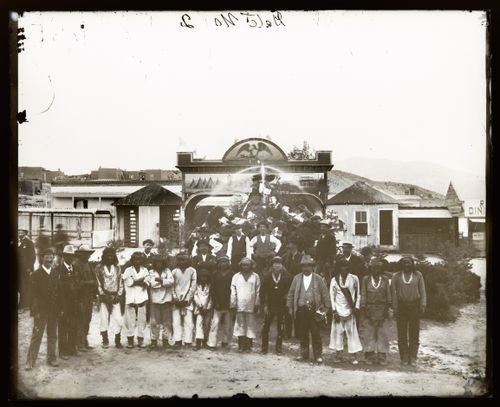
View of a group of Indigenous people and several men in European-American clothing, standing in front of an artificial mountain made from stacked rocks and a painted wooden arch with depictions of teepees paired with industrial buildings in settler-style, USA
PH1984:0977:513
Description:
View of a group of Indigenous people and several men in European-American clothing, standing in front of an artificial mountain made from stacked rocks and a painted wooden arch with depictions of teepees paired with industrial buildings in settler-style, USA
People:
Date:
ca. 1860-1880
ca. 1860-1880
Title:
View of a group of Indigenous people and several men in European-American clothing at a gathering, United States of America
Actions:
PH1984:0977:513
Description:
View of a group of Indigenous people and several men in European-American clothing, standing in front of an artificial mountain made from stacked rocks and a painted wooden arch with depictions of teepees paired with industrial buildings in settler-style, USA
View of a group of Indigenous people and several men in European-American clothing at a gathering, United States of America
Actions:
PH1984:0977:513
Description:
View of a group of Indigenous people and several men in European-American clothing, standing in front of an artificial mountain made from stacked rocks and a painted wooden arch with depictions of teepees paired with industrial buildings in settler-style, USA
Form:
photographs
photographs
Date:
ca. 1860-1880
ca. 1860-1880
People:
Level of archival description:
Project
Project
Reference number:
AP027.S1.D34
Description:
This project series documents a series of commissions to study the various requirements for the future of the Montréal International Airport given the increase in traffic and potential future technological innovations in aviation. Van Ginkel Associates looked at three options: expanding the airport located in Dorval; abandonning Dorval as a site completely; and keeping the Dorval location and adding another airport at a new site. In their study they included future operations, systems, and the impact on the region, including site selection studies, studies of industrial and commercial development related to the airport, and its anticipated activity. Proposals for land use and the reorganization of the territory surrounding the new site were also presented.
AP027.S1.D34
Description:
This project series documents a series of commissions to study the various requirements for the future of the Montréal International Airport given the increase in traffic and potential future technological innovations in aviation. Van Ginkel Associates looked at three options: expanding the airport located in Dorval; abandonning Dorval as a site completely; and keeping the Dorval location and adding another airport at a new site. In their study they included future operations, systems, and the impact on the region, including site selection studies, studies of industrial and commercial development related to the airport, and its anticipated activity. Proposals for land use and the reorganization of the territory surrounding the new site were also presented.
People:
Date:
1966-1968
1966-1968
Title:
Montréal International Airport, Montréal (1966-1968)
Actions:
AP027.S1.D34
Description:
This project series documents a series of commissions to study the various requirements for the future of the Montréal International Airport given the increase in traffic and potential future technological innovations in aviation. Van Ginkel Associates looked at three options: expanding the airport located in Dorval; abandonning Dorval as a site completely; and keeping the Dorval location and adding another airport at a new site. In their study they included future operations, systems, and the impact on the region, including site selection studies, studies of industrial and commercial development related to the airport, and its anticipated activity. Proposals for land use and the reorganization of the territory surrounding the new site were also presented.
Montréal International Airport, Montréal (1966-1968)
Actions:
AP027.S1.D34
Description:
This project series documents a series of commissions to study the various requirements for the future of the Montréal International Airport given the increase in traffic and potential future technological innovations in aviation. Van Ginkel Associates looked at three options: expanding the airport located in Dorval; abandonning Dorval as a site completely; and keeping the Dorval location and adding another airport at a new site. In their study they included future operations, systems, and the impact on the region, including site selection studies, studies of industrial and commercial development related to the airport, and its anticipated activity. Proposals for land use and the reorganization of the territory surrounding the new site were also presented.
Level of archival description:
File 34
File 34
Date:
1966-1968
1966-1968
People:
Form:
photographs
Quantity:
2 File
photographs
Quantity:
2 File
Reference number:
ARCH50508
Description:
01P-01: b/w (19,5 x 24,3 cm); Bell Telephone Work Centre, Ville d'Anjou. Photographer; B&I (Business & Industrial) Photography. Montreal 01P-02: b/w (19,2 x 23,7 cm); Bell Telephone Work Centre [Ville d'Anjou?], interior view. Photographer unknown
ARCH50508
Description:
01P-01: b/w (19,5 x 24,3 cm); Bell Telephone Work Centre, Ville d'Anjou. Photographer; B&I (Business & Industrial) Photography. Montreal 01P-02: b/w (19,2 x 23,7 cm); Bell Telephone Work Centre [Ville d'Anjou?], interior view. Photographer unknown
People:
Title:
Bell Telephone Work Centre, Ville d'Anjou
Actions:
ARCH50508
Description:
01P-01: b/w (19,5 x 24,3 cm); Bell Telephone Work Centre, Ville d'Anjou. Photographer; B&I (Business & Industrial) Photography. Montreal 01P-02: b/w (19,2 x 23,7 cm); Bell Telephone Work Centre [Ville d'Anjou?], interior view. Photographer unknown
Bell Telephone Work Centre, Ville d'Anjou
Actions:
ARCH50508
Description:
01P-01: b/w (19,5 x 24,3 cm); Bell Telephone Work Centre, Ville d'Anjou. Photographer; B&I (Business & Industrial) Photography. Montreal 01P-02: b/w (19,2 x 23,7 cm); Bell Telephone Work Centre [Ville d'Anjou?], interior view. Photographer unknown
Form:
photographs
Quantity:
2 File
photographs
Quantity:
2 File
People:
Level of archival description:
Project
Project
Title:
Pahang Tenggara
Pahang Tenggara
Reference number:
AP027.S1.D51
Description:
The preparation of a comprehensive plan for the socio-economic development of Pahang Tenggara, a region of approximately 4,000 square miles. A master plan for the optimum utilization and development of its human and natural resources over a 20 year period was prepared. A complete inventory of the physical condition and natural resources of the area was required, as well as an assessment of the human and economic capabilities, both in its adjoining regions and the nation as a whole. The plan provides guidelines and a basic framework for future development by public, government-assisted and private investments until 1990. The plan also details the economic feasibility of primary resources and secondary industrial projects, and all related social and physical infrastructure requirements.
AP027.S1.D51
Description:
The preparation of a comprehensive plan for the socio-economic development of Pahang Tenggara, a region of approximately 4,000 square miles. A master plan for the optimum utilization and development of its human and natural resources over a 20 year period was prepared. A complete inventory of the physical condition and natural resources of the area was required, as well as an assessment of the human and economic capabilities, both in its adjoining regions and the nation as a whole. The plan provides guidelines and a basic framework for future development by public, government-assisted and private investments until 1990. The plan also details the economic feasibility of primary resources and secondary industrial projects, and all related social and physical infrastructure requirements.
People:
Subject:
urban planning
urban planning
Date:
1969-1972
1969-1972
Title:
Pahang Tenggara
Actions:
AP027.S1.D51
Description:
The preparation of a comprehensive plan for the socio-economic development of Pahang Tenggara, a region of approximately 4,000 square miles. A master plan for the optimum utilization and development of its human and natural resources over a 20 year period was prepared. A complete inventory of the physical condition and natural resources of the area was required, as well as an assessment of the human and economic capabilities, both in its adjoining regions and the nation as a whole. The plan provides guidelines and a basic framework for future development by public, government-assisted and private investments until 1990. The plan also details the economic feasibility of primary resources and secondary industrial projects, and all related social and physical infrastructure requirements.
Pahang Tenggara
Actions:
AP027.S1.D51
Description:
The preparation of a comprehensive plan for the socio-economic development of Pahang Tenggara, a region of approximately 4,000 square miles. A master plan for the optimum utilization and development of its human and natural resources over a 20 year period was prepared. A complete inventory of the physical condition and natural resources of the area was required, as well as an assessment of the human and economic capabilities, both in its adjoining regions and the nation as a whole. The plan provides guidelines and a basic framework for future development by public, government-assisted and private investments until 1990. The plan also details the economic feasibility of primary resources and secondary industrial projects, and all related social and physical infrastructure requirements.
Level of archival description:
File 51
File 51
Date:
1969-1972
1969-1972
People:
Subject:
urban planning
urban planning
Level of archival description:
Project
Project
Reference number:
AP178.S1.1999.PR08
Description:
This project series documents the Projecto de Ordenación nel Âmbito del Vapor Turull in Sabadell, Spain. While the records were held in the office’s archives this project was assigned the number 114/90. The office assigned the date 1999 to this project. The project was for offices for the municipality of Sabadell in the industrial building of the Vapor Turull company. It included office spaces, an exterior public parking for 330 cars, and an interior parking in the basement. The H-shaped building had a 7634 m2 surface. There is no documentation in the archive suggesting if the building was realized or not. Documenting this project are sketches and plans. Textual material includes correspondence and documentation from the city of Sabadell and photographic materials document the model.
AP178.S1.1999.PR08
Description:
This project series documents the Projecto de Ordenación nel Âmbito del Vapor Turull in Sabadell, Spain. While the records were held in the office’s archives this project was assigned the number 114/90. The office assigned the date 1999 to this project. The project was for offices for the municipality of Sabadell in the industrial building of the Vapor Turull company. It included office spaces, an exterior public parking for 330 cars, and an interior parking in the basement. The H-shaped building had a 7634 m2 surface. There is no documentation in the archive suggesting if the building was realized or not. Documenting this project are sketches and plans. Textual material includes correspondence and documentation from the city of Sabadell and photographic materials document the model.
People:
Date:
circa 1996-2000
circa 1996-2000
Title:
Projecto de Ordenación nel Âmbito del Vapor Turull, Sabadell, Spain (1999)
Actions:
AP178.S1.1999.PR08
Description:
This project series documents the Projecto de Ordenación nel Âmbito del Vapor Turull in Sabadell, Spain. While the records were held in the office’s archives this project was assigned the number 114/90. The office assigned the date 1999 to this project. The project was for offices for the municipality of Sabadell in the industrial building of the Vapor Turull company. It included office spaces, an exterior public parking for 330 cars, and an interior parking in the basement. The H-shaped building had a 7634 m2 surface. There is no documentation in the archive suggesting if the building was realized or not. Documenting this project are sketches and plans. Textual material includes correspondence and documentation from the city of Sabadell and photographic materials document the model.
Projecto de Ordenación nel Âmbito del Vapor Turull, Sabadell, Spain (1999)
Actions:
AP178.S1.1999.PR08
Description:
This project series documents the Projecto de Ordenación nel Âmbito del Vapor Turull in Sabadell, Spain. While the records were held in the office’s archives this project was assigned the number 114/90. The office assigned the date 1999 to this project. The project was for offices for the municipality of Sabadell in the industrial building of the Vapor Turull company. It included office spaces, an exterior public parking for 330 cars, and an interior parking in the basement. The H-shaped building had a 7634 m2 surface. There is no documentation in the archive suggesting if the building was realized or not. Documenting this project are sketches and plans. Textual material includes correspondence and documentation from the city of Sabadell and photographic materials document the model.
Level of archival description:
Project
Project
Date:
circa 1996-2000
circa 1996-2000
People:
Level of archival description:
Project
Project
Actions:
Reference number:
AP018.S1.1973.PR06
Description:
This project series documents a proposal for an athletic, cultural and industrial campus in Mississauga, Ontario, between Dixie Road, Aerowood Drive and the Highway 401. This project was known as Mississauga Sports Complex at the beginning of the project from 1973-1974, but later became the Gordie Howe Sports Centre in 1975. The office identified the project number as 7306. The project consisted of a group of buildings including a tennis court, an arena, and a interior jogging track. The project is recorded through drawings and textual records dating from 1973-1976. The majority of the drawings are originals that show site plans, floor plans, elevations, sections, and structural drawings. Textual records include correspondence with clients and consultants as well as conference reports.
AP018.S1.1973.PR06
Description:
This project series documents a proposal for an athletic, cultural and industrial campus in Mississauga, Ontario, between Dixie Road, Aerowood Drive and the Highway 401. This project was known as Mississauga Sports Complex at the beginning of the project from 1973-1974, but later became the Gordie Howe Sports Centre in 1975. The office identified the project number as 7306. The project consisted of a group of buildings including a tennis court, an arena, and a interior jogging track. The project is recorded through drawings and textual records dating from 1973-1976. The majority of the drawings are originals that show site plans, floor plans, elevations, sections, and structural drawings. Textual records include correspondence with clients and consultants as well as conference reports.
People:
Date:
1973-1976
1973-1976
Title:
Gordie Howe Sports Centre, Mississauga, Ontario (1973-1976)
Actions:
AP018.S1.1973.PR06
Description:
This project series documents a proposal for an athletic, cultural and industrial campus in Mississauga, Ontario, between Dixie Road, Aerowood Drive and the Highway 401. This project was known as Mississauga Sports Complex at the beginning of the project from 1973-1974, but later became the Gordie Howe Sports Centre in 1975. The office identified the project number as 7306. The project consisted of a group of buildings including a tennis court, an arena, and a interior jogging track. The project is recorded through drawings and textual records dating from 1973-1976. The majority of the drawings are originals that show site plans, floor plans, elevations, sections, and structural drawings. Textual records include correspondence with clients and consultants as well as conference reports.
Gordie Howe Sports Centre, Mississauga, Ontario (1973-1976)
Actions:
AP018.S1.1973.PR06
Description:
This project series documents a proposal for an athletic, cultural and industrial campus in Mississauga, Ontario, between Dixie Road, Aerowood Drive and the Highway 401. This project was known as Mississauga Sports Complex at the beginning of the project from 1973-1974, but later became the Gordie Howe Sports Centre in 1975. The office identified the project number as 7306. The project consisted of a group of buildings including a tennis court, an arena, and a interior jogging track. The project is recorded through drawings and textual records dating from 1973-1976. The majority of the drawings are originals that show site plans, floor plans, elevations, sections, and structural drawings. Textual records include correspondence with clients and consultants as well as conference reports.
Level of archival description:
Project
Project
Date:
1973-1976
1973-1976
People:
Level of archival description:
Project
Project
Reference number:
AP018.S1.1962.PR01
Description:
This project series documents the Sifto Salt Division Mill and Warehouse of Domtar Chemicals Limited in Goderich, Ontario, Canada from 1962-1963. The office probably identified the project number as either 6237 or 6264. This project consisted of a 62,000 square foot facility on the existing industrial complex of Domtar. The building was clad in epoxy faced brick and concrete up to the third floor, while the rest of the structure was clad in ribbed cement asbestos siding up to the roof. The building included process areas, packaging areas, a warehouse, bagging room, offices, cafeteria and canteen, and shipping and recieving areas. This project won a special mention at the Massey Medal for Architecture in 1964. The project is recorded through a mounted photograph showing the finished buillding.
AP018.S1.1962.PR01
Description:
This project series documents the Sifto Salt Division Mill and Warehouse of Domtar Chemicals Limited in Goderich, Ontario, Canada from 1962-1963. The office probably identified the project number as either 6237 or 6264. This project consisted of a 62,000 square foot facility on the existing industrial complex of Domtar. The building was clad in epoxy faced brick and concrete up to the third floor, while the rest of the structure was clad in ribbed cement asbestos siding up to the roof. The building included process areas, packaging areas, a warehouse, bagging room, offices, cafeteria and canteen, and shipping and recieving areas. This project won a special mention at the Massey Medal for Architecture in 1964. The project is recorded through a mounted photograph showing the finished buillding.
People:
Date:
circa 1963
circa 1963
Title:
Domtar Chemicals Limited, Sifto Salt Division Mill and Warehouse, Goderich, Ontario, Canada (1962-1963)
Actions:
AP018.S1.1962.PR01
Description:
This project series documents the Sifto Salt Division Mill and Warehouse of Domtar Chemicals Limited in Goderich, Ontario, Canada from 1962-1963. The office probably identified the project number as either 6237 or 6264. This project consisted of a 62,000 square foot facility on the existing industrial complex of Domtar. The building was clad in epoxy faced brick and concrete up to the third floor, while the rest of the structure was clad in ribbed cement asbestos siding up to the roof. The building included process areas, packaging areas, a warehouse, bagging room, offices, cafeteria and canteen, and shipping and recieving areas. This project won a special mention at the Massey Medal for Architecture in 1964. The project is recorded through a mounted photograph showing the finished buillding.
Domtar Chemicals Limited, Sifto Salt Division Mill and Warehouse, Goderich, Ontario, Canada (1962-1963)
Actions:
AP018.S1.1962.PR01
Description:
This project series documents the Sifto Salt Division Mill and Warehouse of Domtar Chemicals Limited in Goderich, Ontario, Canada from 1962-1963. The office probably identified the project number as either 6237 or 6264. This project consisted of a 62,000 square foot facility on the existing industrial complex of Domtar. The building was clad in epoxy faced brick and concrete up to the third floor, while the rest of the structure was clad in ribbed cement asbestos siding up to the roof. The building included process areas, packaging areas, a warehouse, bagging room, offices, cafeteria and canteen, and shipping and recieving areas. This project won a special mention at the Massey Medal for Architecture in 1964. The project is recorded through a mounted photograph showing the finished buillding.
Level of archival description:
Project
Project
Date:
circa 1963
circa 1963
People:
Form:
drawings, textual records, photographs
drawings, textual records, photographs
Actions:
Reference number:
ARCH277580
Description:
Contains 4 volumes entitled: - Pasillo verde ferroviario; - El Centro Sur: Delicias-Legazpi: area de oportunidad, Arganzuela-Este; - Propuesta de posible ordenación de tráfico derivada de un cambio de calificación de los suelos destinados a uso industrial en el eje Mendez-Alvaro; - Tomo 5: Memoria de la ordenación.
ARCH277580
Description:
Contains 4 volumes entitled: - Pasillo verde ferroviario; - El Centro Sur: Delicias-Legazpi: area de oportunidad, Arganzuela-Este; - Propuesta de posible ordenación de tráfico derivada de un cambio de calificación de los suelos destinados a uso industrial en el eje Mendez-Alvaro; - Tomo 5: Memoria de la ordenación.
People:
Date:
ca. 1991
ca. 1991
Title:
Reference materials, Madrid Sur, Spain
Actions:
ARCH277580
Description:
Contains 4 volumes entitled: - Pasillo verde ferroviario; - El Centro Sur: Delicias-Legazpi: area de oportunidad, Arganzuela-Este; - Propuesta de posible ordenación de tráfico derivada de un cambio de calificación de los suelos destinados a uso industrial en el eje Mendez-Alvaro; - Tomo 5: Memoria de la ordenación.
Reference materials, Madrid Sur, Spain
Actions:
ARCH277580
Description:
Contains 4 volumes entitled: - Pasillo verde ferroviario; - El Centro Sur: Delicias-Legazpi: area de oportunidad, Arganzuela-Este; - Propuesta de posible ordenación de tráfico derivada de un cambio de calificación de los suelos destinados a uso industrial en el eje Mendez-Alvaro; - Tomo 5: Memoria de la ordenación.
Form:
drawings, textual records, photographs
drawings, textual records, photographs
Date:
ca. 1991
ca. 1991
People:


